Flight Planning

A quick review of my Part 135 Flight Planning Routine

My company, Flying M Air, is an FAA Part 135 operator. What that means is that I had to go through a lot of paperwork and testing with the FAA to be allowed to take paying passengers more than 25 miles from my starting point or to land with paying passengers on board.

As a Part 135 operator, I have the FAA looking over my shoulder to make sure I do everything “by the book.” The book, in this case, is my Statement of Compliance, a 50+ page document I wrote that explains how I’ll follow the Federal Aviation Regulations (FARs) that pertain to my Part 135 operations. The FAA reviewed this document in painstaking detail and it took about three months to fine-tune it to the FAA’s satisfaction. Of course, the FAA also conducts surprise and scheduled inspections of my aircraft and my base of operations (my hangar) to make sure everything is just right. And because I’m required to be on a drug testing program, I’ve been told that I can expect a visit from the FAA’s “drug-testing police” one day in the future.

For the record, I have no problem following FAA’s requirements for my operation. They’re not asking for anything unreasonable and everything they require is in the interest of safety for me, my passengers, and my aircraft.

Anyway, one of the requirements for Part 135 operations is flight planning. And, at this point, I have it down to a science.

I start by getting the names and approximate weights of the passengers I’ll be carrying, along with our destination, expected time on the ground, and any special route requests.

Today’s a good example. My two passengers want to fly from Wickenburg to Sedona and back. They want a scenic route both ways so they can see as much of the area as possible. At Sedona, they want to take a Jeep tour at least 2 hours long. I’ll have to line that up for them so the Jeep folks meet them at Sedona Airport when we arrive. With lunch and other activities on the ground, I expect to be there 4-5 hours. I expect to depart Wickenburg at 10 AM and depart Sedona by about 4 PM. My route will take them past some of the area’s mining areas, over Prescott, near Sycamore Canyon, and past Sedona’s red rocks before landing. On departure, we’ll swing past Jerome and follow the Bradshaws down to Lake Pleasant, where I can show them some Indian ruins and the house on Sheep Mountain. A final swing around Vulture Peak and over the ranch where they’re staying will get us back to Wickenburg. Total time enroute: about an hour each way.

With this information in mind, I fire up my Web browser and visit the Duats Web site. Duats is a free flight planning service for pilots. I log in and enter my flight plan for a weather briefing that includes current conditions at airports on or near my route (Prescott and Flagstaff) as well as NOTAMs. Today I learned that we’ll have typically clear Arizona weather with the possibility of some high cirrus clouds. It’s windy right now in Flagstaff, with gusts up to 34 knots, but the wind is expected to calm a little bit as the day wears on. Still, I can expect some very light turbulence as the winds pass over the mountains we have to cross or fly around: the Weavers, the Bradshaws, and Mingus Mountain.

Duats also has a flight planning feature and I use this next. It takes the information I’ve already entered to get the weather and uses it to calculate the route and enroute time for the flight. Since I can’t put as much detail into Duats as I need to, its flight plan is much simpler than my scenic route. It says it’ll take 45 minutes to get there and 40 minutes to return. I file both of those flight plans, each with their own times (10 am and 4 pm) with the FAA. They’ll sit in the FAA’s computers until I either activate them (one at a time, of course) or they expire.

Next, I whip out my Manifest form. This is an Excel spreadsheet I designed that automatically calculates weight and balance for my helicopter. I enter all the flight plan information, as well as my starting fuel load and the names and weights of my passengers in the seats I expect to put them. For weights, I add 20 lbs. I used to add 10 lbs, but the folks who book these flights don’t seem to have a clue about weights. It’s always better to overestimate than underestimate. And since it’s nearly impossible to load an R44 out of CG, it doesn’t matter if the two passengers sit somewhere other than the seats I expect to put them in. When my passengers are light — as these two are — I usually put them both on the same side of the helicopter so they have the same basic view. I then fly so that the most interesting views are on their side. But if they both want to sit in back, that’ll work, too. Or any combination they want.

The Manifest form is also designed to be used when I don’t have access to the Internet. It creates the same flight plan that I file with the FAA. So if I have to get the weather from a telephone briefer, I can file my flight plan over the phone at the same time rather than via the Internet.

If I have access to a printer, which I usually do during flight planning, I print out my manifest form for each leg of the trip, my flight plans for each leg of the trip, and my weight and balance for each leg of the trip. If I plan to start each leg of the trip with the same amount of fuel and take the same amount of time, I only print one weight and balance sheet. No sense wasting paper. But today I printed two sheets — I plan to fill up in Sedona since my passenger load is light and fuel is currently cheaper there than in Wickenburg.

I usually give a copy of my manifest — that’s the form with the passenger names and flight plan — to Mike. He’s my backup flight following. I call Mike when I depart and arrive each leg of the trip. If I don’t call in on time and he can’t get me on my cell phone, he takes the next steps with Flight Service.

Of course, I also open my filed flight plans with the local Flight Service Station (FSS). Although I prefer to do this on the ground before I start up, the FSS prefers that pilots do this on departure. My problem is that as a helicopter, I don’t always get enough altitude to access one of the radio frequencies the FSS uses. So I sometimes can’t activate a flight plan until I’m 10 minute into my flight. I close the flight plan by phone when I land, then call Mike to let him know I’ve arrived safely.

All the paperwork that’s generated for the flight is left on my desk in my hangar. After the flight is done, I file it. The FAA likes to look at these papers when they do their base inspection, even though I’m not required to save them.

And that’s about it. As you can see, the whole routine is designed to make sure I properly plan the flight and have at least one form of flight following to make sure a search is conducted promptly if I do not arrive at my destination. It sounds like a lot of work, but I can normally do it in less than 20 minutes with my computer and an Internet connection. To do it manually would take about twice the amount of time.

So I’m flying to Sedona today. I’d better bring a book; I have a feeling I’ll be spending a lot of time at the airport there.

An Excellent Weekend

And it ain’t over yet.

Flying M Air’s second big weekend of the season started on Friday morning, with a call from a man who wanted to charter the helicopter. The weather was cloudy and it had rained earlier in the morning. Although he wanted to go to Sedona with his daughter, he’d settle for Tucson. He decided to wait and see what the weather was like closer to noon.

When I hung up, I started doing some research on the weather. There’s no weather forecast specifically for Sedona, but I checked Flagstaff and Prescott, which are on either side of Sedona. (Sedona is closer to Flag.) Things in Flag didn’t look good. Clouds, thunderstorms, wind with gust up to 27. It looked like there might be a window of opportunity (so to speak) between 11 AM and about 3 PM. But even that was suspect — a forecast like the one I was reading usually doesn’t hold out. It seemed to me that multiple weather systems were going through the area, west to east, and that anything could happen.

But ceilings were forecast high enough for me to fly. I only need 500 feet AGL to get from point A to Point B — “clear of clouds” is what the weather minimums say for helicopters — and the forecast told of clouds at 2,000 feet AGL. That’s certainly enough room for me to move around beneath them.

Things looked better at Prescott. Higher clouds, earlier clearing, less talk of T-storms and wind gusts. But of course, Sedona is closer to Flag.

I worked for a while on my QuickBooks book, did some e-mail, goofed off on eBay. Then I got a call from Stan, who was back from a trip to Portugal. Stan’s Latte Cafe — my nickname for his hangar and its professional espresso machine — was opening for business in a while. Did I feel like a Latte? I certainly didn’t feel like working. So I hopped in the Honda (which I’d just picked up from a nice detailing that morning) and sped on over to the airport.

I wasted a good hour there, then headed over to my hangar to do some paperwork and collect the camera mount I’d bought for the helicopter. I wasn’t happy with the way the mount attached and had thoughts of going to Benner-Nauman (the local fabrication place) and having a custom piece built. I also had to drive out to Congress to put up some posters for the $25 helicopter rides I planned the next day.

I was just heading out toward Congress when my potential customer called again. I told him what I’d learned about the weather, but added that I’d checked more than two hours ago and the forecast could have changed. He was very interested in Sedona and I was very interested in taking him. He and his daughter, who were from out of town, had driven up I-17 as far as Carefree Highway and he wanted to know whether there was somewhere around there that I could pick them up. I told him about Turf Soaring School, near Carefree Highway, and he said they’d head over there. I told him I’d check the weather again and get ready. If he didn’t hear from me, I’d meet him at 2 PM or sooner.

That began a flurry of activity. Checking weather (which did indeed look better), creating my Part 135 flight plan, filing two flight plans with the FAA (one for each leg of the trip), picking up Alex at work, bringing him home, dressing in something more appropriate for flying customers around, pulling the helicopter out of the hangar, fueling up, preflighting, starting up, warming up, and flying down to Turf.

Turf is about 30 miles from Wickenburg and I made it there in .3 hours. I got there 1:45 PM, set down, cooled down, and shut down. My customer, Tony, and his daughter, Angela, were pleasant people who had already flown many times in R44s. Tony, in fact, was a part owner of one and, with his partner and a flight instructor, operated a small flight school in the Detroit area where he lived. After a quick safety briefing, we climbed aboard. Tony volunteered to sit in back. I didn’t think he’d have enough room back there — he was a pretty big guy — but he later told me that the back seat was very comfortable and had good visibility. (It was his first time in the back; I’ve still never sat in the back of an R44.)

We flew to Sedona via Lake Pleasant and I-17. My passengers found the flight interesting — the terrain was so different from their home. The further north we got, the cloudier it got. We could see rain showers off to our right or left and flew through some rain once right before reaching Sedona. The ceilings were high enough and the air was pretty smooth, considering the look of those low, puffy clouds. Things at Sedona were pretty quiet — it was, after all, a Friday, and clouds tend to scare off most Arizona pleasure pilots. I called the FBO for a taxi as I set down on the helipad and the FBO guy came out in a pickup truck to get my passengers. I walked to the terminal in the light drizzle that was falling. My passengers were already gone when I got there.

I ordered fuel, said hello to the few folks I remembered from my back-to-back Sedona flights in late July, and headed over to the restaurant. It was the first time I ever sat inside there. Usually, I sit out on the patio in the shade. But the rain had closed down the patio. I settled down with my book (I’m currently reading The Name of the Rose) and had lunch. Tony would call when they were ready to come back, sometime around 4 PM.

They didn’t last that long. I’d just finished lunch when he called. He said the taxi would take them right to the helicopter, so I hustled up to pay for lunch, pay for fuel (which was actually cheaper than in Wickenburg), and head out to the helicopter.

I had just finished stowing my stuff and checking the oil when my cell phone rang. It was my contact at one of the local guest ranches. She had five people who wanted desperately to go to the Grand Canyon. Could I help? I made a phone call to try to get a second helicopter to take the extra two guests. Then we climbed on board and, after a quick tour of Sedona’s red rocks — looking dramatic but not terribly red in the cloudy weather — headed back to Turf.

After dropping off my passengers (and collecting payment), I flew right back to Wickenburg. It was after 5 PM when I set down on one of the helipads. I was driving home when I started checking messages on my cell phone. My contact at the ranch had called again. So had the guy I’d called to try to get another helicopter. I waited until I got home, then called the guy to get the helicopter story first. Because they’d have to ferry the helicopter from their base of operations (30 minutes from Wickenburg), it would cost my passengers $2,700 for the round trip flight from Wickenburg to the Grand Canyon. Ouch!!! Their hourly rate was $550 (for comparison, I get $395 from Wickenburg and $495 from the Valley but don’t charge for ferry time) and they expected it to take 2.5 hours each way. I charge a flat rate of $995 from Wickenburg to the Grand Canyon and back. So the total, including tax, for both helicopters would be nearly $4,000. For five people. And neither of us were allowed to fly over the canyon (at reasonable altitudes), so the passengers would still have to shell out $75 per person for their tours. Egads.

I called my contact at the ranch and gave her the bad news. She was appalled. I think she realized what a good deal Flying M Air offers passengers. She said she didn’t think the passengers would go for it, but she also said that they were willing to have just 3 passengers go to the canyon. I told her I’d plan on it then and that I’d call her in the morning for the weights and names I needed for my Part 135 manifest.

I called and told the helicopter guy that it was a no-go for him. I also told him that they might want to consider coming up with some kind of industry rate so I could use them in the future. $550 per hour with $550 going right to ferry time is insane.

Then I had to juggle my schedule. The first thing that had to go was the $25 helicopter rides in Congress. It wasn’t a real planned event and no one was really expecting me there. I just thought I’d spend a few hours on the side of the road at the intersection of 71 and 89 with signs up to see how I could do. If I didn’t fly, fine. I had a book to read. And fortunately, I never had an opportunity to put out the posters. But I couldn’t reach my contact by phone because I couldn’t find his phone number in the book. He’s probably still wondering what the hell happened to me.

In the afternoon, I’d been scheduled to help out BC Jeep Tours, the local Jeep tour operator, with a big party they had from the same ranch. I called and asked if Mike could drive instead of me. He’s a better Jeep driver anyway, I told them (and it’s probably true). Cathy said it would be fine and wished me luck on my big charter. Poor Mike was leading a horseback ride in the morning for the Wickenburg Horsemen’s Association. After the ride, he’d have to hurry home with the horses, skipping the lunch they’d planned, so he could be cleaned up, dressed, and in the Jeep at the ranch by 1:30 at the latest.

The next morning, I called my contact at the ranch and got the information I needed about the passengers. If the weights were right (and they weren’t), I’d have a light load. But I never believe weights and assumed they’d weigh more. (Of course, they wound up weighing even more than that, but Zero-Mike-Lima could handle it.) I did all my flight planning and FAA-required stuff, then headed out to the airport.

Stan’s Latte Cafe was open and I joined the crowd there for a latte. Then I preflighted the helicopter, started it up, and flew it over to the fuel island for fuel. Normally, I wouldn’t fly it, but I figured that would be a good way to shorten up the startup time by having the engine pre-warmed before the passengers arrived. The ranch van pulled up to the airport as the fueler was finishing up. I greeted them in the terminal and showed them, on the big chart, where we were going. That’s also when I realized that they were a bit heavier than I’d been told. I was glad I’d taken on less fuel than the flight planning said I could.

My passengers were three German men. One man spoke English very well and was accompanied by his grown son. The other man didn’t speak English very well at all. But all were friendly and in good spirits. I gave them the safety briefing, speaking slowly and using lots of hand motions to make sure they’d all understand. Then we climbed on board. I started up and took off.

I planned to follow a direct route to the Grand Canyon from Wickenburg. The only way I can make money on this fixed-price flight is to keep the flight time as short as possible. Duats calculated flight time as 1 hour and 16 minutes, but that was based on 110 knots. With my heavy load and the climbs necessary to clear the Weaver Mountains and Mogollon Rim near Williams, I was lucky to get 100 knots. The route took us over Yarnell, between Kirkland Junction and Kirkland, east of Skull Valley, West of Granite Mountain and Prescott, west of Chino Valley and Williams, and west of Valle. In fact, much of the ride was over open high desert — mostly deserted ranchland. I pointed out points of interest as I saw them. The men were generally quiet, but occasionally spoke to each other in German. The man who spoke good English usually told me what they were saying or asked me a question related to what they were saying.

It took about 90 minutes to get to the canyon. It was a beautiful day and the air was smooth — until we got to the airport. Then the wind was variable with some small gusts. The tower cleared me to land along the taxiway — with a quartering tailwind — but I didn’t have any trouble with the landing. I set down on the helipad I used to land at when I flew to work at Papillon two summers ago. I cooled down, shut down, and escorted my passengers to the terminal, where they’d board their 12 PM flight on Grand Canyon Airlines.

They weighed in at the counter and that’s when I learned that the “200-lb man” was really a 240-lb man. So I figured that the total weight I was carrying was about 80 pounds more than the ranch folks had told me. I calculated for 40 pounds more. When I ordered fuel, I had only 15 gallons put on. With the airport at nearly 7,000 feet, I wanted to be as light as possible for departure. It least it wasn’t hot — the ATIS claimed 12¬?F.

While waiting for the flight, my passengers broke out their box lunches and I shared it with them. Sandwiches, cheese, fruit, chips, cookies, and lots of bottled water. One of the photographers I knew from Papillon showed up to take pictures. He remembered me and we spent about 20 minutes chatting about things at Papillon and the pilots I’d known there. Then they started boarding. My passengers got on line for their flight and my photographer friend went to work. I settled back in the sun with my book and a bag of chips.

The flight lasted nearly an hour and when my passengers emerged, they flashed thumbs up. We went back into the terminal so they could look at their picture (which they bought) and use the rest rooms. Then we all climbed back into the helicopter. I fired it up, waited a long time while it warmed up, then called the tower and took off. I had a quick beep from the low rotor RPM horn as we started our takeoff run (rusty pilot technique), but we had plenty of power and were soon climbing over the taxiway and then away from the airport.

The helicopter felt heavy at that altitude and vibrated like the R22 used to when I left Grand Canyon Airport with full fuel on board. I could barely get 90 knots at the allowed power setting of 21 inches of manifold pressure. But we had a tailwind and were making well over 100 knots ground speed. I decided to take my passengers back a different way, over Prescott and down the Hassayampa River. I fully admit this was more for me than for them. Flying in a straight line was downright boring.

We descended over the Mogollon Rim west of Williams and the helicopter immediately felt better. More normal, if you know what I mean. Understand that the vibration at higher altitudes when you’re heavy is perfectly normal. Or at least it was to me. I remember my trip in the R22 when I flew around the Grand Canyon Airspace. I had to cross the Kaibab Plateau, where it was necessary to climb to 9600 feet. Even though it was just me and my gear on board and I only had 3/4 tanks of fuel, that poor helicopter vibrated as if it were going to come apart at the seams. (Okay, so I’m exaggerating.) I felt a lot better when I could descend to a more reasonable altitude and the vibrations went back to their normal levels. The R44, on the other hand, has very few vibrations (compared to the R22) so they’re a lot more noticeable when they occur.

Along the way, my passengers showed a keen interest in every rock quarry we passed over or near. I learned that that was their business: making patio blocks out of concrete and rocks. They saw a few antelope just outside of Prescott. We flew around the west side of the airspace because the airport was so busy the controller told us to stay five miles out. Then we passed over the town of Prescott and headed down the Hassayampa River. When we got to the canyon, the man next to me said they were getting their own private tour of a little Grand Canyon.

As we neared Wickenburg, one of the passengers asked if we could fly over the ranch. So I did a fly-by for them. We landed at the airport and the van I’d called for when we were still 8 miles out was waiting to take them back to the ranch. They gathered their belongings, thanked me and paid me, and shook my hand. Nice guys. It was a pleasure to take them.

It’s Sunday morning now and I’m “on call” for the ranch this afternoon. So there might be more flying fun later today. In the meantime, I’ll clean up the helicopter after its two big charters and stay near my cell phone.

The Importance of Reading Notams

Mike and I get a surprise on a day trip to Boulder City, NV.

Mike, my significant other, flies airplanes. I don’t hold it against him. Someone has to do it.

He owns a 1974 Grumman Tiger with a partner, Jeff, who also lives in Wickenburg. The plane is in excellent condition, well cared-for and hangared. Mike’s previous partner, Ray, flew it even less than Mike does, so it didn’t get out much. Jeff flies it more often. Mike knows he needs to fly it more often.

That’s what yesterday’s trip was all about. He knows he needs to fly more often and I know I need to go with him once in a while. One of the reasons he bought the plane was so that we could take longer trips than we could by helicopter. Back then, I owned a Robinson R22, which cruised at 80 knots with 2 on board (if we were lucky) and couldn’t fully tank up with fuel so any flight longer than 90 minutes required a fuel stop. It seemed to make sense to have an aircraft that could get us places farther away in less time. The Tiger, I was told, cruises at 130 knots. (I have yet to see it cruise any faster than 120, but I think it’s because Mike doesn’t like to push it.) Of course, in January I took delivery of a Robinson R44, which cruises at 115 knots and can fly more than 3 hours without refueling, so the speed/long trip point isn’t very valid any more.

Anyway, Mike knew he had to fly more and I knew I had to fly more with him.

For the record, I do not know how to fly airplanes. I have a total of 1.5 hours in single engine airplanes and .9 hours in gliders. All of my other flight time is in helicopters, with a tiny .4 in gyros. I have no interest in piloting an airplane. I admit that I’m a helicopter snob.

So yesterday morning, we poured over books, looking for a destination for a day trip. I should probably say that he poured over books; I was busy trying to see whether my Web server had come back to the world after an IP address change. He used the old iBook to log into various Web sites for more information, including weather. I had suggested the runway at Monument Valley, which I visited by car on my long road trip in August. I was pretty sure it was paved. (His insurance prohibits him from landing on unpaved runways.) But his sources of information — primarily AirNav, I think — said it was dirt and showed a picture with reddish dirt to prove it. Of course, AOPA’s Airport Directory, which appears to include more errors than reliable information, didn’t mention the runway there at all, despite the fact that is widely used by tour aircraft and is walking distance from the Gouldings Lodge complex.

After a while, he declared his conclusion. Boulder City, NV.

For those of you who are not familiar with the southwest, Boulder City was built to house the workers who built the Hoover Dam, the first big dam on the Colorado River, back in the 1930s. It’s the only city in Nevada that does not have gambling. It’s a small but growing city, uncomfortably close to Las Vegas and comfortably close to Lake Mead, the Colorado River, and of course, Hoover Dam. It has a nice airport with three runways (although I think the short parallel runway is closed), fuel, and other amenities I’ll get to shortly.

The plan was to land in Boulder City, tie down — that’s what you do to an airplane so a gust of wind doesn’t take it away while you’re not around — and go into town for lunch.

Our plan set, we went to the airport. While Mike pulled out the plane and did his preflight, I made a quick trip to my helicopter, which I’d left parked out on the ramp overnight. I’d been experimenting with video from the helicopter and wanted to see if a cable adapter I had would fit the headset jack so I could run audio right from the intercom system into my camcorder. It did. Along the way I ran into one of Quantum’s flight instructors, who was fueling up on a cross-country flight with a student from Scottsdale. We chatted a long time. Heck, it’s hard not to chat for a long time with a fellow pilot. His student asked me about Glendale. He said he’d seen me taking off and landing all day long last weekend. I told him about the 131 passengers and both of them were suitably impressed.

Back at the airplane, Mike was just about ready to go. I climbed on board — literally — and buckled up. He started up and taxied out to the runway. A while later, we were airborne, heading toward Needles, NV. His plan was to fly to the Colorado River around Needles, then follow that up through Bullhead City and over Lake Mohave before heading in to Boulder City. The flight should take just over an hour. It was probably the same route I would have taken in the helicopter. A direct flight straight across the desert is incredibly boring. Flying along the river is a lot more interesting.

Everything went as planned with the exception of timing. We had a headwind of about 20 knots around Bullhead City. Bullhead City is notoriously windy and I think that’s one of the reasons so few people fly in there. The airport is right across the river from Laughlin, NV, with its semi-cheesy casinos, cheap hotels, and even cheaper buffets, but because 20 knot winds are relatively common, the casual pilots avoid the place like the plague. It’s silly, really. The wind just about always comes right down the runway, from up the river or down, so it’s not like there’s a challenging crosswind. That day it was coming down the river, steady enough to drop our ground speed down to 105 knots.

Past Bullhead City, I switched the radio frequency to Boulder City’s. It was still 40 or so miles away. But as we climbed to cross the mountains west of Lake Mohave, I got my first inkling that Boulder City wouldn’t be as easy as it should be.

“Young Eagle 12, left downwind runway 27,” came the voice.

Young Eagles is an EAA (Experimental Aircraft Association) program that gives free rides to kids aged 8 to 18. The idea is to introduce them to aviation in a fun, safe, and affordable way. Sometimes an EAA member just takes a few kid for rides. Other times, the local EAA chapter will hold a rally where they fly a bunch of kids. Hearing someone say Young Eagle 12 made me wonder if there were Young Eagle flights 1 through 11 out there, too. That would make 12 (or more) pilots out there, flying around the skies of Boulder City, without an air traffic controller to keep them organized.

My fears were confirmed when I heard a call from Young Eagle 3.

I say “fears” and I do mean this literally. I am intimately familiar with the local Wickenburg chapter of the EAA. These folks will meet religiously every month for an EAA meeting, refreshments, and a “program” — which could be something as stimulating as watching a VHS tape of the Reno Air Races on a television — but most members rarely actually fly. It frustrated the hell out of me. I love to fly and I like to fly with others. You know — a bunch of folks start one place and fly out to another for lunch or something. But these people seldom went anywhere. I used to go to meetings just to see if anything was planned, stay through the refreshments, leave a few bucks for the kitty, and head out before they started up the VCR and dimmed the lights. They did arrange a Young Eagles Rally once back in 2000, right after I got my R22 and I took 5 kids for rides. I think they tried again a few years ago, but only one or two pilots showed up. Not a very active group. I dropped my EAA membership and stopped going to meetings. I’m not the only one who wasn’t impressed. Every once in a while, a young, fresh person — usually a guy — would show up for a meeting. I’d never see him again.

So in my mind, an EAA chapter has a membership consisting primarily of people aged 65 or older who rarely — if ever — fly. Understand my fear when I thought 12 or more of them might be circling the skies of our destination airport?

We came over the hills and the airport came into view, still 15 miles away. That’s when the radio got really active. One call after another — pilots taking off, pilots landing, pilots climbing out, pilots flying downwind. And just to really confuse things, there were helicopters flying in and out, too. Papillon and Silver State were both doing tours. But I wasn’t worried about them. I was worried about those darn airplanes.

Mike flew out to the dry lake bed south of the airport, then turned for a 45° approach to a left downwind for Runway 27L, which was the one all the other pilots seemed to be using. Three airplanes took off in quick succession and made left downwind departures right before he got into downwind. I kept pointing them out for him. I also watched the helicopters make their approaches under the downwind traffic pattern. When we were on downwind, I caught sight of an airplane flying below us. I realized with a start that he was landing on Runway 33, which would have him crossing runway 27 while others were taking off and landing. I pointed him out to Mike just when the pilot said he was going around. Going around (to him) meant making a sharp right turn that put him under Mike’s wing somewhere. Mike saw him go there but never saw him come out. I didn’t see anything and I started getting panicky. In a helicopter, I could just stop where I was, turn around, and look for the bugger. Then Mike saw the guy, confirmed he was no factor, and turned base. I closed my eyes for landing — I always do — and felt relief when the wheels touched pavement.

We taxied back to fuel and found the ramp crammed with airplanes and helicopters on display and tons of people. It was a Young Eagle Rally coupled with the Boulder City Airport Open House. And those people at Boulder City really know how to put on a show.

After fueling up — at only $3.39/gallon — we tied down the Tiger on one of the last open spaces on the ramp. Lots of people had already parked their planes in a gravel parking lot. Then we walked over to the FBO to see whether we could arrange for ground transportation into town. Mike still wanted to go with Plan A.

The FBO at Boulder City is run by Silver State Helicopters, which does tours out of that location. The woman at the desk was just handing us the keys for the Courtesy Car when Brent A, who I knew from Papillon, walked up to the counter. He’d left Papillon to work for Silver State. We chatted for a while before he went back to work. I asked the woman at the counter if there was a Notam for the airport event and she told me there was. Mike and I left the airport feeling very silly.

Notam, for those who aren’t pilots, is short for NOTice to AirMen. (Sexist, I know, but I don’t really care.) It’s issued by an airport or the FAA and published by the FAA to inform pilots of things they should be notified about. Like the fact that the airport will be hosting an Open House that day or the fact that the airport will be closed to traffic from noon until 1:30 PM for aerobatics.

Pilots are supposed to read the notams for an airport as part of their flight planning. I usually read them with the weather info I get from Duats.com when I prepare for a cross-country flight. The problem is, there can be dozens of notams in a typical Duats report and it’s all too easy for your eyes to glaze over while you’re trying to figure out which ones actually apply to you. (Most don’t.) I would use that as an excuse for Mike on this particular trip, but it doesn’t apply. He admitted that he didn’t even look at the notams. Bad Mike!

I don’t want to give you the idea that I always look at notams when I fly to another airport. Although I usually do, I don’t always. For example, if I’m just going to fly up to Prescott and hop in my Toyota to go to the pet store or Home Depot, I’m a little light on flight planning. I usually peek at the weather, especially if it looks questionable, but I all-to-often completely skip the notams. Prescott has a tower and if there’s something going on, it’ll be on the ATIS (a recording of airport conditions) that I listen to on the way in.

I guess the reason we’re so lax about notams is because there’s seldom anything in them that affects us. Okay, so the PAPI lights for runway 21R are out of service. I don’t use PAPI lights. There’s going to be a laser light show at 0400 zulu 5 NM west of the such-and-such radial of the so-and-so VOR. I’m not flying that night. Taxiway Echo is closed from 1500 zulu through 2000 zulu. That’s on the other side of the airport from where I land. Get the idea?

We’re definitely not the only pilots who don’t read notams when we should. Last week, when I flew down to Glendale for my first Thunderbird meeting, I couldn’t get the ATIS. I just included the words “negative ATIS” when I called into the controller and he gave me the airport condition information. But when another pilot specifically asked the tower for the ATIS frequency, assuming that what he had was wrong, the tower told him the ATIS had been notamed out since Sunday. Four days. Oops. And I can’t tell you the number of airplanes that tried to land at Glendale when the airport was closed that weekend for the Thunderbird event. Airport closures are always in notams.

But Boulder City taught Mike and me a good lesson: Always read the notams.

While we walked around Boulder City, taking in the sights, I asked Mike whether he would still have come to Boulder City if he knew about the event. He admitted that he might not have. He’s a relatively new pilot and sharing the sky around an airport with dozens of other pilots in an uncontrolled environment was not something he enjoyed. (It isn’t something I enjoy, either.)

We had lunch at the local golf club, then went back to the airport. By that time, it was just after noon and the aerobatics were starting up. A lot of formation flying and loops and rolls. We wandered around the ramp, looking at the helicopters and airplanes on display. There was a lot to see. We passed the EAA hangar and realized that not all EAA chapters are like Wickenburg’s. The Boulder City Chapter is young and active, full of pilots who fly more often than just enough to keep current with the FAA. I ran into a few more helicopter pilots I knew and made some inquiries about getting stick time in a Brantly.

When the airplane aerobatics were over, the RC aircraft aerobatics started. One excellent RC aircraft pilot did tricks I’d never seen before. Excellent demonstration.

(You know, Wickenburg could learn a lot about putting on an airport event if it got advice from folks who know how to do it. Or maybe if they talked to a few real pilots about it and get them involved. But that’s just a thought. I’m sure Wickenburg will continue to do the same old airport car show and advertise with its tired old flyer every year.)

The airport reopened for traffic and Mike and I headed out. It was an uneventful flight back, mostly along route 93. For some reason, we still had a little headwind. We landed at Wickenburg at 4:30 PM local time. We’d spent more time out than we’d originally planned, but we’d had a great time.

Yes, I did say we. Even I had a good time on an airplane trip.

131 Passengers

Maria Speaks Episode 16: 131 Passengers.

This episode is straight from my blog, Maria’s WebLog. It discusses how I spent the last weekend in October. It wasn’t a typical weekend.

Transcript:

It all started during a conversation with Tom at Gold Coast Helicopters in Glendale about 10 days ago. He mentioned that they were going to be giving helicopter rides at the Thunderbird Balloon and Air Classic. That’s a huge annual event that includes balloons, warbirds, aerobatics, rides for the kids, and all kind of vendors. The event usually draws over 100,000 people and it lasts from Friday afternoon through Sunday afternoon.

“You flying the JetRanger?” I asked.

“No, just the R22.”

An R22, as you may know, is a 2-place helicopter. I owned one for about four years. It’s a great little helicopter, but it has one big drawback: it can only accommodate one passenger. That’s the main reason I sold mine and bought an R44, which can accommodate three passengers.

“You’re going to lose a lot of business to couples and families who want to ride together,” I warned, knowing this firsthand. It was a frustration I used to deal with regularly.

What followed was me suggesting that I bring my R44 down and fly with them to take groups of 2 or 3 passengers. I had already tentatively planned to spend Saturday of that weekend in Congress, doing rides at the Trading Post there. But that was tentative and could be easily changed. Tom and I talked money and decided on a reasonable number. Then he told me he’d ask Bill (the owner) and get back to me.

He called the next day. I was up at Howard Mesa, waiting for the gas guys to arrive, and my cell phone battery was getting low. So we kept it short. Bill had said yes. I should come down and meet with them Thursday before the show.

I flew down to Glendale on Thursday and met Tom face to face for the first time. He let me fly their R22 to the other side of the ramp to reposition it — the first time I was at the controls of an R22 in nearly a year. (I didn’t embarrass myself.) We talked business. We talked people in the business. We knew a lot of the same people and a lot of the same stories that went with them.

He told me to come back on Friday for a meeting at 1 PM. The air show was starting that afternoon. I should tell the controller I was with the show. Otherwise, he probably wouldn’t let me land on the ramp.

I was back the next day with my banners and signs and scale. I wasn’t sure what the GC guys had, so I brought along some of my gear. I had two yellow banners that said “Helicopter Rides” in big letters and some plastic signs that said “Helicopter Rides Today.” I also had my original A-frame sign that said “Helicopter Rides” with an arrow on both sides. I didn’t bring the flags.

I didn’t need the flags. GC had an excellent location for selling tickets. Their JetRanger and their other R22 was parked right in front of the terminal on the ramp. They had an EZ-Up set up between them with a table. My yellow banners decorated two sides of the EZ-UP and my A-frame sign went out in the aisle between booths, pointing in. It was a nice setup.

The airport was packed with other static displays of aircraft, as well as booths for food, aviation-related items, and a few simple rides for the kids. On the north end of the ramp was a parking area for the warbirds that would be participating in the air show. Beyond that was a ramp where 2 F-16s waited for their turn to fly.

There was some confusion, at first, over where we would base the helicopters. The place we thought we’d use was inside “the box” — the area set aside for aerobatics use. But we hopped in Tom’s car and drove around the airport, looking for another place. We found four. The best of the possibilities was right next to the F-16s. We went back and asked all the necessary people — five of them, I think — if it was okay to operate there. Then we talked to the Air Boss, who would be running the show while the airport was closed to traffic, and told him what we’d do. He assigned us call signs of Ride-Hopper-One (me) and Ride-Hopper-Two (the R22) and told us all he wanted to know was when we were departing and when we were returning. “Otherwise, I don’t want to hear anything from you.”

F-16sWe had no problem with that. I repositioned my helicopter to the north end of the ramp and set it down beside the two F-16s.
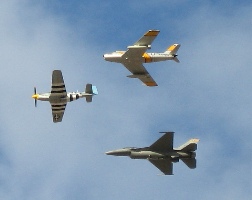
Heritage FlightThe airport closed at 3 PM and the Air Boss took over. A bunch of the performers took turns practicing their routines. It was mostly aerobatic stuff. The kind of flying that makes you wonder why people think helicopter pilots are crazy. These guys, purposely inverting their aircraft and letting it go out of control in tumbling dives are the ones who are crazy. But it was pretty cool to watch, as long as you didn’t try to think yourself into the cockpit. There was also a bunch of tight formation flying, including a flight with the F-16 and two other fighters: the Heritage Flight. (Not a bad shot with my new camera, huh?)

The gates opened to the public at 4 PM.

I did two flights that afternoon with 2 passengers each. The route was about 12 miles round trip. I’d take off from the ramp and follow the power lines between the Glendale and Luke airspaces. Then I’d either go northwest along Grand Avenue to Bell Road or continue north toward Sun City (which is laid out in a bunch of circles that look pretty cool from the air). Then I’d loop around to the right or left and come back pretty much the same way I’d left. The ride ranged from 8 to 12 minutes. GC helicopters was selling them for $45 per person, which I thought was a little high. (I was eventually proved wrong.)

We did rides while the air show was going on. Since we never crossed into the performance area, there was no danger. It was really weird to see a performer’s smoke trail on the return flight to the airport. We also did rides during the brief period when they reopened the airport to regular traffic. One time, on the second day, the Spitfire, which had to make a right traffic pattern during performances, flew over us. My passengers loved it. Late that afternoon, the GC guys brought their R22 over and I think they did a bunch of rides, too.

Balloon GlowThen the sun set and the balloon pilots started setting up for the big evening event: the desert glow. By 6:30, 19 balloons were floating right over the taxiway, using their burners to light up the night. The ramp was open to the public and thousands of people were wandering around right beneath the massive envelopes. It was magic.

I flew home in the dark, disappointed by the amount of work I’d done. Four passengers was not enough to even cover my transportation costs.

The next day — Saturday, October 29 — was distinctly different. Mike and I blew out of Wickenburg at 5:30 AM to arrive at the airport by 6 AM. It was dark in Wickenburg — especially dark since a power outage had affected the airport and none of the lights there worked. But I took off into the dark and soon saw the glow of Phoenix ahead. At 6 AM, I was three miles outside of Glendale. I made a radio call, which was answered by airport management. They told me the airport was closed. I told them I was part of the show. They told me to use caution when I landed.

I set down between the R22 and 2 F-16s again. The rent-a-cop the Air Force had hired to watch their birds overnight was standing exactly where he’d been the night before.

The balloons were already inflating for their morning flights. This was when the balloon owners actually made money — they sold hour-long rides as part of the show. Mike and I had taken a balloon ride back in New Jersey at an event like this years ago. It was expensive but something everyone should experience at least once.

Balloon ClassicI started flying at 7 AM, when the balloons were just lifting off. They drifted to the west-northwest, toward Luke Air Force Base. My pattern was a bit more north, so although I flew between a few of them, most of them were to my south. The view on the return part of our loop was incredible — dozens of balloons hanging in the early morning sky.

I flew on and off throughout the morning. The R22 did, too. Then somewhere around the middle of the day, things got busy. I flew nonstop for several hours, taking a break for fuel and another break when the F-16s flew. (For some reason, they didn’t want us in the air while the F-16 were flying.) Just after sunset, after finishing my last ride for the day, I consulted the tiny notebook where I’d been ticking off the passengers. 84 passengers. Wow.

I had a little excitement just after that last ride. The show had included a pair of rocket powered cars that sped down the runway, drag-strip style. I was still in the helicopter, listening to the radio, when someone told the Air Boss that one of the rocket cars had gone off the runway. The Air Boss acknowledged his words, but said nothing else. The other guy came back and said, “Well, can’t you send someone down there to make sure he’s alright?”

“I have no one to send,” the Air Boss replied.

“Ride-Hopper-One is spinning with no passengers,” I said. “Do you want me to go down and take a look?”

“Could you do that?” the Air Boss replied.

“Will do.”

I took off and sped down the taxiway while thousands of spectators watched me. It was dark and my navigation lights and landing lights were on. I probably looked like a blur of lights to them. I got down to the end of the runway around the same time as a pickup truck. The rocket car was pointed on an angle to the extended centerline, about 100 feet past the end of the runway. It was upright. Someone who looked like he could have been the driver was walking around. I reported all this to the Air Boss, along with the information that the pickup truck was there to help.

“We’re sending a fire truck down there,” the Air Boss said over the radio.

I started back along the runway. “The car is upright and there’s no smoke or flames,” I added.

I came back to my parking space on the ramp, set down, and shut down.

Mike and I watched the balloon glow together, walking among the balloons. It was still going on when we climbed back into Zero-Mike-Lima and went home. The next day, we arrived at the airport at 7 AM. Some of the balloons were already lifting off. The day got off to a slow start for us. But by 11 AM, we were cranking. I flew nonstop for several hours, then sent in the word that I was getting seriously tired and that they should stop selling tickets. By the time I finished at about 2 PM, I’d flown another 43 passengers.

I should say here that two things really amazed me. One was that folks thought nothing of spending $45 per person to take every member of the family for a ride. Mike thinks at least a dozen of the people I flew were kids under the age of 5. How many of those kids will remember the ride? A bunch of them were really excited and happy. One little red-headed boy had a smile bigger than the Cheshire Cat’s. I’m so accustomed to people balking at $30 or $32 per person for a flight that the idea of them lining up to spend $45 on multiple family members really surprised me.

The other thing that amazed me is how good kids are at buckling their seat belts. I don’t have kids and never had. I don’t spend much time at all with kids. But every once in a while, Mike would sit a kid in the front seat beside me for a flight. I’d tell him (they were mostly boys) to reach over and get his seat belt. He’d immediately locate the buckle (not just the strap), adjust it in the strap, and fasten it. Kids did this better than adults! I even watched one sharp 6-year-old untwist the belt before buckling it. Mike says it’s because kids that age are geniuses. They absorb everything they’re taught. I wish they could stay that way.

We managed to escape from Glendale right before one of the F-16s fired up for its part of the show. I called the Air Boss as I hovered into position for departure. “Ride-Hopper-One departing to the northwest.”

“Ride-Hopper-One, proceed as requested. This will probably be your last flight until the F-16 lands.”

“This is my last flight for the day,” I told him. “I’m going home. You guys have been great. Thanks.”

“My pleasure,” the Air Boss replied.

On my way back to Wickenburg, I pointed out the small herd of bison I’d spotted in a pasture less than a mile from Glendale Airport.

Planning Ahead

I get a strange request.

I got an odd phone call today in my office. A man I know — his name doesn’t matter — called to see if he could fly along with another group of passengers on one of my Hassayampa River Canyon tours. He evidently didn’t want to pay the whole price — the hour-long tour is $395 plus tax — and was hoping to split it with someone. I don’t get a lot of calls for that tour but I took his phone number and promised him that the next time I got a request for that tour with only one or two passengers, I’d give him a call.

He asked me if I’d heard the rumors about him. I told him truthfully that I hadn’t. Then he told me he’d been diagnosed with brain cancer. He was going through treatment, but just in case he didn’t make it, he wanted me to know where a specific peak in the Hassayampa River canyon area was so I could come back and scatter his ashes there. He’d buy the ticket for the scattering in advance and leave it with his papers so his sister and brother could have it taken care of.

Is it wrong for me to feel strange about this? Because I do.

I’ve done ash scatterings before, but never for someone who had flown with me and told me exactly where he wanted to be scattered.

Anyway, I’ll see if I can get some folks interested in the tour and give him a call. Perhaps some of his friends will chip in for a custom tour that’ll be shorter and cheaper.

But what I’m really hoping is that that brain cancer goes away and I don’t have to take him — either alive or in a baggy. The idea just gives me the willies!