
Not as bad as it seems.
As I type this, I’m sitting on a leather sofa in the second floor “pilot lounge” area of a friend’s hangar. The hangar is at a San Diego-area airport and the three large windows on this side of the room face out over one of the airport’s three runways. Outside it’s dark. From undefined glow of the lights across the runway that fade into the darkness, I can tell that it’s foggy. I can barely see the sweep of the white and green rotating beacon atop the control tower on the other side of the runway.
It’s 5 AM local time. I get up early no matter where I am.
If I look down out the closest window to the pavement outside the hangar, I can see my helicopter. I tied down the blades — needlessly, it appears; there doesn’t seem to be any wind here — and pushed it over to a level spot on the ramp area, clear of the taxiway. Seems weird to have it parked there, but it’s been there two nights now and no one has bugged me about it. After all, other folks park cars and other vehicles in the same place at the end of their hangars.
In looking at that fog, I’m sure I’ll be wiping the helicopter down with a towel later today. You get spoiled living in the desert.
You might wonder why I don’t put the helicopter in the hangar I’m camped out above. I could. But there’s already a Hughes 500c helicopter, a Diamondstar airplane, Jaguar sedan, and a GT40 sports car in there. There’s still a big empty space where the hangar’s third aircraft occupant usually parks his Twinstar and I probably could have fit in that space. But it didn’t seem worth the bother. A few days out on the sun won’t kill my helicopter. But with this salt-laden fog coming in, I’ll definitely be washing down the helicopter before I put it away at home later on today.
It’s wonderfully quiet here, with just some white noise — a distant hum that could be someone’s heat pump or even a generator. The heat inside the lounge, which just went on, is a lot noisier. The space I’m in takes up half the depth and the full width of the hangar below me. It’s completely enclosed and insulated, finished with nice plaster walls and carpeting. There are windows that open with screens on all four sides of the space; on one side, they open into the hangar’s main area.
There are three rooms up here, including a full bathroom, and one of the rooms has a little kitchen area, with certain conveniences conspicuously missing. There’s no stove or oven or dishwasher, but there’s a double sink and microwave and the small refrigerator has an ice maker in it. There isn’t much in the way of food in the cabinets other than coffee and the non-perishable condiments that go with it. But there’s a Starbucks off-airport, walking distance away, and I know the owner of this hangar frequently drives across the runway in his well-equiped golf cart to get his meals at the airport restaurant.
In all honestly, the second floor of this hangar is very museum-like. My friends collect Mexican, South American, and Native American art. Although their best and most valuable pieces are in their two other homes, there’s a lot of it here. There’s also a lot of weird items you’d expect to find in a museum: a copper diving mask, pull-down wall maps dating from the 1950s and 1960s, a fully restored glass-tanked fuel pump, an old Coke machine that takes dimes (with a small bowl of dimes on top and bottles of Corona beer inside), two free-standing and fully restored wood popcorn machines — the list goes on and on. Sometimes it’s neat just to look at these things. But when you pop a dime into the Coke machine and pull out a Corona, you remember that all of these things are still fully functional.
I’d take a picture and include it here, but I really think that would be a serious invasion of my friend’s privacy.
My friend is not here, although his helicopter is. He used to spend a lot of time here when the place was first built. He and his wife had lived in Wickenburg before then. His wife fell out of love with the town when the Good Old Boy bullshit that makes Wickenburg what it is started directly affecting her. From that point on, it was just weeks before she was desperate to get out of town and continue life elsewhere. She started spending more and more time in California with her daughter and less and less time at home with her husband. The hangar was a temporary solution, followed by an apartment on the coast and then a condo in Beverly Hills with a second apartment in Las Vegas. They spend most of their time in those places now, although my friend uses the hangar as a kind of getaway place when he has a few days off and wants to go flying. They still own their home in Wickenburg and have tried three Realtors in the past two years to sell it. But there isn’t much demand for a $1 million home in Wickenburg these days, even when it has a separate guest house, hangar and helipad, horse setup and plenty of acreage around it for privacy.
They want us to buy it, of course, but I’m not prepared to go into debt to buy a home and I’m certainly not going to sink myself any deeper into Wickenburg.
Mike and I have been camping out here in the hangar for a few days. Supposedly, it’s against federal regulations to live on the property of a Federally-funded airport — which is why this “pilot lounge” is missing a few necessities of life, like a bed. So we’re sleeping on an air mattress. We’re not living here, of course. Just sleeping over. We have business in the area during the say and just needed a cheap place to spend the night. My friend was kind enough to let us camp out here.
It’s a wonderful place to hang out. This airport, unlike a few I could name, has a lively population of tenants in the hangars. When I went out for coffee yesterday morning, I walked by a hangar where a man was busy preflighting a Cessna in preparation for an early morning flight. He greeted me as if he knew me and we shared pleasantries about the weather: “Great day to fly.” “Sure is.”
After lunch, we decided to drop by the hangar to put our leftovers in the fridge. We were very surprised to find our big hangar door wide open. Inside, tending to the Diamondstar, were three Brits. We introduced ourselves by name and were immediately offered coffee. It later came out that we were friends of the hangar’s owner. “Oh, well then you must come by at 5 for cocktails,” the woman said. “We have such fun.” When I mentioned I was in the area working on a video project, she hurriedly took me to meet a man named Steve who is also in film. He was stretched out on a leather sofa in his modest hangar, watching a game on a big television. The TV’s rabbit ears antenna was out of the pavement beside a gas BBQ grill. Inside the hangar was the neatest and cleanest Cessna 140 that I’d ever seen.
Later, when we returned — too late for cocktails, I’m sorry to say; I could have used one — we were treated to stories of other dinner parties in the hangar’s big lower area, with unknown pilots stopping by to join in the fun. There’s a real sense of community here. It’s more than just a place to store your aircraft. It’s a place to hang out and meet people with similar interests. It’s a place to watch the world — and the planes — go by.
It’s nearly 6 AM now and I can see a tiny bit of light in the sky. The fog is still thick on the runway; the rotating beacon is now invisible. If the tower controller have come on duty, there’s not much for them to do. It’s IFC — Instrument Meteorological Conditions — here and I’d be very, very surprised if we saw or heard a plane outside until the fog lifted. But I’ll get dressed and make a run for coffee. We have more work to do today. Then, at about noon, we’ll start the 2-1/2 hour flight back to Wickenburg.
I’m looking forward to camping out here again.
 I’ve ordered charts from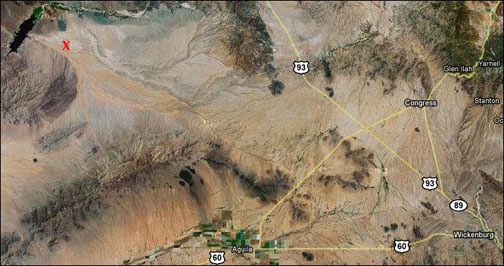
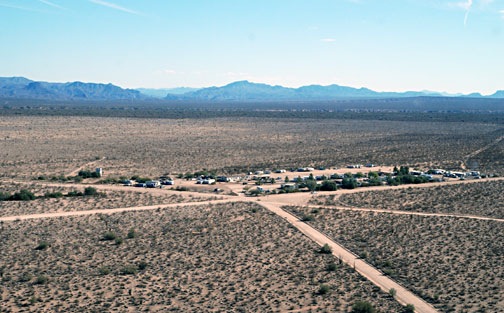
 The writer is sitting up front beside me, taking notes and using my Nikon D80 to shoot images of what she sees. Although a good portion of the shots have some unfortunate glare — not much you can do about that when shooting through Plexiglas — many of them are really good. Like this shot she took of a herd of wild horses we overflew on the Navajo Reservation two days ago.
 I’m treating myself to a few of the activities my excursion guests get to enjoy. For example, on Tuesday, I joined the crew for a boat ride on Lake Powell that visited the “business side” of the Glen Canyon Dam before squeezing about a mile up Antelope Canyon (see photo) and gliding up Navajo Canyon for a look at the “tapestry” of desert varnish on some cliff walls. I skipped the Sedona Jeep tour and Monument Valley tour to work with one of the video guys or just rest up. Normally, while my guest are touring, I’m scrambling to get the luggage into their hotel room and confirming reservations for the next day. You might imagine how tired I am after 6 days of playing pilot and baggage handler.