Bottling Wine, Day 1: Filtering

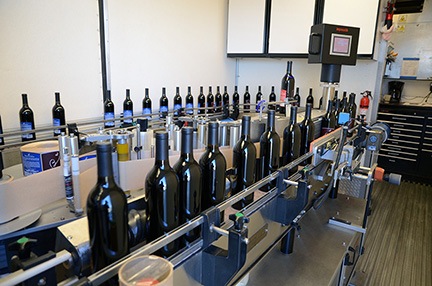
Before wine can be bottled, it must be filtered. Here’s how it works at one winery.

I’ve been neglecting my blog for a week or so mostly because of preparations for my annual migration to Washington State. First it was the packing. Then it was the driving. Then it was the unpacking. I’m here now, parked in my usual spot at the Colockum Ridge Golf Course’s tiny RV park in Quincy, WA. I arrived a full month earlier than usual just so I could witness and help out at Beaumont Cellars Winery’s red wine bottling on April 17.

The Back Story

Beaumont Orchards is one of my cherry drying clients. I’ve been responsible for drying their cherry crop after a rain since 2009. But Pete, the owner of cherry, apple, and pear orchards in Quincy, began dabbling in winemaking a few years back. He (and others) were very pleased to discover that he was pretty good at it. Last year, in fact, his wines began winning awards.

Each year, Pete has expanded his winery operations just a little bit more, producing more hand-crafted wines and setting up a really nice tasting room. Beaumont Cellars, which is based at his home, has become one of the premier wine-tasting destinations in the newly established Ancient Lakes AVA.

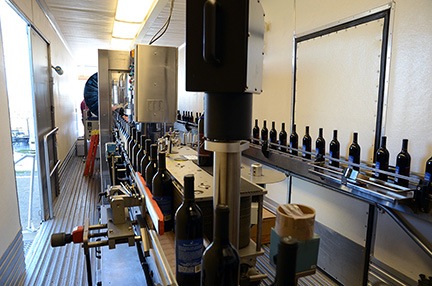
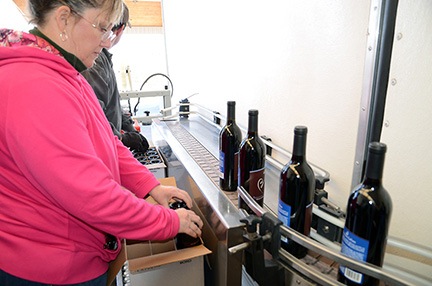
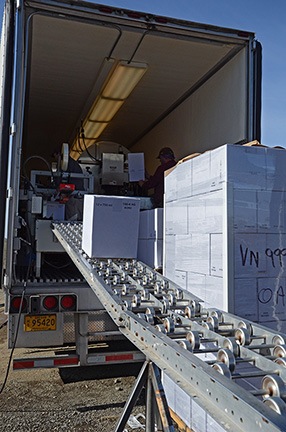
This year, he mentioned that he’d be bottling wines on April 17. I decided that it was something I really wanted to see, something I’d like to do some video about. So I arranged my schedule to arrive earlier than usual in Washington.

Filtering Day

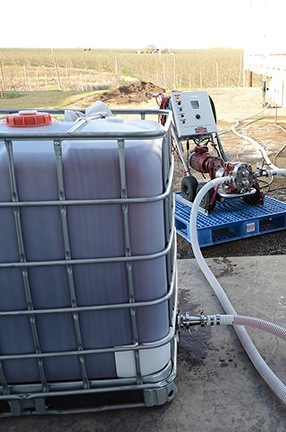
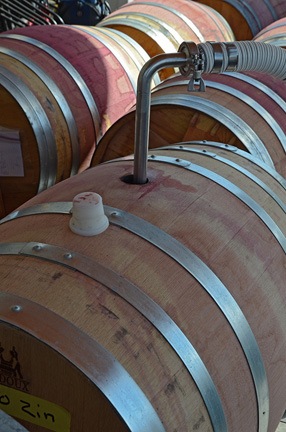
Pumping Out Barrel
The wine is pumped out of the barrel.

Wine Filter
The wine filter consists of multiple vertically mounted filter pads that are discarded after use.

Connecting Hose
Pete and Megan connect a hose to the bottom of a wine vat. Filtered wine enters at the bottom to minimize splashing.

Good to the last drop
Megan catches the last bit of wine as Pete tilts the barrel opening into a pitcher.

Pouring wine into next barrel
Megan pours the last bit of wine from one barrel into the next one being filtered.

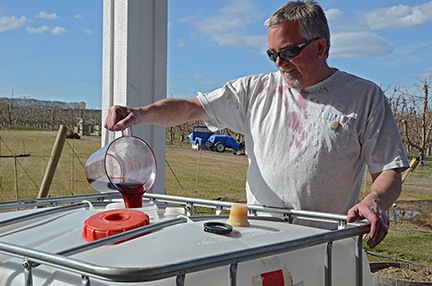
Pouring wine into the Vat
Pete pours some filtered wine into the vat.

I arrived in Quincy at around 2:30 on Sunday afternoon. I had just finished hooking up the mobile mansion’s water, electric, and sewer connections when Pete called, asking where I was. He was in the middle of filtering the wines in preparation for bottling on Tuesday.

Tired from my three-day, 1200-mile drive pulling a 34-foot fifth wheel through the valleys, plains, and mountains of Arizona, Nevada, Idaho, Oregon, and Washington, I nevertheless grabbed my camera and hurried over. Pete and Megan, his winemaking apprentice (for lack of a better term) were more than halfway finished. I got to watch and photograph the activity.

The wine began in barrels. Pete and Megan used hoses and a pump to pump the wine out of each barrel, through a filter, and into a large plastic vat. The barrels for each variety were combined into a single vat.

When the pump is no longer able to suck wine from the bottom of a barrel, the barrel is tipped into a pitcher to catch the last little bit. It’s then poured into the next barrel of the same variety as it’s pumped through the filter. Likewise, any filter overflow is captured in a pitcher and manually poured into the vat. This minimizes the loss of wine.

When the job was done, there was a huge vat of wine for each of the varieties to be bottled on Tuesday. Pete and Megan cleaned up by pumping purified water through the pump and hoses, disassembling the filter, and cleaning everything down with a power washer capable of heating water to 180°F. Pete used a forklift to move the wine vats into a temperature-controlled storage area and stack the empty barrels out of the way.

Throughout the process, we’d been sampling the wine — and it was good!

The Photos

I took a lot of photos during this process — the ones you see here are only a sampling that illustrate the main part of the process. I put most of them on the Beaumont Cellars Facebook pagea gallery on the Beaumont Cellars website. In both cases, the photos include shots taken on Tuesday during the bottling, which I cover in a separate blog post.

Feeling Overwhelmed?

Join the club.

Lately, I’ve been feeling a bit overwhelmed. It isn’t the first time and it won’t be the last. But it is bothersome — an uncomfortable feeling that makes me question everything about my life.

I’ve made some serious personal decisions recently that are likely to rock my world over the coming months. This is a stressful situation that’s not made any easier by the lack of support by friends and family members. I’m going it alone — as I so often do — and it’s weighing heavily on my mind.

But the feeling of being overwhelmed is primarily due to my workload. As a freelancer, I work when there’s work to do. When there isn’t work to do, I’m usually waiting for or looking for more work. Sometimes I need to make work. Other times, work appears unexpectedly — even when I don’t want it or have time for it. But I have to do it all — to turn down work is to possibly miss out on future work.

Such is the life of a freelancer.

Right now, I’m working on four content creation (writing, video, etc.) projects:

  • Book CoverFinishing up a special iBooks 2 interactive edition of my iBooks Author book. This requires me to record and edit dozens of screencast videos and completely re-layout the book in iBooks Author. The good news: I might be able to finish up today. That is, if Alex the Bird can keep quiet and the landscapers don’t spend much time blowing leaves outside my window. And the neighbor’s dog doesn’t bark nonstop for an hour. Again.
  • Lynda LogoPrepare scripts for a revision of my Twitter Essential Training course on Lynda.com. We’ll be recording this course soon and I want to be fully prepared before I fly out to Lynda to record. And my new producer, wants to see the scripts, too.
  • An aerial photography book. I began writing this last year and have put it aside repeatedly because I need artwork and photos that I can’t produce on my own. I suspect it’ll have to wait until this summer to finish up.
  • A book of helicopter pilot stories. I’m collecting these stories from other pilots and plan to compile them in a book for release later this spring. As I get more and more bogged down with other things, however, the self-imposed deadline keeps slipping. I suspect this will be finished up when I get to Washington, too.

Of course, with Mac OS X Mountain Lion announced, I know what I’ll be doing first when I get to Washington: Revising my Mac OS X Lion book for the new version of the OS. Oh, yeah — and then there’s the videos and Websites I’ve been asked to create for a handful of winemakers up there.

It’s not just writing work and the occasional helicopter flight that’s stacked up before me. It’s all the paperwork that goes with it.

I have two separate businesses, each with their own bank accounts and accounting records. I don’t have an accountant — hell, I am an accountant; my BBA is in accounting. To hire an accountant would be silly, since I could do that work myself and save a bunch of money. So I do. Or I try to. Often, it just stacks up, waiting for me to get to. I haven’t balanced a bank account in several months. And I’m only partially switched from Quicken (since it no longer works in the current version of Mac OS) to iBank (which I really don’t like). It’ll take days to sort out the accounting mess I face when I get around to it.

And then comes tax time. What a freaking nightmare that is.

And then my annual migration back to Washington. That’s a logistics issue. Find someone to fly up to Washington with me to help cover the flight costs. Do the flight. Catch a commercial flight back to Arizona. Pack the RV, get the truck ready. (Did I mention that I might have to buy a new truck this year, too? And take delivery before the end of April?) Make the 1200-mile drive to the Wenatchee area. Retrieve the helicopter from wherever I left it in Washington. Get my contracts set up for summer work.

Of course, that’s if there is summer work. My clients never want to sign up until after the last frost. There’s a chance I might get to Washington with the helicopter and a frost will wipe out the cherry crop. No need for my services then. Ready to fly but no clients. How do you think this possibility affects my stress levels?

On the flip side, there might be too much work for me to take on by myself. Then I have to scramble and find people who are willing to put their life on hold for 3-6 weeks and wait around for the rain in Washington. I’ve already started collecting possible candidate phone numbers. None of them are happy that they’ll have to wait until May to know whether there might be work for them.

Before I leave Arizona, however, I do have to pack up everything I own that’s in our Phoenix condo in case it’s rented or sold while I’m gone. That’s a whole office full of stuff, as well as clothes and other personal effects. Hell, I haven’t had enough time to unpack the boxes that brought some of this stuff here.

And I did mention that I have to travel to Lynda.com for a week to record a course, right?

And there is the possibility of a very big client needing to fly with me in late March or early April, before I go to Washington. Unfortunately, they can’t pin down a date. Once they do, if I’m not available, I’ll lose that job — and it’s not the kind of job I want to lose.

Along the way, I need to start seriously considering where I’m going to live and what I’m going to do when my work in Washington is done this year. I’ve been wanting to relocate for years. I’m sick of Wickenburg’s small-mindedness and the bullshit politics and greed that have ruined the town. Phoenix is no gem, either — except on February days like yesterday when the temperature hovers in the high 70s and there’s not a cloud in the sky. The personal decisions I’ve made recently give me a good opportunity to make the change. Unfortunately, I don’t know where I want to live. I’m leaning toward Oregon — perhaps in the Portland area — but who knows?

So with all this on my plate and on my mind is it any wonder that I’m feeling a bit overwhelmed?

But this is typical in my life — and in the life of most hardworking freelancers and business owners. Things don’t get done by themselves. And if things aren’t done, I start feeling it in the bank account. I don’t know about you, but I like to pay my bills on time and eat.

Guess I’d better get back to work.

Yes, I’m Still Around

But busy having a life and dealing with it.

I know I’ve been neglecting this blog when my sister mentions that I haven’t posted anything new in a while. Oops.

Truth is, I’ve been busy. House guest, cell phone lost on mountain top, two days of aerial survey work, rush to finish a writing job, plan a last minute vacation, search for a lost dog, cancel last-minute vacation, find lost dog, etc.

Life. Sometimes it interrupts blogging.

But wouldn’t you want it that way? I’m not complaining.

(Although I could have done without that lost dog episode.)

Weird Health Problems? Check Your Meds!

While trying to track down the cause of one weird symptom, I find the cause of another.

I’m in generally good health. A bit overweight, perhaps, but still able — and willing! — to move around pretty well. The weight issue and genetics is probably the cause of my high blood pressure, which has been kept under control by medication for the past four or five years.

Unfortunately, one of those medications was costing a small fortune — $80/month. (Yes, I know that you or someone else you know probably takes or has taken medicine that costs a lot more. If it makes you feel better, do tell us about it in the comments. Sadly, costly medicine is a fact of life here in the U.S. Remember that when you vote for politicians who support Big Pharma and insurance companies. Can I get back to what I was saying now?) I decided to see if there was a cheaper alternative when I began seeing a new doctor.

He agreed that Micardis (Telmisartan), which is what I was taking, was too expensive. He prescribed two other medications — Lisinopril and Amlodipine. Together, these pills would cost $32/month. A savings of almost $50.

I started taking them. I monitored my blood pressure with a home device. I had follow up visits. Everything was fine. Medicines were working and blood pressure was well within acceptable limits. End of story.

Or not?

Two Weird Symptoms

About a week or two ago, I began noticing two annoying little health problems. I didn’t think much of them and I don’t even know if they started at the same time.

One was an incessant ringing in my ears — mostly my left ear. Not loud. More like the kind of ringing you have in your ears about an hour after a rock concert at a big indoor venue. Like Led Zeppelin at Madison Square Garden (1977).

Yes, I know I’m a helicopter pilot and I’m subjected to loud noises quite often. But I also know that I spent $1,100 on a pair of Bose noise-canceling headsets for a reason. Plus, it’s not as if I’m flying every day. And yes, I do drive my Honda S2000 with the top down on the freeway and it is very noisy. But I don’t do that every day, either. And I’ve begun wearing earplugs on the highway just in case it is the car that’s causing the problem.

My ears are clean — I use Q-Tips after every shower. I have no other symptoms related to ear ringing, such as vertigo, headaches, etc. It’s a simple case of tinnitus that’s worse when I’m in quiet places and worse in the evening. Annoying when it goes on for more than a week and shows no chance of stopping.

The other weird symptom is a dry cough. Everyone gets these coughs now and then. You get a tickle in your throat and you cough. The more you cough, the more you feel like you need to cough. (Some of you out there might know another activity that sometimes causes a cough like that.) It a dry cough, though, and nothing comes up with it. Drinking water or sucking cough drops does not help. Oddly, blowing my nose — even if it’s dry — does help. The cough happens periodically throughout the day and wakes me — and my husband and likely the upstairs neighbor — in the middle of the night.

Normally for me, a cough like this signals the onset of a cold. First dry, then phlegmy, then a post-nasal drip, sore throat, and the rest of it. But not this time. Just a dry cough that comes and goes throughout the day. Every day. And every night. And the more I cough, the more I strain the muscles in my chest, so now I’m kind of sore, too.

Finding the Cause

I figured the ear ringing had to do with my new meds, although I couldn’t understand why the symptom didn’t show up for over a month after starting them. So I pulled out the little flyer that came from the pharmacy for each of them and scanned the side effects. As anyone who has ever watched a drug commercial on TV can tell you, all drugs have numerous side effects and these two were no different.

And guess what I found?

One of the side effects of Lisinopril is a dry cough. I did some more research on the Web and came up with a bunch of search results on “Lisinopril dry cough.” This page even explains why the cough occurs in some people. And that it sometimes takes a while for the side effect to appear.

Damn!

The good news is that the cough usually goes away when you stop taking Lisinopril. The bad news is that it might take months to stop.

Of course, no explanation for the ear ringing. At least not in the med pamphlets.

So today I’ll make an appointment with my doctor and see him about the meds and the ear ringing. Hopefully, we can get to the root of both problems and resolve them soon.

The Moral

There are two morals to this story:

  • When taking meds, it’s important to consider possible side effects when otherwise unexplained symptoms begin appearing.
  • If you stay in good health, you shouldn’t need meds or have to worry about side effects.

Lesson learned.

Charlie’s Four Games

That’s it.

Charlie and Friend
Here’s Charlie, trying to get another dog to chase him.
After a while, he did.

I took Charlie to a dog park in Phoenix today. It was surprisingly large and relatively well kept, although there was a nasty area of wet mud on one side that Charlie just had to lie down in. We were there for about 30 minutes and during that time, there was anywhere from 10 to 20 dogs of all sizes in the enclosure with us.

I watched with fascination as Charlie fetched balls and then played with the other dogs. After having him for only about seven weeks, I realized that he likes to play just four games:

  • You can’t catch me. This is poetry in motion. He gets a dog (or two or three) interested in chasing him and he runs away. He’s pretty fast. But what’s interesting is that he’ll match the speed of his fastest pursuer so that he stays just a few feet in front of him, just out of reach. If the dog behind him speeds up, he speeds up, too. There was only one dog in the park today that could catch him. It should come as no surprise that he was likely the same breed or mix of breeds. I should mention that sometimes he gets other dogs to chase him by grabbing a ball or something else they might want to play with.
  • You can’t get past me. In this game, he corners another dog against a wall or in a corner, usually with a small obstruction like a bush or a tree trunk between them. The other dog tries to get out of the corner, but Charlie darts in front of him. This goes on for minutes sometimes, with the two dogs going back and forth. He plays this game with my neighbor’s Chihuahua sometimes and it drives the little dog crazy. After a while, it gets frustrated and barks.
  • Tug of war. He played tug of war with a pull toy for hours on end with a friend’s dog when we were away recently. He’ll occasionally play it with us.
  • Catch. Don’t confuse this with Fetch. He will fetch a ball or Frisbee, but he really likes to catch them in the air. Balls, anyway. He doesn’t always bring them back and, if he does, he doesn’t always release them. Not much fun for his people. Also, if something isn’t moving, he’s not interested in it at all.

Our last dog, Jack, didn’t like to play with other dogs. He just wanted to play with us. While it’s nice to have a dedicated dog, it’s even nicer to have a dog who can play well with other dogs.

After all, there are only so many times you can throw a ball in a day.