A day that changed my life — and what came afterward.
It was 29 years ago today, on July 10, 1983, that I met the man who would become my husband.
I was living in a studio apartment in Hempstead, NY, on Long Island at the time. I’d been out of college for just over a year and had been working since then as an Auditor at the New York City Comptroller’s Office. I hadn’t been dating; the one date I had after breaking up with my last college boyfriend had been a disaster caused by a complete mismatch between me and my date made worse by his inability to stop talking about his ex-wife. I had a male friend, but it was a completely platonic, if not boring, relationship. For a while, I thought he was gay, but I later learned that he eventually married.
On that afternoon, I’d decided that I wanted to go to Jones Beach with my camera to take pictures at sunset. I’d taken up photography in college — I’d even dated a photographer for a while — and I still tried my hand at it now and then. My friend, however, did not want to go. He wanted to hang around the house — his parents house, where he still lived. I didn’t. We had some minor words and I left on my own.
I wound up at West End 2, the beach closest to the city. I knew from experience that there were good views of the old Manhattan skyline back then — views that included the twin towers of the World Trade Center. Sometimes, when conditions were just right, the setting sun would form a big orange globe as it set behind that skyline. I guess that’s what I was hoping for that afternoon.
Mike was there, too, also with his camera. He’d been swimming and was wearing a bathing suit. His beach blanket was a ratty wool thing from a different time on the airlines. I don’t remember how we started talking, but I know that when he offered me space on his blanket, I said no.
There were some people out on the jetty that evening. They’d been sort of trapped out there as the tide came in. Minor drama — they eventually made it back, but not without some sort of rescue brouhaha. We watched the action. We took photos. We started to talk.
When the sun went down, he invited me out for a bite to eat. He was a stranger and I didn’t like the idea of a stranger buying me a meal. But I only had a few dollars on me — that was common for me back in those days. (I once took a train to Canada with only $20 on me and no credit cards.) We wound up going to the diner in Uniondale, near Nassau Coliseum, in two cars. He drove a white 1981 (I think) Volkswagen Rabbit. I drove my still fairly new light blue 1983 Nissan Pulsar NX.
At the diner, the only thing I could afford was a danish, so that’s all I ate.
I don’t remember what we talked about, but I do remember that we made a date.
Later that week, I told my mother that I thought I might have met “the one.”
We spent every other weekend in the Hamptons where he had a half share with a friend of his in a house for the season. His friend had met a woman there who also had a half share for the same weekends. We often went out together. They thought we’d known each other for years, mostly because we were constantly finishing each other’s sentences.
I was the down-to-earth 9-to-5 accountant type who wore business clothes and heels to work every day. The one putting her accounting degree to good use. The one satisfied with the same kind of lifestyle as any other white collar cube dweller. No, it wasn’t what I really wanted to do — what I really wanted was to be a writer. But my mother had talked me out of that path, telling me that it wasn’t a good career choice. I should have a more practical career and accounting fit the bill.
Mike, on the other hand, was the dreamer, the hobbyist inventor, the one with big ideas. I still remember him showing me his fiberoptic cable — back in 1983! — which he wanted to use to create lit-up signs. “If you want something, you have to make it happen,” he used to say to me.
In January, we got an apartment together in Bayside, Queens. It was a third floor walkup in a block of row houses. Three bedrooms and a view of the bay — and the Cross Island Parkway beneath our window.
I gave up my two cats because of his allergies and asthma.
He worked a manufacturer’s rep designing and selling custom HVAC equipment for a company in New Jersey. He liked his work and he did well at it. Best of all, he made his own hours and worked mostly from home, spending a lot of time visiting clients instead of sitting in a cube.
On weekends, we’d do things outdoors. Hiking, trips to the Planting Fields Arboretum, visits to museums in Manhattan. Or take spontaneous trips. I remember one Friday in particular when we both got home and one of us — I can’t remember which one — suggested going to Cape Cod for the weekend. Just like that, we packed our bags, got in the car, and left.
On September 10, 1984, he proposed to me and I said yes.
But we didn’t get married right away. We just kept putting it off.
In the meantime, we bought a house together in New Jersey. And we got a dog — a Dalmatian named Spot.
After five years with the City of New York, when it became obvious that I couldn’t get promoted beyond my current position unless someone above me died, I left my job. I got a job as an auditor for a small company based in Red Bank, NJ. I hated the job so much that four months later, I’d gotten a new job as an auditor for ADP in their Roseland, NJ corporate headquarters. I liked that job a lot better, mostly because it included a lot of travel. For the next two and a half years, I’d fly all over the country. On trips lasting longer than three weeks, ADP would either fly me home or fly Mike out to me. That’s how we were able to take driving vacations in California, Nevada, and Arizona without ponying up the airfare.
Mike’s job continued to do well. He was bringing in a lot of money. His bosses were talking partnership. Things were looking good.
I decided I wanted to learn how to ride a motorcycle. I bought one: a 1980 Honda 400cc Hawk that had only 941 miles on it. It had been owned by the motorcycle dealer’s wife and he put it in storage for 10 years after she died of cancer. It was a simple bike. At first, Mike thought we’d ride it together, but I set him straight. We took a Motorcycle Safety Foundation course (highly recommended) to learn how to ride. Then he bought a BMW Boxer. I don’t remember the details, but I remember it being gold colored and kind of ugly. We joined up with a group of other riders and made motorcycling a primary activity for weekends. We’d do trips all over the place — even up to Lake George for the annual Americade event. We both bought brand new bikes in 1991: him a BMW K65 and me a Yamaha Seca II. I still remember the looks on our friends’ faces when we joined them for a motorcycle camping trip, each rolling up on brand new bikes.
Meanwhile, I’d gotten myself into a position where I was asked to write a course for the Institute of Internal Auditors about using “microcomputers” for auditing. Personal computers were just taking off and laptops were a rarity. I had a Mac at home and used a PC laptop at work. I was entirely self-taught, but I knew what they needed to teach in their courses. Writing the course would earn me $10K — about 1/4 of a year’s pay back in 1990. I asked for a leave of absence to write it and was turned down. So I quit my job to start the writing career I always wanted.
My mother cried.
My freelance career got off to a rocky start, but soon picked up steam. Mike’s job, on the other hand, was not doing quite as well. His bosses had stopped paying his commissions. After a while, they owed him a lot of money. He kept working for them, earning even more money that they always seemed to have an excuse not to pay. He was unable to support himself on that job so he took on a second job as an energy auditor. Eventually, he parted ways with the company he’d worked for all those years. Two lawyers and a lot of legal expenses later, he had a judgement for a six-figure amount. He’s still waiting to collect.
He got a similar job with another company in New Jersey. He did well there. His boss was a great guy — even though he’s retired now, Mike still keeps in touch. Mike wound up getting a piece of the company but sold it when the primary owner decided to sell out. He stayed on with the new owner.
We still had great trips together — business trips to Cancun and on a cruise ship in the Caribbean. A motorcycle camping trip down Skyline Drive and the Blue Ridge Parkway and up the barrier islands of the Atlantic coast. Driving vacations from Seattle to San Francisco; through national parks in Colorado, the Dakotas, and Wyoming; and through some of the greatest scenery Arizona and Utah have to offer. The Florida Keys.
One cold winter after another and I decided I’d had enough of New Jersey. I spent one winter in Arizona and was hooked. Two years later, in 1997, we sold our home and moved to Arizona. Mike would continue working at his job from Arizona and make monthly one-week trips to New Jersey to meet with clients. He rented an apartment there to make his visits easier. And my work as a freelancer could be done from anywhere.
We wound up in Wickenburg, which, at the time, was a nice western town. Our house was on 2-1/2 acres of horse property, so it wasn’t long before we had two horses. And chickens. Although we still did some motorcycling, the straight long roads of Arizona’s desert can’t compare to the twisty roads we’d raced along in upstate New York and western New Jersey. We spent far more time sitting in horse saddles than motorcycle seats. We’d saddle up and ride into the desert right from our house. Our friends from New York and New Jersey told us we “lived on vacation.”
Around 1999, we bought a 40-acre parcel on Howard Mesa as an escape from Wickenburg’s oppressive summer heat. Over the next few years, we made various improvements to it — including a fence and septic system. We had two different sets of house plans drawn up, but Mike later admitted that it was too remote a place for him to live. But in 2005, we finally put a camping cabin on it. We spent many weekends and holidays there with the horses.
Spot died and we got a new dog, Jack, a Border Collie – Australian Shepherd mix.
My writing career took off. I invested in some rental property. And I started learning to fly helicopters. Like motorcycling, it was one of the things I’d always wanted to learn and do. I never expected to get hooked on it. By 2000, I owned a 2-place Robinson R22 Beta II helicopter and was working toward my commercial helicopter certificate. Mike learned to fly planes. He wound up going into a partnership with another pilot on an 1974 (I think) Grumman Tiger.
I got a contract to be the fuel manager at Wickenburg Airport. I fixed up the airport terminal, got new furniture, and had the landscaping redone. I expanded the hours of operation and added services for the charter and fractional jets that came in. I employed up to seven people at a time. We had monthly pancake breakfasts and occasional poker runs. The local pilots seemed to really like the change. The business netted about $45K per year. At first, Mike said he’d work at the airport for me while he did his other work. But that didn’t last very long.
Somewhere along the line, Mike’s monthly travel back to New Jersey started putting a strain on things. He backed off that. And that’s when his job troubles began. Although he wanted to do HVAC consulting work — which he was extremely qualified to do — he couldn’t seem to get started in Arizona. There’s a different work ethic there — a pretty crappy one if you’re accustomed to the fast pace and competitiveness of the New York market. Money became an issue and he wound up taking the first of several jobs that I really don’t think were a good match for him. He’d bounce from one job to the next after two or three years. He was unemployed for a while.
I worked as a commercial helicopter pilot at the Grand Canyon in 2004, at the height of my writing career. I was at work when I ordered the four-place Robinson R44 I own now. I took delivery in January 2005. By February, I had my Part 135 certificate in place so I could do air taxi work. I started building my business in my third career.
Sometime around then, he told me that when he turned 55, he’d retire and we’d work and travel around together. I felt that it was part of my job to set something up that we could both do. To prepare, he got his helicopter rating.
I sold my airport business due to problems with employees and the Town of Wickenburg’s failed attempts to censor my blog.
In 2006, we finally got married. I’ll admit it: I was concerned about health insurance coverage. After years of me having my own policy, I’d switched to his. We wanted to make sure I was covered. It was a civil ceremony held at the courtroom in Wickenburg. His partner on the airplane and his wife were our witnesses — mostly because all of our close friends had already moved out of town. Afterwards, we went out for dinner.
Mike and I still went on trips together, but they were notably shorter and far more planned. A two-night mule trip into the Grand Canyon with friends in 2005 was a lot of fun. A business trip to Napa Valley in 2006, which we elected to do by car in my Honda S2000, stands out in my mind because it was so much like the old days, when money didn’t matter (much) and having fun was the priority. A cruise to Alaska in 2007 was marred by bad service, lost luggage, and a complete lack of individual treatment that we’d come to expect. With Mike working a regular 9-to-5 schedule and having limited vacation time, we didn’t seem able to get out as much as we used to.
I started traveling on my own. I took the helicopter on long, cross-country flights to Colorado, Utah, Nevada, and California. In 2005 I took what I still refer to as my “midlife crisis road trip,” — 20 days in my Honda, wandering around the northwestern United States, making up every day as I went along. I didn’t mind traveling alone — as long as I traveled. I needed to get out and see something.
Compounding matters was the incredible change in Wickenburg, where we lived. What had once been a “horsey” town with guest ranches and a lot of people to go riding with turned into a retirement community. The mayor and council decided to grow the town by approving ever larger subdivisions with ever smaller lot sizes. They concentrated on expanding housing in town and annexing whatever surrounding areas they could. They did nothing to stimulate business growth. And the new seasonal residents, who were mostly retired, didn’t support local businesses, preferring instead to make the drive down to the Walmart and other stores in Surprise and Peoria 30 miles away. Our friends started moving away. Politics got nasty, with personal attacks and threats against residents who didn’t toe the line. I began to really dislike the town and think about moving.
In 2008, I came to Washington State for my first season of cherry drying work. I was gone for eight weeks. I returned year after year, for slightly more time each season. I started to really like it in Washington — far more than I liked it at home. Each year, when I was away, Mike would come up for one or two visits on his vacation time. But this often turned into a serious inconvenience for me when I had other responsibilities to attend to. There were bitter feelings on both sides.
Mike’s horse died. Faced with the decision of having to get another horse or find a home for mine, we decided to find a home for mine. The chickens went, too. Having these kinds of animals didn’t fit into our lifestyle, with Mike working long hours in Phoenix and me traveling to Washington every summer.
By 2010, Mike was working for a Phoenix company that sold Astroturf. He was living during the week in a condo he’d bought in Phoenix. A friend of ours, who lives in the Williams, AZ area and works for the same company, was his roommate. When I went there, I felt like a visitor in someone else’s home.
I went to see Mike in his job one day and was appalled by his working conditions. He was in a tiny office crammed with two cubicles, one of which was his. His office mate was loud and seemed to spend more time watching YouTube than doing work. He worked at this job from 7 AM to 4 or 5 PM daily. I’d see him on weekends.
Jack died while Mike was in New Jersey on business. He got sick suddenly; within three days he could barely breathe and couldn’t walk. It was a tumor on his heart. I held him when the doctor put him down, then got every trace of him out of the house to ease Mike’s pain when he got home.
Mike turned 55 in May 2011. He showed no signs of giving up his job or working with me.
When I came back from Washington in October 2011, I moved my office down to the condo. His roommate had moved into his own place nearby. Mike and I could live in Phoenix with some level of privacy. But there was an underlying strain from trying to live in two homes and me trying to reconfigure my writing schedule to a Monday to Friday workweek. You see, when I have a project I work almost every day until it’s done. Then, between projects, I goof off. It was difficult for me to keep “office hours.” I couldn’t work efficiently in both places.
We got a new dog, a Border Collie named Charlie.
As the economy began to slump, profits at Mike’s company suffered. His boss started putting the squeeze on everyone at the company, making unreasonable demands. Mike would come home from work miserable. During the week, after work, he was tired and mostly just wanted to unwind in front of the TV. When we were together in Wickenburg on weekends, he was more interested in doing things around the house than spending quality time together. And did I mention that he was still doing work for that company in New Jersey? Making calls and writing bids in his “spare” time?
We fought about the usual things. All couples fight. But as time went on, we fought more and more. I couldn’t understand why he stuck with a job he so obviously hated. I was bitter because he’d broke his age 55 promise to me. He seemed satisfied to struggle with his job in Phoenix, coming to Wickenburg on weekends. I wanted a better life for both of us. One without the kinds of stress he was clearly putting up with. One where we could both relax and enjoy life a little more. I couldn’t understand why he wasn’t aching for the kind of change I was and it frustrated me to no end.
Something else came up around then. I realized that when I made a decision or did something that he didn’t like, he’d give me a sour face but never actually say what was on his mind. No matter what I did or said he didn’t seem happy about it.
It all came to a head in February. His mom had come for a visit. She was supposed to stay in an assisted living place in Wickenburg — a very nice place, I might add. She had her own private apartment. She was supposed to be on her own. But instead, Mike squeezed her into his schedule with me and his other two jobs. And another job he was trying to get started up. I stayed in Phoenix; he brought her by the house in Wickenburg nearly every day. We never had any time alone. This would go on for two months.
And then, when he was on the verge of getting a new job, his boss laid him off.
To me, this was like winning the lottery. He’d finally get some time off — with unemployment pay. I had five days coming up between flying jobs. We had the RV waiting for us in the hangar. Flowers were blooming in Death Valley. We both had new cameras to play with. We’d spend five days in Death Valley with our dog in the RV.
It took him 3 days to agree. Then it took him another 2 days to make reservations at a campground in the park. By that time, they didn’t have five consecutive days for us. We’d have to wing it for 2 days. The countdown to departure day continued. I finished a flying job and came home with two days left. Of course, his mom was at the house. And he hadn’t told her we were going away. One day left — we really needed to pack the RV and prep for the trip. But he let our dog out with the pug belonging to a friend that was spending a few days with us. Our dog came home but the pug didn’t. We spent all day looking for it.
I snapped.
I was just tired of things not working out. Of there always being an excuse for something not happening the way it could or should.
We didn’t go on the trip. I moved into the condo full time. I buried myself in writing work. I began making plans to come to Washington early.
He took his mom home and spent two weeks there doing his other jobs. I was due to leave less than two weeks after he got back.
He asked me if I’d see a marriage counsellor. I agreed. I went once alone, he went once alone, and we went together. It might be my imagination, but I think that my main complaint was communication — I needed him to tell me what was going on in his head. I may also have imagined that we agreed to have THE conversation.
But that never happened. I tried several times and he kept saying he didn’t want to talk about it.
And then I left for my summer in Washington.
In May, he finally got the job he’d been chasing for five years: a regional manager job with an HVAC equipment manufacturer. The job would let him work from home and make his own hours, but he’d be doing a lot of travel. He said I could come with him. And he told me over the phone that he was willing to drive up to Washington with the dog to spend the summer with me.
But first he had to go to Ohio and Florida to get some training. That would be in early June.
He went. We spoke on the phone a few days a week. He came home. He never said another word about coming to Washington.
In late-June, I found two greeting cards he’d sent me years ago. I have no idea why they were in the RV. They made me sad. I sent them to him with a note explaining how they made me feel and how much I missed the dreamer, the inventor, the “make it happen” guy.
I didn’t hear anything from him. Silly me — I began to suspect that maybe he was on his way to Washington. Maybe he’d surprise me for my birthday. Wouldn’t that be great? Something spontaneous and unpredictable? Something like in the old days?
Then, on my birthday, he sent me a text message with a photo of the garden he was growing at our Wickenburg house. (I’d given up on gardening there years ago when he showed no interest in it; funny how things change.) I realized then that he wasn’t coming. Moments later, he called to wish me a happy birthday. It was a normal conversation. Until the end, when he started talking about dividing assets.
He was ending our marriage on my birthday on the phone.
I can’t begin to explain the parade of emotions that swept through me. Anger was certainly one of them. I told him I didn’t want to talk about it on my birthday and hung up. It wasn’t until the next day that I got the letter — a letter! — he’d sent, saying that he believed it was over.
That was ten days ago. Ten days before this 29th anniversary of the day we met. The only anniversary we ever celebrated.
I’m numb. Although I’ve known deep down for at least six months that our relationship wasn’t working out and I was ready to walk out permanently in February, more recent conversations — coupled with him finally getting a job where he might be able to relax and enjoy life a little — gave me the impression that there was still some hope. Wrong again, I guess.
But I’ll deal with it. It’s what I have to do.
Time to pick up the pieces and start fresh.
August 27, 2012 Note: I wrote this blog entry as a tribute to a relationship I was in for more than half of my life. The information here is factual and not intended to disparage anyone. I loved my husband very much — and probably still do, despite what’s been happening since this was written. The pain I’m suffering now is so fierce it cannot be described — his apparent lack of understanding or caring after a 29 year relationship is completely inexplicable to me. While I suspect that my words here will somehow be used against me by his lawyers, I refuse to let my side of the story go untold. The rest of the story will come when the dust has settled. I only hope he treats me as fairly as the man I married would have as I struggle to retain everything I’ve worked hard for all of my life.


 Within her “territory” — which is actually a good term for it because she will bark to chase off neighboring dogs who come near — is a pile of bones. It’s the remains of a rabbit — or at least that’s my best guess based on a skull I snatched away from her when we first discovered it. Although once a good pile of bug-cleaned bones with very little fur or tissue (dried or otherwise), it’s since dwindled to what you see in the photo here:


 Of course, in the back of my mind, simmering like a pot of risotto, is knowledge that when I get back to Arizona in October, I’ll have to begin cleaning up the detritus of a 29-year relationship spread among three dwellings and a pair of hangars. I have to negotiate with The Tormentor on who’s keeping what. I know I’ve already lost custody of our dog, Charlie, despite the fact that I think I can give him a better home. Possession, after all, is 9/10ths of the law. But what else will I get — or be stuck with? And how much can I sell or throw away? And what will I do with my stuff until I land on my feet elsewhere?
 This time around, the book’s revision needed to be done in the summer. Not a big deal;
  For the first time ever, I had enough cherry drying standby contract work to bring on two more pilots. One worked with me for 25 days; the other worked with me for just 9 days, during “crunch time.”
 The busiest time for cherry drying pilots in the Quincy/Wenatchee area is from the beginning of the third week in June to the end of the third week in July. About five weeks.
 And that’s not all. I also got a good charter client who has me fly him and others around to various locations around the state. He likes the helicopter’s off-airport landing capabilities because it saves him time over driving or using the company airplane. I did a bunch of flying for them, too.
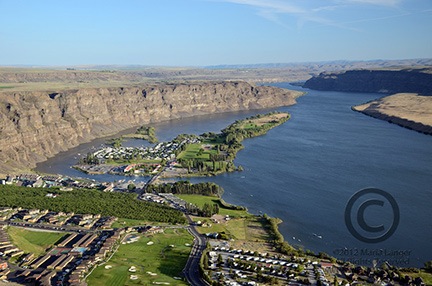
 One of the very good things about my late season contract is where I get to live while I’m working: at the edge of a cliff near the top of a canyon with an amazing view. I never get tired of watching
 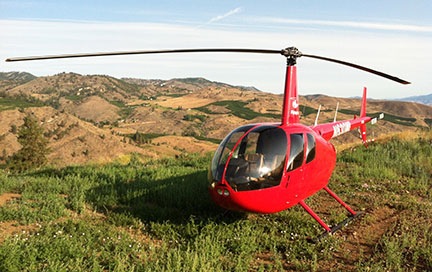 This year, my helicopter is parked on the property about 50 yards from the back of my RV. I can clearly see it out my back window.
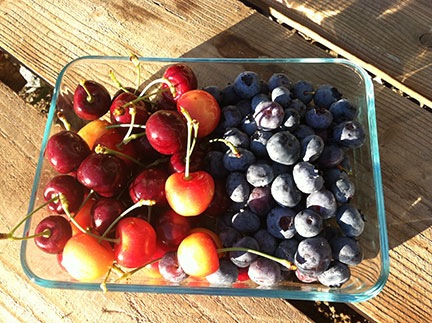
 In the evening, when it cools down, Penny the Dog and I go for a walk in the orchard. One of the owners told me I could pick their cherries and blueberries. Although fruit is not on my diet — more on that in a moment — I simply cannot resist fresh picked cherries or blueberries. So Penny and I go in with a plastic quart-sized container. We pick the small red cherries and yellow rainier cherries, which have very little market value but still taste great. And we finish up by walking down a row of blueberry bushes and picking the dark blue ones. The whole time, Penny is running around in the tall grass beneath the trees or avoiding the sprinklers or finding dead rodents to eat (don’t ask). And I’m getting a workout, climbing hills and sweating in the residual heat.
  We get back and I clean up the fruit and hit the shower. Then I spend the rest of the evening taking it easy — maybe sitting outside in the gathering dusk or watching something on one of the mobile mansion’s two TVs.
 When I arrived in Washington I started exercising again and trying to watch what I ate. But when my pilot friend Mike came up with his helicopter for the 25 days he’d work with me, he told me about how he’d lost 80 pounds on Medifast. His wife had lost 70 pounds. I only needed to lose 35 pounds to get back to my goal weight — which is what I weighed in this photo from 2004. When my pilot friend Jim signed on, I did the same.