I take two guys up to find a misplaced pickup truck.
The call came mid-morning on Tuesday, just as I was preparing to take Zero-Mike-Lima down to Mesa for scheduled maintenance. The woman told me that her son and father were out in the desert looking for her son’s pickup truck. He’d parked it somewhere on Sunday before dawn, left it for some coyote hunting, and couldn’t find it in the morning.
One thing led to another. The son and his grandfather showed up at the airport. I gave them a safety briefing and loaded them on board the helicopter. A while later, we were heading out to the triangle of land between routes 89, 93, and 71, just north of Wickenburg.
Normally, I can spot just about anything larger than a washing machine from the air — especially if it’s a color other than desert beige. The truck had a crew cab and was pewter — about as close to desert beige as you can get. But it was a truck. A shiny, four-month-old truck. And that triangle of land isn’t that big.
I started by following the son’s directions to where he thought he’d come in from route 93. No luck. He claimed he’d parked near a corral. There were about a dozen cattle tanks in the area, each with its own bit of fencing that could be considered a corral. We flew over and around each one. Nothing.
I then went into a standard search pattern grid. Back and forth across the desert, moving northeast to southwest. Nothing.
“It must have been stolen,” the son said. “I can’t believe it. I left the windows open a crack. I guess someone must have found it and taken it.”
I found it hard to believe. It’s not as if there are car thieves hanging out in the desert, waiting for a hunter to park a brand new, $38,000 truck and walk away.
But the truck just wasn’t there.
I climbed about 1,000 feet for a final look. The entire area was spread out beneath us. No luck.
I headed back to Wickenburg. I wrote up a statement they could show the police to prove they’d looked hard for the truck. I cut them a good deal on the flight time, feeling sorry for them.
This morning, I called the mom to collect my fee via a credit card. I told her how sorry I was that we hadn’t found the truck. She told me that they’d found it afterward. It was by a hill. She didn’t have all the details.
I got the credit card info and hung up.
I’ve been thinking about it ever since. There was only one hill in that entire area. We circled it and flew all around it. It’s not as if it’s a forest out there, with big trees to hide something the size of a truck. If it were out there, we would have seen it.
Which leaves me to wonder whether he had me looking in the right area after all.
I guess I’ll never know for sure.
 But Sunday I was there.
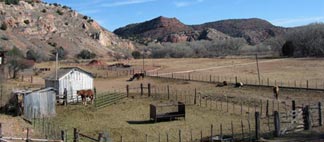 The ride ends at Perkinsville, where the canyon opens up to a broader valley. There’s a ranch there and the train stops literally in front of the ranch house. The place appeared occupied — there were horses and cattle there — but there wasn’t a person in sight. The conductor guy told us the story. Years and years ago, when the railroad was built, the land at the ranch was needed as a station to take on water and fuel for the steam engines. The railroad had offered the land owners a lump sum or a royalty for the use of the land. The Perkins family had taken the lump sum, giving up their control of the right of way. Today, under new ownership, the tour train had control of the land. The people who live in the house make themselves scarce when the train stops there on every run.
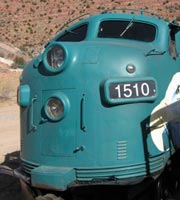 Why does the train stop at all? Well, this is the place the engines are moved from the front of the train to the back for the return ride. There’s a siding there and while we’re waiting, enjoying the scenery and feeling kind of bad for the people who have to deal with 130 tourists a day looking into their windows, the engineer takes the two engines and moves them. The task takes about 20 minutes and they sell ice cream sandwiches to us while we wait. Then we’re on our way back to Clarkdale at a slightly faster speed, leaving Perkinsville behind.