Why (and How) I’m Thinning Out My Library

And how you can help.

Yesterday, I decided that I wanted to start downsizing and simplifying my life. I want to spend more of the year traveling, experiencing more of what this whole country has to offer — rather than what’s around me in Wickenburg or Phoenix. I’m hoping that my travels will help me find the place I want to retire to. I know that neither Wickenburg nor Phoenix is that place.

As George Carlin says, “Your house is a pile stuff with a cover on it.”

I’ve been in my Wickenburg home for 12 years and have accumulated at least 12 years worth of “stuff.” Since I’m addicted to books, a lot of that stuff is books. I have a library of about 500 books spread out over three rooms and lots of shelves. I’ve read many — but sadly, not all — of these books. They cover many of the topics that interest me now — and have interested me over the past 20 or more years. Not much of it is fiction — I tend to use libraries for that these days, since I usually don’t read a novel more than once.

A lot of my library consists of reference books: books I consult — or think I need to consult — for my work or hobbies. For example, I have at least 75 books about writing and at least 40 about flying helicopters. I have books about horses and parrots and aquarium fish — the pets I’ve owned over the years. (We don’t need a book about dogs; we’ve learned through experience.) I have books about Web design and software programs and operating systems. I have books about business and philosophy. I have travel books about places all over the U.S., South America, Europe, and even Australia.

And, of course, I have the coffee table books I’ve gotten as gifts, most of which are beautiful but poor matches for my interests.

Thinning out my library seemed a good place to start thinning out my stuff. So I did what I usually do when I want to sell a book — I listed a bunch of them on Amazon.com.

Listing a book for sale on Amazon.com is very easy — as long as you have the ISBN. Just enter the ISBN in a form field and Amazon displays the book. You indicate the book’s condition, set a price, and choose shipping options. Amazon then lists it as another “Buying Choice” in the right column of the page where the book is listed and described.

A long time ago, I bought a used book on Amazon.com through a “marketplace” seller. The book was described as used in “Used – Very Good” condition. But when the book arrived, I found it full of underlining. I wigged out and contacted the seller. They refunded the payment; I returned the book. The whole experience left a sour taste in my mouth that took several years to wear off.

Since then, however, I’ve bought other books through marketplace sellers. The first after that bad experience was Drood, a novel. The book is enormous — 784 pages — and Amazon was selling it for well over $20 at the time. But someone else was selling it for $8 in “Used – Like New” condition. I took a gamble. The book, when it arrived, was indeed like new. I’ve since bought a few other books this way.

The drawback to buying from Amazon.com Marketplace sellers is that the books never qualify for “Free Super Saver Shipping.” You have to pay shipping for each book you buy. But if you’re saving $10 on a book, you’re still ahead if you spend another $3.99 for shipping.

Anyway, I currently have 57 books listed on Amazon.com’s Marketplace for sale. All of the books are in new or excellent condition — I treat my books very kindly. (The idea of writing in a book appalls me, although I know it’s common.) I’ve priced them to sell, meaning they’re usually the lowest price for a new or used book. The main goal is to unload them without cost — not to make a fortune selling books.

I’ve only gone though about 10% of my library, so many more will be listed over the coming weeks. I expect to list at least 400 books between now and March month-end.

Help me reduce my stuff — check out the list of books and if you want one, buy it from Flying M Productions.

Two Kinds of Road Trips

Reflections on traveling long distance by car.

The TruckThis past week, I traveled with my sister as part of a convoy of vehicles moving her from New Jersey to Florida. The other vehicles included my dad in a Budget rental truck (see photo) containing the contents of my sister’s recently sold condo and my dad’s wife in an SUV. We buzzed down I-95 at highway speed, stopping only for food, fuel, and bladder demands.
If you’ve ever driven I-95 — or most freeways, for that matter — you know how mind-numbingly boring the trip can be. You’re moving at 55 to 75 miles per hour down a corridor that’s often straighter than an arrow shaft. Although there are occasional scenic vistas, they’re usually ruined by the tractor-trailer trucks you’re passing (or passing you). The main points of interest are the billboards and the variety of fast food joints and hotel chains at exits. The only excitement comes when some jackass cuts you off or something falls off the trailer in front of you.

The benefit of the interstate highway system is speed, of course. If there’s no construction or accidents or rush-hour traffic in a major metropolitan area, you can zip right along to your destination. We travelled almost exactly 1,000 miles over a day and a half. My dad routinely makes this drive to/from farther south without an overnight stop. It’s a lot of driving, though. And it just isn’t fun.

Each year, I drive from the Phoenix area to Central Washington State and back towing a travel trailer. It’s about 1,200 miles each way. Although Google Maps tries to put me on freeways for the entire trip, I don’t go that way. Instead, I take the back roads that criss-cross the western states. Last year, I was mainly on Route 93. This year, I was mainly on Route 95. These are long two-lane, so-called “blue highways” that pass through small western towns and cities. Along the way, you can get a feel for the landscape and the way folks live. There’s seldom any traffic and the speed limit is often as high as 65 mph so you can move from place to place at a reasonable pace. You can stop just about anywhere along the way and although your choices for meals and fuel and hotels might be limited, they’re not just the same chain establishments you’ll see along the freeway. It’s a whole different way to travel, a whole different experience.

What I like about the blue highways is the opportunities to stop at interesting spots along the way. Instead of pulling into a McDonald’s for lunch, I might stop in a parking area with a scenic view and have a picnic lunch there. Instead of staying overnight at a Super 8 motel adjacent to a truck stop or parking my camper in a Walmart parking lot, I might roll into a state park and camp alongside a creek. If there’s a historic site or roadside attraction, I can easily pull over to take some time there and enjoy it. I can change my route at any intersection. Best of all, I set the pace.

Back in 2005, I conducted what I like to call my “midlife crisis road trip.” I hopped into my little red Honda S2000 with some luggage and credit cards and hit the road for 16 days. I traveled almost every day, getting as far away from Arizona as Mt. St. Helens in Washington, western Montana, and Yellowstone National Park. I had a general idea of where I wanted to go, but no reservations and no need to be anywhere on any day. I slept in motels, hotels, rustic cabins, and even a yurt. I ate all kinds of meals, from crappy fast food and terrible coffee at drive-thru joints to fine dining at the foot of Mt. Shasta. I made side trips daily, visited parks, and talked to lots of strangers. I put more than 5,000 miles on my car, got two oil changes on the road, and even replaced the rear tires after wearing them out. (Z-rated tires just don’t last very long.) I had a great time — better than most vacations — and I’d do it again in a heartbeat.

While I realize that this week’s trip wasn’t for pleasure — the goal was to get my sister, her car, and her belongings from New Jersey to Florida in the minimum amount of time — it certainly did highlight the differences between my usual kind of road trip and motoring down the interstate between points A and B.

And it reminded me why I prefer the blue highways when enjoying the trip is more important than getting to the destination.

Book on Expedia, Get Stuck in a Middle Seat

Using Expedia may save a few bucks, but it lowers your status to one step above baggage.

Just a quick whine — and a warning for people booking flights with services such as Expedia.

I booked a round trip flight more than 10 days ago. One leg was a non-stop on Continental. The other was a flight with a plane change on American.

Although Expedia allowed me to see the available seats on my Continental flight, it would not allow me to choose one. Each time I tried, it ignored my selection and said I had to get my seat when I checked in.

This evening, I checked in. Still no seat assignment.

I called the airline. Although there had been at least 10 window seats available when I booked the flight and as recently as four days ago, I was offered a choice between two middle seats. And that’s what I’m stuck with: a middle seat.

Crap.

Airline travel already sucks. Who the hell wants to be stuck on a plane for 4-1/2 hours in a middle seat? Not me.

Lesson learned: Don’t book on Expedia. Don’t buy a ticket unless you can get your seat assignment when booking.

Shots from the Edge

Two photos from yesterday’s hike.

Yesterday afternoon, I hiked up Doe Mountain, a mesa west of Sedona, AZ. The mesa has sheer rock walls on all sides except the northwest — that’s where you’ll find a 8/10 mile trail that climbs nearly 400 feet to the mesa top. The top is almost completely flat with stubby trees, bushes, yucca, and various types of cactus and desert grasses. It’s an amazing place at any time of day; simply walk to the side of the mesa with the view you want, sit down on a rock, and suck it all in.

I went up there around 3:30 PM; sunset was around 5:30 PM. It took nearly an hour for me to do the hike. I can hike on flat terrain or downhill all day long, but make me climb and you’ll be waiting for me. I was by myself, so I didn’t hold anyone back. When I got to the top, I was hot and thirsty.

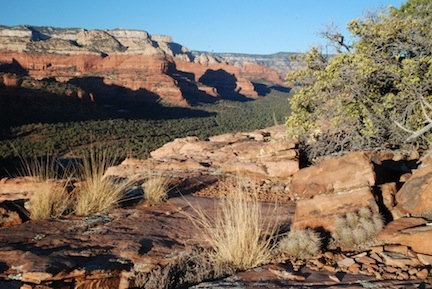
I wandered around as the light continued to soften and redden. I found an excellent spot for photos on the north side of the mesa and shot the two you see here. These are unedited.

From Doe MountainI’ve been experimenting quite a bit with foreground/background combinations. This shot of grasses, rocks, and trees with the red rocks in the distance behind them really called out to me. The foreground elements are on the mesa top. About 10 feet beyond them is a sheer cliff with a drop of 300-400 feet. The green trees you see beyond that are full-sized pinon and juniper pines. The red rock cliffs are several miles away. This one’s a “keeper” that I’ll likely put in my Photo Gallery. (That’s also why it’s so small here; I don’t share larger images unless they’re watermarked.) The only reason it’s not there now is that I haven’t had time to examine it closely and remove any optical imperfections due to dirt on the sensors. (It’s a never-ending battle against dust here in Arizona.)
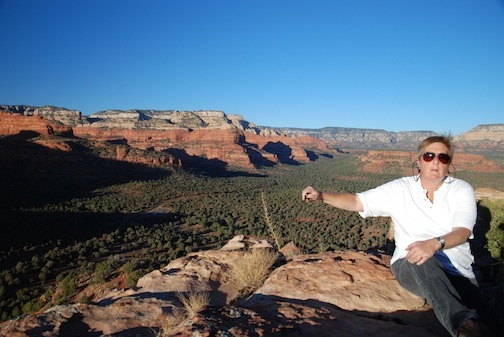
Maria in SedonaThis second shot is a self-portrait. I broke my third wired shutter release and there’s no way I could have used the self-time for this. So I used the camera remote. Of course, the sensor for the remote is on the camera’s right side (when looking at the front) and I was sitting at the left. Hence the stretched out arm and rather cranky look on my face. It’s a dopey picture and I look like an idiot. I guess that’s why I like it.

Oh, and I was about 5 feet from the edge of the cliff in this shot.

More from this trip in future posts. I’ll have better WiFi in Page.

It’s All in the Preparation

What it takes to conduct a 6-day helicopter excursion.

On Sunday, I begin the fourth and final 6-day Southwest Circle Helicopter Adventure I’m conducting for calendar year 2009. The trip is the culmination of months of preparation, most of which happens in the weeks and then days leading up to the trip itself. I thought it might be interesting to some reader to see what goes into it.

A Year in Advance

I make hotel reservations for the weeks of the planned excursions a year or more in advance. I have to do this to ensure that I get rooms for my guests (and myself, in many cases) at some destinations.

The most troublesome destinations are Monument Valley, the Grand Canyon, and Lake Powell, in that order.

Zero Mike Lima at Monument Valley

Zero-Mike-Lima at Monument Valley.

In Monument Valley, we stay at Goulding’s Lodge, which overlooks the valley from the west. It’s not a big place and it has lots of historic significance. It’s also very popular with bus tours. That means it fills up quickly and early. I normally reserve a room with a king bed and a room with two queen beds. If the trip is sold, my guests get first choice based on preferences selected when the excursion is booked. Sometimes, however, I have to get two identical rooms. The other room is for me; there’s no where else within walking distance — I won’t have any ground transportation there — to stay.

At the Grand Canyon, I usually try to book rooms at Bright Angel Lodge (rim cabins with or without views), Thunderbird Lodge (standard rooms with or without views) or Kachina Lodge (standard rooms with or without rooms). I try in that order because, in my opinion, those are the best value rooms. Lots of people want to stay at El Tovar. I think it’s overrated. Sure, its historic — so is Bright Angel — but the rooms are small and cramped, just as you might expect in a 104-year-old hotel. They’re also very expensive — the more spacious rooms cost far more than the budget I’ve set aside for overnight accommodations. And although the hotel is right on the rim — so are the other three I listed — very few of the rooms have any kind of view of the canyon. Bright Angel offers a more rustic, historic experience steps away from the rim. Thunderbird and Kachina are more modern and motel-like but are also more comfortable. And let’s face it: when the sun goes down at the Grand Canyon, there isn’t much to do. A comfortable room is important.

As for me, I go with what I consider the best value on the rim: a half-bath room at Bright Angel. Sure, the shower is down the hall and there’s no television, but you can’t beat the location or price.

At Lake Powell, my guests stay at the Lake Powell Resort. It’s a huge resort complex right on the lake, with views, private patios, pools, a hot tub, restaurants, etc. I get lakeview rooms for my guests. They’ll spend nearly 24 hours at the resort and I want them to be comfortable. I don’t stay there, though. It’s too expensive and too far from the helicopter for me. Lately, I’ve been staying at the Days Inn across from WalMart. Less expensive, clean, and it has wifi.

Of these three hotels, I have to pay for the rooms at the Grand Canyon and Lake Powell up front. That means thousands of dollars in prepaid hotel expenses. I think of it as an investment. And when the excursions sell, I’m ready.

The remaining two nights — one in Sedona and one in Flagstaff — are usually relatively easy to book with at least a month’s notice. I don’t book them until an excursion is booked.

One last thing I do after booking: I modify the Southwest Circle Availability page on the Flying M Air Web site to clearly indicate what dates are available.

On Booking

Lookout Studio at the Grand Canyon by Maria Langer

One of my favorite subjects is Lookout Studio in the early light. (You can click it to see a larger version in my Photo Gallery.)

When an excursion is booked, I start by sending a package of materials out to my guests. The package includes a bunch of brochures, as well as a preferences questionnaire. They fill in the questionnaire with their preferences for rooms (for example, 1 king or 2 queen beds?), tours (for example, Antelope Canyon or Navajo Tapestry boat tour at Lake Powell?), and other options.

When I get the questionnaire, I start working the phones. I confirm and, if necessary, attempt to change existing hotel reservations. Sometimes I might have booked a non-view room at the Grand Canyon, for example, because that’s the only thing that was available at booking; I may be able to change it to a better room. I make new reservations for Sedona and Flagstaff. I also make reservations for tours. I book rental cars and rooms for me.

As I do all this, I’m entering dates and times and details into iCal, which I use for scheduling. This builds an itinerary for my guests. I’ll send them a PDF version of the itinerary for their approval. They may have some changes — perhaps they want to do their helicopter tour over the Grand Canyon a little later in the day to enjoy more time in Sedona that morning — and I’ll make them, if I can, when they tell me.

A Month Before

In the middle of each month, I look at the excursions scheduled but not booked for the following month. Then I work the phones again to cancel the hotel reservations I made for those dates.

Although I can cancel with as short a notice as two or three days, I’ve realized that it’s not a good idea to wait until the last minute. Not only can forget to do it, but I’d prefer to have the prepaid expenses refunded back to my credit card as soon as possible. Besides, with a month or less advance notice, I’m not likely to be able to get the rest of the excursion — other rooms and tours — booked satisfactorily. It’s best to just throw in the towel for those dates. I update the Web site to remove those dates so folks don’t try to book them.

Canceling all those dates takes the better part of a morning. There are a lot of dates in the systems and the reservation clerks don’t understand why. I have to explain it to them. I also have to make sure they only cancel the dates that need to be cancelled.

Accounting for the refunds is a nightmare. I have to match them in my accounting records by date. Although the hotels don’t usually make mistakes, sometimes they do. And it’s a real pain in the butt to fix them.

A month before a booked excursion is also when I take the 50% deposit from guests. I confirm with my guests that we’re still moving forward — this deposit is not refundable. I’ve never had anyone back out at this stage of the game.

Once I have the deposit, I send out the luggage, hats, and other goodies I’ve promised my guests. I provide the luggage so I know it’ll fit in the aircraft. They’re Totes wheelie bags. Admittedly, they’re not the best quality, but they’re lightweight and they will last for the entire 6-days of the trip, as well as through any baggage handling the airlines subject them to on the way to or from Arizona.

If my guests have requested dinner at El Tovar during their stay, this is also when I make reservations. You can make them as far in advance as a month; if you want until the last minute, you’re likely to be eating at 5 PM or 9 PM. I try to book for either a specific requested time or right after sunset.

A Week Before

I reconfirm all reservations about a week before a booked excursion. This takes about a half day.

I also fine-tune the itinerary and do a final check to make sure it’s correct and resolve any problems I might have found.

If my guests are flying in and I haven’t gotten their flight information, I call or e-mail them to get it. I also send them instructions for finding the Terminal Three helispot at Sky Harbor Airport if I’ll be picking them up there. I can’t leave the helicopter unattended there, so they’re responsible for finding me.

I also begin my daily weather checks, just to keep an eye on storm systems, temperatures, and wind forecasts. I’ll be checking the weather along the route every single day for the next two weeks.

Three Days Before

I take the final 50% deposit three days before the excursion. This is also when I do all the paperwork that goes into the guest package:

  • Receipt for payment.
  • Welcome letter.
  • Printed itinerary.
  • Sedona and Flagstaff street maps.
  • Grand Canyon walking tour, shopping, and dining brochures.

I create the flight manifests and weight and balance calculations for each leg of the helicopter flight. This is required by the FAA to be on board the helicopter during the flight.

The Day Before

The day before the trip, I go through the helicopter and pull any item that I won’t need to have on board for the flight. I reorganize the under-seat storage bins so it’s easy to find what I need. The seat behind me will be for luggage — mine underneath and theirs secured on top. I make sure the bungee I’ll need to secure the luggage is on board.

I’ll also add the items I need for a long cross country flight. I usually bring along 4 quarts of the W100+ oil I use — I can definitely expect to add at least one quart during the trip, but I sometimes need more. The oil is hard to find, so it’s better to have enough with me than to have to hunt for it. And for our flight over Lake Powell, I need life jackets, so I bring those along, too. And I stow the manifests I’ve created. I don’t need to consult them in flight, but they must be on board, so I put them in my Hobbs book under my seat.

I also make sure the helicopter and its windows are clean, that my spray bottle for cleaning the windows is full, and that my rags are clean. I do a thorough pre-flight, which I’ll mostly repeat the next day before the flight.

The Trip

On the first day of the trip, I meet my passengers at the predetermined airport. After introductions and hand-shaking, I give them a complete and thorough passenger safety briefing, pointing out things like the fire extinguisher and the location of first aid and survival equipment (under my seat). I load up their luggage — mine is already under that back seat — and secure it. Then I help them aboard, make sure they know how to operate the seat belt and doors, and close their doors securely for them.

Then we’re off. I won’t go into the trip details; you can read about a typical itinerary here.

As we fly, I tell them what I know about the terrain we fly over. I know the routes by heart — I’ve flown over them enough — but I still have occasional surprises: wild horses, a herd of antelope, mild turbulence where I don’t expect it, etc. I share just about everything I see with my passengers — they’re probably sick of listening to me by the end of their trip.

Lower Antelope Canyon by Maria Langer

In Page, my guests visit Upper Antelope Canyon. If I have time, I scramble into Lower Antelope Canyon with my camera and tripod. (You can click it to see a larger version in my Photo Gallery.)

At each destination, I have two goals: get my guests to their tour or other activity on time and handle the luggage. Every day’s activity is different and may have free time around it. I need to get people where they need to be and make sure they know how to get around — especially back to the hotel — for the day. Once I set them loose, I won’t see them until the next morning when we meet for departure.

I’m in charge of their luggage. At most destinations, our rooms are not ready for us when we arrive. That means I Have to either check or carry around the bags but be back for check-in time. When I check in my guests, I get a key to their room and bring their luggage in. I leave the key and, on the first day, I leave the welcome package.

I do this every day. The goal is for my passengers to enjoy a scenic helicopter flight to their destination, worry-free transportation to the central area, and time on their own for tours and other unscheduled activities. Anytime after check-in time, they can go to the hotel’s front desk, give the clerk their name, and get their key. Their bags are already waiting for them.

Heck, why can’t I find a vacation like this?

I also handle any arrangements for parking the helicopter, such as getting fuel, putting on the blade tie-downs, preflighting for the next day, and cleaning the windows.

The next day, I meet my passengers at the predetermined time. Although they usually bring their luggage with them, I can fetch it if they want me to. Then we head on out for the day. Some days, there’s an activity in the morning; other days, we just go to the airport and fly out to our next destination.

We do this for six days with five overnight stops.

Sedona by Maria Langer

I made this photo in Sedona during one of my excursions. (You can click it to see a larger version in my Photo Gallery.)

To be fair, I usually have most evenings and early mornings to myself. Once the bags are stowed in guest rooms — always by 4 PM — as long as the helicopter has been tended to, I’m free. I hike at Sedona and the Grand Canyon, do photo flights for other folks at Lake Powell, relax and blog at Monument Valley, and stroll around town and enjoy Thai food in Flagstaff. I take a lot of photos. I blog. This coming trip, I hope to work on a novel.

I have a huge amount of responsibility — these folks have paid thousands of dollars for a dream vacation. It’s my job to make sure it doesn’t turn into a nightmare. I take that responsibility very seriously. What I’ve found is that by doing everything I can in advance, the trip goes much more smoothly. And the more trips I do, the more smoothly each one goes — although I admit that the first one back in 2006 was the smoothest one of all.

When It’s All Over

On the last day of the trip, I return my passengers to the starting airport and see them off. If they liked the trip — and they always do — I get a nice tip. Then I bring the helicopter back to base, clean it out the best I can, and put it away.

The trip is expensive, but so is flying the helicopter. I’ve recently introduced what I call “a la carte pricing,” to reduce some of the sticker shock. Instead of paying for the whole package up front, guests can simply pay for flight time and my overnight costs. Then they’ll be responsible for taking care of all the other arrangements — hotels, tours, ground transportation, etc. — for themselves. That would certainly take a huge weight off my shoulders. But unless the guests want to skip overnight stops and tours, it won’t save them any money. My margins are tight; I don’t make much on each trip. I seriously doubt whether they could do it for less without sacrifices.

To my knowledge, I’m the only helicopter operator in the country offering these trips. After reading what it takes to conduct one, can you get an idea why? If that’s not enough to explain it, consider this: each time I take the helicopter away for six days, that’s six days that I can’t do any other for-hire flying — other than the occasional photo flight at Lake Powell. So my revenue stream is basically turned off for those six days. Not many helicopter operators would be willing to take a helicopter offline for six days at a time.

If you’re wondering why I don’t just fly back to base each night, consider this: it costs more to fly the helicopter for an hour than it costs to stay overnight at any of the destinations. And since we’re always at least an hour — and as much as three hours — away from base, it simply doesn’t make sense to go home every night.

Don’t get me wrong: I’m not complaining. I love doing the trips. I love sharing my knowledge of Arizona with my guests — especially folks from out of state.

And who could complain about an all-expenses-paid trip to five of Arizona’s most popular destinations — by helicopter?