Silver Falls

A motorcycle ride and a hike.

I had my 1992 Yamaha Seca II motorcycle shipped up to Washington State so I’d have something other than the pickup truck to ride around in while I’m here. Not only does it get about 50 mpg (compared with the trucks 15 or so mpg), but it’s a hell of a lot more fun to get around in.

When it first arrived, I discovered — without any real surprise — that my motorcycling skills were extremely rusty. I took it for a few short rides to get get the feel for it again. Then I took it to Chelan to visit a friend. And I’ve been riding it a few times a week since then.

But it was yesterday that the rust finally shook off.

Along Entiat Road

I decided that it was high time to take it out on some mildly challenging twisty roads. After consulting a map, I decided on Entiat Road (County Highway 19), which winds up the side of the Entiat River. The road is only about 38 miles long — or at least that’s what I gathered by the “Road Ends 38 miles” sign near where I picked up the road in Entiat on the Columbia River. I figured I’d ride it until either it or the pavement ended.

I left Wenatchee Heights at noon and, after winding my way through the city of Wenatchee and up route 97 toward Chelan, reached the turnoff for Entiat road at about 12:30. It was a typical two-lane road in good condition, smooth with no loose gravel. I was able to open up the bike and get some good practice leaning into the curves at speed. I drove past orchards snuggled into the valley — the apples and pears still hung, ripening, while the cherries had already been picked.

I was hungry — I hadn’t eaten before leaving — and figured I’d stop for lunch at the first place I found along the road. That first place happened to be about 10 miles up the road at Ardenvoir, a place called Cooper’s Store. It was also the last place; a sign nearby said “No services past this point.” It didn’t look very appealing, but I didn’t have a choice, so I parked the bike and pulled off all my gear: helmet, gloves, denim jacket. A sign outside said “Food voted five stars by Odee.” So, of course, when I went inside I asked who Odee was. Turned out to be the owner’s dog, an aged terrier that came up to sniff my hand when he heard his name.

I had a chili burger. In Arizona, that’s a burger with a green chili on it. At Cooper’s Store, it’s a burger under a heap of chili con carne with chopped onions and shredded cheese. To put a positive spin on it — it’s always nice to stay positive, no? — I can confirm that it was edible. I grabbed a popsicle out of the freezer in the store for dessert, paid up, and went outside. I sat on a bench out front to eat my popsicle. Three vehicles went by. A Jeep stopped at the store and the driver went inside while the passenger looked at me sitting on the bench. I guess there was nothing else to look at. Finished, I geared up and continued on my way.

The road continued up the river, sometimes quite close, past farms and homes and unlikely subdivisions that had never been sold. Many of the homes were for sale. Lots of waterfront property. A beautiful log house, brand new, with a “For Sale” sign on it. A real homesteaded property. An area that had obviously suffered a forest fire only a few years before — the weathered skeletons of burned trees were all that remained with tall grass on otherwise bare hills.

I have no idea how far up the road I was — 20 miles? 30? — when the pavement became rough and a sign informed me that I was entering the Wenatchee National Forest. No more homes along the side of the road. Now it was just tall pines along steep inclines with sharp curves in the bumpy road. I slowed down after being jarred violently going over a bump. A sign mentioned a place called Silver Falls 8 miles farther up and I figured that was as good a destination as any.

The Hike

My Yamaha at Silver FallsThere were National Forest Campgrounds along the side of the river. I passed two before I reached the parking area and campground for Silver Falls. I parked and stripped off my gear, locking it up in my bike’s Givi saddlebags. Looking up, I saw the top of the falls — can you see it in the photo? It didn’t seem that far away.

I checked the information kiosk. There was no information about the hike, although I could clearly see a trail disappearing into the forest across the road. I did see that there was a $5 day use fee. Although it was midweek and I thought I’d only be there a short while, I know how much the parks are struggling. So I filled out the form on an envelope, put a $5 bill in it, and tucked it into the payment slot. Then I grabbed my camera and started the hike.

At Silver FallsI immediately found myself in a deep, somewhat dark pine forest. As my eyes adjusted to the light, my nose picked up the scent of pine and moisture and my ears heard the sound of rushing water. I came upon the creek immediately — a healthy stream of water gushing over rocks between trees. For me — a desert dweller — it was a real treat.

Rustic BridgeThe path was well-maintained, with rustic protective barriers to prevent hikers from accidentally falling into the stream. The bridges were especially rustic looking, sometimes with curved logs making attractive rails. It was surprising to find something so attractively designed on a trail. I began to wonder how much of the trail dated back to the CCC days, when National Forest trail projects were a source of employment during the Great Depression.

I followed the path as it climbed gently upstream, first on one side, then the other. The trail forked at a bridge where I stopped for a rest. A family of three was just coming down the right side of the creek. “It’s worth it,” the Dad assured me.

I continued up the way they’d come down. The trail began to climb. It moved away from the creek and then back to it, offering stunning views of the rushing water. The farther I went, the steeper the trail got. In many places, it was rock steps. I paused at another rest spot. The mist from the falls chilled the otherwise hot air. I could see the main falls above me. When another family joined me, I asked whether the trail went all the way to the top. The Dad told me it did. Remembering the other guy’s assurance, I continued the hike.

At one point, the trail came back to the creek just beneath a large fall. Although the rustic wooden logs made it clear where the trail stopped, I did as many others had likely done and slipped beneath the two rails. I was able to safely get to a spot beneath the waterfall, tucked under a rocky ledge. I experimented with my camera, trying hard to protect it from the mist, until mosquitos found me and I decided to move on.

Behind the Waterfall

After that point, the trail swung far from the stream — so far that I could no longer hear the water’s flow. It also leveled out. Perhaps I’d misunderstood the other hiker? Perhaps that spot under the falls was as high up as the trail would go? Perhaps it would continue back along the mountainside, away from the falls?

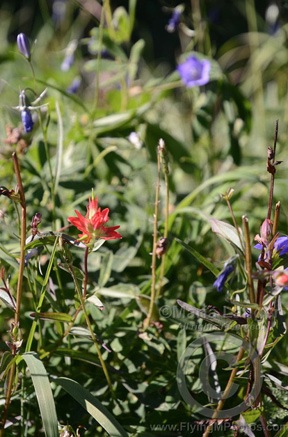
Purple FlowersBut I stuck with it and was rewarded with a switchback and another climb. A while later, I was back alongside the stream at yet another streamside bench, photographing some beautiful purple flowers just past the peak of bloom.

It was then that I noticed a similar rest area on the other side of the creek. The trail had split and, apparently, the other trail climbed up the other side. Would they meet again at the top, forming a loop? Could there possibly be another bridge? It was too much to hope for. I’d assumed I’d be returning the way I’d come. Now I was starting to wonder.

I continued on my way, up more stairs and another turn away from the creek. After another switchback, I returned to the creek and saw the bridge over a smaller falls. I spent a lot of time up there, relaxing in the shade, snapping photos of the water falling over the rocks. Again and again I wished I’d had a tripod or at least my monopod along with me — the shade was dark in the dense forest.

Bridge at the Top  of the Falls

Stairs on the TrailThen I started down the other side of the creek. At first, it was one long flight of stairs after another. Then the trail moved away from the falls in a series of relatively level paths with switchbacks. In some places, the trail emerged from the forest into the sun; not only could I feel the heat on my skin, but I could smell it. Then back into the trees for cooling shade and pine aromas.

Waterfall with RainbowAt one point, the trail came back to the falls just below where I’d walked along the ledge on the other side. The mist and sun worked together to produce a small rainbow. I did the best I could to capture the scene with my camera; I really do need to learn how to photograph waterfalls properly.

A while later, I was back near place where the trail had split. I took my time following the trail back out to the main road. The parking lot was empty except for my motorcycle.

It was 4:30 PM. I’d been there for nearly 2 hours.

I’d gotten my $5 worth of nature — and more.

The Ride Back

Although the road continued farther up the river, I was tired and thirsty. I figured I’d save it for another day — perhaps a day when I could share it with someone. So I geared up and pulled out.

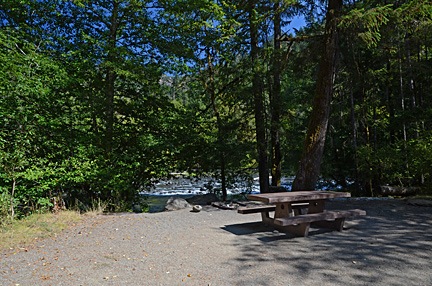
I did take time to check out the three campgrounds I passed on the way back. The first and third were partially occupied and had nice sites looking out over the Entiat River. I’m not sure, but I think I could get the mobile mansion into at least some of the spots if I wanted to. It would be tough, though. The second campground was deserted and I could understand why; the sites were small and unappealing. None of the campgrounds had utilities, although they all had centralized water spigots and outhouses. The single campground host was not around.

I rode more aggressively on the way back. I felt as if I’d regained a lot of the motorcycling skill I’d had back in the 90s when we rode all the time. It felt good to lean deeply into the curves and accelerate through them, especially when I was out of the National Forest and the road conditions were a little better.

I passed Cooper’s Store with only a momentary thought of stopping in. I do wish I’d taken a photo, though. The Odee sign was pretty funny.

The motorcycle started losing power about 5 miles from the end of the road. I was able to switch to the Reserve setting while moving and before the engine quit.

At the junction of Route 97, I turned left toward the town of Entiat. My first concern was fuel; I took 3.6 gallons. Then I pulled up to 97 Brew, one of Washington State’s ubiquitous drive-through coffee stands. I rode up on the shady side and after getting my smoothie, asked if it was okay to stay parked there in the shade until someone else pulled up. No problem. I sucked my smoothie down while reading an article on the Web on my phone.

Then I geared up again and headed south on 97. About 40 minutes later, after winding my way through Wenatchee traffic, I was back in my RV. It was 6 PM.

So You Want to Be a Helicopter Pilot, Part 8: Be Willing to Travel

Simply put: you have to go where the jobs are.

Back in July, I got an e-mail message from a reader with a question. His message is reproduced below, with his name changed to protect his privacy:

Hello, my name is Joe. I am 16. I live in Indiana, and I have been thinking a lot about my future career. I was thinking about all of the jobs that I would be interested in doing, and one of the big ones was a helicopter pilot. I read all of your posts about getting a job as a helicopter pilot, and I am confident that I have a chance in piloting as a career. I am willing to move around the country to get the right training on being a helicopter pilot, and I am willing to find a way to make it through all of the expensive training that you talked about. The only thing that really bummed me a lot about being a helicopter pilot was that once you make it through all of the training that it takes to actually get a job, the hours for piloting jobs can be unappealing, and I was just wondering if that is the case with all piloting jobs. Because some of them require you to be away for long periods at a time, and I was curious if all piloting jobs have strange hours, because I am kind of a family guy, and I don’t know if being away for long periods at a time on the job would be the thing for me.

I think it’s an excellent lead-in to my next topic in this series: travel.

Look at it Logically

For a moment, think about the kinds of jobs that are out there: doctors, mechanics, lawyers, restaurant servers, bankers, construction workers, accountants, supermarket managers, insurance agents — the list goes on and on. These jobs might be very different, but they all have one thing in common: there are job opportunities everywhere. Unless you live in the middle of nowhere, chances are that you could find people in all of these jobs within 5 or 10 miles from your home.

Now think about pilot jobs or, more specifically, helicopter pilot jobs. How many helicopter pilot jobs do you think there are within 5 or 10 miles from your home? Unless you live in a big city or tourist town, you can probably count them on two hands. Even if there are more jobs, they’ll likely have strict requirements for experience, certification, and skills, making them difficult to qualify for until you’ve been flying for a while.

Travel May Be Unavoidable

Let’s look at the big picture based on time:

  • Flight Training. If there’s a suitable flight school in your area, you might not need to travel to get your training. My first flight school was 90 miles from my home; I later trained at a second location of the same school that was only 70 miles away. That’s a lot of driving, but I was able to sleep in my own bed at night. When I had a falling out with my flight school and needed to finish up my commercial rating elsewhere, I went to Long Beach, CA, which is not driving distance from my home. (Fortunately, I only needed 10 more days to get my rating.) Whether you have to travel for training is dependent on what’s available near where you live. And don’t pick a flight school just because it’s the only one nearby; consult Part 4 of this series, “Choose a Reputable Flight School,” for more on choosing a flight school.
  • Time-Building Job. Your first job as a pilot is very likely to be as a CFI. This is, for most people, a time-building job. In other words, the only reason you’re doing it is to build flight time so you qualify for another job. If you’re lucky, you’ll be able to get a CFI job either at the flight school you trained at or another one close to home. But again, this isn’t always the case. That first job is often very difficult to get — especially when, for a while, flight schools were churning out new helicopter pilots at an alarming rate. If you want to move forward in your career, you must get a time-building job. If the job market is tight, you might have to take the first job you’re offered, no matter where it is.
  • First Pilot Job. Once you’ve build enough time, you’ll be eligible for a “real” pilot job — one where you’re actually doing all the flying (as opposed to sitting beside someone else who is trying to). Again, there aren’t many entry level jobs. Some of them are seasonal tour jobs, meaning they’re only available during the season. I wound up at the Grand Canyon, which I recommend because of the challenging flying conditions. Other people go to Alaska. The more time you have, the more options will be open to you. In many cases, this first job will also be your introduction to turbine helicopters. (Frankly, I don’t see much difference between turbine and piston helicopter operations — except how much damage you can do if you don’t start it right or try to pull too much power.) Employers make a big deal about turbine time it so you should probably try to get into a turbine ship as soon as possible. The point is, once again you’re required to travel to where the job is available. And there’s probably no coming home on weekends if you’re working in Alaska.

Sometime after that first “real” job, you’ll begin qualifying for other flying jobs. In my mind, they fall into three categories:

  • Contract Jobs. A contract job is where you are hired as a pilot to fulfill a contract for specific work. The cherry drying work I do in Washington State is an example of a contract job: I’m hired to provide services for a short length of time. I’m paid a per diem amount to be available each day of the contract and I’m paid an hourly rate when I fly. My duty hours are all daylight hours, 7 days a week until the end of the contract, which is normally 2 to 6 weeks. I’m not employed by anyone — in other words, I don’t get a paycheck, have taxes deducted, or have benefits. I’m also out of work when the contract is up. Firefighting is another example of a contract job. Contract jobs tend to be seasonal and require specific skills, equipment, and/or certifications. These jobs require the most travel — you could be in Arizona fighting a fire one week and two weeks later be in Montana waiting for a fire call.
  • Schedule Jobs. What I’m referring to as a “schedule” job is when you work for a specific employer on a schedule — for example 7 days on and 7 days off or 14/14. I worked 7/7 at the Grand Canyon, but they also offered 4/3 schedules (I think; my memory isn’t as good as it was). 7/7 and 14/14 is common with EMS and Gulf operation jobs. Some contract jobs — especially firefighting — work on 14/14 (or similar) schedules. These schedules are designed, in part, to make it possible for pilots to “go home” between work shifts. They’re recognizing that pilots don’t always live where the job is and, indeed, they don’t. When I worked at the Grand Canyon, most of the pilots on the 7/7 schedule went home on their off days, including me.
  • Regular Jobs. What I’m calling a “regular” job is one where you work “regular” hours at the same place for a specific employer. ENG and law enforcement jobs are good examples. An ENG pilot might have to fly morning and afternoon rush hours and be available during the day for breaking news. But he might get nights and weekends off. A law enforcement or EMS pilot might work a 12-hour day shift for a week, get a week off, and then work a 12-hour night shift at the same base. These are the folks most likely to live where they work. And if their job is stable enough, they can have a home life pretty much like anyone else’s.

Of course, there is overlap between these three broad categories and someone else might come up with a different way to distinguish between them. This is just my way of looking at them and how travel is involved.

I should also point out that a “regular” job might require travel. For example, you could argue that Phoenix-based Flying M Air is my employer and I normally work out of a Phoenix airport. However some photography or survey assignments require that I travel to other locations — Lake Powell, Bryce Canyon, Kingman, Winslow, etc. — for a day or more. If clients need a helicopter where there isn’t one, I’m sometimes called to bring mine to them.

In general, however, to answer Joe’s question about hours, I’d say that 95% of helicopter jobs have what you might consider “odd hours.” If you’re looking for a 9 to 5 job, a career as a helicopter pilot is not for you.

Living Conditions on the Road

A humorous look at this aspect of being a helicopter pilot.

It’s worth a moment to look at some of the living conditions you might find if you do get a job away from home. While they’re not always terrible, they’re not usually very good.

At the Grand Canyon, pilots were offered housing in double-wide mobile homes about 30 miles from the airport. For a reasonable fee, four pilots shared one four-bedroom house in a subdivision of mobile homes. I was fortunate in that I had other living arrangements available to me, so I didn’t need to take advantage of this opportunity. My understanding was that living conditions depended on your roommates and and their habits. The area was so remote with such limited facilities that our employer actually warned us before we were hired about the lack of night life and social activities so we couldn’t use that as an excuse to back out later on.

In Central Washington State, I now live in a fifth wheel RV that I own and transport to my various bases of operation. It’s very comfortable, although it does have limitations that vary based on where it’s parked. In previous years, I spent a whole month at a motel in a very cramped room with no cross-ventilation. (The motel did have a pool, so I really can’t complain.) Other pilots doing this work are often called on to live in housing provided onsite — usually small travel trailers. One pilot I know was put in an 18-foot travel trailer with no bathroom; she had to use a portable toilet (think blue or green outhouse) and walk to the orchard owner’s home to shower. Her cell phone didn’t work there either, so the only way she could get or make calls was to drive into town.

A friend of mine who works fire contracts is typically put up in a motel near the base. Because the base can change at any time and he has to carry his gear with him from base to base — sometimes in the helicopter when he repositions — he’s limited on what creature comforts he can bring along. Motel quality and cleanliness can vary widely depending on what’s available.

Yet another friend of mine who works fire contracts typically travels to Greece, Italy, and Australia for work. I don’t know the details of his living conditions, but I sure do like the idea of going to places like these with someone else footing the travel bill.

Living conditions are a crapshoot that depends on many factors. If you’re picky about where you sleep at night, a career as a helicopter pilot might not be for you.

Be Willing to Travel

The point of all this is that you need to be willing to travel and willing to deal with less-than-perfect living conditions to move forward in a career as a helicopter pilot. But that’s part of paying dues — which is up next.

Travel Insanity

Too many miles, too little time.

I’m just recovering from a crazy week with too much travel in too short a time span.

Our Flight Path

Our flight path, recorded on my iPad with GPSTrack. Can you tell where we did some scud running?

It all started last Saturday, when I flew with two companions from Phoenix, AZ to Wenatchee, WA by helicopter in one day. It was almost 11 hours of flight time with mostly very brief stops for fuel. Although I had very little stick time — one of my companions did almost all the flying — I was still alert and able to fly at a moment’s notice.

It got a little tense when we had to do some scud-running in Oregon that lasted far longer than I like to be spending scud running — as if I like it at all. It never got dangerous, but more than a few times, I began scouting the remote hillsides around us, looking for a place to set down and wait it out. I was very glad when the terrain finally descended, dumping us in an area where we could get back on course.

We spent the night in Wenatchee and I parted company with my travel companions, leaving them to catch an early flight to Seattle while I took care of other things locally.

Sunday was relatively restful. I needed to reposition the helicopter to Quincy, WA, where I’d be spending part of my summer. That was just a 15-minute flight. Then I spent some time socializing at Ferguson Flying Services, where my helicopter is parked in Quincy, and the Colockum Ridge Golf Course, where my RV would be parked soon. Then a friend/client picked me up and drove me the 5 miles to his winery in town, where I spent the afternoon socializing with him, his family, and the folks who came for wine tasting. A nice, mellow afternoon.

But at 4:15, the craziness started again. I got a lift to Wenatchee Airport, where I caught a flight to Seattle with a connecting flight to Phoenix. My husband picked me up there at about 10:30 PM. Overnight at our Phoenix condo.

Monday morning, bright and early, we were on our way back up to Wickenburg. I spent the day finishing up some work on a chapter of my book and then packing. It wasn’t until nearly 9 PM that night that we were done and pulling the RV out of the hangar where it lives most of the year. We left it parked in front for the night.

Welcome to NevadaAt 6:45 AM, I was in the driver seat of the truck with Alex the Bird in the seat beside mine. We were starting a 1,295-mile drive from Wickenburg, AZ to Quincy, WA. My goal was to make Jackpot, NV that first day — a distance of 725 miles. I spent most of those miles on Route 93, a two-lane road with speed limits up to 70 miles per hour. There was no traffic and certain stretches of the road were straight and flat as far as the eye could see. We made Jackpot before nightfall. After dinner n the casino, I spent the night in the RV with Alex in comfort — in the casino parking lot.

My Rig, in Jackpot, NVThe next morning, I woke at 6:15, which is late for me. Anxious to get on the road, I rushed around making my coffee and Alex’s breakfast and then buttoning up the RV for another day on the road. It wasn’t until after I topped off the fuel tank across the street from the casino that I realized it was an hour earlier; that part of Nevada is on Mountain Daylight Time. So I got a very early start. I left Route 93 behind in Twin Falls, ID, and hopped on I-84. The route was mountainous and the truck sucked diesel at an alarming rate as I struggled to maintain speed up hills. I left the interstate just past Pendleton and got back on smaller, traffic-free back roads to head north. After 10 miles on I-70 and the last five miles through familiar farmland, I rolled into the parking lot at the Colockum Ridge Golf Course RV Park just after 3 PM.

My Route

My route, as captured by GPSTrack on my iPhone.

I was fortunate to have had good weather all the way. Towing 13,000 pounds of fifth wheel RV on wet pavement is no fun — as I learned last year. It was just starting to rain when I finished hooking up my utilities at 4 PM.

Do I need to say how exhausted I was? I’d snacked my way from Wickenburg to Quincy, eating only snacks on my low-carb diet: jerky, almonds, and cheese sticks. The only real meal I’d had was at the casino in Jackpot. My digestive system was a mess for the next two days.

And of course, I developed a bad cold, which I think I’m just coming out of now.

But on the bright side of this, I managed to get all my assets in position for the first half of the cherry drying season. I set up my RV office and yesterday I managed to knock off another chapter of the book I’m working on. I’m also in the area early enough to set up helicopter tours and wine tasting trips with the local wineries.

It’s been a rough week, but now I’m settled in. It feels good to be at my home away from home.

More Blog Posts…Soon

Still very busy, getting ready to relocate, but the end is near.

First of all, you need to understand that I really do like writing in this blog. It makes me feel good to post something each morning as I enjoy my morning coffee. Whether it’s a poorly disguised rant or a detailed account of my latest helicopter trip, it feels good to get the words out and share them with others. I am, after all, a writer at heart and writers need to write.

And that’s actually what I’m doing. I’m working on a revision to a 600+ page book and am about 3/4 finished. There’s a very tight deadline — one I’m not sure I’m going to make this time (don’t tell my editor) — and I’ve been working my ass off on it, getting very burned out in the process. I’m not complaining; this one book earns a whole year’s income so it’s worth what I put into it. But it does leave me too tired and burned out to write in this blog — and not really enough time to do it right anyway.

But the end is near! I’ll soon be repositioning my helicopter and RV to Washington State for the summer. (My house-sitter is already installed to care for the fish and backyard birds and keep an eye on things.) Once there, I’ll finish up the book and have a lot more time for other projects, including some videos and, of course, this blog.

Between now and then, I’ll be making two trips from Phoenix to Washington. On one, I’ll be a passenger in my own helicopter for a day or two. On the other, I’ll be driving my “rig” on a two to three day journey through Arizona, Nevada, Idaho, and Washington. On both trips, I won’t be writing about computers. So I expect to have a clear enough head to share some stories about the trips. Maybe some photos, too. With both hands free in the helicopter, I’ll have no trouble taking photos.

So bear with me just a little longer. New blog posts will come soon. I promise.