Tourist Photos from San Francisco

Or fun with a camera.

Note to feed subscribers: You may not see the photos in this article in your RSS reader. That’s because of the way they’re embedded. If you like photography, I do hope you’ll take a moment to visit the site and see the photos. If you don’t, just skip it. I understand.

I was in San Francisco last week for Macworld Expo. In the old days, I used to spend every day at the show. Nowadays, I’m more interested in seeing things outside the exhibit hall. With a half day to spend on my own, I took the cable car from Market and Powell to Fisherman’s Wharf. Here are some of the photos I took that morning.

I started my day just after sunrise at the corner of Powell and Market, five or six blocks from Moscone Hall, where Macworld Expo is held each year. This is the terminus for two of San Francisco’s three cable car lines. The photo here shows one of the cable car drivers turning the car around for the trip back to Fisherman’s Wharf. Although the photo is distorted (because of that darn fisheye lens I like so much), the ground here is relatively level. They manually push the car onto the turntable and turn it, then push it back onto the main track. After paying off a homeless person for telling me that I could buy my ticket on the cable car — it was either that or buy a newspaper I didn’t want to carry — and assuring another homeless person that I didn’t need him to take a photo of me and the cable car with my camera, I climbed on board.

The cable car took off up Powell a while later with a surprising number of people on board. The corner of Market and Powell isn’t far from the BART station and apparently the cable car is a valid mode of transportation for commuters. There certainly weren’t many tourists on board at 7:30 AM. We climbed up Powell, dropping off passengers here and there. I took this photo when the car was nearly empty. Again, there’s some distortion from the fisheye lens, but I think it’s a cool shot of the cable car and its driver.

The car deposited me at Bay Street about two blocks from Fisherman’s Wharf. From there, I wandered around, taking photos of the area. The sun was too low to get the shots I wanted, so went in search of breakfast. Boudin’s Bakery was there and I stepped inside. I love freshly baked bread, but I was on a diet and trying hard to avoid excess carbs. But I did get a good photo op when I saw this “Bread Line” sign. It was just too ironic for me to pass up.

Back outside at the Wharf with the sun still too low for shadow-free photos, I asked one of the fish guys where I could get a good breakfast in a place the tourists didn’t go. He pointed up the street to a “hole in the wall” called Darren’s Cafe. While waiting for my meal, I snapped this weird self-portrait with that fisheye lense. I don’t look happy here, probably because I knew the camera was shooting a picture up my nose.

After breakfast, I strolled north along the wharf area, stopping a few times to take photos of the fishing boats. Unlike most tourists, I didn’t stick to the well-trodden places. I poked around on all the piers, taking my time and seeing as many different things from as many different angles as I could. It was a beautiful day with clear blue skies and light wind. Not very cold, either. Here are a few of my more interesting shots in that area.

After a while, I found myself in Aquatic Park, which is part of the San Francisco Maritime National Historical Park. There are a number of old, art deco buildings there and the light was just right to get creative with some shapes and shadows on a round building that used to house a public restroom. A flight of stairs curved up the side of the building to an observation deck on top. But the views from up there didn’t interest me as much as the stairs, shown here.

From the park, there were sweeping views of San Francisco Bay. But the best views were obviously from the curving arm of the Municipal Pier. So I took off on foot along the long, crumbling concrete and steel pier. The only people on the pier were a handful of Asian fisherman, although when I reached the remains of the building at the far end, another tourist pedaled up on a bicycle. We had a short chat before I walked back. Here are the photos I took along the way. They show, in order, the rust of steel embedded in the concrete, the Golden Gate Bridge, and Alcatraz.

It was nearly 10 AM by the time I got off the pier. I had to check out of my hotel by 1:30 PM, but I had a few errands to take care of on the way back. So I walked up to the cable car terminus at Hyde, which is just a few blocks away. By this time, the tourists were coming out and there was about a dozen people waiting. I snapped a series of photos of the cable car being turned. If I look at them quickly in sequence, they look like a movie. Here are five of the six shots in miniature:

Cable Car Turning at Hyde

On the way back to the Union Square area, I had a nice conversation with a woman who lives in San Francisco and uses the cable car to commute back and forth to work across the city. I couldn’t help but be envious. How wonderful it would be to ride in an open seat through such a beautiful city every day.
Over Quartzsite

An interesting photo gig.

I got the call about a month ago. From France. A photographer with a name I couldn’t easily pronounce wanted to photograph Quartzsite, AZ from the air during its busiest time of year. This year, that’s January 19 through 27.

About Quartzsite

Quartzsite, in case you’re not familiar with the place, is a small desert community about 20 miles east of the Colorado River, right on Interstate-10. During the summer, it’s a glorified truck stop, with gas stations, a handful of fast food joints, and a few of the necessities of everyday life for the 1,000 or so people who live there year-round. But in the winter, it’s home to numerous events, including gem and mineral shows, a huge RV show, and flea markets. That’s when the snowbirds flock to the place, filling in the otherwise empty campgrounds and spilling over to the millions of acres of BLM land around the town. The population swells to an estimated 100,000 people, most of whom are living in extravagant RVs and motorhomes.

From the air, this is simply amazing. Quartzsite is nestled in a valley between two small mountain ranges. I-10 cuts through it east/west while route 95 between Parker and Yuma cuts through it north/south. The town is a concentrated sea of white rooftops. Scattered all around, in every direction, grouped in the BLM-approved camping areas, are more white rooftops, sometimes arranged in circles or rows.

Sadly, I don’t have a single photo of the place that shows it off.

Back to France

I gave the Frenchman a quote. He’d have to pay for me to fly to Quartzsite, fly around there for his photos, and fly back. We estimated that at about 3 hours: 1 hour ferry, 1 hour photo shoot, and then 1 hour ferry. At $495/hour, which is my current going rate, it wasn’t going to be cheap. He didn’t book, but that didn’t surprise me. About 90% of the calls I get are from folks who are “fishing.”

Two weeks went by. I got CCed on a message to a Frenchman from Robinson Helicopter, Inc. They told him that the closest Robinson helicopter operator to Quartzsite was Flying M Air. In other words, me.

Another week went by. I got an e-mail message from the Frenchman. He wanted to know about dates and weather. I told him that the weather in Arizona this time of year is usually perfect. He tentatively scheduled a flight for January 25. But since he wouldn’t provide a credit card number, I wouldn’t guarantee it. If someone else put up a card for the same date and time, he’d be out of luck.

The Gig Happens — Suddenly

On Saturday morning, I got a call from Etienne. He was in Arizona. He wanted to do the flight that afternoon because the weather forecast for midweek wasn’t very good. Was I available?

Oddly enough, Mike and I had planned to go camping in Quartzsite that weekend but had decided, just the night before, to skip the overnight trip and just drive out there for the day on Sunday. So I was available after another flight booked for 10 AM.

Etienne picked up an RV from a rental place in Mesa, AZ and drove it up to Wickenburg. He parked it in the airport parking lot. We had a pow-wow to go over details on timing. Then he went into town to book a hotel room — don’t ask me why; I don’t understand either. At 3:15 PM, he was back.

We took off to the west with coats on and his door off.

Fuel Concerns

I’d filled the helicopter’s fuel tanks to capacity. That’s close to 50 gallons of fuel. At my normal rate of consumption, that would last close to three hours. Unfortunately, we were expecting to be out for a full three hours. There’s no fuel between Wickenburg and Quartzsite. The closest fuel is Blythe, which is 20 minutes farther west. If we went there for fuel, it would add 40 minutes to his flight time. It would also have us crossing through very dark desert — and over several mountain ranges — long after sunset.

So I filled an approved fuel container with another 5+ gallons of fuel and tucked it into the back passenger area. There were two paved runways between Wickenburg and Quartzsite, as well as numerous other landing zones. If fuel got low on the way back, we could land, shut down, add 5 gallons, start up, and get back. Of course, if we spent a lot more time in Quartzsite than we expected to, we’d have to detour to Blythe anyway. Five gallons was only about 15-20 minutes of fuel.

The Gig

The flight out to Quartzsite was as boring as I remembered it. Etienne had asked me to show him Arizona. I warned him that the ferry flight didn’t have much of interest, but he assured me it would be interesting to him. I think that by the time we were on our way back, he agreed with me. The landscape is mostly flat, empty desert, with the exception of a few small communities, some of which have farms. We cruised over all of this about 700 feet off the ground, doing exactly 100 knots. Why 100? Because with a door off, that’s my maximum airspeed.

We crossed over two tiny mountain ranges: one just west of Salome and the other just west of the intersection of Route 60 (which we’d followed) and I-10. After the second one, Quartzsite came into view. We’d been in the air less than 50 minutes.

Etienne had envisioned a shot that included mountains in the foreground, Quartzsite in the middle, and the low-lying sun in the background. Problem: the mountains to the east that he was thinking of for his foreground were simply too far away to make the shot work. So we headed into town to see what he could do.

Thus began at least 90 minutes of aerial photography over Quartzsite.

At Etienne’s request, I started by climbing up to about 3,000 feet over the town. I circled the town several times while he shot down at it with two different cameras, each sporting a monster zoom lens. I spiraled down to get closer to the town while he snapped away. Then we flew up and down along the freeway and the BLM camping areas. Then out to the west, to get a shot of the town behind a sunlit mountain. Then lower over the camping areas, with me flying sideways at about 10-20 knots groundspeed so he could shoot right down at the campers.

By this time, most folks had returned from their day at the markets and were gathered around within their “circled wagon” compounds. It was impossible for them not to see and hear us, so there were a lot of people waving up at us. I think each group was competing to be included in the photos.

We broke off from that and started following campers on the Interstate or side roads as they moved to their campsites. We must have followed five different rigs, following above and behind them. I’m sure none of them realized they were being followed. (It reminded me of that scene in Goodfellas where Ray Liotta’s character is followed by a helicopter as he drives around the city.) Etienne was especially interested in rigs that included motorhomes pulling cars. We hit the jackpot when we found a motorhome pulling a pickup that had an ATV in the back of it. There must have been $400,000 worth of equipment down there, driving out into the dusty desert to dry camp.

We did some more shots all over town as the sun started sinking to the west. Etienne got some really interesting shots at the dry camping campground southeast of the I-10/95 intersection.

The sun finally disappeared, but Etienne still snapped photos.

My fuel situation was interesting: I was showing 1/3 tanks of fuel. If we broke off soon, we might still make it to Wickenburg without stopping.

I think Etienne read my mind. He announced that we were finished. I swung out to my right, added power, and headed back. I’d already programmed the GPS for Wickenburg and I made a beeline for it.

Flying Back

The flight back was almost as boring as the flight out had been. The only difference was the moon and the fuel situation.

The moon was nearly full, out in front of us to the east. Each time I passed over a body of water — the Central Arizona Project canal, a cattle tank, etc. — I’d see a quick flash of light as it caught the moon’s reflection. Beautiful.

The fuel situation kept me on edge, wondering if we’d make it all the way back. We were still excellent shape as we flew over the first paved strip at Salome. About 20 minutes later, we were still in reasonably good shape as we passed over the second paved strip at Aguila. And when we landed at Wickenburg in the darkness, we still had fuel and no low fuel light.

When I finally shut down, I was amazed to note that we’d flown 3.3 hours on the full tanks of fuel. Based on what we had left in the tanks — at least 5 gallons because of what the gauges said and there was no low fuel indicator — I figure we burned only about 13-14 gallons per hour. My normal burn rate is closer to 17 gallons per hour. But one look in the Pilot Operating Manual confirmed what I vaguely remembered: maximum range speed is 100 knots. So the fact that my speed was limited by the door being off helped us save fuel.

Since the airport was dark and the FBO office was closed, Etienne and I finished up the paperwork in his rented camper. He was shivering; sitting beside that open door all the way back had chilled him to the bone. I went back to the helicopter, put the door back on, and closed it up for the night.

Some Photos from a Desert Trek

A handful of photos.

I don’t usually put a lot of large photos on this site, but I thought I’d give it a try today. Yesterday, Mike, Jack the Dog, and I went for a combination Jeep ride/hike out in the desert northeast of Wickenburg. All of these photos were taken within 15 miles of my home, so it gives you an idea of the landscape I live in.

Winter is a great time for enjoying Arizona’s Sonoran desert. Oddly enough, however, our party of seven (including Jack the Dog) didn’t run into anyone else along the way.

We started at the Rodeo Grounds on Constellation Road in Wickenburg, then headed out on Constellation Road. We made the left hand turn just before Monte Cristo Mine, followed that road for a short while and took a right where it forked off. We drove through one drag gate, closing it behind us to keep the cattle on their appropriate sides of the fence, and continued down the road. Eventually, it merged with Slim Jim Creek. We followed the dry creek bed as far as we could, maneuvering around and over two nasty places where the last flood had scattered boulders in the wash. When we reached a point where we could follow the creek no further, we pulled onto the side and parked our pickup and two Jeeps. The road continued, but there were two narrow places just beyond where we parked. Besides, it climbed away from the creek, which was our intended trail.

We geared up with drinking water, lunch bags, and cameras and headed down the creekbed on foot. I figure we walked about 1-1/2 to 2 miles. The creek wound through some of the most beautiful Sonoran Desert scenery before ending abruptly at the Hassayampa River. Although there isn’t a drop of water flowing under the bridge in town, there was quite a bit at the mouth of Slim Jim Creek.

Here are my favorite photos of the day, along with some captions.

The south-facing hills were absolutely covered with saguaro cacti.

I played with my fisheye lens here. This rock face was actually quite flat, but the lens makes it look like it curves out into the river. Not very realistic, but it looks cool.

Here’s Jack the Dog with that fisheye lens again. He found some quicksand near this spot and almost got stuck in it.

The river flowed a lot higher earlier in the week. This sand shows the pattern from the receded water. It was still quite wet.

Believe it or not, this is the skeletal remains of a type of prickly pear cactus. (We also found the decomposing body of a javelina, but I didn’t photograph it, primarily because it was really gross.)

This is the windmill near the remains of Sayer’s Station, which we passed on our way on Constellation Road. The road climbs past the windmill and I took this shot from the road, just about level with the top of the windmill. I like taking photos of windmills.

Comments? You know where to put them.

Christmas Off-the-Grid, Part II

Photography, dinner, and more photography at the Grand Canyon.

We closed up the shed and headed out to the Grand Canyon at around 4 PM. We’d wanted to get an earlier start to do some hiking along the rim, but it had taken too long to troubleshoot and fix our water problem.

I should mention here that last year when we came to Howard Mesa for Christmas, the water pipes were broken. Mike spent the entire first day and half of the second day finding and repairing broken pipes. Since then, we’ve replaced the PVC with copper. But it seems like there’s always something to fix up here. It’s part of the place’s charm, I guess. Mike doesn’t seem to mind. And in my mind, nothing could be as bad as the mouse problem we’d had, which forced me to start every visit here with a 2-hour cleaning job.

The Grand Canyon is a 40-minute drive from our place. About 1/3 of that time is spent just driving the five miles from our place to pavement. (Not an easy task, as there was more mud and the pickup did a lot of fishtailing on certain parts of the road.) The rest is on SR 64, a two-lane road that stretches from Williams, AZ to the Grand Canyon. The speed limit on the road is 65 MPH for most of its distance, but because there’s only one lane in each direction for most of the way, it’s pretty common to get caught behind slower vehicles. They added some passing lanes clearly marked with signs that say, “Keep right except to pass,” but since everyone is more important than everyone else, no one moves over to the right. So you basically have to pass on the right.

We were heading toward the canyon at about the same time someone who had left Phoenix earlier in the day for a leisurely drive up there would be arriving, so there was a surprising number of people on the road.

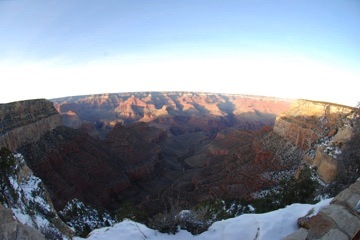
Grand Canyon Wide AngleInside the park, we got a parking spot in the small lot right near El Tovar, where we’d be eating dinner with friends. The hotel is right on the Rim, so we spent some time out on the pathway there, looking into the canyon as the sun was dipping ever lower into the southwestern sky. I played around with my fisheye lens — this was the first time I’d had a chance to use it at the Canyon — and got an interesting shot that includes the snow all around on the Rim.
It was cold. There wasn’t much wind, but the breeze contributed some wind chill to the situation. I don’t own a good winter coat anymore — I’d rather avoid the cold than buy special clothing for it — so I didn’t want to spend much time outdoors.

We went into Hopi House for a short while. This used to be one of the nicer gift shops at the Canyon, a place where everything was high quality. Somewhere along the line, Xanterra (which runs the park concession) had decided to add the kind of tourist crap you can find in most other gift shops there, especially t-shirts, hats, and sweatshirts that say “Grand Canyon” on them and a lot of fake Indian-style dolls, statues, rugs, etc. The good stuff — including a wonderful selection of Native American handmade jewelry — is still in the gallery upstairs, and we made the climb to see it all.

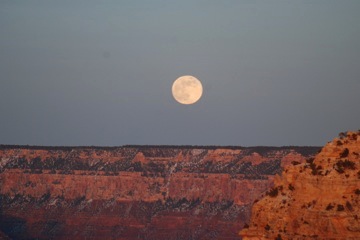
Grand Canyon MoonriseAfterwards, we came out for another peek into the canyon and were rewarded with a view of the newly risen full moon inching into the sky over the north rim. I snapped a few photos of it, but was too cold (or lazy?) to set up my tripod and do it properly, so the shots I took with my 200mm lens aren’t as clear as they could be.
We met our friends inside the hotel. We were booked for the private dining room just to the left of the hostess desk at the restaurant entrance. We’d eaten there the previous year for Christmas Eve. It had been just six of us last year: Mike, me, our two friends, and his parents. A quiet dinner. This year there were ten of us; our friends had invited six of their friends. The rectangular table in the small room was filled to capacity.

Our waiter was excellent. Extremely professional, full of advice, attentive to most details. The food was very good, too — although not as good as I remember from our early days visiting El Tovar 20 or so years ago. (I know: things change.) Conversation was relatively interesting, too. It was a nice meal. The only thing that marred it was when it was time to pay the bill; certain members of the party didn’t chip in their fair share and Mike and I and our friends wound up making up the difference, paying about three times as much as some other members of our party. I know we drank, but we didn’t drink that much.

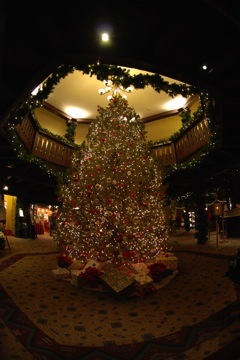
Christmas TreeAfter stopping for some photos inside the hotel lobby where a tall Christmas tree stretched up to the second floor, we stepped outside and walked back to the Rim. The moonlight was shining brightly down into the canyon, casting shadows that defined the rock walls. It was a beautiful scene, but one my camera couldn’t seem to capture properly. (I really need to play around a bit more with the bracketing feature.)
I’ve been at the Grand Canyon many times at night. If there’s no moon, you can look down into the canyon from the Rim and not see a single detail at all. It’s like a black abyss that could be a hundred miles deep. But add some moonlight and you get a completely different picture. This is part of what makes the Canyon such a special place. Different lighting conditions can completely change the experience.

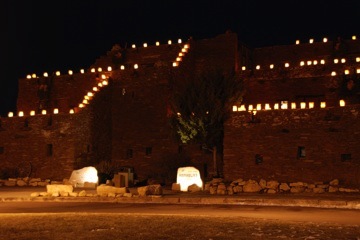
Hopi House at NightSince I was out there with my tripod, I took a few moments to photograph Hopi House and El Tovar. Hopi House was especially festive with its [electric] luminarias.
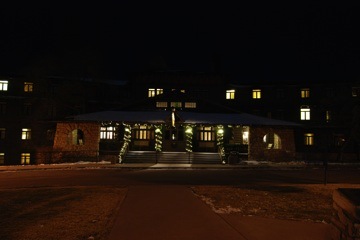
El Tovar at NightIt was after 9:30 PM and it wasn’t very cold at all. The wind had died down and the air was crisp and dry. There wasn’t anyone around except us. That made good conditions for taking these photos. They create the illusion that the historic buildings along the Rim are private, special places. In reality, during the day, these places are mobbed with tourists and it would be nearly impossible to photograph them without including a few people in each shot.
We drove back to Howard Mesa in the full moonlight. There were few cars on the road.

As I opened the gate on our driveway, I noted that all the mud was frozen solid.

It was warm and cosy inside the camping shed and even more so under the covers in bed.