Prepping and Planning for my Winter Migration

In waiting — and planning — mode.

Autumn is just about over. The leave are mostly gone and nighttime temperatures are dipping into the 30s. There’s been frost on the ground every morning. As the sun rises and fills the valley north of my home with light, odd little patches of evaporation fog form over the Columbia River 800 feet below the shelf where my home perches. I often stop my morning activity to watch, wishing I had one of my good GoPros around to create a time-lapse of the slow cloud formation and dissipation.

Of course, by the time that happens, I’ve already been up for a few hours. I’ve had my coffee and usually my breakfast. I’ve probably finished my daily journal entry and maybe even a blog post. I wake very early no matter what the season is, usually between 4 and 6 AM, although sometimes earlier. I’m a morning person and I have been for at least the past 20 years. It’s hard for me to believe that I had trouble attending 8 AM classes when I was in college. These days, by 8 AM, I’m usually ready for my mid-morning snack.

Sunlight and the Shadow Time

Living this far north — latitude 47.34° — the days start getting very short around the middle of October. By mid November, there’s only 9 hours and 15 minutes of daylight each day and we’re losing about 2 minutes of it every day. By the Winter Solstice, the sun is up for only about 8 and a half hours a day. That means the sun isn’t up for 15 and a half hours a day.

But worse than that is what I call the Shadow Time — the six weeks each year that the sun fails to clear the cliffs south of my home. For that brief period, sunlight does not shine at all on my house, although it does still reach out and fill the Wenatchee Valley. For the days leading up to the start of Shadow Time — December 1, I think — there’s less and less light on my house. Yesterday, there was about an hour of it starting around 1 PM. I love the way it shines into the high windows on the south side of my home, sending warm light at weird angles into my living space. But it’s weird looking out the north windows and seeing a big shadow in the foreground with the brightness of the valley behind it.
November View
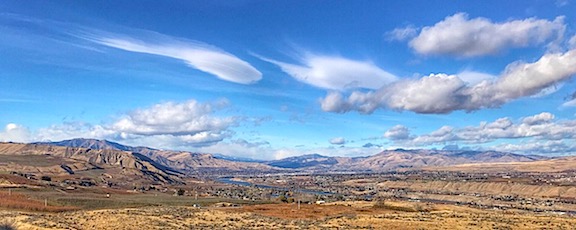
I shot this photo yesterday afternoon from my deck. The clouds were great and the river was so blue. It’s a panorama for a reason — I cropped out the shadow in the foreground.

And I don’t have it bad at all. Some of my neighbors on the south side of the road have been in it for weeks already. Their Shadow Time lasts months. I can’t imagine living that long in the shadows, without the rejuvenating properties of warm, direct sunlight coming through the windows. Honestly, I don’t know why some of them built their homes where they did, especially when I see the occasional boulder coming down off the cliffs dangerously close to one neighbor’s backyard. It seems like it’s only a matter of time before one of those basalt columns lets go and ends up in their living room.

The Shadow Time is one of the reasons I go away for the winter. I’m a sunlight person — I need to be in the sun. That’s one reason why I like living on the east side of the Cascade Mountains. People think it rains a lot in Washington, but that’s not true. It rains a lot in Seattle. It doesn’t rain much here. And those short days turn into gloriously long ones in the summer time; it’s actually light out when I wake up and sometimes when I go to bed.

My goal is always to be gone during the Shadow Time and I’ve been pretty good about that for the past few years. But this time, I’m can’t get out quite as early as I hoped to.

Killing Time

So as November winds down, I find myself waiting for my departure date.

I’m spending much of my time at home goofing off and doing odd jobs around the house, with a few occasional forays down into town to catch a movie, have dinner or cocktails with friends, or run errands. My home and its menagerie — currently 13 chickens (including a rooster just learning to crow properly) and two garage cats (for rodent control) — are pretty much prepared for winter. There’s always something to do around here, but none of it is pressing and some of it has to wait until spring.

I’m also working on glass projects again — something I haven’t done for years. The goal is to create some recycled glass wind chimes for sale in Quartzsite, AZ in January. I’ve been working with my new kiln for a few days now but have had disappointing results. Apparently, I’ll be spending a few more days troubleshooting before I can start churning out new pieces.

And, of course, garage reorganization is something I’m always working on. I’ve still got boxes to unpack. I’m also prepping for a garage sale in the spring. I have a lot of stuff I don’t want/need anymore — some of it from my old home/life in Arizona. While Craig’s List has been instrumental in offloading the larger items, there’s a ton of little stuff I can sell cheap.

My helicopter business is slow this time of year — and only gets slower as winter creeps in. I do have a nice charter later this month; I’ll be working with two other helicopters to take a group of nine men on a flight to various points of interest (to them) around the state. I’m hoping our flight path takes us past my house; my next door neighbor’s kids love it when I fly by with other helicopters — they say it’s like an air show.

Then, of course, is the primary thing keeping me in the area: my December 3 flight bringing Santa to Pybus Public Market. This is a community service I do every year. (Last year was the first time I missed a flight but that’s because the helicopter was in Arizona for overhaul.) The last time I did it, about 300 kids and parents were waiting on the ground when we landed at Pybus in my bright red helicopter. There were photos in the newspaper. I usually shut down and stick around for a while so folks can come up to the helicopter and get their photo taken with it. I’ll do that this year if the weather cooperates.
Pybus Market
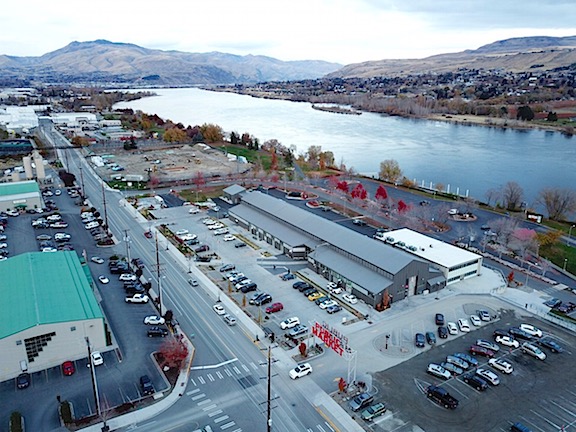
An aerial view of Pybus Public Market, shot with my Mavic Pro the other day. I land the helicopter in the corner of the parking lot in the lower right part of the photo, not far from the white building. One year, we rolled the helicopter into the main (gray) building where I left it on display for a week.

Of course, that doesn’t mean those are the only days I’ll fly the helicopter. There’s a pretty good chance I’ll take it out today. I have two wine club shipments waiting for me at Cave B Estate Winery down in Quincy. That’s an hour drive but only 20 minutes by helicopter. I figured I’d take a few friends down there for lunch — I fly for food — and pick up my wine while I’m there.

And the helicopter will go to California for its sixth season of frost control work, likely in mid February.

Going South

Once I’m done with the few things I need to do in the area, I’ll hop on a flight to Phoenix with Penny the Tiny Dog. My truck, camper, and boat are already down there waiting for me. With luck, a month from today I’ll be camped out on one of the Salt River Lakes, soaking up the sun while I explore the lake in my silly little boat.

I’ll spend Christmas along the Colorado River with some friends, camped out in the desert. The site I hope we get — we got it last year — has a boat ramp and easy access to a stretch of river that runs 76 miles from the Palo Verde Dam north of Ehrenberg, AZ to the Imperial Dam north of Yuma. I brought along my new tent and some tent camping gear so I can do overnight boat camping trips along the river. My friends are seriously into fishing and I know we’ll do some of that, too. Last year, we had fish tacos a few times. We have a campfire nearly every night; it gets cold but not too cold to enjoy the outdoors.
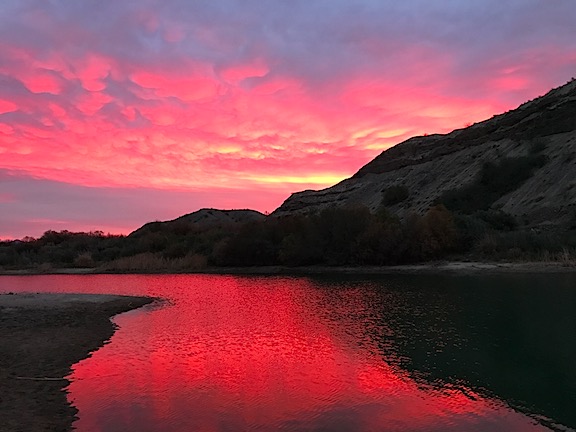
Sunrise at the River
We were treated to a few amazing sunrises during our stay along the Colorado River last year.

Then in January, we move to Quartzsite where my friend sells her artwork at a 10-day show at Tyson Wells. This year, I got a booth, too. I’ll be selling drone aerial photography services for folks camped out in the desert, as well as my recycled glass wind chimes (if I can get the problems with the new kiln worked out). It’ll be weird and it might not make any money, but I’m really in it for the experience more than anything else. Besides, my booth at Tyson includes a full hookup and it’ll be nice to get a bit of “civilization” after more than a month camped out in the desert.

After that, I’ll likely start heading north along the Colorado River with my truck, camper, and boat. I’m hoping to do some camping and boating at each stretch of the river between dams, all the way up to Hoover. I’ll definitely revisit Arizona Hot Springs — this time in my own boat — and tent camp for a day or two in the mouth of the canyon there.

In mid-February, I’ll come home (via commercial flight), fetch the helicopter, and take it down to the Sacramento area for its frost contract. From that point on, I’m “on call.” This is different from cherry season, when I need to stick around with the helicopter to be called out on a moment’s notice. Instead, I get my callout at least 12 hours before they might need me. That’s enough time to hop on a flight from wherever I am to Sacramento.

I’ll be in the Vegas area for a week or so in late February to explore Lake Mead, visit some friends, and see HAI’s big helicopter show. When that’s over, I’ll continue north and west, eventually ending up in the Sacramento area. I’ll stick around there, boating on Lake Berryessa and Clear Lake, wine tasting in Napa Valley, and hiking in the foothills of the Sierra Nevada Mountains until March. If I’m lucky, I’ll get a few callouts while I’m already there; this can really be lucrative when I don’t have to hop a commericial flight, rent a car, and get a hotel room. Then, depending on weather in California and back home, I’ll make my way back north. I did a coastal route last year, but I might try a more inland route this time. It’s all about going new places and seeing new things.

It’s the typical migratory route I’ve been doing with minor variations since 2013 but I’m going to make it count this year. It might be the last season I go to Arizona for the winter; I’m hoping to begin researching retirement destinations in Mexico, Costa Rica, Belize, and possibly New Zealand in future winter seasons. We’ll see.

Of course, I will be working every day. I’m writing a book about my flying experiences and am determined to finish it before I get home. So I expect to spend at least 4 hours at the keyboard daily — likely early in the morning — to knock out a manuscript. I’ll handle publication next spring.

While I’m gone my house will be in good hands. I have a house-sitter who will live there for the entire time I’m gone. We did a trial in October when I took a 2-week vacation south to visit friends, re-explore a few national parks in Utah, and reposition my portable winter home in Arizona. While I’m gone, he’ll make sure the chickens and cats have food and water and collect eggs. Maybe he’ll even put up my Christmas decorations, which I haven’t bothered to do in years.

Waiting

So I’m in a sort of limbo right now, waiting for my departure date to roll along.

I feel as if I spend most of my life waiting. In the old days, I was waiting for my wasband to get his head out of his butt and start enjoying life. It was frustrating, to say the least. The older I get, the less time I have left. Waiting for someone else was like idly watching my life slip by without being able to do anything to enjoy it.

Now, with him out of the picture, I do a lot less waiting and a lot more doing. I spend a lot of time traveling when I’m not busy with flying work. When I’m home, I spend my time building and learning new things. My life is much more full and interesting; my time is much more flexible.

But I still have responsibilities that tie me to my home, even if I’m not kept here by work. So I’m waiting for calendar pages to flip by again so I can do the few things I need to do.

And then I’m outta here.
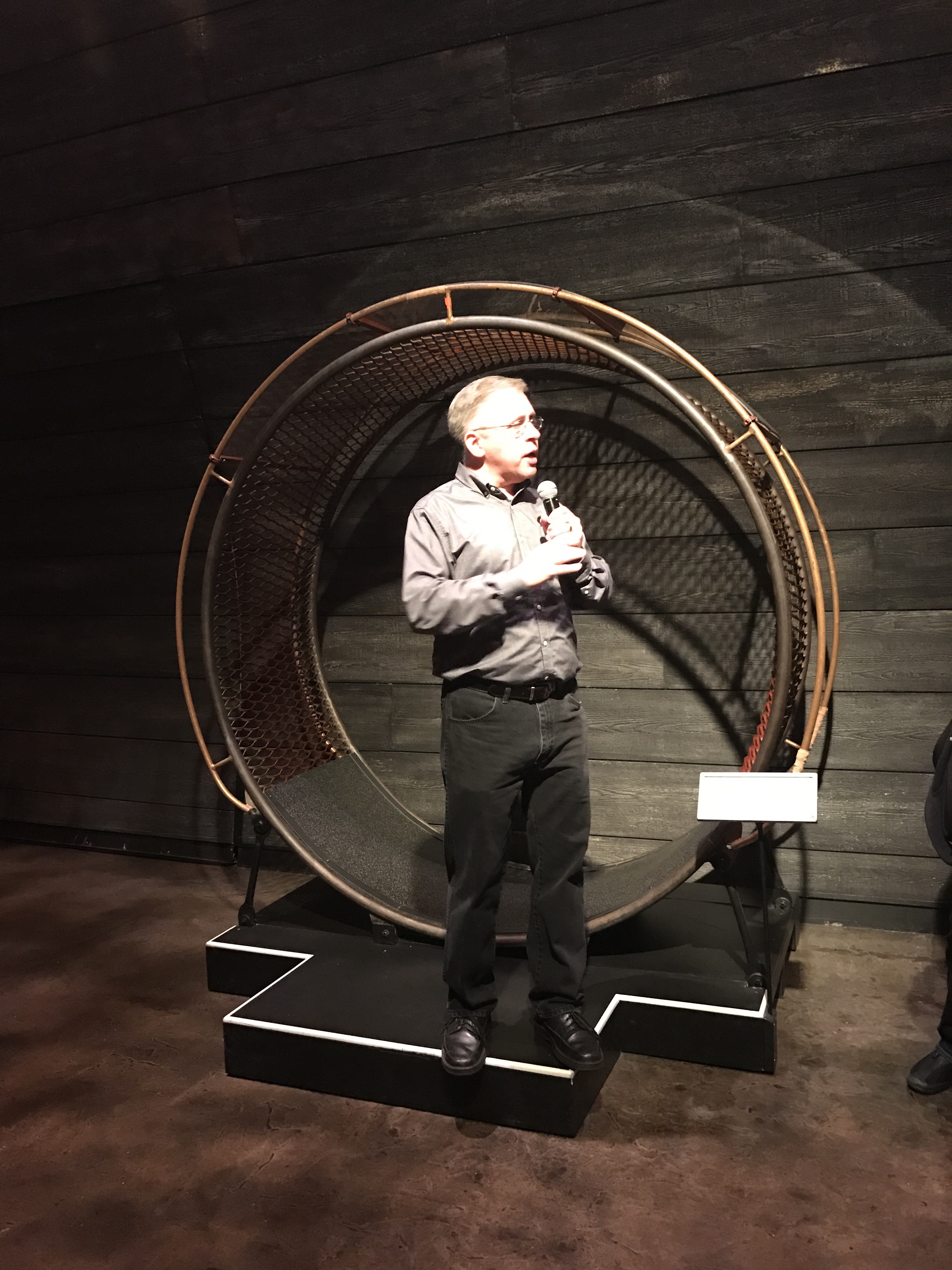
Snowbirding 2017 Postcards: Behind the Scenes at KÀ

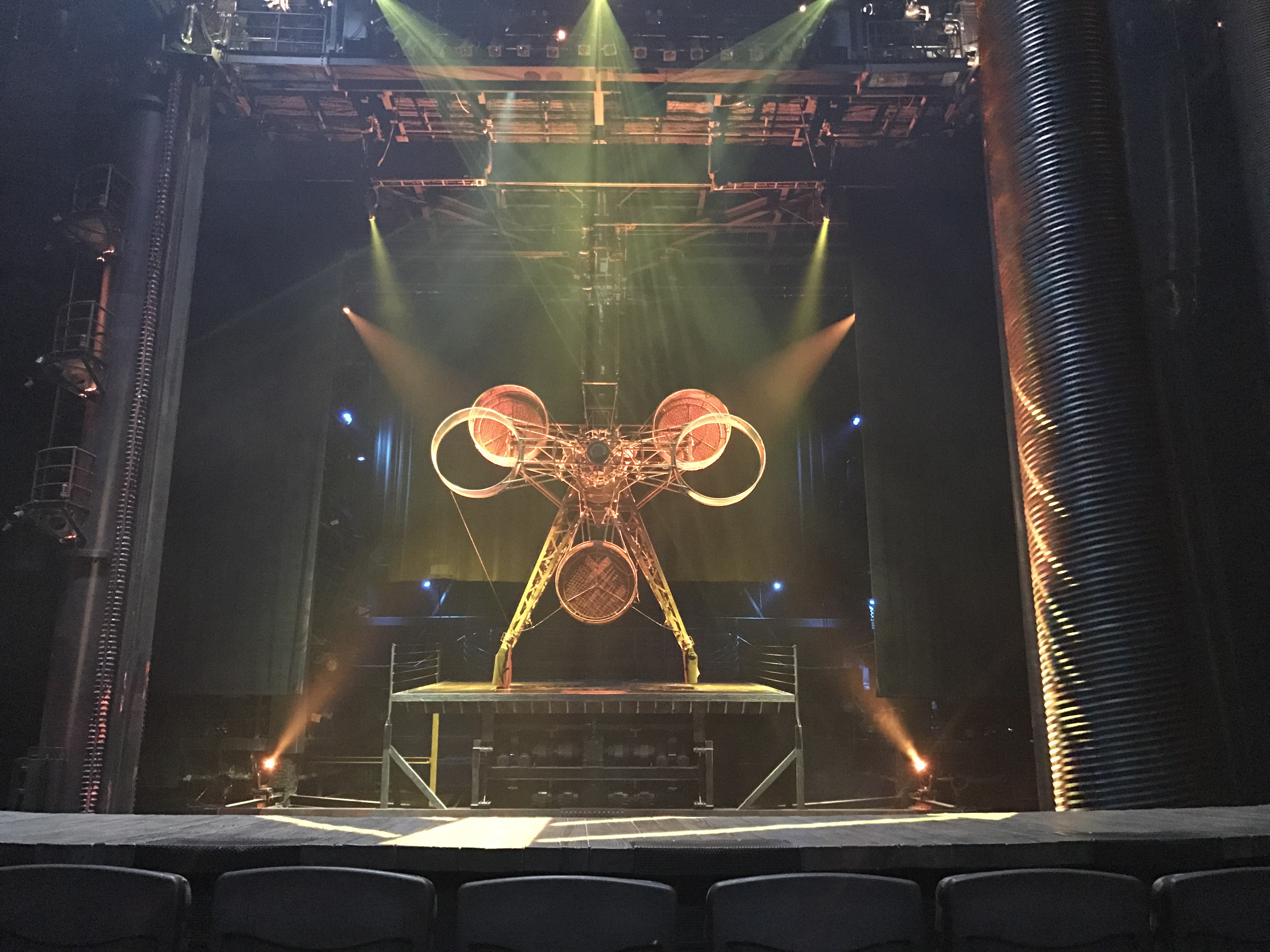
I saw the Cirque du Soleil show KÀ yesterday at the MGM Grand Hotel. I didn’t realize it, but it was the third longest running show in Las Vegas. It’s also the first Cirque du Soleil show to actually have a storyline.

The show was amazing — no doubt about that. Then I had great seats: seventh row center. But I still came out feeling a little disappointed. I like Cirque du Soleil with various acts within the show. And the costumes, of course. And the music. While this show had acrobatic acts and costumes and music, I felt that it relied too heavily on the special effects made available through the incredible stage set up. Simply said: it was a technological marvel more than the amazing human performance i’ve come to expect from Cirque du Soleil.

Yesterday evening, on my way to the show, I heard an announcement that they were going to have a “open house” at the KÀ theater at 11 o’clock today. Because my schedule is sort of free-flowing, I made time to go see it.

It was a half hour presentation led by a man who is involved with the show. After discussing some of the items on display in the lobby of the theater, he brought us inside where we sat in seats and he told us about the various stages and sound system. The theater has 10 stages, several of which move. The most amazing one is the giant flat stage that can be raised, lowered, tilted, and spun. As he told us about this large stage, someone demonstrated the various things it could do, including instantaneously deploying dozens of rods that the performers can use for acrobatics. They then put the stage on its side in a vertical position and used it as a screen for projections they gave us further information about the production.

In all, the open house was fascinating and I’m very glad I stuck around to attend. Here are a few pictures I shot of the theater.

I should mention here that I love to do behind the scenes tours. If you use the search box for this blog, you could find a post about a tour I tagged along on of the Kolb Studios at the Grand Canyon.

Snowbirding 2017 Postcards: The Las Vegas Strip Walk

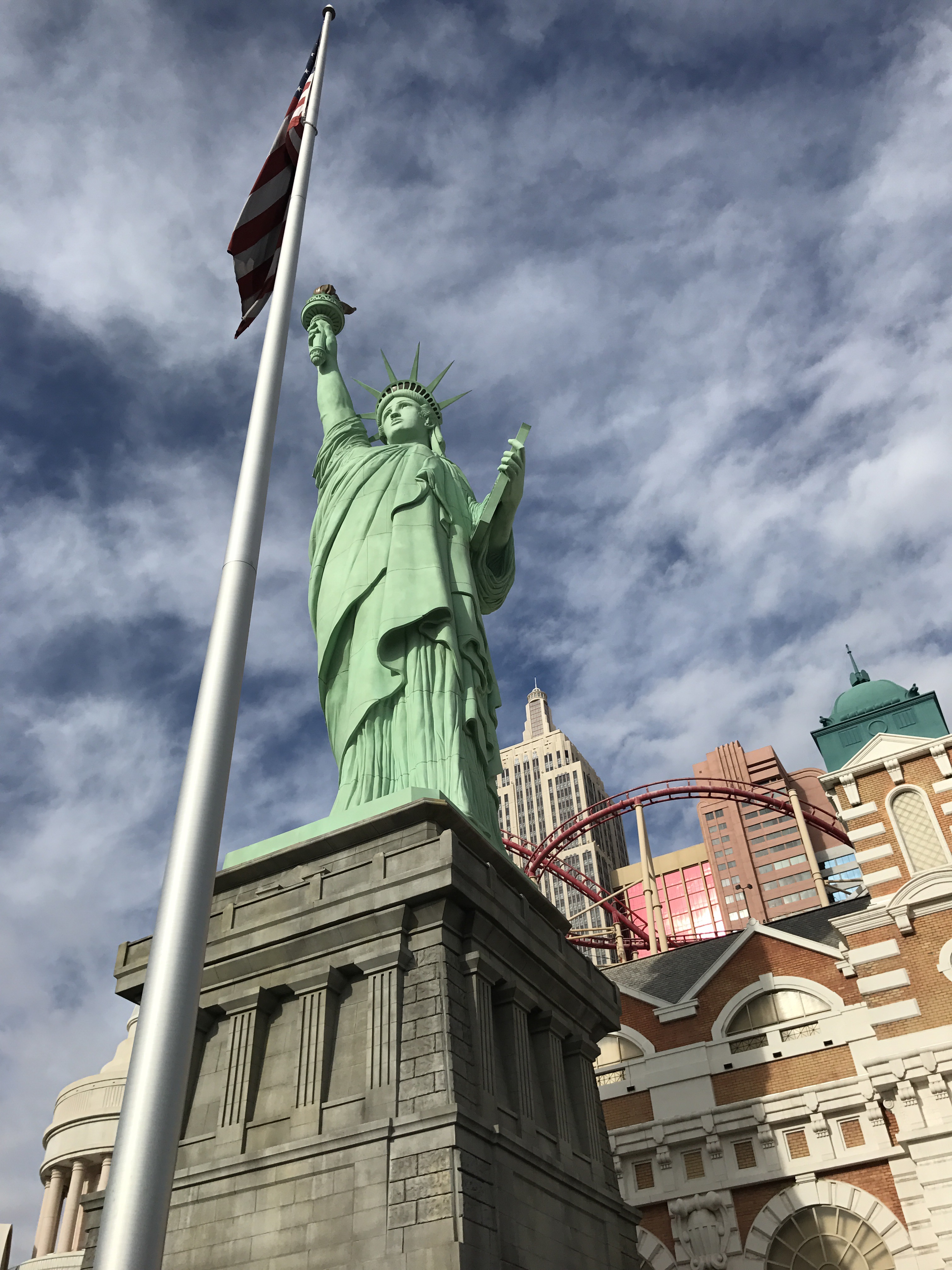
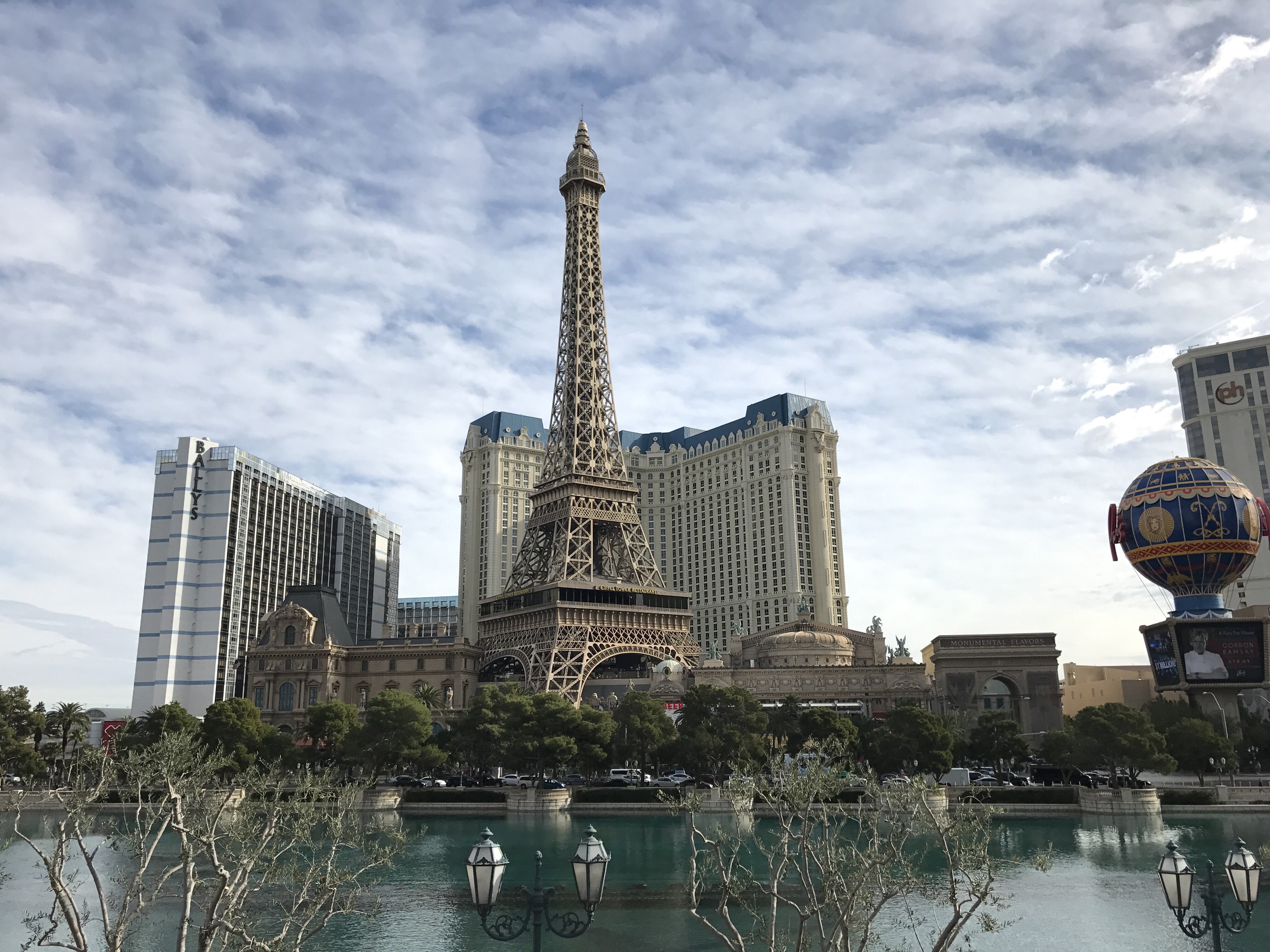
One of my very favorite things to do when I come to Las Vegas is to take a very brisk walk along the Strip, walking through hotels and their shopping areas. I start at one end — normally Mandalay Bay or Luxor — and walk along the west side of Las Vegas Boulevard northbound. If I’m feeling very energetic, I can usually get up to Treasure Island. Then I cross the street and I take an equally brisk walk down the other side. This is not a straight line walk; sometimes I’m on the sidewalk, sometimes I’m on a casino floor, sometimes I’m in a shopping area. I zigzag my way north and then south. I do this early in the day, always before noon, and I usually start around 8 or 9 o’clock in the morning. That’s when Las Vegas is just starting to wake up but not yet fully engaged.

I did that walk today, although I only got as far as Caesars Palace. I like Caesars, although I’ve never stayed there. I always visit it when I come to town. It was kind of neat to see sashes over the statuary proclaiming Caesars 50th anniversary. It’s really an historic hotel casino, mostly because it’s one of the first on the strip. It used to be a very classy joint inside, but now not quite as much. Everything gets tacky over time in Las Vegas.

One of the reasons I didn’t get any further than Caesars is because of time constraints — I was supposed to meet some friends for lunch. The other reason is that I’m simply out of shape and couldn’t keep up that brisk pace for more than what turned out to be a total of 5 miles. Who says hiking needs to be done in the woods?

I did do some shopping in Caesars Forum Shops. I bought a couple of pairs of jeans and a sweater. I also bought dark chocolate Reese’s Peanut Butter Cups in the Hershey’s store in another casino.  As I mentioned on Twitter, it was a real pleasure to be able to walk through a shopping area without having to stop at every single watch shop or men’s shoe store. That’s one thing about my wasband that I don’t miss it all.

Anyway, these are some of the photos I took along the walk. One of the things I love about Las Vegas is how surreal it is; I think some of these photos illustrate that.

Snowbirding 2017 Postcards: Luxor and Blue Man Group

After a 5 hour drive from Walker Lake to Las Vegas, which included a harrowing drive on slippery roads near Goldfield, Nevada, where cars were spinning off the road everywhere, I arrived in Las Vegas shortly after 2 PM. With tickets to see the Blue Man Group at 7 o’clock, I thought I had plenty of time to relax, take a shower, get dressed, and go get some dinner before the show. I made dinner reservations for 5:15 and at 4:30, I headed out. That’s when I actually looked at my ticket. It said the show time was 4 PM.  

Shit. 

Long story short: The very nice folks at the box office traded my 4 PM ticket for 7 PM ticket. The amazing thing about this? I still had a third row center seat, on the other side of the aisle from where I would’ve been sitting at 4 o’clock.

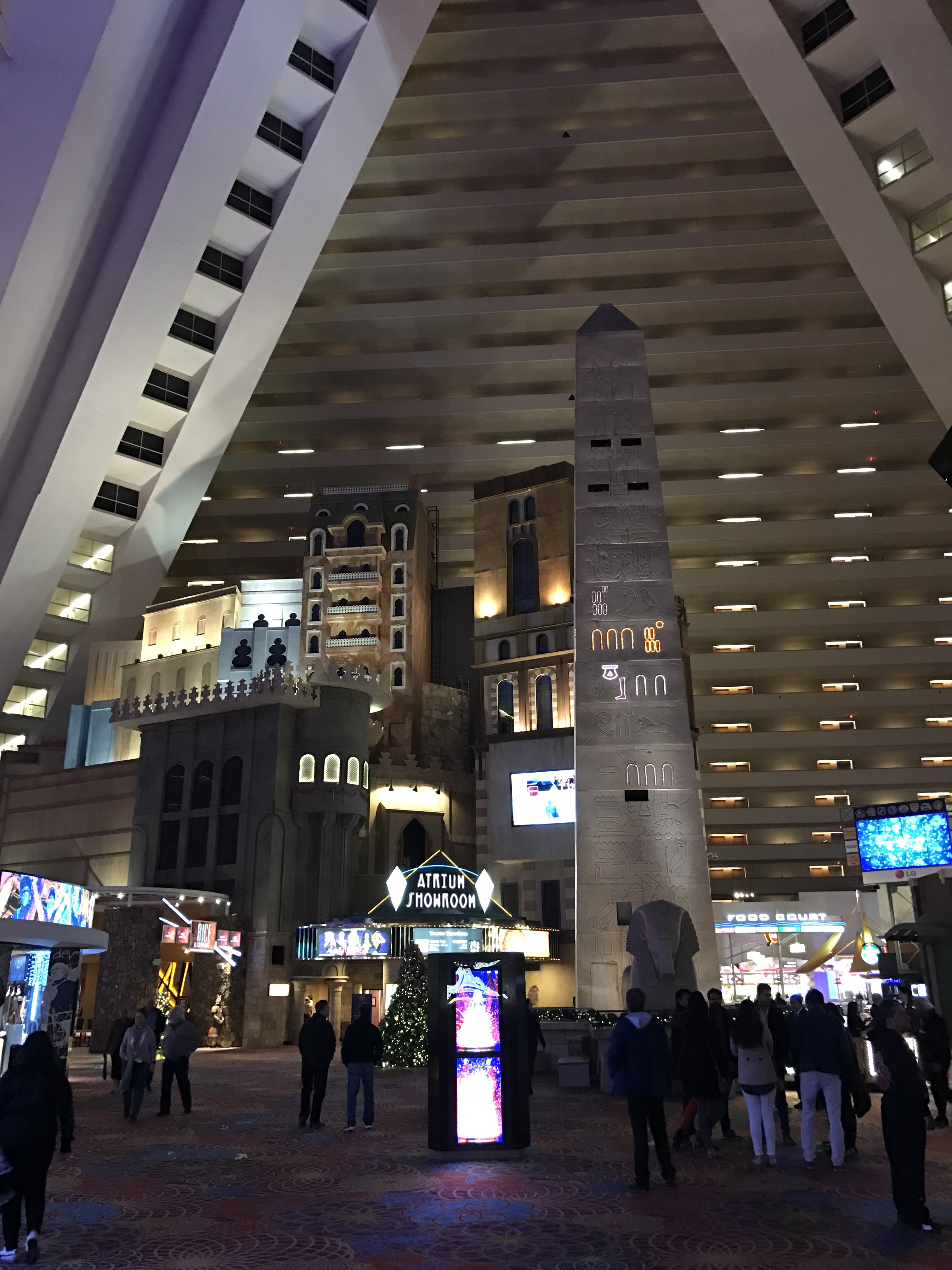
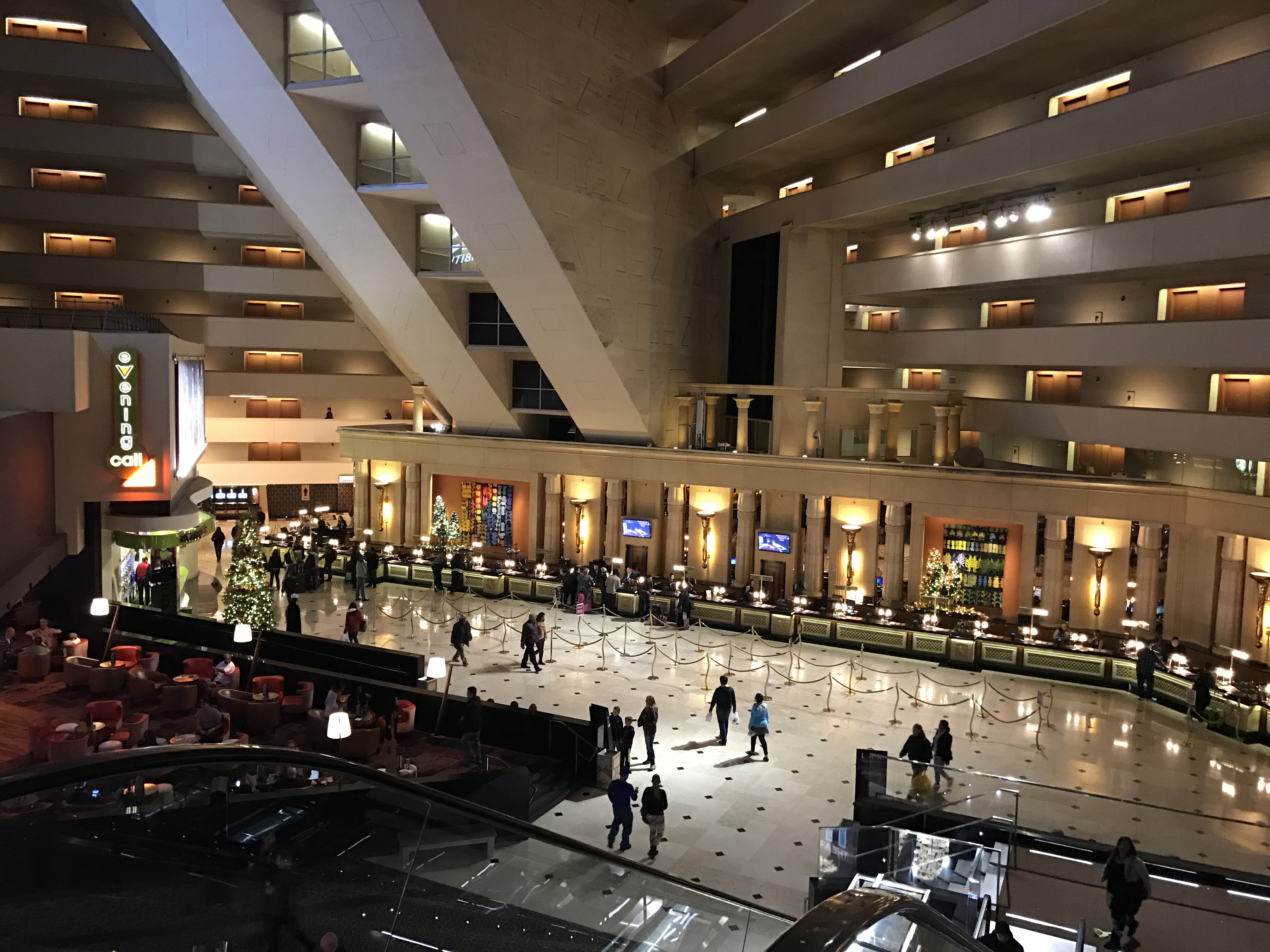
So I had dinner and saw the show exactly as I had originally planned. It was a great show and afterwards I got a selfie with one of the cast members. I also took some photos of Luxor before leaving. 

I first stayed at Luxor when it was about a year old and there was still a boat ride that went around the circumference of the pyramid. That was back in Las Vegas’s idiotic family days, when they thought they could build casinos to attract families. Luxor had game arcades in the space currently occupied by restaurants and shows. It was a weird place but I could get a suite in the corner of the pyramid that included a Jacuzzi right in front of the big window. I could soak in the tub and watch the happenings on the Strip far below me while tour helicopters flew by. 

I’ve been to Vegas more times than I can count and I’ve been there by myself most of those times. I seem to enjoy it more on my own, making my own decisions about food and shows and how to spend my time. I don’t gamble and I’m not much of a drinker but I do love to walk through the casinos to see what outrageous new things they’re showing off. I’ll do my casino walk tomorrow morning — it’s a great way to get exercise.

Lessons from the Goldfinch

A long and winding, beautifully written book with numerous disturbing story lines.

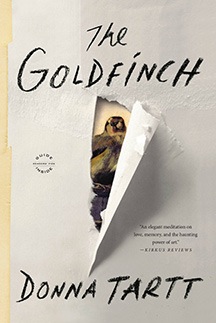
The GoldfinchMy friend Barbara, an avid reader, recommended The Goldfinch by Donna Tartt to her Facebook friends, including me. I’d been looking for something modern and mainstream to read since binging and burning out (and subsequently dropping) the Arthur C. Clark (and ghostwriter) Rama series books. (Clarke’s original Rendezvous with Rama is a short masterpiece of science fiction; the long, drawn out books in the series that came afterward were some ghostwriter’s attempt to fill too many pages with unnecessary personal drama reminiscent of today’s reality TV shows that, quite frankly, annoyed and bored me. I was in the middle of the third book when I decided I’d had enough.)

On a whim, I looked it up on my library’s website, discovered they had an ebook version, and put it on hold. When it became available two weeks later, I checked it out and began reading on my iPad.

I soon realized two things about the book:

First, it was beautifully written. The author used words to expertly paint pictures of New York, Las Vegas, and other backdrops for the story that put me right in those places. Keep in mind that I’ve spent a lot of time in both places and I can assure you that she nailed every aspect of her descriptions. From grabbing a taxi in New York to wandering the streets of ghost housing developments in the desert outskirts of Vegas, she put the reader there expertly. She also managed to convey the moods of not only her first person narrator but the places and situations he was in. I realized almost immediately that I’d been stuck in a rut reading garbage fiction. This book was like a breath of fresh air for my brain.

Here’s a paragraph from near the beginning of the book to give you an idea of what I mean:

If the day had gone as planned, it would have faded into the sky unmarked, swallowed without a trace along with the rest of my eighth-grade year. What would I remember of it now? Little or nothing. But of course the texture of that morning is clearer than the present, down to the drenched, wet feel of the air. It had rained in the night, a terrible storm, shops were flooded and a couple of subway stations closed; and the two of us were standing on the squelching carpet outside our apartment building while her favorite doorman, Goldie, who adored her, walked backwards down Fifty-Seventh with his arm up, whistling for a taxi. Cars whooshed by in sheets of dirty spray; rain-swollen clouds tumbled high above the skyscrapers, blowing and shifting to patches of clear blue sky, and down below, on the street, beneath the exhaust fumes, the wind felt damp and soft like spring.

Holy cow. Are you there with me? I can see the yellow of the cabs speeding by, all with their “hired” lights on, while the doorman, in his cap and long coat, steps out onto the avenue, arm held high with his whistle blowing wildly in his mouth, trying hard to get a taxi while mother and son wait under the arched awning in front of the building. I can hear the car horns and other doorman whistles, see wisps of steam rising from the manhole covers, smell the pungent odor of flooded storm drains. All the while, pedestrians rush by under umbrellas, collars turned up against the driving rain as they splash through small puddles on the sidewalk in hopelessly wet shoes.

So much of the book is like this for me.

Second, it was extremely long. I didn’t realize how long it was in real pages until today when I looked it up on Amazon just to get that piece of information: 755 pages. Wow! And my library loan gave me just two weeks to get through it!

The story follows the narrator through the tragic loss of his mother and the morally questionable acquisition of a 17th century Dutch masterpiece, The Goldfinch. Throughout the story, Theo describes the events of his life, from being shuffled from one home to another, left on his own to discover drugs with a friend to his troubled adult life. I don’t want say more because I don’t want to spoil any of the plot lines for readers. Amazon’s description, which was obviously written by some publishing house marketer who didn’t bother to read the book, is a bit misleading.

Simply stated: the story is dark and although I never actually disliked the first person narrator, I kept thinking over and over how stupid he was being to screw up his life the way he was. As one reviewer who found the book too sad to finish put it, “Just when I think it will get better something else bad happens.” A note on Amazon says that 172 reviewers made a similar statement. I would have, too.

But it was the beauty of the writing and my hope for a happy ending that pulled me through the book. Reading in bed before dawn or curled up on the sofa on a foggy afternoon, I paged through it, marveling at the quality of the prose while lamenting the main character’s often self-inflicted misfortunes. Although friendship was a major theme throughout the book, Theo’s friend was not a good influence and I had a lot of trouble getting past that until the third part of the book.

I was rewarded at the end with two passages that I bookmarked because they had special meaning to me. Both occur near the end of the book, in the narrator’s lengthy summation of his story and what he learned from what he’d been through.

Theo talks a bit about the goldfinch in the painting, a small bird fastened to its perch with a length of chain. He talks about the bird not being afraid of its surroundings despite its tiny size. About it not being timid and not being hopeless and refusing to pull back from the world. And then he says:

And, increasingly, I find myself fixing on that refusal to pull back. Because I don’t care what anyone says or how often or winningly they say it: no one will ever, ever be able to persuade me that life is some awesome, rewarding treat. Because, here’s the truth: life is a catastrophe. The basic fact of existence — of walking around trying to feed ourselves and find friends and whatever else we do — is catastrophe. Forget all this ridiculous ‘Our Town’ nonsense everyone talks: the miracle of the newborn babe, the joy of one simple blossom, Life You Are Too Wonderful To Grasp, &c. For me — and I’ll keep repeating it doggedly till I die, till I fall over on my ungrateful nihilistic face and am too weak to say it: better never born, than born into this cesspool. Sinkhole of hospital beds, coffins, and broken hearts. No release, no appeal, no “do-overs” to employ a favored phrase of Xandra’s, no way forward but age and loss, and no way out but death. […]

And — maybe it’s ridiculous to go on in this vein, although it doesn’t matter since no one’s ever going to see this — but does it make any sense at all to know that it ends badly for all of us, even the happiest of us, and that we all lose everything that matters in the end — and yet to know as well, despite all this, as cruelly as the game is stacked, that it’s possible to play it with a kind of joy?

Not exactly the kind of quote that makes you feel good about life. But in my own life, it has a lot of meaning.

Although I can’t complain about most of my life — I’ve worked hard and played hard and enjoyed life within my limited means — the events of the past two years or so have taken a serious toll on me. They’ve made me see life from Theo’s point of view. Life’s a real struggle sometimes, especially when difficult, unexpected situations are thrown in your path. A marriage gone sour for reasons you can’t comprehend. A formerly loving spouse lying, cheating, and committing a never-ending series of hurtful acts against you. Stranger-than-fiction situations triggering PTSD-driven responses that cause a chain reaction of apparently unsurmountable problems.

This is the catastrophe Theo is talking about, complete with broken hearts and no appeals or do-overs. Unlike Theo, however, I didn’t bring the catastrophe on myself — it was thrust upon me by others. I suppose I should consider myself fortunate that I haven’t had to deal with it until recently.

I struggle now to move forward with as much of the joy as I can muster. My friends and family tell me I’m doing an amazing job, that I’m a strong woman and will get through my temporary setbacks. I know they’re right. I have plenty of good days among the bad. But I also know the feeling of utter despair that Theo shares throughout the book.

The other passage I bookmarked reminded me a bit about what’s driven me my entire life.

In the book, Theo does self-destructive things: drugs, theft, fraudulent transactions. He knows these things are wrong, but he does them, sometimes justifying them in his own mind to make them more acceptable. Sometimes he’s just too weak or lacks the willpower to stop. In this lengthly passage, he questions the “norms” and what people are expected to do with their lives.

I look at the blanked-out faces of the other passengers — – hoisting their briefcases, their backpacks, shuffling to disembark — and I think of what Hobie said: beauty alters the grain of reality. And I keep thinking too of the more conventional wisdom: namely, that the pursuit of pure beauty is a trap, a fast track to bitterness and sorrow, the beauty has to be wedded to something more meaningful.

Only what is that thing? Why am I made the way I am? Why do I care about all the wrong things, and nothing at all the right ones? Or, no to take it another way: how can I see so clearly that everything I love or care about is illusion, and yet– for me, anyway — all that’s worth living for lies in that charm?

A great sorrow, and one that I’m only beginning to understand: we don’t get to choose our own hearts. We can’t make ourselves want what’s good for us or what’s good for other people. We don’t get to choose the people we are.

Because — isn’t it drilled into us constantly, from childhood on, an unquestioned platitude in the culture — ? From William Blake to Lady Gaga, from Rousseau to Rumi to Tosca to Mr. Rogers, it’s a curiously uniform message, accepted from high to low: when in doubt, what to do? How do we know what’s right for us? Every shrink, every career counselor, every Disney princess knows the answer: “Be yourself.” “Follow your heart.”

Only here’s what I really, really want someone to explain to me. What if one happens to be possessed of a heart that can’t be trusted — ? What if the heart, for all its unfathomable reasons, leads one willfully and in a cloud of unspeakable radiance away from health, domesticity, civic responsibility and strong social connections and all the blandly-held common virtues and instead straight towards a beautiful flare of ruin, self immolation, disaster? Is Kitsey right? If your deepest self is singing and coaxing you straight toward the bonfire, is it better to turn away? Stop your ears with wax? Ignore all the perverse glory your heart is screaming at you? Set yourself on the course that will lead you dutifully towards the norm, reasonable hours and regular medical checkups, stable relationships and steady career advancement, the New York Times and brunch on Sunday, all with the promise of being somehow a better person? Or — like Boris — is it better to throw yourself headfirst and laughing into the holy rage calling your name?

It’s not about outward appearances but inward significance. A grandeur in the world but not of the world, a grandeur that the world doesn’t understand. That first glimpse of pure otherness, in whose presence you blew out and out and out.

A self one does not want. A heart one cannot help.

I was raised to believe that people follow a predestined path: grow up, go to school, get a job, get married, buy a house, have kids, retire, have grandkids, die. Somewhere along the line, “get a job” turned into “have a career” and that career was supposed to be in an office working 9 to 5 for a paycheck.

But something about me made me question that path when I was in the “go to school” phase. You see, rather than getting that office job with good career opportunities, I realized I wanted to be a writer. To say I was discouraged is an understatement, but I toed the line like the relatively obedient kid I was. It wasn’t until years later, when I’d invested quite a bit of time in the “have a career” phase that I realized how unhappy I was.

You see, I didn’t follow my heart. I followed someone else’s “life formula” and that formula just wasn’t working for me. I got off the path I was on and started fresh on a new path. And I haven’t regretted it one damn bit. The only thing I regret is not getting on that path in the first place and wasting 8 years of my life doing something I really didn’t want to do.

My situation really isn’t anything like Theo’s in the book. Theo’s path was self-destructive, mine was constructive. But the point this passage reinforces is that we need to follow what our heart tells us is right, even if it doesn’t conform to what’s “normal” or what’s expected of us. I’m fortunate in that my heart usually steers me onto a path that I do want, one that’s good for me and others around me.

It just saddens me that people close to me have ignored their heart in favor of the easy life formula that’s considered “normal.” I know they will eventually regret taking the path they took — if they don’t already regret it.

Anyway, that’s my takeaway from this book. I recommend it if you like well-written prose and you don’t mind a dark story with a brighter ending.

One last thing. In prepping to write this, I Googled The Goldfinch. I wanted to see what the painting looked like. I was disappointed. What do you think?