Handmade vs Assembled: What Does Artisan Mean?

I try to define the concept of artisan goods and why they should be valued more than manufactured goods.

I have been dabbling in physical artistic endeavors — as opposed to writing, which is an intellectual artistic endeavor — for about six years now, when I started making jewelry from the rocks I began acquiring at the Arizona rocks shows I attended every winter. It wasn’t long before I got to the point where I wanted to sell what I made. The best way to sell art is either in a shop or at an art show. I didn’t have (or want) a shop so I started hunting down shows.

Art Show Tests

Art shows can be juried or non-juried. A juried art show is one where you need to provide details, samples, and/or photos of your work and the process of making it. A panel of people who are supposed to know what they’re doing and seeing judge whether your work is good enough for their show.

In general, artists want to be in a juried show because they will be among other artists who have passed the same test. Quality work means a quality show which also means buyers who are interested in quality work. It also makes a level playing field for the artists who participate.

One of the things art shows ask about when you apply is what percentage of your work contains manufactured items. For example, for jewelry you might use manufactured ear wires (for earrings), clasps (for bracelets and necklaces), jump rings, head pins, and bezel settings. But you might also buy manufactured stylistic components, like shapes, charms, rings, and mounted stones. A good art show wants your work to be mostly handmade — meaning that you got the raw materials and made the components yourself.

I can make ear wires, jump rings, head pins, and large (over 10 mm) bezel settings these days, but I won’t (or maybe can’t) make the kind of good, reliable clasps I want to secure my bracelets and necklaces on the wearer or the teeny-tiny bezel settings I need to set tiny stones. And although I do have the equipment and skills to polish rocks into the cabochons I use in my jewelry, that would make me a lapidary in addition to being a silversmith, and I’ve decided I don’t want to go there. (Fortunately, that isn’t expected.)

Each art show has its own standards, but the more handmade an item is, the more likely the work will get approved for a quality show.

(Of course, the actual artistic quality of the work is also considered. You can be an incredibly skilled artist but if your work looks like it was made by a kindergartener who’d been drinking espresso, you probably won’t get far. But that’s a whole other topic for discussion elsewhere.)

Unfortunately, not everyone is honest about how they make their “artisan” goods. People lie on applications. Sometimes they buy “handmade” items from overseas and try to pass it off as their own. Other times, they buy manufactured items and assemble them and pass off the results as handmade.

Assemblers are Not Artisans

The assemblers bother me a lot. Let’s take a look at this.

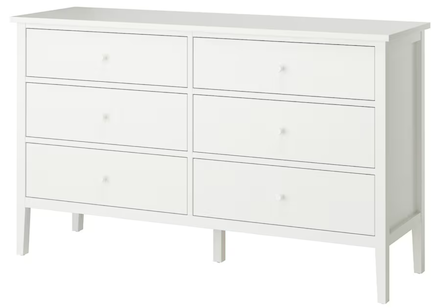
Gullaberg Dresser from IKEA
Here’s the Gullaberg dresser from IKEA. It won’t look like this when you buy it.

Say you go to IKEA and you buy a dresser. It comes in a flat box with instructions in an often-mocked format. You open the box and remove all the pieces, including laminated wood panels, drawer sliders, hardware, and maybe even a few primitive tools that you supplement with your own tools. You decipher the instructions and you assemble the parts into a dresser. Would you then tell someone you made that dresser? Would you bring it to an art show and try pass it off as a handmade item?

Of course not. (At least I hope not.)

So tell me this: what’s the difference between doing that and buying a bunch of manufactured jewelry components and putting them together into a piece of jewelry? Could you tell someone you made that jewelry? Can you bring it to an art show and try to pass it off as a handmade item?

Well, some people do.

The only distinction I see here is that the IKEA furniture comes with instructions and if you don’t put it together the right way, you won’t have the dresser in the picture. Or maybe any dresser or usable piece of furniture at all. If you assemble manufactured jewelry parts, you have more creative freedom. But that still doesn’t mean you made the jewelry. It means you assembled it.

Like that IKEA dresser.

Making the Parts

Step-by-Step, with Photos

A little side note here. If you follow my Mastodon account (@mlanger@mastrodon.world) and you pay attention on one of my jewelry shop days, you’ll likely see at least one thread where I discuss and illustrate the various steps for making a piece of jewelry. I do this because it interests some people and because I want people to understand the amount of work and often highly specialized tools that are required to make the jewelry I make.

Forgive me for using jewelry as an example, but that’s what I know best. So let me tell you a little bit about what goes into making the parts of a piece of jewelry.

I’ll start with something simple: an ear wire. An ear wire is the part of an earring that attaches a hanging earring to your ear. It does this by going through a piercing on your ear.

The first step is getting the raw material, which is wire. I need to know what kind of wire to get. While it’s true that I can buy stainless steel wire, which is cheap and will do the job, some folks are allergic to stainless steel — including me — so it’s an irritant for an ear piercing. There’s also silver plated, which is cheaper than sterling, sterling silver, or fine silver. Fine silver doesn’t tarnish as quickly as sterling but it’s expensive and soft so it will require extra work to harden. There’s also gold and white gold and rose gold and gold filled at different quality points. And platinum. And titanium. And copper and nickel and brass. A lot of choices! I have to know which one to buy to compromise between price and quality and help me achieve the artistic aesthetic I want.

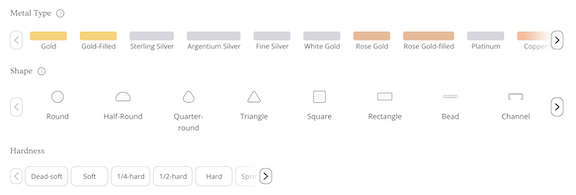
Wire Selector
My jewelry supplier now has this handy wire selector to help you find the wire you want. The trick is, you have to know which wire you want first.

I also need to know how thick that wire needs to be. Too thick and it will be too thick to comfortably go through an ear piercing. Too thin and it’ll bend when it’s put on or in use. And the hardness is important, too.

So far, these are all decisions. I haven’t actually made anything yet.

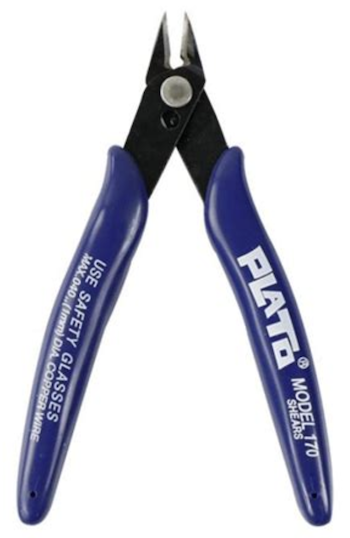
Plato Cutters
Yes, it’s true. My favorite jewelry making wire cutters are actually made for the electronics industry.

So I buy the wire. It’ll either arrive in a coil or on a spool depending on how thick it is. I have to cut off the length I need for the ear wire. The length depends on the style I want for the ear wire. That’s where the creative process comes in. I have to have a design for the ear wire that not only meets my artistic needs, but functions as an ear wire.

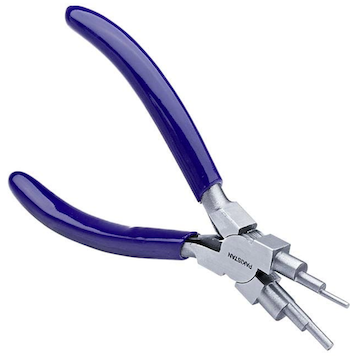
Bail Forming Pliers
This is my go-to tool for making ear wires. I rarely use them for making bails.

With the design in mind, I cut off the length of wire I need. I then get out my forming tools — usually a bail-making pliers — and shape the wire into the ear wire shape I need. Sometimes I include decorative elements, like beads, which need to be added before the ear wire is complete.

Does the wire need to be hardened? If it’s a soft wire, it will need me to perform additional steps which could include hammering or tumbling to prevent the wire from accidentally bending in use after it has attached to make the final earring.

Now this is just an ear wire, which is one of the three simplest components I can make. (The others are head pins and jump rings.) It’s easy to make and I’ve made hundreds of them at this point. Would it be easier to buy them pre-made? Sure! In fact, I used to do just that. But then I realized that the more manufactured components I had in my jewelry, the more I looked like an assembler instead of a maker. And the more art show juries thought the same way.

Earrings
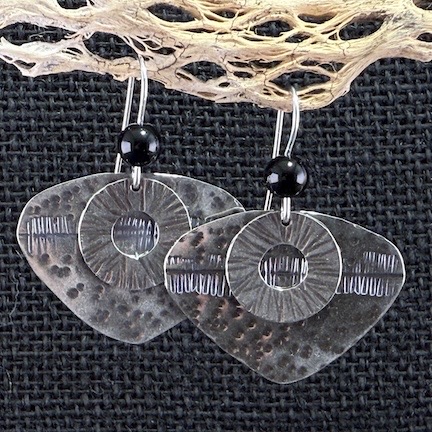
These earrings have just three components each, but I use a variety of tools and techniques to make them.

And I need to point out here that the ear wire is only part of an earring. The photo here shows an example of a pair of earrings I designed and make entirely from sterling silver wire and sheet. Each earring has three components, each of which required cutting, shaping, texturing, and polishing using a wide variety of tools and techniques. I make these in batches, completing a batch of each component at a time, and can spend an entire day making just eight pairs. Figure an hour per pair on average.

Assembly is Quick

It’s not the assembly that takes all day. That takes minutes. It the manufacturing of each individual component that takes so much time. And I hand-make each component so it looks exactly the way my design — a function of my own creativity — needs it to look.

It Takes Years

My friend Janet LeRoy is an artist who has been making a living for more than 40 years painting mostly wildlife on mostly feathers. She does a lot of art shows ranging from crappy shows not much better than glorified flea markets (mostly for convenience; long story there) to extremely high end fine art shows in Scottsdale, Jackson Hole, and beyond.

One of the questions she gets a lot is “How long did it take you to paint this?” Her response these days: “40 years.” Every single thing an artist creates is the end result of the amount of time she has been working on her art, developing her style and techniques. Keep that in mind the next time you look at original art.

So yeah: I get pissed off when I’m put into an “artisan” fair among assemblers. It took me an hour working with tools I bought using skills I developed through training and practice and using quality materials like sterling silver and onyx beads to make one pair of these earrings. So yes, I have to charge $44/pair. Meanwhile, three booths down, an assembler who bought stainless steel and chrome-plated components made in a Chinese factory spent 5 minutes putting them together with a pair of pliers can charge just $15/pair.

A buyer might not see the difference. It’s a pair of earrings! It’s silvery and shiny! Why should I buy the $44 pair when I can buy the $15 pair? They don’t care if the finish starts flaking off in a few weeks or if the ear wire makes their piercing turn red or get itchy. They’ll eventually just throw them out. $15! Who cares?

At this point, I’m starting to wonder why I should keep making the $44 pairs of earrings.

My Most Recent Unpleasant Experience

I participated in a Holiday Artisan Fair yesterday at Wenatchee’s Pybus Market and walked away feeling angry and frustrated.

Pybus was the first place I sold my jewelry, back when I only had an inventory of about 10 pieces. I was only doing wire framed cabochon pendants in those days. (Wire work is generally frowned upon by art show juries — which is why I pretty much stopped doing it — but my work isn’t the typical “wire wrapping” you see in new age crystal shops. It still sells in certain markets, but I can do a lot better.) On some weekends, there were a lot of really crappy vendors at the day tables there, selling a mixture of amateurish “granny crafts,” assembled manufactured components, and obvious buy-sell merchandise. I didn’t care much because my work really stood out in that crowd and I was able to make the sales I needed.

I stepped away from Pybus for a few reasons, not the least of which was a management change and what I saw as unfair treatment of some artists. (They definitely had their favorites and I was not among them.) Around the same time I found other venues where my work was more appreciated and sold a lot better. Instead of making a few hundred dollars in a weekend, I could bring home a few thousand. Between that and selling my work in galleries and gift shops, I no longer needed to do small shows with questionable jury practices.

Fast-forward to this autumn. After nearly two years of full-time travel, I found myself back home and ready to start selling at art shows again. But I goofed! I should have applied in spring and summer for the autumn and winter shows. I totally missed my opportunity and had no shows lined up for the holiday shopping season.

Why not try Pybus? a fellow artist who used to sell there suggested. Okay, I thought. Why not? It had been more than four years. Surely management had changed. I got on their website and applied, very happy to see how concerned they seemed to be about items being handmade. They even wanted to know where we sourced our materials. This was promising.

After some email tag with no response from the folks running the day tables there, I started thinking it was a bad idea. I told them to cancel my application.

By some miracle, they not only responded, but offered me a spot at the two upcoming Holiday Fairs. While this should have thrown up all kinds of red flags — what kind of holiday fair has openings the day before it starts? — I decided to give one day a try. They tried to get me to sign up for the second fair in December, but I told them I needed to try the first fair first.

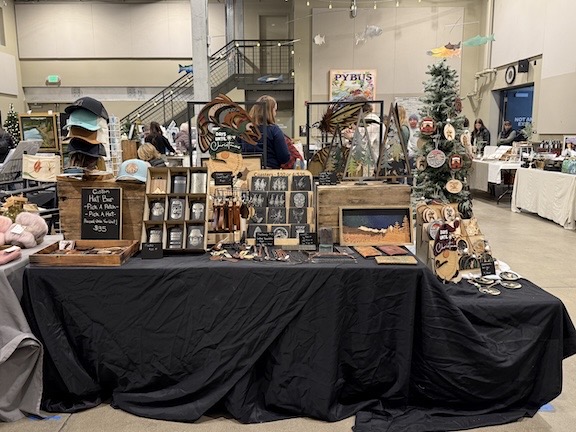
It’s a good thing I did. They put me in a back room that few shoppers visited and surrounded me mostly with assemblers, most of whom put very little effort into their booth display. The one across from me bothered me most: all of her stuff was buy-sell with the exception of laser-cut wood items she claimed to make at home. I know that kind of work. Put a piece of wood in your cutter, push a few buttons on your computer, and go get a cup of coffee while it makes “art” you downloaded from the laser cutter company. The “Custom Hat Bar” really bugged me: take a manufactured hat, iron on a manufactured patch and you’ve got a $35 piece of assembled crap.

Junk for Sale
The person across from me threw a black sheet over her table, letting it fall where it may on the floor, and just stacked up her items for sale. This was not uncommon in the back room they stuck me in.

My Booth
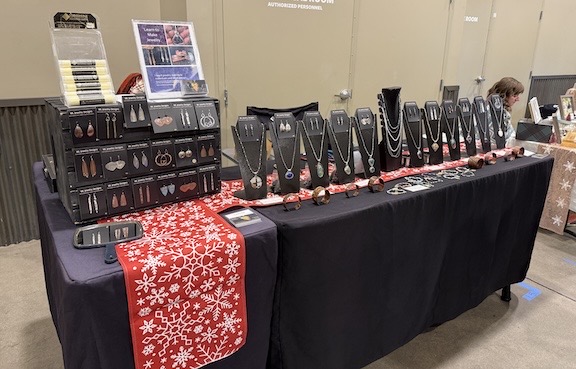
Meanwhile, my tables featured fitted table covers, seasonal runners, and custom displays.

Next to me was a woman selling stickers and plastic cups with decals on them. Just about everything in her booth was buy-sell with little or no effort on her part. The woman on the other side of me made artwork with real butterflies, but on seeing all the buy-sell crap around us, told me that next time she was going to bring the used books she’d bought for resale. Her idea of “handmade” was taking scrap paper, laminating it, and hanging a tassel on it to make a bookmark. When she told me all this, I wanted to suggest that she have a garage sale.

And there I was, the sucker selling handmade silver and gemstone jewelry. Or trying to. I didn’t make my first sale until 12:30 PM and, by the time I started packing up at 2 PM, I’d taken in just enough to cover my booth fee.

Lesson learned. I won’t be back.

I’m Tired of Selling with Assemblers and Buy-Sell “Artisans”

My friend Janet keeps telling me that I should just do the high end fine art shows. She says I’m ready for them, that my work is ready. I’ve always hesitated, worried that the high booth fees would make it impossible for me to turn a profit. But now I’m not so sure. I think that if I focus on taking all of my work up to the next level and leave the mass market appeal stuff behind, I have a chance of making that work for me. I have six months to maybe next winter I’ll go back on the road and start doing the good shows in Arizona and California.

The snow that’s falling outside as I type this now makes that very appealing.

Making

Going from working with words to working with my hands.

For years, my creativity has always centered around writing. I started writing in my early teens — fiction, back then — and managed to turn my writing skills into a career starting in the early 1990s. I wrote books and articles, mostly about how to use computers. Later, I wrote about flying and, most recently, about boating. And, of course, I’ve had this blog for nearly 20 years.

Building Solutions

But it was around 2014 that I started branching out into other creative endeavors — actually making things with my hands. It started when the building that would become my home was under construction and I had a need to make things for it. I think the first thing I might have made for the inside of my shop was my workbench, a sturdy affair made of 2×4 lengths and plywood. It’s ugly, but it’s sturdy as hell, mostly because it weighs a ton.

Shelves
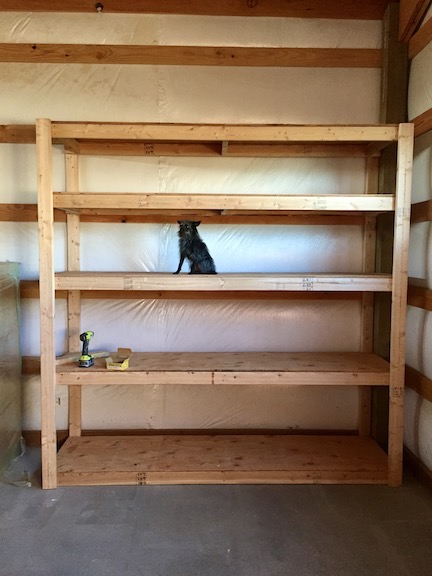
This is the first set of garage shelves I built. It’s 8 feet tall, 8 feet wide, and two feet deep. I put Penny the Tiny Dog on a shelf for scale. I built this on the garage floor and needed help getting it upright.

Since then, I’ve built various other solutions for needs I’ve had, including a number of other work surfaces, storage shelves for my garage and garden shed, and three chicken coops. (It was the third coop, a 4 x 8 foot building with a metal roof that’s large enough to walk into and has four perches, six nests, and a brooding area, that finally did the trick.)

I did a bunch of the work necessary to build or finish my home, too. I wired the whole place, laid down Pergo laminate flooring and tile, built stub walls and a shower stall, constructed deck rails for my outside deck and inside loft, put down the Trex decking on my 600 square foot deck, and added trim around doors and walls. More recently, I worked on a bathroom project that required me to lay out plumbing drains and vents, install insulation, and put up paneling. Although none of these activities called for much creativity, they still involved making things with my hands.

Along the way, I’ve accumulated a pretty respectable collection of power tools — certainly more than my father, stepfather, or wasband ever had. I have a chop saw and a table saw. I have an impact driver, three drills, and a pair of battery operated screwdrivers. I have a circular saw, a reciprocating saw, and a jig saw. I have an angle grinder and a Dremmel. I have two nail guns and a big compressor with enough hose to reach anywhere in my home or garage from the garage. And hand tools! I have just about everything I need. As my wasband used to say, “Any job is easy when you have the right tool.” Hell, yes!

And I’ve come to realize, after nearly 10 years of doing this kind of work, that I like it.

Making Jewelry

Elsewhere in this blog, I’ve already discussed how I got started making jewelry so I don’t want to rehash that here. Instead, I want to talk about how making jewelry makes me feel and why it has become a part of my life.

I look at jewelry making as a combination of challenges:

  • The engineering challenge is to come up with a design that physically works. For example, a pendant that includes a stone must have the features necessary to hold the stone securely in place. It must have a bail to hang it from a chain or other necklace. It must be balanced so it doesn’t hang awkwardly from its bail.
  • The aesthetic challenge is to come up with a design that looks good. What design elements can I include? Which stone will I work with? How will the overall design complement the stone?
  • Ruby In Zoisite
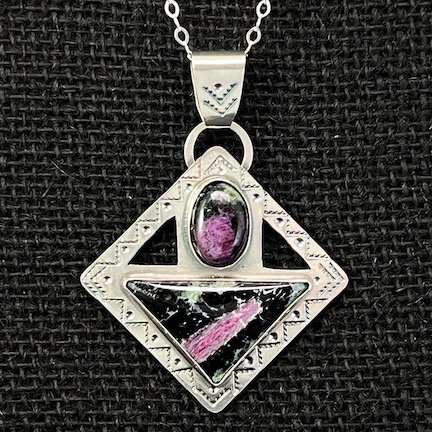
    This piece on includes two ruby in zoisite stones. It was entirely handmade from sterling silver sheet, bezel strip, and wire. The skills I used to make it include cutting, piercing, filling, stamping, shaping, and soldering the metal. As for tools — well, it took a lot more tools than I could take with me in my travels.

    The skills challenge is to be able to create the piece of jewelry I’ve designed using the silversmithing skills I have or am building. Those skills include cutting, filing, texturing, and soldering metal. My skills improve with every piece of jewelry I make, but they’re limited, in part, by the tools I have available. (I have a full set of jewelry making tools in my home-based studio, but I’m very limited when I travel.)

It’s these three challenges that make jewelry making a rewarding activity for me. There’s always something new to try. There’s aways a skill to build or hone. I will never be an expert, although I will get better and better at what I do just by doing it.

Making Jewelry for Sale

When my seasonal flying work was earning enough income to support me, making and selling jewelry was a “side gig” and it didn’t matter much whether I made more money than I spent on materials and equipment. But with my retirement this year, that has changed. I’m now treating my jewelry business more seriously as source of income. That means making more (and selling more) jewelry.

I’m fortunate in that I have several avenues for selling and they’re all pretty good. Some are better than others. About a month ago, one of my wholesale clients pretty much cleaned out my inventory of pendants, leaving me with slim pickings for my online shop and a lot of work to do before my next art show. That show is coming up in about 10 days, so, as you might imagine, I’m hustling to make more inventory.

The challenge now is to keep my creativity level up and not just make different versions of the same item. I do that, too — it’s quick to be able to make certain designs in “batch mode” — but it also takes a bit of the fun out of making. (See the second bullet point above.)

Lately, I’ve been very busy with garage projects, but for the next 10 days, I’ll try to spend 4 to 8 hours a day in my studio. (Fortunately, it has an air conditioner, which I’ll definitely need with temperatures getting into the 100s for the next few days.) I’ll work primarily on pendants, which I’m so short on, but will also try to get some earrings made. In the evening, while I’m relaxing with my pups upstairs, I’ve been making the beaded necklaces that coordinate with the pendants; I’ve made four in the past three days.

I have two back-to-back shows in Leavenworth, WA, including a five-day show for Labor Day weekend. Then I might do a half-day show in Twisp before taking whatever inventory is left to my wholesale customer in Winthrop and a gallery in Twisp. By then, it’ll be pretty close to the end of my stay at home and the start of my travels.

On the Road

Will I make jewelry while I’m away?

It was easy when I traveled with the cargo trailer I turned into a mobile jewelry studio. I could camp out in the desert all winter and spend as much time as I liked inside it with just about every tool I needed within reach. But I’m not traveling with the cargo trailer anymore. These days, I’m on a boat and space is very limited.

Ruby In Zoisite
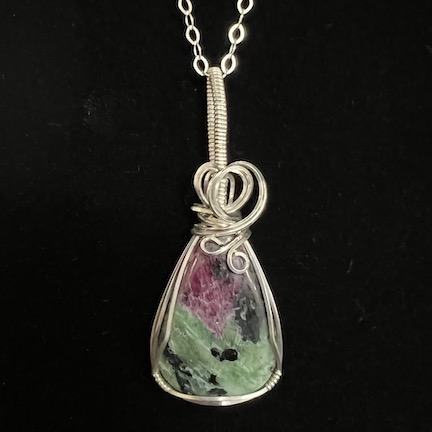
Another ruby in zoisite piece, but wire-framed. I can make this kind of pendant anywhere and it still sells well, but I’m bored with it.

The main challenge will be to put together a set of tools and materials that’ll keep me producing without taking up too much space. The wire work I used to focus on is extremely portable, but I’m kind of sick of doing that. Beading is also something I can do anywhere, but even the beads take up a surprising amount of space so I’ll need to limit what I bring along.

I’d like to be able to keep fulfilling online shop orders as I travel, but that means taking all of my inventory with me. That’s not a huge deal since jewelry is relatively small and I have a good storage case to keep it all in. I’d also like to be able to set up new wholesale accounts along the way — but that means having enough inventory to sell. And that means making while I travel.

So the answer is yes, I will make jewelry as I travel. I just don’t know how much. The next 12 months should be quite a challenge.

Why I’m Leaving Etsy — and Maybe You Should, Too?

For years, I had an online shop on Etsy to sell my jewelry. Not anymore.

I’ve made some changes in my online shop and I thought I’d take a moment to explain why and what I changed. But let me start with an explanation of how I sell my handmade jewelry.

How I Sell My Work

Most of my sales are either directly to buyers at art shows, via consignment sales at two Washington State galleries, or wholesale to a variety of gift shop owners. Each method has its own pros and cons:

  • Art shows take a lot of time and effort. I’ve got to get to the show, set up my booth, and then sit in it for the duration of the show. At the end, I have to pack it all up and get it home. Those are the cons. On the plus side, however, is that I have complete control over my inventory and sell at retail price. So I have the potential to make more money per item sold.
  • Consignment is a different ball game. I drop off inventory that the consignment place may or may not put on display immediately. When I drop it off, I lose control of it and can’t sell it. But I also have to keep track of it. If and when it sells, I get a check for 60% to 65% of the retail price. Ouch. If it doesn’t sell, I get it back, usually in serious need of cleaning before it can go back into my inventory. Those are the cons. On the plus side, it doesn’t take much effort to sell and my work eventually appears in a shop with other gallery quality items. I generally get checks every single month, year-round. Still, I’d rather not do any more consignment selling, especially for high ticket items.
  • Wholesale is pretty much the same as retail with the main benefit being that I get paid up front, don’t have to keep track of what’s sitting out there, and I never see it again. It’s the same as selling to a retail buyer, but at a deep discount. Once it’s gone, it’s gone for good.

I’d like to do a lot more wholesale selling and a lot less art show selling. Part of that is that art show success is so dependent on the venue and the weather. I usually turn a decent profit at each art show I attend, but I did lose money at a Christmas Show in Spokane last year and that hurt.

When I sell wholesale, I know my cost of sales right up front: the amount of the discount I have to offer and the cost of getting the merchandise to the buyer. When I sell at art shows, I have a lot of costs to cover before I can start seeing profits: jury fees, entrance fees, transportation costs, lodging costs, etc. — and that doesn’t even include the cost of my booth tent, tables, table coverings, displays, etc. It’s possible to pay $400 for a booth at an outdoor show 50 miles away and have weather so miserable that no one comes out to the show. Or pay $500 for an indoor show 150 miles away and be stuck in a back room none of the shoppers walk back to. This has happened to me and it sucks.

Selling Online

Of course, selling online is probably the best of all worlds. I keep control of my inventory and sell it at retail price (or maybe a slight discount with a coupon or sale). The online shop calculates and collects the money and sends my share — more on that in a moment — right to my bank account. I package the merchandise — which is easy because I’m selling small items — and ship it out. I don’t have to set up, sit in, or tear down a show booth. I don’t have to sell at deep discounts or wait until an item out of my control is sold. When an item is sold online, it’s gone and I never have to think about it again.

Lots of folks think this is the only way to sell. They think it’s as easy as setting up an online shop and ringing in the sales. But what they don’t understand is that people not only have to want what you sell, but they have to be able to find it.

And that’s where Etsy comes in.

Etsy — Then and Now

Etsy started as a marketplace for handmade goods — items created by crafters and artists. It built a reputation as a place where you could buy unique things while supporting makers. And, for some people who don’t know any better, it probably still has that reputation.

Mastodon Toot
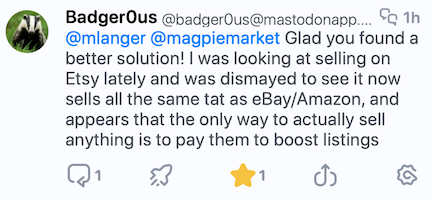
A response to my toot this morning about my switch from Etsy to Square for online selling. I giggle at the word “tat,” which is apparently UK English for “junk.”

But it’s a farce. Etsy is now full of manufactured junk, much of it made overseas and passed off as “handmade” by people trying to cash in on Etsy’s reputation. As a web designer on Mastodon commented to me today, “I was looking at selling on Etsy lately and was dismayed to see it now sells all the same tat as eBay/Amazon, and appears that the only way to actually sell anything is to pay them to boost listings.”

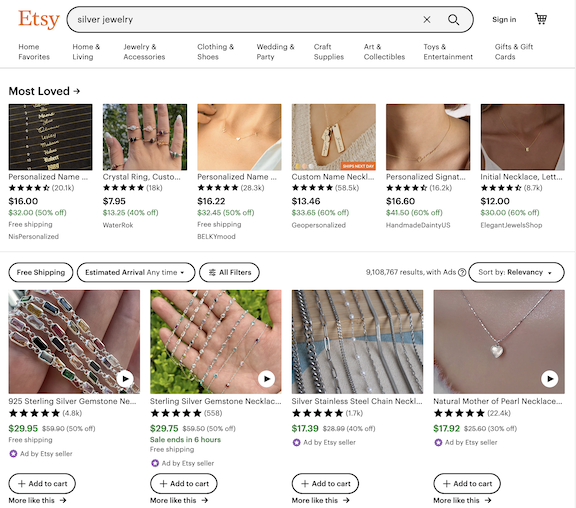
And that brings up another one of Etsy’s ploys. If you search Etsy for an item — say “silver jewelry” — it will bring up search results with Etsy sellers who paid to have their posts boosted before any other sellers. Sometimes, the search results don’t even match the search phrase. In so many cases, the results that come up are cheap crap that you know isn’t handmade.

Etsy Search Results
My search for “Silver Jewelry” brought up this collection of garbage. Are we expected to believe that someone will make you a personalized name necklace for only $16? And how much of this stuff looks like silver to you? The whole second row is paid advertising. Scrolling down (beyond this screenshot) displays more of the same. As a seller, do you think anyone will find what you make in this mess?

White Buffalo Pendant
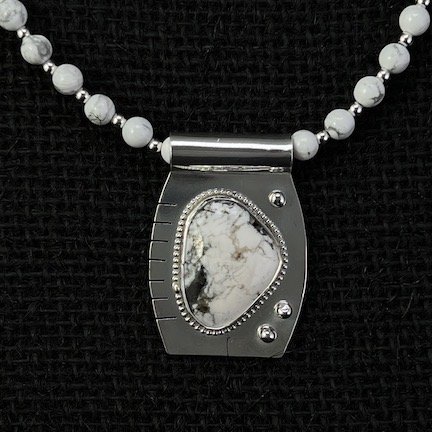
While this might not be your taste in jewelry, it’s solid sterling silver, hand formed from sheet, strip, and wire with a genuine White Buffalo Turquoise cabochon in it that was hand polished by a lapidary friend just for me. Even the beaded necklace has sterling silver beads, although the white beads are howlite.

So I’m making quality sterling and fine silver jewelry with gemstones using a wide variety of silversmithing tools and techniques and I’m competing on Etsy with this crap?

But wait, there’s more!

Recently, Etsy decided, out of the blue, that it was going to hold back 70% of my payment as a “reserve.” No real explanation of why. It just had to wait an extra week or two to get my money.

Add that to Etsy’s fees:

  • 20¢ for each listing, including automatic re-listing of an item that didn’t sell in 60 days and automatic listing of multiple quantity items when one sells. So, in other words, you’re going to pay 20¢ per item just to be able to show it on Etsy.
  • 6.5% of the order total, including shipping and gift wrapping fees, if charged.
  • 3% + 25¢ for payment processing fees.
  • 15% of the order total for sales made through the use of Etsy’s offsite advertising. Yes, if Etsy puts an ad on Google and someone clicks that ad and it takes them to your shop and they buy something, you pay Etsy an extra 15%. This is an opt-in feature and I’m pretty sure the fee used to be 20%. I opted out when I realized what it was costing me; somehow all of my sales were being hit with this fee.

And this doesn’t even begin to cover the optional monthly fees you can pay for shop customization options or the optional marketing fees you can pay to boost listings and get them at the top of search results.

So, in all, we’re looking at roughly 10% to 25% of the listing price to sell it. And that’s if it sells the first time it lists. You’ll pay an extra 20¢ every time it’s relisted.

Yes, I know this is less than the cost of selling by consignment or wholesale and even less than the cost of selling directly to buyers at art shows given the cost of doing art shows. But I think it’s a bit outrageous when you consider that I’m not getting my money immediately and my work is pooled in with so much other crap.

Sellers Revolt

Etsy sellers are not taking this sitting down. Or at least some of them aren’t. The withholding of money has gotten Etsy sellers up in arms enough that they’re threatening to strike. And that has resulted in Etsy backpedaling to reduce the amount it withholds. I got an email telling me that they were only going to withhold 30% of my sales.

Too little, too late. For the reasons listed above, I’m outta there.

I set up my shop to be “on vacation” with a vacation notice that says my shop is permanently closed and they can find my new shop on Square. Of course I included a link. I also turned off all automatic listing renewals for everything still listed in my shop. One by one they’ll disappear. When they’re all gone, I’ll delete the shop. Unless Etsy deletes it first.

The Square Solution

I use Square for credit card processing. I have been using it since it first appeared as a credit card acceptance option, back when its target market was garage sale runners and babysitters.

Back then, I set it up for my flying business. I was tired of using a credit card acceptance system that charged me a minimum monthly fee, statement fees, and a relatively high credit card processing fee. It was costing me more than $50 a month, even when I didn’t accept any credit cards.

Square was different. It used a smartphone app, charged a reasonable processing fee, and that was it. No monthly fees, no minimum fees. The only catch (back then) was that they wouldn’t pay out more than $1,000 per week. They weren’t expecting folks like me who sold service that often started at $1,000. But I was able to get around that with them by providing documentation that proved I was legit and had other credit card processing service in the past. The upped my weekly limit to $5,000, which was fine. (There isn’t any limit anymore.)

So when I started doing art shows, it made sense to set up a Square account for my jewelry business. While people might whine and complain that the rate is too high — seriously? — or they have some other imagined gripe about it, I have no complaints about Square, at least not yet.

One of the things Square now offers is the ability to sell online. While they didn’t implement this in a user friendly way, I have enough tech knowledge that I was able to figure it out. I started building my online store more than a month ago and now have most of my inventory in it. You can find it at MLJewelryDesigns.square.site.

It’s simple, but that’s okay. I think it looks professional — certainly a lot better than Etsy ever looked. It works.

Best of all, it’s free. No listing fees, no selling fees. All I pay is the cost of credit card processing, which I would if I were selling at an art show. It even has a built in shipping calculator that lets me buy discounted postage to ship items out. Just like Etsy.

Yes, there are upgrades available for a monthly fee. One of them would let me use a custom domain name, which I’m considering. Others offer better marketing options or shop analytics — most of which I don’t need and certainly don’t want to pay for. I’m not fooling myself here: I don’t sell much online and don’t think I ever will. But I want the option. I want to be able to send folks to a place where they can buy what I make 24/7.

And that brings me to marketing.

Promoting My Online Shop

I remember the early days of the worldwide web — you do know that’s what the WWW stands for, right? Back in the day, everyone wanted an online shop. They thought that all you had to do was set up a website and people would just buy, buy, buy whatever you were selling. No one seemed to realize that people had to want what you sell and find your shop before you could maybe sell to them.

And that’s where marketing comes in.

Yes, I have an online shop. Yes, there are features built into Square’s online shops to be found by Google in searches. But I’m not dumb enough to think that I can just sit back and let those two things bring me sales.

If Facebook is your business’s website, you’re doing it wrong.

Serious business owners have real websites for their businesses, not Facebook pages.

You might think it’s enough to just put your business on Facebook and steer folks to your page, but it isn’t. First of all, it’s alienating people like me who wouldn’t open a Facebook page to follow a friend, let alone get more information about a business. Second, as discussed in this blog post by UK web designer Nick (who also authored the Mastodon toot above), you’re at the mercy of Facebook’s algorithms to determine whether what you post on Facebook will even appear for the folks who follow you.

You can do better than that without breaking the bank. Heck, even my WordPress-based sites have the ability to forward all of my posts to the folks who want to see them. No algorithm will block that.

No. I have to send people to my shop. And I do that several ways:

  • Maintain a website. I use the ML Jewelry Designs website as way to share news with visitors, including folks who actually subscribe to get that news. And yes, I get a bump in website hits and even a few online sales after every art show I attend. Also note that I used the word “maintain.” That means adding fresh content regularly. No one wants to visit an out-of-date website more than once.
  • Distribute business cards at art shows. My cards have a photo of one of my pieces of jewelry and a link to the ML Jewelry Designs website. The website is not my shop, but it does have links to my shop and links to specific pieces of jewelry. Those cards are not only available in multiple places in my booth, but I also slip them into the packaging for every single item I sell.
  • Post about new work on social media. The website does this for me. I use WordPress which posts to Mastodon for me. I’m not on Facebook or Twitter (or X, the dead bird site) anymore. I do have an Instagram account and I try (but mostly fail) to post there. Any social media post I make has a link to either my website or the actual listing in my online shop for the jewelry I’m showing off.
  • Link where appropriate. I link to the ML Jewelry Designs website wherever appropriate, including this blog and from the organizations that sponsor the shows I do.

No More Etsy for Me

While I know that several of my artist friends have had some success with Etsy and haven’t seemed too bothered with the reserve or fees, I can’t say the same. If you’re like them and Etsy is working for you, stick with it. But if, like me, you’re tired of your work being hidden away among so much manufactured crap, maybe it’s time to find another solution.

I’m done.

Doing the Math on Art Shows

I compare art show venues to see which ones really do give me the best bang for the buck.

I’ve got a sort of running debate with a friend of mine about art show fees and which methodologies are best for artists.

Fee Considerations

Clearly, in a beautiful, perfect, artist-friendly world, show fees would be low and shows would be full of art lovers with deep pockets and plenty of empty wall space or jewelry/pottery/other craft needs.

But that’s not the way it is. Show runners want to make money far beyond the cost of running their venue and the artists are the draw. They set their fees based on what they think artists can afford to pay, with the goal of filling every available spot.


Here’s my jewelry sales booth as it appeared at Leavenworth Village Art in the Park on May 19. I’m trying to display my work as serious and elegant; most folks seem to think I’ve done it.

Artists, on the other side of the transaction, have to consider fees when they decide which shows to apply for. The higher the fees, the more work needs to be sold. Is it possible to sell enough work at the artist’s price points to cover show fees? And what about other expenses, such as the cost of getting to and from a show, lodging, parking, and who knows what else?

In general, better shows — ones with good track records for attracting lots of shoppers and scoring high on artist satisfaction — command higher fees. That can also be said for shows that can attract shoppers with deeper pockets or ones where the quality level of the artist work meets a higher than average standard. In both cases, the potential to sell work at higher prices might make it easier to cover fees.

But in nearly all cases, it’s a gamble. And in the short time I’ve been doing art shows, I’ve seen that firsthand.

Two Fee Methodologies

There are several fees involved with doing art shows and it’s worthwhile to take a look at each one.

  • Application Fee. This is usually a small amount of money — under $50 but usually closer to $10 or $20 — that must accompany an artist’s application to participate in a show. It is non-refundable and is apparently used to cover administrative costs.
  • Jury Fee. This is also usually a small amount of money — again, under $50 — that’s paid to judge an artist’s work before acceptance. Artists are normally required to submit photos of their work and their booth and may also sometimes be required to submit one or more photos showing them actually making the work to prove that they make it themselves. This is also non-refundable. Some shows will charge just a jury fee, if the show is juried, and not an additional application fee.
  • Booth Fee. The booth fee is usually the expensive part of doing a show. Fees can range from $20 for a Farmer’s Market table to well over $1000 for a spot in an indoor venue showcasing fine art in a major city. Just about every show is going to charge a fee for your space, based in part on the size of the booth and its position. A 10×20 foot space that’s open on two or more sides — like in a corner — would usually cost significantly more than a 10×10 space in line with other artists.
  • Commission Percentage. In addition to the booth fee, some venues charge a commission based on artist sales. They could process the sales of all artists centrally or provide special sales slips for artists to fill out to record each sale or use the honor system for artists to report sales. Commission percentages vary and are usually higher at venues with lower booth fees.
  • Other Fees. In addition to all this, some venues charge extra for power, draperies, tables, lighting, local business licenses, and insurance.

I’ll give you two examples.

Wenatchee Apple Blossom Festival Arts and Crafts Show, a three-day show where I’ve sold my work twice in the past four years, has the following fees:

  • Application/Jury Fee: $30
  • Local Temporary Business License: $25
  • Insurance Fee*: $85
  • Booth Fee: $299

Leavenworth Village Art in the Park, a three- to four-day show where I sell my work on about five weekends per year in the spring and late summer, has the following fees:

  • One-time application/jury fee for season: $15
  • Per weekend Security Fee: $30
  • Booth Fee: $0
  • Commission Percentage: 21%


* You can usually skip the insurance fee charged at an event by carrying your own insurance, which I do. It costs $375/year and covers all of my events.

The Debate

So the main part of the debate is this: which fee structure is best for artists? Flat fees or commission based fees?

First I need to mention one other thing: I’ve seen shows that have a relatively high booth fee — maybe $500 — plus a commission percentage of 20% or more. (I’m looking at you, Sacramento.) I avoid shows like that because I honestly don’t see how I can make any money. I also think those show runners are being unreasonably greedy and I don’t want to support them in any way.


Oh, this Seattle show! Although I paid the same as the artists in the main room with 10×10 booths, I was given a 10×7 space in a side room with six other unfortunate artists. The window behind my booth was old and drafty; on those November days, it was about 50°F in my chair. I didn’t lose money on this show, but sales were disappointing. I think I would have kicked butt in the other room, but who knows?

That said, the answer to the question of which is better really depends on the show. If it’s a great show and you have lots of sales, it’s better to avoid paying a commission on sales. After all, the more you sell, the more you pay.

But, at the same time, if the show is crappy and sales are low, commission based fees are better because you’ll pay less.

Let’s look at some hypothetical numbers, comparing the Apple Blossom show to the Leavenworth show. For the sake of argument, we’ll say the artist does Leavenworth just once so that one-time application fee doesn’t need to be split among multiple shows.

ItemApple BlossomLeavenworth
Gross Sales$3,000$3,000
Fees:  
  Application Fee$30$15
  Business License Fee250
  Insurance Fee850
  Security Fee030
  Booth Fee2990
  Commission0630
Total Fees$439$675
Net Sales*$2,561$2,325
Sales Cost Percent (Net÷Gross)14.6%22.5%

So in this case, the fixed fee event would be a better deal for the artist, allowing her to take home more money.

But what if the outdoor event was on a really crappy weather weekend? Cold and rainy and folks just didn’t want to come out? Say the artist sales that weekend were a disappointing $1,000. The story changes quite dramatically:

ItemApple BlossomLeavenworth
Gross Sales$1,000$1,000
Fees:  
  Application Fee$30$15
  Business License Fee250
  Insurance Fee850
  Security Fee030
  Booth Fee2990
  Commission0210
Total Fees$439$255
Net Sales*$561$745
Sales Cost Percent (Net÷Gross)43.9%25.5%

Totally different picture, no? Basically, the worse the show is for you, the less you pay in fees if your main fee is based on a commission.

This really comes into play when you have a totally crappy show, like the one I did in Spokane last November. Billed as a Holiday Arts and Crafts show where the show runners actually charged shoppers a fee to get in, most shoppers seemed more interested in buying $13 caramel apples than any sort of quality artist work. Between the show fees of $340 and the cost of making the 3-hour trip (each way) to Spokane, I wound up losing money on the show. (It would have been worse if I’d had to stay in a hotel, but I stayed in my truck camper on the fairgrounds and no one ever collected a fee.) Needless to say, I won’t be doing that show again.

But then again, if you have a great show that charges a commission percentage, it really costs you.

And that’s where the debate stands.


*Net Sales does not include other expenses of attending a show, such as transportation, lodging, parking, credit card fees, etc. All those do need to be calculated by the artist to come up with a total cost for the show when evaluating it.

What’s the answer?


Sunday mornings are always slow in Leavenworth, no matter how beautiful the weather is.

We don’t know how a show is going to be before we attend so it’s impossible to determine which will work out better in advance. Of course, prior attendance at a show can give you an idea of how it might work out. But even that isn’t guaranteed. I did well in Spokane in 2021 so I assumed I’d do just as well in 2022. I didn’t. Not even close. And the weather is always a factor, especially at outdoor shows.

I’ve done three shows in Leavenworth this spring and the first two were disappointing while the last one was really good. I paid relatively low fees for the first two but was hammered at the third. Still, my cost percentage remained between 22% and 26%. The percentage I take home is pretty solid. There’s some reassurance in that. It’s pretty much impossible to lose money at a percentage-based show. Low sales, low fees.

So there is no answer. It all depends.

And that’s part of what artists deal with when they try to sell their work at shows.

The other part? Setting up and tearing down a booth. Buying and maintaining display equipment. Getting to and from shows. Parking. Sitting in a booth all day, possibly leaving work unattended during trips to the restroom. Dealing with often thoughtless shoppers who make audible comments to friends about how easy it is to make this or how overpriced that is. Seeing your work handled by people who then drop it back down to bang against the metal display. Watching kids with ice cream on their hands touching everything. Keeping an eye out for dogs lifting their legs on table draperies and tent sides.

But let’s not forget the good stuff, too. Being told your work is beautiful. Being complemented on your unique designs. Having a customer buy an expensive piece that took you hours to make and telling you how much they love it.

All that should figure into the costs and benefits of being an artist at an art show, too, no?

Welcoming a Vaccine Mandate

I share some thoughts about how Washington’s upcoming vaccine mandate may affect my participation in an art show.

Custer's Arts & Crafts
The Christmas Arts & Crafts shows are just two of the shows Jim Custer Enterprises produces.

Yesterday, I got an email from Jim Custer Enterprises, a Spokane-based company that manages arts and crafts and other shows in Washington state. I’m signed up to participate in two of their holiday art shows in November this year. The email was related to a vaccine mandate going into effect on November 15, 2021 for all indoor events to be attended by more than 1,000 people.

My History with Custer Shows

This will be the first time I’m attending any of Custer’s shows. I had originally applied to one of their shows way back in spring of 2019 but my application was late and they were already full. I applied again for the November 2019 shows and was waitlisted. Undaunted, I applied again for their two spring 2020 shows and was accepted. But then Covid came along and both shows were cancelled. The November 2020 shows were also cancelled. So were the spring 2021 shows.

But the November 2021 shows were not cancelled and my previous acceptance got me in without going through the whole reapplication process.

There are two shows — one in Pasco and one in Spokane — and both are indoors. Most of the artists I know in the area are familiar with the shows and several from Leavenworth’s Village Art in the Park, where I sell my jewelry a few times each year, are going to both of them. They say good things. I was slightly concerned when I learned that the shows had an admission fee — it seems to me that less people will attend if they have to pay a fee to get in — but I suspect that if people are willing to pay to attend, they’re also more likely to buy. I’d rather have X number of serious shoppers than X times 5 number of browsers who are coming to waste time (theirs or mine) or look for ideas for their own work.

Because both of the upcoming shows are in November, they are holiday shows full of gift buyers. I’ve been spending the past week making jewelry and, will continue to do so right up until November 3 when I have to pack for the Pasco show. It would be a crying shame if I ran short on inventory and I’ll do everything in my power to prevent that from happening. These two shows are the last two I’ve got scheduled for 2021, so I want them to be successful. As I’ve mentioned elsewhere, 2021 is the year that ML Jewelry Designs will finally turn a profit — after years of investing in equipment, materials, and education and taking a big hit from Covid closures in 2020. These shows will be my last chance to make that profit big.

The Vaccine Mandate

The email message I got from Custer talked about a vaccine mandate that I was not aware of that takes effect on November 15 and how it may affect the Spokane show. It started like this:

We are sending this email today to bring you updated Covid-19 protocol information. Last Friday, Washington State Governor Jay Inslee announced a new Vaccine Mandate that is going into effect on November 15, 2021. If you are an artist in both our Pasco and Spokane Shows, this mandate only applies to the Spokane Show since it will take place four days after the mandate goes into effect.

It then went on to provide exact wording from the mandate:

Everyone over the age of 12 must show proof of Covid-19 vaccination (verified by CDC record cards, photo of the card, printed certificate or screenshot from MyIRMobile.com or other immunization records from health providers) to attend the event OR show proof of a negative Covid-19 test taken within 72 hours of the event.

It then explained how the mandate affected the show and reminded artists that if they have not been vaccinated yet, their only current option is the one-shot Johnson & Johnson vaccine, since there isn’t enough time now to get both shots of either the Pfizer or Moderna vaccines prior to the show. If the artist did not want to get the vaccine at all, he/she would have a very narrow window to get the Covid-19 test and prove negative results prior to the show — and testing is backed up in Spokane right now.

(Honestly, I think that anyone who makes a living participating in art shows who is not vaccinated is a total idiot — how can they risk regular exposure to so many people without protection? But hey, I believe in science and I think the “personal freedom” argument is a lot of bullshit fed to gullible people incapable of their own thought by manipulative “conservatives” in their never-ending efforts to divide Americans into Us vs. Them.)

Expected Trouble

The email includes the following, which also came to my mind:

If you are wondering how this will affect attendance, we are in the same boat. There will be people who will be frustrated and upset by the mandate who will make it political. There will also be people who will feel more comfortable attending because of the mandate. At this point, we are so happy to be having any show that we will take what we can get! Truly, it’s better than last year when there was no show at all. The people that will be there, will be ready to buy! There’s no doubt about that.

First of all, I have to admit that I will feel a lot more comfortable participating in a show with this new mandate in effect. I had the less effective J&J vaccine — which was the only one available when I went to be vaccinated at the end of March — and am not sure if I’ll be able to get a booster prior to the show. I’m terrified of becoming a breakthrough case — two of my vaccinated neighbors got it from a vaccinated employee who tested negative three times before a positive test result. That tells me that I can’t put 100% of my faith in either vaccines or tests. Despite that, I feel a lot safer knowing that everyone attending will either be vaccinated or have gotten a negative test. While this does not eliminate the risk (in my mind, anyway), it does greatly reduce it.

I should also reiterate here that I’m not worried about dying of Covid-19. I’m worried about long-term effects that could possibly reduce my quality of living for the rest of my life.

Unfortunately, both shows — Pasco (to be held pre-mandate) and Spokane — are in the red side of our blue state. That means many folks have bought into the “conservative freedoms” argument for not getting vaccinated. Never mind that vaccines for polio, smallpox, measles, mumps, rubella, shingles, tetanus, and flu have been either required or widely available and used with little or no side effects for decades. These people have been convinced that their personal freedoms are being threatened by Covid-19 vaccine mandates and that it’s their “God-given Constitutional right” to refuse a vaccine that has the potential to save their life or at least help them avoid a serious, contagious virus.

So I suspect there will be a lot of push back including, but not limited to arguments at the gate. Violence would not surprise me. I hope Custer hires a good security outfit.

I also suspect that folks will be using — or trying to use — fake vaccine cards. I sure hope they’re caught. I believe they should be arrested, but I suspect they’ll just be turned away. If they’re caught at all.

Will folks who, like me, are worried about Covid be more likely to attend? I sure hope so. I’d honestly prefer selling my work to like-minded folks. I’m sick and tired of listening to anti-vax whiners moaning about their freedoms while putting my health at risk.

Meanwhile, I have to admit to hoping that a few angry, idiotic artists back out of the show in some sort of protest. First of all, I don’t need two work among people like that. And second, well, less competition.

It’s Business

In the meantime, I have a lot of sympathy and respect for the folks at Jim Custer Enterprises. These people make their living producing shows and everyone I’ve spoken to about them agrees that they are good people. I can imagine how having to cancel shows for a year and a half must have affected their business. No income for that period! It’s a wonder they’ve been able to survive at all.

It’s this closing paragraph that sums up their situation to me (emphasis added):

As we wrote in our cover letter when you first applied, flexibility is the key to your successful show participation this year. We are in a global pandemic and it is not over. Yes, everyone has an opinion about it. However, as business owners of a company who brings together large numbers of people, we will continue to trust the science and comply with whatever mandates will help the shows go on.

No matter how the show turns out, it’s a real pleasure to do business with an organization that not only thinks like this, but isn’t afraid to make their thoughts on the matter public.