Getting a Part 135 Certificate

Don’t expect free help from me.

Last night, I received yet another e-mail from a helicopter operator with questions about getting a Part 135 certificate. I thought that it was about time for me to explain why people who e-mail me for free help about this won’t get it.

But first, a bit of an explanation of what a Part 135 Certificate is.

What Is a Part 135 Certificate?

A Part 135 certificate is literally a piece of paper issued by the FAA that permits a commercial aircraft operator to perform air-taxi operations. The phrase air-taxi refers to the mission of picking up a passenger at Point A and transport him to Point B. A Part 135 Certificate also permits an operator to conduct aerial tours beyond the 25 statute mile limitation set by Part 91 or the relatively new Part 136. Part 135 gets its name from the Federal Aviation Regulations (FARs) Part 135, but a Part 135 operator must also comply with all other applicable FARs, including Parts 61, 91, and 119.

Zero Mike Lima at Monument Valley

Zero-Mike-Lima at Monument Valley during one of my multi-day excursions.

A Part 135 certificate is worth more than its weight in gold for an operator that has one and can use it properly. For example, if I didn’t have one, I’d be limiting my operations to short tours within 25 miles of my starting point and aerial photo/survey flights. With a Part 135, however, I can also take my tours as far as I like, transport passengers between two points, and even offer day trips and multi-day excursions. In the highly competitive area I live in — Arizona is just swarming with helicopter operators — a Part 135 Certificate gives me the competitive edge I need to stay in business. (With less local competition, I might even become profitable. Wouldn’t that be special?)

There are three types of Part 135 certificates: Single Pilot, Single Pilot in Command, and Basic. I have a single Pilot Part 135 certificate. That means that under my company’s certificate, only one pilot is allowed to fly the aircraft under Part 135: me. (Hint to jobseekers: that’s one reason why I don’t ever hire other pilots.) A Single Pilot in Command certificate is similar, but is used mostly in organizations with aircraft that require more than one pilot; just one of those pilots is allowed to fly as pilot in command, but any other pilot can be second in command. The Basic Part 135 certificate — and I may have its name wrong — allows multiple pilots to act as pilot in command on multiple aircraft. The Grand Canyon tour operator I worked for had a Basic Part 135.

At a recent meeting at my local Flight Standards District Office (FSDO; pronounced fizz-doe), I learned that there are only 4,800 Part 135 certificates in the entire country. If you take a moment to consider what percentage of those could possibly be helicopter operators, you’ll realize that I’m part of a very small club.

The penalty for conducting a Part 135 operation without a Part 135 certificate? Well, I know of at least one pilot who had his license permanently suspended. Ouch. When you consider the amount of time and money a commercial pilot — especially a helicopter pilot — might have invested in a career, that’s a very costly penalty.

Airline operations, by the way, are Part 121, which has tighter regulations.

How to Get a Part 135 Certificate

You work with your local FSDO to get a Part 135 Certificate. It requires multiple meetings at the FSDO to work your way through a flow chart of activities. Although I’ve heard of people getting their Single Pilot Part 135 as quickly as three months — it took me four months — it takes other people years. In fact, more than a few operators have gone out of business while working through the process.

Want Help Writing a Statement of Compliance?

When I wrote this blog post back in 2010, I was firmly against helping operators create their Statement of Compliance. At time time, I was based in Arizona with a lot of competition making it damn near impossible to turn a profit. Things are different now. It’s 2017 and I’m comfortably settled in Washington State with a small market but little competition for Part 135 work. In addition, I have found more lucrative sources of flying revenue that don’t require a Part 135 certificate at all. Add to that the FAA’s recent requirement for all Part 135 helicopter operators to have a radio altimeter and the cost to obtain that and I’m a bit softer about helping others — for a fee. Let’s just say that the FAA has motivated me to sell my experience and possibly increase its workload.

So here’s the deal. If you’re interested in getting help writing a Statement of Compliance for a Part 135 certificate, use the form on the Contact page of this site to get in touch with me. Tell me a little about your business and the aircraft you fly, the kind of Part 135 certificate you’re seeking, and where you are in the process with your FSDO. If I think I can help you, I’ll let you know what kind of compensation I need to write a Statement of Compliance for you.

Keep in mind that although this will make the process easier, it’s still time-consuming and you’ll still have a lot of work to do on your own.

There’s a lot of paperwork. The biggest challenge to most people is the creation of a Statement of Compliance. That’s where you list all the applicable FARs and state exactly how you will comply. My Statement of Compliance, written in 2005, was 54 pages long. It wasn’t difficult for me to create because, after all, I am a writer. But I’d say that 90% of the people who try to get their Part 135 certificate stumble on this component, which occurs about halfway through that flow chart.

You’ll also need to get on a drug testing program, create a training manual for carrying (or not carrying) HazMat, and obtain a secure location for basing your aircraft. You’ll need to create forms for pilots to log time flown, aircraft flight time, and squawks. You’ll need to have perfect maintenance records. If you’re going for a Basic Part 135, you’ll need all kinds of other manuals and documents, as well as staff in predetermined positions, such as Director of Operations, Director of Maintenance, etc.

The FAA did not make the process easy. If it were easy, everyone would have a Part 135. Instead, they made it a challenge.

I am extremely fortunate to be working with an excellent FSDO full of people who are reasonable and helpful. Yes, I’m required to jump through the same hoops as everyone else, but my contacts at the local FSDO help me make those jumps. In turn, I comply with their requests promptly, without question. After all, their mission is to keep me safe. Why wouldn’t I want to be safe?

Why I’d Rather Not Help You Get Your Part 135 Certificate

I’ve already given you several hints on why I’d rather not help you get your Part 135 Certificate. Did you read between the lines to get the answer? If not, I’ll spell it out for you.

  • Rise to the challenge. I personally believe that the FAA makes it challenging to get a Part 135 Certificate as a test to see if applicants are worthy. Let’s face it: the FSDO folks spell out what you need to do — using a flowchart, for Pete’s sake! If you come into the application process with the right attitude, they’ll help you achieve your goal. But they won’t just give you a certificate for showing up. You have to earn it. By jumping through all the hoops and smiling the whole time, you’ll prove that you have the right stuff to be a safe and cooperative aircraft operator. If I — or anyone else — help you get your certificate, you won’t prove anything other than that you can’t do it alone.
  • Membership has its privileges. That old American Express slogan can easily be applied to the 4,800-member club of Part 135 certificate holders. We can do things that Part 91 operators can’t. This gives us far more flexibility in our operations. I can’t tell you what a joy it was to finally be able to say yes to a client request for an air-taxi flight. Saying yes means more business, more revenue.

I get e-mails and calls at least twice a month from helicopter operators hoping I’ll help them get their Part 135 certificate or make their business grow. Apparently, it isn’t enough for me to write about my own experiences here so they can use them as learning tools. Instead, they want me to take them by the hand and walk them through the process.

Why should I? What’s in it for me?

I did the hard work I needed to do to get my certificate and build my business. Isn’t it in my best interest to have other operators jump through the same hoops I did and prove they’re worthy of getting a Part 135 certificate? Wouldn’t I rather be sharing the skies with pilots who passed muster with the FAA? Wouldn’t I rather refer overflow business to an operator I know has the ability to do his own homework?

You want a Part 135 certificate? Take my advice: Call your local FSDO and set up a meeting to get started. Then put a smile on your face, roll up your sleeves, and get to work.

Helicopters 101: Flight Planning

The basics of cross-country flight planning for helicopters.

Articles in the Helicopters 101 series:
Flight Planning
CG
Weight
Hover Charts
Ground School

Recently a reader of this blog wrote to suggest that I cover cross-country planning as a blog topic. I searched my archives and found that I already had. My post, “Flight Planning,” goes into a great deal of detail about the process I use to prepare for Part 135 charter flights, which require a complete flight plan. But that’s probably not what this reader was talking about. I think he was more interested in the nuts and bolts of creating a flight plan.

This weekend, I have to make three relatively long cross-country flights:

  • Wickenburg, AZ (E25) to Page, AZ (PGA) – 189 nm direct
  • Page, AZ (PGA) to Salt Lake City, UT (SLC) – 232 nm direct
  • Salt Lake City, UT (SLC) to Seattle, WA (BFI) – 601 nm direct

I’ve flown the route from Wickenburg to Page and back numerous times. I’ve done Salt Lake CIty to Page once and Seattle to Salt Lake City once. I figured I’d use the PGA to SLC flight, which I’ll be doing alone, as an example of how I plan a flight.

Weather

A few days before the scheduled flight, I start checking the weather along my route. I use the National Weather Service’s NOAA Web site for weather information. After all, the NWS is the source of all the weather data for the United States. That’s where the Weather channel and Duats and the FAA get raw weather data. Although each weather reporting organization may interpret it slightly differently, it’s all based on the same stuff. And the NWS site doesn’t bombard me with obnoxious advertising.

A lot of folks use the Aviation Weather link to get aviation weather information. I don’t — at least not a few days out. Remember, I’m flying a helicopter. I’m 500 – 1000 feet off the ground. I don’t care much about upper level disturbances, the jet stream,or icing in clouds. I’m not getting anywhere near that stuff.

Page Weather

The graphic weather forecast for Page on the morning this post was written.

What I’m interested in is forecasted conditions for the departure and arrival airports, as well as any cities in between. So, in this case, I would check out the weather forecast for Page, Salt Lake City, and possibly Richfield, which is roughly halfway between the two. I’ll pay close attention to the forecast for my day of travel, as well as the day before and after.

What I see today is relatively poor forecasted conditions for Saturday, the day of my flight, with chance of rain or snow at each location. Not what I want to see, but remember, it’s a forecast. It will probably change. I have to hope it gets better.

Route

Next, I plan out my route. Although I listed straight-line distances at the beginning of this piece, I seldom fly in a straight line. Instead, I try to find a route that’s a compromise between a straight line — which, out in the desert, usually means doing a lot of flying in the middle of nowhere — and following roads — which is where people will be if I need help.

Now I need to make it clear that unless there’s a road going the way I need to go, I’m not going to follow roads to get from Point A to Point B. I don’t want to go out of my way — at least not too far. Helicopters are expensive to fly and I’m not made of money. The time budget for this trip is 2 hours — that’s what the client paid for — and I’ll need all of it and then some. So what I want is a compromise that puts me near roads for part of my trip.

I plan my route with charts. World Aeronautical Charts (WACs) are very handy for long cross-country flight planning. But sectionals offer more detail.

Of course, I cheat. I use SkyVector.com. It puts the charts onscreen and enables me to do some very basic flight planning — mostly distances and directions. As the site warns — probably with the advice of lawyers — it’s not for navigation or preflight use. But I use it for preliminary planning. It really helps me get a good idea of where I need to go.

Options

The pink line at the bottom is the direct route from Page to Brice; the red and blue lines are my two options for continuing northbound without overflying 10,000 foot mountains.

In this case, I’m seeing that a direct flight from Page (PGA) to Bryce Canyon (BCE) would take me 57 nm mostly over remote, high desert terrain, climbing from about 4300 feet to over 7000 feet. No major mountain ranges to cross along the way — and that’s good.

From there, I can follow the East Fork of the Sever River and the road beside it northbound between a pair of mountain ranges topping out at over 10,000 and 11,000 feet, then follow a pass that’ll hook me up with Highway 89. This map shows it as the red route. That’s the way I flew last time and the only drawback I recall was the rough air in that pass.

The other option is to continue on almost the same heading to Panguitch (U55), which will hook me up with Highway 89. I can then follow that northbound between two mountain ranges topping out at 11000 feet, staying slightly lower in overall altitude and sticking with a well-traveled road. This map shows it as the blue route.

Completed Route

My planned route, roughed out on SkyVector.

I continue this process for the entire trip. This one’s pretty easy; I’ll be following Route 89 most of the way. When I get to the outskirts of Salt Lake City, I’ll be following I-15. This turns my 232 nm trip into a 259 nm trip and adds at least 15 minutes of flight time. But I’ve minimized my flying time over the middle of nowhere without detouring too much out of my way. The WAC charts I pasted together here from SkyVector screenshots give you an idea of what the entire route looks like. I can also see that my flight without wind could be as long as 2-1/2 hours. My helicopter’s endurance is just 3 hours, so I need to consider the possibility of needing a fuel stop if I hit headwinds. Fortunately, there are plenty of airports with fuel along the last 50 miles of my route.

By the way, the main benefit to following a road when you enter busy airspace and don’t know the local reporting points is that you can state your position to ATC in relation to the road. For example, “Helicopter Zero-Mike-Lima is ten miles south over I-15” is a very definite location.

Once I get a rough outline of the course, I go into detail with sectional charts. I buy them as needed for my cross-country flights. I’ll check to be sure there’s no special airspace or weird activity (think gliders and ultralights) along the way. I’ll also look for charted power lines — not that I’ll remember them when the flight time comes. I’ll make a cheat sheet of airport names, designators, elevations, and frequencies so they’re easy to enter into my GPS for added navigation assistance during flight.

Although I don’t usually mark up my local charts (Phoenix sectional and terminal area chart), I don’t mind taking a highlighter to the Las Vegas and Salt Lake City Sectionals I’ll use for this trip. I’ll also have a Salt Lake City terminal area chart on hand. Before I start my flight, I’ll fold them all neatly to expose the route. With just one hand to fiddle with charts, it’s much easier to prepare before lift off.

Destination Information

On this particular trip, I’ll be landing at Salt Lake City Airport, a Class Bravo airport I’ve never landed at before. I’ll need to know where on the airport I’ll be landing so I don’t sound like a complete idiot when I talk to the tower.

Airport Diagram

The airport diagram for SLC. General aviation is handled in the southeast corner, not far from the I-15 freeway.

I could pull out my Airport/Facilities Directory and look up the airport, but that green book is already stowed in the helicopter for the trip. So instead, I’ll hop online to the FAA’s AeroNav Services (formerly NACO) web site. Once there, I’ll click the link for Free Digital Products and then click d -TPP and Airport Diagrams on the page that appears. (Note that you can get a PDF of the page(s) for a specific airport from this site, too.) I’ll use links and search to get the Airport Diagram for SLC, which will be downloaded as a PDF. I can print it out for future reference and put it with my charts.

I’ll also go to AOPA Airports and get information for SLC. I’m interested mainly in FBOs. I was told to go to Million Air, so I want its location, frequency, and phone numbers. AOPA Aiports also shows a zoomed in satellite image of the FBO’s location, making it easy to mark on the airport diagram.

While I’m at the AOPA Airports site, I’ll also jot down the phone numbers for the AWOS or ASOS systems along my route. I’ll program these into my cell phone. This way, if I need up-to-date weather information for a specific airport, I can get it by simply calling. This has come in handy in the past in marginal weather conditions. I have quite a few airports stored in my computer and phone.

Note that I always get airport frequency information from FAA sources: up-to-date charts or the Airport/Facilities Directory. No online database that isn’t maintained by the FAA is guaranteed to be accurate. There’s nothing worse than trying to land at a towered airport and having the wrong frequency for it. I’ll also update my Garmin 420‘s database before this flight. I have an annual subscription, but I often skip updates because they’re such a pain in the butt to install.

Final Planning

I’ll keep watching the weather all week. If it starts to look like its getting worse, I’ll start thinking about rescheduling my trip. In all honesty, the only thing that would stop me from doing the flight would be winds in excess of 40 miles an hour (possible, but not likely), low clouds (definitely possible), or freezing rain (possible). Although I mostly fly in great weather here in the desert, I’ve flown in ugly weather, too. A fair weather pilot should not be flying for hire.

The day before the flight, I’ll call Million Air and tell them to expect me. I don’t have to do that, but it’s better than just dropping in. They’ll also give me some insight about where to land/park. I’ll note it on my airport diagram.

The day of the flight, I’ll check the weather again. This time, I’ll use Duats.com. I’ll punch in my flight plan airports and let Duats tell me the official aviation weather and notams and give me a more precise (official) flight plan that factors in the wind.

Could I do it by hand? Yes, if I had to. But I don’t so I don’t.

I’ll also make my fly/no fly decision.

I’ll file a flight plan via Duats. I might forget to open it when I take off, though. I often do when I fly by myself. But I have a Spot Messenger that broadcasts my location to a Web site that my husband monitors. I think that’s better flight following than I could get from the FAA without climbing to 12,000 feet. (Keep in mind that I don’t have oxygen and the R44 vibrates like a coin op motel bed at altitudes above 9500 feet.)

That’s About It

That’s all there is to it. The longer the flight, the more variables to consider. This is a pretty short one. The flight from Salt Lake City to Seattle is another story. Lots of variables there. My co-pilot on that trip will plan and fly the entire route. I’ve already looked at the route he suggested and it seems fine to me. I’ll just follow along on the chart.

The main thing that makes this different from planning for an airplane flight is the altitude issue. Airplanes climb several thousand feet over terrain. Mountains don’t get in their way; they’re above the mountains. Helicopters generally don’t fly that high, so we often look for routes that take us around obstacles like 11,000 foot mountain ranges. We also have the luxury of being able to land almost anywhere if we have a problem

Flight Planning Realities

It’s more than just drawing a straight line.

Every week I get at least one weird helicopter flight request. Yesterday’s was for a flight from Scottsdale to Four Corners and back.

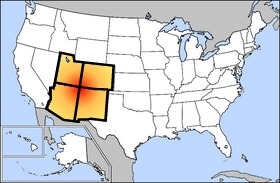
Four Corners

Four Corners, on a map. (Wikipedia image.)

When I say Four Corners, I’m talking about the place on the map where Arizona, Colorado, Utah, and New Mexico meet. In drawing their rather arbitrary state lines years ago, the mapmakers created this manmade point of interest: the only place in the United State where four state boundaries meet at one point. There’s a monument there that supposedly marks the exact point where the states meet. Tourists like to drive in and get down on all fours for photos with one limb in each state.

These days, the monument is managed by the Navajo Nation, which has land on three of the four states. The Colorado section is on Ute Indian land. I’m pretty sure there’s a fee to get in, but I could be wrong. I’ve driven past the point and flown over it, but have never stopped there.

So the passengers wanted to land at Four Corners, which is on Navajo land. That means I need permission from the Navajo Nation to land there. That’s the first hurdle the booking agent has to jump. (I won’t get permits for my passengers; I’ve wasted enough time trying for flights that didn’t happen.)

The booking agent evidently uses some kind of flight planning tool to estimate flight time. He estimated 2-1/2 hours each way. But the booking agent didn’t take into account the realities of endurance, refueling locations, weather, and FAA reserve fuel requirements.

I used SkyVector — highly recommended! — to come up with a basic flight plan — something I could use to estimate the cost of the flight. Its built-in aeronautical charts make it easy to identify places to stop for fuel if needed.

I learned that a direct flight from Scottsdale to Four Corners would take approximately 2-1/2 hours — just as he’d estimated. But this didn’t take into consideration the possibility of headwinds and my aircraft’s endurance. I roughly estimate 3 hours endurance on full tanks of fuel. But could I fill the tanks? I had no idea what the passengers weighed yet. And with my 20 minutes of required reserve fuel, planning a direct flight was not a good idea.

But what made it a really bad idea is that there is no fuel available between Winslow, AZ and Four Corners — a distance of 143 NM or 1-1/2 hour of flight time. Indeed, the closest fuel to Four Corners is 42 NM to the east — not on our way back — at Farmington.

My Flight Plan

SkyVector makes preliminary flight planning very quick and easy.

That meant I needed to plan three fuel stops: Winslow (INW) on the way up and Farmington (FMN) plus Winslow (INW) or Payson (PAN) on the way back. The resulting flight path is a narrow triangle totaling 549 NM and at least 5-1/2 hours of flight time. To be on the safe side, I’d estimate 6 hours.

This is what kills me about some of these booking agents. This particular one is based in Atlanta, GA. I can pretty much guarantee he’s never spent any time in an aircraft over the Navajo Reservation — which is where at least half this flight would be conducted. He has no concept of the vast distances and empty terrain a route like this would cover. He — and likely his passengers — can’t conceive of the utter boredom of six hours flying over this area. Sure, there are scenic parts, but not six hours worth. They’d be paying me close to $3,000 for this one-day adventure.

And all for what? A photo opportunity at a manmade “monument” in the middle of nowhere? Heck, look at it on GoogleMaps! There’s nothing there or anywhere near it!

Yet the booking agent will sell it to them if he can. And I’ll provide the service if it’s paid for.

I think the booking agent could do them a better service by selling them a Sedona tour or a trip up to the Grand Canyon. Or even Lake Powell, for Pete’s sake! Closer, cheaper to visit, and far more interesting.

Of course the weird requests of uninformed passengers or booking agents isn’t really my point.

My point is this: There’s a lot more to flight planning than simply measuring the distance between two points. The preliminary flight plan I cooked up here is just the first part of a lengthy planning process I have to go through if I get this job.

I have to admit that I find it a bit annoying when a booking agent oversimplifies the requirements of a flight — especially if he fails to inform his clients about what they’re getting into. In this case, it’s a long and expensive flight over the high desert of Arizona with very little of interest to see along the way.

Autorotation is Not a Low Rotor RPM Emergency Procedure

Especially when you’re two miles out at sea.

Picture this: An R22 helicopter without floats operating two miles off the coast of Miami, FL. On board is the CFI-rated pilot with 600 790 hours of total flight time and the private pilot rated “passenger” with 115 hours total flight time. They’re operating at about 40 knots 100 feet above the waves on an aerial photo mission, photographing boats. The wind in Miami, 13 miles away, is from 120 at 13 knots and it’s 26°C with a dew point of 21°C, resulting in a balmy 74% humidity.

The pilot had just completed a 180° turn to the south when the low rotor RPM horn sounds.

The pilot adjusts the throttle to compensate — in other words, we should assume that he adds throttle. The horn stops blaring, but 3 seconds later, it does it again.

So what does the pilot do? Despite the fact that the helicopter does not have floats, he enters an autorotation. The helicopter crash-lands in the ocean, the occupants escape, and the helicopter sinks. The pilots are rescued 10 minutes later by a privately owned boat. The helicopter is left unrecovered (so far) in 150-250 feet of seawater.

What We Don’t Know

There are a few things we don’t know that could explain the reason for the low rotor RPM horn:

  • How much did the pilots and their equipment weight? An R22 Beta (not Beta II) is a very small helicopter. Although they had burned off 45 minutes of fuel, there is a possibility that they were still heavy for the flight conditions.
  • Which direction did they turn? A turn that would have put them into a tailwind situation — especially at low speed — could rob them of airspeed. If airspeed dropped below ETL, the helicopter would have to work harder to stay in the air.
  • What speed were they operating at? Without the benefit of forward airspeed and effective translational lift, the helicopter would have to work harder to stay in the air. If the speed was close to zero, the aircraft might have gotten into a settling with power situation. The natural (but incorrect) reaction of increasing the collective to arrest the rate of descent could have triggered a low rotor RPM warning if available power was exceeded.
  • Were the engine and its components functioning properly? If the engine or magnetos were not performing to specifications, the resulting reduction of engine power could cause a low rotor RPM horn. We have to assume the engine was still running because the NTSB report didn’t mention an engine failure.

But regardless of the reason for the low rotor RPM horn, it’s the pilot’s decision to perform an autorotation to into the ocean that needs to be questioned.

The Robinson Low Rotor Horn

In a Robinson helicopter, the rotor RPM green arc is 101% to 104%. (Please don’t ask why; I don’t know. Yes, it is weird.) The low rotor RPM warning system is designed to alert the pilot at 97% RPM. (See it in action for yourself here.) This is a very early warning. The idea is that if rotor RPM is deteriorating, once it gets past a certain point, it could could become unrecoverable very quickly. The earlier the pilot is warned, the better off he is.

At the Robinson factory safety course — and, one might assume, at many flight schools that train in Robinsons — pilots are taught that a Robinson can generally fly at an RPM of 80% plus 1% per 1000 feet of density altitude. Given the temperature, dew point, altitude, and altimeter setting (30.01), the density altitude was 1,612 feet. That means that the helicopter should have been capable of flight when operating at only 82% RPM.

I need to stress here that this is a general rule of thumb. Do not attempt to fly around at low rotor RPM to test this. While it’s true that my flight instructor at the Robinson safety course had me fly for a few minutes in the Long Beach, CA area at 90% RPM with the horn blaring just to prove that flight was possible, RPM is not something we play with in non-training situations. The formula is simple: RPM = life.

Low Rotor RPM Emergency Procedures

The Robinson R22 Pilot’s Operating Handbook is quite specific on what to do in the event of a low rotor RPM warning. On page 3-10, in the red-tabbed “Emergency Procedures” section, it states:

A horn and an illuminated caution light indicates that rotor RPM may be below safe limits. To restore RPM, immediately roll throttle on, lower collective and, in forward flight, apply aft cyclic.

The NTSB report indicates that the pilot initially “adjusted the throttle to compensate for the [low rotor RPM warning] condition” and was immediately rewarded with recovery. But that was followed by the horn sounding again only 3 seconds later.

It had to be scary for the pilot. After all, he’s only 100 feet above the water and he’s supposed to react by lowering the collective. But the emergency procedure and repetitive training doesn’t tell us to enter an autorotation, which would be a full-down reduction of the collective. The reduction of the collective, coordinated with the rolling on of the throttle, should be slight — perhaps an inch or so. This reduces drag on the blades while the increased throttle provides power to increase their RPM.

What Was the RPM?

One of the things we don’t know is what the RPM was when the pilot decided to enter autorotation. If it had deteriorated to the point where autorotation and cyclic flare were the only tools to recover RPM, his decision was probably a good one. Better to hit the water relatively softly than from 100 feet up, falling like a brick.

If RPM had deteriorated to that point that quickly, however, it’s important to recover the aircraft to learn why. Other than a complete engine failure — which was not mentioned in the report — it’s hard to imagine what would cause RPM to drop enough to warrant such a drastic recovery action.

Who Was Flying?

There may be more to this than what meets the eye.

The helicopter was operated by Helicopter Academy, a flight school with locations across the U.S. The school’s Web site clearly advertises it as a low-cost training company:

$250 PER HOUR R22 HELICOPTER TRAINING TIME BARGAIN and we are the ONLY company in the world that can guarantee you a job.  We operate a fleet of helicopters and like other schools our insurance requires 300 hours helicopter time and an instructor’s rating to fly for us. We train you to work for us and offer a job to all graduates, including transfer student and instructors who can’t get jobs elsewhere.

Helicopter Academy’s other business is BoatPix, which uses helicopters to photograph boats and then sells the photos to the boat owners and others. It’s widely known that BoatPix pilots pay BoatPix (or Helicopter Academy) for the time they fly aerial photo missions. The company’s Web site alludes to this:

…you pay for the first 100 hours at $250/hr, the second 100 hours at $200/hr and the third 100 hours at $150/hr….It’s  $25,000 for the first 100 hours where you’ll do mostly training, $20,000 for hours 100  through 200 where we’ll introduce you to our photo contract which will subsidize your flying and $15,000 for hours 200 through 300 where you’ll do almost exclusively photo and will learn this skill that is valuable to our photo contract and making you a valuable pilot to us.

I added the emphasis in the above quote. It begs the question: who was actually flying this aircraft? The NTSB report suggests that it was the 600791-hour CFI. But was that really the case? Was the 115-hour private pilot paying $200/hour to be “introduced” to the photo contract — as a pilot — while the 600791-hour CFI took the photos?

High Risk Operations

In March 1999, Robinson Helicopter issued Safety Notice SN-34. The latest version of this Safety Notice is dated April 2009. Titled “Aerial Survey and Photo Flights – Very High Risk,” it starts out saying:

There is a misconception that aerial survey and photo flights can be flown safely by low time pilots. Not true. There have been numerous fatal accidents during aerial survey and photo flights, including several involving Robinson helicopters.

It goes on to list some of the possible dangers of low time pilots conducting aerial photo flights. It also makes some recommendations for minimum requirements for aerial photo/survey pilots, including a minimum of 500 hours pilot-in-command. BoatPix is one of the operations that has chosen to ignore this recommendation.

My question to helicopter pilot wannabes out there: Are you that desperate to become a pilot that you’re willing to trade your safety for flight time?

Pilot Experience and Decision-Making

What it all comes down to is whether the pilot made the correct decision for the situation he found himself in. I’m not convinced that entering autorotation over the ocean on hearing a low rotor RPM warning horn is the correct decision.

True, both pilots walked (or perhaps I should say, swam) away. But if the rotor RPM could have been brought back into the green while in flight — something a well-trained or experienced pilot could have accomplished if there wasn’t a mechanical problem — the watery autorotation and the resulting loss of the aircraft could have been avoided.

Hopefully, the Probable Cause report for this accident will shed some light on what really happened. Until then, it certainly gives pilots some food for thought.

November 1, 2011 Update: The Probable Cause report doesn’t add much to what’s reported here other than to clarify airspeed and PIC experience. The official Probable Cause is “A loss of main rotor rpm for undetermined reasons.”

Update, March 17, 2012: Just found another accident report with someone else using autorotation as a cure for low rotor RPM. He crashed, too.

Weight and Balance: A Primer for Passengers

Or why you shouldn’t lie to your pilot about your weight.

The other day, I booked a scenic flight for three passengers. At the time of the booking, I took the passenger names and weights — as I always do. Here’s what I was told:

Joe: 200 lbs
Bill: 200 lbs
Sally: 150 lbs

Why Pilots Ask for Weights

You might be wondering why a pilot needs the weight of passengers on a flight. After all, when you book a flight on United or US Airways, they don’t ask how much you weight. Why should a helicopter pilot care?

First of all, you should be aware that the airlines do care about weights. Weight information is required to calculate aircraft weight and balance (W&B) at takeoff and landing. The airlines are allowed, however, to use a blanket estimate for each person’s weight. This is set forth in an Advisory Circular issued by the FAA. (I found AC 120027C dated 1995, but I think this has been recently revised to account for heavier passengers; can’t find the new info, though.)

As a Part 135 operator of a small aircraft, I’m required to calculate an accurate weight and balance for each flight I conduct. The calculation is complex and customized to my aircraft. If I had to do it manually, it would take a good 15-20 minutes — with a calculator. Fortunately, I’ve created an Excel worksheet that does the number crunching and calculations for me, so the whole process, which I can do on my laptop, takes less than 5 minutes and spits out a required flight manifest and flight plan at the same time.

Weight and balance is important for safe flight. An aircraft is loaded out of CG (center of gravity) could fly erratically or have impaired controls. For example, if my helicopter is loaded too heavy up front, I might not be able to pull the cyclic back far enough to arrest forward movement in flight. That would make stopping and landing very difficult indeed.

Likewise, an aircraft loaded beyond maximum gross weight will not perform to specifications and could suffer structural damage. For example, if my helicopter is carrying a heavier load than what’s specified in my Pilot Operating Handbook (POH) and legally allowed, I might not be able to hover in ground effect or take off with a climb rate sufficient to avoid obstacles.

What a Weight and Balance Calculation Looks Like

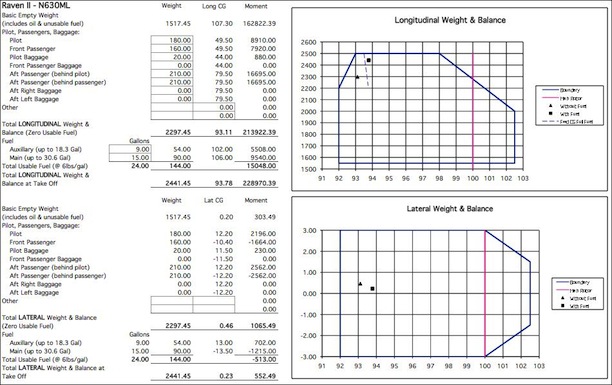
A weight and balance calculation includes a bunch of very large numbers that are subsequently divided to make much smaller numbers. The result is plotted on a graph surrounded by boundaries often called an envelope. The goal is for the plotted points and the line often drawn between them to be within the envelope.

Here’s what the W&B calculations and envelopes look like for the charter flight with Joe’s party with 1/2 tanks of fuel on board:

Weight & Balance

Note that the plotted square and triangle are within the envelope for both Longitudinal and Lateral Weight and Balance. I can look at these two graphs and see that based on how I’ve seated the passengers, we’ll be a little heavy in front and on the pilot’s side. But the weight distribution is within the range my aircraft and its controls can handle.

It’s Not a Time to Be Vain

Weight and age are the two things people are least likely to be truthful about. As a pilot, I don’t care how old you are — I’ve flown with passengers aged 6 months up to 95 years — but I do care how much you weigh. Lying is not in your best interest at all.

But because I assume people will lie, I automatically add 10 pounds to each passenger’s stated weight when calculating my W&B. So here’s the revised W&B looks like for Joe’s party:

Weight and Balance

Now we’re starting to get closer to the limits. The weight is way up front now — almost at my limit. Still okay to fly, still legal. But I know that there’s very little wiggle room.

I know from experience that I can make the situation better by putting a lighter person up front. So maybe I’d put Sally in the seat beside me. Here’s what that looks like:

Weight and Balance

That looks a lot better. See how the two boxes in the top graph have shifted to the right? That means the weight is shifted aft. More balanced.

But I also know from experience that some men are unlikely to take a back seat to their wives. And I know that big guys don’t fit very well in the back seat of my helicopter. There was a pretty good chance that the guy who’d booked the flight and was paying for it would not sit in the back.

Getting it Wrong Can Make it Dangerous

Unfortunately, not everyone underestimates weight by just a pound or two. Sometimes, they’re very wrong. Consider Joe’s party. Turns out that they’d underestimated weights by at about 20 pounds per person. Now my W&B calculation looks like this:

Weight and Balance

Ouch. As you can see here, the two plotted points on the top graph are just outside the envelope for forward CG. That means that the aircraft would be too nose-heavy for safe flight.

How could I fix the problem? Again, I could shuffle around the passengers, putting the lightest one up front. I could take the contents of the pilot’s baggage compartment and shift it to the baggage compartment for one of the back seats — or leave it behind. Loading less fuel would not help — although it would reduce the weight of the aircraft (and the endurance time), it wouldn’t resolve the CG issue.

How do I know all this? By playing what-if with my Excel spreadsheet and observing the results.

Don’t Lie to Your Pilot

What bothers me sometimes is the flippant attitude some passengers have about weight. These people were a good example. The man who booked the flight didn’t take any of it seriously. He just threw some numbers at me to answer my question. I could tell when I laid eyes on them that they were heavier than reported. One passenger confirmed his weight at 220; the other passenger’s wife confirmed his weight at 220. 20 pounds is not a small error. It’s 10%.

In this case, it was the difference between a safe flight and a potentially unsafe one.

What they don’t realize is that underestimating or just plain lying about weights can make a flight dangerous. They can put their lives at risk by providing incorrect information. Is it worth it? Just so a stranger thinks you weigh less than you really do?

I don’t think so.