
You learn something new…
Yesterday, I picked up my helicopter down in Chandler (CHD) where it was getting some maintenance. After 10 years of mechanic hopping — not my choice — it looks like I’m finally back with a good mechanic who won’t disappear and who will be able to handle my maintenance needs in the Phoenix area on a timely basis.
Because I’m a commercial operator, I am required to get a big inspection every 100 hours. The 100-hour inspection is basically the same as an annual inspection for my helicopter. I fly about 200 hours a year — although I’m likely to hit 300 this year — so I get these big inspections at least twice a year. I’m very happy to be having it done by someone who has been maintaining and repairing Robinsons for longer than I’ve been flying them.
After I paid up, they rolled the helicopter out onto the ramp, and we said our goodbyes, I did a good walk-around. Then I climbed on board and started up. And that’s when I noticed things were different.
Normal Startup
Understand than when you start the same aircraft over 1,000 times over a 6-1/2 year period, you get a pretty good idea of how startup goes. On my ship, with temperatures in the high 80s as they were yesterday, 5 seconds of priming is usually enough to get a cold engine started. I press the starter button and push in the mixture control gradually. When the engine catches, I push in the mixture in all the way, flick on the Alternator, Clutch, and Strobe, and watch the RPM gauges as the clutch engages and the belts catch the drive train.
Right around this point, the helicopter’s engine compartment usually starts making a gawdawful squealing noise. It’s the rubber belts catching on the upper and lower sheaves as they move apart and the belts tighten. The engine RPM is dragged down by the weight of the drive system it’s becoming burdened with. I add a bit of throttle to keep the engine RPM as close to 55% as possible. There’s a final drag on the engine and then the belts become secure. The squealing stops and the RPM recovers. The two RPM needles — Engine and Rotor — become matched and begin to climb. I normally reduce throttle a tiny bit again, just to keep RPM at about 55%. This whole process — from engine start to squeal end — takes about 15-20 seconds. When the clutch light goes out — usually 15 to 30 seconds later — I throttle up to 68% RPM to complete the warm-up process.
Yesterday’s Weird Startup
Unfortunately, that’s not how it happened yesterday and I was in tune to everything that was different. First, no squeal. Second, the engine RPM wasn’t dragged down. Third, the rotor RPM did not match the engine RPM until after the clutch light had gone out. And that clutch light went out a lot quicker than normal.
What the hell was going on?
Everything sounded okay and when I throttled up to 68%, everything seemed okay. I continued the warm up process, watching gauges. Everything seemed normal.
Until I throttled it up to 75% for my mag check. The rotor RPM lagged and the engine sped more than it should have. It was obviously not carrying the full burden of the rotor system.
I signaled to my friend Don, who was in the helicopter next to mine going through his startup routine, that I had to shut down. Don had kindly flown me down to Chandler from Deer Valley so I could pick up my ship. Now it looked as we wouldn’t be flying back as a “flight of two helicopters” after all. I filled him in on the situation, certain there was a problem with the clutch that the mechanics inside could fix, and sent him on his way. Then after checking “under the hood” to make sure it wasn’t an obvious problem, I walked back into the hangar to track down the mechanics.
Under the Hood
My description probably sounded flakey, but I managed to communicate to them that there was a clutch issue. They came out and, with the engine shut down, flicked on the Master switch and engaged the clutch. Looking into the compartment that gives a clear view of the upper sheave and clutch actuator, we could hear the clutch engage and see the upper sheave begin to move. It moved for about 10 seconds, then stopped.
“Did you hear the click?” one mechanic said to the other.
“No,” the other one replied.
They disengaged the clutch and it began running again, now in the opposite direction. It stopped when fully disengaged. Then they engaged it again. It ran and stopped, again without the click.
For some reason, the clutch wasn’t fully engaging. That meant the belts weren’t properly tightening. That also meant that the engine would not be able to turn the rotor blades sufficiently for flight.
In other words, I had a serious problem if I planned on using the helicopter for anything other than as a lawn ornament.

From the R44 Maintenance Manual, this illustrates how to use the MT558-1 [Clutch Actuator Test Plug] Tool. Warning to Pilots: Do not use this tool without following the instructions in the manual!
As R44 pilots should know, there’s a little plastic socket inside the compartment near the warning light test buttons. R44s come with a pair of plugs that go into this socket. Each plug disables one of the two up-limit switches for the clutch. Although I had the plugs under the pilot seat (with a spare gas cap, batteries for my Spot Tracking device, and duct tape), they didn’t ask for them. (I guess they didn’t think I carried them with me.) Instead, they used the scissors on my pocket knife to do what one of the plugs does. They engaged the clutch and this time, it ran all the way up with a satisfactory click.
Not completely satisfied, they disengaged the clutch and then cycled it again, this time without the scissors. We were rewarded with a nice, healthy click. Then again. Click. Then again. Click. It seemed to be working fine.
They disengaged it again and let the belts fully loosen up. They told me that sometimes, when they wash inside the cowling, the clutch switch gets wet and doesn’t work quite right. They’ve had this problem once or twice on R22s. They listed a bunch of symptoms to watch out for in case there was a problem with the clutch switch itself, but they doubted that it was a real problem. Just one of those weird things that happen sometimes.
I know about those weird things. They do happen. When they do, they get your attention and you watch them closely. If they don’t happen again, after a while you just write them off as one of those weird things. But if a pattern begins, you follow up with a mechanic.
Fixed? Looks that Way
I thanked them, started up without any problems, and headed up to Scottsdale (SDL) — a 15-minute flight. I parked on the ramp, walked to the Apple store about 1/2 mile away, and took care of some business there. After dinner with my husband at a restaurant in the area, I went back to the helicopter. It started up again without any problems. I flew it to Deer Valley (DVT) and left it on the ramp for the FBO line guys to put away.
I’ll be watching the situation closely as I prepare for my annual trip to the northwest. I’ve already been advised on how to handle the situation when I’m on my cherry drying contracts — I’ll be keeping those two plugs handy, just in case.
 The month started off with a bang. One, two, three: three days, three charters. I took a couple on a
  I changed gears the following week and spent a good portion of the next two weeks conducting
  The emphasis this time around was on “adventure” in that the weather really messed with us. Not only did we get
  I did, however, get a chance to fly down to Marble Canyon at dawn for breakfast with a friend.
  So instead of giving my guests their Phoenix Tour and heading up the Verde River on Day 1, we took a shorter route to Sedona that overflew Lake Pleasant and stayed within several miles of the I-17 corridor. I figured I’d save the scenic flight for when visibility was better. I also expected visibility to be better in the Sedona area and was very surprised that it was not.
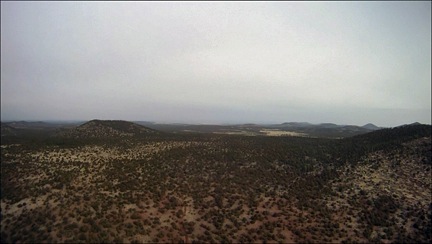 The flight to the Grand Canyon on Day 2 wasn’t anything special — except for that white haze that persisted, even up on the Coconino Plateau. Very odd for Arizona. It wasn’t blowing dust, either — the wind wasn’t strong enough for that. Just an ugly haze.
 Day 3 dawned gray but with plenty of visibility. I even got out and snapped a few
 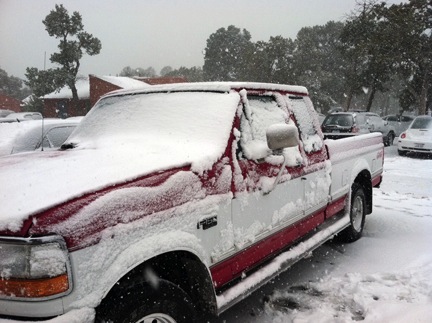 I felt bad for my guests. They’d spent a lot of money on this trip and now they were stuck at a scenic place with no scenery and no helicopter flight to get them to their next destination. So I became their driver for the day. After realizing that the truck was not likely to make it to Desert View (on the east end of the park) before the roads were cleared, we stopped at the Visitor Center and the Geology Museum before heading into Tusayan (the tourist town outside the park) for lunch. The plan was for them to see the IMAX movie across the street next.
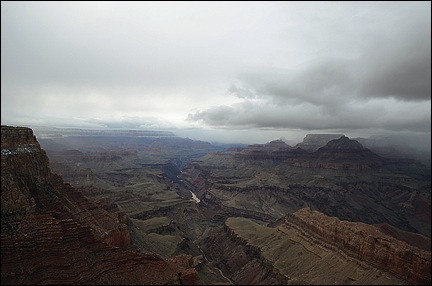 I wound up driving them to Page. The trip should have taken just over 2 hours, but since the weather was clearing enough to see into the canyon, we made several stops along the way. We arrived in Page at 8 PM. I checked them into their room, made sure they were set for the next day’s boat ride, and checked into my room at the Day’s Inn.
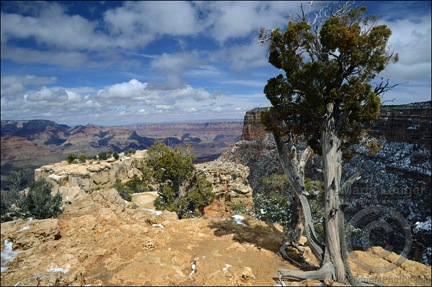 Now what I needed was a thaw — temperatures above 32°F. I must have called the AWOS number for GCN a dozen times before 10:30 AM on Day 4. Then I climbed into my redneck truck and made the trek down to Grand Canyon Airport. It took 2 and a half hours with just one stop to snap
 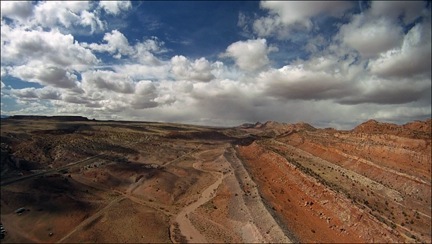 The flight was, for the most part, smooth. I ran the video camera (as you might expect) and captured some good footage over the Little Colorado River Gorge and along the Echo Cliffs. I set down on a helipad at Page Municipal Airport at 3 PM.