Autorotation Explained

A primer for non-pilots.

One of my pet peeves is finding inaccurate information in works of fiction (or non-fiction, for that matter). You can argue all day long that fiction is fiction and the writer can write whatever he wants. After all, fiction, by definition, is a made up story. That gives the author license to make things up as he goes along.

I agree that it’s fine to make up the story, but unless it’s a work of science fiction or fantasy (where it might be acceptable to change the laws of physics), it’s not okay to make up the details of how existing things work. I explored this theme in my post “Facts in Fiction,” and picked apart the work of a bestselling author in “Dan Brown Doesn’t Know Much about Helicopters.” Both posts were triggered, in part, by basic errors about how helicopters work that appeared in works of fiction.

The Question

“Facts in Fiction” was also triggered by an email message I received from a writer looking for facts about how helicopters fly. Oddly, I just received another one of those messages not long ago:

I’ve recently been writing a novel in which I have to describe the sound a helicopter makes, how they fly and things along these lines.

But there is a section of my book where a helicopter runs out of fuel and begins to drop. However, below them is a forest and they crash into the canopy. But in order to minimize damage the pilot uses autorotation to make the helicopter somewhat stable. I don’t want to be an ignorant writer that makes stuff up at the expense of fact. I’ve looked up autorotation but it’s still not clear to me- would you be able to help me out with how a pilot would initiate autorotation (in simple terms!)

Again, I applaud this writer’s desire to get it right. The aviation community certainly doesn’t need yet another work of fiction that misrepresents basic aerodynamic facts.

Unfortunately, it’s pretty clear that this writer does not understand how helicopters fly. This is common among non-pilots. Some folks think that the rotor disc — when the blades are spinning — works like a giant fan that keeps the helicopter in the air. Other folks — well, I don’t know what they think. But very few seem to realize that like airplanes, helicopters have wings.

Yes, wings. What do you think the rotor blades are?

Helicopters are rotary wing aircraft. This means that they have wings that rotate.

The Real Question

Although this writer seems to want an explanation of “how a pilot would initiate autorotation,” he has a bigger misunderstanding to clear up first. It all stems around these two phrases:

…a helicopter runs out of fuel and begins to drop.

and

…in order to minimize damage the pilot uses autorotation to make the helicopter somewhat stable.

The problem is that if a helicopter ran out of fuel and the engine quit (assumed), the pilot has only about 2 seconds to enter an autorotation to prevent a catastrophic crash. You don’t enter an autorotation to “make the helicopter somewhat stable.” You enter an autorotation to maintain a controlled glide to the ground that, hopefully, concludes with a landing everyone can walk away from.

Or, put it another way, in the event of an engine failure, the pilot must perform an autorotation if he wants to survive.

So in order to answer the question this writer asked, I need to first address his misunderstanding of how helicopters fly and what autorotation does.

How Helicopters Fly

Let’s start with something most people do understand — at least partially: how an airplane flies.

An airplane has at least one pair of wings that are fixed to the sides of the fuselage. The wings have a specific shape called an airfoil that makes lift possible.

When the pilot wants to take off, he rolls down the runway, gathering speed. This causes wind to flow over and under the airfoil. After reaching a certain predetermined minimum speed, the pilot pulls back on the yoke or stick which lifts the airplane’s nose. This also changes the angle of attack of the relative wind on the wings. That change produces lift and the plane takes off.

Obviously, this is an extremely simplified explanation of how airfoils, relative wind, and angle of attack produce lift. But it’s really all you need to know (unless you’re a pilot).

A helicopter’s wings — remember, they’re rotary wings — work much the same way. But instead of moving the entire aircraft to increase the relative wind over the airfoil, the wings rotate faster and faster until they get to 100% (or thereabouts; long story) RPM. Then, when the pilot wants to take off, he pulls up on a control called the collective which increases the pitch or angle of attack of all the rotor blades. That change produces lift and the helicopter takes off.

It’s important to note here that when you increase angle of attack, you also increase drag. Whether you’re in an airplane or in a helicopter, you’ll need to increase the throttle or power setting to overcome the increased drag without decreasing forward speed (airplane) or rotor RPM (helicopter).

Rotorcraft Flying HandbookIf you’re interested in learning more about lift and how helicopters fly, I highly recommend a free FAA publication called Rotorcraft Flying Handbook. This is a great guide for anyone interested in learning more about flying helicopters. You don’t need to be an aeronautical engineer to understand it, either. If the text isn’t enough to explain something, the accompanying diagrams should clear up any confusion. I cannot recommend this book highly enough.

What Happens when the Engine Quits

Things get a bit more interesting when an aircraft’s engine quits.

On an airplane, the engine is used for propulsion. If the engine stops running, there’s nothing pushing the airplane forward to maintain that relative wind. Because it’s the forward speed that keeps an airplane flying, its vital to maintain airspeed above what’s called stall speed — the speed at which the wings can no longer produce lift. To maintain airspeed, the pilot pushes the airplane’s nose forward and begins a descent, thus trading altitude for airspeed. The plane glides to the ground. With luck, there’s something near the ground resembling a runway and the airplane can land safely.

On a helicopter, the engine is used to turn the rotor blades. If the engine stops running, there’s nothing driving the blades. Because it’s the spinning of the rotor blades or rotor RPM that keeps a helicopter flying, its vital to keep the rotor RPM above stall speed. The pilot pushes the collective all the way down, thus reducing drag on the rotor blades — this is how he enters autorotation. (The helicopter’s freewheeling unit has already disengaged the engine from the drive system, so the blades can rotate on their own.) The reduction of the angle of attack of the blades starts a descent, trading altitude for airspeed and rotor RPM. The helicopter glides to the ground. With luck, there’s a clearing or parking lot and the helicopter can land safely.

It’s extremely important to note that as long as the pilot maintains sufficient rotor RPM, he has full control of the helicopter all the way down to the ground. He can steer in any direction, circle an appropriate landing zone, and even fly sideways or backwards if necessary (and he has the skill and nerve!) to make the landing spot. So to say “the pilot uses autorotation to make the helicopter somewhat stable” shows complete ignorance about how autorotation works.

About 30 feet above the ground, the pilot pulls back on the cyclic to slow his forward airspeed. The resulting flare trades airspeed for rotor RPM, thus giving the main rotor blades extra speed. That comes in handy when he levels the helicopter and pulls the collective full up — thus bleeding off RPM, which he won’t need on the ground — to cushion the landing before touching the ground.

The point that needs to be made here is that helicopter engine failures and autorotations don’t always end in a crash. In fact, with a skilled pilot and a suitable landing zone, there’s no reason why it should end in a crash. So in the example presented by this writer, the helicopter doesn’t have to crash at all. It could have an engine failure and safely land in a clearing.

And here’s another newsflash: every helicopter pilot not only knows how to perform an autorotation, but he’s tested on it before he can get his pilot certificate. He’s also required to prove he can do one every two years during a biennial flight review. And if he’s like me, he’s tested annually by an FAA inspector for a Part 135 check ride.

Writers: Do Your Homework!

It’s good to see this writer trying to get the information he needs. But in my opinion, he went about it all the wrong way.

It’s been over a month since I got his emailed request for information. I never replied by email; this is my reply. Has he written his passage without the answers to his question? I have no idea. He never followed up.

But wouldn’t it have been smarter to simply talk face-to-face with a helicopter pilot? Any helicopter pilot could answer these questions and set him straight. Helicopter pilots aren’t so hard to find. Flight schools, tour operators, medevac bases, police helicopter bases, etc. Not only could the writer get his questions answered by someone who knows the answers from experience, but he could gather a wealth of information about helicopters, including their sound, why they don’t usually take off straight up, and other operation aspects. And if he visited a flight school or tour operator and had some extra money to spend, he could even go on a flight to see what it’s like from the inside of the aircraft.

Emailing a blogger who happens to write a lot about helicopters and complain when novelists get it wrong [hand raised] is downright lazy.

And despite what you might think, writing is not a job for lazy people.
Drying Cherries

Up close and personal with a whole lot of trees — and fruit.

One of the things that has been keeping me very busy — at least lately — this summer is my work as a cherry drying pilot.

What It’s All About

In brief: During the last three or so weeks that cherries are on the trees, if they get wet, they can become damaged — usually splitting or developing mold. Growers who don’t want to lose their crop hire helicopter pilots to stand by during cherry season. After a rain, they call us out to hover over trees. The downwash from our rotor blades shakes the branches, thus shaking off accumulated water.

There’s a lot more I can say about this, but I don’t think it’s necessary. As I mentioned here, the work can be dangerous and requires good flying skills. (There was an accident in an orchard just the other day that was likely caused by a failure to respect density altitude in a heavy helicopter. Both occupants survived uninjured; the helicopter didn’t.) It’s not for low-time pilots. And it’s a crappy way to build time — I was here 6 weeks before I was called out to fly at all and, now seven weeks in, I’ve only flown about 9 hours.

Oh, and did I mention how incredibly tedious the work is?

Some Snapshots

Anyway, yesterday I was called out twice to dry. There was a 15-acre orchard that I had to dry twice and a 40-acre orchard that I dried just once. Add that acreage together and you get 70 acres of cherry trees.

For my second call out, I mounted my GoPro “nosecam” on the helicopter. I actually have video from that viewpoint of both orchards I dried on that call. It’s not very exciting stuff. As I type this, I’m debating on whether to throw a few minutes’ worth into a video to share. I wouldn’t want to put anyone to sleep.

I did, however, pull out a few still images as photos to share here.

Cherry Drying
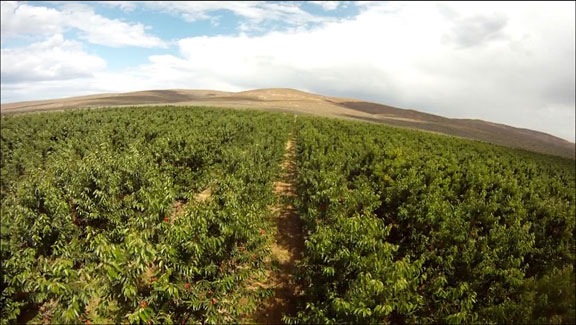
This is a typical view down an aisle of cherry trees. I fly very low.

Orchard and Rain
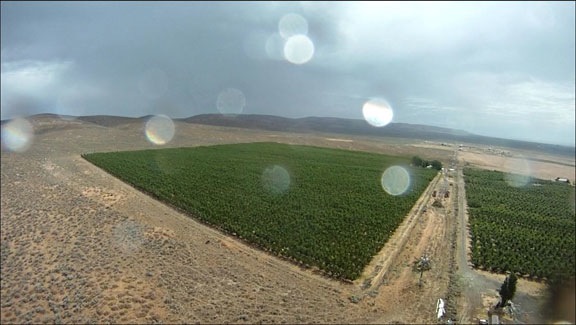
Here’s a shot as I approached the 40-acre orchard block. You’re looking at hundreds, if not thousands, of trees. It was still raining lightly as I flew up. I took the opportunity to land near the orchard and pull my door off. When the sun comes out, it gets very hot in the cockpit — especially when you’re wearing a Nomex flight suit and helmet.

Cherry Drying
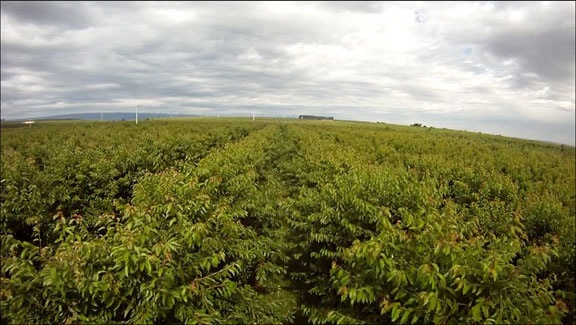
Here’s another drying shot. These trees are younger than the ones in the smaller orchard and were heavy with fruit, which you may be able to see in this shot. The sun was out for much of this dry, so time was of the essence.

Serious Business

Cherry drying is serious business. My client is paying me good money to sit around and wait for the rain. When the rain comes, it’s my job to quickly and effectively dry his trees. If I fail to do my job, my client can lose his entire crop. That could be hundreds of thousands of dollars worth of fruit, the difference between a profitable year and a year living on credit.

It’s a huge responsibility that I take very seriously.

The next time you eat fresh US-grown cherries, think about the folks in the production chain that put those cherries on your plate. I might be one of them.

Dangerous Flying: Abrupt Control Inputs

How sloppy flying could get you killed.

Recently, while flying with a 200-hour helicopter pilot, I was startled when he rather abruptly shifted the cyclic to make a turn. I didn’t say anything then because it wasn’t too abrupt (whatever that means). But when he did it again later in the flight with an even more abrupt movement, I spoke up and told him not to do it again.

Understand that we were flying a Robinson R44 Raven II, which has a rather unforgiving semi-rigid rotor system and very long rotor blades. We’re taught — or should be taught — during primary training to use smooth control inputs, especially when working with the cyclic.

I’m not a CFI and I don’t feel that I have the right to tell someone how to fly, but when a pilot does something I believe is dangerous, it’s my duty to speak up. So I did.

The trouble is, I’m not sure if he believes what I told him — that abrupt inputs are dangerous — or if he thinks I was just nitpicking his technique. (I let it go the first time partially because I didn’t want to be seen as a nitpicker.) Since so many pilots seem to read this blog to learn — or at least to get my opinions on things — I thought I’d discuss it here.

What Robinson Says

Section 10 of the R44 II Pilot’s Operating Handbook includes safety tips. Here’s the one that applies:

Avoid abrupt control inputs or accelerated maneuvers, particularly at high speed. These produce high fatigue loads in the dynamic components and could cause a premature and catastrophic failure of a critical component.

What Robinson is saying is that when you make abrupt control inputs you put stress on various aircraft components. They’re likely concerned about the rotor blades, mast, transmission, and control linkages most. This makes perfect sense.

Robinson Safety Notice SN-20, titled “Beware of Demonstration or Initial Training Flights,” includes these statements:

If a student begins to lose control of the aircraft, an experienced fight instructor can easily regain control provided the student does not make any large or abrupt control movements. If, however, the student becomes momentarily confused and makes a sudden large control input in the wrong direction, even the most experienced instructor may not be able to recover control.

And:

Before allowing someone to touch the controls of the aircraft, they must be thoroughly indoctrinated concerning the extreme sensitivity of the controls in a light helicopter. They must be firmly instructed to never make a large or sudden movement with the controls.

Of course, what worries Robinson here is that student pilots may make erroneous control inputs beyond what an instructor can fix to regain control of the aircraft.

What Worries Me More

January 31, 2012 note: Since writing this, a friend on the Rotorspace site has brought the topic of Mast Rocking to my attention. Apparently, some folks think that this accident may have been caused by Mast Rocking rather than an abrupt cyclic control input. I’m not convinced. Mast rocking supposedly does not cause the main rotor blades to diverge from their normal plane of rotation. How else could the tail be cut off in flight?

But what worries me more than putting stress on components is an accident report from 2006. I read this report on the NTSB Web site not long after the accident occurred. Back then, there was no known reason why an R44 helicopter with just two people on board for a long cross-country flight should fall out of the sky with its tail chopped off, but I had my suspicions. After my recent flight with the new pilot, I looked it up again. Here’s the probable cause (emphasis added):

The Canadian certificated commercial helicopter pilot was conducting a cross-country delivery flight with a non-rated passenger occupying the copilot seat. The passenger and pilot together had previously made delivery flights from the Robinson factory to Canada. Two witnesses saw the helicopter just before it impacted the ground and reported that the tail boom had separated from the fuselage. No witnesses were identified who saw the initial breakup sequence. Both main rotor blades were bent downward at significant angles, with one blade having penetrated the cabin on the right side with a downward slicing front to rear arc. The primary wreckage debris field was approximately 500 feet long on an easterly heading. The helicopter sustained damage consistent with a high-energy, fuselage level, vertical ground impact. Detailed post accident investigation of the engine, the airframe, and the control systems disclosed no evidence of any preimpact anomalies. The removable cyclic was installed on the left side copilot’s position, contrary to manufacturer’s recommendations when a non-rated passenger is seated in the left seat. The removable pedals and collective for the left side were not installed. The cyclic controls for both the pilot’s and copilot’s positions were broken from their respective mounting points. The copilot’s cyclic grip exhibited inward crushing. The Safety Board adopted a Special Investigation Report on April 2, 1996, following the investigation into R22 and R44 accidents involving loss of main rotor control and divergence of the main rotor disk, which included a finding that the cause of the loss of main rotor control in many of the accidents “most likely stems from a large, abrupt pilot control input to a helicopter that is highly responsive to cyclic control inputs.”

The National Transportation Safety Board determines the probable cause(s) of this accident as follows:
a loss of control and the divergence of the main rotor blade system from its normal rotational path for undetermined reasons.

(A full narrative is also available.)

This is pretty much what I’d imagined. The helicopter is cruising along at 110 knots in a very boring part of the California desert. For some reason, the pilot (or his passenger, who has access to a cyclic control), jerks the cyclic one way or the other. Maybe he was trying to dodge a bird. Maybe he was goofing off or pretending to be Airwolf. Who knows? The sudden input is enough to cause the blades to diverge from their normal path. One (or both) of them dip down and chop off the tail boom. The result: two dead bodies in a 500-foot long debris field.

And this is what was going on in the back of my mind when the pilot beside me made those sudden inputs.

Anyone who has flown a Robinson helicopter can tell you how responsive the cyclic control is. It wouldn’t take much effort to knock the blades out of their path. That’s why we’re taught — or should be taught — to use smooth control inputs.

Other accident reports like this one include: CHI05CA267 and MIA00FA102 (which is a “watch this” moment).

Other Concerns

Rotorcraft Flying HandbookThere are at least two other reasons to avoid abrupt cyclic movements. You can find all these in the Rotorcraft Flying Handbook, an FAA publication that’s a must-have in any helicopter pilot’s library.

Under the “Retreating Blade Stall” heading (page 11-6):

High weight, low rotor r.p.m., high density altitude, turbulence and/or steep, abrupt turns are all conducive to retreating blade stall at high forward airspeeds.

Personally, I don’t think retreating blade stall is an issue in Robinson helicopters, except, perhaps, at high density altitudes and high speeds. But in that case, you’d be exceeding Vne.

Under the “Low G Conditions and Mast Bumping” heading (page 11-10):

For cyclic control, small helicopters depend primarily on tilting the main rotor thrust vector to produce control moments about the aircraft center of gravity (CG), causing the helicopter to roll or pitch in thedesired direction. Pushing the cyclic control forward abruptly from either straight-and-level flight or after a climb can put the helicopter into a low G (weightless) flight condition. In forward flight, when a push-over is performed, the angle of attack and thrust of the rotor is reduced, causing a low G or weightless flight condition.

You can find an account of this (with a lucky pilot and passenger) in this accident report from July 22, 2010. Indeed, the problem may have occurred during the right turn the pilot initiated — did he jerk the cyclic over as my companion had done?

Another accident report that suggests mast bumping is SEA03FA148 (which took the life of a pilot I knew).

I’m Not Just Nitpicking

The point of all this is that I’m really not just nitpicking a fellow pilot with limited flight time. He performed a maneuver which I consider dangerous and I have all this information to back me up. It’s important for him — and for others who might not know any better — to avoid abrupt control inputs.

Robinson helicopters aren’t capable of safely performing aerobatic maneuvers. Don’t fly them as if they are.

Update, March 17, 2012: Here’s another example of an accident likely caused by an abrupt control input. This one resulted in mast bumping.

Travel Insanity

Too many miles, too little time.

I’m just recovering from a crazy week with too much travel in too short a time span.

Our Flight Path

Our flight path, recorded on my iPad with GPSTrack. Can you tell where we did some scud running?

It all started last Saturday, when I flew with two companions from Phoenix, AZ to Wenatchee, WA by helicopter in one day. It was almost 11 hours of flight time with mostly very brief stops for fuel. Although I had very little stick time — one of my companions did almost all the flying — I was still alert and able to fly at a moment’s notice.

It got a little tense when we had to do some scud-running in Oregon that lasted far longer than I like to be spending scud running — as if I like it at all. It never got dangerous, but more than a few times, I began scouting the remote hillsides around us, looking for a place to set down and wait it out. I was very glad when the terrain finally descended, dumping us in an area where we could get back on course.

We spent the night in Wenatchee and I parted company with my travel companions, leaving them to catch an early flight to Seattle while I took care of other things locally.

Sunday was relatively restful. I needed to reposition the helicopter to Quincy, WA, where I’d be spending part of my summer. That was just a 15-minute flight. Then I spent some time socializing at Ferguson Flying Services, where my helicopter is parked in Quincy, and the Colockum Ridge Golf Course, where my RV would be parked soon. Then a friend/client picked me up and drove me the 5 miles to his winery in town, where I spent the afternoon socializing with him, his family, and the folks who came for wine tasting. A nice, mellow afternoon.

But at 4:15, the craziness started again. I got a lift to Wenatchee Airport, where I caught a flight to Seattle with a connecting flight to Phoenix. My husband picked me up there at about 10:30 PM. Overnight at our Phoenix condo.

Monday morning, bright and early, we were on our way back up to Wickenburg. I spent the day finishing up some work on a chapter of my book and then packing. It wasn’t until nearly 9 PM that night that we were done and pulling the RV out of the hangar where it lives most of the year. We left it parked in front for the night.

Welcome to NevadaAt 6:45 AM, I was in the driver seat of the truck with Alex the Bird in the seat beside mine. We were starting a 1,295-mile drive from Wickenburg, AZ to Quincy, WA. My goal was to make Jackpot, NV that first day — a distance of 725 miles. I spent most of those miles on Route 93, a two-lane road with speed limits up to 70 miles per hour. There was no traffic and certain stretches of the road were straight and flat as far as the eye could see. We made Jackpot before nightfall. After dinner n the casino, I spent the night in the RV with Alex in comfort — in the casino parking lot.

My Rig, in Jackpot, NVThe next morning, I woke at 6:15, which is late for me. Anxious to get on the road, I rushed around making my coffee and Alex’s breakfast and then buttoning up the RV for another day on the road. It wasn’t until after I topped off the fuel tank across the street from the casino that I realized it was an hour earlier; that part of Nevada is on Mountain Daylight Time. So I got a very early start. I left Route 93 behind in Twin Falls, ID, and hopped on I-84. The route was mountainous and the truck sucked diesel at an alarming rate as I struggled to maintain speed up hills. I left the interstate just past Pendleton and got back on smaller, traffic-free back roads to head north. After 10 miles on I-70 and the last five miles through familiar farmland, I rolled into the parking lot at the Colockum Ridge Golf Course RV Park just after 3 PM.

My Route

My route, as captured by GPSTrack on my iPhone.

I was fortunate to have had good weather all the way. Towing 13,000 pounds of fifth wheel RV on wet pavement is no fun — as I learned last year. It was just starting to rain when I finished hooking up my utilities at 4 PM.

Do I need to say how exhausted I was? I’d snacked my way from Wickenburg to Quincy, eating only snacks on my low-carb diet: jerky, almonds, and cheese sticks. The only real meal I’d had was at the casino in Jackpot. My digestive system was a mess for the next two days.

And of course, I developed a bad cold, which I think I’m just coming out of now.

But on the bright side of this, I managed to get all my assets in position for the first half of the cherry drying season. I set up my RV office and yesterday I managed to knock off another chapter of the book I’m working on. I’m also in the area early enough to set up helicopter tours and wine tasting trips with the local wineries.

It’s been a rough week, but now I’m settled in. It feels good to be at my home away from home.

On “Air Vortexes”

The media stumbles over a basic aerodynamic aspect of helicopter flight.

I was on Twitter Thursday evening when manp, one of my Twitter friends, tweeted:

So, what is this ‘vortex’ condition with ‘higher than expected temperatures’??? @mlanger any idea?

To be honest, I had no clue what he was talking about. But I Googled “vortex condition with higher than expected temperatures” (don’t you love Google?) and saw an article about the helicopter that went down during the Bin Laden assault in Pakistan. Moments later, manp sent me a link to a Bloomberg article titled “Helicopter Carrying SEALs Downed by Vortex, Not Mechanical Flaw or Gunfire.” The first paragraph read as follows:

A United Technologies Corp. (UTX) Black Hawk helicopter carrying U.S. Navy SEALs to Osama Bin Laden’s hideout was downed by an air vortex caused by unexpectedly warm air and the effect of a high wall surrounding the compound, not mechanical failure or gunfire, according to U.S. officials and a lawmaker.

Whoa. What a mishmash of information. You have to read further into the article where the phenomena they’re trying to explain — vortex ring state — is explained at least two more times by people who actually have a clue what it is. But that first paragraph sure is misleading. It makes it seem as if there was come kind of weird warm air vortex in the compound that brought the helicopter down.

Any vortexes, however, were caused by the helicopter itself. My educated guess of what happened, based on this article and knowledge of helicopter aerodynamics, is this:

As the helicopter was descending inside the 18-foot walls — a descent that was likely nearly vertical — it encountered a setting with power — or vortex ring state — condition. This occurs when the helicopter settles into its own downwash. This may have been made worse by the change in the flow of air due to those 18-foot walls — as suggested in the article. It may also have been made worse by the outside air temperature being warm.

This image from the FAA’s Rotorcraft Flying Handbook helps illustrated what the vortexes are and how they manifest themselves in a hover far above the ground and close to the ground:

Hover Vortexes

As the Rotorcraft Flying Handbook explains:

Vortex ring state describes an aerodynamic condition where a helicopter may be in a vertical descent with up to maximum power applied, and little or no cyclic authority. The term “settling with power” comes from the fact that helicopter keeps settling even though full engine power is applied.

In a normal out-of-ground-effect hover, the helicopter is able to remain stationary by propelling a large mass of air down through the main rotor. Some of the air is recirculated near the tips of the blades, curling up from the bottom of the rotor system and rejoining the air entering the rotor from the top. This phenomenon is common to all airfoils and is known as tip vortices. Tip vortices consume engine power but produce no useful lift. As long as the tip vortices are small, their only effect is a small loss in rotor efficiency. However, when the helicopter begins to descend vertically, it settles into its own downwash, which greatly enlarges the tip vortices. In this vortex ring state, most of the power developed by the engine is wasted in accelerating the air in a doughnut pattern around the rotor.

Vortex Ring StateIn addition, the helicopter may descend at a rate that exceeds the normal downward induced-flow rate of the inner blade sections. As a result, the airflow of the inner blade sections is upward relative to the disc. This produces a secondary vortex ring in addition to the normal tip-vortices. The secondary vortex ring is generated about the point on the blade where the airflow changes from up to down. The result is an unsteady turbulent flow over a large area of the disc. Rotor efficiency is lost even though power is still being supplied from the engine.

There are three ways to recover from settling with power once you’re in it:

  • Cut power – you can’t settle with power if you don’t have power. This is usually not a good option when you’re very close to the ground.
  • Lower the collective – this reduces the blade pitch. This is also not a good idea close to the ground, since it will result in a descent.
  • Get some lateral airspeed – this breaks you out of the vortex ring state so you’re not settling in your own downwash. This is not possible when you’re surrounded by an 18-foot wall.

(They train us to recover from settling with power using a combination of the second two methods, but we always practice at altitude, since you can get a good descent rate going if you’re really into it. Indeed, settling with power is a serious danger during aerial photo missions requiring hovering at high density altitudes or heavy weights.)

So the pilot did the only thing he could: land hard. Fortunately, although his hard landing damaged the helicopter, it didn’t cause injuries to to men on board. They were able to complete their mission and come home safely. And they left a souvenir lawn ornament in Bin Laden’s yard.

I realize that this is a pretty complex topic and it’s probably not reasonable to expect the press to get it right. But I personally believe that all technical content published in the media should be reviewed by an expert — or at least someone knowledgeable — to make sure it’s not misleading or unclear to the layperson who will read it.

manp is a pilot — although not a helicopter pilot — and he couldn’t figure out what they were talking about. I can only imagine how much that opening paragraph confused the average reader.