A Dinner with Friends

Salmon, local wine, and home-made cherry pie with friends.

If you’ve been following this blog or my Twitter or Facebook accounts, you know that I’m in Washington State on the last of several cherry drying contracts. I’m not the only helicopter pilot doing this work. At the peak of the season, there were probably about 20 of us working in central Washington state for a handful of service providers. My company, Flying M Air, is probably the smallest of those service providers; this year I was able to add a second pilot for about half my season.

My friend, Jim, has been doing this work for about fifteen years. He starts the season in the Mattawa area and ends it in the Chelan area. He usually starts before me and finishes before me.

This year, I met Lisa, who was new to this work. She worked for the same service provider as Jim, starting down in Kennewick, moving up to Brewster for a while, and then ending the season in Malaga.

Unfortunately, I only met Lisa last week, on Thursday. I say “unfortunately,” because we really hit it off. She came up to my RV for dinner that evening and accompanied me to the Beaumont Cellars Dinner on the Crushpad event the following evening. We went wine tasting and had dinner together again on Sunday. By then, I felt as if I’d known her a long time.

The End is Here

On Friday, my contract in Wenatchee Heights was extended two weeks. It made sense; they’d barely started picking the 86 acres I was responsible for. Since this particular client picks by color, it would take at least two weeks to finish picking. Lisa was told she’d be needed until Wednesday. Jim, the last pilot left in Chelan, was waiting to get cut loose any day.
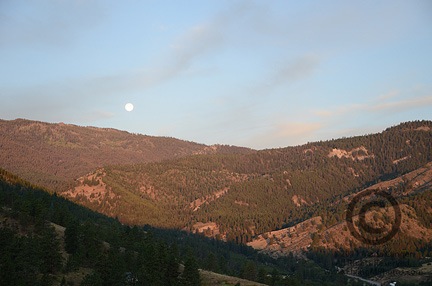
Moonset over Squilchuck

My view at dawn.

Weather moved in Sunday night. Asleep in my RV at the edge of a cliff over looking Squilchuck Valley, I was awakened by the wind at 3:30 AM. I looked out the window and realized I couldn’t see any stars. I fired up the Intellicast app on my iPad and was shocked to see the green blob indicating rain mostly to the south of my position. I dozed fitfully for an hour, expecting to hear rain on my roof at any moment. It may have been drizzling when I finally fell back to sleep.

At 7 AM, I woke to the sound of voices, trucks, and construction noise. The mostly blue sky was full of puffy clouds. Down in the lower part of the orchard, the pickers were already at work. There was no rain in the forecast at all.

Jim called at about 10 AM. I knew instinctively what he would say and beat him to the punchline: “You’re calling to tell me they cut you loose.”

“You’re a mind-reader,” he said. “Today’s my last day.”

We chatted for a while and then I remembered that Lisa had an opportunity to do a trip with a friend and would probably be open to letting Jim take over her contract for the next two days. He was also open to that, so I hung up and called Lisa. I told her what we were thinking.

“That’s great,” she said, “but today’s my last day, too. They’ll be done picking in about an hour.”

It was then that I realized that both of them would be gone by the next day.

Errands, Favors, and a Cherry Pie

The end of a cherry drying contract comes with logistical challenges.

Lisa’s challenge was easy. All she had to do was pack up, move out of her motel room, and drive the company pickup truck back to Spokane. Her employers would be sending some pilots in time-building mode out to Malaga to pick up the helicopter. She needed to send them the GPS coordinates for where the helicopter was parked so they could find it. She was toying with the idea of leaving that afternoon so she could spend some time with her family before her trip.

Jim’s challenge was a bit more…well, challenging. His helicopter was four hours from its 100-hour inspection, which needed to be done by his mechanic in Seattle. Flying to Seattle was usually a challenge in itself — the weather in the Cascade Mountains was typically miserable with low ceilings, making it a difficult, if not dangerous, flight. A weather window was required, but you never knew when that would be. After dropping his helicopter off in Seattle, he’d have to come back to Wenatchee to fetch his truck and drive it home to Coeur d’Alene. Of course, both his helicopter and truck were in Chelan, about 40 miles farther up the Columbia River. He needed to move his truck to Wenatchee to stage it there for his return from Seattle by airline. Then he needed to get back to Chelan so he could fly out with his helicopter the next day. He suggested a farewell dinner that evening and I promised to drive him back to Chelan.

I had a bunch of errands to run in Wenatchee and I got around to starting them that afternoon. While I was out and about, Lisa called. She’d decided not to leave that day; she’d leave first thing in the morning instead. What she really wanted to do was make a cherry pie. We’d already planned to do that before she left, but that was before she was cut loose early. I had an oven in my RV, so it made sense to do it at my place.

We decided to do it that afternoon. And instead of Jim and me going out to dinner in a restaurant, I’d pick up a piece of salmon and salad fixings and make dinner for all three of us. I was finishing up my errands and heading back to my RV when Jim called and I told him our revised plan. He was on board.

Lisa showed up around 5 PM. Since Jim was still a half hour out, we each took a bowl and headed into the orchard. Five minutes later, we had enough cherries for a pie — and then some.

Back in the RV, I gave the cherries my usual three-soaking bath in cold water to clean them thoroughly. Then Lisa went to work with my junky cherry pitter. It didn’t surprise me much when it broke when she was only half finished. She pitted the rest by hand. By the time Jim showed up, her hands were stained with cherry juice, making her look like a mass murderer.

Jim helped me put a filled propane tank back into its cabinet on my RV and hook it up. The strap that holds it in place bent and he was determined to fix it — which he did. If I wanted to be mean, I would have shown him the strap on the other tank which had similarly broken but had not been fixed. But instead, we went inside and kept Lisa company while she worked on the pie.

We also drank wine. Both Lisa and I had bottles that we’d opened recently but had never finished. We polished them off, one after the other over the course of the evening. I even opened another bottle to keep the wine flowing.

The Salmon Recipe

When the pie was safely in the oven, I got to work on dinner. That’s when Jim gave me a recipe that another one of the pilots had shared over the summer. Oddly, I happened to have all the ingredients. I reproduce it here because it was so excellent:

Ingredients:

  • Salmon filet
  • Mayonnaise
  • Onions, sliced thinly
  • Bacon, cut into pieces

Instructions:

  1. Place the salmon on a piece of aluminum foil.
  2. Spread mayonnaise on the fleshy side of the salmon.
  3. Sprinkle the onions and bacon pieces over the mayonnaise.
  4. Fold up the foil to make a packet.
  5. Place the packet on a preheated grill set to medium heat. If possible, cover the grill to keep the heat in.
  6. Cook until the salmon is done.

The Summer’s Best Dinner

I’d bought a beautiful 1-3/4 pound Coho salmon filet. It was too large to fit on my portable grill in one piece, so I cut it into three portions and made three packets. I absolutely lucked out with the timing. The fish was fully cooked, but still moist. The onions and bacon were cooked to perfection.

I served it with a salad of mixed greens, cucumber slices, vine-ripened tomato, bacon bits, goat cheese, and bottled balsamic vinaigrette dressing.

At one point, Jim said it was the best dinner he’d had all summer. I thought about it and had to agree.

It was the conversation that made it perfect. We talked about flying and about the surreal situation of a cherry drying contract. They seemed to think I had the best setup, living in my mobile mansion on a cliffside with a view, with 86 acres of cherries just steps away. I agreed that it would be tough to go home in September.

Jim was happy that his contracts had gone long enough to cover his annual insurance bill and the cost of his upcoming maintenance. He added up the hours he’d flown during the ten or so weeks he’d been in the area. It wasn’t a lot — cherry drying is not a time-building job — but it was more than usual.

Lisa said it was the best summer she’d ever had and that she’d do it again if she could. Her future holds bigger and better things, though: she’s starting officer school with the Coast Guard in January. She was already looking forward to the trip she’d be starting on Wednesday with a friend.

After dinner, Lisa sliced up the pie, which had been cooling on the stovetop. I produced some Haagen Daaz vanilla ice cream from my freezer. The cherries were big and plump and tender — not the mush you usually find in a cherry pie. It was a perfect finish to a great dinner.

The Party’s Over — and So Is the Summer

The party broke up after 10 PM. Lisa left to drive back to her motel for one last night. Jim and I climbed into my truck and started the long drive to Chelan. We talked politics on the way. We don’t agree on all points, but we’re both too stubborn to give in to the other. We’re also too smart — and too close as friends — to let our disagreement hurt our friendship.

I dropped him off at the house he’s renting. In the morning, his boss would pick him up and drive him to the orchard where his helicopter is parked. Then, weather permitting, he’d make the one-hour flight to Seattle. I’d pick him up at Wenatchee Airport at 5:12 PM and bring him back to his truck. The plan set, I started on my way back.

I got back to my RV just after midnight. The moon was up by then, casting a gray-blue light over the valley spread out before my RV. I listened to the crickets and looked out over that valley for a while. I had 12 days left in my contract and there was a slight chance that it would be extended again.

Yet with my friends gone, I felt as if my summer was over, too.

Weather Forecasting: A Bad Joke?

Each “source” of weather tells a different story.

My work this summer is highly dependent on weather. Simply stated, if the weather is picture perfect and there’s no chance of rain, I pretty much have the day off to do what I like. But if there’s any chance of rain, I need to stick around my base just in case rain starts. And if it’s raining, I go to work.

So, as I mentioned elsewhere on this blog, I’m really in tune with the weather.

Or at least I try to be.

The trouble is, I track the weather using multiple sources on my computer, iPhone, and iPad. And it’s very seldom that they all agree.

Today is a perfect example. Here are screenshots for the various sources, all captured within the save 5-minute period. What interests me is what it says for Sunday, Monday, and Tuesday.

National Weather Service

The National Weather Service website is my preferred source of weather data. It’s a no-frills site that doesn’t have very good weather graphics — radar, etc. — but does have well-described weather forecast data.

National Weather Service Forecast

Note that in this forecast, they’re showing a 20% chance of rain on Monday.

The Weather Channel

Everyone loves the Weather Channel website. I don’t. It’s full of ads and info that most people who are serious about weather forecasts has no interest in. But it is a source of weather info and I do occasionally consult it — usually for radar graphics.

The Weather Channel Forecast

Note that this forecast indicates a 20% chance of rain on Sunday and only 10% on Monday.

Intellicast

Intellicast is the pessimist of weather forecasting. I’ve discovered that if any forecast shows a chance of rain, it’ll be Intellicast. I use the Intellicast app on my iPad, but there’s also an ad-heavy website.

Intellicast Forecast

In this case, Intellicast matches the Weather Channel’s forecast regarding rain: 20% Sunday and 10% Monday.

WeatherBug

WeatherBug ForecastI use Weather Bug on my iPad and WeatherBug Elite on my iPhone. They usually have the same forecast.

This screenshot is from the iPad version. It’s showing a 20% chance of rain on Monday, just like the National Weather Service. As you might imagine, the iPhone version shows the same information (although in a different way).

Which One is Right?

In this example, at least there is some agreement between the different programs. The way I read this is that rain is possible sometime on either Sunday or Monday or both. Chances are slim but is possible — at least as of now.

Of course, I’ll watch all of these sources throughout today and tomorrow to see how they change. These forecasts will change. They were, after all, different yesterday.

Will they ever all agree? No. I’ve experienced rain when the forecast for one said no rain and another said there was a 10% chance.

Monday, July 25, was a good example. I went to bed on Sunday after seeing a 10% to 20% chance of isolated thunderstorms for Monday, yet was awakened at 4:30 AM on Monday by a pouring rain that didn’t really let up until 2 PM that afternoon. All the pilots flew all day that day; it was a nightmarish situation where all the orchards got wet and needed service. (I also got calls from orchard owners who weren’t under contract with me, begging me to come. I couldn’t — I service my clients first and it took all day to take care of them. A lot of cherries were lost that day.)

So I’ll be watching the weather closely for the next few days, never wandering far from base.

Who knows? Maybe tomorrow raindrops on my rooftop will put me on active standby before my morning coffee.

So You Want to Be a Helicopter Pilot, Part 8: Be Willing to Travel

Simply put: you have to go where the jobs are.

Back in July, I got an e-mail message from a reader with a question. His message is reproduced below, with his name changed to protect his privacy:

Hello, my name is Joe. I am 16. I live in Indiana, and I have been thinking a lot about my future career. I was thinking about all of the jobs that I would be interested in doing, and one of the big ones was a helicopter pilot. I read all of your posts about getting a job as a helicopter pilot, and I am confident that I have a chance in piloting as a career. I am willing to move around the country to get the right training on being a helicopter pilot, and I am willing to find a way to make it through all of the expensive training that you talked about. The only thing that really bummed me a lot about being a helicopter pilot was that once you make it through all of the training that it takes to actually get a job, the hours for piloting jobs can be unappealing, and I was just wondering if that is the case with all piloting jobs. Because some of them require you to be away for long periods at a time, and I was curious if all piloting jobs have strange hours, because I am kind of a family guy, and I don’t know if being away for long periods at a time on the job would be the thing for me.

I think it’s an excellent lead-in to my next topic in this series: travel.

Look at it Logically

For a moment, think about the kinds of jobs that are out there: doctors, mechanics, lawyers, restaurant servers, bankers, construction workers, accountants, supermarket managers, insurance agents — the list goes on and on. These jobs might be very different, but they all have one thing in common: there are job opportunities everywhere. Unless you live in the middle of nowhere, chances are that you could find people in all of these jobs within 5 or 10 miles from your home.

Now think about pilot jobs or, more specifically, helicopter pilot jobs. How many helicopter pilot jobs do you think there are within 5 or 10 miles from your home? Unless you live in a big city or tourist town, you can probably count them on two hands. Even if there are more jobs, they’ll likely have strict requirements for experience, certification, and skills, making them difficult to qualify for until you’ve been flying for a while.

Travel May Be Unavoidable

Let’s look at the big picture based on time:

  • Flight Training. If there’s a suitable flight school in your area, you might not need to travel to get your training. My first flight school was 90 miles from my home; I later trained at a second location of the same school that was only 70 miles away. That’s a lot of driving, but I was able to sleep in my own bed at night. When I had a falling out with my flight school and needed to finish up my commercial rating elsewhere, I went to Long Beach, CA, which is not driving distance from my home. (Fortunately, I only needed 10 more days to get my rating.) Whether you have to travel for training is dependent on what’s available near where you live. And don’t pick a flight school just because it’s the only one nearby; consult Part 4 of this series, “Choose a Reputable Flight School,” for more on choosing a flight school.
  • Time-Building Job. Your first job as a pilot is very likely to be as a CFI. This is, for most people, a time-building job. In other words, the only reason you’re doing it is to build flight time so you qualify for another job. If you’re lucky, you’ll be able to get a CFI job either at the flight school you trained at or another one close to home. But again, this isn’t always the case. That first job is often very difficult to get — especially when, for a while, flight schools were churning out new helicopter pilots at an alarming rate. If you want to move forward in your career, you must get a time-building job. If the job market is tight, you might have to take the first job you’re offered, no matter where it is.
  • First Pilot Job. Once you’ve build enough time, you’ll be eligible for a “real” pilot job — one where you’re actually doing all the flying (as opposed to sitting beside someone else who is trying to). Again, there aren’t many entry level jobs. Some of them are seasonal tour jobs, meaning they’re only available during the season. I wound up at the Grand Canyon, which I recommend because of the challenging flying conditions. Other people go to Alaska. The more time you have, the more options will be open to you. In many cases, this first job will also be your introduction to turbine helicopters. (Frankly, I don’t see much difference between turbine and piston helicopter operations — except how much damage you can do if you don’t start it right or try to pull too much power.) Employers make a big deal about turbine time it so you should probably try to get into a turbine ship as soon as possible. The point is, once again you’re required to travel to where the job is available. And there’s probably no coming home on weekends if you’re working in Alaska.

Sometime after that first “real” job, you’ll begin qualifying for other flying jobs. In my mind, they fall into three categories:

  • Contract Jobs. A contract job is where you are hired as a pilot to fulfill a contract for specific work. The cherry drying work I do in Washington State is an example of a contract job: I’m hired to provide services for a short length of time. I’m paid a per diem amount to be available each day of the contract and I’m paid an hourly rate when I fly. My duty hours are all daylight hours, 7 days a week until the end of the contract, which is normally 2 to 6 weeks. I’m not employed by anyone — in other words, I don’t get a paycheck, have taxes deducted, or have benefits. I’m also out of work when the contract is up. Firefighting is another example of a contract job. Contract jobs tend to be seasonal and require specific skills, equipment, and/or certifications. These jobs require the most travel — you could be in Arizona fighting a fire one week and two weeks later be in Montana waiting for a fire call.
  • Schedule Jobs. What I’m referring to as a “schedule” job is when you work for a specific employer on a schedule — for example 7 days on and 7 days off or 14/14. I worked 7/7 at the Grand Canyon, but they also offered 4/3 schedules (I think; my memory isn’t as good as it was). 7/7 and 14/14 is common with EMS and Gulf operation jobs. Some contract jobs — especially firefighting — work on 14/14 (or similar) schedules. These schedules are designed, in part, to make it possible for pilots to “go home” between work shifts. They’re recognizing that pilots don’t always live where the job is and, indeed, they don’t. When I worked at the Grand Canyon, most of the pilots on the 7/7 schedule went home on their off days, including me.
  • Regular Jobs. What I’m calling a “regular” job is one where you work “regular” hours at the same place for a specific employer. ENG and law enforcement jobs are good examples. An ENG pilot might have to fly morning and afternoon rush hours and be available during the day for breaking news. But he might get nights and weekends off. A law enforcement or EMS pilot might work a 12-hour day shift for a week, get a week off, and then work a 12-hour night shift at the same base. These are the folks most likely to live where they work. And if their job is stable enough, they can have a home life pretty much like anyone else’s.

Of course, there is overlap between these three broad categories and someone else might come up with a different way to distinguish between them. This is just my way of looking at them and how travel is involved.

I should also point out that a “regular” job might require travel. For example, you could argue that Phoenix-based Flying M Air is my employer and I normally work out of a Phoenix airport. However some photography or survey assignments require that I travel to other locations — Lake Powell, Bryce Canyon, Kingman, Winslow, etc. — for a day or more. If clients need a helicopter where there isn’t one, I’m sometimes called to bring mine to them.

In general, however, to answer Joe’s question about hours, I’d say that 95% of helicopter jobs have what you might consider “odd hours.” If you’re looking for a 9 to 5 job, a career as a helicopter pilot is not for you.

Living Conditions on the Road

A humorous look at this aspect of being a helicopter pilot.

It’s worth a moment to look at some of the living conditions you might find if you do get a job away from home. While they’re not always terrible, they’re not usually very good.

At the Grand Canyon, pilots were offered housing in double-wide mobile homes about 30 miles from the airport. For a reasonable fee, four pilots shared one four-bedroom house in a subdivision of mobile homes. I was fortunate in that I had other living arrangements available to me, so I didn’t need to take advantage of this opportunity. My understanding was that living conditions depended on your roommates and and their habits. The area was so remote with such limited facilities that our employer actually warned us before we were hired about the lack of night life and social activities so we couldn’t use that as an excuse to back out later on.

In Central Washington State, I now live in a fifth wheel RV that I own and transport to my various bases of operation. It’s very comfortable, although it does have limitations that vary based on where it’s parked. In previous years, I spent a whole month at a motel in a very cramped room with no cross-ventilation. (The motel did have a pool, so I really can’t complain.) Other pilots doing this work are often called on to live in housing provided onsite — usually small travel trailers. One pilot I know was put in an 18-foot travel trailer with no bathroom; she had to use a portable toilet (think blue or green outhouse) and walk to the orchard owner’s home to shower. Her cell phone didn’t work there either, so the only way she could get or make calls was to drive into town.

A friend of mine who works fire contracts is typically put up in a motel near the base. Because the base can change at any time and he has to carry his gear with him from base to base — sometimes in the helicopter when he repositions — he’s limited on what creature comforts he can bring along. Motel quality and cleanliness can vary widely depending on what’s available.

Yet another friend of mine who works fire contracts typically travels to Greece, Italy, and Australia for work. I don’t know the details of his living conditions, but I sure do like the idea of going to places like these with someone else footing the travel bill.

Living conditions are a crapshoot that depends on many factors. If you’re picky about where you sleep at night, a career as a helicopter pilot might not be for you.

Be Willing to Travel

The point of all this is that you need to be willing to travel and willing to deal with less-than-perfect living conditions to move forward in a career as a helicopter pilot. But that’s part of paying dues — which is up next.

So You Want to Be a Helicopter Pilot, Part 7: Stay Slim

Fatties need not apply.

As strange as it might seem, one of the biggest barriers to building a career as a helicopter pilot is size — pilot size. Simply put, if you’re a heavyweight, you’re going to have a heck of a time learning to fly and getting your first job.

How Big is Big?

What do I mean by “heavyweight”? Well:

  • N7139LHow much do you think you can squeeze into one of these?

    If you weigh more than 250 pounds, you may as well forget about learning to fly helicopters for a flying career. Most training helicopters simply can’t accommodate a big guy (or gal) plus a flight instructor. Even if you did learn how to fly, no one will hire you as a flight instructor.

  • If you weigh between 200 and 250 pounds, you might find a flight school that can accommodate you for training, but it’s highly unlikely that you’ll find one willing to hire you as a flight instructor. After all, the more the CFI weighs, the less capacity there is for the student pilot. A big CFI could only train small student pilots; flight schools simply don’t want to deal with this limitation.
  • If you weigh between 180 and 200 pounds, you’ll likely find a flight school that can accommodate you for training and might consider hiring you as a flight instructor. But you’d have to be really good with no serious competition to get that job.
  • If you weigh less than 180 pounds, not only will you have no trouble finding a flight school, but if you prove your worth throughout training, you probably won’t have much trouble getting a job as a flight instructor either.
  • If you weigh less than 150 pounds — listen up, ladies! — and you’re a good pilot with the right attitude, you will be sought after as a pilot.

Remember, the less the pilot weighs, the more other stuff — passengers, cargo, etc. — can be loaded on board.

Real-Life Examples

Don’t believe me? I can back this up with a two real-life stories.

One guy who flew with me on my annual journey from Arizona to Washington state needed to build R44 time to qualify as an R44 CFI. He was a tall guy — probably at least 6 ft 2 in — and weighed 220 pounds. This was not a fat 220 pounds; he was tall, thin, and fit. He’d been told flatly by the school he hoped to get a job with that he weighed too much to be a CFI in R22s. He figured he’d go after a job as a CFI for R44s. What he didn’t realize is that flight schools don’t want CFIs limited to training in just one aircraft model. They could easily prep a 180-pound R22 CFI to train in an R44 — in fact, they could use that possibility as motivation (think carrot) for their R22 CFIs. I don’t know if this guy ever got a CFI job, but I tend to doubt it.

A very tiny female pilot who has been flying helicopters for years at the Grand Canyon weighs in at only 115 pounds. While it’s true that she’s too small to fly solo without ballast in the EC130 she flies at work, her employer loves her, referring to her as their “secret weapon.” Indeed, I saw her value one spring day when I dropped off two passengers for a flight over the Grand Canyon. The aircraft originally had only four passengers who would fly with one of the other pilots. When two more passengers showed up for the same flight, they pulled the other pilot — a man who probably weighed in between 180 and 200 pounds — and put her on board instead. They’d gained at least 65 pounds of capacity by simply swapping pilots, making a flight that may have been over gross weight now under gross weight. What company wouldn’t see the value of that?

And if these two examples aren’t enough for you, take a look at helicopter pilot job listings. You’ll see that a surprising number include maximum pilot weight as part of the requirements — or ask you to include your weight with your resume. In other words, fatties need not apply.

Don’t Disregard this Advice!

This is not advice that should be disregarded. This is vitally important for career pilots.

If you’re a 220+ pounder and a flight school trying to sign you up tells you not to worry about it, they are lying to you to get your business — as they may have done to the 220 pounder who flew with me. Sure, they may be able to squeeze you and a tiny CFI on board an R22 for flight training. Or maybe they’ll convince you that you’ll be better off training in an R44, which costs about twice as much per hour to fly. But you’ll still find it impossible (or nearly so) to get a job as a CFI when your ratings are in hand. And unless you plan to pay to build your first 1,000 hours, you’ll need that CFI job to move forward in your career.

It should go without saying that even if you start on the slim side, it’s important to stay that way — at least until you’ve reached a point in your career where your personal body weight doesn’t matter as much.

For example, I have two not-so-slim friends who are well along in their pilot careers. Both are utility pilots; one flies medium twins like Hueys and Bell 212s and the other flies Sky Cranes. Both of these guys are between 200 and 240 pounds. But they (obviously) weren’t always that big. Pounds are often added with years.

Yet another friend of mine was a medevac pilot who allowed his weight to creep up over time. When his company started closing bases, he was one of the first pilots to go. Coincidence? I don’t think so. At the time, he probably weighed about 250.

What You Can Do

If your current weight is above 200 pounds and you know some of it is body fat, it’s time to go on a diet. Do your best to get your weight down to what I consider the magic number for helicopter pilots: 180. If you can keep your weight at or below 180 pounds, weight will not be a barrier to your career.

Keeping slim and trim will help you throughout your life. Not only will it make it easier for you to get work as a pilot, but it will keep you healthier. Obesity-related illnesses such as high blood pressure, heart problems, and diabetes can end your career. If this isn’t motivation to take care of yourself, nothing is.

Next up, I’ll talk about what I consider the best part of being a helicopter pilot — but what others hate: travel.

So You Want to Be a Helicopter Pilot, Part 6: Study Hard

Flying a helicopter is more than just knowing how to move the controls and perform maneuvers in flight.

As with any other skill you might acquire in life, learning to fly helicopters is made up of many components. The most obvious is getting the motor skills — including reflex reactions — to handle the actual mechanics of flying: working the controls, etc. But behind all that is the knowledge you need to acquire so you fully understand what to do, why you need to do it, and how it works.

Ground School

Ground school — time spend on the ground with a flight instructor learning the what, why, and how parts of flying — is an important part of flight training. Unfortunately, it’s not usually the fun part and, because of that, most pilots try to minimize it. Instead of learning as much as they can about ground school topics such as aerodynamics, aircraft systems, weather, and physical (or medical) issues, some pilots learn only as much as they need to know to pass the written and oral tests that come later.

This is not a good idea if you intend to build a career as a helicopter pilot. At some point in your career, the gaps in your knowledge will be noticed — perhaps by the chief flight instructor you hope will give you your first job or by the chief pilot who can put you in the seat of a turbine helicopter. Or maybe by the mechanic who asks you to perform and document power checks in flight and you clearly don’t understand what he’s talking about. Or maybe by the new pilot you’re asked to show around — the pilot who did study hard and realizes how clueless you are.

Ground school is where you can learn what you need to know, with an experienced flight instructor who’s there to answer your questions. Dig in and learn. Make sure you understand everything — if you’re hazy on something, ask questions. Discuss topics with other student pilots and flight instructors. When you fly, try to understand how ground school topics apply to flight. Take notes, review them, jot down things in the margins when you connect the dots between topics later in your studies or during flights.

Hitting the Books

There are many books and study materials that can help you understand and learn the topics you need to know.

I’ve already pushed the excellent FAA publication, Rotorcraft Flying Handbook, several times on this blog, but I can’t recommend it often enough. Where else are you going to find a free, generously illustrated guide that explains much of what you need to know about flying helicopters in terms anyone can understand? It’s an excellent starting point for your studies.

FAR on iPadAnother pair of must-have publications is the Federal Aviation Regulations (FARs) and Auronautics Information Manual (AIM) which are often published in the same volume. The FAR is updated throughout the year and most publishers publish new editions annually. You should get the most recent edition when you begin your training and try to update it at least every two years. Or do what I do: buy it in app format for an iPad (shown here) or iPhone. You can find them both on Tekkinnovations.com; once you buy them, updates are free (at least they have been so far for me).

Another handy book to have in your possession is a copy of the Pilot Operating Handbook (POH) for the aircraft you’ll be flying during most of your flight training. Yes, I know there’s one in the helicopter — it’s required to be there — but unless you plan to sit in a helicopter to do you studying, it’s nice to have your own copy to jot down notes, etc. I learned to fly in an R22 and bought a copy of the POH the first time I attended the Robinson Factory Safety Course; I added all kinds of notes in the margins during that course.

Cyclic & CollectiveThere are other books about flying helicopters. Many of them have been written by experienced helicopter pilots. One of my favorites is Cyclic & Collective by Shawn Coyle. This is a huge book jam-packed with information that goes beyond the basics offered by the FAA.

It’s likely that your flight school will also recommend or require certain books to help you study. The Jeppesen books are a big hit — especially to your wallet. But, to be fair, they do have excellent illustrations to make important points clear.

But remember, buying a book isn’t enough. You have to crack it open and read it.

Going the Video Route

There are also training videos that you might find helpful to reinforce what you learn in ground school and on your own. I used the King School videos. Although the series is designed for airplane pilots, there was an extra video in the set that covered helicopter operations. In general, I found the videos painfully boring at times, but I admit they were informative. By the end, however, I wanted to grab John and Martha King and crack their heads together. This, of course, was more than 10 years ago; hopefully, the videos have been revised by then. There’s also a good chance you can some of this material on their website.

I think Sporty’s has a set of videos that compete with the King’s — so you might want to check that out as an alternative.

If you decide to buy the videos, I bet you can find them used on eBay or Craig’s List for less than regular price. You can always sell them when you’re done.

Make It Count

Your flight training will cost as much as — if not more than — a college education. You need to take it just as seriously.

If you fail to learn the concepts by studying hard and asking your flight instructor to explain things you’re struggling with, you’re not only throwing away the money you’re spending on your education, but you’re setting yourself up for failure in your career.

Make it count by putting real effort into it and studying hard.

Next up, I’ll explain why you shouldn’t hit the books with a bag of chips within reach.