Elk and Bison and Bears — Oh, My!

Day 12 takes me through two national parks on my way south.

I slept better at Lynn’s house than anywhere I’d been so far. The bed was warm and cosy, the air was clean and fresh, and the sound of the creek rushing by the house was the perfect white noise for sleep.

I got up my usual time and soon realized that Lynn was awake, too. I had some coffee and Lynn had some tea and we chatted. Then I went up to take a shower while she put the horses back out to pasture.

She drove me to a town called Alder for breakfast. On the way, we stopped at a town called Laurin (which is not pronounced the way it’s spelled, but I can’t remember how to pronounce it) where Lynn showed me two small houses that had been built inside metal grain silos. She said that when she and Ray had farmed down near Klamath Falls, they’d had a bunch of those silos and never knew what to do with them — they didn’t grow grain and no one else in the area did either, anymore. This seemed to be a perfect solution.

We had egg sandwiches at a local farmer cafe and I picked up the tab. Then we went back to her place, where I packed up the car, said goodbye, and headed out.

I gassed up in Sheridan, at the only gas station. I then retraced our miles through Laurin and Alder on route 278. Along the way, I saw a bald eagle. It looked exactly like all the photos I’d seen of bald eagles, but it was picking on some road kill when I approached. It flew off to wait atop a fence post until I was gone so it could continue its meal.

I passed Nevada City along the way. My map indicates that it’s a ghost town, but there was plenty of activity there. Perhaps someone had fixed up the buildings alongside the road as a tourist attraction? Or built them from scratch to look like old western buildings? In either case, there were an awful lot of them and they were right on the road. A sign said that there would be living history events that day. A bunch of tourists had already gathered, including three motorcyclists who had found it necessary to take up a full parking spot for each of their Harleys. Ah, the good old American “I’m all that matters” attitude in action.

A few minutes later, I passed Virginia City, which has to be the most authentic western town I’ve seen so far. There were plenty of old buildings, in wonderful condition, housing shops and museums. Makes me sick to remember how Wickenburg tries to promote itself as “the west’s most western town,” when I pass through one that makes Wickenburg look like a shadowy imitation of something out of a sixties western. Somehow, the fast food joints ruin the effect.

Quake LakeI reached Ennis, which Lynn had told me was very touristy. I didn’t really notice that, but I made my turn there, so I may have missed that part of town. I was still on route 287, but it was heading southbound now. After a while, the road joined up with the Madison River, which I followed for quite some time. When I got to the turnoff for Quake Lake, I turned in. Lynn had told me a little about the place and said she’d wanted to see it when she and Ray had driven past. Ray hadn’t been interested at the time, so they’d gone past without stopping. The place was situated in a canyon where the Madison River flows. In the late 1950s, an earthquake had caused a landslide that dumped debris into the river bed. Twenty-eight people had been killed, although I don’t know how. Perhaps they were on the road there? In any case, the natural dam caused by the landslide had created Quake Lake. I read all this on the sign outside the visitor center. It was all I needed to know, so I didn’t go in. I took a picture of the little lake, then got back into the car and continued on the road as it wound alongside it. There were lots of dead trees sticking out of the water. I imagined a heavily forested canyon suddenly filled with water and the slow death of the trees that were submerged.

The road passed on the north side of Hebron Lake, a manmade lake along the Madison River. There were lots of homes on its shores, a few marinas, and some fishermen. Then, at the junction for route 191, I turned right, heading south.

My car’s odometer turned 14,000 miles about a mile outside of West Yellowstone, MT.

I was going to just drive through West Yellowstone when I spotted an IMAX theater. I enjoy IMAX movies — except the 3D ones, which look blurry to me — so I pulled in. They were showing three different movies: Yellowstone, Lewis and Clark, and Coral Reef. Although I wanted to see Lewis and Clark, Yellowstone was next up, so I bought a ticket to that. Since my cell phone finally had a decent signal, I called Mike while I waited and left him a message telling him where I was and where I was going.

The movie was good. Grand Canyon, which plays at Tusayan near the South Rim, was better, though.

YellowstoneI headed into the park, crossing over the border into Wyoming, the eighth state I’d visited so far. My National Parks pass got me in without a fee. (It works at Yellowstone but not Mt. St. Helens? What kind of bull is that?) I took the map and gave it a quick look. My objective was not to visit the park. My objective was to take a nice, scenic ride south toward Salt Lake City. The problem was, it was a Saturday in August. The park was full. And the tourists were of the most annoying variety: drive-through tourists who will stop their car anyplace someone else has stopped, just to take a picture of whatever that other person is taking a picture of. When I wanted to drive slowly, there was someone on my butt. When I wanted to drive faster, there was someone in front of me. When I wanted to stop in a place where no one else was stopped, two or three other cars immediately appeared, spewing occupants armed with cameras to take the same picture I was trying to take. At one point, I reached a traffic jam on a narrow, one-way road as at least 30 cars had stopped to photograph a grizzly bear on the other side of a creek. I was so wigged out by the crowd that I neither stopped nor saw the bear.

BisonI did see plenty of elk, though. The first herd was right inside the park, grazing along the Madison River. I guess seeing tourists have tamed them, to a certain extent, because some very gutsy tourists were approaching quite close and the elk didn’t seem to care. I also saw a few bison. Most of the bison, as I recall, are on the grassy east side of the park. I was on the west side. I saw four individual animals, each of which were the subject of many tourist photos. But the one that amazed me the most was the one walking alongside the road in a forested area. I think he was lost. But he was walking on the pavement, forcing vehicles to go around him. That, of course, caused a traffic jam because everyone wants the thrill of driving alongside a walking bison. When it was my turn to pass him, I didn’t stop. I just aimed my camera and pushed the button while I kept driving. He was so close that someone sitting in my passenger seat could have reached out and touched him. Although he didn’t seem interested in me (or anyone else), I could imagine what those horns would do to my car’s paint job if he decided he didn’t like the color red. I wondered what he thought of the long line of campers and SUVs and cars filing past him in slow motion. I also wondered where he was going. Probably to the administrative offices to complain about all the traffic and exhaust.

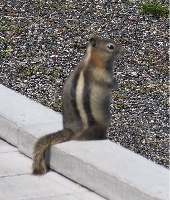
Old FaithfulI took the exit to the Old Faithful Inn, in search of a decent lunch. I got a great parking spot in the shade and got out with my camera. There was a huge crowd of people sitting on benches, facing the Old Faithful Geiser, which was spewing out various amounts of steam to keep them entertained. I tried two places and found a cafeteria and a buffet. I checked out the buffet and was surprised to find that the cafeteria food had looked better (although it didn’t smell better). As I was walking back to my car, Old Faithful let go and I managed to get a bunch of good photos. It was still bubbling water when I left. ChipmunkI also managed to get a photo of this little fellow. It’s unfortunate, but people at national parks find it necessary to feed the wildlife. As a result, they become tame, like this guy probably was, and they forget how to forage for themselves. In the winter, when there are fewer tourists around, they starve. That is if they don’t get sick and die from the junk the tourists feed them.
I found a restaurant with table service at the Snow Lodge. I had a nice salad with warm goat cheese cakes on it. Tasty. Then I got back into the car and made my way out, before a new post Old Faithful eruption could start another traffic jam.

I followed the signs to Grant Village, crossing the Continental Divide twice along the way. At one point, I caught a glimpse of Yellowstone Lake. I was surprised — I didn’t remember it being so big. And I saw plenty of evidence of forest fires: where I’d first come into the park, near Old Faithful, and now as I left the park, driving toward the South Entrance. I passed Lewis Falls, on the Snake River, the first waterfall Mike and I had seen when we’d come into the park from the south years before. I clearly remember the fresh forest fire damage at the falls — there was nothing alive back then. Now the dead trees were still there, but new pines were growing in. It would take a long time for the park’s forests to recover.

Grand TetonsThe road followed the Snake River down to Jackson Lake and Grand Teton National Park. The main feature of Grand Teton is the mountain with the same name, on the southwest side of the lake. It’s 13,770 feet tall, very rocky, and has a glacier not far from the top. In this photo, it’s the mountain that’s farthest away. It was after 3 PM and the sun was moving to the west, making it difficult to get a good photo of the mountains from the east. I followed the road, choosing the path that kept me close to the lake rather than the faster road that went direct to Jackson. A scenic drive.

I passed through the southern boundary of the park and, a while later, was approaching Jackson. By this time, I was exhausted. I’d left the top down most of the day and I had been slow-roasted by the sun. All I wanted was a clean, quiet motel room. I stopped about about a half-dozen places on the north side of town and was told that they only rooms left were either smoking or very expensive. I drove through Jackson, figuring I’d find a place somewhere outside of town, on the south side. Jackson, WY, is a tourist processing plant. Tourists go there, park their vehicles, and then proceed through a series of shops and restaurants and tourist attractions designed to wring their money out of them. I couldn’t believe the number of people on the streets. Traffic was horrendous. And I couldn’t understand what attracted these people, like flies to honey. The real tourist attraction was north of town, the lakes and mountains and wildlife. Gift shops and cheap t-shirt joints can be found anywhere. When I finally got out of town, I was glad I hadn’t found a room there.

I wound up at a motel along a creek, just where the creek merges with the Snake River. I took an upstairs room facing the creek. After getting some dinner at a restaurant 3 miles away, I sat on my patio with my maps and a bottle of wine, trying to figure out where I’d go next. I was on my way home — that was for sure. After nearly two weeks and over 3,000 miles on the road, I was ready for my own bed.

Bird Biscotti

A recipe for parrot treats.

A while back, I surfed the ‘Net and found a bunch of recipes for bird treats. I wanted healthy, homemade treats for my parrot, Alex the Bird.

I followed one of the recipes, called “Bird Biscotti,” to make cookies for Alex. I had to substitute a bit, using Avian Essentials in place of wheat grass and egg shells. And the batter turned out too thin, so I added more cornmeal and flour to get the right consistency. The resulting creation was very green. Alex, however, liked them quite a bit.

That one batch of cookies lasted about two months. I stored them in the freezer to keep them fresh. When it was time to make another batch, I decided to experiment, adding ingredients that another recipe suggested. Here’s my concoction:

1 cup granola cereal
1/4 cup 7-grain hot cereal, uncooked
1/2 cup cornmeal
1 cup whole wheat flour
1 tablespoon Avian Essentials
4 eggs
4 eggshells, washed and ground
2 large carrots, cooked and finely chopped
1/4 cup sesame seeds
1/4 cup flax seeds

A few notes about all this.

The 7-grain cereal is a hot cereal mix I bought at Safeway supermarket. It’s something I happened to have in the house and figured I’d throw in. If you can’t find that, skip it or use oatmeal.

Avian Essentials is an off-the-shelf bird supplement you should be able to buy in a good bird or pet store. It contains spirulina (which is why it’s green), cuttlebone powder, and wheat grass.

These provide beta carotene (vitamin A), essential amino acids, and calcium.

Ground eggshells also provide calcium. Frankly, I could have skipped this, since I used Avian Essentials — I actually did skip it in the first recipe. But I wanted to see how hard it was to prepare the eggshells. So I washed them, let them air dry, and used my mortar and pestle to grind them up. It took about 10 minutes total. The resulting powder didn’t look anything like eggshells.

The carrots were easy to prepare. I cooked them up in the microwave, drained off the water, and ran the carrots through my food processor. If I’d added other ingredients with them (or had used the smaller food processor bowl), I could have turned them into a paste. But that didn’t really matter. The original recipe called for carrot baby food, but I didn’t feel like running to the store to buy it.

I’d bought the sesame and flax seeds at my local health food store. (Yes, there is one in Wickenburg: Ginny’s Vitamin Village.) According to another bird treat recipe I’d found online, these two ingredients provide nutrients that help prevent feather plucking. So why not throw them in, too?

If you mix this all up, it should result in a green, dough-like mass with orange flecks. (Sounds good, huh?) If it’s too runny to work with your hands, add more whole wheat flour to thicken it up. If it’s too thick (unlikely but possible), add unsweetened fruit juice or water.

I split the dough into about 5 pieces and used my hands to make long cylinders. I put these on a lightly greased cookie sheet and baked them for 30 minutes at 325°F. Then I pulled them out, cut them into 1/4 to 1/3 inch pieces, and laid the pieces flat on the cookie tray for another 10 minutes of baking. Alex likes his cookies crunchy.

When the cookies cooled, I gave one to Alex to sample. He loved it!

A Good Attitude

I’m happy to be appreciated.

Yarnell Daze is coming up in May. It’s an event that’s been happening just about every spring in Yarnell for the past 30+ years. It includes a parade, art fair, car show, and all kinds of other activities for people of all ages. A lot of fun up in Yarnell, high above the low desert just as the low desert is starting to really heat up.

Years ago, I noticed someone giving helicopter rides as part of the Yarnell Daze festivities. He was flying out of a lot beside the Mountainaire convenience store (Woody’s) in Peeples Valley. I only saw him one year and that’s because I was just driving through on my way home from Prescott.

So I figured I’d call the Yarnell Chamber of Commerce and ask if I could do helicopter rides for them. There was a machine when I called. (There’s always a machine when you call. I don’t think Yarnell’s Chamber of Commerce is very busy.) So I left a message. And so began our game of telephone tag.

Someone from the Chamber called back and said they were thrilled that I’d called. Thrilled. Wow. Can’t help liking that attitude. Her message said their first Yarnell Daze planning meeting was coming up on a Monday in February and could I attend? I checked my calendar and called back. I told the machine I’d be out of town that day (I was going to be at the Grand Canyon doing a mule trip I’d planned eight months in advance). Then I didn’t hear anything for a while.

I called back early this month to see where things stood. I left another message. Someone named Linda called back and left a message for me with a different phone number. I called back and actually spoke to Linda. Their second meeting was March 28. Could I come? I put it on my calendar.

The meeting was at the Buzzard’s Roost, an interesting little cafe on the north end of town. The Buzzard’s Roost was always a funky, kind of junky-looking place that specialized in smoked food — ribs, pulled pork, etc. It was tiny inside — maybe six tables? — and had a few tables outside. Then someone came along and fixed the place up. They enclosed the outside with clean, neat-looking siding, removing the outdoor seating and making the place look….well, normal. Around that time, the bikers stopped coming in and the place looked empty all the time. It had been stripped of character. Then someone must have woken up to the fact that the place’s old funky look was part of its formula for success. They somehow managed to make it look weird and funky again, added more outdoor seating, and parked an old Harley out front. Now it’s the same old place it was but bigger and people stop in for meals again.

I stepped inside, wearing my freshly pressed Flying M Air oxford shirt and feeling a bit out of place. There were people there having breakfast, but no big groups. A woman at the counter looked at me and said, “Yes, this is the meeting.” Her name was Wendy and with her was a man who turned out to be the cook. When he went into the kitchen to get to work, I noticed that he wore a western style holster under his apron with two revolvers tucked inside it. I don’t think they were fake.

Wendy owned the Buzzard’s Roost and was evidently part of the Yarnell Chamber. She was excited that I’d come and excited that I’d be doing helicopter rides. In fact, she told everyone who walked in or called on the phone while I was there that they’d be having helicopter rides at Yarnell Daze. I know she was more excited than I was. We talked about pricing, hours of operation, etc.

Then she asked me if I could be in the parade. She wanted me to hover down the street. Wow. I’ve always wanted to do that. I know I have the skills required. But the downwash would create hurricane-like winds as I passed. It could blow up dust and tiny pebbles. It could get in people’s faces or eyes or damage property on the parade route. I had to say no. But I promised to do a low fly-by during the parade.

Wendy suggested advance ticket sales. A great idea, especially after the farce at Lake Havasu City. I’d know in advance how many people I could expect at a minimum. We’d do advance ticket sales at a slightly lower price, to encourage people to buy before the event. The tickets would have time slots on them, so not everyone would show up at once. She could sell them at the Buzzard’s Roost, which would help her draw people in. All I had to do was create the tickets and a bunch of flyers.

Linda came by and we talked about landing zones. That’s the only thing that bothered me about the gig: the proposed landing zone was all the way out in Peeples Valley, about three miles further up route 89. Not exactly the in-your-face LZ I like to have. The presale tickets would help get people out there, but didn’t they have a better location?

A man having breakfast, who’d already chatted with me about doing aerial photography from the helicopter, suggested a field near “Choo-Choo,” the train museum at the edge of Yarnell. Linda and I scoped it out when we went to check the Peeples Valley LZ. We both agreed it was better. Linda had the job of finding out who owned it and getting their permission to operate there.

That in itself was weird. Most hosts require that I find and get permission for landing zones. Yarnell was doing everything for me.

Want to know something else that was weird? Linda told me they have insurance and I didn’t have to worry about it. Wow. Normally, the big stumbling block for these events is insurance — hosts normally want to make sure I have it and add their names as additional named insureds. It’s become part of my planning ritual for events. So I told Linda that I have insurance, too. I produced the certificate and made her take a copy. I told her that I pay a ton of money for my insurance and I wanted everyone to know I had it. She took it — probably just to be polite.

Yesterday, I had all the tickets and flyers ready to bring to Yarnell. But I don’t get up there too often so I wanted to mail them up. This way, they’d get them right away. So I called Wendy at the Buzzard’s Roost to get her address. They don’t have mail to their physical address in Yarnell. It’s all Post Office boxes. She told me that she appreciated me doing this. As if I were doing her a favor. I told her that it was my pleasure, that Yarnell was a pleasure to work with, and that I hoped I met their expectations.

And I meant it.

It’s nice to see a Chamber of Commerce that actually works hard to ensure the success of its events, one that invites local businesses to participate and makes it easy for them to do their part. A Chamber of Commerce with a positive “can-do” attitude rather than the “why should we do something for you?” attitude I’ve seen all too many times around here. I think I’ll be joining the Yarnell Chamber of Commerce. It’ll be a real pleasure to support such a good organization.

Now if only all of my helicopter ride hosts were as pleasant and accommodating as Yarnell.

Ugly Fat Americans

I hear a startling bit of information on the radio.

I listen to NPR. For those of you who favor reality TV over reality, NPR stands for National Public Radio. It’s PBS (Public Broadcasting System) for the radio waves. Funded by “listeners like me,” charitable foundations, and corporations looking for tax breaks, it’s primarily talk radio with news and information shows that go far beyond what you can find on regular television and radio. News shows focus on politics, foreign affairs, literature, science, and other topics that people who think actually think about.

My friend Jim says that NPR is for liberals. But Jim worships Rush Limbaugh, so I can’t take anything Jim says very seriously anyway.

The other day, on my way to work, the discussion on Talk of the Nation or the Diane Reems Show — I can’t remember which one I was listening to — they can be very much alike at times — focused on the problems with Social Security and Medicare. As you may (or may not) know, both services are in financial trouble, although Medicare is in much bigger trouble than Social Security. Why? Well, the government is paying out more in benefits than it’s collecting and it isn’t earning enough on the balance of funds to sustain it. (I think financial mismanagement is partly to blame for that, but that’s not the point here so I won’t pursue it.)

The man being interviewed — and forgive me if I can’t recall his name or the position that gives him his expertise — presented a shocking piece of information. For the first time in decades, the average life expectancy of Americans is going down. Yes, down. That means that today’s Americans are not expected to live as long as Americans a few years back.

The cause of this sorry statistic: obesity.

The phrase “ugly fat American” takes on new meaning. Not only are we spoiled rotten and accustomed to having our way with the world (thus making us “ugly” in the eyes of the people who really don’t like us), but we are literally fat. And those fat tissues are starting to eat away at our life expectancy.

If you’ve got eyes and you use them to look around yourself in public places, you must have noticed it by now. There are a lot of fat people. But worse yet, there are a lot of very fat people.

Look at yourself. Honestly. How many extra pounds are you carrying around?

Heck, I’m overweight. I’m 5’8″ and weigh about 30 pounds more than I should. Anyone looking a me would likely say to himself, “Now that’s a big girl.” He might not use the word fat, but that’s only because (lucky for him) he hasn’t seen me in a bikini. My height helps camouflage my extra pounds. Those 30 pounds are 20% more pounds than I should be carrying around. And I can feel that extra weigh. Last spring, when I weighed 20 pounds less (can you believe it?) I felt better. Healthier. And my clothes fit a heck of a lot better, too.

I was lucky enough to have a high metabolism until I was about 30. That meant I could eat as much as I wanted and never put on a pound. In fact, for a while, I had trouble keeping weight on. In college, my weight dropped down to 105 lbs. I looked terrible, like a walking skeleton. I began to have digestive problems. I wasn’t anorexic — it wasn’t like I was trying to keep the weight off. I was just too darn busy. Working two jobs, commuting 30 miles each way to school, shouldering an 18-credit course load. I had trouble finding time to fit meals in. Then I moved on campus and got on the meal plan. That fixed me up. They made these warm rolls….

As time ticked on, my metabolism adjusted. Now I have to watch what I eat to prevent myself from getting any heavier. And I have to diet to take off the pounds. I’m on a slow diet now. I’d like to drop 20 pounds over the next few months. Maybe by the end of June. We’ll see how I do. I’ve been at it for a week and have lost 3 pounds. Big deal. But if I can keep that up, I’ll do okay.

Obesity runs in my family. (Yes, it has been linked to genes.) At 5’1″, my mother weighs more than I do. Her brother (my uncle), who died last year, was at least 100 pounds overweight. He did a lot of sitting in front of the television in the last few years of his life, and pretty much ignored the doctor’s recommendations about diet. He developed diabetes (which also runs in my family) and heart problems. We weren’t surprised when he died at age 69. Instead, we were surprised that he lasted that long. Fortunately, I have a good helping of my father’s genes. He’s always been tall (6’4″) and thin as a rail. So was his mom. I think that spared me from a fat fate.

But my 30 pounds of extra weight is nothing compared to some of the people I see when I get out and about. I’ve seen many people who are 50, 75, or 100 pounds overweight. There are people who can easily be described as round. People who, if you tipped them over on their side, would roll down a hill with arms and legs sticking out, just like in a cartoon. People who are so fat, they have difficulty walking, so they wedge themselves into one of those motorized carts at the supermarket when it’s time to do their grocery shopping. And around the house, when they’re not hiding the La-Z-Boy from view with their bulk, they use wheelchairs.

Don’t these people understand what’s happening to them? Don’t they care? Don’t they want to be healthy and active, to live life to the fullest — and longest — possible? Why won’t they get help?

And what of the millions of Americans like me who are “just a little” overweight? How many of them don’t make a conscious effort to stop their weight gains and start to reverse them? They’re 30 pounds overweight one year and 40 pounds the next. Then 50 and 60 and before you know it, they’re spending more time on the sofa in front of the television than moving about — simply because that’s the only thing they can do.

I don’t want to live forever, but I also don’t want my life cut short by obesity — something I can prevent.

How long before the rest of this country wakes up to what’s quickly becoming a leading contributor to early death?

Sunset and Moonlight, All in One Flight

I take Mike and two friends down to Falcon Field for dinner.

Depart Wickenburg by helicopter about a half hour before sunset and head southeast. Behind you, as the sun sinks into the horizon, the light casts a golden glow over the mountains all around you. The saguaros and hillsides throw long shadows that add texture to the desert below you. Off ahead, in the distance, you can see the tall buildings of downtown Phoenix. They get closer and closer as desert gives away to west valley subdivisions. You pass over familiar landmarks: Arrowhead Mall and Bell Road, Metro Center Mall and I-17. Look straight down Central Avenue, now lit by the headlights or taillights of cars on their way north or south. The helicopter crosses highway 51 and banks to the east to pass between Piestewa (Squaw) Peak and Camelback Mountain, where you can see the homes of some the area’s wealthiest residents clustered in the foothills around you. At the Loop 101, the course shifts back to the southeast. The land below you, now mostly in shadow as the sun has set, is Reservation and you can clearly see where Indian lands stop and Scottsdale subdivisions begin. The pilot talks on the radio now, to Falcon Tower, requesting entry into its airspace with the intent to land. The controller issues instructions in what sounds like code and the pilot replies. You pass over the Salt River, which has flooded its normally dry course, approach the twin runways at Mesa’s Falcon Field airport, turn to the east, and land — right in the aircraft parking lot in front of a restaurant. Inside, patrons lucky enough to get a window seat are watching the helicopter maneuver to a parking spot and set down. A short while later, when the engine has been turned off, you step out onto the pavement, where the air is still warm and the sky to the west is glowing with color. A short walk up a path to a door marked “Pilot’s Entrance” and you’re inside at the hostess desk, waiting to be seated.

That’s what Mike, John, and Lorna experienced yesterday evening, when they climbed aboard Zero-Mike-Lima for a dinner flight to Falcon Field. Mike and I had made the trip many times before in my old R22, but this was the first flight down there in my new R44. It was great to have some friends along for the ride. It’s the kind of trip that makes getting around by helicopter kind of magical. But the best was yet to come.

Anzio’s Landing at Falcon Field is an excellent Italian restaurant. They combine quality ingredients with imagination to offer a wide variety of tasty appetizers, entrees, and desserts. Although they are located at the approach end of Falcon’s Runway 22 left (the southeast corner of the airport, for those of you who are not pilots) and have six aircraft parking spots right out front, the vast majority of their patrons do not arrive by aircraft. I think that says a lot about the restaurant; a typical airport restaurant caters primarily to pilots and those interested in flying.

We skipped the appetizers (to save room for dessert) and ordered entrees we couldn’t get within 30 miles of Wickenburg: veal chianti, veal parmesan, shrimp and mussels, and sliced pork tenderloin. All dishes were served with an excellent sauce over a bed of pasta. For dessert, we split a bread pudding with vanilla sauce and ice cream and creme brulee. The meal was served at a leisurely pace by a server who greeted us by asking how the flight had been and telling us that he’d always wanted to fly in a helicopter. Through the window, we could see the arrival and later, the departure, of a Cessna that had also flown in for dinner.

John graciously picked up the tab for the meal and we slipped back outside, through a gate marked “Pilots Only.” It was now dark outside, but the moon, which was almost full, glowed from behind a thin veil of clouds. I checked the helicopter’s fluids with the aid of a flashlight and we climbed aboard, stowing our leftovers under the seats. A while later, the engine warmed up, I picked up to a hover, called the tower, and got permission to cross both runways for our return flight home.

All around us, the city of Phoenix and its suburbs sparkled with light. Street lights, store lights, headlights, house lights, park lights — white lights, red lights, blue lights, green lights — there was more light from the ground than from the moon high above us. We took the same route home but it looked completely different. The light reflected up into the cockpit, illuminating the bubble and the main rotor blades spinning above us. Once past route 51, we could clearly see the deep darkness to the northwest where the urban sprawl ended and the empty desert began. After a while, we crossed into this darkness. Our eyes, not yet adjusted, filled the windows with a whitish haze that faded away slowly. Then the desert below us was clearly illuminated by the light of the moon. We saw cars cutting through the desert on roads and winding their way around the track at the Chrysler proving grounds. Ahead, in the distance, a line of headlights clearly indicated the path of route 93 southeast bound towards us from Kingman. The town of Wickenburg sparkled like a little chest of jewels. Five miles out, I made my radio call on the otherwise empty Wickenburg Airport frequency. Gus, at the airport, responded with current winds and altimeter setting. A few clicks on the mike button and the airport lights came alive. We flew up Sols Wash and made a straight in approach for runway 23. I showed John and Lorna how the PAPI lights, which I never use, turn color when an airplane gets on the proper glide slope for landing. Then we zipped down the runway, about 50 feet off the ground, and set down on one of the parking spaces near the hangars.

It was 9:30 — just over 3 hours from our departure from Wickenburg. It had been a great flight and a wonderful night out.

Now that I have a Part 135 certificate, I can do this flight for hire. I think it would make a very special evening for a couple celebrating an anniversary, or a great gift for someone’s birthday. Since the trip takes 1-1/2 to 2 hours of flight time (depending on wind), it’s a bit pricey: $595 for up to 3 passengers (and that doesn’t include dinner). But I hope there’s someone out there willing to splurge. I don’t think they’ll be disappointed.

Me, I’m just looking forward to the opportunity to share this experience with others.