Why Flying Experience Matters

Experience helps pilots make good decisions.

I’m often amazed by pilots who seem outraged that they can’t find a decent flying job until they’ve logged 500, 1,000, or even more pilot-in-command (PIC) flight time. Too many of these people seem to think that they’re qualified to fly for hire as soon as they get their commercial rating and a few hundred hours of flight time.

How Pilots Gain Experience

Some new pilots don’t seem to understand that the best way to build time quickly is as a flight instructor (CFI) and they stubbornly try to enter the job market without sufficient experience.

I can name more than a few of these people who have been floundering around, taking odd jobs that give them a few hours of stick time here and there with little or no pay. Some even pay to work for the privilege of working for a helicopter owner. One good pilot I met managed to lock in a flying gig with decent flight time — I can’t use the word “job” because he never got paid at all — and added a few hundred hours to his logbook. Then the company’s owner disappeared, leaving the leased helicopter sitting on an airport ramp for its owner to repossess and the pilot locked out of the hangar he’d been living in because he couldn’t afford an apartment.

More than a few of these low-time pilots make their way to Washington in the summertime, with unrealistic dreams of logging hundreds of hours of flight time drying cherries. I’ve had guys offer to fly for me for free just to get the flight time. Really. (News flash: this ain’t Seattle. It’s usually dry here and the likelihood of flying even a dozen hours is slim. Don’t believe me? Ask the four pilots over the past two years who came up to fly for me who didn’t turn a blade in over four weeks.)

I didn’t come up through the ranks of a flight school to build my time, either, and it took nearly five years to get my first 1,000 hours. But it was different for me — I never intended to make flying a career. My second career put me in an excellent financial situation, one that included the ability to buy a helicopter and fly it around for fun. I put nearly 1,000 hours on my first helicopter, an R22, before selling it and buying the R44 I took delivery of in 2005. By that time, my goal was to simply earn enough with the helicopter to pay for the helicopter — a goal I achieved in 2007 when I started doing aerial survey work. That changed, and, by around 2012 (or thereabouts; I’d have to check my tax returns for an exact date), I was earning more as a pilot than as a writer and my flying career was in full swing. By then, I had more than 3,000 hours in helicopters, none of which was flying under the supervision of a flight school.

But is building time as a flight instructor the best way to get experience? I’ll always argue that it isn’t — as I did in a 2009 blog post titled “Real Pilot Experience.” In that post, I discussed the value of my experience at 2,100 hours vs. the experience of several newly minted 300-hour CFIs that I’d flown with. My experience was built flying real-life missions that required planning, decision making, and aviating while theirs was in a flight school environment, mostly with a slightly more experienced CFI sitting beside them. I thought it odd at the time — and I still do — that they were more qualified to teach people how to fly than I was.

Still, how else can a new pilot get the experience they so sorely need to be good, safe pilots on for-hire missions?
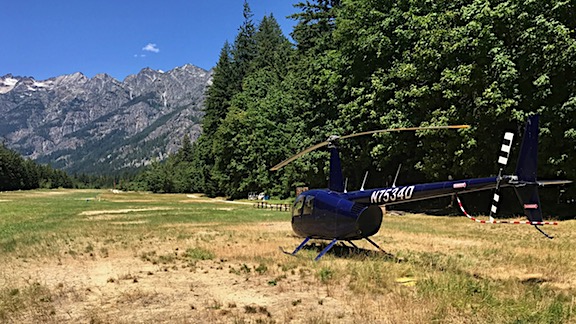
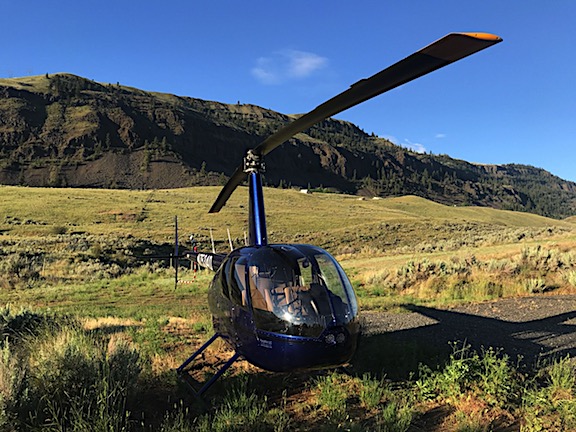
At Stehekin
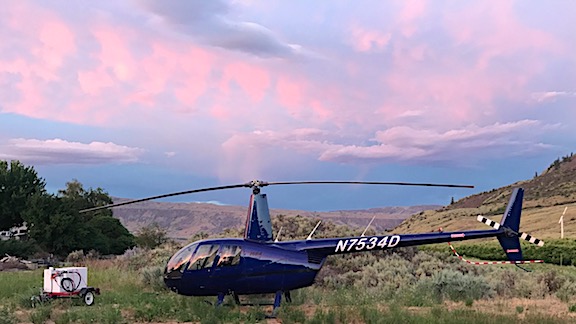
I took Mr Bleu, Penny, and a friend up to Stehekin on Sunday for a nice day trip. In this shot, I’m parked next to the grass runway.

Landings and Wind

The other day, I blogged about the stress I felt at facing my 15th Part 135 check ride. In that post, I wrote a little about the decision making process on one particular maneuver. Here’s what I said:

On my check ride, I was asked to land in a confined space on a hillside. It was a relatively big area — I’ve certainly landed in a lot tighter spaces — and there were no real obstacles, although there were some open range cattle, fencing, and a water tank nearby.

I misjudged the wind. I thought it was light and inconsequential and set up my approach to give me a the best angle of approach. As I came near the landing spot, however, I saw trees blowing and felt the wind buffeting me. Left pedal kept things under control without getting too sloppy.

Still, I decided to go around and approach from a different angle. As I told the examiner as I started going around, “If the helicopter is light, performance is not an issue, and the wind isn’t too strong, I could make this work. But making a bad approach work is probably not a good idea on a check ride.” He agreed.

And that’s the difference between flying as a pilot and flying as a CFI. A pilot flies depending on her skills, the conditions, and her intimate knowledge of the aircraft. A CFI flies depending on the best scenario learned in training. We all know it’s best to land with a headwind and that’s what the CFI will always try to do. But an experienced pilot also knows that you don’t have to fly into the wind if other conditionals make a safe operation possible. In this instance, there wasn’t that much wind and we were light. I knew I could land safely with that right quartering tailwind; I’d done similar landings before. But I also knew that the FAA was more interested in a textbook approach. My going around showed good decision-making skills and the second attempt was a lot smoother with a lot less dancing on the pedals.

A Story about CFIs and Headwinds

About 10 years ago, I had to fly from Arizona to Washington State for cherry season — a 10+ hour flight. In those days, there were plenty of low-time CFIs who wanted to build time in R44 helicopters so they could meet the requirements of SFAR-73 for flight training. I think they needed a total of 25 hours. I’d let these guys, who already had their R44 endorsement, lease my helicopter with me as a passenger to bring me and the helicopter up to Washington State. They’d get cheap flight time and I’d get the helicopter moved at no cost. Win-win.

This particular flight has a lot of stories to tell, but I’ll focus on one: landing at Redding, CA. The airport is towered. We arrived late in the afternoon, light on fuel, from the south. The ATIS said the wind was about 4 knots from the south. The tower told us to land on Runway 34 — in other words, straight in with a slight tailwind. The pilot at the controls — a 300-hour CFI — acknowledged the instruction.

As we got closer to the airport, it came into view. The pilot was flying to the west of it. I assumed he didn’t see it — after all, when you fly at 500 feet AGL it’s not easy to see airports. I pointed it out to him.

“I was going to go around to the west in a downwind and turn midfield and land to the south,” he told me. For you non-pilots, that meant he was going to go around to the left and then land on the same runway but in the opposite direction.

I was floored and took a moment to figure out how to gently explain the problem with that. “Well, the tower told you to land straight in on Runway 34. So you have two options. You can either call the tower and request a landing on Runway 16 or you can land on Runway 34 as instructed.”

(Is it me, or am I correct in thinking that I shouldn’t be instructing a CFI?)

He took a moment to think about it, then changed course and landed straight in on Runway 34. Of course, he came in hot and did a quick stop so he wouldn’t overshoot the parking area. The quick stop was unexpected but well executed and he was so proud of it that he sought my approval when he touched down in our parking spot moments later.

I’m afraid I didn’t deliver. Instead, I said the first thing that came into my mind based on my experience-based knowledge of flight conditions and possibilities: “If you do that at the Grand Canyon on a 90° day with a full load of passengers, you’ll have one hell of a hard landing.” (I can be such a bitch.) Most sea level pilots are completely clueless about flying at high density altitude and I can tell stories about that, too.

In my defense for misjudging the wind, during my high reconnaissance of the landing zone, there were no wind indicators — flags, bodies of water, large trees, blowing dust, smoke, etc. — for me to get an idea of the wind. The trees down near the landing zone weren’t big — maybe 10 feet tall? — and I didn’t see any movement from above. The location we’d departed from less than five miles away had a light wind out of the west. I came in from the north, assuming the wind would be about the same. It was, but it was also a bit stiffer. A better low reconnaissance would have helped me see this, but in the grand scheme of things, it really didn’t matter.

And that’s my point. Whether the wind over my right shoulder was 4 knots or 10 knots didn’t matter. (And yes, 20 or 30 knots would have mattered and I definitely would have noted on such winds.) The helicopter, with half tanks of fuel and just two average sized people on board, was light. It was still cool out and we were operating at about 1500 feet MSL, so density altitude wasn’t an issue. The helicopter’s performance was good. I was making a relatively slow, shallow approach, so airspeed and descent rate would not have put me into a settling with power situation and the minor tailwind would not have caused me to overshoot my intended touch down spot. As I came in on my approach and felt the wind, I could easily keep the helicopter under control with the pedals. I knew from experience — over 2,000 hours flying R44s in all kinds of conditions — that I could make a safe landing.

The only reason I went around was because I was on a check ride. The FAA isn’t interested in seeing pilots who can make a bad approach work. They’re interested in pilots who can made good decisions, even if those decisions mean breaking off an approach to go around and do it differently. So going around is exactly what the examiner wanted to see. He wanted to know that I could recognize a bad approach and act accordingly.

And I need to make one thing very clear: I’ve done go arounds on bad approaches before, without an FAA examiner sitting in the seat beside me. I recall one in particular at Sedona Airport, elevation 4830, years ago. There were three of us on board with luggage and half tanks of fuel, so we were pretty heavy. It wasn’t hot, but it was windy. I made my approach to the helipad following the path I always followed — I flew in there a few times a month. But in this case, it was a little too squirrelly for me and I was dancing on the pedals a lot more than I like to dance. I broke off about 50 feet from the ground and went around. My second approach was more into the wind and a lot smoother. Could I have made the initial approach work? Maybe. But why risk it?

That’s what experience teaches you. It teaches you what works and what might not work and what definitely won’t work. It teaches you how to fix little mistakes before they become big mistakes. Or fatal mistakes.

Does it teach you everything? Apparently not, as my February incident proves. But at least that won’t happen again. I learned my lesson.

Don’t Fly Like a CFI

Before you go ape and blast me for the above heading, let me explain.

A CFI is taught to fly “by the book.” If you’re a CFI you know exactly what I mean. Or you should.

Let’s take an example: taking off. Common instructions tell you to follow these steps:

  1. Bring the helicopter into a 3 to 5 foot hover.
  2. Pitch forward with the cyclic to start moving forward.
  3. Add pedal as necessary to stay in trim.
  4. Push through ETL and pitch for 45 knots, staying within 10 feet of the ground.
  5. At 45 knots pitch for 60 knots to climb out.
  6. When at desired altitude, pitch for cruise speed.

Did I leave anything out? This is from memory and I never taught anyone to fly.

This is basically how low-time CFIs always take off (unless they’re in a confined space or have an obstacle) because (1) it’s how they were taught and (2) it’s how they teach their students. Do takeoffs like this for 1,000 hours and it’s pretty much engrained in you.

But is that how all helicopter pilots take off all of the time? Of course not. The situation you’re in determines how you take off.

Need to get away from the ground quickly because of the potential for dust or damaging downwash along your flight path? (I was once with a low-time CFI when he did a textbook takeoff right past an ultralight sitting idle next to his flight path. He’s lucky the owner grabbed it as we went by.) While a maximum performance takeoff (with its inherent risks) might not be needed, there is some middle ground — and yes, it might require some flight in the scary part of the height velocity diagram.

And landing. I cannot tell you how many times a low-time CFI flying with me entered a traffic pattern at an airport in the middle of nowhere, did a one-mile final approach to land on the runway numbers, and then hover-taxied on the taxiway a half mile to the midfield self-serve fuel pump. What’s that all about? If you’re flying a freaking helicopter, you don’t need a freaking runway. Landing to get fuel? Land at the pumps.

(Want a story about that? I was passenger on a flight my friend Jim did to Prescott Airport (PRC) in his Hughes 500c. We were headed for the restaurant, which was adjacent to a parking area. The tower there put him on a wide downwind for one of the runways on the other side of the airport. Jim barked into the microphone: “Negative! Helicopter One-Two-Three-Alpha-Bravo is a helicopter! We want direct to the restaurant! When the controller recovered from the shock of getting this demand after working with flight school pilots all day every day, he gave Jim exactly what he wanted. Did I mention that Jim was a retired Eastern Airlines pilot?)

About high density altitude experience

Landing or departing at high density altitude is no laughing matter, especially if your ship is heavy and your experience is limited. That’s one of the lessons learned from this doomed flight in Easton, WA about 11 years ago. That’s what I was thinking of when I departed with three passengers at near max gross weight from an off-airport landing zone on a hot day this July.

I’m not exaggerating when I say that I struggled to gain altitude without puling pitch past the redline on my manifold pressure gauge. There was hardly any wind, which didn’t help matters at all, and the air temperature was about 90°F. When you consider our landing zone elevation of about 800 feet, that put our DA at about 3200 feet. Fortunately, the area around us was clear of obstacles and we inched up into the sky.

Once on our way, everything was fine. But I knew I had two problems ahead of me: making a safe landing in a confined space landing zone at 1400 feet and then departing from that confined space when it was likely to be up to 10°F hotter. That put us at about 4500 feet DA. We would not burn enough fuel on the 20-minute flight to make a significant difference in weight.

The landing didn’t worry me that much. I have a lot of high DA experience and it really paid off. I came in smoothly and landed to a hover, then quickly but surprisingly gently put it on the ground. My passengers climbed out and went about their business. While I idled there, I looked around me at the shop buildings, wires, and mature apple trees, and decided that there was no way I’d depart from there with all of them on board. I didn’t need performance data to tell me that it wouldn’t be safe. That 2007 Easton crash was up front in my mind.

So I called my client and told her that I’d pick up the group at an airport about 5 miles away. It was only a minor inconvenience for them; they were attending a meeting at the orchard and the orchardist had a truck he could take them to the airport in. I departed the orchard landing zone and waited for them at the airport.

My OAT gauge read 103°F when they met me for departure. I loaded them up, pointed the helicopter into the wind, and did one of those textbook takeoffs over the ground and across the runway of the deserted farm country airport, pitching for a 60 knot climb before I reached the fence line. We climbed out smoothly and safely, which is what any pilot should aim for.

And here’s my argument for why experience matters: According to the accident report, the Easton accident pilot had “a total time in helicopters of 2,122 hours, 1,492 hours of instruction given in helicopters, 160 hours in the last 90 days, 24 hours in make and model…” While 2,122 hours of helicopter experience is considerable, she had just 24 hours of experience in the make and model of the crashed helicopter (an R44). She was based in Seattle and had done the vast majority of her flying at sea level. The calculated density altitude at the crash site was 6,841 and the helicopter was only 33 pounds below max gross weight. The probable cause was listed as “The pilot’s improper planning/decision in attempting a downwind takeoff under high density altitude conditions that resulted in a loss of control and impact with terrain.  Contributing to the accident were the helicopter’s gross weight in excess of the maximum hover out of ground effect limit, a high density altitude, and the gusty tailwind.” I have to think that her limited experience with the helicopter and high DA conditions, combined with an understandable desire to please the client, contributed to bad decision making and execution of departure maneuvers.

Only experience can help protect you from a similar fate in a similar situation.

But what I’m trying to say here when I tell pilots not to fly like flight instructors goes beyond modifying standard procedures to fit a situation. It’s this: You will never become a better, more experienced pilot if you don’t push the edges of what’s comfortable to you.

Now I’m not saying you should go out and fly like a lunatic, pushing your skills and aircraft to their limits. That’s a good way to get yourself and possibly others on the ground hurt or killed. I’m saying that you should push gently to expand your comfort level and learn valuable lessons along the way.

Has your flight school forbidden flights when the winds exceed 15 knots? Fly when the wind is 20 knots. Then, when that’s comfortable, bump it up to flying at 25 knots. (Obviously, you should consult your pilot operating handbook to see if there are any limitations.) Don’t be like I was when I went to work at the Grand Canyon. After being taught to avoid flying in high wind situations, I was suddenly required to fly when the wind speeds were up to 50 knots. I learned to deal with high wind a little faster there than I probably should have.

Does your flight school limit flights to a handful of airports? Fly somewhere else. (Yes, get permission if necessary. Duh.) One of the best ways to get real-life flying experience is to fly to different places. It works your flight planning, navigation, and communication skills. It challenges you to think about your approach and landing rather than to do the same thing you’ve been doing for weeks or months.

If you’re a sea level pilot — I’m talking about someone who has learned to fly and usually flies mostly at or near sea level — do yourself a huge favor and fly to a destination above sea level. Someplace high enough where you can really feel the difference in the aircraft’s performance. Then take it to another destination even higher. Do you really want to get your first high density altitude experience when you get a job flying tours at the Grand Canyon, elevation 6600 feet? (And yes, I’ve done running takeoffs from Grand Canyon Airport twice: once in my R22 and once in my R44. They teach us that stuff for a reason.)

Do long cross-country flights. Solo. That’ll really test your flight planning and navigation skills — especially when unforecasted weather or other conditions force you to choose an alternate destination airport or land off-airport to wait out a storm.

I guess what I’m trying to advise is to do the things CFIs don’t generally do when they’re working as CFIs. But don’t go nuts. Build your skills and confidence levels slowly.

And shame on flight schools that don’t give their CFIs or commercial students the opportunity to do these things.
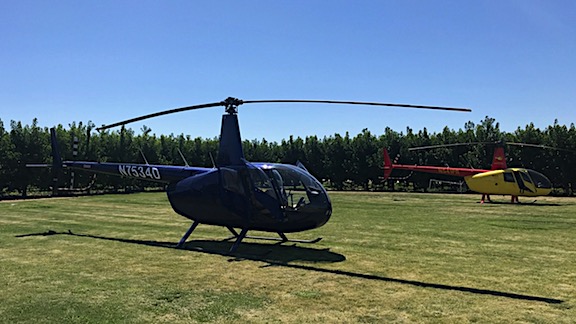
Mr Bleu and a Friend
Here’s Mr Bleu with a friend from Lake Chelan. We occasionally work together to take more than 3 passengers on charter flights. Here, we’ve landed in a soccer field beside a cherry orchard.

Passionate for a Reason

I feel very passionate about real life vs. CFI flying and even more so after my own accident.

I’m not a complete idiot. I realize that my accident was caused by two things:

  • Distraction in the cockpit. I was flying VFR and I should have had my eyes outside the cockpit. Instead, I allowed myself to get distracted and failed to maintain awareness of my flight path.
  • Lack of experience with night flight. Seriously! What was I thinking? I’ve got 3,700 hours of flight time, but less than 100 hours of that is at night. How could I possibly have allowed myself to get as complacent as I obviously was about the additional challenges of flying in the dark?

I’m lucky to be alive and I know it. And although I’m seriously embarrassed about the mistakes I made that led to my crash, I’m not too embarrassed to use my learning experience to teach others.

Throughout this blog, you’ll find lots of lectures about safety, many of which touch upon NTSB-analyzed accident reports. When reading between the lines, so many of them can be traced back to insufficient pilot experience with the situation or aircraft.

Don’t be one of those pilots. Push yourself gently to expand your skills and knowledge with real-life scenarios you can only get from non-CFI style flying. And never stop learning to be a better pilot.
A Word about Life after Stress

That whole thing about a weight being lifted off your shoulders? It’s true.

This past week, I’ve been stressed out a lot more than I occasionally get. It had gotten to the point where I felt an overall malaise that I couldn’t shake, accompanied by an overwhelming desire to give up on all the things I do that contribute to the stress that was making me feel so crappy.

And that’s never a good thing.

The Check Ride Stress

Quick Note:
I know that in the grand scheme of things — comparing my sources of stress to the sources other far less fortunate people face every day — I shouldn’t complain. And I’m not. I’ve been in far more stressful situations. The point of this post is not to complain or to gather pity. It’s to share an observation.

The main source of that stress was an upcoming FAA check ride scheduled for Thursday (yesterday). It was my first check ride in my new old helicopter, Mr. Bleu. I take a check ride for my Part 135 certificate every year, so it had been a full year since my previous one. I won’t hide the fact that the Spokane FSDO, which oversees my Part 135 certificate, has been getting under my skin with a series of what I consider to be unreasonable requirements. I’d been pushing back, which is something I’d never had to do with the more reasonable FSDOs and inspectors I’d worked with in the past. This was their big chance to “teach me a lesson.” At least’s that’s what was in the back of my mind as I prepped for the check ride.

But check rides are always stressful to me. You see, I never became a certified flight instructor (CFI) and I never spent 500 to 1000 hours sitting next to new students, teaching them about all the weird aerodynamic issues inherent in a rotary wing aircraft and doing dozens of autorotations every day. I have always lived in a place with amazing weather, operating primarily out of Class G and Class E airspace, so I have trouble remembering silly little (but important) things like weather minimums for the various classes of airspace. I know how to fly and I’ve been called a good stick. But that doesn’t mean I can necessarily meet the requirements of a Part 135 check ride, especially if the examiner is tough or wants to fail me.

Add to that that although I usually prep by flying with someone who works full-time or nearly full-time as a flight instructor, no one like that was available to me. My check ride was scheduled for Thursday but the CFI I’d hoped to fly with beforehand was gone until Friday. So I flew with my friend Woody, who has tens of thousands of hours flying Airbus airliners and a bunch of time flying mostly Schweizer helicopters. He’s a CFI and he’s taken more check rides over the years than there are long, hot rainless days in Arizona every year, but he approaches flying as a pilot instead of as a CFI. While that should be a good thing, I wasn’t convinced that it was a good thing for someone prepping for a check ride. (More on that in a sidebar.)

The stakes were relatively high. I needed to pass the check ride to continue doing charter and air taxi flights. Those account for about 10% of my flying revenue, which isn’t really that much. But a Part 135 certificate means I can say “yes” to just about any flight request, including something as simple as a tour that goes more than 25 miles from a starting point. It sucks when you have to turn down work because you lack the piece of paper that makes it legal. If I failed the check ride, I’d have to redo it. Since I was already in my grace month due to FAA scheduling limitations, that meant I could lose that piece of paper staring August 1. And I already have a flight booked for August 3. Redoing it meant more stress, too.

And did I mention the wind? Winds were forecasted to gust to 22 miles per hour on the date of my check ride. The check pilot was coming from Seattle and there was no chance that he’d reschedule after a 3-1/2 hour ride (each way). (I’d offered to meet him in Ellensburg to save him 90 minutes of that drive, but the wind was forecasted to gust to 37 there, so he agreed to come to Wenatchee.)

So although this was the 15th Part 135 check ride in my near 20 years as a pilot, it was stressing me out.

My R44 Helicopter in the Morning
My new old helicopter, Mr Bleu, parked in its landing zone.

On “making it work”

On my check ride, I was asked to land in a confined space on a hillside. It was a relatively big area — I’ve certainly landed in a lot tighter spaces — and there were no real obstacles, although there were some open range cattle, fencing, and a water tank nearby.

I misjudged the wind. I thought it was light and inconsequential and set up my approach to give me a the best angle of approach. As I came near the landing spot, however, I saw trees blowing and felt the wind buffeting me. Left pedal kept things under control without getting too sloppy.

Still, I decided to go around and approach from a different angle. As I told the examiner as I started going around, “If the helicopter is light, performance is not an issue, and the wind isn’t too strong, I could make this work. But making a bad approach work is probably not a good idea on a check ride.” He agreed.

And that’s the difference between flying as a pilot and flying as a CFI. A pilot flies depending on her skills, the conditions, and her intimate knowledge of the aircraft. A CFI flies depending on the best scenario learned in training. We all know it’s best to land with a headwind and that’s what the CFI will always try to do. But an experienced pilot also knows that you don’t have to fly into the wind if other conditionals make a safe operation possible. In this instance, there wasn’t that much wind and we were light. I knew I could land safely with that right quartering tailwind; I’d done similar landings before. But I also knew that the FAA was more interested in a textbook approach. My going around showed good decision-making skills and the second attempt was a lot smoother with a lot less dancing on the pedals.

The stress affected my ability to sleep. On Wednesday night, I was up for four hours in the middle of the night. Wide awake enough to read my helicopter’s Pilot Operating Handbook (POH) and Federal Aviation Regulations (FARs) in bed (on my iPad) without them putting me to sleep. I fell back to sleep at around 3:30 AM and was up again at 5:30. So on Thursday morning, I was facing a check ride with a total of about 5 hours of sleep. Not ideal. I was a basket case by the time I got to Wenatchee Airport with my helicopter to wait for the examiner.

Fortunately, it had a happy ending. I took the check ride starting at about 10:45 AM and did surprisingly well on the oral part, which usually makes me seem like an idiot. As for the flying part, I flew fine but could have made better in-flight decisions at least once. Still, it was good enough for me to pass. So by 12:30 PM Thursday, that source of stress was gone.

The Cherry Season Stress

Another source of stress this week was cherry season. We’d gotten over the hump and it hadn’t rained in a month. (We get paid for standing by, so it isn’t as if we didn’t make any money. We did fine.) But the season was winding down and there was no rain in sight and I had to decide whether to extend the contracts for any of my crew. This came down to a basic math and probability problem: How many acres were left to cover and what were the chances of it raining on all of those acres at once?

Early in the week, I didn’t have the information I needed to make a decision. That was the source of the stress: needing to make an important decision I couldn’t make because I didn’t have the information I needed to make it.

Once my crew left, I couldn’t get them back, so I had to decide at least a few days before they planned to leave. I knew I’d only need to keep one of them around if I needed any of them and I knew which one of them it would be. And I knew he wanted to stay, although his partners back in Arizona wanted him back with the helicopter. The trouble is, if I asked him to stay, I’d have to pay him more standby money. That money was coming out of my pocket and it wasn’t chump change. So the stressful part of all of this was figuring out whether I should ask him to stay before he made unchangeable plans to leave.

Cherry season is stressful.
I should mention here that cherry season is always a very stressful time for me, starting in April, a good two months before the season starts. In April, I’m trying to secure my contracts and get acreage counts so I know how many pilots I need. In May, I’m trying to lock in pilots who are freaking out because I can’t give them exact start dates. In June and July, I’m watching the weather, trying to foresee storms and flight needs, and making sure my pilots don’t wander off. In August, I’m still watching the weather and hoping that I can cover whatever acreage is left by myself. So it’s up to five months of varying levels of stress. August 11 is my last day this year and I can’t tell you how much I’m looking forward to it.

I started getting acreage estimates on Tuesday. By Wednesday, I was able to do the math part with some degree of accuracy. If I let all my guys go, on the first day they were all gone, I’d be right at the limit of the number of acres I could cover alone. If it rained everywhere, I’d be stretched thin. But too thin? And what was the chance of rain?

By Thursday, I was confident that there was no chance of rain for at least three days after the last member of my crew left. By the end of those days, it didn’t matter if it rained because the number of acres left to dry — remember, they’re picking cherries every day now — would easily be within my capability to dry alone.

So the stress from that decision was gone by Thursday, too.

The Tiny Sources of Stress

I have a few other tiny sources of everyday stress in my life.

  • Jeep air conditioner. It’s on the fritz, making a weird sound when the fan is on medium-high or high. That’ll need to get looked at.
  • Business planning. Believe it or not, I’m considering starting a new business with a partner here in Wenatchee. This is a huge decision for me and there’s some stress related to the yes/no decision of starting it at all.
  • Responsibilities. Like most folks, I have the responsibility of owning and managing a home and doing the work I do to make a living. Sometimes it’s more stressful than other times, but if I couldn’t handle that stress, which never really goes away, I should probably sell out, retire, and live in a rest home.

In all honesty, I can’t even count these as “stress,” mostly because they come and go on a daily basis. They’re part of life.

When the Stress Is Gone

What I really wanted to write about here is how I feel this morning. In one word: great!

Yesterday, after my check ride and lunch with Woody and an appointment to get my hair tended to, I rescheduled the business planning meeting I had set for 6 PM to sometime later in the weekend. On my way home from the hairdresser, I shopped at my favorite craft cocktail place and had one of their concoctions. I normally don’t drink at all during cherry season, but with absolutely no chance of rain, I didn’t think it would hurt. And I thought it might help for what I had planned next: sleep.

I was dead asleep by 7 PM. And I stayed that way until 3:30 AM. That’s 8-1/2 hours.

Now most folks probably wouldn’t be happy waking up at 3:30 in the morning. But after a solid night’s sleep, what difference does the time make? I spent some time sitting out on in the cool air on my deck, just looking out at the lights of the Wenatchee Valley. Then, as the eastern sky started to brighten, I went in and made my coffee.

That’s when I realized how good I felt and why: the stress was gone.

And with the stress gone, so was the malaise.

How could I have even considered giving up on the things I do? Running my helicopter services business? Managing over a dozen cherry drying contracts? Caring for and improving my home? Managing Airbnb properties? Making and selling jewelry? Raising chickens for eggs? Keeping bees? Gardening? Polishing gemstones?

And why wouldn’t I dive into a new business venture with a friend?

When I was stressed out earlier in the week, that feeling of malaise was making me question why I was doing any of these things, reminding me that the people whose lives revolve around a dull job and evenings spent watching television don’t get stressed out. The stress comes, in part, from facing challenges. No challenges, no stress.

But what those people don’t realize is that without self-imposed challenges, there’s no real meaning to life. They’re missing out on the amazing feeling of success that comes when facing a hurdle and jumping it.

Because isn’t that what I’m doing?

I wouldn’t have to take that check ride if I didn’t build and maintain a Part 135 helicopter business.

I wouldn’t have to make difficult staffing decisions if I didn’t take on the challenge of managing cherry drying contracts every year.

I make my stress when I take on these endeavors. The stress is usually temporary. And getting past it is what makes me tick, the reward of success is what drives me.

And I feel great today.

First Impressions of Making Cabochons with the CabKing 6

As a ghost from my past used to say, any job is easy when you have the right tools.

One of the things that has been frustrating me lately in my jewelry-making endeavors is my inability to fine-tune the stones I acquire so they better meet my standards. For example, I bought a bunch of cabochons from a dealer in India and they all arrived with unpolished backs. While that’s acceptable if you plan to set the stones with something behind them, I don’t. I want the entire stone polished.

So I tracked down a local lapidary, Gary, who does it as a sort of retirement hobby. He polished the backs of the stones and charged me a nominal fee. It was neat to watch him do it on his cab making machine. But when I got another set of stones from another dealer and realized how much work they’d need to be usable, I realized that I’d soon become a nuisance to Gary.

Add to that a load of local petrified wood and obsidian that an orchard-owning friend of mine, Donn, was trying to unload. As is, no one would touch them — and I must have asked a half-dozen rock people. But with a little cutting and polishing, they might be salable — or at least usable in the jewelry I make.

And, of course, I was making fused glass cabochons in my kiln from repurposed wine bottles and they needed polishing to make them usable.

So it made sense to buy a cab machine.

At least that’s what I told myself.

It was a big expenditure and I sat on the fence for a few weeks before pulling the trigger. I needed a birthday present, I reasoned. There were only two things in the running: an inflatable Hobie pedal kayak that could accept a sail kit — yes, they do make things like that these days — or the CabKing 6 cabbing machine. Believe it or not, the CabKing was about $1,000 cheaper. I reasoned that I could use it for my jewelry business and, thus, write it off. That would reduce the cost by my current year tax rate — as if that really mattered. The fact that I needed a birthday present was enough to get me to buy it. (Maybe I’ll get that kayak next year.)

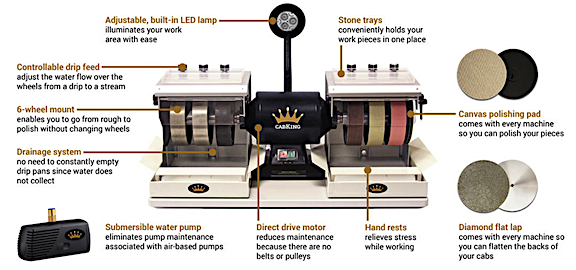
CabKing 6
The CabKing has 6 grinding/polishing wheels and other features that make it a great tool for making cabochons.

I should mention here that a lapidary friend of mine that I know from Quartzsite, AZ, John, told me not to buy the CabKing. He’s a Diamond Pacific dealer and that’s what he uses. He told me he could get me a deal on a comparable Diamond Pacific machine that had only been used about 10 hours in one of the stone-cutting classes he leads. But even with the discount, the machine would cost about $500 more. And I really liked the way the CabKing handled the water used to cool the stones as you grind and polish: it always puts fresh water on the wheels so there’s no chance of contamination from earlier stages in the grinding/polishing process.

Gary said the CabKing was a good machine but it had a tendency to splash a lot of water.

It came last week. So did some stones for tumbling and polishing. I played around with it. I was surprised about how easy it was to use to shape stones.

I had some trouble getting fine scratches out of my finished stones. I attended YouTube University for about an hour or two and watched a bunch of cab-making videos, including this good one. I soon realized that the scratches had to come out very early in the process — on my machine, by the time I’d run the stone through the third wheel, a 280-grit diamond resin pre-polish wheel. I took the stones back down to my shop and reworked them. The results were very satisfactory.

First Batch of Stones
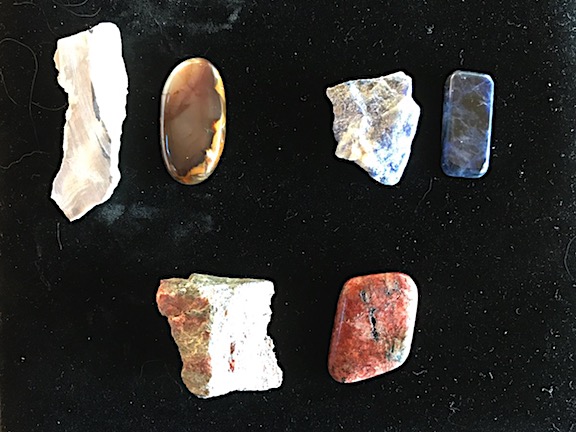
This is the first batch of stones I polished: petrified wood, sodalite, and a mystery stone I got from a friend’s garden.

I found that the petrified wood I’d gotten from Donn polished up beautifully.

Yesterday evening, I gave it another go with five pieces of stone: rose quartz, hawk’s eye, local obsidian, local petrified wood, fused wine bottle glass. In the afternoon, the driveway in front of my shop is in the shade and, with a nice little breeze blowing, it can be quite cool, even if it’s hot in the sun. So I wheeled the machine out — I installed it on one of the many wheeled carts I have accumulated — put a stool in front of it, and got to work. Two hours later, I had five decent cabochons.

To show them off better, I made a little video this morning. Check it out:

I’m learning a lot about stones and how the hardness affects how easy they are to cut and polish. The hawk’s eye is a mix of soft (tan) and hard (dark gray) stone and I have to be careful not to press too hard on the soft side. It doesn’t polish very well. The rose quartz and petrified wood polish very nicely. The obsidian had imperfections that turned into pits in the finished surface. And the glass polishes nicely, although fuse lines in the glass appear almost as cracks in the finished piece.

I’m starting to wonder what basalt, which we have no shortage of here, would look like polished. (You can bet I’m going to try it.)

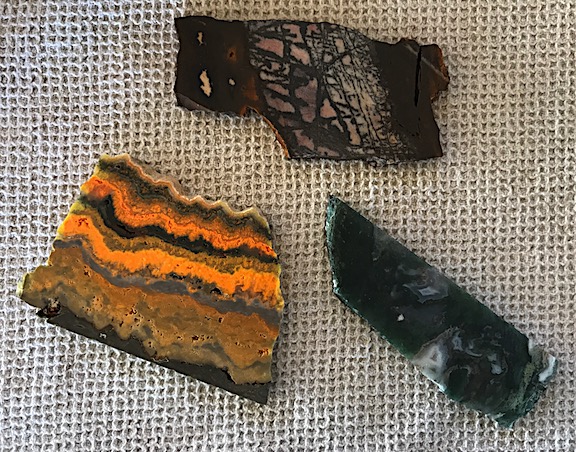
I bought some slabs of outback jasper, bumble bee jasper, and moss agate to work with. I figure that each of these small slabs should yield 2 to 3 cabochons. The bumble bee jasper, which is a soft stone, is pitted and I’ll likely try stabilizing it before cutting and polishing it. I’m hoping that process fills the pits with a clear epoxy that’ll make it possible to get a good polish. We’ll see.

Slabs
I bought these three slabs to try to make cabochons. I’m just hoping that my tile cutter can cut them into pieces without breaking them.

I think what I like most about this is how much I’ve learned about stones and lapidary work since January. (Yes, it’s just been since January that this became my latest hobby-gone-wild.) I love being creative in ways other than with words. I love being able to share nature’s beauty in a way that people can appreciate. And it’s nice getting paid to make the things I make.

Some Notes on My Jewelry Business

Surprisingly successful.

I started creating wire-wrapped jewelry back in January of this year. I’ve come a long way.

Getting Serious and Developing a Style

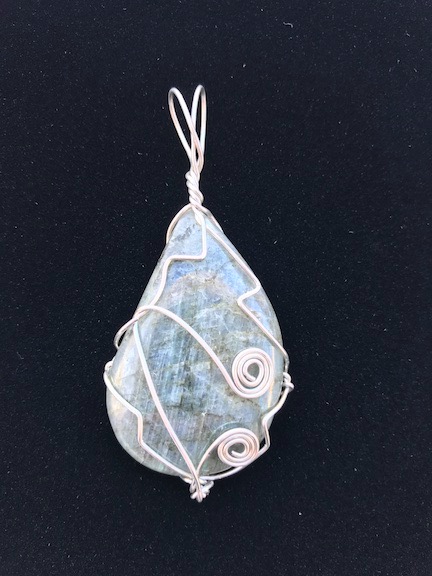
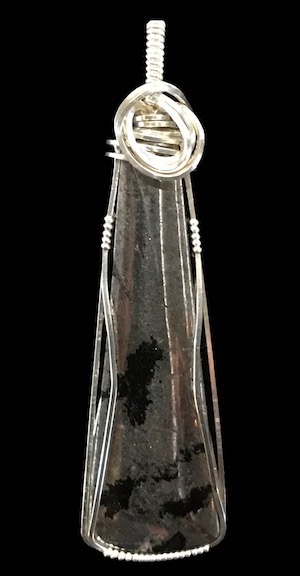
Labradorite Wrapped in Silver
My first wire-wrapped jewelry piece. Don’t laugh; I was proud of it back then. And I still think those are excellent swirls.

My first attempts were predictably amateurish. Cringe-worthy, in fact, when looking back on them. I learned from watching a few YouTube videos — which, in hindsight, I now realize were the wrong YouTube videos. But I had a lot of positive feedback from the people who saw my work, including some professionals. (I was in Quartzsite, AZ at the time and literally surrounded by rock hounds and lapidaries.) I realize now that they were probably just being nice. That early stuff was gawdawful, although I subsequently did manage to sell every single piece. (Go figure, eh?)

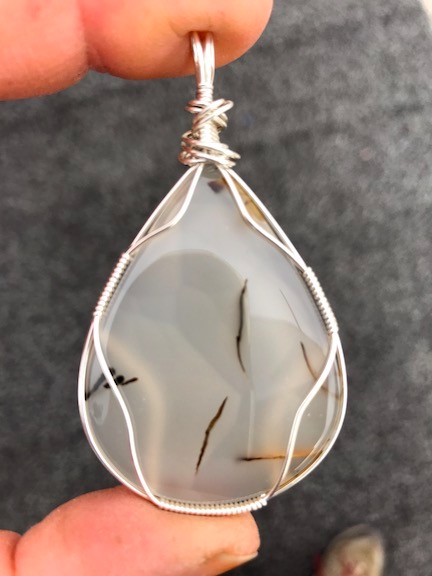
Montana Agate
Finishing this first piece in sterling silver was when I think I started getting serious. That was a really beautiful stone. It was one of the first pieces I sold.

In mid January, I got a lesson from a friend who is one of those professionals. Dorothy guided me to create my first piece in sterling silver. I think this was the point at which I realized that if I wanted to acquire nice stones, I needed to get serious about creating nice jewelry with them. The things I learned really helped put me on the right path.

At around the same time, I found another YouTube wire-wrap artist who showed me additional techniques, such as wire-wrapped bails, that I’d incorporate into my own work to develop my own style. That style now includes hand-formed swirls at the top of each piece, an occasional drop-down wire or two that end in tiny loops, and a pair of tiny loops at the back of the piece.

Since January, I’ve created well over 100 pieces of wire-wrapped gemstone jewelry, most of which are wrapped with silver. I’ve shifted slowly from the inexpensive stones I acquired in Quartzsite to more exotic, higher quality stones I get from gemstone dealers and at gem shows.

It’s All about the Stones

For me, it’s all about the stones. I’ve always liked beautiful stones but never had a reason to acquire them. Making jewelry gives me an excuse to buy stones. I put them on display in cases so I can look at them and choose one for my next piece. It seems silly to folks who don’t have a thing for stones, but if you do, I’m sure you know exactly what I mean.

Of course, these stones aren’t cheap and I really didn’t want to continue funding this — dare I say it? — obsession with stones. So I decided to try to sell my jewelry.

The Birth of ML Jewelry Designs

I did a few things pretty much all at once:

  • I came up with a company name. I needed a name so I could identify the company. I’m afraid I didn’t get very creative. I put about 10 minutes of thought into it. ML Jewelry Designs.
  • I registered a domain name. Honestly, I don’t know why so many businesses put their eggs in the Facebook basket. There’s nothing that gives a company more legitimacy than an address on the web. So MLJewelryDesigns.com was born.
  • I set up a Facebook page. (I later pretty much abandoned it when I decided that I’d had enough of Facebook. I did the same for my other company, Flying M Air, LLC.)
  • I set up a Twitter account for the company. I wanted a way to tweet only company news, including photos and links to new pieces.
  • I registered my business with the state. I knew I’d have to collect and pay sales tax.
  • I built a website with WordPress. What else was I going to use?
  • I started photographing my jewelry and adding it with descriptions to the website.
  • I set up WordPress to automatically tweet posts about new pieces.
  • I set up Square to accept credit card payments and, more importantly, an online store.
  • I designed and bought materials for unique packaging that included clear pillow boxes and card inserts.

All this took less than a week. Maintaining the website and online store to add jewelry pieces would take a few hours every week.

I got my first online sale within a week. It was to a Twitter friend who lived overseas. (Thank you, mdy!) As I packed up the piece, I found myself kind of sad to see it go. But I felt less sad when I saw the money in my bank account and placed another order for stones. It’s all about the stones!

Selling in Person

The one thing I knew for sure is that the photos of my work that I was putting online did not do the pieces justice. They look way better in real life. That was confirmed when I showed photos to several shop owners and got a lukewarm response. (I don’t do that anymore. I tell people I don’t have photos with me.) One of those shop owners saw them in person yesterday and was very impressed.

I knew that Pybus Public Market, a local shop/restaurant/farmer’s market venue on the Wenatchee waterfront, had “day tables” for vendors. The rates were affordable. Some friends of mine were already selling handmade furniture and other woodworking items there on Saturdays. I decided too see if I could get a table there.

AtPybus
My first table at Pybus Public Market. I now use a black tablecloth and have really improved my display.

It was remarkably easy, especially in the spring when there wasn’t much of a demand for space. I set up one Saturday for the first time. My table consisted of several jewelry display busts with pendants hung around them and black burlap-covered boards with the pendants on display. I had the stones on display, too, all priced so folks could buy stones to take with them or have me wrap for them.

And I sold three pieces of jewelry.

Now that might not seem like a lot, but I’m not making cheap stuff. My prices range from $49 to $59 for most pieces, with a few cheaper ones (clearance items and quick wraps for folks on a budget) and a few more expensive ones (especially lately with the high quality stones I’ve been acquiring). The cost of the table was cheap enough that if I sold just one piece, I’d be ahead of the game. I considered three a good day.

I came back other Saturdays with mixed results. None of the Saturdays were bad, but some were better than others.

After talking to other vendors, I decided to try Fridays. With the exception of one day that no one did well — they didn’t even charge our table fees that day — I did fine.

Saturdays got busier when the Wenatchee Valley Farmer’s Market started up outside. That didn’t necessarily mean more people were spending money indoors, though. It was hit or miss, but never a complete failure. It did start getting better when the Seattle weekenders started coming in.

When the Wednesday evening farmer’s market started last week, I started coming on Wednesdays, too. I sold two pieces the first time — and I had to leave at 2 because of weather. (I’m still cherry drying pilot.) I sold four this past Friday. And I sold five yesterday.

Although I sit there making jewelry as I chat with shoppers, vendors, and employees, I often sell more pieces than I can make in the same time. Sometimes the jewelry I’m making is a special order for someone who really liked a stone in one of my cases and wanted a jewelry piece made from it.

I get lots of complements from everyone who stops to look, even if they don’t buy. (After all, I know that not everyone is interested in wearing a pretty rock on a cord around their neck.)

And a shopper yesterday, as I gave her my usual spiel — “I buy the stones already cut and polished. I do all the wire work to make the pendants and earrings in sterling silver, copper, or both.” — said, “I know. My friend told me about you.”

Whoa. Word of mouth. How cool is that?

The Gallery

Of course, a better way to sell my jewelry was to have someone else sell it for me. So I continued looking for places that might take my work.

I quickly learned not to use the phrase “wire wrap” when describing my jewelry to a shop owner. And not to show photos. The best way to approach a shop owner was to go in when it wasn’t crowded with my case of finished pieces.

You see, I store all my pieces in a glass-topped jewelry display case when it’s not on display on the labeled board at Pybus. The case has dividers and each piece fits into a slot on black velvet. It looks neat and impressive.

Native Silver
This piece of Native Silver sold at the Two Rivers Art Gallery last week.

And that’s what I took into the Two Rivers Art Gallery when I went to ask if they’d display them — despite the fact that the manager told me they had no room for me when I called him on the phone. They were suitably impressed and they made room. I’ve got a whole shelf in a locked case in one of the front rooms. And last week, I got a check for the sale of two pieces of jewelry, including my most expensive piece (Native Silver), which sold for $89.

But I’m not done. I’m hoping to get my jewelry into a handful of other stores in the area and beyond. (If you’re reading this and am interested in helping me sell my work in your store, please get in touch.)

Looking Ahead

I’m always looking for ways to improve my display with the goal of increasing sales at events.

Jewelry on Display
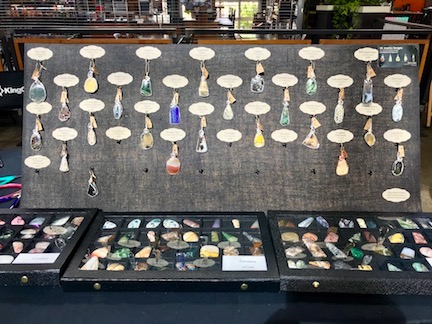
Here’s my current display board with some of the cabochon cases in front of them. (And yes, it’s a terrible photo.)

Over time, I modified my display to include a bigger board, labeled hooks that included the name of the stone and the price (so people wouldn’t have to fumble with the tag or unnecessarily touch anything), and lights. There was an easel to lift and tilt the board without having to depend on boxes behind it. My selling junk (iPad, Square, packaging, etc.) is hidden behind the easel, leaving the table neat. The three gemstone display boxes, which have plexiglas tops, are unsnapped so they can be easily opened to remove a stone for inspection by someone who is seriously interested, while keeping kids and light-fingered passersby from touching or taking home souvenirs. Not perfect, but better.

I’m also looking into other venues, specifically one where artwork is displayed and sold. I have a lead on an “Artisan’s Booth” at the Grant County Fair in August and am still sitting on the fence about it. I suspect I’ll give it a try just to see what it’s like, even though I don’t think it’s the kind of crowd my work would appeal to.

I’d like to get into some events in a metropolitan area like Seattle where people are willing to spend more money.

Meanwhile, I’m buying more rocks. I can’t tell you how many complements I get on my selection of stones.

Shiva Shell
The second Shiva shell piece I made yesterday sold, too.

And since I’m starting to learn what sells best, I’m making sure I always have pieces using those stones in stock. Kingman turquoise, Shiva shell, rose quartz, lapis lazuli, and K2 are nearly impossible to keep in stock. On Thursday night, I made a Shiva shell piece and it sold on Friday. On Saturday, I made one and it sold before I was finished. I made a second one and it sold before I packed up. I have one on order for my best customer and need to make at least two more — one for the gallery and one for Wednesday at Pybus. So you can guess what I’ll be doing this evening — or this afternoon when the wind invariably kicks up. (What is it with the wind this year?)

Black Pyrite
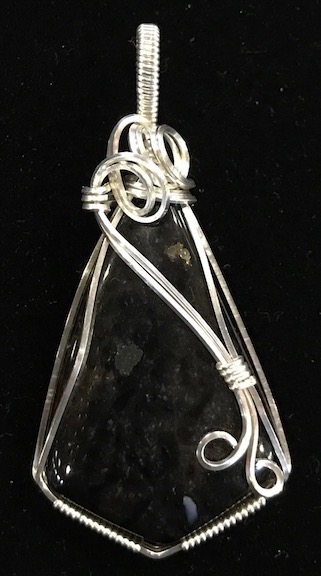
This little piece of black pyrite came out a lot better than I expected it to and is currently my favorite piece.

I need to stress that I enjoy making the jewelry. I find it strangely relaxing and rewarding, especially when a piece comes out better than I expected it to. I’ve never felt so creative before. Artistic, even. And although I’m kind of sad to see a piece I really like get sold, I’m also thrilled every time I make a sale. I’m creating something visual (as opposed to the millions of words I’ve sold as a writer) that people want to buy. How cool is that?

So at this point, I think it’s safe to say that this is not just a passing phase for me. I feel invested and rewarded and even still excited about this work. I’m looking forward to continuing and improving my technique and style for years to come.

A Weekend of Flying

15+ hours of cherry drying, hop rides, and horse roundup in three days.

My new old helicopter, Mr Bleu, had a lot of time to rest after our flight up from Arizona to Washington in April. Too much time, if you ask me. I did a 2-hour photo flight one day not long after I brought it home and then a handful of hour-long tours of the area for locals and tourists. I took it down to Cave B Winery for lunch with some friends and to pick up my wine club shipment. And I ran it over to the airport once for a bit of maintenance. But other than that, it’s been parked, mostly waiting for cherry season and my big June event.

Cherry Season

The work that pays my bills every year is cherry drying. I started doing this way back in 2008, making this my eleventh season.

I’ve blogged about this extensively since I started, so if you want details or more information about cherry drying, use the search box to search for “cherry drying.” Then read what comes up. Or watch this surprisingly popular video or this more informative video I made.

The short version is that cherry growers hire helicopters to stand by during the last 3-5 weeks the cherries are on the trees. When it rains, we fly low and slow over the treetops to blow the water off so the cherries don’t split. It’s slow, tedious, and often dangerous work and very few pilots do it more than one or two seasons before they find more interesting things to do. But I’ve stuck with it and built up a bit of a reputation based on consistent customer service.

My business has grown over the years. About seven years ago, I started getting more contracts than I could handle alone and began hiring pilots with helicopters to work with me as a team. Every year, I have a few core guys I can turn to and a number of slots that are filled with different guys every year. Last year was tough — although I had a lot of acreage to cover and six pilots with helicopters to join me, it didn’t really rain. That turned off a lot of guys who thought they’d make big bucks. The previous year was the opposite; it never seemed to stop raining and we flew more than I thought possible.

That’s how it is, though. As I tell my crew, the only thing you can count on is the standby pay; if you can’t make it work financially with just that, you shouldn’t come.

This year, I have a small team: there are just four of us. I started on June 1 with the other guys joining me as my acreage load picked up. One guy started June 15, two more will start tomorrow. Then, as cherries are picked and the acreage load drops, the pilots will leave and I’ll finish up alone. As of now, I should be done by August 11.

I work mostly with R44s, but this year we have a Bell 206L with us, too. (Last year we had an S-55.) They’ve been pulling out a lot of acreage in my area due to small cherry virus so I lost a few contracts for that. And since last year was so dry, a handful of growers and orchard managers decided to skip helicopter coverage and toss the dice with Mother Nature. There’s always crop insurance to prevent a total loss.

Contrary to what a lot of people seem to think about the entire state of Washington, it isn’t all as rainy as Seattle. I live on the east side of the Cascade Mountains which is desert-like. In fact, I’d say our climate is almost identical to Flagstaff or Prescott, AZ. So we have a lot of sun and, without irrigation from the Columbia River, which flows right through the area, we wouldn’t have orchards or farming.

I did some flying the first week I was on contract. On Friday afternoon, I took two pilots out to see the orchards that were going on contract within the next few days. Then, on Friday evening, with one pilot just settling in after his flight up from Mesa, AZ, and another already on board and prepped to do a handful of local orchards, it rained again. I launched at 8:15 PM. I only had 20 acres of bings to dry, so I was able to get the job done before sunset, which is at about 9 PM this time of year.

That turned out to be the first of many cherry drying flights that weekend.

Mr Bleu at Sunset
Here’s Mr Bleu at its temporary home after Friday’s last flight.

The Big June Event

On the Saturday before Father’s Day every year, Pangborn Memorial Airport in East Wenatchee holds its big Aviation Day event. There are static displays of airplanes and helicopters, informational booths manned by Alaska Air and other aviation-related companies, a fire helicopter rappelling demonstration, and, of course, helicopter rides. I’ve been doing the rides with my cherry drying crew for the past six or seven years.

DC-3 At Wenatchee
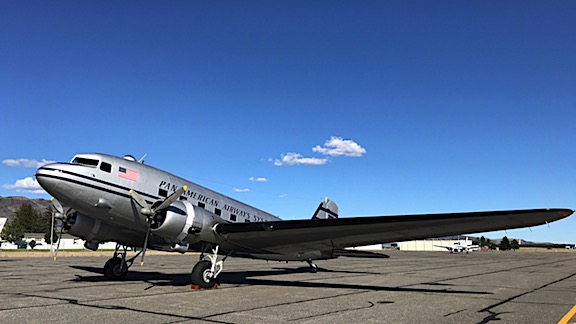
One of the planes on display was this beautiful DC-3, which I got a chance to photograph both inside and out on Thursday and Friday. (Blog post to come.)

This is a huge rides event for us. After all, how often can a helicopter company fly non-stop all day long with three helicopters giving rides? Honestly, I think that if we had a fourth helicopter on the team, we’d still be flying all day.

We had a good ground crew this year. With three people on that crew — one to sell tickets and two to handle safety briefings and escort passengers to and from the helicopters for hot loading — the pilots never had to wait more than a few seconds after touching down for the passengers to be swapped out. The quick turn time is vital for maximizing the number of rides you can do and keeping passenger wait times short.

Part of the equation is also making sure the pilots space themselves properly so there’s only one helicopter on the ground at a time. The rides we 8 to 10 minutes long so even with three helicopters, there were a few minutes between each landing. Any time one of us looked like we might land before the one ahead of us departed the landing zone, we slowed up to improve spacing. It worked like a charm.

And it should. The three pilots doing the ride had a lot of aviation experience. I’ve got about 3700 hours in helicopters and have been flying for about 20 years. At this point, I must have done close to 100 rides events. Woody, who retired from American Airlines in March of this year, has over 30,000 hours as a pilot and is a partner in a flight school that also does rides at events. And Gary, who owns and operates a fleet of helicopters at a flight school near Salt Lake City with his wife Lorri, has probably done even more rides events than me. Lorri is, by far, the best ground crew manager I’ve ever worked with.

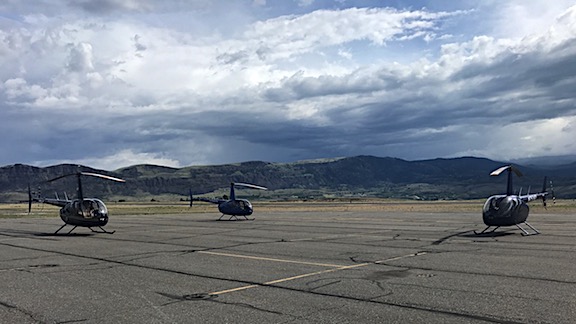
Three Blue R44s
Our three R44s, parked on the ramp later in the day, after the event. Oddly, all three are blue.

More Cherry Drying

The forecast for Saturday called for rain. Some forecasts said 50% chance, others said 80%. The rain came in the form of fast-moving storms that seemed to come up out of nowhere and blow through the area. I really thought it would impact our passenger count, but there were always people waiting to fly. We just adjusted our tour routes to avoid flight in the areas where the rain was pouring down and the wind was howling. I was actually surprised at how easy it was to work around the weather.

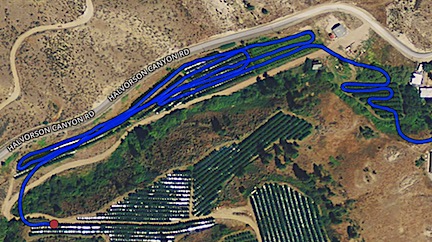
CherryDryingTrack
ForeFlight kept track of some (but not all) of one of my afternoon cherry drying flight. Fun stuff, eh?

Of course with rain came calls to dry cherry trees. They were evenly spaced. I took the first one since I was prepped for it: 34 acres of mostly bings and Rainiers up a canyon about 7 miles from the airport. While I flew over the trees, Woody and Gary kept doing rides. I heard them on the radio making their position calls as I flew back and forth blowing water off the trees.

I was just finishing up when the second call came. Since Gary was prepped for that orchard, I put him on it and I went back to doing rides with Woody. By then, the wind had shifted and we reversed our tour direction. With more rain over downtown Wenatchee, we flew mostly over Malaga. That was kind of neat because we passed close enough to where Gary was working for my passengers to see him. On one tour, I even circled the orchard to make sure he knew where the Rainiers he was supposed to dry ended and the bings they didn’t want dried began.

He finished up, refueled, and joined us for rides. That’s when another grower called. This time, Woody was prepped for the orchard so I sent him while Gary and I kept doing rides. By then, the event was winding down and, as usual, the only crowd of people around was the crowd at our landing zone. Lorri stopped selling tickets and, by just after 4 PM, we took the last group. Gary and I set down near the landing zone. Our ground crew loaders left, we packed up our gear, and we went into a hangar where Century Aviation was displaying two antique aircraft it was restoring for clients. Woody joined us a short while later.

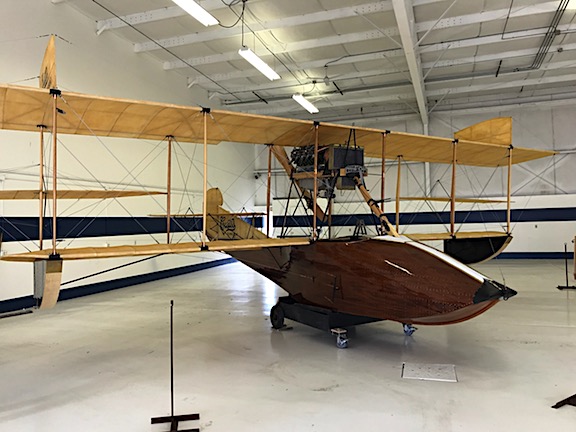
Restored Curtiss Flying Boat
My friends at Century Aviation have restored the sole remaining Curtiss Flying Boat in existence. I’ll be the photo ship for its first test flight next month at Moses Lake.

Between the three of us, we’d flown 12.4 hours of rides flights and another 5.2 hours of cherry drying flights. Needless to say, it was a good day.

More Storms, More Wet Cherries

We all refueled and headed back to our parking areas. I’m based at a neighbor’s landing strip, Gary’s based at an orchard nearby, and Woody is based at a client orchard. We met up back at my home where Garry and Lorri are staying in their RV and Woody is staying in mine.

We were just talking about dinner when my phone rang again. This time, a client in Quincy was on the line. Although his contract didn’t start until the following Friday, a big storm had come through Quincy and he was wondering if he could have his cherries dried off contract. Since Gary was the guy who’d be drying his orchard when the contract started, I put it to him. Sure, he said. And he drove off to return to his helicopter. Fifteen minutes later, he did a flyby on his way to Quincy, which was 15 air minutes away.

Gary Flies By
I snapped this shot of Gary as he flew by enroute to Quincy. I suspect there will be a lot of helicopters flying by my home this summer.

Woody was getting ready to put a rib eye steak on my grill when we both noticed the storm clouds to the east, right where Gary had gone. A few minutes later, he called to say that he’d hit weather and had made a precautionary landing in a field. I checked radar and saw a huge cell right over the orchard he was headed for. Putting radar in motion showed me it was heading our way.

When the storm hit, it hit with a vengeance. Honestly: I have never experienced such wind and rain at my home. Because it was coming from the east, it even blew water under the door to my deck at the front of the house. Poor Woody had to go out and turn his steak on the grill with a towel draped over his head.

The power went out, came back, went out, came back with some flickering, and then went out again. It stayed out.

I knew the calls would be coming, so I headed down to Mr Bleu, leaving Woody to gobble down a beautiful steak and some salad. I parked in my truck near the helicopter and turned off the engine, leaving the radio on. It poured on me. My neighbor drove up and parked beside me. We rolled down our windows and chatted. He told me he needed to spray his apples and was hoping to do it that evening, but with all the rain, he’d have to wait. We chatted about a few other things, including my asshole neighbor who no one in town seems to like. The rain stopped. My phone rang. Five minutes later, I was in the air, heading toward one of the orchards on my list.

Meanwhile, Gary had made it to Quincy and was drying 50 acres of very wet cherry trees.

A call came in for Woody’s orchard and I told the owner that Woody was on his way.

I dried an 18-acre orchard, then zipped across the river and dried another five-acre orchard. The owner of the orchard Woody was drying asked if Woody would do one block again when he finished. I passed on the request via radio and Woody immediately reminded me that it would be dark soon and there were wires in the block the orchardist wanted dried. I told him to do whatever he felt comfortable with. (We didn’t know then, but another pilot had crashed after hitting wires farther upriver. She’s okay, but the helicopter is out, at least for the season.)

Another call came in for five more acres close to my home. By that time, it was getting dark and the wind was kicking up. I started to dry those last five acres but soon had trouble maintaining control in a gusty wind. Another storm was coming through. I decided to break off for safety’s sake. Maybe Mother Nature would do my job with the wind.

It was a good thing I stopped when I did. The wind was howling all the way back to my landing zone and, although it was light enough to see, it was darker than I like it to be when I’m working low-level. I managed to set Mr Bleu down in its parking spot. I cooled down the engine and shut down just as it started to rain again.

The power was still out at home. Woody had landed safely and was on his way back in my Jeep. Gary texted to let me know he was done but he had run low on fuel. Lorri was on her way over with their truck and fuel tank. It would be a 40-minute drive each way for her. Meanwhile, Malaga was still dark from the blackout, although Wenatchee and East Wenatchee seemed unaffected. I later learned that lightning had struck a transformer in the area during the first big storm of the evening. When Gary flew past on his way to his landing zone, I got back in my truck to go pick him up since I knew it would be at least 30 minutes before Lorri returned.

Saturday Night
I shot this photo from my deck at about 9:30 Friday night. The power was still out in Malaga.

It was 10 PM by the time the helicopters were all tied up for the night and the pilots were back at base.

But I’d already begun getting calls for the next morning. We all knew we’d be up by 4 AM.

Drying at Dawn on Sunday

I was up at 3 AM. At exactly 3:56, I got a text from one of my clients asking me to dry his five acres in East Wenatchee again. I already had 48 acres lined up for Gary and 28 acres lined up for me.

I dropped Gary off at his helicopter on the way to mine. He launched at 4:40; I was five minutes behind him. I finished the first five acres before dawn and was nearly done with the second five acres when the sun broke over the horizon.

It was a beautiful day and I said as much over the radio. A guy in the ground crew at Pangborn Airport, checking the runway for FOD before Horizon’s 5:30 AM flight would depart, replied “Why wouldn’t it be?” Gary’s voice came through next: “It sure is.” I shared another piece of wisdom over the radio on my way to the 23-acre orchard waiting for me: “Any morning you get paid to fly is a beautiful morning.” Someone double-clicked a mic button in agreement.

I’d forgotten my sunglasses and cap, so I had to deal with the low sun shining in my face while I dried the parts of the orchard that were already in sunlight. No big deal; I’m used to it. The trees weren’t that wet and I was able to finish the job quicker than usual, saving the owner some money.

I was done and back at my base before 7 AM.

My R44 Helicopter in the Morning
Here’s Mr Bleu parked in its landing zone after Sunday morning’s cherry drying flights.

Herding Horses

I wasn’t done flying for the day, though. I still had a big job ahead of me: herding horses on the Yakama Reservation south of Yakima, WA.

I went home, took a shower, had a second cup of coffee, and made breakfast. At 8:30 AM, I was back in my helicopter, climbing out past my home to get some fuel at the airport.

While the fueler did his job, I rigged up one of my GoPros, hoping to capture some footage of my flight down to Yakima, the work I did there, and my flight back. Although I used to mount the camera on the outside of the helicopter, the local FSDO wasn’t happy with my setup so I had to mount it inside the cockpit bubble. I had a solution with a suction cup mount and it worked good enough, although it wasn’t ideal. I was able to get it plugged into the intercom system so I’d have audio in.

Why move wild horses?

If you’re wondering why they bother to move the horses, the answer is pretty simple: with no predators and decent grazing in the spring, the wild horse population booms. (I think I saw at least 300 horses in this one area of maybe 20 square miles that day and I know there are a lot more in the hills to the south.) Soon, the horses have devastated the grazing area, leaving nothing for them or any other animal — including the cattle that the Yakama nation depends on for its own food — to eat. As winter comes, these herds begin to starve to death.

While we all love the romantic idea of the Wild West filled with herds of wild horses, the overpopulation in some areas is a serious problem for both the horses and the people who are trying to live on the land.

When I asked what they do with the horses, I was told that they put them up for auction. I think it’s a hard sell; it’s unlikely that the adult horses can be trained to work on ranches or do horseback riding. The colts and fillies, however, have a chance at being trained to serve a useful purpose and would likely be bought by someone who would keep them alive.

I didn’t dwell on this aspect of the work I was doing. I recognize the problem and want to be part of the solution. I believe, however, that the best solution would be to try to limit reproduction. I believe that a better solution would be to somehow introduce birth control into the herd. Ideally, if possible, it could be done by darting from a helicopter. I’m assuming there’s some reason — technology? availability of drugs? cost? — that they don’t use an approach like this.

It would be sad if the problem got as bad as the wild pig problem in Texas — they shoot those from helicopters and leave their carcasses for scavengers.

I started back up and pointed the helicopter south, climbing steadily to clear the cliffs behind my house along the way. I had a nice little tailwind and did the 52 NM flight in less than 30 minutes. On the ground, I had the fueler top off both tanks and went inside the FBO to wait for a passenger. He was a no-show, but my client had texted me GPS coordinates to meet him. So when it became certain that my passenger was not going to show up, I climbed back into Mr Bleu and flew another 12 miles southwest over a ridge to a flat area in the middle of nowhere.

On the way, I saw a herd of about 20 horses on the south side of that ridge.

I was over the coordinates wondering where my client was when I suddenly saw him and two other people standing on a two-track road. The truck they’d come in was hidden out of sight behind a small rise. I landed on the road, cooled the engine, and shut down.

I met Troy, his nine-year-old son, and his cousin or nephew — I can’t remember which. We talked about what had to be done — get the horses that were up on the ridge down into the flat area and up against the fence and drive them up into the trap. I asked where the trap was and Troy just pointed up the road beyond the truck.

Meanwhile, they were looking out to the west where other wild horses were being driven into other traps by other members of their party: Troy’s father, brother, cousins, and nephews. I could barely see the activity — it was quite a ways off. We’d start off working separately and then maybe help them.

I gave Troy and his son a safety briefing and loaded them into the left side of the helicopter where they’d be able to see the same thing. I didn’t discover until later that it was Troy’s son’s first time ever airborne. (Please, parents, don’t introduce your kids to aviation on an animal roundup flight.)

We took off to the east, heading slightly north to the ridge I’d come over. I assumed he wanted to start with the herd I’d seen, but he wanted to go farther east than that. I’d estimate we went at least three to five miles from our starting point. He instructed me to go up a sort of canyon in the hillside with the idea that we’d get beyond whatever was up there and start moving them west.

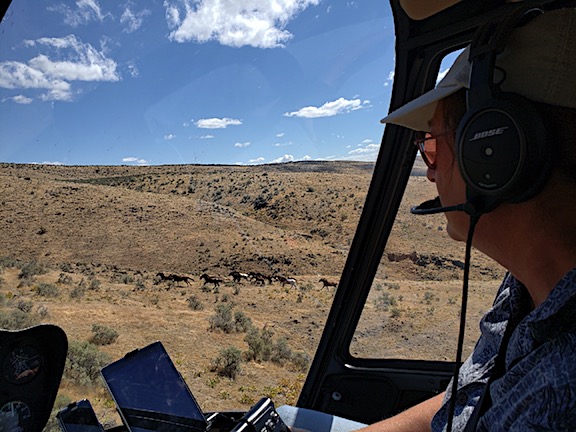
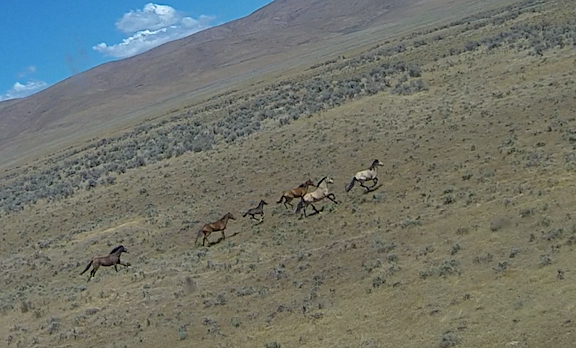
It didn’t take long before we started seeing horses. A lot of horses. Maybe 15 or 20? Mares, colts, fillies, and always at least one stallion. I descended and moved in close from one side and, as I expected, they began running. I stayed behind them, just far enough off to keep them running without scaring them to death.

I could try to give you a play-by-play of the movement — after all, the video camera was running for most of the time and both Troy and I were talking — but do you really want to read it? I wouldn’t. Although it was sometimes a bit of a rush to fly, it wouldn’t make good reading. I basically had to keep the horses moving southwest down the ridge and into the flats. I did this by flying low behind them, moving right or left to “encourage” them to go the right direction.

Herding Horses by Helicopter
Troy captured this image of me at work with a herd of horses up near the top of the ridge.

When Troy was confident they were going the right way, he’d instruct me to go back up and find another herd. It seemed that he wanted to gather all of the horses together into one big herd and get them all moving southwest toward the trap. So we went up and found another herd and started driving them down. And then another. And then another. And then we’d come up for a look to see where they all were and go back down to get the ones who were wandering back in track.

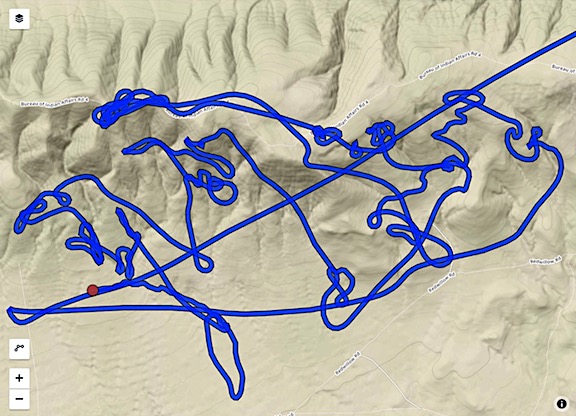
Horse Herding Track
ForeFlight kept track of part of my first horse herding flight. Can you understand why a kid on his first ever fight might get pukey?

This went on for at least an hour. In the back seat, Troy’s son got sick — how could he not, considering our motion? — and I was very glad that Mr Bleu’s previous owner had left a barf bag in the front passenger pocket.

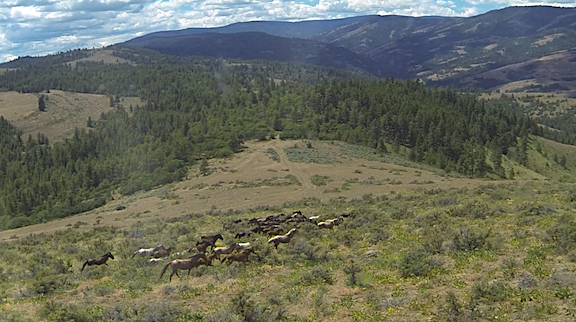
At one point, we had about 100 horses all in one big group following their established horse trails west in the foothills of that big ridge. It was a beautiful sight.

Little by little we got close to the trap, which I still hadn’t seen. A lead group of horses peeled off and started going back up the ridge. Troy told me to move the back down. I was working on it when he said, “Too late. They’re past the trap.”

What trap?

Horse Herd
Here’s the second herd we tried to herd into Troy’s trap. This is a screen grab from my GoPro; it gives you an idea of the kinds of attitudes required for this work.

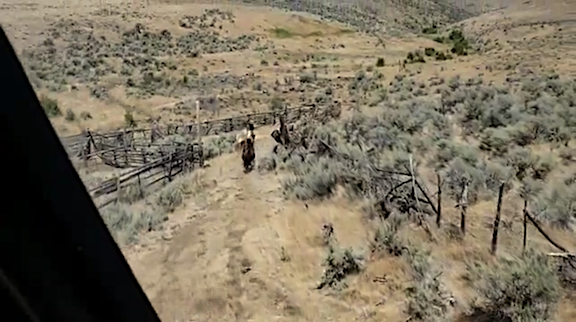
We went after another herd and had better success. I kept them south of an imaginary line only Troy could see and then moved them west to the fence line. That required me to jump a small power line and pick them back up on the other side. Once against the fence, Troy had me move them north without letting them move east. I drove them as he instructed, going only close enough to keep them moving. They followed a road and I suddenly began seeing red ribbons tied to the sagebrush. And then old wooden beams. A corral.

They got right up to the entrance of the corral, saw what was up ahead — a dead end — and stopped. For a moment, I hovered about 20 feet away from them and they all looked at me. It was a sort of standoff. Then I inched forward. They turned around, ran into the corral, and Troy’s cousin/nephew pulled a tarp across the entrance to trap them inside.

My camera didn’t capture this — Troy had accidentally disconnected its power about 20 minutes earlier — but Troy’s cell phone camera did.

Herding Horses
Here’s the moment when the horses finally ran into the trap.

We went back down the road and I landed. I wanted Troy’s son out before he puked again and messed up my nearly new carpeting. (Mr Bleu might need an overhaul in 200 hours, but its carpet was obviously replaced just a short while ago and is in excellent condition.) I also wanted a closer look at the trap which, in my mind, wasn’t very big or sturdy. So we got out and walked up to where Troy’s cousin/nephew was attempting to get the horses to move from the “big” capture area to a much smaller holding pen.

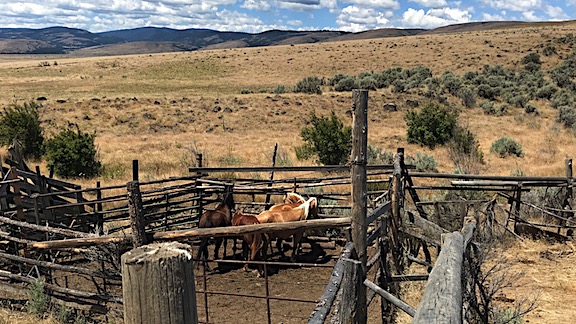
We’d caught four mares, who of which might be pregnant, a colt, and a stallion. While the two guys worked the horses, the stallion got excited and jumped the fence. That left a total of five horses.I didn’t think that was very good — especially when you consider the 100+ horses we’d been moving all over the area — but Troy seemed happy enough.

Coraled Horses
Here’s a shot of the five horses we ended up with in the smaller holding pen.

I was ready to go get some more — I wanted them to get their money’s worth — when Troy got a call from someone working the other horses west of us. They needed help. So he and I got back on board, leaving his son with his cousin/nephew, and headed west.

There were more horses there and a lot more guys working them. Two guys on horseback, one guy on a dirt bike, and a woman in an SUV. There was a herd of about eight near the mouth of one of the traps and they wanted us to help them get it in. I got into position and started moving them with the vague idea of the trap being in a patch of woods. The horses got close, saw the trap, and broke into two groups. I went left and moved that group back toward the others. Then Troy told me they’d missed the trap and we’d get them in the next one.

The next one was at least a half mile away. I moved the horses along the top of the ridge and then down a hillside to another patch of woods. The dirt bike came into view and herded from the left as I moved them from the right. Together, we funneled them down to where a two-track road went into the woods. The dirt bike pulled up quickly — I couldn’t get close because of the tall trees. A moment later, the rider was off the bike closing the trap. I caught a glimpse of a bunch of horses in the woods there and Troy told me they’d already caught some. They now had 15 in that trap.

He guided me around to the west to find a few more herds. We spent another 30 minutes driving them down one ridge to the flats and then to the east where we had to drive them up another canyon. At one point, we were driving a herd of about 30 horses toward the trap. He got a call and we broke off to help them move another bunch of horses that they were working near the trap.

Of course, although I’d topped off both tanks in Yakima I’d also been flying almost nonstop for hours. My helicopter’s endurance is roughly three hours and we we’d been flying for about two and a half. I told Troy we had about 20 minutes until I needed to refuel. He understood and he told me that he’d only been cleared for a total of four to five hours of flight time. With the 90-minutes estimated round trip to get to him, our three hours in the air was all he could do.

We worked the large herd of horses near the second trap for another 20 minutes and couldn’t get them any closer. The trouble was, the woman in the SUV had revealed the vehicle to the horses too soon and the horses wouldn’t go past it. We had no way to contact her — she wasn’t picking up her cell phone. To make matters worse, every time we got the horses closer, she’d move the vehicle and spook them. Troy was really pissed off; I was just frustrated. Back and forth, back and forth. We had those poor horses running in circles while we flew around them, trying to keep them together moving in the right direction.

Horses with Trap
Here’s the last group of horses I worked with. The goal was to get them into the trap, which is in the woods at the end of the road in this photo. You can see the SUV that kept spooking them. I had these horses running around in this 40 to 50 acre area for about 20 minutes before I had to give up and go for fuel. This is a screen grab from a GoPro video.

And then it was bingo time. If I didn’t go get fuel then, I might not make it back to the airport to get fuel.

I told Troy, fully expecting him to tell me to bring him back to his truck at the far trap where I’d picked him up. But instead, he told me to drop him off anywhere.

So I flew us to a nearby hilltop where it looked flat enough to land, set down, and let him off. He thanked me, shook my hand, and closed the door. I checked the door, made sure he was clear, and headed back to Yakima Airport, 15 miles away.

I was on the ground before the low fuel light illuminated, which is always my goal, but especially my goal in a helicopter that’s new to me. With fuel expensive at Yakima, I told the fueler to just top off one tank. I went inside, got change for a vending machine, and ate the only thing I’d consider food that was for sale: a package of Knott’s Berry Farm cookies. I chatted briefly with two airplane pilots snacking on popcorn after a cross-country flight up from Bend, OR. Then I settled my fuel bill and went out to start my trip home.

The Flight Home

I flew pretty much direct from Yakima to Wenatchee Airport. The tailwind I’d had on my trip south was now a headwind. There was some turbulence, but not much. I popped over Jumpoff Ridge just south of my home and started a long spiraling descent to the airport, swinging past my home on the way down. I saw Gary, Lorri, and Woody hanging out in my driveway.

Watch My Helicopter Videos on YouTube

Time for a shameless plug…

Flying M Air Logo

If you like helicopters, you’ll love the FlyingMAir YouTube Channel. Check it out for everything from time-lapse annual inspections to cockpit POV autorotation practice to a flight home from a taco dinner at a friend’s house — and more.

At the airport, I asked the fueler to top off both tanks. (Although I have cheaper fuel in a DOT-approved transfer tank at my landing zone, I’m saving that for when I need fuel when the airport is closed.) During cherry season, my helicopter’s tanks are always topped off so I’m ready to fly for a full three hours when client calls start coming in. When the tanks were full, I fired it back up and made the three-minute flight back to my landing zone, flying past my home as I made my descent.

I landed, cooled down, and shut down. I took a snapshot of my hobbs meters so I could enter the time in my logbooks. A short while later I was backing my truck into the garage, glad to be home.

I later calculated that I’d flown more than 15 hours in 48 hours, nearly all of it revenue time. A good weekend for business.

Sunday Night Sunset
Sunset on Sunday night, after a good dinner with friends and a two-hour nap.