Your Aircraft Engine Talks to You. Listen to it!

I realize I have a bad video clip by the sound of my helicopter’s engine.

An interesting thing happened to me Saturday as I was editing the video for my most recent YouTube upload, Part 5 of my all-too-long, bad weather flight to McMinnville this past May.

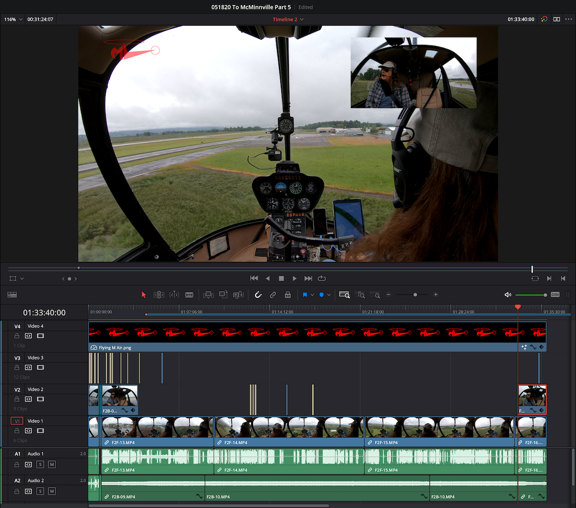
First, you need to understand what goes into editing these videos. The short version is this: I take clips from multiple cameras and place them in the editing timeline (see below). I then move one or more of the clips to sync them up. For example, if the front-facing camera shows my left hand in the air, fingers spread wide, the back-facing camera should show exactly the same thing. This way, when I move or speak, the two views show the same motions and my lip movements correspond to my speech.

The front-facing video, which is the preferred view for my cockpit POV videos, also has the voice track, synchronized by the camera (of course) and sourced from a special cable connection to the helicopter’s intercom system. Simply said, whatever I hear in my headsets is sent through that cable to the camera, whether it’s me speaking into my mic or someone on the radio talking. The rear-facing video picks up ambient sound inside the helicopter, which is mostly the sound of the engine and rotor system.

So if I sync these two camera feeds properly, the helicopter sound should correspond with the phase of flight. This latest video shows this quite well near the beginning; as you see me bend forward to start the helicopter, you hear the sound of the helicopter’s engine starting.

Timeline View
This is what my Part 5 video looks like in Davinci Resolve, the editing software I use. The top two tracks are for my logo watermark and some of the callouts that appear. The next track is for the rear-facing PIP video clips with a few more of those callouts. (Honestly, the callouts should probably all be on the same track, but I’m sloppy.) The next track is for the front-facing camera. Below that are the two audio tracks: intercom audio (my voice, radio calls, etc.) and the sound of the helicopter, dialed down by 10 decibels.

In cruise flight, the helicopter sound is a pretty consistent drone. So consistent, in fact, that I have learned that I can patch in that sound from an unrelated flight if, for some reason, the actual sound from a flight is not available. The only time it makes a different sound is if I’m maneuvering: slowing down, making a turn, coming in for landing, etc.

With me so far?

I’ve grown to realize that although I can do a picture-in-picture (PIP) video that shows the view out the cockpit bubble with a smaller view with me in a corner, no one really needs to see me for a whole flight. I like to show me when I’m talking before or after a flight or if I’m “lecturing” about something and my face gets expressive. So once the two video feeds are synced, I’ll usually cut the back-facing video (but not audio) to give viewers a better look out the window.

Now because my videos are so long, they normally have multiple video files from each camera. That’s easy enough to deal with: when one clip ends, I just insert the next one, being sure to butt it up against the previous one. I do this for both views, even if I don’t plan on showing the back-facing view. After all, I still need the corresponding helicopter engine audio, don’t I? I just separate the video from the audio on that back-facing video and put the video portion on a hidden track so it doesn’t appear. Later, when I know I don’t need that portion of video track, I just delete it from the timeline.

And that’s when something weird happened yesterday. I was constructing the edited video, watching and listening to it as I worked. It was near the end and I was getting close to my destination, but I was still at full cruise speed. Yet the engine sounded wrong. It sounded as if I’d reduced power.

What the hell? I asked myself. What’s going on with the engine? Why didn’t I notice that when I was flying?

And then I looked at the corresponding back-facing video. I saw that it was no longer aligned with the front facing video, despite me adding each clip properly to the end of the clip before it. Although I was in normal cruise flight in the front-facing camera, I was coming in for landing on the back-facing video. Turns out that the back-facing camera had shut off recording along the way and then turned itself back on. (If you’ve watched enough of my videos, you know I have a finicky camera.) As a result, I had a gap in the recording.

Of course, this required me to jump through a few hoops to “fix” the problem. I basically reused some cruise flight audio to fill the audio gap, then synched up the two views for landing so the engine sound would match the phase of flight. (It’s workable, but not perfect.) If you watch the video to the very end, you’ll see that I also brought the PIP image back in and got the synching just right. You probably wouldn’t even notice the problem if I didn’t just tell you about it.

But my point is this: when you fly the same aircraft so much, you become in tune with its sounds. I immediately noticed the problem when I watched the video and couldn’t understand, at first, why I hadn’t noticed the engine sound difference in flight. The reason, of course, is that it didn’t happen then, when I was in cruise flight. It happened later when it should have. There was nothing to notice in flight.

If you’re a pilot and you’ve been flying long enough in the same aircraft to to know it well, you should notice changes in the engine sound for different phases in flight. The engine is talking to you. It should be reacting to what you tell it to do. In a way, you’re communicating with each other.

But when your engine starts leading the conversation, you’d better be listening to it.

Cross-Country Helicopter Flight from Malaga to McMinnville, Part 5

Another video from the FlyingMAir YouTube channel.

Join me for the fifth part of my cross-country flight from my summer base in Malaga, WA to McMinnville, OR. In this video, I depart Scappoose (where I made a precautionary landing in the previous video) and finally get across that dinky little mountain that separates me from my destination. From there, I get a special VFR clearance to cross Hillsboro’s airspace and find a path between the hills to McMinnville. The weather is pretty miserable, with rain and low clouds. I had two cameras rigged up for this video — the nosecam got wet along the way so I didn’t even run it. Audio is from direct connection to the intercom so you can hear me narrate the flight and make radio calls, plus dialed down volume of the helicopter’s engine/rotor noise.

You can see all of the videos for this flight here:
Part 1: https://youtu.be/pgKDciGP4eA
Part 2: https://youtu.be/CmupuFDXa4Q
Part 3: https://youtu.be/vyveMEm_MhQ
Pups in a Helicopter: https://youtu.be/eEVq9sRlJK8
Part 4: https://youtu.be/3KXR_D3SliA
Part 5: https://youtu.be/eghRyzhPigg (this video)

I should mention here that “cross-country” in the world of aviation is any long flight. For airplanes, it’s 50 miles or more; for helicopters, it’s 25 miles or more. This is only part of a 178 nautical mile trip.

Western Washington Wander 2020: Dungeness Recreation Area

I spend two nights in a pleasant campground, recovering from a weekend of hard work and bad air.

Last year, I spent a weekend in Port Angeles, WA, on the Olympic Peninsula, selling my jewelry — or at least trying to — at a rock show there. I had done very well in January at a rock show in Mesa, AZ, and figured that might just be my niche. It wasn’t. I barely made enough to make the trip all the way out there worthwhile.

While I was at the show, I camped out in a corner of the municipal parking lot. It was surprisingly pleasant — heck, deer came out of the woods right there to nibble on the blackberries that grew beside the spaces — but I knew damn well that I’d be overstaying my welcome if I spent the night after the show there. So I whipped out my public lands campground app, Ultimate CG, and found Dungeness Recreation Area, a county park just down the road in Sequim.

It was raining gently when I arrived just before dark and I found a campsite in one of the loops. It was surprisingly large and private, as were most of the other sites. Very pleasant. And I had the added bonus of finding a few very healthy lobster mushrooms at the back of my site in the woods.

Settling in at Dungeness

All that was on my mind when I left Eatonville and headed west. It was a 2-1/2 hour drive and I arrived at least a half hour after dark. With those lobster mushrooms in my mind, I tried to remember what site I’d been in. I wound up in the site right next to it.

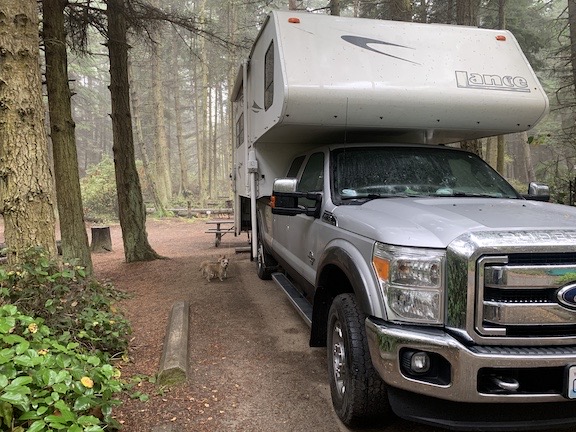
Campsite1
Here’s a photo I shot in the morning of my truck backed into our campsite. There was lots of privacy with dense vegetation on either side of us.

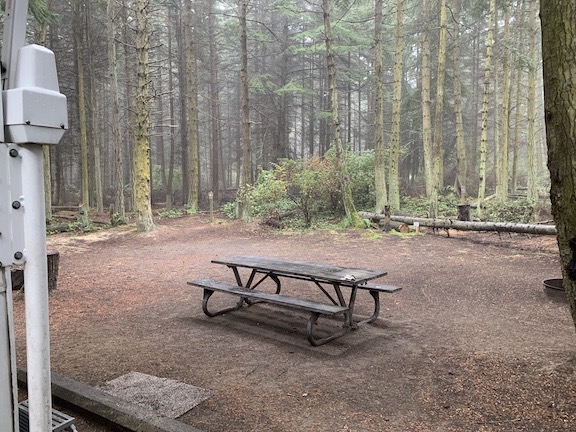
Campsite 2
The campsite was spacious with a picnic table, fire pit (just out of the shot), and enough space to erect multiple tents. Because there was no campsite behind ours, we had the illusion of woods going on forever.

I was dead tired and tightly wound when I backed into the spot, using a lantern as a parking guide. It was darker than I thought possible for a county campground. I absolutely hate driving at night in an unfamiliar area and the last 45 minutes had been stressful for me. I was glad to get in. I had just enough energy left to take the girls for a quick business walk, make us all dinner, and then take one more short walk for good luck. I had the pay envelope, but it didn’t give a rate anywhere on it and I certainly wasn’t going to walk all the way back to the pay station in complete darkness anyway. I’d pay in the morning.

I slept surprisingly well. Well, maybe not so surprising when I think about how tired I was. I made my coffee while the girls were still asleep and managed to finish half of it before they woke up. Then it was time to take them for a walk.

And that was the drawback of staying at a real campground: I couldn’t just open the door and let them out to pee. I had to put them on leashes and take them for a walk.

I got dressed, grabbed the campground registration form I’d filled out the night before, put some money in my pocket, and leashed up the girls. Then we set out toward the pay station.

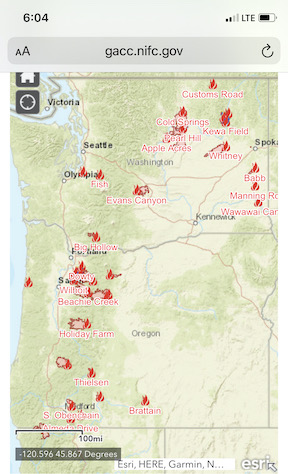
Fire Map
There were fires burning throughout Washington, Oregon, and California (not shown on this map). The smoke in the west had become “hazardous.”

It was a pleasant walk despite the foglike smoke that had settled over the area. Visibility couldn’t have been more than a half mile, but since we were walking in the damp forest, it didn’t really matter. We cut through the campground on a path I’d remembered from the previous year. The girls sniffed and did their business along the way.

At the pay station, I put $26 in the envelope and noted the 12 noon checkout time. I grabbed a park map and we headed back to the camper. I finished my coffee and made us all breakfast.

Full Day at Dungeness

The plan that day was to hike out on a path along the ocean known as “the Spit.” There was a lighthouse at the end that I’d never seen. So after breakfast I packed up a small daypack with rain gear — there was rain in the forecast — bottled water, and some snacks. I almost put the binoculars in there but then wondered what I expected to look at with visibility so low and put them away.

We cut out along another path through the woods that took us toward the Spit trailhead. I really love the forest in that park. It was dense and damp but somehow still bright. The forest floor was thick with pine needles and branches and leafy undergrowth. In wetter conditions, it would likely be full of all kinds of mushrooms. It had a sort of atmosphere that seemed to absorb sound, or at least make it quieter.

We emerged at the end of the trail at a parking area and crossed it to the trailhead. I looked at the signs to learn more about the hike. Of course, the one I noticed first was the one that said “No Pets.”

Okay, to be fair it was a wildlife refuge. And yes, I do get the fact that park managers don’t want big bumbling dogs — or even small ones, for that matter — chasing wildlife. But I was still disappointed. I was really looking forward to a walk on the beach with my pups.

Fortunately, Dungeness has many trails. Without wasting anymore time there, I headed off on the one that went along the bluffs with my two little dogs in tow.

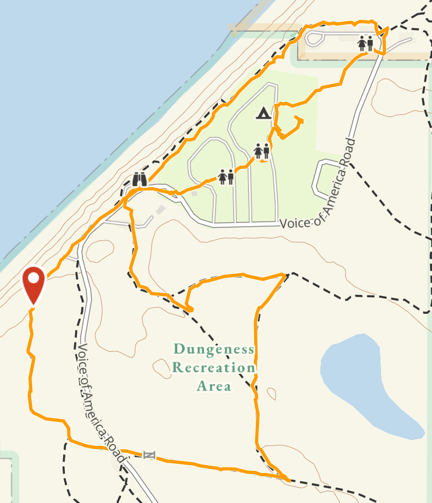
Hike Map
The orange line marks our hike route. You can see it on GaiaGPS, along with the one crappy photo I took.

We spent the next hour or so meandering on trails throughout the park, passing a handful of mostly masked hikers along the way. (I’m sorry, but although I do believe that masks help prevent the spread of the virus, I don’t believe they’re necessary when hiking outdoors, especially in places where the chances of passing another person are slim. I should add here that all the people I saw wearing masks along the trails were seniors so maybe they felt more at risk? I kept my distance from them.) The only wildlife I saw were squirrels, birds, and a single deer.

At one point, a woman with two medium sized dogs warned me that her dogs weren’t friendly; as if to prove her point, the two dogs strained at their leashes, growling and barking as they tried to get at my pups. To their credit, my girls hurried past them on short leashes. (Poor Lily looked absolutely terrified.) But it makes me wonder why someone wouldn’t better socialize their dogs before taking them out in public where there might be other dogs. Seriously folks: either you’re going to make your dog a part of your life and train it appropriately or you’re not. There’s very little middle ground.

One thing I noticed along the walk was that I was getting tired a lot more quickly than I should have been. The trails were relatively flat and very easy walking, yet I felt exhausted and had a headache within the first mile and a half. My left knee was aching. I definitely did not feel like hitting the road again to places unknown. I felt like taking a nap. And it wasn’t even 11 AM.

So we stopped at the pay station on the way back to camp. I filled out another envelope and stuck another $26 into it. I’d spend the day there at the park, just taking it easy, and head out the next day.

To my credit, I did hike about 2-1/4 miles that morning — basically the same walk I do three times a week with a neighbor at home.

A Lazy Afternoon

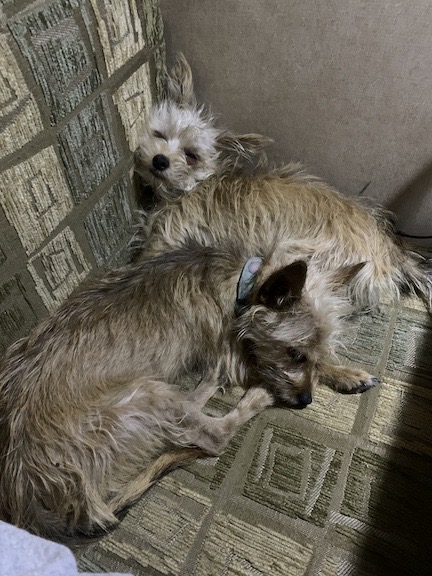
Rosie and Lily
The bench seat on my RV’s dinette is small, but both pups managed to squeeze in a nap sitting next to me sometime during our stay at the park.

After a satisfactory visit to one of the campground’s coin-op showers, I reheated the previous night’s leftovers for lunch and did a little work on my blog outside at the picnic table. I tried leaving my pups off-leash at the campsite, but they invariably got “the zoomies” and chased each other out of the campsite boundaries, winding up at someone else’s site where Rosie went in for pets and Lily played keep-away. Around 2 PM, I went in for a nap with the girls. They’d skipped breakfast — sometimes they’re finicky — but wound up eating most of their food for lunch. We all climbed up on the bed together. I read for a while and then fell asleep.

I had begun wondering whether my spent feeling was due to the bad air or possible COVID exposure during my travels. I’d been with two other people, all of us maskless in a large open indoor area, all weekend. As I’ve been doing occasionally since the virus has begun spreading, I cataloged my symptoms: mild cough, mild sore throat, headache, general feeling of fatigue. I managed to get a good enough Internet connection to check the air quality in my area and saw that it was over 300: Hazardous. Maybe breathing bad air was making me sick? Whodathunkit?

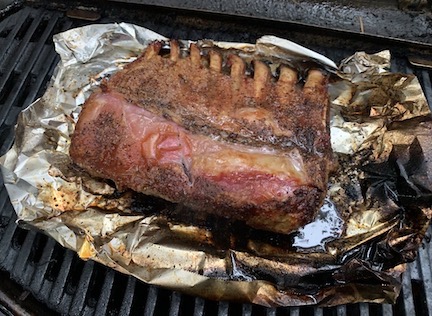
Rack of Lamb on the Barbie
I used aluminum foil to protect the meat from the flames I knew would start up when fat hit the burners. My portable BBQ grill is very temperamental, but keeping it set to low and closing the lid gave me the ovenlike cooking I wanted.

I started dinner at 5 PM. I’d defrosted a rack of lamb and had decided to cook it on my grill instead of coating my camper’s tiny oven with spattered lamb fat. I’d never cooked rack of lamb on the grill before. I also didn’t have a meat thermometer with me. Amazingly, however, I managed to pull it off, ending up with a perfectly cooked rack that I served up with pan-fried garden potatoes and the last of my garden scallions. I had sliced figs on the side. I put half the rack in the fridge for lunch the next day.

A Feeling of Malaise

We went for two more short walks before bedtime. The nap had really helped me. I think that just taking it easy and breathing less of that bad air is what really helped me.

But I had also begun feeling as if I’d fallen into a sort of mental funk. Was I depressed? Maybe.

The situation in this country is really out of control. Between the virus and the wildfires (and their smoke) and the bullshit politics, I really don’t know how anyone can remain upbeat. There’s just too much stupidity, hate, and anger in this country these days.

I’m looking forward to a Biden presidency, but if it’s stolen from him (as it was stolen from Clinton in 2016) by foreign players and Electoral College inequities, I don’t know what I will do. I know I can’t live through four more years of what we have now but I don’t want to abandon the life I’ve built for myself and become an expat. I can’t see a compromise without putting on blinders and ignoring the damage being done to our country, its reputation in the world, and its people.

And even if Biden does win, I have worry that wacko Trump supporters — and I do mean wacko — will try to start a civil war, spurred on by Trump and Fox News. They’ve been fed a steady diet of lies about Biden and the democratic party and they honestly fear for their way of life. How can we hope to undo the damage of those lies? How can we help them see reason? I think it’s impossible.

Every day more negative stories about Trump are emerging — even stories with him on tape admitting that he misled the American people! Yet none of these stories are penetrating the thick skulls of his supporters to help them see reason. They truly are cult members. Cult members with guns who don’t think twice about ending another person’s life.

Anyway, I’ve been avoiding talking politics in my blog because, honestly, I’m sick of it. But I needed to get this off my chest, to explain the general feeling of malaise that has come over me. I think that it’s a combination of these things: COVID, smoke/fires, and politics. I suspect that if COVID and the smoke weren’t part of the big picture in my life, I’d be able to better deal with the politics. But I can’t.

[And if you’re a Trump supporter reading this, FUCK YOU. I have zero tolerance these days for people STUPID and UNPATRIOTIC enough to support the greedy, racist, narcissistic conman in the White House. I hope someday you WAKE THE FUCK UP and realize how much damage he’s done to this country. In the meantime, please leave a big, long comment on this blog post so I can have the pleasure of marking it as spam without even reading it. I want you to waste your time trying unsuccessfully to share your bullshit with my blog readers. You might want to read this if you’re worried about your First Amendment rights.]

A Peaceful, Restful Night

Sometime during the afternoon, a light rain started up. I love the sound of rain on the roof of my camper and that cheered me considerably. It was the first rain I’d experienced since June 28 and I was ready for it.

The campground was amazingly quiet; no generators, no barking dogs, no screaming kids. I think that’s what I liked most about the campground — large private sites, sparsely populated on weeknights, with very little camper noise. It gave me the illusion of staying someplace like Buck Creek Camp with the benefit of toilets, showers, and garbage receptacles.

Throughout the night, the rain came and went. Even when it wasn’t raining, I could hear big drops from the trees on top of the camper. It was like music to my ears. I slept well and woke refreshed.

The afternoon before, I’d booked a campsite at one of the coastal campgrounds in Olympic National Park. Although I had my doubts about the campground, I was able to get a site right on the ocean. It was 2-1/2 hours away. After breakfast and two dog walks, I packed up my grill, neatened up the camper, and pulled out for a leisurely drive west.

I would definitely get my walk on the beach that day.

Western Washington Wander 2020: The Blacksmithing Weekend

Two days of heating and hammering metal.

I have been interested in blacksmithing — heating and hammering metal to shape it — for a while now. In a sense, it’s related to the metalsmithing work I do with my silver and copper jewelry, but rather than cold working relatively small pieces of soft (annealed) metals, blacksmithing involves hot working larger, harder metal: steel. So last month, when the Tacoma Metal Arts Center announced the Blacksmithing Weekend course in the Seattle area, I immediately signed up for it and then began planning my vacation around it.

And that’s why I was in Eatonville on Saturday morning after a terrible night’s sleep, following Google’s directions to a five-acre farm with a huge shop on the outskirts of town.

The Setup

Mike on YouTube

Mike has a YouTube channel to provide information about the equipment he makes. He’s also interested in doing tutorials. If you’re reading this because you searched for “blacksmithing,” be sure to check out his YouTube channel, Mathewson Metals, and give him feedback about what you’d like to see. Oh, and please do subscribe; that’ll help motivate him to make more content.

The class was taught by Mike Mathewson of Mathewson Metals. Mike has been blacksmithing for years and has done all kinds of work, from the small projects we created over the next two days and tools to much larger furniture and architectural installations. He’s also the inventor and manufacturer of several different simple, affordable, propane-powered forges, one of which was in use for the whole weekend.

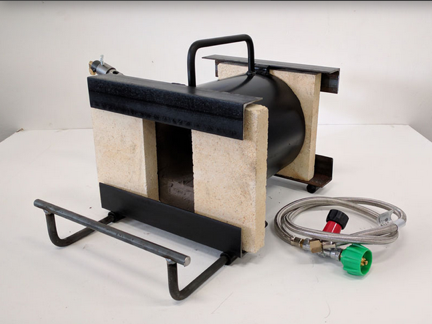
Forge
This is the MetalSmith Propane Forge that we used in class. You can see a video of it in action here.

The class was conducted on one side of his 48 x 72 foot shop building, with the big sliding door on that end wide open to let in lots of air. (The air wasn’t anything we could call fresh, though, since the wildfire smoke situation only worsened over the weekend.) He had the one forge set up as well as several anvils and vices, with dozens of hammers in all shapes and sizes to choose from. He used an amazingly quiet Jet metal saw to cut the 3/8 inch mild steel rods we used for our projects and I watched it in awe nearly every time he ran it. He had lots of other equipment that we didn’t use, like an old Little Giant power hammer and various cutting and finishing tools. The place was a bit of a mess outside our work area; he had only been in the space a little more than a year and he was still figuring out the final organization he wanted. He spent a lot of time organizing while we worked on our own, staying nearby in case we had questions or needed help.

Because of COVID-19, class size was limited to four students. We started with three: me, Travis, and Gary. Gary made a phone call while I went back to my rig to get a flannel shirt. When I returned he was apologizing and saying goodbye; his wife was ill and he needed to get back home. So that left two of us for the class, which was fine with me.

Travis already had a forge and anvil and a bunch of other equipment at home. He was serious about learning blacksmithing and wasn’t moving forward with his self-taught skills. I hoped he’d get an “aha moment” that helped him break through whatever was blocking him in his own shop.

Of course, I wasn’t very serious at all — I just wanted to try it out — so if there were any situations where we had to work one at a time, I usually let Travis go first. As the weekend wore on, we developed a good working rhythm when we had to share a tool; while I heated my piece, he’d work on his and then we’d switch positions. Very efficient. I’m not sure if it would have gone that smoothly with three of us.

The Projects

Mike has obviously taught this many times before. He’s a good, patient teacher who explains everything clearly before we start work. He uses visual aids when necessary to illustrate processes. He is encouraging and never tells you when you get something wrong — unless neither of us did? Instead, he points out a way you can do it better or easier to guide you on the right path.

Nail Hook
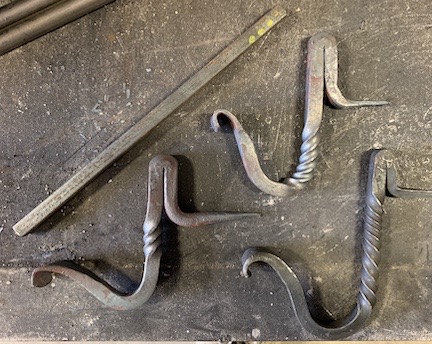
Here’s the nail hook project. From left to right: bar we started with (this is actually Gary’s, which he never did more than mark with dots to identify as his), my version, Travis’s version, and the model we were going for. I made my nail part too long so I made my twist a lot shorter — too short? — and ended up with a sort of wimpy hook.

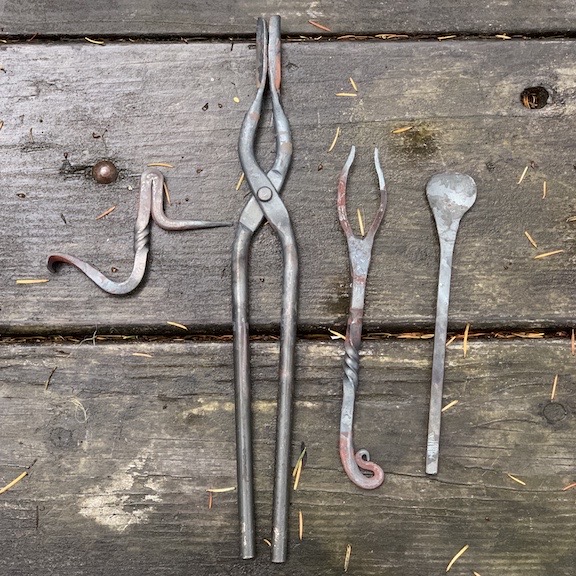
We did four projects, all of which were made from varying lengths of round or square 3/8 inch mild steel rod: a nail hook, a pair of blacksmithing tongs, a fork, and a spoon. Each project taught and gave us an opportunity to try or practice specific skills. For example, the nail hook got us to hammer one end into a point, hammer the other end into a paddle, twist the rod, and then bend the rod in a variety of ways. The blacksmithing tongs had us create two rectangular paddles, bend the paddles to be able to grip 3/8 inch steel rods, bend the rods into a scissors shape, and then rivet a pivot point between them. You’d start a project thinking “how the hell am I going to be able to make that?” and Mike would break it down, step-by-step until you were done.

I have to admit that I was surprised that I was able to “keep up” with the class — especially given that my classmate already had some experience and I had none. Well, that’s not actually true. A lot of my silver/copper forming techniques did apply to the steel work. I think that’s what allowed me to give most of my shapes a decent form and not embarrass myself.

My Blacksmithing Projects
My four projects. They need to be wire-brushed to take the fire scale off.

The class ran two full days — 10 AM to 6 PM — with just 30 to 45 minutes for lunch. In that time we finished three of the projects and had gotten a good start on the last one, the spoon, which only required that we finish it to match the fork. Travis will probably finish his up this coming weekend; mine will likely remain as is forever.

Fringe Benefits

Pigs
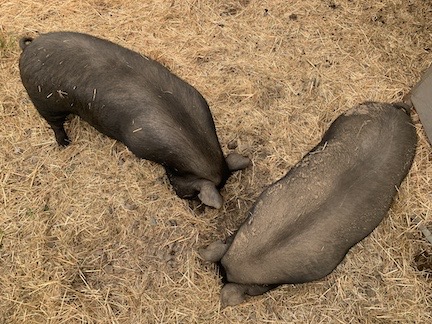
A look over the fence at the pigs, which were actually quite large and didn’t stink.

A fringe benefit for me at the class is that Mike kindly let me park in his yard overnight, so I didn’t have to scramble (again) for a place to stay. He had me back into a space near his pig yard, then moved the two pigs out so I wouldn’t be bothered by their grunting. The space behind my rig was perfect for my pups to go out and take a pee first or last thing in the day.

Blackberries
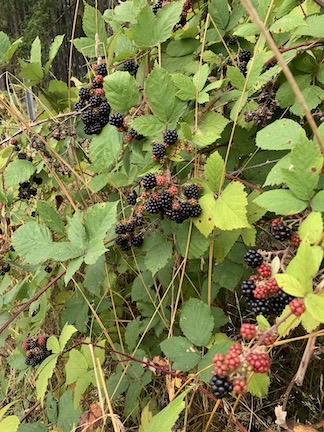
There were a ton of huge, fresh blackberries along the road in front of Mike’s house.

We also went for walks out on the road in front of his home. The first walk is when I spotted the blackberries, which were mostly ripe and ready for picking. I ate a few right off the bushes. Later, I asked for permission to pick them and filled an empty clamshell container (previously holding a pound of fresh dates) with the nicest blackberries I’d ever seen. I’ve been eating them with breakfast since then.

On to the Next Destination

When class was over, it was time for me to bug out. I had planned to stay at Dungeness Recreation Area near Port Angeles that night. It was over two hours away by car. I detest driving in unfamiliar areas at night, so the last half hour or so was brutal for me. We made it by just after 8 PM and I was very happy to back into a campsite in the forest.

Western Washington Wander 2020: A Driving Day with a Crappy Campsite

I spend much of the day on the road, driving into smoke and spending the night in a crappy place.

Friday was a driving day for me that was a lot longer than it should have been. The only highlights were lunch with friends and a long-postponed trip to Trader Joe’s. Even my campsite that night sucked.

So I’ll keep this short.

The Long Drive

I needed to be in Maple Valley at noon to meet some old friends for lunch. Normally, that would be less than an hour from where I was camped at Buck Creek Camp: Go northwest on 410 to Enumclaw and then north on 169 to Maple Valley. Easy.

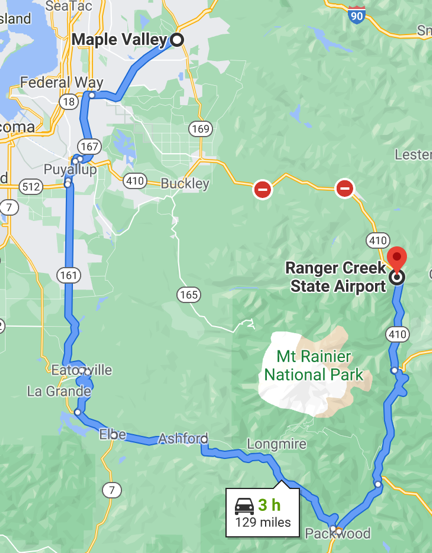
Route to Maple Valley
Not exactly the most direct route to my destination.

But a fire had route 410 closed at Greenwater and there was apparently no way to get through. So I had to go around to the south before going west, basically circumnavigating Mt. Rainier National Park. That made it a 3-hour drive.

Of course, I didn’t know that when I pulled out of my campsite at 8 AM sharp. I knew the road was closed and that I’d have to go around the long way, but I had no idea how long that long way was. I had no Internet access and couldn’t use Google Maps to calculate drive time. So I thought I’d make a leisurely drive around the park and get there with time to spare.

I realized this wasn’t the case after stopping for fuel at Packwood and using Google Maps to give me a good route with timing. That’s when I discovered, at after 9 AM — I guess I forgot to mention stopping at a bakery and going about 5 miles out of my way in search of a ranger station — that I still had a 2 hour and 16 minute drive ahead of me. If I left at that moment, I could be there by 11:52.

Holy crap.

So I drove. I took a winding road north from Packwood to the National Park Road and continued west on another road and another road through a succession of towns, each getting a little bigger and more traffic-filled than the one before it. For the first time in days, I was stopping at traffic lights and seeing red lines on Google Maps.

And that’s when I started experiencing the smoke that has blanketed the entire state. It started as a haze and got thicker and thicker until I couldn’t see far ahead. I couldn’t smell it, but by the end of the day I’d have a sore throat.

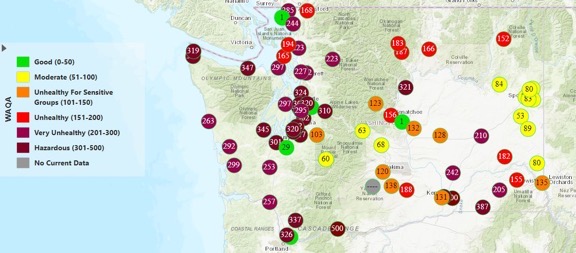
Air Quality
Here’s a picture of the air quality situation on Friday. It hovered around 300 where I was.

Anyway, after a miserable 2+ hours of driving, I finally arrived at my destination: a restaurant in Maple Valley, WA. I parked my rig, took my pups out for a quick pee walk, stowed them in the camper where they had access to food and water, and met my friends for lunch.

A Few Hours in Civilization

The friends I met were Don and Johnie, a couple I’ve known for at least 10 years. Don was a Robinson R44 owner and helped me find hangar space at Deer Valley Airport in Arizona for a season or two before my divorce, when I really tried to make a go of helicopter charter work down there. Don has since sold his helicopter and embraced retirement. I don’t see them often, despite the fact that their summer home is right on the other side of the mountains from me and he has a helipad in his yard. Even stranger is that, like me, they go to Arizona in the winter time and I seldom see them there, either.

It was nice to catch up with them. They’ve been mostly sheltering in place, seeing very few people. This particular restaurant was one of the few they felt comfortable eating at, although they preferred eating on the outdoor patio, which was closed that day due to the smoke. They’re heading back down to Arizona later this month and I’ll make a special effort to meet up with them when I’m in their area.

After lunch, I had Google Maps direct me to the nearest Trader Joe’s. I was in search of figs, which I buy at Trader Joe’s every autumn. They did not disappoint me; I bought three pounds. I also bought some of their olive oil sardines, sugar free chocolate bars, tamales, and the fixings I need to make my granola — mostly unsweetened coconut and flax seeds which are nearly impossible to find at a reasonable price in Wenatchee. By the time I left with my three bags full of food, there was a line to get in; I didn’t realize it, but they were limiting access to the store during the pandemic and I was lucky to be able to get right in.

One more quick stop — this time at a Lowes. I bought a pair of leather gloves and eye protection that I’d need for the blacksmithing course I was starting the next day.

The Crappy Campsite

By that time, it was after 3 PM. I needed a place to park for the night and I didn’t see any decent options between there and my morning destination in Eatonville. I took a route that kept me as close to the national forest as possible, hoping for a forest road I could slip down and park along. But no joy.

In the end, I wound up parking in a mostly empty lot in the town of Eatonville. I spoke to the guys at the used car place across the street and they assured me that the owner of the lot didn’t care who parked there and that semis parked there all the time. I did notice a police car cruising through slowly to check me out, but no one bothered me.

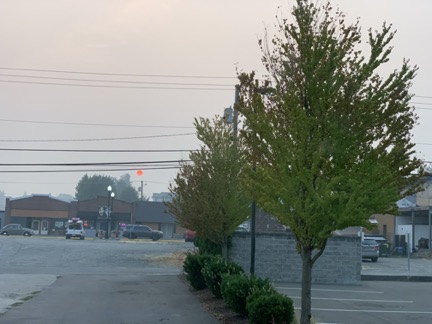
Bad Air in Eatonville
Here’s a view out my window in my Eatonville “camp.” That tiny orange dot just under the wires is the sun.

I took the girls for a walk to a nearby restaurant called Shaken, which had outdoor dining. I figured I’d get a drink and a snack. I thought the place might be nice but it turned out to be kind of redneck. They played country music and none of the servers wore their masks properly. I ordered a drink and food; the drink came quickly and was okay but the food never came. I flagged down the waitress and told her I’d take it to go. She came back a moment later to ask me what I’d ordered. They never made it; I think she forgot to put the order in. I got the check for the drink, paid it, and left. Against my better judgement, I did give her a tip. She had, after all, gotten water for my pups.

I had a terrible night’s sleep. I heard cars go by all night and it didn’t quiet down until after midnight. Some people walked by at 2:30 AM, talking loud enough to wake the girls and get them growling.

I was out of bed by 4 AM. I spent some time working on blog posts and drinking coffee. The girls woke up when it got light out and I took them for a walk. There was a coffee place across the street and I got a breakfast sandwich from them. Pre-made, microwaved. Edible but barely.

By 8 AM, I decided to move on.