Copyright for Writers and Bloggers – Part III: Fair Use and Public Domain

What’s fair? Use common sense.

In the first article of this series (Part I: Why Copyright is Important), I discussed the importance of copyrights to authors. In the second article (Part II: Creative Commons), I tell you about the Creative Commons license I use to protect the work on this site.

In this last article of the series, I explain the concept of fair use — or attempt to, anyway — and how it enables you to quote copyrighted works for certain purposes.

CopyrightFair Use

Now here’s a good question. What if you want to use one of my articles on your AdSense-supported Web site? Obviously, that’s in violation of my Creative Commons license. But what if you’re satisfied using only a part of it?

That’s where Fair Use comes into play. Fair use allows you to take a portion of copyright-protected material and use it provided the use meets the definition of “fair” as set forth by the Copyright Act of 1976:

…the fair use of a copyrighted work, including such use by reproduction in copies or phonorecords or by any other means specified by that section, for purposes such as criticism, comment, news reporting, teaching (including multiple copies for classroom use), scholarship, or research, is not an infringement of copyright. In determining whether the use made of a work in any particular case is a fair use the factors to be considered shall include—

  1. the purpose and character of the use, including whether such use is of a commercial nature or is for nonprofit educational purposes;
  2. the nature of the copyrighted work;
  3. the amount and substantiality of the portion used in relation to the copyrighted work as a whole; and
  4. the effect of the use upon the potential market for or value of the copyrighted work.

You can read more about this on Wikipedia.

Fair Use is Common Sense

Fair use, of course, is ruled upon by judges when copyright infringement cases get to court. But you can keep yourself out of court — and be a good member of the blogging community — by using common sense and thinking through the use you have in mind.

For example, suppose you want to use portions of this article as part of a college course you’re teaching about copyright in the Internet age. You could print the article and share it as a handout with your students. Of course, you should also credit me as the author. That’s common courtesy in the writing world.

Or suppose you want to blog about this article as part of your own opinion piece about copyright. You could take a quote from my article and use it to make one of your points — or to present one of my points that you want to argue. (Be gentle, please.) For fair use, you’d have to limit the amount of material you used so it’s only a portion of the entire piece. You should also include my byline and a link back to my article — that’s common courtesy in the blogging world.

Both of these uses would be considered fair. What’s not fair is using a work in a way that would reduce demand or marketability for it — like reproducing it in whole on your Web site without a link back to the original. Or using it to make money by providing content on a site that exists primarily to generate advertising revenue.

Public Domain

There’s one more thing I want to mention here.

If you don’t care about how people use your work, you can release it into the public domain. This essentially means that you’re giving up all rights to it and people can do with it what they want.

If you find a work that’s in the public domain — including classic novels that are out-of-copyright — you can use them pretty much anyway you like. But let your conscience be your guide. Do you really want to claim that that passage from Mark Twain’s Roughing It was really penned by you?

Just remember, there’s nothing in this blog — or in most others — that’s in the public domain. Respect the author’s copyrights, whether they’re a standard copyright “All Rights Reserved” notice, a Creative Common’s license, or something less formal. It’s not just courtesy. It’s the law.

What Do You Think?

Got something to say about this? Use the Comments link or form for this post to get it off your chest.

Bald Eagle

Not endangered anymore…and I can see why.

At the end of our trip to Alaska in June 2007, Mike and I stopped for a few days in the Seattle, WA, area where Mike’s cousin, Rick, lives. Rick took us northwest for a day trip, where we went island hopping via ferry. During our travels, we stopped at the northern part of Deception Pass State Park on Fidalgo Island, where we went for a walk.

There was a bald eagle perched at the top of a pine tree. Normally, this would have floored us, but we’d just come from 10 days in Alaska, where eagles are considered nuisance birds, like pigeons or seagulls. Still, it looked like a good opportunity to get a photo of an eagle doing sometime more interesting than waiting for the fishermen to dump their garbage. So I raised my camera, which (fortunately) had a 200 mm lens on it, focused, and waited for something interesting to happen.

ImageThe bird took off and I caught him in flight.

The photo isn’t perfect, but it is, by far, the nicest picture of a bald eagle I got while on vacation.

We saw a lot of bald eagles in captivity in Alaska. They were all injured birds that would never return to the wild. They were beautiful animals — quite large and very majestic looking. But those small, close-set eyes and sharp beak and claws were enough to remind anyone that these are birds of prey. Not a coincidence, I think, for the national bird of this country.

But I’m not complaining — it could have been worse. As you may know, Benjamin Franklin wanted the turkey to be our national bird.

NPR Playback

An excellent podcast for those interested in history.

Last October, National Public Radio (NPR) began a new monthly series called Playback. Each month, the show explores the stories that were making news on NPR 25 years before.

NPR PlaybackI’d heard commercials for the podcast on the other NPR podcasts I listen to, but never got around to checking this one out. This past week, I found NPR Playback on iTunes and subscribed.
The show is hosted by Kerry Thompson. She introduces segments with a few facts and plays actual news stories and interviews from those days. Some segments include current-day interviews with NPR reporters who were covering the story back then. Each monthly 20- to 30-minute episode is an amazing look back at the past, brought into perspective by the events that came afterward.

For me, however, I think it’s more interesting. 25 years ago, I was just getting out of college, starting my new and independent life. News was going on around me, but I was only 21 and how many 21-year-olds really think much about world events? Playback brings these events back to the forefront of my memory and gives me the information I need to think about them as an adult with a more fine-tuned sense of what’s going on in the world, what’s wrong, and what’s right. I can think about these events the way I would have if I’d been 46 back then. It’s helping me understand what the world was like in the early 80s and why it has become what it is today.

I can’t say enough positive things about this podcast. If you’re interested in history and world events, give it a try. I don’t think you’ll be disappointed.

You can learn more on the NPR Playback page of the NPR Podcast Directory, on NPR.org.

Copy Editing – Part I: What Is Copy Editing?

Copy editing — an important part of the publishing process.

Prepare yourself for the usual author rant — but with a difference. This one is coming from an author who just completed her 69th book. An author who has worked with about eight different publishers and dozens of copy editors over the course of 15 years.

So no, this isn’t a newbie writer griping about a heavy-handed editor on her first or second book. It’s coming from someone who has been doing this for a long time and feels as if she’s “seen it all.”

I’ve taken this topic and split it into three parts. In this part, I’ll start off with an introduction to the topic of copy editing and tell you what I believe it should be.

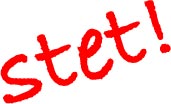
Stet!What is Copy Editing?

The purpose of copy editing should be to ensure that the original text is:

  • Free of spelling, grammar, and punctuation errors. Note the use of the word “error” here; that’ll be important later in this discussion.
  • Consistent with a publisher style guide. A style guide, in the world of publishing, is a document that sets forth usage in those gray areas. I’m talking about capitalization issues such as web vs. Web, hyphenation issues such as email vs. e-mail, and design issues such as boldfacing figure references.
  • Clear and easy to understand. This usually involves breaking up long or complex sentences or possibly rearranging sentence components.
  • Unlikely to be misinterpreted. For example, when you say the “Color in pop-up menu,” do you mean a pop-up menu named “Color in” or are you talking about color in a pop-up menu?
  • Consistent with the writing style of the established book or series. This only comes into play when you’re writing for a series that has a predefined format and style. For example, Visual QuickStart Guides (VQSes) tend to be short and to the point, so I don’t have room for personal stories, as I do in other books. VQSes also have level 2 headings that begin with the word “To” and are followed by numbered steps, each of which presents a single task. (I could list about a dozen style issues specific to a VQS, but you get the idea.)

Flowers for AlgernonOf course, what you’re writing should determine how much of the above is required. If you’re writing a novel much of this may not apply at all. Consider the book, Flowers for Algernon by Daniel Keyes. The book’s first person narrator is a retarded man. The book is in journal format and the first few chapters are so full of spelling and punctuation errors (or omissions) that the book is difficult to read. But that’s because of the author’s choices and the method he uses to communicate. Would you expect a retarded man to have perfect spelling, grammar, and punctuation? Of course not. The author is using the character’s shortcomings as a writer to make his character more real — as well a to drive home the changes in the character as the story progresses. This technique was used again more recently in The Curious Incident of the Dog in the Night-Time, which featured an autistic first-person narrator. If a copy editor had done a thorough job on the grammar or punctuation in either of these two books, he would have altered the characters. The same can be said for dialog in most novels, since few people speak using perfect grammar.

So copy editing of fiction is a different subject — one I’m not addressing here. I’m discussing copy editing of non-fiction, primarily technical or how-to books, since that’s where my experience is.

More to Come…

This is the first part of my discussion of copy editing. There are at least two more parts to go. In the next part, I’ll rant a bit about my experiences with one particular book over the ten-year course of its life (so far). You’d think that after 10 years, the process would be trouble-free…

Why not take a moment to tell us what you think copy editing should be. How do you expect it to change or improve your writing? Use the comments link or form to share your thoughts.

Copyright for Writers and Bloggers – Part II: Creative Commons

Providing a solution for protecting creative works on the Internet.

In the first article of this three-part series (Part I: Why Copyright is Important), I discussed the importance of copyrights to an author like me. But is an “all rights reserved” copyright appropriate for work published on the Web? I don’t think so.

In this article, I tell you a little about Creative Commons and how I use it to license my work.

CopyrightCreative Commons

What I write on my Web site is available here for free to anyone who wants to come read it. (Don’t get me wrong — if I can sell an article for real money, I do — and then link back to it from this site so my readers can still find it for free online.) But just because this material is available for free to read and link to doesn’t mean it’s not copyrighted. It is.

Many blogger and Web content creators use a Creative Commons licenses to set down the rules for using or reusing their work. The Creative Commons Web site makes this easy with its License page. As the page states:

With a Creative Commons license, you keep your copyright but allow people to copy and distribute your work provided they give you credit — and only on the conditions you specify here.

Creative Commons LicenseYou fill out a form like the one shown here by selecting options. You can click a link to display optional fields to provide more information for the licensee about the work you are licensing.

When you click Create License, the site generates some HTML code that you can copy and paste into your blog or site. The box to the right shows the example for my site. As you can see, the code includes a Creative Commons logo and the name of the license you chose as a link to a page with the full text of the license. (Follow the link in the box to see the license I use on my site.) If you go to the © page of this site, you’ll see the same logo and link.

What It All Means

Here’s what my Creative Commons Attribution-Noncommercial-No Derivative Works 3.0 License means.

You are free to share, copy, distribute and transmit the material on my Web site under the following conditions only:

  • Attribution. This means you must attribute the work to me. In other words, you must make it clear that I wrote or prepared the material you’re sharing. Not you. Not someone else. Not an unknown being. (So imagine my surprise recently when I found the full texts of one of my articles on someone else’s Web site under his byline!)
  • Noncommercial. This means you cannot use my work for commercial purposes. In case you’re wondering, if your Web site or blog or publication is sold, subscribed to for a fee, or even earns revenue from Google AdSense or some other advertising program, you cannot use my work. In other words, you can’t make money by sharing my content. Period. End of statement. (And people who haven’t understood this have had their Google AdSense accounts shut down when I complained about their violation of my copyright, which is also a violation of Google’s Terms of Service.)
  • No Derivative Works. This means you can’t take part of my work and use it as the basis for another work. You like my discussion of Creative Commons. Well, thank you. But don’t think of using it as Part 1 of a series of posts you want to do about copyright without firs talking to me. This license does not allow it.

The license goes on to state:

  • For any reuse or distribution, you must make clear to others the license terms of this work. The best way to do this is with a link to this web page.
  • Any of the above conditions can be waived if you get permission from the copyright holder.
  • Nothing in this license impairs or restricts the author’s moral rights.

What does this mean to you? It means that you can only reproduce or share my work if you give me credit, don’t make any money on it in any way, don’t use it as the basis of another work, and include my Creative Commons licensing terms. If you want to make other arrangements, you need to make them directly with me.

That’s My License. Yours Could Be Different.

I’m very restrictive in my license. You might not want to be.

For example, you may not mind commercial use of your work as long as you are cited as author. Or perhaps you don’t mind allowing others to build on your work — as many open source software developers allow. This can all be stated in your Creative Commons license. Just choose the options that matter to you and let the Web site generate the Creative Commons license you want to use.

Remember you can always learn more about Creative Commons licensing on their Web site. The Creative Commons Licenses page provides detailed descriptions of all licenses.

But Wait! There’s More!

While my creative commons license may seem very restrictive, there are ways you may be able to use a writer’s work — even my work — without violating any law or license. The third and last part of this series explains the basics of fair use and public domain.

Do you use a Creative Commons license on your Web site? If so, which one? And why did you make that choice? Use the Comments link or form for this post to share your thoughts.