How to Annoy Other Helicopter Pilots

When a pilot’s attitude problem leads to safety issues.

Last week, Mike and I took my brother and sister-in-law for a day trip to a popular scenic destination here in Arizona. I’m purposely being vague here to obscure the identify of the subject of this post.
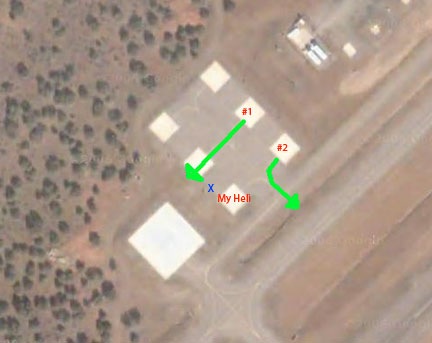
Helipad DiagramThe airport we landed at has a special helicopter area that consists of a large landing pad and six parking spaces. You can see the layout in the image here, captured from Google Maps. I’ve never seen anyone use the big pad. I parked in the spot marked “My Heli.” When I touched down, all the other pads were empty, although as we walked away, an Enstrom flew in and parked at the other end of my row of pads. He was gone before we returned a few hours later.

Some Background on the Parking “Turf War”

One of the helicopter tour operators at this destination uses the pads marked #1 and #2 in the illustration. About a year before, right after they started operating, I landed at the airport and attempted to set down in my usual parking space. A pilot was spinning on #2 and asked me to park on one of the other pads. Not knowing why — but assuming he had good reason to ask — I moved over.

I later discovered that he liked to take off through the spot where I normally parked and I was in his way. That kind of pissed me off. After all, I usually come with passengers and it’s a long enough walk to the terminal. My usual spot was the safest (pointing my tail rotor away from where people were likely to be walking) and most convenient (shorter distance to the terminal). I decided that I’d park there whenever the spot was available.

Another time when I came in for a landing, the same pilot asked me again to move over. When I said I preferred to park where I was, he said he was worried about damaging my blades as he went in and out of his spot. I didn’t say what I was thinking: how bad a pilot could he be that he couldn’t avoid another helicopter on such well-spaced pads? Instead, I told him I wasn’t worried and I used my blade tie-downs before leaving the area.

When I arrived the other day, I was glad that other pilot wasn’t around to ask me to move. Just in case he was out and about, I did tie down my blades.

An Unsafe Departure

We returned to the airport after a nice hike and walked back out to the helicopter. Now there was a tour helicopter on the pad marked #1. He’d just started up and was warming up the engine with passengers on board.

On the HelipadI wanted to get some video of my helicopter sitting on the pad with the scenery behind it as a jet took off on the runway. I asked my passengers to stand by the blue X while I did this. I assumed that the helicopter on pad #1 would depart along the markings in the helipad area. That’s what we’re trained to do. That’s why there are markings there. My passengers would be well out of the pilot’s way and safe — or as safe as possible in an active helicopter landing area.

I assumed wrong. The helicopter picked up to a 10-foot hover and hovered straight out toward the opposite pad, right next to mine. (See the straight green arrow in the illustration.) It was less than 15 feet from my waiting passengers as it paused at the back edge of the pad, over concrete and dirt. Dust, small pebbles, and grass clippings went flying all over us. Then the pilot took off, leaving us to brush debris out of our hair and clothing.

I was angry. The pilot’s departure was unsafe. Not only did his unusually high hover put his own passengers at risk in the even of an engine failure, but his proximity to us was downright dangerous. There was no reason for his departure route. He could have more safely departed across pad #2 (which was empty) or behind (above in the image) pad #2.

My husband, Mike, who is also a helicopter pilot, commented on the departure immediately, calling the pilot an asshole. I couldn’t agree more.

The other company helicopter returned from a flight and landed across from mine in pad #2. My group climbed into my helicopter and I started the engine. While warming up, the helicopter on #2 changed passengers. By this time, we had headsets on and were monitoring the radio. The pilot politely asked if I was ready to go. I told him I was still warming up and that he could depart. He picked up into a hover and hovered from the pad to the taxiway (see the bent green line in the illustration) — as I assumed the other helicopter would have done — and departed.

Teaching Me a Lesson?

I was almost ready to do my mag check when the first helicopter returned. The flight couldn’t have lasted more than 8 minutes. The pilot came in on the taxiway from the northeast and asked on the radio if the “Robbie” would hold position. (The way he said “Robbie” was definitely condescending; sit a guy in a turbine helicopter and he forgets what he learned to fly in.) I told him I would remain on the pad. As he taxied in for landing — before he even touched down– he told me that if I’d park at one of the other pads, I would be out of his way and my passengers wouldn’t get dusted.

This absolutely enraged me. This was obviously the same pilot who had told me to park elsewhere in the past. Apparently, he’d purposely hovered past my passengers — my family members putting them at risk — to teach me a lesson. Now he was making sure I understood. He also very condescendingly added that they like to see out-of-town visitors, but it’s better if they park on one of the other pads.

Until this point, the parking situation had been a turf war between the tour operator’s pilots and the other helicopters who land and park at that airport. But with this incident, it became a serious safety issue. I got extremely rude to the pilot on the radio — I admit it — and, after telling him that I didn’t like him putting my passengers at risk, I said that I’d park “Any damn place I wanted.” He told me not to “cuss over the radio” and then tried to smooth it over by saying he was trying to be courteous. I told him he should be safe first.

Why?

The question I have after all of this is, why?

Why should a pilot care where other pilots park, as long as they’re not in his assigned space?

Why would a pilot purposely put people on the ground at risk to prove a point?

Why would a tour company hire a pilot with an attitude like this?

As you might guess, I didn’t let this go. I reported it to the FAA. I did it more to get the incident on record than to initiate any kind of action. If anyone else complains, I want my complaint to provide additional evidence of an ongoing problem.

The way I see it, each pilot represents all other pilots. When one pilot does something stupid and dangerous, he’s making all of us look bad. I work too hard to keep my own operations safe and trouble-free to tolerate this kind of bull from a pilot with an attitude problem.

What do you think about this? Use the comments link or form for this post to share your thoughts.

City Slickers

We become part-time city dwellers.

The situation was absurd.

Mike was driving 70 miles each way from Wickenburg to Tempe for work every weekday. He was spending more time in the car than doing the things that make life worth living.

I was trying to operate a helicopter charter business in a town where the retiree population was far more interested in making day trips to WalMart than spending money on something new and different. All my business was in Phoenix, Scottsdale, and Glendale, making me wonder why I’d even bothered getting a Wickenburg business permit.

We were both trapped in a town with an ever-aging population, few shopping and dining opportunities, and an economy based on real estate and property taxes. There were few good-paying jobs and more than half of the new businesses failed. All of our friends in our age group had already moved out of town to places like Colorado, New Mexico, Nevada, and even Michigan. Our remaining retiree friends weren’t usually interested in activities like camping, off-roading, hiking, or weekend trips by plane or helicopter.

I was miserable, starved for input simply not available in Wickenburg. At least Mike got out of town every weekday, where he could socialize with younger, more liberally minded people and enjoy lunch out with a wide variety of ethnic options.

So when the housing crisis sent house values in Phoenix down 30% in one year, Mike acted. He bought a two bedroom, two bath condo in Phoenix.

Condo Living

We moved a bunch of stuff down to the condo on Tuesday, including a futon, Alex the Bird’s old cage, our old bedroom furniture, and a brand new leather sofa we’d bought at Macy’s. My brother and his wife were still in town and they helped out. They were also the first people to sleep on the new sofabed, since we all stayed over on Tuesday night. The new bed arrives January 14. We’ll bring the futon back home when it arrives.

I spent Wednesday shopping for the things we needed to make the condo a home — mostly kitchen and bathroom stuff. Then I came back to the apartment and began cleaning the kitchen. I soon found that the insides of the cabinets needed more than just soap and water. Soon I was giving them a fresh coat of white semi-gloss paint.

The apartment is part of a large complex of two-story buildings set around grassy, tree-shaded courtyards. It was built in 1965 and the cabinets and closets and bathtubs clearly date back to that time. The cabinets have new doors and drawer fronts and the kitchen is fully modernized with a huge refrigerator, gas stove, and dishwasher. It’s a small kitchen with limited counter space, but there’s plenty of cabinet and drawer space. I don’t expect to do much cooking here, especially with so many restaurants nearby.

Our place has two bedrooms, each with two full baths. The master bedroom has a walk-through closet big enough to satisfy any clothes horse — so big, in fact, that we put my long dresser inside the closet. There’s a big living room/dining room area with a gas fireplace and a wall big enough for the flat screen television Mike keeps talking about. There are two patios, one accessible from the living room and second bedroom and the other accessible from both bedrooms. (Yes, the second bedroom sits between two patios.) Each patio is surrounded by a 5-foot block wall with a gate to the courtyard.

The apartment complex is on Highland Avenue, between 22nd and 24th Streets. That’s part of the “Biltmore” area of Phoenix, although it might officially be just south. It doesn’t matter. We are walking distance from a Trader Joe’s, a Fry’s supermarket, the Apple Store in the Biltmore Fashion Park (which also features Macy’s and Saks), two bookstores, and dozens of restaurants. If Wickenburg is a desert island, our new part-time home in Phoenix is in the port city.

Part-Time Home

Yes, I did say “part-time.” We have no intention of living here full-time — at least not yet. Like at least two other friends of ours, we’ve decided to maintain a home for work and a home for play. We’ll still be in Wickenburg part of each week. The rest of the time, we’ll be in Phoenix.

You see, despite Wickenburg’s shortcomings and the direction that the town’s former administration pushed the town in — real estate growth above all else, including business or job growth — it still has a few things you can’t get in a big city:

Dark skies.
At night, it gets very dark around our Wickenburg home. We’re on the edge of town and few of our neighbors believe in those ridiculous accent lights on their homes and trees. We see the Milky Way every clear night — which is just about every night in Arizona. At the Phoenix condo, there are parking lot lights and pathway lights and the general glow of the city all around. You can see some stars — after all, this part of Phoenix isn’t nearly as bright at night as Los Angeles or New York — but stargazing is not an option.

Peace and quiet.
Because we live on the edge of town in Wickenburg, at the very end of a road, there’s no traffic noise. Because we have 2-1/2 acres of land, we have no neighbor noise. Sure, there’s an occasional barking dog, but we’re more likely to hear coyotes howling at night. And yes, if the wind is blowing just right, we can hear the occasional loud motorcycle or truck air brake from Wickenburg Way or Vulture Mine Road. And, during the spring and fall months, when windows are open at night, we do hear the garbage collector making her 4 AM rounds. At the Phoenix condo, however, there’s a bit more noise. Outside on the patio, you can clearly hear the sound of traffic passing by on Highland, 100 yards away. Police helicopters fly by once in a while, mostly at night. There are more neighbors with more dogs and we can occasionally hear them. Don’t get me wrong — the Phoenix condo isn’t what I’d call loud. But it’s not as quiet as the peaceful quiet in Wickenburg or the absolute dead silence at our Howard Mesa property.

Privacy.
Having 2-1/2 acres of hillside land helps keep neighbors away from your windows. Indeed, in Wickenburg we rarely bother closing blinds or curtains. We have absolute privacy, which is the primary reason we purchased a home that wasn’t in a subdivision. (Who the hell really wants neighbors that close?) At our Phoenix condo, however, privacy is simply not available. Our windows — all of which are actually full-wall sliding glass doors — look out into our patios. Beyond the 5-foot walls is the courtyard. Beyond that is another two-story building looking out our way. Ever see the movie Rear Window? That’s my nickname for this place. No, it’s not quite that bad, but that’s the idea.

Is all the shopping, dining, and convenience of a Phoenix home really worth sacrificing these things for a few days each week?

You bet they are.

A Tale of two Copyright Infringements

Together, we can stop it.

CopyrightThe other day, while trying in vain to catch up with missed tweets by the people I follow on Twitter, I noticed that two of my Twitter friends were dealing with copyright-related issues. Since then, both issues were resolved. I believe that part of the reason for the speedy resolution of these problems was involvement by the Twitter community.

Content Theft

The first case came to light when one of my Twitter friends, @anntorrence, complained that she had not gotten a response from the blogger who used one of her articles on his site. The link to the article in question told the rest of the story. Ann had written a great tips piece about preparing for a cold-weather photowalk. The article was originally published on Ann’s blog, Pixel Remix: the Ann-alog. Later, it was picked up with her permission on Photowalking Utah. The same article was picked up without her permission by a new photowalking Web site that was obviously anxious to build content and Google juice.

Ann’s article is copyrighted — as is most content on the Web. Her obvious distress over the piece being used without her permission bothered me. After all, I earn my living as a writer and have seen my own content stolen again and again. In my case, it often affects my livelihood by distributing content that I normally receive royalties for. But that doesn’t mean that content theft is any less wrong when it’s from a blog or other free source.

I went to the Web site guilty of the theft and posted a comment there. I also wrote to the owner of the site. I was horrified not only to see the theft, but because that site was one of the few that I actually paid to advertise my helicopter business on. I was not interested in supporting a site that was stealing content. If they stole from Ann, who else had they stolen from? How much of the content was original or reused with permission? (Needless to say, I pulled my ad immediately.)

The owner of the site made the fatal error of replying to me in Twitter. He defended his actions by saying that he “gives credit when due.” He was obviously clueless about copyright law — as most people incapable of creating their own content appear to be. He seemed to think that if it was on the Web, it was free for use anywhere, as long as he put a byline for the original author. He appeared to think he was being generous by including a link back to the article — not the original, but the site he stole it from.

An @reply argument ensued, with me trying to educate him and him responding arrogantly. He tried to continue the argument in e-mail. After I left my computer (and Twitterrific), he was apparently blasted by other Twitter users who got in on the discussion with their own @replies.

Ann has since gotten satisfaction for the situation — her article has been removed. Unfortunately, the owner of the site still doesn’t get it. He has written a post apologizing for not giving proper links back to original articles. He evidently does not understand that he needs permission to reuse copyrighted work.

I wonder what Scott Kelby will say when he sees his work used on the offender’s site. Personally, I hope he sues the site owner’s sorry ass.

I would urge people to boycott the site, but that might send new visitors there just to check it out. Instead, I’ll just urge people not to frequent sites that steal content. If you think a blog’s post contains content used without permission, don’t be afraid to comment about it.

Removing Copyright Notices

The second case was far more blatant. Some idiot had written a blog post about how to remove copyright notices from photos and other images found on the Web. As if that wasn’t bad enough, he used someone else’s copyrighted image for his example. That someone else was @PattyHankins, one of my Twitter friends.

Patty mentioned the problem in Twitter and I went to investigate. The post in question was a typical hacker/pirate post with instructions for removing copyright notices that were part of a photo. Patty’s photo appeared numerous times in the step-by-step instructions. After the first time, the author of the post made a comment like, “I don’t know who Patty Hankins is, but nice picture.” Extremely obnoxious.

I posted a comment to the post. I can’t remember exactly what I said, but it clearly pointed out that the author of the post and site was violating Patty’s copyright. Evidently, many other Twitter users did the same thing. So when Patty sent his ISP a DMCA notice, she got a quick response. The photo was removed within four hours.

Patty referred me to “Using the DMCA Takedown Notice to Battle Copyright Infringement” on NatureScapes.net for what she says is the most effective sample DMCA letter she’s ever used.

Again, I believe that one of the reasons Patty had a relatively easy time of getting the photo off the infringer’s Web site was the outpouring of comments by outraged Twitter users.

For More Information…

If this post interests you, you might be interested in the following links.

And please do use the Comments link or form to add your thoughts about this matter. If you are one of the offending bloggers, however, don’t waste your time. My blog is not your soapbox.

Related Links:

Silent Keynote Campaign? Get a Grip.

Some spoiled kids plot to whine in silence.

Here’s a sad example of the mentality of some Mac users. The “Silent Keynote Campaign at Macworld Expo” is one way some people think they can send a message to Apple about how “mad” they are about Apple dropping out of future Macworld Expo. In reality, all they’re doing is exposing themselves as whining fanboys (or fangirls, perhaps).

If you’re attending the Macworld Expo keynote on Tuesday, Jan. 6, you can send a message to Apple by remaining silent during the 2009 keynote. While Phil Schiller is on the stage, let there be no applause, no whistling… just utter and complete silence.

Boo hoo. Apparently, I’m not the only one who thinks this campaign is stupid and childish.

Get a grip, folks. This isn’t the end of the world.

I’m as big an Apple supporter as the next guy — probably even bigger, since I’ve been using them and writing about them since 1989. I have to admit that although the announcement saddens me because it marks the end of an era, it’s not going to have a major impact on how I buy and use computers and software.

I get better attention and support in an Apple store than I ever got in the Apple “booth” at Macworld Expo — and half the time I had a Press badge on at the show. Indeed, an Apple Store is like having a Macworld Expo Apple booth with attentive staff available almost every day of the year. And I’d rather see Apple cut back on its trade show budget than cut back on employees or development costs. Wouldn’t you?

As for the silent treatment aimed at Phil Schiller, that’s not only rude, but it’s inconsiderate and unbelievably childish. And think of the message that sends to the rest of the computing world about Apple users.

Giving My iMac a Fresh Start

Why I’m reformatting my iMac’s hard disk.

iMacAs I type this, I’ve set the wheels in motion for my iMac’s internal hard disk to be reformatted and a fresh installation to be installed on its clean surface. This is a “clean install,” in the real sense of the phrase, and I expect it to take most of the Christmas holidays to get things back up and running in a way that I can be productive again.

This may seem drastic, but drastic times call for drastic solutions. My computer has been plagued with problems for the past two months — since my return from points north after this summer’s galavanting — and I simply cannot tolerate it anymore. I not only get kernel panics several times a week, but I also get what I call “blue screen restarts” (screen turns blue and computer restarts itself for no apparent reason), frozen mouse pointers, and unresponsive applications. I’m losing unsaved work — although less than you’d think because I’ve actually come to expect problems and save often.

I’ve run every diagnostic tool I have on the hard disk, booting from the CD/DVD drive whenever possible. Disk Utility says the hard disk is fine, but it finds all kinds of problems with permissions, which it just can’t fix. Drive Genius won’t even check the permissions, but it finds an error with my preferences file and gives up scanning. Permissions are definitely screwed up because my document permissions include permissions for (unknown).

Did I mention that it’s just over a year old now?

I know the cure for the problem — reformat and reinstall. So that’s what I’m doing.

Oddly enough, I used to do this regularly back in the old days, before the operating system got so darn complex and my hard disk filled up with music and video files. Each time a new version of Mac OS came out, I’d install it by reformatting my hard disk and putting the software on a clean disk. Then I’d reinstall all my applications and copy back the documents I needed on my hard disk. It took about a half a day to get the job done and the computer worked flawlessly afterwards.

But nowadays, things aren’t that simple. Reformatting a hard disk and reinstalling everything from scratch is a real pain in the ass. Before I could even think of doing it, I started by making three backup copies of what was important on the disk: the Time Machine backup I always have, a disk image of my entire hard disk, and a copy of my home folder. All this had to wait until I got an external hard disk large and fast enough to make the extra two backups. I bought it yesterday: a 1TB Western Digital FireWire/USB drive.

Never in my wildest dreams did I think I’d own a 1 TB hard disk. The amazing thing: it only cost $200. So storage is no longer an issue here.

At least not for the next few months.

Right now, my iMac is still verifying the installation DVD. I can still change my mind. But the thought of dealing with daily blue screen is too frustrating for words. So I’ll do the drastic thing and fix my problem.

And next week, I’ll pump my iMac up to 4 GB of RAM. If that doesn’t make it happy, nothing will.

Related Articles: