Twitter is NOT a Popularity Contest

And Twitter is being destroyed by the people who think it is.

The other day, there was an update in my tweet stream from MrTweet. It said:

New Posting: Twitter & the Law of Reciprocity (Why you should be a generous Twitterer, and how to!) http://bit.ly/Ni5tb

MrTweet is the Twitter account name for an online service that supposedly helps you find Twitter users who are like you. I joined up a while back, interested in adding a few people that I might connect with to the list of people I follow. I don’t know what MrTweet’s algorithms are like, but it didn’t come up with any matches. Still, there were few incoming tweets on that account, so I kept following it. That’s how I received the above tweet.

I followed the link. The blog post that appeared, “Twitter & the Law of Reciprocity,” included the author’s opinion of Twitter: “People may not like it, but Twitter is as old-fashioned a popularity game as high school is…”

WTF?

Is that what people think? Or, more likely, is that what people have turned Twitter into?

The post went on to provide tips for increasing the number of people who follow you, prefaced with this word of warning:

This isn’t a magic “popularity” ingredient, nor can I ensure you’ll get followers by the droves if you take my advice. This IS however, a philosophical theory that can bring you benefits if you understand it and are able to take advantage of it in your self-promotional efforts.

Among the pieces of advice were to reciprocate follows. That means if someone follows you, you should automatically follow back. It doesn’t matter who the person is, where he’s from, what he tweets, what his motives are, or how well you could possibly connect with him. Just follow him blindly.

This advice made me sick. It’s this attitude that’s turning Twitter into a meaningless waste of bandwidth, full of self-promotional links and blatant advertising.

Not long afterward, I caught wind of a new site called TweepMe. This is a pure piece of automated trash with just one goal in mind for the user: increase follower count. Here’s how it works: you sign up, providing both your Twitter user ID and password. You’re automatically followed by everyone else who signed up and you automatically follow all of them. So if TweepMe has 1,000 members, you automatically have 1000 followers. Ready for the punchline? The service is free to start out. Afterwards, you pay for your membership (and new followers).

Holy f*cking cow! What moron is so desperate for followers that he’d pay to get them? Oh, yeah. These morons.

Twitter logoHas everyone forgotten the original purpose of Twitter? It’s a social networking site, a way to connect with people you know. It’s “microblogging.”

If you’re a Twitter member, log out of your account on Twitter and go to http://www.twitter.com/. Here’s what you’ll find right on the Home page, under “What is Twitter?”:

Twitter is a service for friends, family, and co-workers to communicate and stay connected through the exchange of quick, frequent answers to one simple question: What are you doing?

I don’t see anything in there about selfishly eating up bandwidth to create hundreds or thousands of meaningless connections to strangers whose only interest is to do the same.

Tell me something: are these thousands of strangers you’re collecting as followers your “friends, family, and co-workers”? Are they likely to ever fit into any of those categories? Do you even care about them?

Why the hell are you “collecting” them, like a kid collects pretty rocks at the beach?

Have you read Jennifer Leggio’s excellent post on ZDNet, “I am popular on Twitter. Here’s why this means nothing.“? She echoes my sentiments exactly.

While I’ve been watching the growth, use, and misuse of Twitter for some time now, the childishness of follower collectors has only been a source of amusement for me. Until now.

The increase in demand on Twitter’s systems and bandwidth may be causing service outages. While that was bad enough as Twitter went through its growing pains, it truly sucks if it’s caused by what one Twitter user, @pageoneresults, refers to as a “Twitter Self Replicating Human Virus.” While I don’t usually link to SEO sites (I don’t believe in messing with Google search results), Edward Lewis’s blog post, “TweepMe Twitter Application,” is more than just an angry rant. It provides a wealth of information about what TweepMe is, how it works, how it can be compared to trojans and viruses, and how the idiots who initially signed on can make a clean break with it. He also opines about TweepMe’s possible role in recent Twitter outages:

There appears to be a bit more with this TweepMe application that many have overlooked. The thing is growing exponentially. It is a Twitter Self Replicating Human Virus. If it continues at its current rate, it may even hamper the performance of the Twitter pipelines. Whale Watchers are claiming that TweepMe is behind the recent Fail Whale sightings on Twitter although none of us can be sure of that.

Personally, I’m saddened by what is happening to Twitter. Since becoming an active Twitter user two years ago, I’ve always thought of my Twitter friends as “water cooler buddies.” I work in a home-based office and spend most of my days alone. Having the 100 people I follow in the Twitterrific window on my computer’s desktop gives me the social interaction I need during the day to keep my sanity. While some of these people are friends — including folks I was very close to 20 or more years ago! — others are people I met through Twitter. I’ve made good, solid connections with quite a few of them. I’ve met several of them in person and can now consider them real friends.

To me, that’s what social networking is all about. Twitter makes it easy. It enhances my life.

So you can imagine my anger and frustration when I see blog posts and Web services created with the sole purpose of increasing follower count, wasting bandwidth, and undermining Twitter’s original purpose and goals.
The First Day of Spring at our House

The start of our annual fight against the sun.

On Twitter, lots of folks are talking about the fact that today is the first day of spring. That day has special meaning in our Arizona household. It’s the start of “blinds closed” season.

Upstairs
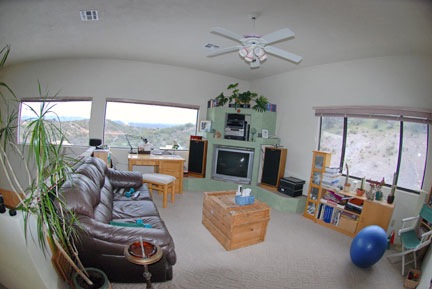
One of two upstairs rooms in our house. I took this shot with a fisheye lens, so things are a bit distorted, but it shows the three big windows.

Our house sits diagonally on its lot. The front faces northeast; the back faces southwest. The second floor has two 4 foot by 8 foot windows facing front — northeast — and one similarly sized window facing the side — southeast. In the winter, sun coming through that side window most of the day helps keep our house warm. The windows work together to keep the house bright — that second floor room is open to the downstairs.

I like living in a bright place with big windows. It makes me feel good — healthy and alive, part of nature even while indoors.

Anyway, what we’ve found is that when mid-March rolls along, the sun starts to angle into those two big, front windows for the entire morning. While that’s quite nice when daytime temperatures outside are in the 60s and 70s, it’s not very nice when those temperatures reach toward triple digits. The sun warms the upstairs when we’re trying to keep it cool. The solution: lower the blinds to shut out the sun.

Downstairs
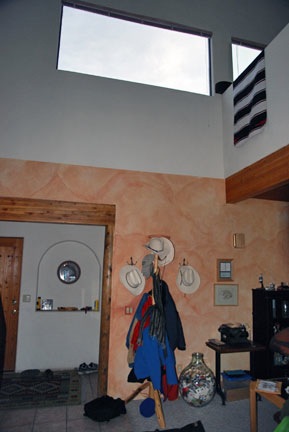
The upstairs room is open to downstairs, so the big windows let in a lot of light

Blinds and curtains in our house are an afterthought. We don’t have any neighbors close enough to look in, so there’s no real need for privacy. My office and the guest room have blinds because they both get overnight guests once in a while — I’ve found that most guests just keep the blinds closed all the time they’re with us. (I can’t figure that out. Why would someone choose to live in darkness in such a bright, sunny place?)

The two upstairs rooms have blinds or curtains strictly to block out the sun half the year. And we need them. If we didn’t have them and use them, the air conditioning simply would not be able to keep up with the power of that bright sun shining in those big windows in spring and summer. So we begin lowering the blinds in that room on the first day of spring.

At first, we lower them just in the morning and raise them after noon. But later, as the sun creeps northward and spends more time shining in, we keep them closed all day. You see, as the sun shines on the house, it also heats up the double-pane glass, which then radiates heat into the house. The blinds offer another layer of protection.

The first day of spring is a kind of sad day for me. It means the end of the bright mornings in my house and the prelude to what I’ve begun calling hell season. You might know it as summer.

Landing Zones: Howard Mesa

Not my regular landing zone, but it worked.

A while back, I started a series of posts showcasing some unusual landing zones. I knew I had a picture of this one, but couldn’t seem to find it. Today, while labeling old backup CDs, I found it.

Howard Mesa LZN630ML at Howard Mesa, November 2008

This is my helicopter at our Howard Mesa property. You can see our camping shed in the background. I normally don’t land here — instead, I have a regular landing pad that’s covered with gravel. But because we didn’t get rid of the tumbleweed on the pad during the season, it had grown to be several feet tall. Landing on it with a hot engine would probably have caused a fire. We we landed nearby where the tumbleweed was a lot shorter. When Mike got out, he cleared away any dead tumbleweed from the back of the aircraft where the engine could heat it up. Since then, we’ve manually burned a lot of it away, hoping to kill the seeds and curb future growth.

I land here several times a year. It’s a good LZ, protected by intruders — including open range cattle — by a barbed wire fence.

Lake Powell from the Air: First Trailer

Finally online.

After several false starts, I’ve finally managed to put together a short trailer for the video project I’ve been working on since October. The project is stalled right now due to circumstances beyond my control, but I hope to get it back up and running soon and have the DVD ready to ship by the end of April.

Until then, I hope you enjoy the trailer I put together today.

You can find a higher resolution version of this short video on the Flying M Productions Web site’s new Trailers page. You’ll need a fast Internet connection to smoothly access the 29 MB file. The file is in QuickTime format and if you have QuickTime Pro installed, you should be able to save it to disk. Feel free to share it with your friends.

Your comments are always appreciated. Go easy on me, though. This is my first foray into the world of Final Cut Express.

When is a Complaint Not a Complaint?

When it isn’t a complaint.

Get a grip, readers! Not every negative thing you read in a blog is a complaint. Not every negative thing you read in a blog needs defending by someone who is apparently indignant that a negative comment can appear online.

I’ve been blogging over five years now. This blog is chock full of opinions — both good and bad — about a wide range of things.

It never ceases to amaze me that some commenters find it necessary to get all defensive about any “negative” opinions I have. Sometimes, they even come to the defense of comments that weren’t really negative at all — just an observation they didn’t like.

Case in point, my “Airport Codes: SBP” post. I wrote it last summer after flying from Wickenburg to Seattle by helicopter. One of our refueling stops was San Luis Obispo Airport (SBP). I’d never landed there before and although I had both a chart and a detailed airport diagram, I was not familiar with the local landmarks and landing procedures. So I did what any pilot might do: I said I was “unfamiliar” when I made my initial radio call to the tower. This, in part, triggered a fountain of guidance from the female controller. Way more guidance than I needed or wanted. I commented, in my post, that she was “chatty” because she talked so much it was difficult for other pilots to make their radio calls. More than one commenter on this post took issue with my opinion and came to the woman’s defense.

Give it a rest, guys. It was just an observation and opinion. It wasn’t exactly negative. And did you even bother to watch the video accompanying the post so you could hear her go at it?

And so what if I said she’s chatty? I’m sure plenty of people have used harsher terms about my motormouth sometimes. Do I take offense? Not usually. Everyone is entitled to an opinion.

My point is this: blogs are full of personal opinions. Not all negative opinions are complaints — just as not all positive opinions are praise.

If I mention that the car wash guy did a good job cleaning my car, am I praising him? It’s his job to clean cars. Of course he’s going to do a good job. But if I say he did a kick-butt job cleaning my car and that it looks brand new and that he was smart enough not to put that smelly spray crap in it or leave my steering wheel greasy with Armor All — well, then I’m praising him.

(And no, I didn’t just issue a veiled complaint about Armor All. Stop reading between the f-cking lines when there’s nothing there to read!)

In any case, non-positive opinions are not always complaints. Get a grip — and stop being defensive for no reason.

Embrace the opinions of the bloggers you follow. They open your world to a different point of view.