Dan Brown Doesn’t Know Much about Helicopters

I guess a best-selling author doesn’t need to check his facts.

A few weeks ago, I forced myself to slog through Dan Brown’s The Lost Symbol. I’m trying really hard to understand why people like this guy’s work. He’s a gawdawful writer. Have we become a nation of illiterates?

As a helicopter pilot, I’m really sensitive to errors about helicopters that appear in fiction. The Lost Symbol was chock full of them. Apparently, it’s too much to ask Dan Brown to take a peek at Wikipedia or talk to a helicopter pilot when writing passages that concern helicopters. It makes me wonder what other “facts” he got wrong.

This bugged me so much at the time that I wrote a post title “Facts in Fiction,” where I discuss the failure of novelists to check the real-life components of their fictional worlds. I wanted to include a discussion of Brown’s failures in that post, but didn’t have time to complete it. Instead, I’ll cover them here.

These are the passages that bugged me most:

Without warning, Omar felt a deafening vibration all around him, as if a tractor trailer were about to collide with his cab. He looked up, but the street was deserted. The noise increased, and suddenly a sleek black helicopter dropped down out of the night and landed hard in the middle of the plaza map.

Deafening vibration? We get it: helicopters are loud. But do they deafen with their vibrations?

Black Hawk Helicopter

Public domain image of UH-60L by SSGT Suzanne M. Jenkins, USAF from Wikipedia.

The “sleek black helicopter” he’s describing is a “Modified Sikorsky UH-60,” which is basically a Black Hawk. I’m not sure what kind of modifications Brown is talking about — there are many versions of this helicopter. I’m also not sure I’d use the adjective “sleek.”

But what bothers me more is how it “dropped down out of the night and landed hard” — if it “dropped out of the night,” it would indeed “land hard.” This poor helicopter “landed hard” three times in the book. I think the CIA should consider getting a new pilot.

CIA field agent Turner Simkins was perched on the strut of the Sikorsky helicopter as it touched down on the frosty grass. He leaped off, joined by his men, and immediately waved the chopper back up into the air to keep an eye on all the exits.

“Perched on the strut,” huh? Not perched on a skid? Oh, yeah, that’s right: A Black Hawk doesn’t have skids. It has wheels. If someone can tell me where a Black Hawk’s perchable strut is, please do.

High above the National Cathedral, the CIA pilot locked the helicopter in auto-hover mode and surveyed the perimeter of the building and the grounds. No movement. His thermal imaging couldn’t penetrate the cathedral stone, and so he couldn’t tell what the team was doing inside, but if anyone tried to slip out, the thermal would pick it up.

I honestly don’t know if there’s an auto pilot in a Black Hawk or whether it has an “auto-hover mode.” I suppose I could research this and find out. But I do know that there’s no way in hell that a CIA Black Hawk pilot (if there is such a thing) would be responsible for flying a helicopter and doing overhead surveillance using thermal imaging at the same time. Pilots fly, on-board observers observe.

As they rounded the corner at the top of the stairs, Katherine stopped short and pointed into a sitting room across the hall. Through the bay window, Langdon could see a sleek black helicopter sitting silent on the lawn. A lone pilot stood beside it, facing away from them and talking on his radio. There was also a black Escalade with tinted windows parked nearby.

Hello? Mr. Brown? A Black Hawk has a crew of two pilots. The original Black Hawk had a crew of four pilots. Yet the book consistently uses the word pilot — a singular noun — when referring to the person flying the helicopter. I guess it’s easier to write one character than two.

The modified UH-60 skimmed in low over the expansive rooftops of Kalorama Heights, thundering toward the coordinates given to them by the support team. Agent Simkins was the first to spot the black Escalade parked haphazardly on a lawn in front of one of the mansions. The driveway gate was closed, and the house was dark and quiet.

Sato gave the signal to touch down.

The aircraft landed hard on the front lawn amid several other vehicles . . . one of them a security sedan with a bubble light on top.

Google Maps shows Kalorama Heights to be a densely populated area of Washington, D.C. filled primarily with embassies. This is an especially poor location for the bad guy’s lair:

Black Hawk Dimensions

Sikorsky UH-60 Black Hawk dimensions public domain line drawing from Wikipedia.

  • An area filled with embassies is likely to have very, very tight security. It’s unlikely that the events Brown reports could happen at a “mansion” there without anyone noticing and calling the police.
  • Properties are not large — not in relation to the buildings on them. The fronts of buildings are generally right up on the street. It would be a stretch to park multiple vehicles on a lawn.
  • The area is heavily vegetated with lots of tall trees. This makes me wonder how a helicopter that’s almost 65 feet long and has a rotor diameter of nearly 54 feet can land on a lawn full of parked cars in this area.

So we’ve got a big helicopter and some loud activity happening in a densely populated, heavily treed embassy area of Washington, D.C.

Sato moved the group toward the dining room. Outside, the helicopter was warming up, its blades thundering louder and louder.

Warming up is a function of the engine. The blade sound would not be different. Spinning up is a function of the blades. In either case, the sound of the blades would not get louder. If the helicopter were spinning up, the sound of the blades — the rhythm of the blades — would get faster.

Sato could hear the whine of the helicopter blades at full pitch.

Pitch is a poor choice of words here. “Helicopter blades at full pitch” literally means the collective is full up. The helicopter should be flying, not on the ground (as it is in this passage). Full speed — meaning that they’re spinning at 100% RPM — is probably what Brown meant here.

Langdon felt his stomach drop as the CIA helicopter leaped off the lawn, banked hard, and accelerated faster than he ever imagined a helicopter could move.

This is a classic ignorant writer passage. If the helicopter could leap off the lawn — which it might, depending on load — Langdon’s stomach wouldn’t drop. He might feel pushed back in his seat. The only time you’re likely to feel a helicopter motion in your stomach is if the helicopter entered autorotation, which feels — especially the first time — as if you’ve crested the top hill of a kiddie roller coaster and are suddenly zipping downward.

As for accelerating fast, I don’t know much about Robert Langdon’s imagination, but helicopters generally don’t accelerate quickly. It’s not like slamming down the gas pedal in a Ferrari in first gear. (In fact, one of the challenges I face when photographing car and boat races is catching up to a high-speed car or boat that has passed us while we’re hovering.) Can’t say I’ve flown a Black Hawk lately, though.

Langdon held his breath as the helicopter dropped from the sky toward Dupont Circle. A handful of pedestrians scattered as the aircraft descended through an opening in the trees and landed hard on the lawn just south of the famous two-tiered fountain designed by the same two men who created the Lincoln Memorial.

There’s that hard-landing helicopter again. Maybe the problem is that Brown — and most of the rest of the population — doesn’t understand that helicopters don’t just “drop out of the sky” to land. There’s a thing called “settling with power” that will basically ensure a very hard landing if you descend too quickly straight down.

And don’t even get me started on the encyclopedic fact that has nothing to do with the plot, fouling up the end of that sentence.

Once everyone had jumped out, the pilot immediately lifted off, banking to the east, where he would climb to “silent altitude” and provide invisible support from above.

Silent altitude? What’s that? About 50,000 feet? I don’t know of any altitude above a point where a helicopter would be silent — especially if it still had to provide “invisible support” — whatever that is. I look forward to the day when the words silent and helicopter can be used in the same sentence as adjective describing noun.

The UH-60 pilot threw his rotors into overdrive, trying to keep his skids from touching any part of the large glass skylight. He knew the six thousand pounds of lift force that surged downward from his rotors was already straining the glass to its breaking point. Unfortunately, the incline of the pyramid beneath the helicopter was efficiently shedding the thrust sideways, robbing him of lift.

He threw his rotors into what? What the hell is that supposed to mean? And what’s with the “six thousand pounds of lift force” surging down from this rotors? Is he trying to say that rotor wash is exerting 6,000 pounds of force?

Hello? Helicopters do not work just like big fans blowing air down to fly. They have wings, just like airplanes do. Airfoils create the lift that makes a helicopter fly. Downwash just helps a bit when the helicopter is near the ground. That’s called ground effect.

And let’s look at this in real life — the helicopter had only 2 or 3 people on board. It had already discharged its passengers. Is Brown trying to say that the pilot was depending on ground effect to fly? On a winter night (cold; it landed on “frosty grass” once) in Washington DC (sea level)? How did it get off the ground with passengers on board — let alone leap into the sky — if it couldn’t even hover out of ground effect when it was nearly empty?

And what’s all this about skids? Didn’t we already establish that the Black Hawk has wheels? If you can’t read the words, Mr. Brown, at least look at the pictures.

Errors like this just prove that the writer has no understanding of how helicopters fly. Yet this and many of the other helicopter-related errors in this book could have been prevented if the passages were handed off to an experienced helicopter pilot as part of the editing process.

But I guess a bestselling author is beyond all that.

Two Kinds of Road Trips

Reflections on traveling long distance by car.

The TruckThis past week, I traveled with my sister as part of a convoy of vehicles moving her from New Jersey to Florida. The other vehicles included my dad in a Budget rental truck (see photo) containing the contents of my sister’s recently sold condo and my dad’s wife in an SUV. We buzzed down I-95 at highway speed, stopping only for food, fuel, and bladder demands.
If you’ve ever driven I-95 — or most freeways, for that matter — you know how mind-numbingly boring the trip can be. You’re moving at 55 to 75 miles per hour down a corridor that’s often straighter than an arrow shaft. Although there are occasional scenic vistas, they’re usually ruined by the tractor-trailer trucks you’re passing (or passing you). The main points of interest are the billboards and the variety of fast food joints and hotel chains at exits. The only excitement comes when some jackass cuts you off or something falls off the trailer in front of you.

The benefit of the interstate highway system is speed, of course. If there’s no construction or accidents or rush-hour traffic in a major metropolitan area, you can zip right along to your destination. We travelled almost exactly 1,000 miles over a day and a half. My dad routinely makes this drive to/from farther south without an overnight stop. It’s a lot of driving, though. And it just isn’t fun.

Each year, I drive from the Phoenix area to Central Washington State and back towing a travel trailer. It’s about 1,200 miles each way. Although Google Maps tries to put me on freeways for the entire trip, I don’t go that way. Instead, I take the back roads that criss-cross the western states. Last year, I was mainly on Route 93. This year, I was mainly on Route 95. These are long two-lane, so-called “blue highways” that pass through small western towns and cities. Along the way, you can get a feel for the landscape and the way folks live. There’s seldom any traffic and the speed limit is often as high as 65 mph so you can move from place to place at a reasonable pace. You can stop just about anywhere along the way and although your choices for meals and fuel and hotels might be limited, they’re not just the same chain establishments you’ll see along the freeway. It’s a whole different way to travel, a whole different experience.

What I like about the blue highways is the opportunities to stop at interesting spots along the way. Instead of pulling into a McDonald’s for lunch, I might stop in a parking area with a scenic view and have a picnic lunch there. Instead of staying overnight at a Super 8 motel adjacent to a truck stop or parking my camper in a Walmart parking lot, I might roll into a state park and camp alongside a creek. If there’s a historic site or roadside attraction, I can easily pull over to take some time there and enjoy it. I can change my route at any intersection. Best of all, I set the pace.

Back in 2005, I conducted what I like to call my “midlife crisis road trip.” I hopped into my little red Honda S2000 with some luggage and credit cards and hit the road for 16 days. I traveled almost every day, getting as far away from Arizona as Mt. St. Helens in Washington, western Montana, and Yellowstone National Park. I had a general idea of where I wanted to go, but no reservations and no need to be anywhere on any day. I slept in motels, hotels, rustic cabins, and even a yurt. I ate all kinds of meals, from crappy fast food and terrible coffee at drive-thru joints to fine dining at the foot of Mt. Shasta. I made side trips daily, visited parks, and talked to lots of strangers. I put more than 5,000 miles on my car, got two oil changes on the road, and even replaced the rear tires after wearing them out. (Z-rated tires just don’t last very long.) I had a great time — better than most vacations — and I’d do it again in a heartbeat.

While I realize that this week’s trip wasn’t for pleasure — the goal was to get my sister, her car, and her belongings from New Jersey to Florida in the minimum amount of time — it certainly did highlight the differences between my usual kind of road trip and motoring down the interstate between points A and B.

And it reminded me why I prefer the blue highways when enjoying the trip is more important than getting to the destination.

Reuse, Recycle

And I’m not talking trash.

In this day of Internet publishing, quality content is in very high demand. Freelance writers and bloggers who can create good content can often sell it to new markets. But what’s better than writing for hire is republishing the work you have all rights to on sites looking for inexpensive content.

Recently, I was approached by a publisher who was interested in having me write for their online magazine. While many publishers these days try to get something for nothing from writers, this publisher was willing to pay. And when I offered them a choice of existing content refreshed for publication and new content at twice the price, they went for the existing content.

This is great for me. I’ve been blogging for more than six years and have over 1,900 posts on a variety of topics. One topic — “adventure flying” — has interested the publisher quite a bit. They’re paying me a reasonable amount of money for each post I brush the dust off and send to them for republication. I keep copyright; they get one-time publication rights.

So I’ve gone back to the beginning of this blog and have been pulling out old posts to polish up and send out. I call this recycling and I don’t see anything wrong with it at all. After all, I’m not trying to pass it off as new material. And I can even leave it on my blog.

Today, I spent about 45 minutes on a lounge chair with my laptop next to my mom’s pool and earned an easy $300.

I guess the point I’m trying to get across here is that if you’re a writer with some existing content that you own all rights to, you may be able to find a paying market for that material. The Internet is a big place and publishing on it is cheap. With publishers looking for quality content, why not reuse and recycle some of that old material — and make a few bucks in the process?

Two Ways NOT to Ask for a [Pilot] Job

More real stories from my e-mail in box and blog.

I was away for four days, completely off the grid. Even my cell phone didn’t work where I was. I had a lot of catching up to do when I got home Sunday night. This included my e-mail in box and comments on my blog. Both yielded fodder for this blog post.

The post is really about job hunting and two things you shouldn’t do when trying to find a job as a pilot. In this case, it’s a helicopter pilot job, but it could be any kind of pilot job. In fact, it could be just about any kind of job at all.

Fishing with Comments

The first was a comment on one of my blog posts. The post in question was from June, 2008. That’s over a year ago. I’d written about my upcoming work drying cherries in Washington State. The post had gotten a few comments — over a year ago. But this weekend’s comment came out of the blue and had very little to do with the post content:

Do you hire any pilots of have any pilots that help you out with flying?

Knowing the number of out-of-work helicopter pilots are out there, I automatically jumped to the conclusion that this person was fishing around for job openings. I wasn’t kind to him. (I really can be a bitch sometimes.) My response was:

If this is the extent of your job-hunting capabilities — posting comments on old blog posts — you may as well give up on finding any job. Sorry to be so blunt, but you asked for it.

After posting this snippy response, I considered that maybe he wasn’t looking for a job. Maybe he was just curious to know whether I hired other pilots to help me — but didn’t necessarily want to be one of those pilots.

But my first instinct was probably right.

The One-Paragraph Resume by E-Mail

The second poor job hunting attempt arrived in my Flying M Air e-mail in box. Keep in mind that unless you have my Flying M Air e-mail address, which I no longer publish anywhere, you can only e-mail me by filling in a form on Flying M Air’s Web site. The same page that includes the form also includes my phone number. Yet this person chose to use e-mail to inquire about job openings. Here’s what he wrote; I XXXed out the identifying info to protect this guy from personal ridicule:

Maria Langer/Chief Pilot:

My name is XXX and I am a commercial helicopter pilot. I am inquiring about whether there is an available pilot position within Flying M Air. I have a little over 200 hours total time, which consist of 120 hours in the R-22, R-44 pilot in command endorsement, 70(+)hours in the Hughes 300, and the Robinson safety course in 2008. In addition, I will be receiving my Associates in Applied Science degree-Flight Technology in December 2009. If you have any questions or would like to schedule an interview I can be reached at XXX-XXX-XXXX or emailed at XXX@XXX.com.

This is wrong on so many levels:

  • This guy has only 200 hours. What helicopter charter company would even consider hiring a pilot with barely enough flight time to qualify for a commercial certificate?
  • This guy has only 10 hours of time in the aircraft my company owns and operates: an R44. (Do the math.)
  • How much of this guy’s flight time is solo or other PIC? (Remember, he said total time.) I’m guessing less than 25 hours solo and only 100-125 PIC.
  • Does this guy really think that an AS degree is worth anything to an employer looking for a pilot? (Or, with apologies to those of you who place significant value on a 2-year degree, any employer?)
  • Is this the extent of this guy’s resume?
  • Does this guy really think that an employer would call him for an interview after receiving a paragraph about him via e-mail?

Although I wanted to reply with any combinations of these thoughts that ran through my mind, I didn’t. Instead, I wrote:

Sorry, we don’t have any jobs available at this time.

Good luck.

And that brings up the real problem with this lame attempt at job-hunting: my reply e-mail bounced back. He’d entered the wrong e-mail address in the form.

FAIL.

Think of What You’re Asking For

When you ask for job, you’re asking for a responsibility.

For a pilot job, you’re responsible for your employer’s paying passengers or cargo. That means other lives or possibly valuable merchandise. Do you honestly think someone would consider hiring you when the best you can do is fish for a job online via blog comments or e-mail? When the ink is barely dry on your commercial pilot certificate? When you can’t even type in the correct e-mail address to get a response from the person you’re querying?

The helicopter job market is tight — especially for low-time pilots. The economy has tourism down — and tourism jobs are the entry level jobs most pilots wind up with. The other jobs are being filled by the out-of-work tour pilots who have just enough turbine time to give them added value to an employer. Silver State and the copycat flight schools that still exist are pumping out helicopter pilots after feeding them healthy doses of optimism and lies about the job market and taking their money — much of it acquired through loans.

The truth is, I don’t know of any employer who will hire a pilot with fewer than 500 hours of flight time. If they say they will, read the fine print. Are they really hiring and paying as a pilot? Or is it just a scam for them to get free pilots while suckers build flight time?

I get at least one contact per week from a helicopter pilot looking for a job. I’m not hiring. But I know that I wouldn’t hire the vast majority of the folks who contact me. They just don’t understand what it is that employers want and what they’re asking us to give them.

Video Flight with a Tyler Mini Gyro

New client, new equipment.

September 2010 Update:
Flying M Air is now the proud owner of a gyro-stabilized Moitek video camera mount, which is available to aerial photography clients. Learn more about this mount here.

I got the initial call about a month ago. A videographer from the east coast had to shoot aerial video footage of two properties in the Mesa/Chandler area of Arizona. Was I available?

There was more to it. The videographer was looking for someone who could fly 20 to 40 knots sideways so he could get point of view (POV) footage out one of the rear doors (which would be off, of course). He planned to use a Tyler Mini Gyro and would likely be dangling his legs out the helicopter door while shooting. He had his own harness and had worked with R44s before. This, however, was his first experience with the Tyler mount.

I met him at Falcon Field in Mesa, AZ last Tuesday. We met at the Heliponents ramp. I knew Barry from Heliponents from a shoot he’d done at Monument Valley about two years before. He’d been flying either a JetRanger or a LongRanger helicopter and they’d put a full-blown Wescam ball with counterweight on his ship. I’d been based at Monument Valley, at the Goulding’s airstrip to provide helicopter flight services for aerial photographers at the valley for a few days. We chatted briefly. I remembered him; he remembered me.

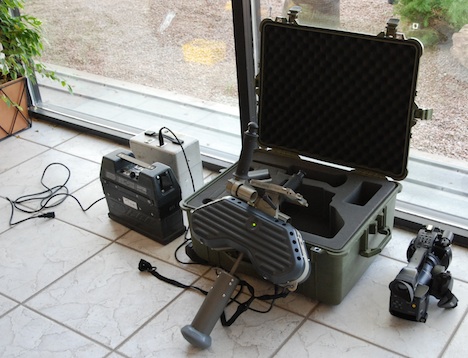
Tyler Mini Gyro

The Tyler Mini Gyro and its packing case, along with its run-up battery and the camera used with it. The mount can support much larger cameras.

Heliponents has a Tyler Mini Gyro that it leases out by the day. This $30K+ device is kind of like a monopod with a heavy duty, gyro-stabilized mount on top. There are springs in the monopod base, which is short and designed to sit on the user’s lap or between his legs in use. A large battery box provides 28 volt power. There are two adjustable handles to hold the entire thing. The camera goes on top. The two main parts — base and tripod leg– get tied off to the photographer or aircraft so it can’t fall out during flight.

I should mention here that I’ve done some work with video and gyros and wrote a lot about it here. We’d used a much smaller mount from Blue Sky Aerials called a Micro Gyro Mount. Our conclusion was that the best solution would have three gyros. This Tyler mount, although much more difficult to work with in a tight space, had three gyros. I was very interested in seeing the results.

My Client, in the helicopter

Here’s my client, posing for a photo before we started up and took off.

Barry and my client got the system set up. Barry ran up the gyros using one battery pack but planned to send us on our way with another, fully charged pack. I pulled both back doors off the helicopter. My client climbed into his harness. We brought the equipment out to the helicopter and wedged my client into the seat behind mine with it. We secured the big battery on the floor, then tied off my client and his equipment to the helicopter. He put his seatbelt on, too. I shot this photo before climbing in to start up. A while later, we were headed southeast, toward the first of two targets. I’d prepped in advance by converting the addresses to GPS coordinates using GoogleMaps, so we didn’t waste any time looking for the spot. We were on point within minutes of taking off.

The first site was difficult, with lots of high tension power lines. We needed to get footage of a golf course and two different clubhouses. My client likes sweeping, point-of-view shots, which meant I needed to do a lot of sideways flying while he shot straight out. The area was too confined to do any fast flying, but we did the best we could. One of the better series, which we repeated several times, had me flying sideways from north to south with the late afternoon sun at our tail. I’d start relatively high, off property, and come down lower as I flew in, breaking off near the clubhouse. The whole time, I was monitoring Falcon Field’s frequency, since we were right on the edge of its airspace.

We made quite a show for the folks on the ground, which is unfortunate. The video is supposed to just show the place from the air — but not with people gawking or waving (or perhaps shaking their fists?) at the camera.

For me, it was great, challenging flying. Sure, there are challenges in the other kinds of work I do, but aerial photo flying with a professional photographer who isn’t afraid to tell me exactly what he needs me to do is the most challenging of all. It forces me to really work for my money and it gets me in “the zone” — that place where I become one with the helicopter. And there’s nothing more rewarding than doing precision flying to complete a pass and having my client complement me when I’m done.

Of course, I have to admit that it was also easy. There was very little wind — less than 5 mph — and my single passenger weighed roughly what I do. The temperature was in the 80s, so density altitude was not an issue. I had no trouble flying sideways or even maintaining a lengthy, completely motionless, out-of-ground-effect hover. I couldn’t have asked for better precision flying conditions.

After spending at least 30 minutes over that property, we broke off to do the second property, which was farther south, in Phoenix Mesa Gateway (formerly Williams Gateway) airspace. As I was making contact with the controller, my client realized that the power cord had pulled out of the camera and the gyros had spun down. We flew lazy circles around the property for a good 10 minutes, giving the gyros a chance to spin up again. Then it was back to work shooting a clubhouse and some sports facilities. I think a shuffleboard competition was going on because the courts were full. The shiny court surfaces reflected the colors of the flags that flew on poles above them. And we realized that the folks waving to us from the pool might just be good footage to meet the marketing requirements of the videos.

We left Gateway’s space, then returned to our first property to redo a bunch of footage. We weren’t quite sure when the gyros got disconnected, so we redid most of it. Then we headed back to the airport. We’d flown over an hour on the mission; I’d also be billing for about a half hour or ferry time from my base in Deer Valley. (I’d like to note here that if I were still based in Wickenburg, I probably wouldn’t have gotten the job at all; no one wants to pay more for ferry time than mission flight time.)

Back at Heliponents, my client didn’t waste any time reviewing the shots he’d taken on a small video monitor he’d brought along. Most of them were great. He was very pleased. And I felt the kind of pride I usually feel when I realize that my helicopter and I form an important part of a photography client’s equipment.

As for the Tyler Mini Gyro, it costs roughly the same as the Blue Sky Aerials Micro Gyro Mount to rent (when you factor in shipping) and has the additional benefit of being available locally. I’m not sure, but it might be easier to use, too. While I think it’s overkill for my own little HD video camera, it’s a good match for the camera this client used or even larger models. I’m hoping I have an opportunity to recommend it to clients in the future.