Buying My R44

Looking back 5 years.

January 7 marked the 5 year anniversary of the day I brought my new Robinson R44 Raven II helicopter home from the Torrance, CA factory. I blogged extensively about the experience and the days leading up to it. I put this post together to help me remember it all. It’s full of links that you can follow to read the details behind the summary.

The Backstory

On June 30, 2004, I was working as a pilot for a Grand Canyon helicopter tour operator. I’d aspired to the job since I realized four years earlier that I wanted to fly helicopters commercially. When I was hired in March of 2004, I was thrilled.
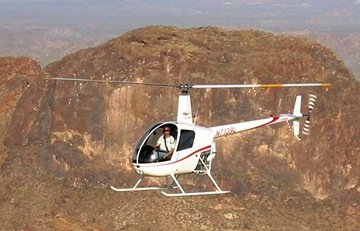
Three-Niner-Lima
An air-to-air shot of me at the controls of my R22 back in 2002.

I was not a typical tour pilot for the company. Besides being a woman — which has its own issues in a male-dominated field like aviation — I was about 20 years older than most of the “kids” they’d hired. It was an entry level job, after all. Most of my coworkers had built their time the usual way: as helicopter flight instructors. I, on the other hand, owned my own helicopter, a 1999 Robinson R22 Beta II, and was trying to run my own helicopter tour business with it. I’d built my 1,000 hours of PIC time flying passengers for hire, tooling around the desert, and taking very long cross-country flights by myself. To this day, I believe I have more solo flight time than 90% of the commercial helicopter pilots out there.

While I enjoyed flying at the Canyon and all the challenges that went with it, it soon became clear that flying there could not be a permanent position for me. My writing career was doing extraordinarily well and I was earning far more writing on my days off than I could ever learn sitting in the pilot’s seat for 8 or more hours a day.

I realized that June that I was at a crossroads of my life and careers. I knew I couldn’t maintain my standard of living if I got a full-time job as a pilot for someone else; without time to write, my income simply wouldn’t be sufficient to cover my living expenses. I knew I couldn’t build a real business with an R22 — especially without a CFI rating. I began thinking about taking the next step and buying a larger, better equipped helicopter. One that could take more passengers. One that made sense to build a business with, likely with a single-pilot Part 135 certificate to give me additional flexibility.

So, on June 30, I ordered a Robinson R44 Raven II.

The Wait Begins

In those days, Robinson had a 6-month backlog for new helicopter orders. You’d work with a dealer to choose options like instruments and colors and other features. The dealer would come up with a price. I’d already done all that in February of the same year, at HeliExpo. When it came time to order, all I had to do was make a phone call, sign a bunch of papers, and send in a check for $25K. That got me on the waiting list.

At the end of September, I left my job at the Grand Canyon. It would probably be the last time I flew there and I was more than a little sad.

In late October, I sold my R22. I’d need the money for part of the R44’s down payment. I was planning to put enough money down to keep my monthly loan payments the same as the R22’s were. I also started work with the local FSDO to get my single pilot Part 135 certificate.

By November month-end, I was going stir-crazy. It was the first time in years that I didn’t have access to an aircraft for flying. I flew as a passenger with friends who had helicopters. I buried myself in my writing work. I tried not to think about flying.
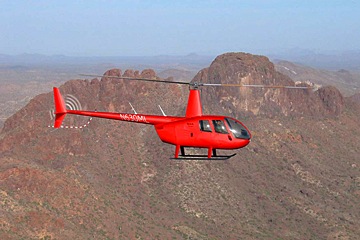
Zero-Mike-Lima NOT
Photoshop guru Bert Monroy gave my friend Tristan’s helicopter a paint job to illustrate what mine would look like in flight.

A friend of mine used Photoshop to doctor up a photo of another friend’s R44 flying near my home, applying my aircraft’s color scheme. It was an air-to-air photo of a helicopter that didn’t exist yet. But it existed to me. I’d already begun referring to it by its last three call sign digits: Zero-Mike-Lima.
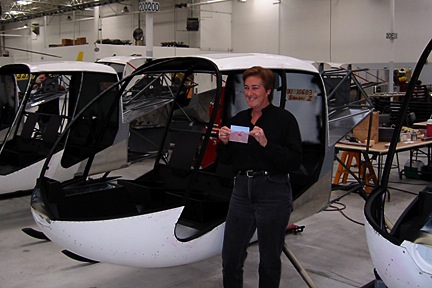
A Giddy Kid
They put SN 10603 on the line the day I visited the factory.

When my family flew in from the east coast for Thanksgiving, some of us took a road trip out to California. We got a tour of the Robinson factory. By some incredible coincidence, it was the day they put my helicopter’s frame on the assembly line. My sister snapped a photo of me standing next to the frame, holding up the fake photo I’d brought along to show the folks at the factory.

(Yes, I realize that I sound like a giddy kid.)

By late December, the six month wait was almost over. I started booking rides gigs. I was anxious to get the helicopter by year-end, but that wasn’t going to happen. December ended and January 2005 started. By now, I was very anxious. I’d already cancelled one gig for December month end. I had another lined up for January 8.

Then, on Wednesday, January 6, the wait was suddenly over. You can pick up the details of the rest of the story here.

Real Life Flying: Researching Client Requests

Doing your homework is part of flying safely — and legally.

This afternoon, I got a call from a potential client. He’s the manager of a country club that does catering for weddings and other big events. He wanted to know if it were possible for me to land my helicopter on the country club property after dark, pick up a couple — say a new bride and groom — and fly them around Phoenix for about 45 minutes before dropping them off at a hotel with a helipad or an airport where a limousine would be waiting. He also wanted to know whether it was okay for them to have some wine while aboard the aircraft.

Off the top of my head, I said, yes, we should be able to do that. But then I listed the things I’d have to check out before giving a definitive answer.

I thought this might make a good topic for a blog post for commercial helicopter pilots interested in real life helicopter missions. You see, commercial helicopter flying is not always as easy as picking up two passengers at an airport, flying them around for a while, and returning them to the starting point. So, as an example, I’ll discuss the things that come into play for this particular kind flight.

Landing Zone

Mansion LZ

Off-airport landings are something I’m accustomed to. Photo by Jon Davison.

First and foremost is the safety of the landing zone. How big is it? Is it level? Are there obstacles such as trees, buildings, or wires? What are my approach and departure paths like? Can it be controlled to prevent onlookers from coming too close or walking behind the aircraft? How about neighbors? Are there homes in the area? Is it close to another airport where air traffic control might be an issue? Since landing and departing will be at night, can the landing zone be properly lit so I can find it and land safely on it?

I made an appointment to meet with the client to see the landing zones he had in mind. Hopefully, one will work. I also checked the location of the country club using the satellite view of Google Maps. Although its golf course is indeed surrounded by homes, there’s also a nearby freeway and shopping center that’s likely to be empty at night. I could see some possible approach and departure paths, but could not judge obstacles, such as light posts or wires.

As for a destination hotel — if one is found, I’ll have to go through the entire process there, too. It’s more likely, however, that I’ll just land them at Deer Valley Airport, which is my home base.

Local Ordinances

Of course, no off-airport landing would be possible without a lot of hoop-jumping if there were a local ordinance that prohibited off-airport landings. Scottsdale has such an ordinance, enacted, primarily, to prevent local helicopter pilots from doing asinine things like landing in residential subdivisions. (I guess it was done one too many times.) Wickenburg’s ordinance isn’t quite as restrictive; it states that landing is possible with the permission of the Police Chief. When I asked the Police Chief about this some years ago, he had no idea what I was talking about.

The client said that the mayor the country club’s city is a member, so if there was an issue, he might be able to get permission on an as-needed basis. But when I hung up the phone with him, I started making other calls. First, the local police, to see if they knew of any ordinance. They directed me to the city’s compliance office. They told me they had no ordinances, but that I should check with the FAA. I already know that the FAA is fine with landing a helicopter on private property, as long as it is done safely and in accordance with any related FARs.

So this would not be an issue for this particular location. No hoop-jumping necessary.

Passenger Loading

Night Flight Over Phoenix

The lights of Phoenix are beautiful at night. Photo by Jon Davison.

The client wants to use the helicopter as part of the event’s entertainment. At the predetermined time, the guests would be guided to “the patio” (wherever that is) where they could watch the helicopter come in for a landing. The bride and groom would climb aboard and the helicopter would take off, perhaps doing a quick circle of the area before departing.

This sounds great and its sure to make a memorable wedding party. But passenger loading could be an issue here.

Is the client willing to wait for the helicopter to cool down and shut down before the passengers are loaded? And then wait again while the helicopter starts up, warms up, and spins up before departure? If the wait is okay, the pilot (me) can do the passenger briefing and loading. While this might not make for good entertainment, it is the safest option.

The other option is “hot loading,” where the passengers board the helicopter while the engine is running and blades are spinning. Many people will simply not do hot loading, but I will — provided there’s a qualified ground crew to escort all passengers to their seats and ensure they’re buckled in. That means operating with someone on the ground — likely my husband — who would arrive before me and handle briefing and loading duties.

While you might think I prefer the first option, I actually prefer the second. It minimizes the amount of time I’m on the ground and ensures a qualified person is there to handle my next concern: crowd control.

Crowd Control

I firmly believe that a spinning helicopter is more dangerous on the ground than in the air. My tail rotor is literally invisible when it’s spinning — even at idle speed — and if someone walked into it, they’d be dead. That’s why I always set down in a landing zone with my tail pointed away from where people are most likely to be. Any helicopter pilot who doesn’t do this is looking for trouble.

Unfortunately, when landing in an uncontrolled area, there’s nothing to stop people from running up behind the helicopter. There’s a restaurant in Peoria, AZ that I used to land at for lunch quite often. It’s in a relatively remote area with lots of open desert around it. I always landed just outside the parking area with my tail rotor facing away from the building. The last time I landed there, however, a bunch of kids on off-road motorcycles saw me come in and began swarming around the helicopter as I was shutting down. Good thing my husband was with me to keep them clear. I haven’t gone back since.

When I inspect the landing zone, I’ll try to determine how well it can be controlled. And then I’ll put a plan in place to control it for my arrival. Having a reliable and experienced ground crew person will certainly help when the time comes for me to operate there.

Alcoholic Beverages

The final request that requires research is the glass of wine during the tour. FAR 135.121(a) states:

No person may drink any alcoholic beverage aboard an aircraft unless the certificate holder operating the aircraft has served that beverage.

This means they can’t bring their own alcohol aboard — it’s also why you can’t legally bring your own alcohol aboard an airliner!

If you’re wondering who the “certificate holder” is, well, so am I. It’s either me personally — since I have a single pilot Part 135 certificate and I’m the pilot — or it’s my company, Flying M Air. If it’s me, serving wine while I’m at the controls of a helicopter will be nearly impossible. If it’s my company, I can theoretically have an employee or agent of my company serve the alcohol for me, preferably right before we take off.

If there are any pilots out there who have real knowledge about this, please do use the Comments link or form to share what you know with me. Otherwise, I’ll just ask my FAA Primary Operations Inspector (POI). He’ll either tell me or help me figure it out for myself based on what I know.

One thing I do know: if I can’t legally serve alcohol on the flight, I won’t. No client request is more important than my certificate.

FAR 135.121(b) and (c) offer two other rules regarding alcohol:

(b) No certificate holder may serve any alcoholic beverage to any person aboard its aircraft if that person appears to be intoxicated.
(c) No certificate holder may allow any person to bard any of its aircraft if that person appears to be intoxicated.

That means I can’t serve them if they’re drunk and I can’t even allow them to board the aircraft if they’re drunk. This is something I need to make sure the client knows. It would be a shame if I brought my shiny red helicopter in for a landing at the big party and the bride or groom was too shitfaced from champagne to fly. (It would be a bigger shame if one of them puked on my leather seats.)

The Other Usual Stuff

Every flight has the usual collection of pilot tasks before it can be completed. I’m talking about things like calculating weight and balance, getting weather and NOTAM information, creating a flight plan, preflighting the aircraft. I might want to do a daytime landing at the landing zone in advance, just to make sure I was familiar with it. There’s lots of the usual responsibilities, none of which can be taken lightly for any flight.

This Is What It’s All About

This should give most folks an idea of what goes into planning what seems like a simple mission. Any pilot faced with a client request like this who doesn’t look into these things — at a minimum — is simply not doing his job.

I’ll know by Saturday, when I review the landing zone, whether we’ll be able to work for this client. I hope so. It would be great to have some regular gigs like this throughout the year.

Office Cleaning Time-Lapse

It had to be done. Again.

Yesterday, I spent the entire day cleaning my office. It was a disaster.

This is a time-lapse of the process. I used a 10.5mm fisheye lens to get my whole office in the picture. I shot one frame every 30 seconds, then compiled them at 15 frames per second in QuickTime. The result compresses about 8 hours of time into 1 minute.

NOW I can get back to work!

Why I Canceled My Nook Order

And why I might buy one anyway.

As an avid reader, I’ve been attracted to the idea of an ebook reader for years. But until this past autumn, I haven’t really found one I thought I’d actively use.

Before that were offerings from Sony, which seemed to fall far short of what I thought was a good design. The blinking page turns would drive me batty, since I knew I could go through an average page in 10-20 seconds. (Have I mentioned that I read very fast?)

Kindle came out and lots of people loved it, but I was turned off by Amazon.com’s aggressive marketing, limited format support, and high book prices. (Like many other book buyers, I don’t feel that an ebook’s cost should be anywhere near the cost of its printed version.) And when Amazon snatched purchased books off of Kindles without warning, I started wondering what other kind of access Amazon had and whether it would use it.

Enter, the Nook

NookThen Barnes and Noble introduced its Nook. Or at least it announced it. It seemed more in line with what I was looking for in size, cost (for the unit and books), features, and flexibility. I visited B&N stores regularly to get my hands on one and give it a try. No joy there. Even after November 30, when the units were supposed to be available for purchase, I could not seem to find one. And I certainly wasn’t going to buy one until I either read a lot of reviews about it or had some quality time with a demo unit. I did see a few reviews and they were, for the most part, positive. But I still wasn’t prepared to buy one until I could walk away from the store with it.

Christmas came. My husband decided to buy one for me. Of course, he couldn’t get his hands on one, either. But he ordered one online. They said it would ship in January. He asked for some kind of card he could give me on Christmas Day, in its place. They charged him $4 for a card that looked like a nook. And that’s what I opened on Christmas Day.

A few days later, he checked with B&N again to see when the Nook would arrive. They projected the end of January.

FAIL

An Apple Tablet?

This week, the Apple Tablet rumors have been in full swing. I’ve been wanting an Apple Tablet — or at least thinking I wanted an Apple Tablet; more on that in a moment — since last spring. I actually put off the purchase of a 13-inch MacBook Pro, hoping a Mac netbook would become available before then. Apple kept insisting they weren’t going to develop a netbook. I caved and bought the 13-inch MacBook Pro to replace a 15-inch MacBook Pro and the 12-inch PowerBook before it. (I still have both of those; anyone want to buy one?)

So here I sit, on January 6, expecting a Nook right around the same time that Apple might announce something infinitely better.

Or not.

The way I see it, Apple could do one of two things:

  • It could announce an Apple Tablet that basically reinvents ebook readers and tablet computers at the same time. Kind of like what the iPod did for MP3 players years ago. Something that would blow all the existing options out of the water. Something not only I’d want, but everyone with a need (or desire) for mobile computing or an ebook reader would want.
  • It could announce an Apple Tablet that, although attractive in its design and interface, falls short of what I need or want as an ebook reader or tablet computer. Or marry the device to a partner that I can’t do business with. This is what I thought about the iPhone and AT&T. I might have gone with the iPhone if I could choose my own carrier — without jailbreaking — but the AT&T partnership was a deal breaker for me.

An iPhone-like Situation

Indeed, my situation today has a lot in common with the iPhone announcement and release. Back then, I was in the market for my first smartphone. My Motorola flip phone was four years old (at least) and I wanted to tap into the basic computing power of a smart phone to store contact information, calendar events, and simple applications that would help me as a pilot (weather, flight planning, etc.). It was vital that the phone be able to communicate with my Macs to exchange information. When the iPhone came out, it looked like a dream come true.

Yet just days before people started lining up to buy iPhones, I bought my Palm Treo 700p. At the time, it was a better decision for me. Two years later, I updated to a Blackberry Storm. Again, it was better for me.

You see, unlike so many other people, I don’t buy the hot new gadget just because it’s a hot new gadget. I buy it because it meets my needs. The iPhone doesn’t meet my needs. I need a carrier with coverage in remote places. Verizon is that carrier. (Hell, AT&T can’t even get a good signal at my house.) I’m not interested in dropping $1.99 every few days or weeks on cool apps I don’t need or playing games on my phone. I’m not interested in being able to join wi-fi networks — in the very remote places I go, I consider myself lucky to have a cell signal at all. I need “tethering” to get my computer on the Internet via my cell phone’s Internet connection. The Treo and the Storm both support that through Verizon; I just learned that the iPhone still does not via AT&T. I’m not interested in jailbreaking a phone to add features that the maker and carrier don’t want me to have. I want a fully functioning, fully supported smartphone that does exactly what I need it to do, right out of the box. That’s why I don’t have an iPhone.

Now before you iPhone lovers get your panties in a bunch, just remember that I’m talking about my needs and wants. Not yours. Yes, your iPhone is very cool. Yes, I wish it met my needs. But although it might be perfect for you, it simply doesn’t meet my needs. I made my decision. Don’t waste your time and mine blasting me in Comments because I haven’t drunk the iPhone Kool-Aid and sacrificed my needs so I can be cool, too.

My Point

And that brings up one of two points in this post:

  • Barnes & Noble failed when it introduced its Nook right before Christmas and didn’t have enough units on hand to sell to customers who wanted them. That failure was only made worse when the Apple Tablet rumors starting churning up again. Why would anyone buy now and wait until January month-end for a device when Apple, which is known for innovative, game-changing designs, could announce a competing product around the same time? Hell, if the Apple Tablet is the product I hope it is, I’d buy one even if I already had a Nook. But the Nook hasn’t arrived and B&N has just lost a sale.
  • Although I’m huge Apple fan who has been using Macs since 1989, writing about them since 1990, and, indeed, earning a living as someone who teaches others about Apple products and software, I won’t buy an Apple Tablet if it doesn’t meet my needs. (Maybe it’s because I’d be buying it for me, and not to impress others with it. ) I’d like to think that there are other people like me who feel the same way. Don’t buy it just because it has an Apple logo on it. Buy it because it’s the best product to meet your needs.

It’s because I’m willing to wait and see what might be available soon that I’m in a good position to get what I want instead of compromising on features. I like immediate gratification as much as the next geek, but after buying so many gadgets over the years — heck, I still have a Newton MessagePad on the shelf! — I’ve learned not to rush out and buy what might be the next great thing. I’m willing to wait, at least until April or May, to make my ebook reader purchase.

Whether it’s an Apple Tablet or a Nook or something else that materializes between now and then remains to be seen.

But one thing’s for certain: it will be the right purchase decision for me.

Why I Just Signed the Worst Publishing Contract I Ever Got

And why I probably won’t regret it.

Moments ago, I put my signature on a contract to create a series of videos based on one of my books. Details beyond that are neither prudent nor required for this blog post. Let’s just say that the book is one of my better-selling efforts and the publisher is one that I’ve enjoyed a good relationship with for a while.

The contract, however, sucked.

My main concerns with the contract fall into two areas:

  • The language of the contract makes it nearly impossible to understand without drawing a flowchart or having a lawyer at my elbow to translate the legalese. We’ve come a long way since 1995, when the owner/publisher of the company signed the contracts and all checks and I, the author, was referred to throughout as “Maria.” Instead, it’s “we” and “you” and the single-spaced monstrosity stretches for six full pages, with numerous cross-references to other paragraphs. Whoever wrote this thing could easily get work writing government documents in legalese, such as FARs for the FAA or the latest version of the health care bill. It’s a shame they’re wasting their talents on publishing contracts, where contract recipients actually have a chance of understanding what they’ve written. They could be confusing a much larger audience.
  • The rights clause(s) in the contract require me to give away all rights to the work. All of them. For every possible means of publication and market, existing now or in the future. Forever and ever. It even says that if they need me to sign some other document to give them rights, I’m required to sign it. (Have you ever heard of such a thing?) I get it. I’m writing something for them and I should never expect to have any right in it ever again.

You might be asking why I would sign such a thing. After all, why should I give away all rights in a work I create? After 20 years in the business of writing technical books, don’t I have enough of a track record or reputation or following or whatever to successfully push back and keep some of those rights?

My response: Why would I want to?

Let’s face it — what is the life of a computer book these days? I feel fortunate when I see sales on a book that’s a year old. What good is having the rights revert back to me on a book that’s too stale to sell? Especially when I’ve already written and published the revision?

And do I really think I can sell something better than the marketing machine that my publisher controls? While I don’t think they do as well as they could, they certainly do better than I could.

But the real reason I signed without dwelling on it was the money. There. I said it.

The contract did not offer an advance against royalties. It offered a grant to compensate me for production expenses. The difference between the two is huge:

  • An advance against royalties is applied against royalties as they’re earned. So if you earn $8K in royalties in a quarter and they paid you $5K in advances, your first royalty check would be for just $3K.
  • A grant isn’t applied against any royalties. That means you start earning money on the very first unit sold. Using the same example, if you earned $8K in royalties in a quarter and they paid you a $5K grant, your first royalty check would be for $8K.

The royalty rates in this particular contract weren’t the greatest, but they weren’t bad. If this works out well and they want me to do another one, I think I can push a bit harder for better royalties or perhaps a larger grant. But not this first time.

You see, this is the first project of this kind at this particular publisher. We’re all sailing uncharted waters here.

And that’s probably the third reason I signed. I wanted an opportunity to try this.

Publishing is changing.

I remember the day about 10 years ago when I received six book contracts in the mail. All on the same day. The total advances for those books exceeded what a lot of people I knew earned in a year. And that year, I wrote ten books.

Things are different today. Titles that I thought would last forever — Microsoft Word for Windows Visual QuickStart Guide comes to mind — have died. Too much competition, not enough novice users needing a book, too much online reference material. The Internet’s free access to information is cutting into the royalties of the writers who used to get paid to write the same material. Paper and shipping is expensive. Ebooks have a lower perceived value than their printed counterparts. Brick and mortar bookstores have limited shelf space and a fading customer base. All this spells hard times for the folks who do the kind of writing I do: computer how-to books for the beginning to intermediate user.

When opportunity knocks, I answer the door. If the deal looks good, I shake hands, accept the offered check, and get to work. Even if the deal isn’t as good as I’d like it to be, I’m more likely to take it than I was 10 years ago.

After all, who knows when I’ll hear another knock on my door?