Bottling Wine, Day 1: Filtering

Before wine can be bottled, it must be filtered. Here’s how it works at one winery.

I’ve been neglecting my blog for a week or so mostly because of preparations for my annual migration to Washington State. First it was the packing. Then it was the driving. Then it was the unpacking. I’m here now, parked in my usual spot at the Colockum Ridge Golf Course’s tiny RV park in Quincy, WA. I arrived a full month earlier than usual just so I could witness and help out at Beaumont Cellars Winery’s red wine bottling on April 17.

The Back Story

Beaumont Orchards is one of my cherry drying clients. I’ve been responsible for drying their cherry crop after a rain since 2009. But Pete, the owner of cherry, apple, and pear orchards in Quincy, began dabbling in winemaking a few years back. He (and others) were very pleased to discover that he was pretty good at it. Last year, in fact, his wines began winning awards.

Each year, Pete has expanded his winery operations just a little bit more, producing more hand-crafted wines and setting up a really nice tasting room. Beaumont Cellars, which is based at his home, has become one of the premier wine-tasting destinations in the newly established Ancient Lakes AVA.

This year, he mentioned that he’d be bottling wines on April 17. I decided that it was something I really wanted to see, something I’d like to do some video about. So I arranged my schedule to arrive earlier than usual in Washington.

Filtering Day

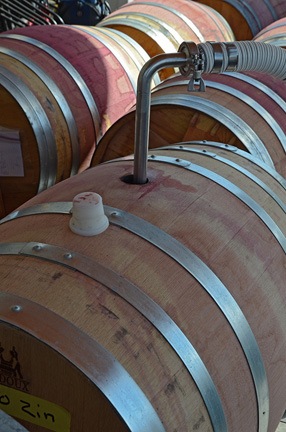
Pumping Out Barrel
The wine is pumped out of the barrel.

Wine Filter
The wine filter consists of multiple vertically mounted filter pads that are discarded after use.

Connecting Hose
Pete and Megan connect a hose to the bottom of a wine vat. Filtered wine enters at the bottom to minimize splashing.

Good to the last drop
Megan catches the last bit of wine as Pete tilts the barrel opening into a pitcher.

Pouring wine into next barrel
Megan pours the last bit of wine from one barrel into the next one being filtered.

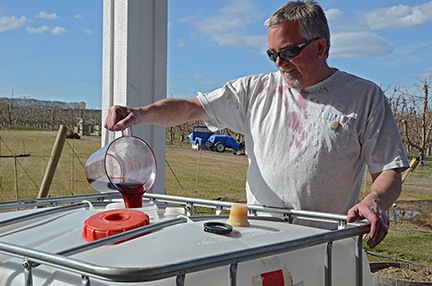
Pouring wine into the Vat
Pete pours some filtered wine into the vat.

I arrived in Quincy at around 2:30 on Sunday afternoon. I had just finished hooking up the mobile mansion’s water, electric, and sewer connections when Pete called, asking where I was. He was in the middle of filtering the wines in preparation for bottling on Tuesday.

Tired from my three-day, 1200-mile drive pulling a 34-foot fifth wheel through the valleys, plains, and mountains of Arizona, Nevada, Idaho, Oregon, and Washington, I nevertheless grabbed my camera and hurried over. Pete and Megan, his winemaking apprentice (for lack of a better term) were more than halfway finished. I got to watch and photograph the activity.

The wine began in barrels. Pete and Megan used hoses and a pump to pump the wine out of each barrel, through a filter, and into a large plastic vat. The barrels for each variety were combined into a single vat.

When the pump is no longer able to suck wine from the bottom of a barrel, the barrel is tipped into a pitcher to catch the last little bit. It’s then poured into the next barrel of the same variety as it’s pumped through the filter. Likewise, any filter overflow is captured in a pitcher and manually poured into the vat. This minimizes the loss of wine.

When the job was done, there was a huge vat of wine for each of the varieties to be bottled on Tuesday. Pete and Megan cleaned up by pumping purified water through the pump and hoses, disassembling the filter, and cleaning everything down with a power washer capable of heating water to 180°F. Pete used a forklift to move the wine vats into a temperature-controlled storage area and stack the empty barrels out of the way.

Throughout the process, we’d been sampling the wine — and it was good!

The Photos

I took a lot of photos during this process — the ones you see here are only a sampling that illustrate the main part of the process. I put most of them on the Beaumont Cellars Facebook pagea gallery on the Beaumont Cellars website. In both cases, the photos include shots taken on Tuesday during the bottling, which I cover in a separate blog post.

Apple iBookstore: Understanding Payment Requirements

It’s a royalty agreement, folks.

The other day, I received an unusual email on my Flying M Productions email account. Flying M Productions is my little publishing company, the one I use to publish Maria’s Guides and other books. Its website isn’t much to look at; just a lot of promotional material for the items it publishes and sells. There’s no support for any book there; all support for Maria’s Guides can be found on the Maria’s Guides website.

The Question

Here’s the message, in its entirety; I’ve only omitted the sender name:

I am looking for understanding of this financial requirement for ibooks author:
(Apple does not pay partners until they meet payment requirements and earning thresholds in each territory. You should consider this before applying to work directly with Apple as you may receive payments faster by working with an Apple-approved aggregator.)
Apple was not able to explain this and said I had to contact you.
Please explain.

This is obviously a lie — or a big misunderstanding — I seriously doubt whether Apple even knows of the existence of Flying M Productions — especially since I’ve been waiting over a month for it to approve two titles for the iBookstore. The idea that Apple would refer someone to me about one of their policies is truly laughable. The idea that a tiny publisher with just four titles in 20 years would provide support for the most valuable company in the world is a real joke.

And that explains why I didn’t reply.

What’s This About?

But I wanted to know what she was talking about so I did a little search. I wanted to see whether the text she’d included in parentheses was actually present in any Apple agreement. I picked “payment requirements” and “Apple-approved aggregator” as my search phrases.

First I searched the most recent version of the 37-page Ebook Agency/Commissionaire Distribution Agreement that I’m required to sign to create books for sale on the iBookstore. No joy.

Then I searched the license agreement for the current version of iBooks Author. No joy.

Then I went online, and followed a bunch of links on the Apple and iTunesConnect websites. I eventually wound up on the requirements page for the Paid Books Account. And there, in the third bullet under the heading “Financial Requirements,” was the full text she’d put in parentheses in her email message.

Apple’s Stand on This

Before I go on, you need to understand two things:

  • Apple does not want everyone capable of typing a sentence and turning it into an epub or iBooks Author document to publish on the iBookstore. Think I’m kidding? Why else would they require ISBNs for every title sold on the iBookstore? That’s just another hurdle for authors/publishers to jump. Why does Apple take this stand? Because Apple (1) doesn’t want to publish crap and (2) doesn’t want to hold the hands of hundreds or thousands of author/publisher wannabes to walk them through the publication process.
  • “Apple-approved aggregators” exist primarily as a support mechanism for Apple. If an author/publisher is too clueless to publish on the iBookstore, Apple wants a way to graciously hand them off to someone else. Thus, they approve aggregators who apparently don’t mind holding hands with clueless authors/publishers in exchange for a fee.

The Requirements page linked to above is another hurdle for authors/publisher to jump. It lists requirements to further weed out the folks they don’t want to deal with. Hell, you have to have a relatively new Mac to publish on the iBookstore — if that doesn’t weed out a bunch of people, nothing will.

What are the Payment Requirements?

But what the person who contacted Flying M Productions was concerned with was the “payment requirements.” Of all the requirements, this is the least onerous. All this means is that Apple won’t pay royalties until you’ve reached certain minimum sales amounts. Why? Well, Apple doesn’t want to deal with thousands of tiny payments every month. Instead, it holds your royalties on account until you’ve earned enough for them to make it worthwhile to pay.

This, by the way, is common. Google has always done this with Adsense. Amazon.com does it for the Kindle Direct Publishing program.

While this may seem to suggest that you need to reach a threshold for each individual territory to get payment for that territory, that’s not what I’m seeing. In fact, I was just paid today for February’s sales. My royalty earnings on sales in each of six territories ranged from a low of $38.73 to a high of $659.40, and I was paid for the total amount earned.

Paragraph 5(c) of the Ebook Agency/Commissionaire Distribution Agreement states (in part):

After deducting Apple’s commission from eBook Proceeds, Apple shall either remit to Publisher, or issue a credit in Publisher’s favor, subject to Apple’s standard business practices, including minimum monthly remittance amount thresholds determined by Apple (e.g., $150), the remaining balance by electronic funds transfer (“EFT”) no later than forty-five (45) days following the close of the previous monthly sales period.

This tells me that you need to earn a certain amount of royalties before Apple will pay you and they’re required to pay within 45 days of the close of the period. That’s why I didn’t get my February earnings until April 5 — which is still a hell of a lot better than I get from my traditional print publisher contracts.

The $150 is an example. In looking at my past statements, for periods when I only had one title listed in the iBookstore, I was paid $28 one month and $31 another. Clearly Apple is not waiting for me to earn $150 before it pays me.

How Apple-Approved Aggregators Fit In

In re-reading this Requirements page, I’m thinking that Apple is using this scary sounding “requirement” as a way to encourage authors/publishers to use aggregators. But will aggregators pay more quickly? I can’t see how. Unless Apple uses different thresholds for different publishers? Or aggregators are willing to make payments for very small amounts? Or aggregators are willing to pay before the 45-day period has gone by?

Either way, it’s nothing to get all hot and bothered about.

But I do agree with Apple: if you can’t meet their requirements, use an aggregator.

About the Golf Ball Drops

Your questions, answered.

Yesterday, I did a golf ball drop. I have another one scheduled for today. And I’ve done at least three of them in the past. (You can read a blog post that details one of them and see a video of another drop embedded in this post.) Here’s a shot from my helicopter’s skidcam to give you a better idea of what it looks like:

Golf Ball Drop

The Tweets

Last night, when I tweeted:

Today’s golf ball drop had 2100 balls. Just learned that tomorrow’s will have 4900. Can you even IMAGINE that many golf balls? Not me.

I got two replies:

mjburian
I don’t understand (but I’m intrigued). You’re dropping them from altitude? Where? Individually?

Daniel_Loxton
Wait, what? Why would someone drop golf balls (or any solid object) out of a helicopter? http://www.youtube.com/watch?v=ST01bZJPuE0

(The link is to a pertinent WKRP in Cincinnati video clip; watch it if you haven’t seen it before.)

So I figured I’d explain what this is about.

Golf Ball Drop Explained

A golf ball drop is usually a charity or fund-raising event. The fundraisers “sell” numbered golf balls for a set price. The balls are taken up in a helicopter and dropped from 200-300 feet onto a target which is normally a standard sized golf hole or cup. Often, a ring of lines is drawn around the target on the grass to mark different levels of prizes. The ball(s) that go in the cup or are within the rings or are even just closest to the center of the target win the prize(s). The money left over after paying for the helicopter, the balls, and the prizes makes up the proceeds from the fund-raising event.

Normally, this is a big spectator event. After all, who doesn’t like helicopters? Who wouldn’t want to watch something being dropped out of one? It’s a fun way to raise money.

Safety Issues

As a safety-conscious pilot, I do everything in my power to make the flight as safe as possible. The dropper sits behind me, strapped in with his door off. All the other helicopter doors are on to limit the possibility of loose items flying out another door.

The balls are usually stored in bags or boxes on the seat beside the dropper. He drops them out the open door — which is on the side opposite of the helicopter’s tail rotor. The balls generally go straight down, but some do bounce off the skid. I’ve never had one bounce dangerously, but I do leave my door on in to prevent one from bouncing back into the cockpit and getting under my pedals.

Below us, the target area is clear of all people and non-essential equipment. I allow only one passenger — the dropper — on board and run with minimum fuel to keep the aircraft light. I point into the wind during the hover.

The only real danger to the flight is the out of ground effect hover right smack dab in the middle of the deadman’s curve. In the unlikely event of an engine failure, things would get ugly fast.

Yesterday’s Drop

Yesterday’s drop was done at the CrackerJax Family Fun Park less than 1/2 mile from Scottsdale Airport. This required additional coordination with the Scottsdale Tower, since CrackerJax is right under the helicopter approach path to the airport.

It was done to raise money for the notMYkid charity. There were a total of 2,100 balls preloaded into 11 very nice drawstring canvas bags. Due to the size and weight of that many balls — an estimated 400 pounds that would not fit in the left rear passenger seat — we did it in two drops, with a hot loading of the balls between the drops.

The photo above is from my helicopter’s skidcam, which I’d rigged up specifically for the flight. On hindsight, I wish I’d pointed it down more; maybe I’ll try a different angle for today’s drop of 4,900 balls — it’ll likely take 3 or 4 drops to do them all.

It’s All in a Day’s Work

Do I like doing golf ball drops? I like doing anything different and interesting, especially if it’s something that can entertain spectators, too. There were very few spectators for yesterday’s drop, but I expect at least 100 for today’s.

And I really can’t knock getting paid to fly.

Why I Bought a New iPad

No, I really didn’t need it. (Who does?)

I’ll admit that when I first heard the features of the new iPad, I was unimpressed. Although a lot of people made a big deal over the new retina display, that didn’t really interest me at all. After all, I don’t really use my iPad for graphics, movies, or anything else that really takes advantage of the display. But there were two features that really interested me:

  • MiFi
    Smaller than a pack of cards, this MiFi connects me to the Internet just about anywhere I go.

    4G connectivity with hotspot capabilities. I do a lot of traveling and have a MiFi unit that I take with me on the road. In fact, because I travel so much, I actually turned off Internet access at my house and use the MiFi there as well. I could imagine replacing my life I with the new iPad and transferring my MiFi data plan over to my new iPad and then using that as my hotspot. Not only would save me $20 a month, but it would give me 4G access instead of 3G wherever 4G was available. It would also reduce the equipment I need to take with me on the road — I would no longer need to take the MiFi and its power adapter.

  • The dictation feature. As a writer, one of the things that frustrates me about using my iPad is the keyboard. On a computer keyboard, I’m a very quick and accurate typist. I think it’s safe to say that I can type faster than I can write by hand. But that speed is completely lost on an iPad. I make too many errors that slow me down too much to use an iPad as a serious writing tool. That means that even on trips where packing light is very important, I still need to bring a laptop if I plan to do any writing. The dictation feature, however, changes all that. If it works well, I should be able to use it for some of my writing.

Because the feature set, as a whole, didn’t really impress me, I had no plans to buy a new iPad in the near future. Part of that was because my iPad 2 had been dropped when it was new and had a dent in one corner. Although it worked perfectly fine and the screen was not damaged, I knew that I would have trouble selling it. And without getting a few hundred dollars for it I just couldn’t justify the purchase of a new iPad to replace it.

All that changed the other day. Fellow author, Jeff Carlson, mentioned that Amazon buys back used iPads. I checked out the Amazon Trade-In Store, and learned that even if classified as “acceptable” (i.e., lowest acceptable) condition, I could still get $342 for my dented iPad 2. So I sold it to Amazon, went to the Apple Store, and bought a new iPad with Verizon 4G and 32 GB of storage space.

(And no, I didn’t have to wait on line. Those of you who know me should know how I feel about that.)

Getting my new iPad ready for use was very easy. I merely backed up the old one to iCloud and then restored the new one from iCloud. A few passwords and photos weren’t carried over properly and I lost a few free samples in my Kindle app, but everything was easily replaced. The new iPad was completely ready to use less than an hour after powering it up for the first time.

I had a $20 per month month-to-month data plan on my iPad 2 and, since I’d just paid for the current month period, I figured I’d switch that over to the iPad 3. It automatically utilizes 4G in areas where 4G is available. Before I leave to go to Washington for the summer, I’ll turn that plan off permanently and switch the 5 GB data plan on my MiFi I to my new iPad. Then I’ll be able to use that for all my 3G/4G wireless needs on a go forward basis, wherever I go.

Dragon Dictate
I wrote this book last year. Learn more.

In all honesty, I had forgotten all about the new iPad’s dictation feature. But the other day, after struggling to type a tweet early in the morning, I remembered it and decided to give it a try. This was actually very easy for me — last autumn I’d written a book about Dragon Dictate for Peachpit Press and the dictation features in the new iPad work very much the same way. The key is to speak slowly and clearly, and if you need to include punctuation you need to say the punctuation.

So I began using the dictation feature of my new iPad whenever I remembered to: for tweets, Facebook updates, and even e-mail messages. I discovered that as long as I spoke slowly and clearly, what I was saying would be pretty accurately transcribed by my iPad. Although I occasionally needed to make a few corrections to what was typed, even correcting that text was quicker than trying to type it on the iPad keyboard myself.

What’s good about this is it it has also reminded me to make more use of Dragon Dictate on my Mac. Dragon Dictate is an amazing software program, but there is a learning curve — the best way to tackle that curve is to use the software as often as possible. Once you get the knack of dictating what you want to write, it comes naturally. So when I decided to write this blog post about my new iPad and my desire to use the dictation features, it seemed natural to do this with Dragon Dictate.

While this blog post talks mostly about my new iPad, why I bought one, and how I’m starting to use its dictation features, I’ve also written a how-to post for the Maria’s Guides website where I explain how to use the dictation feature on an iPad. I’ve also included a link to a new video that shows exactly how this works.

Did you just buy a new iPad? If so why? If not, why not? I’m curious about what people are doing, especially people who already owned an iPad. (I’m almost embarrassed to admit that this is my 3rd iPad — I usually keep my electronic devices at least two years before replacing them, but circumstances have encouraged me to replace my iPads more frequently.)

I’m also curious to know how many people who purchased a new iPad are using it for dictation and what their results are. If you have something to say about this, I hope you’ll use the comments link or form to share them with the rest of us.

Amazon KDP Select Double Fail

A contractual failure followed by a customer service failure.

As detailed in this blog post, I enrolled one of my ebooks into the Amazon.com KDP Select program. Almost immediately, I began seeing weird numbers on my royalty statements for the book: Sales at unit prices of 9¢, negative royalties, free books in a period when they were not authorized.

I immediately began a long and frustrating email correspondence with Amazon.com’s “customer service” staff. In this blog post, I’ll share the chain of correspondence that began in January and ended just the other day.

My original message, sent on or around January 10, 2012:

Subject: WTF? Positive unit sales with negative royalties?

This had better be a mistake.

1/7/2012 shows net unit sales of 13 yet net royalties of MINUS (-) $1.40. How is that even possible? Also, why is the royalty rate only 35%? I am set for 70%.

1/7/2012 also shows net unit sales of 169 at 70% royalty. The book sells for $3.99, yet you’ve calculated an “average offer price” of 9¢. How is THAT possible? I never authorized a selling price less than $3.99 except for 12/25 (free).

What’s going on here? Please explain WITHOUT using some canned response that does not apply to my situation.

The response from someone named Prasanna came on January 12 and, as expected, it contained a bunch of canned information:

Hello,

I can certainly understand your concern about the reports reflecting the royalties in negative. I checked our records and was able to confirm that the all the sales made in the week ending 01/07/2012 were completely free sales due to the free promotion you offered for your book.

However, among those free sales, I noticed that there was a refund that was made for your book which was for a sale made in the previous month. It is due to the refund for the sale made in the last month, the royalty amount is appearing as -$1.40.

Further, with reference to the 35% royalty option, I’ve found that one or more copies of your book were sold outside of countries where the 70% Royalty Option is currently applicable. The 70% Royalty Option is only applicable for sales to customers in these sales territories:

Andorra
Austria
Belgium
Canada
France
Germany
Italy
Liechtenstein
Luxembourg
Monaco
San Marino
Switzerland
Spain
United Kingdom (including Guernsey, Jersey and Isle of Man)
United States
Vatican City

Sales to customers in other locations will receive a 35% royalty. These sales are recorded separately in your royalty reports at the 35% rate.

At this time, the reports don’t show the specific location where your titles were sold. I’ve shared your request for this feature with our business team for consideration as we make future improvements.

Thanks for using Amazon KDP.

This did not make sense. I had authorized only one day as a giveaway for my book: December 25, 2011. That’s the day I advertised it as being free on Twitter, Facebook, and elsewhere. There should be no free book sales in January at all.

I replied on the same day:

I’m sorry, but this is NOT true. The book was offered for sale for free on just one date: 12/25/11. That is NOT in the week ending 1/7/11.

Kindly explain why there were unauthorized giveaways of my book.

This time, Anuradha replied on January 14:

Hello,

Please know, the Prior Six Weeks’ Royalties report shows the sales you’ve made over the past 6 weeks. The total “units sold” and the “units refunded” will fluctuate each week depending on which day you view the reports and the number of sales made over the combined previous six weeks (to date). Keep in mind the “Week ending” column shows the date that the week ends instead of the week beginning.

Thus, as communicated earlier, the refund which is reflects in week ending 01/07/2012, was for a sale made in the previous month. Hence, the royalty amount is appearing as -$1.40, in week ending 01/07/2012.

Further, the price at which we sell your book may not be the same as your list price. This may occur, for example, if we sell your book at a lower price to match a third party’s price for a digital or physical edition of the book, or Amazon’s price for a physical edition of the book and it appears that your title was price matched with a third party’s web site (to match the competitor’s price).

I hope this information is helpful. Thanks for your understanding and for using Amazon KDP.

This information was not helpful. There could not be any “price matching” because the book was available only on Amazon.com due to their KDP Select requirements.

I replied on the same day:

I did not authorize price matching. At least I did not intend to. If I did, kindly tell me where I can de-authorize it.

There is no other version of the book to match to. Amazon has an exclusive for the ebook title. THAT WAS REQUIRED BY AMAZON. The only currently available print copy of the book sells for $14.99. How is 9¢ matching that?

You are obviously picking prices out of thin air and it MUST stop.

On January 18, Violet replied:

Hello Maria,

Our price for your title, Making Movies: A Guide for Serious Amateurs is $3.99 and it was never offered for $0.99. You can confirm the price here:

http://www.amazon.com/dp/B005ZSZMCS

I hope this helps. Thank you for using Amazon KDP.

Of course, this didn’t help either. I replied on the same day:

No, this does NOT help. Your reports indicate that you sold over 100 copies of the book for 9¢. WHY? You told me it was price matching. There is no price matching since Amazon has an exclusive on the book.

WHAT IS GOING ON? It certainly seems to me that you are either lying on my royalty statements or selling the book for a lower than authorized price. Which is it?

Violet replied again on January 21:

Hello Maria,

I’ve raised a request to the concerned department to check why your title was offered for a lower price in the week ending January 7, 2012.

I will contact you with more information by the end of the day on Wednesday, January 25.

Thanks for your patience.

And then again on January 30:

Hello Maria,

I wanted to send you a quick e-mail to let you know that I’m still researching on this issue. It usually takes 1-2 business days for this sort of research, but in this case it’s taking a little longer. I’m very sorry about this delay.

I’ll be in touch shortly with an answer for you. Thanks for your patience.

I guess “shortly” has a completely different meaning to the folks at Amazon.com than it does to most folks. I didn’t hear from Violet again until March 20 — more than two months after my initial support request. She finally admitted that Amazon had screwed up:

Hello Maria,

I apologize for the delay in getting back to you.

Your books’ promotion did not occur as scheduled on December 25th, and began instead on January 6th. A technical error then caused the promotion period to last longer than expected, but this issue has now been resolved.

We’re sorry for the inconvenience this may have caused. Thanks for your understanding.

So let’s get this straight:

  • Amazon did not do my free book promotion on the day I authorized it.
  • All the advertising I did that day to generate interest in a free copy of my book was not only wasted but must have looked like a cheap lie to the people who followed the link and couldn’t get a free book — thus damaging my credibility.
  • Amazon then ran the free book deal for “longer than expected” — a length of time that is still a mystery to me — thus giving away free copies of my book for longer than I wanted the offer to run.

I replied to her message the same day:

Screw-ups like this, and the amount of time it took you to answer my question — more than TWO MONTHS — are why I’ll never be in KDP Select again.

I promoted that book as free on Christmas Day. So I look like a liar to everyone who attempted to get the book that day on YOUR program for free.

By extending the sale beyond the allowable time, you gave away more copies of my book than you should have. How will you compensate me for those lost sales?

You’re already ripping me off — in comparison to other ebook sellers — by charging a bogus distribution fee and cutting my royalty rate to certain countries. You are clearly using your position in the marketplace to take advantage of authors and publishers.

You should be ashamed of yourself.

But I know you don’t care. It’s business as usual at Amazon.com.

Even though I replied to her message by using the same technique I’d been using all along, the automated response I got said:

Our Customer Service department didn’t receive the e-mail message below. If you still need help, please visit one of the pages below so we can quickly provide you with additional information or give assistance via e-mail or phone.

In other words: fuck off, we’re tired of you.

Think KDP Select is a good deal? Think Amazon actually cares about its publishers? Think again.