Julia’s Thanksgiving Cranberry Recipe

The real recipe; not the lazy-cook knockoff circulating among her family and friends.

My mother-in-law Julia may not have been the best all-around cook, but there were a few things that she made extraordinarily well. One of them was her Thanksgiving cranberries. For a kid who grew up with cranberries served out of a can — still shaped like the can, mind you — this was an amazing revelation that cured me of canned cranberries for good.
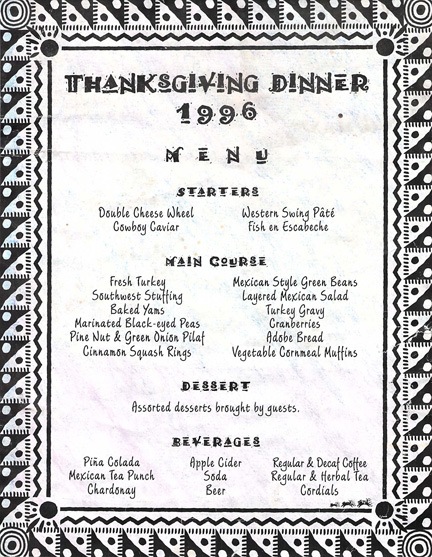
Thanksgiving 1996I first made Julia’s cranberry recipe for Thanksgiving dinner in 1996. This was an amazing meal served in my New Jersey home. Our Salvation Army-acquired dining table, expanded to its full length with the help of a homemade leaf fully five feet wide, made it possible for all 15 of us to sit together. Amazing timing with the help of a standard sized oven and the microwave I still own made it possible to serve the entire meal at the same time, fresh and hot. If there is such a thing as miracles, this was one of them. I’ll never be able to top that feat again.

Anyway, Julia gave me her cranberry recipe for that meal and I prepared the cranberries a day or two in advance to her specifications. It came out perfectly.

Recently, I obtained a copy of the recipe that was distributed to family and friends on the back of a card handed out at her funeral. I was shocked to see that it included canned cranberries. The recipe Julia shared with me didn’t have cranberries out of a can. It had fresh cranberries prepared on the stove — the way a real cook would prepare them.

Here, then, is the recipe Julia shared with me back in 1996. I’ll be making this for my friends to enjoy at Thanksgiving this year.

Ingredients:

  • Cranberries
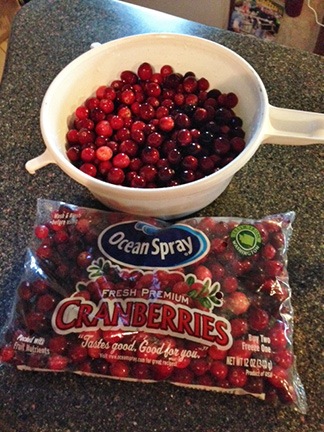
    Julia’s real cranberry recipe started with fresh whole cranberries.

    2 12-oz bags fresh, whole cranberries

  • 2 cups water
  • 1-1/2 cups sugar
  • 1 12-oz can crushed pineapple (packed in natural juice; do not drain)
  • 1 10-oz can Mandarin orange pieces (drained), crushed or chopped
  • 3 or 4 figs, fresh or dried, chopped
  • 1 stalk celery, diced (optional for crunchiness; I usually omit it)
  • 1 small apple, peeled, cored, and chopped
  • 1/2 cup walnuts, chopped
  • 1/4 cup Grand Marnier, Cointreau, or orange juice
Instructions:

  1. Rinse the cranberries and place them in a pot.
  2. Add the water and one cup of the sugar and stir.
  3. Bring to a boil, then lower heat to simmer, stirring occasionally.
  4. Listen for the cranberries to “pop.” When about two thirds of them have popped, remove them from the heat and allow to cool for at least 10 minutes.
  5. Drain away the cooking water and place the cranberries in a large bowl.
  6. Add the remaining half cup of sugar and still well. Sugar should dissolve.
  7. Cool thoroughly.
  8. Add remaining ingredients and stir well.
  9. Cover and store in the refrigerator at least overnight so the flavors will meld.
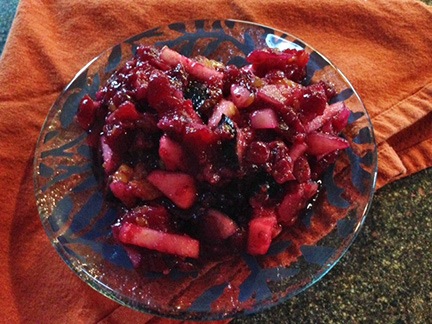
Finished Cranberries
Here’s what my cranberries look like this year.

Serve with turkey (for Thanksgiving!) or pork (any time of the year).

If you’re looking for something different with your turkey this year, try homemade mango chutney. That’s also good with pork.

By the way, the other thing Julia made so perfectly was a New York style cheesecake. I dreaded when she made it in my kitchen because she made an enormous mess. But it was worth it: creamy, delicious, and just sweet enough — if you could convince her not to top it off with something silly like cherry pie filling.

I miss you more than I thought I would, Julia. Rest in peace.
Roasted Pumpkin Seeds

Fresh, tasty pumpkin seedy goodness.

I bought a bunch of pumpkins in October — all kinds of pumpkins — from a local pumpkin farm. I bought them mostly because I could pick them myself and it was fun. I liked the seasonality of having pumpkins around. And I figured I might carve them and put candles in them and do the whole Jack ‘O Lantern thing, even though I knew damn well I wasn’t going to get any trick or treaters.

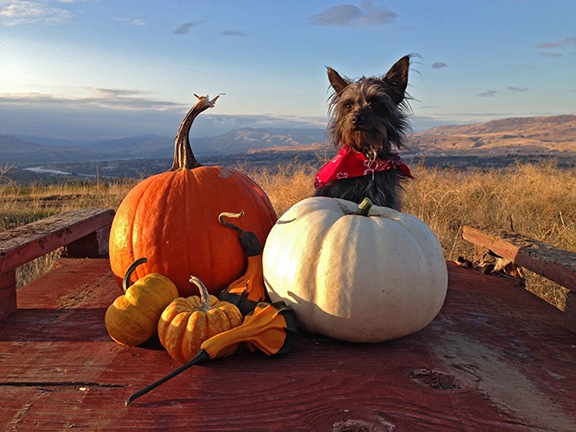
Penny with Pumpkins
Penny posed with the pumpkins the day we brought them home.

But then my godfather got sick and died and I went to New York. When I got back, right before Halloween, I didn’t really feel like carving pumpkins.

So they sat outside. Halloween came and went. We had a warm spell and then it turned cold. Very cold. “Frost on the pumpkin,” as my stepdad would say, cold.

I got the idea that I wanted to pull seeds from the pumpkins to plant them in my own garden next year. (Don’t tell Monsanto.) So one-by-one I bought them in, cut them open, and scooped out the seeds. I cleaned them and dried them and put them in labeled plastic bags.

Of course, I don’t need that many seeds to plant and the orange pumpkin had plenty of them. So I decided to roast them — just as I did most years that I carved pumpkins in Arizona and New Jersey.

Here’s how.

  1. Preheat the oven to 350°F.
  2. Using oil or spray oil, lightly grease the bottom of a large pan. (I used olive oil because that’s the way I roll.)
  3. Cut open the pumpkin and remove the seeds and loose pulpy stuff around them from the inside.
  4. Separate the pulpy stuff from the seeds. This could take some time. Be patient. Drinking wine or chatting with a friend or loved one is a good multi-tasking activity.
  5. Put the seeds in a colander and rinse them. Don’t rinse them too well; they’re better with just a little bit of pumpkin on them.
  6. Put the pumpkin seeds in the prepared pan and spread them evenly.
  7. Roasted Pumpkin Seeds
    Roasted pumpkin seeds, straight from my oven.

    Sprinkle the seeds with a generous helping of salt. (I used Kosher salt because I had some. Regular salt works, too.)

  8. Put the pan in the oven and roast for at least 10 minutes. If necessary, stir the seeds to prevent uneven browning, spread them out again, and continue to roast. You might have to do this more than once, depending on how many seeds there are and how big the pan is. The seeds should be light brown and kind of crispy when they’re done.
  9. Remove from oven.
  10. Enjoy as soon as they’re cool enough to eat without burning your mouth.

And yes, you do eat the entire seed.

Enjoy!

Just Because the Helicopter Has Four Seats Doesn’t Mean You Have to Fill Them

Or why I won’t do aerial photo/video flights with three passengers on board.

It’s that time of the season again: time to go through the NTSB reports to see how and why helicopters are crashing. As I’ve mentioned elsewhere in this blog, it’s usually due to “stupid pilot tricks.” Here’s yet another example.

The full narrative is a bit lengthy to quote here, but I’ll summarize:

R44 Raven I helicopter with four people on board. The pilot estimates the weight of the aircraft at the time of the accident was 2,391 pounds — just 9 pounds less than max gross weight for that aircraft. The accident occurred 25 to 30 minutes after takeoff. If the aircraft burns 15 gallons per hour (as conservatively estimated by Robinson), it burned at least 7 gallons during the flight. 7 gallons x 6 pounds per gallon = 42 pounds. So yes, the helicopter was over max gross weight at takeoff. No wonder the pilot “was concerned with the density altitude at the departure airport.”

Speaking of density altitude, the temperature was 31°C at the closest weather station, which was 12 miles away and sat at 4,964 feet. The calculated density altitude was 7,721 feet. The wind was 17G32.

The purpose of the flight was aerial photography. As any commercial pilot can tell you, that often means low and slow flights. So slow, perhaps, that the helicopter began to settle (under power) during a turn about 100 feet above the ground. There was a close call with two sets of power lines, which the pilot was able to clear while the low rotor horn blared. But the pilot was unable to gain enough speed and keep enough altitude to prevent settling into the ground. The helicopter rolled and three of the four occupants received minor injuries. The helicopter was totaled.

Out of Ground Effect Hover R44A look at the performance chart for an R44 (Raven I) makes it pretty clear why the pilot had trouble maintaining altitude at slow speed. At max gross weight on a 30°C day, the helicopter can’t even perform an out of ground effect (OGE) hover at sea level, let alone nearly 5,000 feet. That means it would have to continuously fly above ETL (approximately 25 knots airspeed) to stay in the air. At slow speed, a turn into a tailwind situation would rob the aircraft of airspeed, making it impossible (per the performance data, anyway) to stay airborne.

(It’s important to note that the R44 Raven II helicopter has much better performance at high density altitude. That’s why I paid the extra $40K to buy a Raven II instead of a Raven I.)

How could this accident have been prevented? Lighten up the aircraft. One way is to take just the passenger with the camera. Leaving two passengers behind would likely have lightened up the aircraft by 300 (or more) pounds. According to the OGE hover chart, at 2,050 pounds, the helicopter could (barely) hover out of ground effect. But even in that situation, the high density altitude would have made the helicopter sluggish and limited its performance. While an experienced pilot may have been able to pull it off, not every pilot could.

But this doesn’t excuse the pilot from doing his homework. A quick look in the pilot operating handbook (POH) would clearly show the aircraft’s limitations. The chart is in there for a reason.

Still, I could put myself in the pilot’s shoes and envision his situation. He knows density altitude could be an issue. But there are three guys and they see a helicopter with three empty seats. Why can’t they all fly? The pilot does a test flight with two of them on board and doesn’t have any trouble. What’s one more person, the passengers ask. Joey really wanted to come, too. The pilot succumbs to the pressure of this passengers and does something he knows deep down inside is probably very stupid.

And he pays for it.

How many times has this happened to you? Once?Twice? Ten times? I know that some version of this has happened to me. Every time it’s happened, I walked away without any problems. But during the whole flight, I worried. I knew what could happen. And I was relieved when things didn’t go wrong.

Is that the way we should be flying?

Hell, no!

Now I personally have a hard and steadfast rule: maximum of two passengers for aerial photo/video flights — preferably just one. And if I don’t feel like I have enough reserve power under the flying conditions — keeping the OGE Hover Chart in mind — I won’t do any hovering or very slow flight.

In my opinion, it’s not worth risking the safety of flight just to make a client happy.

Think about this the next time you’re preparing for an aerial photo mission.

I rock? At least one person thinks so.

A buried treasure in my inbox.

The other day I began a full frontal assault on my email inbox. I had accumulated more than 1600 messages — which is really absurd when you consider that I also use about 20 individual folders to sort my mail into topics and projects. I needed to sort through all the inbox messages and either file them into the folders or delete them.

I wound up deleting more than 1000 messages. Seriously: 1000 messages? How the hell did I accumulate all that crap? I also filed about 500 of them. Right now, my inbox sits at 31 and I’m very proud of myself.

Along the way I found a handful of messages from blog readers that I just didn’t get a chance to reply to. Here’s one from June that’s worth saving. But rather than save it filed in my email account, I’d rather share it here.

From: CG [I’ll let her remain anonymous]

Subject: You rock!

Message Body:
Maria,

I found your blog by accident while googling for something random, and I ended up reading several of your posts and looking at some of your photography.

I am a 28-yr-old woman with an engineering degree and too many hobbies (photography, music, motorcycles, scuba diving, bicycling, arts&crafts of various sorts, reading). I just wanted to tell you how inspiring your blog is to someone like me. While I do love shoes and own too many of them, most of my interests have made it easier for me to relate to men and to find far more male friends/role models/mentors/inspirations than female ones. I have shared your experience that most women are either interested in things that seem petty and pointless to me, or else they have focused on building a family instead of building a career or having adventures. So it really excites me whenever I discover a woman who is independent, bold, adventurous, strong, rational, intelligent, and highly skilled.

I’m not looking for advice, or even a reply. I only want you to know that you have one more admirer as of today. I’m sorry for the pain you have experienced at the hands of your father and husband. I also don’t believe in karma but am hoping for it in this case! That picture of the amazing view from your Washington home is proof that you are capable of making a wonderful life for yourself. I know that reading your blog does not mean that I know you, of course, but as far as I can tell, you are an amazing person and I wish there were a lot more women like you!

Thanks for making my day.

– C

Thank you, C, for making my day. Back in June when you originally wrote to me and then again this week when I found your buried message.

It’s email like this that convinces me that I’m on the right track in my life. And makes me glad that I share so much with readers on this blog.

And if CG lived around here, I bet we’d be very good friends. She rocks, too!

On Luck

Does it even exist?

“You’re so lucky that you can work at home.”

“You’re so lucky that you can fly for a living.”

“You’re so lucky you can live in such a beautiful place.”

These are things I’ve heard multiple times from people I’ve met in my day-to-day life. They all seem to think that luck plays a major role in my life and lifestyle.

I can’t tell you how much it bothers me when people tell me this. Luck has nothing to do with it.

In my mind, luck is something that comes into play when you win a lottery. That’s pure luck. After all, no skill is required; nothing you can do — other than buy a lottery ticket — can change the odds of winning.

I’ve tried, in the past, to explain this to people without sounding rude. My problem, I guess, is that because I’m a writer I take words very literally. And I really can’t help feeling offended when someone attributes various benefits of my hard work to “luck.”

This past summer, my good friend Cheryl shared something her father used to say:

There’s no such thing as magical “luck.” It’s when preparation meets opportunity.

I’ll take that a step farther. The benefits often attributed to luck happen when opportunity is recognized and acted upon.

So preparation leads to opportunity which leads to benefits.

An Example: My Writing Career

Let’s look at my “luck” in becoming a freelance writer.

Dreams don’t work unless you do.

I prepared by learning to write, which I did by being an avid reader and practicing writing for many years. I saw opportunities: the first being to write an article for a professional organization. Despite the lack of monetary compensation, I took advantage of the opportunity and got my first published clip. That, in turn, was part of my preparation to move forward as a writer.

As opportunities presented themselves, I seized them, kind of like a relay racer seizes the baton and runs with it to hand it off to the next person in the race — or take it over the finish line. Step-by-step, opportunity-by-opportunity, I climbed the ladder of success in a writing career. The benefits — advances, royalties, a smattering of fame, and the flexible lifestyle I’ve enjoyed for the past 23 years — were the rewards of this preparation-opportunity chain.

The preparation was my effort to move forward. Preparing book proposals, contacting editors and publishers, learning new software, spending money on computers and other equipment I needed to get the job done. Seizing the opportunities meant getting the work done as needed by the people who hired me within the time limits they specified.

I don’t see much “luck” here, do you?

Another Example: My Flying Career

Although I never intended to fly for a living, I did prepare for such a career by simply learning to fly. It was a lot of work and even more expense. There’s no luck involved in becoming a pilot.

When I realized that I liked to fly and needed to do it for money to keep doing it at all, I began preparing for a career as a pilot. More training, another certificate, more expense. Practice, practice, practice. Time-building. Applying for a job to get more varied experience. Working that job to meet my employer’s needs.

Buying a larger helicopter. Working with the FAA to get Part 135 certification. Advertising, marketing. Answering the phone and learning which jobs would move me forward. Being open to weird suggestions — like spending the summer in Washington state to hover over cherry trees after it rains. Expanding on that seized opportunity to grow my client base.

Do you see any “luck” here?

You Make Your Own Luck

Your life is a result of the choices you make.
If you don’t like your life, it’s time to start making better choices.

I’ve often heard wise people say, “You make your own luck.” This is what these people are talking about: preparation and seizing the resulting opportunities.

There’s no reward without risk. That’s something I’ve learned.

My writing career never would have gotten off the ground if I didn’t take the risk of leaving my full-time job in corporate America to write a 4-1/2 day course about using computers for auditing. And I never would have gone beyond that first big project if I hadn’t worked hard to prepare for other opportunities.

My flying career never would have taken off (pun intended) if I didn’t take the risk of spending all that money on flight training or spending even more money on a helicopter that would help me prepare for opportunities. Or take the risk of leaving my home for a few months each summer to seize an opportunity that made my business thrive.

The only thing standing between you and your goal is the bullshit story you keep telling yourself as to why you can’t achieve it.

Too many people don’t understand this. Too many people seem to think that they can achieve success through luck or wishful thinking. It doesn’t happen. And then, when they don’t move forward in the direction they want to go, they make excuses for why they don’t. Bad luck.

Bullshit.

You are in charge of your destiny.

A smart man once told me that if you want something in life you need to make it happen. That man’s gone now, dead and buried. But even today, his words are the ones that drive me to move forward in my life.

What’s driving you?