You Can’t Get There from Here

Another Apple Maps fail.

I’m planning a trip to Pullman, WA next Thursday to attend a beekeeping seminar. I got the street address of the college campus building I need to go to in an email message. Under OS X Mavericks, I can point to the address to display a map of its location, like this:

Address in Email

I clicked the Open in Maps link to open the location in the Maps application that comes with Mavericks. Then, because I was curious about how long it would take to make the drive, I clicked the Directions button in Maps. I filled in my current location in the Start box and Maps recognized it as my current location. Then I clicked Directions.

Here’s the result:

Maps Fail

If you can’t read the note on the right, here’s what it says:

Directions Not Available
Directions cannot be found between these locations.

Of course, when I went to Google Maps and plugged the same info in, I got complete directions:

Google Maps

Hello, Apple? How about leaving the mapping to the experts? I never asked for Apple Maps on my phone, iPad, or desktop computer.

The apps you provide with the OS are like tools for getting a specific job done. When you provide tools that don’t work, it’s like reaching for a hammer and having it break when you need to bang in a nail.

Shoveling Snow Time-Lapse

I shovel snow for the first time in 16 years.

It snowed last night. Finally.

Yeah, we did have some minor snowfall way back at the end of November or beginning of December, but it wasn’t much. I bought a snow shovel at the local Habitat for Humanity shop for $5 but was better off just sweeping that snow away.

But last night we had the real thing. About four inches of the stuff, slightly wet but otherwise powdery. I saw it in the dark when I woke up and let Penny out. She ran to the edge of the porch, saw the white stuff on the walk and in the yard, and turned tail, running back into the house, obviously afraid. It was 30 minutes later, after she’d finished most of her breakfast and really had to go that she stepped out into it. That’s when I got an idea of how deep it was — she sank in up to her little body and wound up doing her business under the porch.

I walked out, still in my slippers, and stuck a forefinger in the fresh snow on the walkway. My finger was buried before I touched the ground.

At least four inches. Whoa!

I waited eagerly for the sun to rise. I was actually looking forward to using that new shovel.

Those of you in winter wonderlands who have had snow dumped on you all season probably think I’m nuts. I’m not. I grew up in the New York Metro area where the weather was a bit colder in winter than where I am now — and a lot colder than where I lived in Arizona for 15+ years. I didn’t realize how much I missed the snow until I got here, prepped for winter sports, and then waited for the snow to fall.

It didn’t.

Until last night.

Anyway, at about 8 AM, I donned my winter pants and jacket and boots and fashioned my Buff into a balaclava. Then I pulled on my ski gloves and went out to do a chore most people hate: shoveling snow. Of course, I created a time-lapse:

I don’t have to shovel the driveway, which is quite long. The man who owns the house I’m living in right now has arranged for snow plow service if the snow gets too deep. Right now, I don’t think it’s too deep at all — my Jeep has big, gnarly tires that won’t even notice the snow. Besides, temperatures later this week are expected to rise above freezing — heck, it’s already 31°F outside right now — so I don’t expect the snow to linger.

Maybe that’s why I was in such a hurry to get out there and shovel? I didn’t want to miss my opportunity.

Besides, once it starts melting, I suspect it’ll be a lot heavier and harder to move.

Sales Force Email Scam

Yep. Another one.

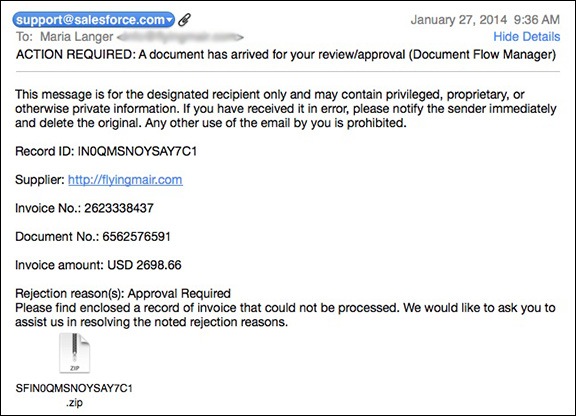
Here’s another attempt to get unsuspecting people — in this case, business owners — to open a file that will likely install malware on their computer. This one supposedly comes from support@salesforce.com and has a ZIP file attachment. It was addressed to my Flying M Air business email address and includes a link to my website. Keep in mind that my business email address is quite generic and could have been guessed by the sender.

The complete message is shown below.

Sales Force Email Scam

Once again I need to remind everyone who might be taken in by emails like this: don’t open any file attachment that you are not expecting, especially if it comes from a person or organization you are not already doing business with.

Crock-Pot Beef Soup

Easy recipe for a winter day.

I love Crock-Pot® — or, more generically, slow-cooker — cooking. There’s nothing like throwing a bunch of ingredients in an appliance, covering it, turning it on, and coming back 6 to 10 hours later for a delicious meal. Best of all, the aroma of that slow-cooked meal permeates your home, greeting you quite pleasantly when you get back from a long day at work or play.

True story: a few weeks ago, I had to make a trip down to Goldendale for some business. it’s a 3-1/2 hour drive — each way. I set up a slow-cooker before I left at 7 AM and completely forgot about it. On my way home that afternoon, I thought about what I could cook for dinner without having to stop at the supermarket. When I turned the key in the door and pushed it open, I smelled the lovely aroma of the chicken soup that had been cooking all day and actually thought to myself, “What did I make yesterday that smells so good today?” I was actually stepping into the house when I remembered the slow cooker-meal waiting for me. What a reward at the end of a very long day!

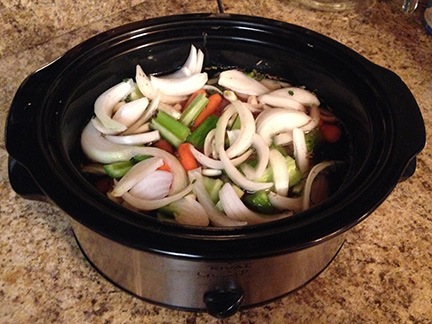
Anyway, I was in the supermarket Sunday and found some very meaty “soup bones” in the meat department. Remembering the excellent beef soup I’d made last winter in Arizona from similar “soup bones” in my chest freezer from a half cow we’d bought the previous year, I decided to whip up a batch here. But rather than put it on the stove, I pulled out the slow-cooker. Here’s the recipe I used.

Ingredients

  • 3-4 pounds of very meaty beef soup bones
  • 3 carrots, cut into 2-3 inch lengths
  • 2 stalks celery, cut into 2-3 inch lengths
  • 1 medium onion, sliced
  • 4 cloves garlic, peeled and halved
  • 1 teaspoon salt. You might want to put more; I’m trying to limit my salt intake. Remember; you can always add it later.
  • 1 teaspoon fresh ground pepper. Is there any other kind?
  • 1 tablespoon Herbs from Provence. The prepared blend I used includes chervil, basil, rosemary, tarragon, garlic, lavender, marjoram, savory, thyme, and parsley.
  • 3-4 cups water

Root vegetables also work well in this recipe, although I never use potatoes because I’m trying to avoid starches.

Instructions

  1. Place beef bones at the bottom of a slow-cooker.
  2. Spread vegetables on top of beef.
  3. Sprinkle salt, pepper, and herbs on vegetables.
  4. Beef SoupPour enough water over slow-cooker contents to barely cover them. In the slow-cooker I’m using, that was just over 3 cups.
  5. Cover the cooker and set to high.
  6. When the cooker contents start to boil or simmer, set to low. If it never starts to boil, that’s okay. It really depends on the slow-cooker. If you need to go out for the day, just set it to low before you leave.
  7. Cook all day. I’m thinking at least 6 hours to tenderize the beef and bring out the flavors of the meat and vegetables.
  8. Remove the beef bones from the soup and allow to cool enough to remove meat pieces from them.
  9. Cut the meat as necessary and return it to the soup.

Serve piping hot with crusty bread.

Again, I’m watching my carb intake so I’ll be skipping the bread. I’m also avoiding pasta. But noodles or orzo would be really good in this recipe. Cook it separately and add right before serving.

This should make enough soup for at least 4 people. I use plastic containers to freeze leftover soup in single-serving portions. I can then pull out a container and heat up a nice hearty meal any time.

One more note: If you expect to be pressed for time on the morning of the day that you’ll be making this, you can put all ingredients except the water into the slow-cooker insert the night before and store it, covered, in the fridge. Then put the insert into the slow-cooker first thing in the morning, add warm or hot water, and turn it on high. Be sure to set it down to low before you leave for the day.

Scavenging in a Landing Zone

Sunflower seeds, right from the source.

The other day, I had a helicopter charter from Wenatchee to Ephrata. My landing zone was a harvested sunflower field.

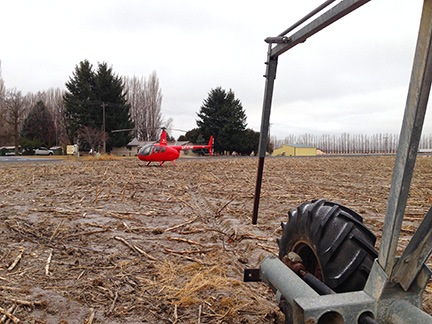
Parked at the Sunflower LZ
I parked not far from the end of the irrigation pivot for the field.

The ground was rough but frozen hard. I landed with my skids perpendicular to the furrows where the plants had been lined up during the growing season. Thick dried stalks littered the field and, as I came in for my landing, I wondered how many would become airborne and whether they’d cause me any problems. Some did stir while other pieces of the harvested plants got airborne in my downwash as I neared the ground. But there was no danger. I settled down so softly, my passengers even commented on it.

“Smooth,” one of them said as he unbuckled his seatbelt.

My two passengers climbed out as I began the cool down procedure. They walked around the front of the helicopter, well beneath the spinning blades, and met the men they’d come to see alongside the road. I watched them cross the street and disappear down a driveway.

It didn’t take long to cool down the engine. It was 1°C outside. I brought the blades to a stop and climbed out to survey my surroundings and take another look at the ground near my skids. It’s a habit I have on off-airport landings — checking the skids to make sure they’re free of objects or terrain that could cause a dangerous pivot point later when it was time to leave. And, of course, I took a few pictures; I always photograph my landing zones.

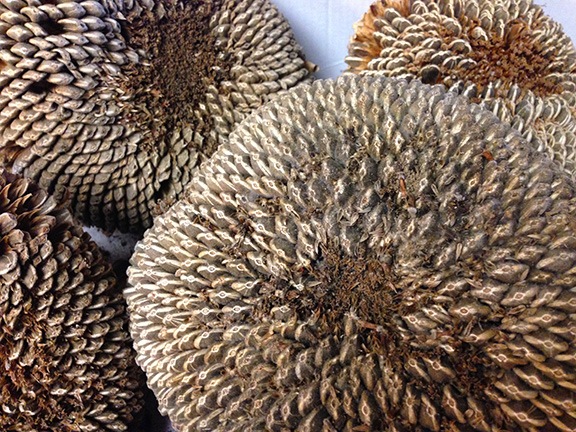
That’s when I found out what I’d landed on. From the air, I’d assumed it had been corn. But there were quite a few big, round structures in the field and it didn’t take long to figure out what they were: the seed heads of sunflowers.

The Seed Heads

The Sunflower LZ
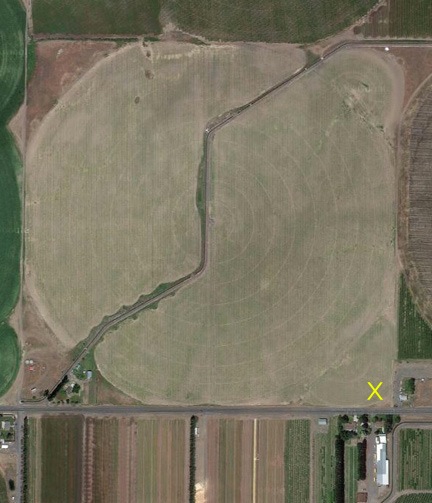
This Google satellite view tells the story of a big round field with a draw running through it and a smaller field in the corner where I’d parked.

This part of Washington is farm country. While they mostly grow tree fruit and grapes in the Wenatchee area where I live, out toward Quincy and Ephrata and Moses Lake they grow a lot of row crops. The corner of this huge field had its own little irrigation pivot. I don’t know what they grew in the rest of the field, but this corner had been sunflowers, and lots of them. I could only imagine how beautiful they must have looked in bloom.

Now there were just scattered seed heads lying around. Like any machine-harvested field, some crops are left behind.

I got to thinking about those sunflowers and all the seeds that were embedded in them. Hundreds in each seed head. They obviously didn’t want them. If I grabbed a bunch, pulled the seeds off, and scattered the seeds around my 10 acre lot in Malaga, there’s a good chance I’d get a few sunflowers for very little effort. My bees would be very pleased indeed for the late season pollen and nectar source.

I started gathering seed heads. They were dry but dirty. The stalks on some were quite long. I pulled out my pocket knife and sawed them off.

I’d gathered four of them and had stowed them under one of the back seats when I got a text message from my client.

“You can come in if you want,” it said.

Usually, I sit out at the helicopter and read while I wait for my passengers. But usually, it isn’t 1°C outside. I realized I was cold. I closed up the back seat, put my knife away, grabbed my iPad, and traced their steps across the street and into the lobby of the nursery/packing house they were visiting. After explaining who I was, I settled down on one of the chairs there, took off my coat, and read.

The Seeds

I brought the seed heads home from the airport after our flight and stowed them in a big shoebox in the garage. (Now I know why I saved that box.) I wasn’t sure how wet they were and I didn’t want bugs in the house or mice among the seed heads.

Today, I took them out for a better look. They were quite beautiful in an old, post-harvest kind of way. They were brown — not black, as we’re so accustomed to seeing in snack packaging. I’m not sure if they were brown because of the dirt or because of the type of sunflower.

Sunflower Seed Heads
Seed heads in a shoebox.

Sunflower Seeds
Harvested sunflower seeds beside the largest of the four seed heads I brought home.

I picked one up and, holding it over the box, rubbed it roughly with my thumb. The seeds began to dislodge and fall off into the box. About ten minutes of rubbing cleared them off the three smaller seed heads. I figured I had about 2,000 sunflower seeds. The final seed head would likely add another 1,000 or so.

The plan is to let them dry indoors in the box. When I’m sure they’re good and dry — and I honestly think they already are — I’ll put them in a bag. In February, before I leave for my frost gig, I’ll scatter them all over my property, keeping about 100 or so to manually plant alongside my vegetable garden.

But before I do any of that, I’ll likely soak a few of these to make sure they sprout. After all, there is a chance that they’re hybrids grown for some specific purpose — oil, seeds, etc. — and that the seeds themselves aren’t fertile. I’ll know soon enough.

3,000 free sunflower seeds. Not bad for a bit of scavenging.