
A Trip to a Beekeeper’s “Candy Store”

I visit the California location of Mann Lake, Ltd.

If you’re a beekeeper in the U.S., you’ve undoubtably heard of Mann Lake, Ltd. They’re a major mail order supplier of beekeeping equipment for hobbyists and professionals. They have quality merchandise, fair prices, satisfactory delivery times, and free shipping for orders over $100 — which is pretty easy to reach, especially when you’re first starting out.

Mann Lake’s website is an odd combination of printed catalog pages reproduced page-by-page coupled with a back end database that makes searching possible. It’s not my favorite shopping interface, but it does work. It works best, though, if you have a copy of the printed catalog and can just enter item numbers to order. The printed catalog is a great reference guide, too, with lots of information about each product and plenty of pictures. (You can get one for free by filling in this form.)

Mann Lake is based in Hackensack, MN — a place I’m not likely to ever see. (Actually, Minnesota is the only state in the U.S. that I’ve never been to; don’t see that changing any time soon.)

Somehow, not long after I began shopping for beekeeping supplies last May, I discovered that Mann Lake had a Woodland, CA location. This really bummed me out — I’d spent a bit of time near Woodland just a few months before and, had I known I’d be a beekeeper soon, I would have stopped in to see what they had. Although I didn’t realize it then, I’d soon be back in the Woodland area on another contract.

And that’s where I am now.

So yesterday, my first full day based in this area, I drove over to the Mann Lake California location at 500 Santa Anita Drive. (Yes, it’s true. I went from being a computer nerd to a beekeeping nerd in only a few short years.)

Mann Lake's CA Location
Mann Lake’s CA location is in an industrial park; it’s mostly warehouse.

From the outside, the place didn’t look very exciting. The parking area out front was completely empty. But when I walked inside, I think my jaw must have dropped. Every single item in their extensive catalog was fully assembled and on display in neatly organized aisles.
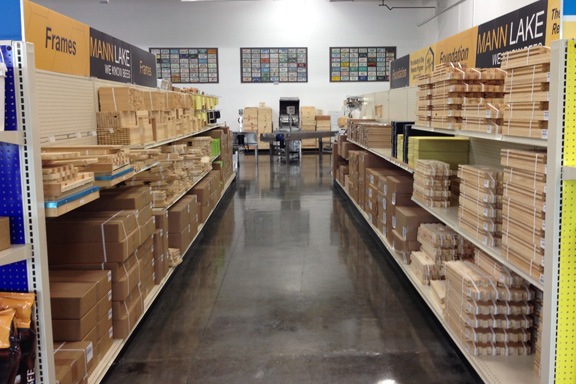
Inside Mann Lake
Frames and foundations

Inside Mann Lake
Covers and bottoms.

Inside Mann Lake
Hive bodies.

Kid in a candy store, is the phrase that came to mind. I felt like a crazy tourist taking pictures, but I have some beekeeping friends who would really appreciate seeing what I’d seen.

I walked up and down the aisles, seeing firsthand all the equipment I’d seen in their catalog. While some of it wasn’t a big deal — after all, if you’ve seen one standard Langstroth hive body, you’ve seen them all — other items were great to see and touch: propolis collectors, queen cages, honey extractors.

When a sales guy — who turned out to be the sales manager — asked if I needed any help, I asked him to show me the pollen collectors. I wanted an easy solution but apparently there isn’t any. Still, I got to see how the commonly used pollen traps work. The catalog doesn’t really make it obvious.

I wound up buying a frame puller — which I’ve been wanting for a while — and a few other odds and ends that wouldn’t add up to the $100 amount I’d need for free shipping anyway. The sales manager checked out my purchase and looked me up in the computer system and offered to apply my “bee bucks” to the purchase, saving me $25. Sweet!

It was a good experience and I’m sure I’ll be back before I head home. After all, I was crazy enough to bring my beehives with me on this trip and I’m sure I’ll need one or two more things as they enjoy the early spring and start strengthening their hives. Who knows? I might even be ready to extract some honey before I leave.

Oh, and if you’re wondering why Mann Lake chose this location for their California warehouse/store, I can guess. Woodland is near the heart of California’s almond country. My 5,000 or so bees, just recovering from a northwest winter, are only a handful of the 31 billion bees from all over the country that are here right now.
Airport Life: Today’s Drop-In Surprise

You never know what you’ll see out your back window.

Just a quick post to share a photo of the view out my RV’s back window this morning. The mobile mansion is parked at an airport in the Sacramento area. I’ll be living here for the next 7-8 weeks on a frost contract for almond orchards in the area. I’ll tell you more about that in another blog post when I get time to write it.

This Morning's Drop In Visitor
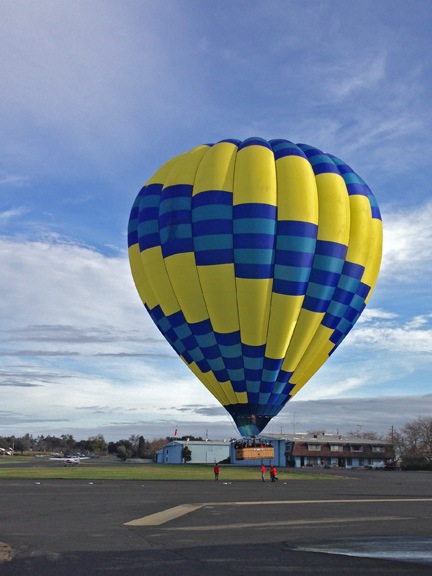
Look what landed in my “backyard” this morning.

The airport I’m living at isn’t very busy at all — despite the fine weather. But this morning I was very surprised to see a big hot air balloon just miss the hangar behind the mobile mansion on a descent to a field near the airport office. The crew was already onsite when the balloon landed with only a bit of ground run. I got some pictures as it came in.

Once it was stabilized and the balloon deflation begun, at least 20 people climbed out of the huge wicker basket. Penny and I went to greet the passengers and chat with the pilot while the crew worked to stretch out the balloon on the dewy grass. My chat with the pilot was fruitful. Looks like I’ll be swapping a balloon ride for a helicopter ride one day soon.

Other balloons were on their way in, but approached too high and ran out of room before being able to land on the airport property. They climbed up and drifted off to the north, one after another. I suspect I’ll see them again soon.

Bees: Late January Hive Inspection

I take a peek at my wintering bees and get good and bad news.

I started my beekeeping hobby in June 2013 and have been blogging about it periodically. If you’re interested in reading the other posts in this series, follow the Adventures in Beekeeping tag. Keep in mind that the most recent posts always appear first on this blog.

Full sun is back on my property up at the base of the Malaga cliffs and my beehives are getting direct sun on them several hours a day again — at least when the sun is out. I was there midday on Friday when full-sun temperatures at my place were at least 45°F. I saw a few bees buzzing around two of my hives — including the one I considered weakest.

I decided to take a few minutes and peek inside the hives. I wound up opening only two of the three hives.

Original Hive

The first hive I opened was my original hive, begun with a nuc in the beginning of June 2012. Over the course of the season, the hive had developed a serious mite problem that I combatted with drone frames and, late in the season, medication. If I were to put my three hives in order of strength, I would rate this #2 — neither strongest nor weakest. It had a good population and I added both sugar water and a food patty via a top feeder before closing it up for the winter.

It was very difficult to get the hive open. I think it was a combination of a great deal of propolis between boxes and the cold weather. When I finally got the feeder box off, I saw mostly empty frames with a scattering of dead bees. Although I was unable, due to the cold, to remove any of the frames, I’m quite certain that there are not any live bees inside the hive. There were, however, frames with plenty of honey so I know that they did not starve to death.

Hive Spit

The second hive that I opened was a hive split taken from that original hive in July. The split had never been very healthy and it had the same mite problem that the original hive had. Because it was my weakest hive, it was also the one that I took to the Chelan County Fair in my observation hive. I did not have very high hopes for its survival over the winter. I had prepared it with several full frames of honey and a frame feeder. When I closed the box up for the winter, it was only one deep box tall.

I was very surprised, therefore, to see many live bees when I opened the outer cover and pulled away the Styrofoam insulation I had put in just beneath it. I did not pull off the inner cover; I merely peeked in the oval opening and saw a lot of moving bees. I added a food patty to the top of the inner cover, put some more of the insulation around it, and put the outer cover back on. I didn’t see any reason to further disturb the bees, especially when it was still so cold out.

Swarm Hive

My third hive was a swarm capture from June. It was my strongest hive. Like my first hive, it had a top feeder with sugar water and a food patty. I did not bother to open it. But I did see bees at the entrance and suspect things are still buzzing inside.

Upcoming Weather

We’ve had a relatively mild winter so far. Other than some bitterly cold days in early December, temperatures in the area have hovered around freezing for the rest of that month and all throughout January.

Things are forecasted to change this week, with more bitter cold temperatures, possibly getting into the single digits during the night and staying below 30°F most days, at least for the foreseeable future. Direct sunlight on my beehives during sunny days should give them relief — at least during the day — from the bitter cold. I’m hoping my two remaining hives can survive the coming cold weather.

I’m also hoping that we get at least one more extraordinarily warm day sometime within the next two weeks. I’d like to pull the tops off both of my surviving hives and check on food stores, possibly replacing empty frames with full ones from the dead hive. I have a 2-month trip coming up and although I toyed with the idea of taking my bees with me — after all, I am going to California’s almond country — it makes more sense to leave them behind. I’d like to get them set up for their best chances of survival before spring finally arrives.

More about Drones

Once again, no one is thinking about helicopters.

An aviation friend of mine, Rod, posted a note on Facebook titled “The Drone Industry Should Play by the Rules, or Help Change Them.” I’m not sure if you need to be logged into Facebook to read what he posted, so I’ll just echo it here; I do urge you to read and comment on it there if you can and have something to add to the discussion:

Look folks, I’ve got no problem with drones operating outside the National Airspace System. (i.e. below 400 feet.) 

But if this innovative industry wants to conduct business in the NAS, you should have to play by the same rules as manned systems and certify the operators, the components, and the systems to the standards required by law.

If you don’t like the regulations that currently govern how the NAS is managed, help get the laws changed and deregulate aviation.

If you, like Rod, think that the national airspace system starts at 400 feet AGL, you need to read “Busting Myths about the FAA and Unmanned Aircraft” on the FAA website.

I asked where the 400-feet number comes from, pointing out that I’m authorized by the FAA to operate under Part 135 as low as 300 feet with passengers on board. He linked to an article on Politico about a lawsuit pending by the FAA against an “aerial anarchist” who uses a styrofoam plane for commercial aerial photography. From that article:

The FAA has never officially regulated model airplanes or small drones. The closest it has come was an “advisory” issued in 1981 that created a set of voluntary guidelines for model aircraft: stay within the line of sight, do not fly within three miles of an airport, do not fly a model airplane higher than 400 feet.

The article makes interesting reading, although it entirely misses the point of my problem with the kind of RC aircraft that are becoming more and more prevalent among amateur “drone pilots.” My problem has to do with the operation of these devices in areas where I fly, which can be within 400 feet of the ground, causing a nearly invisible hazard to me and my passengers.

As a helicopter pilot, I have no minimum flight altitude for my Part 91 operations — including aerial photography/videography, cherry drying, frost control, animal herding, wildlife survey — the list goes on and on. Part 91 allows me to fly as close to the ground as I need to (as long as I don’t create a hazard to people and property on the ground, of course). These are legitimate and legal low-level helicopter missions that often keep me within 100 feet of the ground. As previously mentioned, even my Part 135 operations allow me to operate as low as 300 feet above the ground.

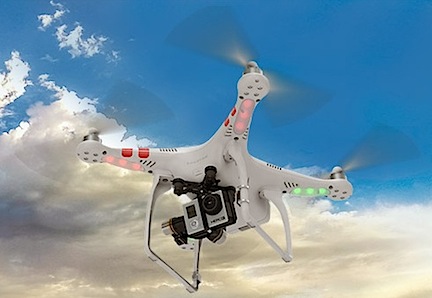
Phantom with GoProThe Phantom 2 Quadcopter with a GoPro Hero attached. This aircraft can weigh nearly 3 pounds. How’d you like to get hit on the head with that dropping from 400 feet?

Imagine this scenario: I’m drying a cherry orchard and a local photo hobbyist decides to take out his Quadcopter with GoPro to get some footage of me or another cherry drying pilot in action. He keeps a respectable distance but is not prepared when one of us suddenly lifts up away from the trees and moves to another orchard. We don’t see him — we’re focused on our work and the location of other helicopter traffic — and one of us flies right into him. The helicopter’s cockpit bubble is smashed or the main rotor blades are damaged or, worse yet, the tail rotor is taken out and the aircraft crashes to the ground. Who’s right or wrong here? The drone is operating under 400 feet and at least 3 miles from the airport, so he’s “legal.” The helicopter pilots are performing a mission that we’ve been doing for years, relying on proven safety measures and radio communication to avoid obstacles and other traffic. Are we supposed to keep an eye out for amateur RC aircraft operators, too?

My aviation friend, Rod, suggests that drone operators should “help get the laws changed and deregulate aviation.” Does he really want aviation deregulated? Does he really want a free-for-all by anyone with a few hundred dollars to spend on an RC aircraft to fly it wherever they like for whatever purpose they desire?

Doesn’t he realize that it’s only a matter of time before they stray up into his previously safe airplane altitude?

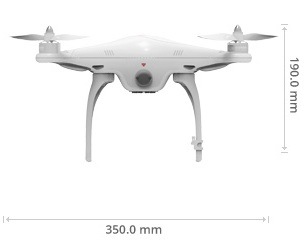
Quadcopter
The Phantom Quadcopter is small and white, less than 14 inches wide. I’ve seen birds bigger than that.

And what are helicopter pilots supposed to do? How do you think I feel worrying that any one of my flights could be ended by a collision with an RC aircraft piloted by a hobbyist with a new toy who doesn’t care about the rules or safety? Someone who mistakenly thinks it’s my responsibility, while cruising at 80 knots, to keep an eye out for his toy? Something that might not much larger than a Frisbee?

And make no mistake about it: an impact on a main rotor blade or tail rotor could disable my helicopter and cause a crash.

What would I like to see? Here are a few suggestions for the operation of unmanned radio or computer controlled aircraft:

  • Limit amateur/hobbyist operations to designated RC aircraft fields that are marked on aeronautical charts.
  • Require professional/commercial operators to receive training and pass tests established and overseen by the FAA.
  • Require professional/commercial operators to publish NOTAMS whenever an operation outside an RC aircraft field is conducted.
  • Require all operations to be conducted with a spotter to keep an eye out for full-sized aircraft operating in the area.
  • Limit all operations to altitudes below 300 feet AGL.

I firmly believe that these aircraft, when operated by amateurs, are a danger not only to other aircraft but to people on the ground. There have been numerous crashes in populated areas, including one in Manhattan, and even a death attributed to a crash. How long will the FAA wait before it steps in and properly regulates these aircraft? These aircraft are proliferating at an alarming rate. As a pilot and property owner, I’m starting to get tired of worrying about the consequences of a careless operator’s actions.

And no: deregulating is not the answer we need.

February 26, 2014 Update: The FAA has spoken.

Art History Book Mystery Partially Solved

So that’s why they sent me a copy!

Last spring, as I was finishing my packing and preparing to leave my Wickenburg home for good, a box arrived in the mail from Pearson Education. I’d been writing for Pearson’s Peachpit imprint since 1995 and assumed the box contained copies of my latest book about Mac OS X, translated into other languages. Of course, all my other books had already been packed and I was bummed that I couldn’t pack this latecomer with the others.

The Mystery

Art HistoryBut when I opened the box, I was very surprised to see that it wasn’t a translation of one of my books. It was an absolutely beautiful 1240-page hardcover book about art by Marilyn Stokstad and Michael W. Cothern titled simply, Art History (Fifth Edition). A quick look on Amazon.com showed me that the book would cost nearly $200 to buy. That wasn’t difficult to believe. The book was beautiful.

I’ll be the first to admit that I have only a passing interest in art history. But paging through this book while trying to figure out why it had been sent to me, I realized that I was holding the definitive guide to the history of art — a book that covered art history as far back as prehistoric times. It was chock full of gorgeous full-color photos. Everything the average person could want to know about the history of art worldwide was in this amazing textbook.

But why the heck had it been sent to me?

I didn’t know the authors and I didn’t write textbooks. I had never voiced an interest in art history to anyone I knew. There was no note with the book. Nothing at all to explain why I’d gotten it. I wound up assuming that someone at Peachpit had sent it to me as a gift — I’d been getting quite a few little gifts from friends who sympathized with my divorce ordeal.

I packed the book carefully in one of the last boxes I sealed up. It would look nice on the coffee table in my next home. And maybe — just maybe — I’d have time to read some of it when I settled down again.

A Partial Solution

This morning, I got two email messages, each referring to permission to use one of my photos.

One message was from a woman named Evi, who I vaguely remembered from the past. In this new message, she told me she needed to “re-clear the rights to use the below picture” for a new edition of Stokstad’s Art, A Brief History. I scrolled down and saw one of my photos of the Grand Canyon.

Lookout Studio
I shot this image of Lookout Studio after dawn one day in October 2008, most likely while I was on one of Flying M Air’s Southwest Circle Helicopter Adventures (which I stopped offering when I permanently moved out of Arizona).

It was very important, Evi told me, that my rights be extended to Pearson, the US publisher. The other message was from Pearson and included a permission form. (Pearson has forms for everything.)

Art Brief HistoryI looked up the book on Amazon.com and found a 640-page paperback book titled Art: A Brief History (5th Edition). Although I’d never seen the book before, it did get the wheels turning in my head. I did another Amazon search on the author’s name and found the book discussed at the beginning of this blog post — the book I’d received out of the blue at least nine months ago.

And then I remembered a bit more about my email exchange with Evi. It had been about two years ago. Her company had bought — actually paid — for the rights to use the photo. Somewhere along the line, I must have also requested a copy of the book. Months later, I got the check from the UK-based company drawn on a US bank, cashed it, and promptly forgot all about it.

Is it possible that they used my photo in such a big, beautiful book? Or did they use it in the shorter paperback she mentioned in her email message?

But the dates didn’t jive. The paperback book was published in December 2011. Surely it hadn’t been that long since all this transpired.

And if it was in that 640-page paperback book, then why had they sent me the 1240-page hardcover book?

Without asking for details — which I really don’t think is worth the bother; after all, this poor woman has thousands of pictures to get permissions for — the only way to know is to look through the book they sent me to see if my photo is in there. Of course, that box is still packed and still in storage. I likely won’t unpack it until later this summer, at the very earliest.

Permission Granted

I’ll definitely be giving them permission to use my photo again. And I won’t charge them a fee this time. I’m hoping that the photo did appear in the bigger book and that I get a copy of the smaller book once it’s revised.

Needless to say, I’m tickled that my work appeared in such wonderful volumes. Photography is just a hobby for me; to have my work recognized and used — with permission — in such a way really makes me happy.