California Strawberries

Sweet, with bittersweet memories.

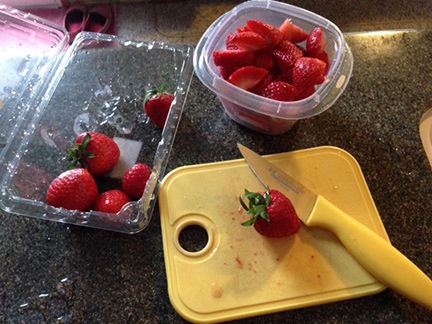
StrawberriesThis morning, as I cut up some fresh, ripe California strawberries for breakfast, I found myself thinking back to April days in the late 1980s.

Back then, I worked as an Internal Auditor for ADP. Each spring, in April, they’d send a team of us — usually 3 or 4 auditors — out to their La Palma, CA location. In those days, I lived in New Jersey with the man I’d later marry and a three-week trip to California at the tail end of winter was like a gift from heaven.

They put us up in the Embassy Suites (now a Radisson Suites) up the road from Knotts Berry Farm, each in our own suite. (Back in those days, a “suite” was really two rooms.) Great breakfast every day, happy hour every evening. We really got to know the staff and used to party with them once in a while. There was one rental car for each pair of us, so ground transportation was not a problem. 9 to 5 at the office a few miles away, then on our own with expense accounts for R&R in the evenings.

There was a set of high tension power lines running alongside the hotel’s property. And there, under the power lines, they farmed strawberries.

That’s not the only place, of course, Fresh local strawberries were all over southern California in April. Strawberry shortcake in every restaurant. I especially remember a place near Disneyland in Anaheim. My brain keeps telling me it was called Carroll’s, but I can’t find it in Google. We joked that it was Paul Bunyan‘s restaurant — the portions were enormous. Even the flatware was huge — a soup spoon could not fit in my mouth. The strawberry shortcake there could feed a whole table of people.

On weekends, we had the option of sticking around or using our hotel allowance to pay for lodging elsewhere. One year, I met up with fellow auditors working in the San Francisco area for a trip to Lake Tahoe where they skied and I sipped spiked hot cocoa. Another year, we went to La Jolla and stayed in a hotel on the coast with a trip into Tijuana.

The trips to California were three weeks long and we were given a choice: fly home one of the two weekends or have someone from home fly out to California. Each year, my future wasband would fly out on the second weekend. (That was back in the days when he preferred to spend his vacation time with me rather than with his mother.) We’d do something fun together over the weekend and then he’d spend the week goofing off while we worked, taking the rental car to explore the area. He saw the Spruce Goose and Queen Mary, drove up the coast, and did all kinds of things during his free vacation. At 5 PM, he’d be back in the parking lot with the rental car to pick us up.

When the job was over, I’d take my vacation, tacking a week on to the end of the trip. One year, we drove out to Death Valley and Las Vegas. Another year, we explored Kings Canyon, Sequoia, and Yosemite National Parks. We’d car camp — he’d bring our camping gear with him in a big duffle bag — and explore. They were some of the best vacations I had, visiting beautiful places with the man I loved, back when he seemed more interested in the beauty of the world around us and having fun than buying expensive cars and other assets he didn’t need and couldn’t afford. Best of all, the trips were remarkably affordable with the airfare for both of us covered by my employer.

When I moved out of my Wickenburg home last year, I left behind the photos I took on those trips. They’re in photo albums of prints painstakingly laid out afterwards to share with family and friends. I wanted to forget that part of my life and the man, now dead, who I shared it with. But too many memories survive, even without the photos.

And they can be triggered by something as simple as the look, smell, and taste of fresh, ripe strawberries from California.

Busting Myths about the FAA and Unmanned Aircraft

A good link to some real information — from the source.

I wrote about “drones” or “UAVs” in two recent blog posts:

The issue is rather polarized, with most pilots and people on the ground wanting more regulation and most drone/UAV operators wanting less. One reader nitpicked over my use of the word “drone” and comparison to radio controlled helicopter — as if one radio-controlled flying object is that much different from another.

If any flying object hits an aircraft in flight or falls from a sky onto someone’s head, it’s going to do some serious damage.

FAA LogoThe FAA, which, like most government agencies, operates so slowly it often seems as if it’s moving backwards, finally woke up and published an update on its website that clears up any “myths” surrounding the use of unmanned aircraft or UAS. Titled “Busting Myths about the FAA and Unmanned Aircraft,” it lists 7 myths and the corresponding facts for each.

Two myth/fact pairs stand out:

Myth #1: The FAA doesn’t control airspace below 400 feet

Fact—The FAA is responsible for the safety of U.S. airspace from the ground up. This misperception may originate with the idea that manned aircraft generally must stay at least 500 feet above the ground

I cannot tell you how many times I’ve heard people tell me that the FAA has no control over airspace near the ground. The number of feet from the ground that the FAA control begins varies from 50 to 150 to 300 to 400. These numbers seem arbitrary to me. The truth of the matter is, FAA-regulated airspace begins in the U.S. at the ground.

Myth #3: Commercial UAS operations are a “gray area” in FAA regulations.

Fact—There are no shades of gray in FAA regulations. Anyone who wants to fly an aircraft—manned or unmanned—in U.S. airspace needs some level of FAA approval. Private sector (civil) users can obtain an experimental airworthiness certificate to conduct research and development, training and flight demonstrations.  Commercial UAS operations are limited and require the operator to have certified aircraft and pilots, as well as operating approval….

Flying model aircraft solely for hobby or recreational reasons doesn’t require FAA approval, but hobbyists must operate according to the agency’s model aircraft guidance, which prohibits operations in populated areas.

Did you get that? Even hobbyists are prohibited from flying their radio controlled model aircraft over populated areas. That includes large gatherings of people for outdoor events.

If you’re interested in this topic, I urge you to read this article on the FAA website. It should help you realize that there’s really no “debate” about this — the rules are quite clear.

My Life as a Migrant Farm Worker

Well, it’s not quite what you might be thinking.

It’s true. I’ve become a migrant farm worker.

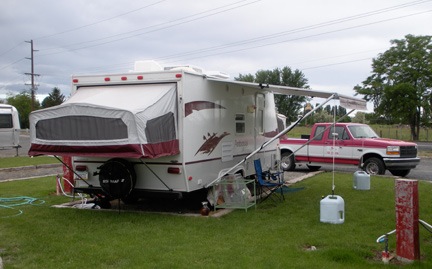
Original RV
My original setup was pretty pitiful. I didn’t realize then how much time I’d be spending on the road.

It all started back in 2008 when I made my first annual migration from Arizona to Washington state to do agricultural work: cherry drying. I’d learned about the work two years before, but it took that long to be assured of a contract after the long migration. And one thing was for sure: I wasn’t about to move my helicopter, truck, and trailer 1200 miles (each way) without some guarantee of work on the other end.

It was a win-win situation for me. Escape Arizona’s brutal summer heat while earning some money with my helicopter, which would likely be parked most of the summer anyway. How could I turn it down?

The first season was only seven weeks long and I only flew 5 hours on contract. It was barely worth the travel time and expense.

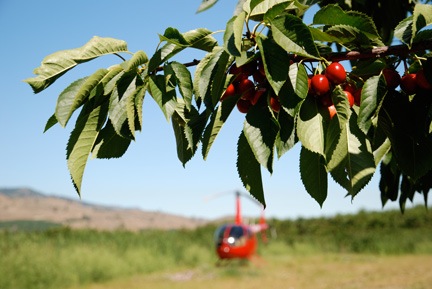
Cherry Drying Parking
In 2009, I picked up late season work in Wenatchee Heights.

But the next year was 11 weeks under contract and I’ve managed to get about the same every year. I’ve also managed to add contracts to the point where I now bring a second pilot in for 5 weeks and a third pilot in for about 10 days. Fly time varies, as you’d expect, with the weather. My goal is to have two pilots (including me) for at least 10 weeks and a third for a month.

The Work

The work situation is unusual. I’m required to stay in the area for the entire length of the contract, on call during daylight hours seven days a week. No days off, no going home on weekends. On nice, clear days with 0% chance of rain, I can wander a bit from base, as long as I keep an eye on weather forecasts and radar. Still, day trips to Seattle (150 miles away) or off-the-grid locations were pretty much out of the question. Heck, I couldn’t even hike in parts of Quincy Lakes, less than 5 miles from my base, because there was no cell signal there.

One pilot I know was in Seattle when he saw the weather coming in on radar. He hopped in his truck and sped east. I don’t think he planned to have the truck break down an hour away. He hitchhiked in and got started on his orchards about the same time I was refueling to finish up mine. Not sure if he learned his lesson. He was back the following year playing the same risky games.

When rain is possible, things are different. I stay close — often at my base all day. If radar shows rain coming, I’ll go out and prep the helicopter for flight — make sure its full of fuel, preflight it, and take off the blade tie-downs or hail covers (whichever it’s wearing). If radar shows rain on one of my orchards, I’ll suit up and wait in my truck beside the helicopter. Then, when the call comes, I can be in the air in less than 5 minutes.

Cherry Drying
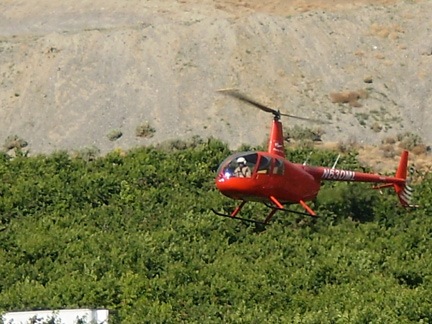
Cherry drying is all about flying low and slow.

The work itself is dangerous and requires good hovering skills in all conditions. I’m hovering just over the trees at low speed, firmly inside the Deadman’s Curve. If the engine quits, a crash through the trees is assured. Some orchards are hilly, others have obstacles like buildings and poles and wires. I can be called out as early as predawn and can be flying after sunset — I’ll fly as long as I can see a horizon.

The summer days in Central Washington State are long, with sunrise around 5 AM and sunset around 9 PM on the summer solstice. Because the night is only 8 hours long and I never really know whether I’ll be flying at dawn, there’s no alcohol, even at the end of a long day — remember: “eight hours from bottle to throttle.”

But the standby pay is good, compensating me not only for getting my helicopter into the area but keeping it there and assuring it’s available when called. It used to bother me when I got calls from tourists in Arizona wanting to see the Grand Canyon in July and I couldn’t take them because I was 1200 miles away. Then I realized that I was being paid for my time in Washington and knew that it was nicer to be paid to sit around and wait than to fly cheap midwesterners — who else visits Phoenix in July? — to a place I visited more times than most people can imagine.

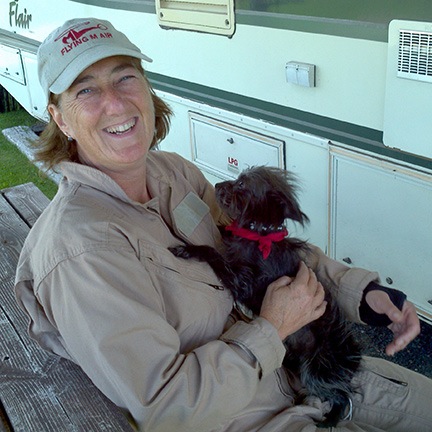
Maria and Penny
Here I am with Penny the Tiny Dog last year after a cherry drying flight.

I did all the work myself: prepping the helicopter, flying, refueling, putting the helicopter to bed. I’d take the truck to the bulk fuel place in Ephrata or Wenatchee and fill my 82-gallon transfer tank with 100LL so I always had some on hand. I’d move, park, and move the RV as needed, dealing with all the hookups, including the often nasty sewer line. I’d handle propane tank refills and minor repairs. I’d also tend to the truck, making sure it got its oil changed with Rotella (as requested), even though it meant a trip to the Walmart in Chelan, 60 miles away. In the meantime, I handled all the client relations stuff, including getting clients signed up, visiting their orchards so I knew where hazards were, invoicing, and collecting fees.

In between, I managed to have a nice, easy-going life, making lots of friends and doing fun (albeit local) things.

The Logistics

The logistics of being a “migrant” worker were daunting. Each May I needed to get my helicopter and RV from Arizona to Washington. Each August or September, I needed to get them both back to Arizona. That meant a total of three round trips.

Logistics
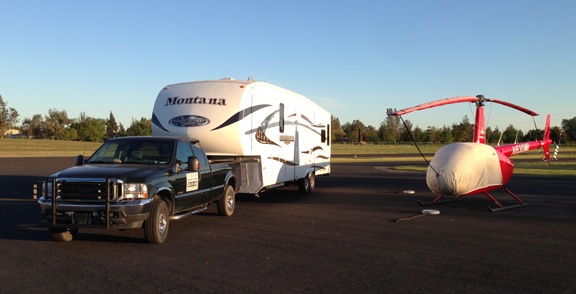
Here are all of Flying M Air’s assets: our helicopter, 1-ton diesel Ford Truck, and a 35-foot fifth wheel RV. It takes two trips for me to move them to a worksite.

I usually brought the helicopter north first, leaving it in Seattle for maintenance. Then I’d fly home on an airliner, hook up my RV to a truck, and make the 2-3 day drive north with my parrot, Alex the Bird. (Alex is gone now; he has a new home.) Then I’d take a flight from Wenatchee to Seattle and pick up the helicopter. With luck, I had decent weather and could come east through one of the passes: Snowqualmie or Stevens.

One time I had rotten luck and, after several aborted attempts to get over the Cascades, wound up flying all the way down to Portland and following the Columbia River through the Gorge. That was a costly ferry flight.

Later, I skipped the Seattle maintenance — saving a ton of money not only on ferry flying but maintenance itself; my Phoenix area mechanics seemed to be able to do the same work for a lot less money.

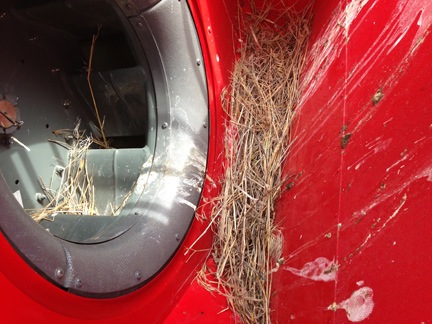
Bird Nest in Fan Scroll
It was not fun cleaning this out of my helicopter.

The last time I left the helicopter behind while fetching the RV, during the week I was gone some birds built a nest in my helicopter’s fan scroll and engine compartment. That was quite a mess to clean up.

The drive up was an adventure, too. I tried all kinds of routes. The fastest was Route 93 from Wickenburg, AZ (where I lived at the time) to Twin Falls, ID and then Route 84 to the Tri-Cities area of Washington and back roads from there. It was a long drive. If I made it to Jackpot NV on the first day — 679 miles from home — I’d have a shorter drive the next day. But most times, I couldn’t do it on my own.

Once, I arrived at my Washington destination after sunset and faced the task of parking a 35-foot long fifth wheel trailer in a parking spot between two railroad ties. I still don’t know how I did it in the gloomy light after driving more than 600 miles that day.

In August or September, I did the same thing in reverse. Take the RV home with my parrot, then fly back on an airliner to fetch the helicopter.

In 2009, my wasband and our dog Jack accompanied me on the return RV drive. My wasband was between jobs and it seemed like a great opportunity to enjoy a late summer trip — we so seldom had real vacations together. We went east to Coeur d’Alene, ID, where a friend of mine lives, then kept going and visited Glacier National Park. We camped there and in Yellowstone. Then, for reasons I can’t quite comprehend, my wasband was in a big hurry to get home, cutting the vacation short by at least a week over what we could have done.

My wasband also occasionally accompanied me on the helicopter flight. I think he did it twice with me. Once, we flew from Seattle to Page, AZ. Another time, we flew from Seattle down the coast until the marine layer forced us inland. I thought he enjoyed those flights, but apparently he considered them “work” — during our divorce trial, he claimed he was working for me to fly the helicopter back. Not likely, since he wasn’t a commercial pilot and wasn’t legal to work as one. Maybe if I’d charged him for the opportunity to build flight time — as I charged every other pilot who flew that trip with me — he would have seen it differently. To me, however, it was just another helicopter “road trip” with the man I loved.

Silly me.

I wonder who’s helicopter he’s flying these days.

Today’s Migrant Farm Work

I started frost control — another kind of agricultural work — last year.

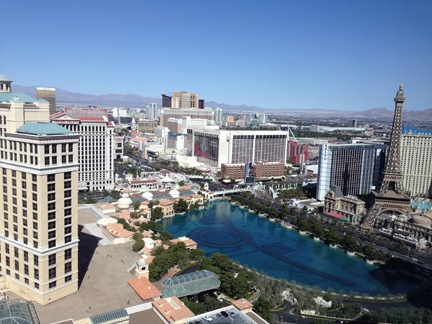
Cosmo View
I went to HeliExpo last year in Las Vegas during frost season and stayed at the Cosmopolitan, with an excellent view of the strip from my room.

My contract required me to put my helicopter in California, but didn’t require me to stay with it. Instead, I’d be paid generously for callouts and standby time. I moved it to the Sacramento area in late February and spent the following two months traveling between Phoenix and Sacramento, Wenatchee, and Las Vegas, spending most of my time in Arizona packing up my belongings for my move to Washington later in the year.

The contract terms weren’t good unless there was frost — and there wasn’t any last year. I just about broke even when you consider my investment in additional lighting for the helicopter and the cost of repositioning it and my RV. But at least I got my foot in the door as a frost pilot and got to see what it was like flying over almond trees in the dark.

Can’t say I liked it.

I moved to Washington in the spring, when the divorce proceedings were over and I’d relinquished exclusive use of my house to my wasband and his chief advisor — the woman who’d apparently convinced him to spend more than $100K to go after my money. (Seriously. I can’t make this shit up.)

I was still “migrant” for a while — I started in Quincy and moved to Wenatchee Heights, just as I’d done the previous five years. But when that late season contract was over, I moved to my future home, a 10-acre parcel of view property overlooking the Columbia River Valley and Wenatchee. It looked as if my migrant farm worker days were over — I could commute from my new home to my clients’ cherry orchards.

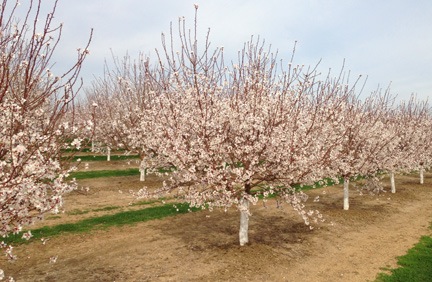
Almond Trees
The almond trees are beautiful when they’re blooming — and they smell nice, too!

I had no intention of doing frost control work under the same contract as last year. But I didn’t have to. I got a much better contract — one that paid better if I didn’t fly. With winter dumping snow on my home in Washington, I moved the RV and later the helicopter down to the Sacramento area again, setting up camp at a small local airport in a nice farming community. With rent at a startlingly low rate of only $200/month with a full hookup, the season would be very profitable even if I didn’t fly.

Best of all, I like the area: the weather was warm, the town was full of great restaurants (and even a beekeeper supply place), there was a nice dog park for Penny the Tiny Dog, and Sacramento was only 20 minutes away. I had a friend in Carmichael, only 30 minutes away, and more friends in Georgetown and Healdsburg, each only 90 minutes away by truck — or 30 by helicopter.

Frost is different from cherries. With frost work, you seldom fly during the day. Instead, you fly any time between 2 AM and 8 AM — most often right around dawn when it’s coldest. That means you have the whole day to do anything you like — hiking, bicycling, kayaking, wine tasting, whatever. As I write this, I’m planning a spa day in Geyserville, a trip to San Francisco, and at least one wine tasting trip to Napa Valley. I’ve joined a few local meetup groups and will be hiking and kayaking with new friends. All while “working” — or at least being paid to stand by in case it gets cold.

It’s almost like a paid vacation — with the added bonus of being able to build night flying time.

It’s a Living

My agricultural work has been very good to me. It saved my business from failure and has made it possible for me to save up enough money for the helicopter’s overhaul.

Once my home is built and my possessions are stored away inside it, I can go back to a modified version of my earlier plan: eight months out of the year flying frost and cherries in in the Sacramento and Wenatchee areas and four months goofing off. But instead of hanging around my old house in an Arizona retirement community with a bunch of seniors, I’ll travel and actually see some of the world on my own terms.

It’s the semi-retired lifestyle I’d expected at this stage of my life, delayed about two years by my wasband’s inexplicable greed and stupidity, and enjoyed without the company of a sad sack old man.

Amex Personal Key Scam

Yet another phishing scam.

Got this one supposedly from American Express today. Pointing to a link in the email message clearly showed that clicking a link would not take me to an American Express website:

American Express Scam

Compare the look of that email message with the top of a real one from Amex:

American Express Legit message

Note that the real one includes my full name and even the last five digits of my credit card number (which I’ve blurred out here). When I point to a link in that message, the URL goes to a page at americanexpress.com.

Don’t be fooled! If you get a message from a bank or credit card company — or any other organization on which you have an account — go directly to that organization’s website by typing in the URL. Do not click a link in an email message. It may take you somewhere you don’t expect or install software that can infect your computer with malware.

My Traveling Bees

If spring won’t come to the bees, the bees will go to spring.

I was very surprised, about a month ago, when a fellow helicopter operator offered me a 6-week (minimum) frost control contract in the Sacramento area. I’ll explain what frost control is in another post; for now, just understand that it required me to relocate with my helicopter to California for at least the 6 weeks of the contract.

Winter in Washington had been mild, with seasonal daytime temperatures around freezing but very little snow. All that changed about two weeks ago when the temperature dropped and then the snow started falling. Not a lot of snow, but enough to make it actually feel like winter for the first time. It was my first real winter since leaving New Jersey in 1996 or 1997 and although I didn’t exactly mind the cold weather, I was ready for spring. So I was very pleased to be offered an early escape from winter that would bring me back home in time for the local spring.

My bees, of course, were all set up for winter. I’d lost one of the three hives and wasn’t sure how the other two were doing. The cold weather was keeping them inside their hives where they’d cluster together around the queen to keep her and themselves warm. It wasn’t a good idea to open up the hives for a good look when it was cold out. I’d already had a peek in late January and had a good enough idea of the situation.

The Crazy Idea

Sometime in the last week before moving my RV out of Washington, I got this crazy idea: it was warm in California and the entire area would be full of blooming almond trees and then walnut trees. If I brought my bees with me, they could skip the last two months of winter and get an early start on spring. I might even be able to get a good start on honey production and do a hive split. And of course, with so many bees in the area for almond pollination, there was even a chance I’d be able to capture a swarm or two.

But could I bring my bees? While it’s true I was driving a full bed pickup truck, I was also pulling a fifth wheel RV. But that fifth wheel had a gooseneck hitch on it, greatly reducing the amount of space the hitch needed in the bed. Could I fit the hives in the pickup bed and still tow the trailer?

The two hives were set up differently. One, the weaker of the two hives, was a single deep hive body with a frame feeder in it to supplement the frames of honey. The other was a deep hive body with a medium body on top; that contained a top feeder. But I didn’t need that top box or feeder for the trip south. I could make that a single deep box high, too. That would fit in the truck bed beneath the fifth wheel.

In all honesty, it wasn’t until the day before I pulled out that I made the decision to give it a try. Even then, I decided that if I couldn’t get it to work out, I’d leave them behind. But late Wednesday morning, I was up at my property with the pickup parked in eight inches of relatively fresh snow near the hive shelter I’d built the previous autumn. And as the temperatures climbed into the high 30s, I was unwrapping the winter insulation from the hives, reconfiguring the taller hive, strapping the hive boxes between their covers and bases, and stuffing rags into the hive entrances. Then I lifted them into the back of the truck. I put the dead hive in there, too; I’d need its components for a hive split or swarm capture and may as well bring it along.

The Drive South

By 12:30 PM — a half hour after my planned departure time, I was at the airport where I’d parked my RV before the snow had come. (Good think I did!) It was all packed and ready to go. I just needed to hook it up to the truck.

When I backed into position, however, I realized that there were bees flying around the back of the truck. On closer inspection, I discovered that they were escaping through the bottom of the hive. You see, I’d replaced the solid hive bottoms with screened bottoms for mite control. While the weaker of the two hives had a Mann Lake screened hive bottom, the other one had a hive bottom made by a friend of mine. He’d used 1/4 inch mesh. As I pointed out to him, he really needed to use 1/8 inch mesh — the bees could squeeze through the larger openings. And indeed, that’s what they were doing. Some of them were coming out for cleansing flights. This would be a problem.

I went into my hangar and found some cardboard. I stuffed it under the hives. Then, for good measure, I stuffed an old saddle blanket I keep in the truck under the hive the bees were coming out of. That would have to do.

Day One
I covered 287 miles the first day of driving.

I hooked up the RV, did my walk around, climbed into the truck, and started off. It was 1 PM and I was hoping to cover about 450 miles that day all the way to a casino near Klamath Falls, OR.

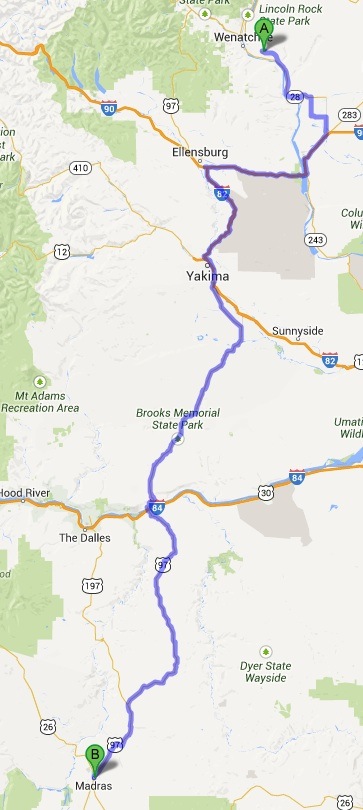
The drive was long but pleasant, with lots of sun and scenery. I drove through Quincy and got on I-90 at George. Then onto Route 97 near Ellensburg. South through Yakima. Cross the Columbia River at Maryhill State Park. Diesel on the Oregon side. Then mile after miles of rolling Oregon farm and ranch land.

It got dark along the way. I don’t like driving in the dark. Weird shit happens.

I changed my destination from Klamath Falls to Bend and then to whatever outpost of civilization I could spend the night in.

I wound up in Madras, parked overnight at a Les Schwab tire dealer parking lot, with a coffee stand on one side of me and a Subway restaurant across the street. I’d driven 287 miles.

I checked the bees before going in for the night. The hives had shifted around a bit, but there were no bees outside the hive. That didn’t surprise me. It was too cold for them to want to come out.

Icy rain fell during the night. In the morning, on my way to the coffee stand at 6:15 AM, I nearly slipped on the ice that had formed in the parking lot.

No sign of life among the bees. But I honestly didn’t expect them to be out and about with temperatures around freezing.

Day Two
I covered 461 miles on the second day of my trip.

I waited until 7:30 before continuing on my way. (Related: Subway, which opens at 7 AM, sells breakfast sandwiches.)

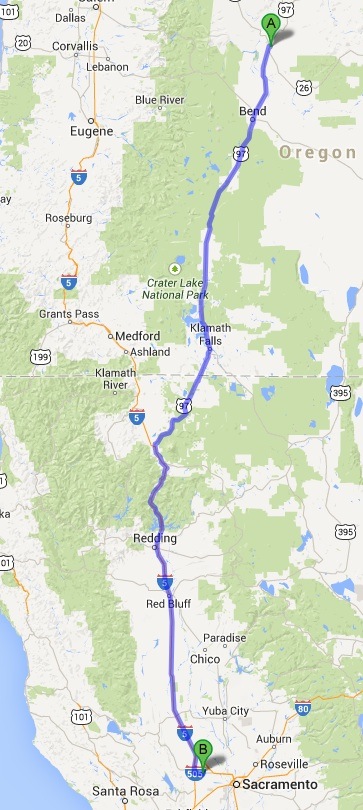
I continued along Route 97, passing through Bend and Klamath Falls. I was lucky to find a truck stop just before the border of Oregon and California where I fueled up for the second time on the trip. The truck was getting about 300 miles per tank of fuel. (It gets way better mileage than the Chevy I used to drive.) I realized that I might make it all the way to my destination without refueling again.

I followed a remarkably straight piece of road that had to be at least 50 miles long before climbing and descending in the foothills again.

At one point, I had an amazing view of Mount Shasta. Or at least the bottom half of Mount Shasta — the top was in a cloud.

Eventually, I reached Weed and joined up with I-5. The next 100 or so miles were mountainous, which wasn’t much fun in the rain. At least I didn’t have to worry about the bees wanting out.

Lake Shasta looked nearly empty. The water was at least 80 feet below the high water mark.

Finally, past Redding, the home stretch. It was great to see flowers on the almond trees I passed.

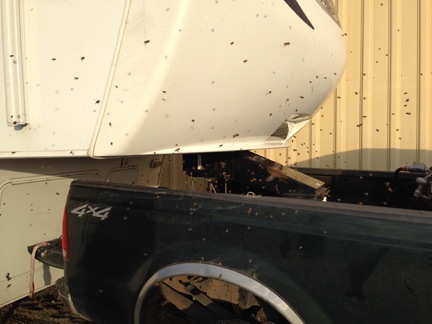
I got off the freeway at my exit and waited at the stop sign to make a left turn. That’s when I glanced up in the rearview mirror and saw about 200 bees flying around the back of my truck. As I’d driven, the weather had cleared and it had gotten warmer. The hives had shifted; the bees had begun to find their way out. With the truck stopped, they wanted out.

Bees
Hundreds of very unhappy bees buzzed around the back of my truck as I parked the RV.

I made my left turn and hurried the last 6 miles to my destination. By the time I was ready to back the RV into its space beside a hangar at the airport, it looked as if there was a swarm of bees in the back of my truck.

It was just after 4 PM and I’d covered 461 miles.

I had to put on my bee suit to unhook the RV. (Thank heaven no one was around to see that.)

I carried the two hives over to the side of the hangar about 25 feet in front of my RV and took the rags out. The bees from the strong hive immediately began flying out. The other hive remained quiet. I was beginning to think it was dead.

I went into town for a richly deserved dinner of chicken chow fun and Chinese ribs from my favorite Chinese restaurant West of the Mississippi. When I arrived at the restaurant, the bees that had been flying around the back of my truck were gone.

Parking the Bees

The next day, the airport manager told me to move the bees to the other end of the airport, in a rough grassy area where they tended to dump junk like old wood, tires, and fencing. We picked a place near the base of a tree. I dropped her off, donned my bee suit, and loaded the bees into the back of the truck. I had to move fast; it was getting warm quickly and the bees were eager to get outside.

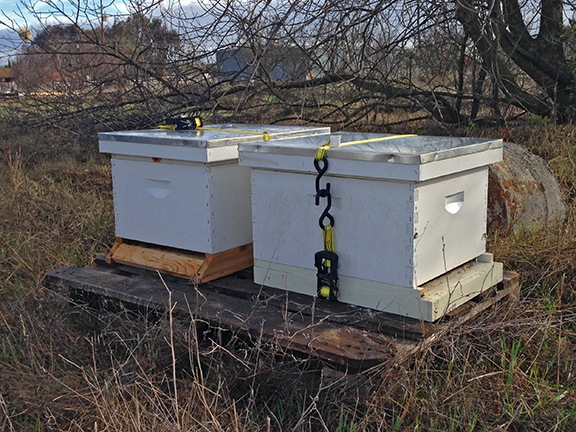
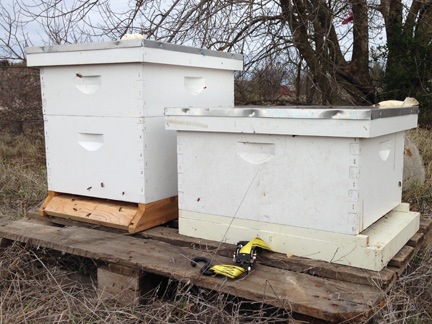
I found an old palette in the temporary bee yard and set it up as a base. Then I put the hives on it, one facing northeast and the other facing northwest.

Bee Hives
The bees on arrival in their temporary home. (Can you see the hot air balloon in the corner of the photo?)

Later on, I returned with the dead hive and my beekeeping toolkit. I unstrapped the two hives and opened them up one at a time. I was shocked to see the number of bees in the healthier of the two hives. The population looked nearly as high as it did when I last looked inside that summer.

I pulled out and examined a few frames. I replaced empty honey frames with partially filled honey frames from the dead hive. I shuffled the frame around and put some brood frames from the dead hive near the center of the live one. The brood cells were empty, but there was plenty of honey in the cells around them. With luck, the queen would get right to work filling these cells with eggs. I also added a drone frame. (What the heck; why not?) Then I put a medium hive body on top of the deep and filled it with 10 medium frames. I kicked myself for leaving queen excluders at home; later, I’d buy one at the local Mann Lake store.

I closed up that hive — which was a good thing, because the bees were pretty pissed off by then — and moved on to the other one. I really didn’t expect to see anyone alive inside. But there was a clump of bees on two frames on one side of the box. They’d apparently eaten their way through the honey stores in the middle of the box. The clump wasn’t big — maybe 1,000-1,500 bees? I could only hope the queen was in the middle of the clump.

Bees
The two beehives after being configured for the next few weeks.

I did some major reorganizing. I removed some very old brood frames and replaced them with newer and cleaner brood frames from the dead hive. Then I added a honey frame filled with honey. I shuffled things around. I had to move the bees, of course — I used my bee brush to brush them into the frames in the center of the hive. Then I closed up the hive. I figure there’s a 50-50 chance of the bees surviving. If they make it through the next week and the queen is still alive, they’ll survive. I’ll examine the hive closely when I return from a trip to Santa Barbara this coming week. If I see the queen or eggs, I’ll know it’s all good. If I see neither, I’ll take action.

Either way, you can bet I’ll report on my progress here.

One more thing: it feels great to be working with my bees again.