Online Store Launched

I’m now selling a few hand-made odds and ends online.

Just a quick note to let folks know that I’ve decided to start selling a few of my hand-made items online using Square.

Ornament
Here’s one of my recent ornaments. Sorry, but this one isn’t available for sale — I included it with a Christmas gift to an extremely supportive family member.

If you go to http://mkt.com/AnEclecticMind, you’ll find whatever items I’ve had time to photograph and put online. So far, that’s most likely to be a handful of fused glass ornaments that I’ve been making with my kiln out of recycled wine and sake bottles. Because each piece is hand-made and, thus, different, I need to photograph each one so they’ll be listed as quickly as I can photograph them. I’m just hoping Square doesn’t display items that are out of stock.

I’m still sitting on the fence about listing my honey, mostly because shipping it will be a bit of a chore and I really don’t have that much to sell this year.

Anyway, this is mostly for the folks who have been complementing me on my glass work. They’re telling me they want to buy these things so here’s where they can do it.

Planning My New Kitchen

It’s small but functional, with lots of counter space and plenty of light.

On May 20, 2014, I began blogging about the construction of my new home in Malaga, WA. You can read all of these posts — and see the time-lapse movies that go with them — by clicking the new home construction tag.

I had two main points of consideration when designing my new home:

  • The total living space needed to be less than 1,200 square feet. That’s because I’m not building a primary residence here. Instead, I’m building the secondary living space allowed by Chelan County on a lot zoned like my 10 acres. The idea is to leave the primary building location — the one that can take better advantage of the views — available for either me or a future property owner to build a house on. That house can be any size as long as this space is 1200 square feet or less.
  • I needed to include lots of windows. What sold me on the lot is that it has amazing views, especially out toward the Wenatchee Valley. Big windows would not only let me take in those views from any room in my home, but they’d also let in lots of light. So I have lots of big windows. The entire building has 21 windows, not including those on each of my five garage doors or three man doors. Sixteen of those windows are in my living space.

Got Windows?
Got windows? I do! My living space is above my garage. I designed it to have regularly spaced, large windows so I could take in the view from indoors.

These two factors combined determined my floor plan. The walls had to be placed between the regularly spaced windows. This made special challenges in the bathroom and kitchen — you can’t put fixtures or cabinets right up against a window that starts 18 inches off the floor and stretches five feet above that.

Although I played around with several designs for my kitchen, I finally came up with a design that utilized a “galley” style with an island/breakfast bar. The key was setting the refrigerator into a wall and putting the stove on the island. That gave me more than 47 square feet of counter space in a room roughly 9 x 13 in size, even though I can’t take the counter all the way to the window. And because my ceilings are so high, I was able to use tall wall cabinets and for extra storage space.

Floor Plan
Here’s the latest version of my floorplan, with my appliances and some of my furniture included. Measurements are rough and don’t account for the thickness of drywall (1/2 inch). The gray shaded area is a storage loft above the hall and utility area.

Understand that although my kitchen in Arizona was large, it was not ideal. The textured tile countertops made it impossible to do something as simple as roll out a pie crust or cookies — and let’s not even talk about the chore of keeping the grout clean in a household where only one person knows how to use a dishrag to clean up spills. The appliances, although supposedly high quality, left a lot to be desired, as I discussed here. Food storage was in the cabinets rather than in a dedicated pantry; small appliances lined the countertop because there was no other practical place to store them. And while it might be difficult to believe, the abundance of countertop space made cooking a chore by allowing multiple work surfaces to leave bowls, measuring spoons, and ingredients — and to clean up.

While I certainly didn’t have the same amount of space in my new home, I could design a better kitchen to meet my needs.

Help from Home Depot

Getting an idea of the kitchen layout was the first part of the process. Getting actual cabinet configurations was another. For that, I turned to the local Home Depot.

Kitchen Drawing
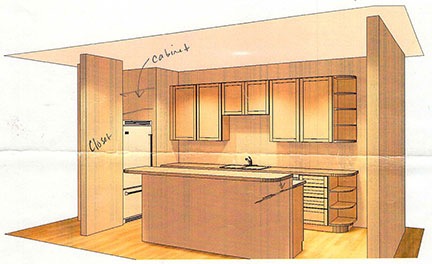
Here’s Home Depot’s first stab at my kitchen. In this original version, I’d planned to mount the microwave in the cabinet below the stove in the island. The island’s breakfast bar was also designed higher in the back. We forgot about cabinets over the refrigerator.

I visited Home Depot back in July to get the process started. This helped me see how cabinets might work in my kitchen. With their kitchen planning software, they selected and placed cabinets to my specifications, then provided me, on request, with a printout of the configuration and a conceptual drawing. This made the room more real to me and gave me some time to think about it and how it might work. It also spit out an estimate of cost, although I wasn’t really thinking much about that yet.

Time passed. I got my living space framed to fit the kitchen we’d designed. I got other things done, like the ceiling/roof insulation and, more recently, the HVAC air handler and ductwork. Although I’d toyed with the idea of going south for the winter, I decided to stick around and finish construction work on my home this winter so I could dedicate early spring to settling in and late spring to putting in the massive garden I was planning.

I’d also had some other thoughts about the kitchen layout. After visiting a new friend’s place in Friday Harbor, I realized that putting the microwave down low would not be a good idea — especially when I considered how much I used my microwave. And although I’d hoped to use the microwave I’d brought from Arizona — the one my parents had given me as a housewarming present for my New Jersey home back in 1986 (!), I decided I deserved a new one. I’d get a large shelf model and put it on a shelf beneath the cabinets. I also decided to keep the island all one level — I saw that at the Friday Harbor home, too, and really liked it. More homey and lots of contiguous counter space for baking and cheesemaking projects.

My goal was to fit a dream kitchen into a small space and I was pretty sure that the changes I had in mind would help me achieve that goal.

Getting Serious

With those changes in mind, it was time to get solid price quotes from at least two sources: Home Depot and Lowe’s. I visited both yesterday.

Lowe's Kitchen
Home Depot's Kitchen
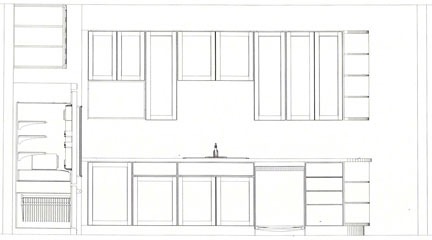
The kitchen drawing as prepared by Lowe’s (top) and Home Depot (bottom). I like the way Home Depot does a cutaway of the fridge.

At Lowe’s, we created the kitchen design on their computer system — which is virtually identical to Home Depot’s — making sure to get every detail. It took a long time and, since my appointment was delayed due to the previous customers taking longer than expected, I ran out of time before we could get into the countertops. Still, she designed the kitchen as I wanted it and gave me a printout of the primary wall’s layout, along with a detailed price quote.

Then I went to Home Depot. Fortunately, my design was still in their computer. We modified it to match what Lowe’s had drawn for me so I could compare apples with apples. I got a printout of the main, refrigerator, and island parts, along with a price quote. We also had time for me to pick out a granite countertop, select options, and get a quote for that. (That’s how I know I have 47 square feet of countertop.)

At this point, I’m leaning toward Home Depot. Their kitchen came in about $1,000 cheaper than Lowe’s for the same quality product — and that’s after manufacturer and retailer incentives. To get the incentives, I have to order at Lowe’s by December 15 or Home Depot by December 21. Both offer an additional 5% savings for using their credit card — which is one reason I have one for each company. Both will charge about $1,500 – $2,000 for installation, which I’ll likely get so I’m sure it’s done right.

As for the countertop, I need to get more estimates. Although the $54/square foot installed price sounds pretty good to me — and the few other folks I’ve asked — I might be able to get a better deal elsewhere. I will definitely check in at Lowe’s.

Keeping It Simple

One more thing… a lot of people have told me not to use Home Depot or Lowe’s for my kitchen. They say there are better options: Ikea, a local kitchen place called Bagdon’s (which I am visiting later today), and various local cabinet makers. But these people need to understand that my decision to use these big box companies is being driven by three factors:

  • Cost. I don’t have an unlimited budget. This is a small living space and I can’t pour a lot of money into it that I might never get back. (Although everyone seems to agree that I’ll have no trouble selling this place for far more than I put into it.)
  • Time. I can’t wait for various contractors to come and measure and plan. I want this done already. I’ve waited long enough.
  • Ease. I’m not interested in buying cabinets at Ikea and cabinet fronts at some local cabinet maker and finding some contractor to put it all together. I want to pick something out in one place, know it will work, and pay one organization to put it in my home. I have way better things to do with my time than play around with vendors and contractors.

While I’d love to spend my money locally with small organizations to get the perfect custom solution, I also need to do what’s right for me. And what’s right now is keeping it simple.

Ladies! Don’t Be Afraid!

There’s no reason you shouldn’t do what you want to do.

The tweet that prompted this post.

Yesterday, one of my Twitter friends shared a tweet that contained a list of the “Top 10 things British women would love to do but are too scared.” The heading at the top of the list asked if readers had done any of them.

I looked at the list and realized I’d done seven of them.

Which ones? Let’s go down the list:

  • Ask for a pay raise. Although I haven’t had an “employer” for more than 20 years, I have asked clients for increases in the rates they pay me — most recently just last week. I honestly can’t remember if I asked my last employers for a raise; in most cases the raises and promotions came automatically and I didn’t need to ask.
  • Travel or holiday alone. I do this all the time — and have been doing it since I began driving in the late 1970s. Hell, I remember taking a train to Canada by myself with just $20 in my pocket when I was 20. One of my Top 10 vacations, in fact, was the “midlife crisis road trip” I took in 2005. I spent 19 days cruising around Arizona, California, Nevada, Utah, Oregon, Washington, Montana, and Idaho in my little convertible with no destination or reservations. I had a blast!
  • Get a tattoo. I have two of them on my right ankle. I got them in the 1990s, before everyone and their kid was getting them.
  • Have a bikini wax. Check. ‘Nuff said.
  • Short Hair
    My hair was actually growing out in this photo from 2012.

    Get your hair cut very short. The first time was in the early 1980s when I got a perm cut out down in Greenwich Village in New York City. That was quite a shock to most folks. After that, I wore my hair short much of the time, getting a few super short haircuts in summer months. My hair is shoulder length now for the first time in more than 30 years. I still haven’t decided if I like it this way.

  • Ask someone out on a date. Still doing that once in a while. Sometimes I’m disappointed, sometimes I’m not.
  • Quit your job. Not only did I quit my job way back in 1990, but I quit it to start a freelance career. That takes courage. But sometimes you need to cut ties to move forward — a tip for any kind of relationship, including employment.

What about the other three? Let’s take a look:

  • Sing in public/karaoke. I’ve never actually seen live karaoke and haven’t had the opportunity to do it. Not sure if I would, though. Is it cowardice? Probably some version of it. No one likes to look like a fool in public.
  • Do a naked photo shoot. It isn’t fear that stops me from doing this. It’s common sense. Women who have naked photos of themselves — or near-naked photos of themselves — out there are just asking for trouble. Do you really want photos of you like that circulating around? My advice, ladies, is to keep your clothes on when a camera is present. Those pictures can and will come back to haunt you. (Ask my wasband’s girlfriend about the ones she sent him that I got my hands on. I’m still wondering whether the playing cards were a hit with his poker friends. My friends sure got a kick out of them.)
  • Have cosmetic surgery. Again, it isn’t fear that holds me back from this one. For years it was the simple fact that I didn’t think I needed any. But as I age and gravity begins to take hold, I’m reconsidering it. It’s on my list but at a low priority. Need to get settled into my home first.

Now I’m not sure if British women — the group supposedly polled for the list — are more cowardly (for lack of a better term) than American women. I suspect they might be. I’m also not sure about the age of the women polled and would have to think that very old and very young women would be more cowardly than those of young enough to be “modern” and old enough to have conquered most of our fears.

But now it’s your turn. How many of these things have you done? What’s memorable about any of them?

And if you haven’t done something you really want to do, why not? Tell us what it is so we can talk you into it. Never let your gender hold you back!

Pride for My Prized Possession

Why I like to keep my helicopter clean.

The other day, I did a Santa flight. When I landed and shut down, one of the many people who’d crowded around the helicopter for a closer look commented on how clean and shiny it was. Although I thanked her, I didn’t say what I was really thinking: it was filthy.

That was my opinion and it wasn’t shared by many others. I’m often complemented on how good my helicopter looks. Just the other day, a pilot friend from Oregon stopped by and he said pretty much the same thing. I pointed out the smashed bugs on the mast and leg fairings and the grime on the back panel near the tailpipe. He then saw what I saw and conceded that it could use some cleaning.

Indeed, it had not been washed with a hose in more than two years.

Keeping it Clean

Washing my Helicopter
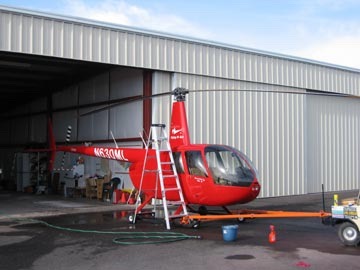
This photo from 2006 shows my wash setup back in Arizona.

Back when I was still living in Arizona, I’d take it out a few times a year with a hose and sponges and a ladder and give it a good cleaning, from back to front and top to bottom. It was quite a chore and often took as much as two hours. I had to time it right so the sun wasn’t full on it and I could towel it dry before water droplet stains could form. Often, I’d finish it off with a coat of RV spray wax. Occasionally someone would help, but more often than not, they didn’t seem as interested as I was in getting it perfectly clean — or as close to perfection as possible.

Since January 2013, my helicopter has been bouncing from Washington to California and back to Washington on various agricultural flying contracts. It lived outdoors for months at a time, spending the winter of 2013/14 in a Wenatchee Airport hangar before settling into its permanent space in my RV garage at home only two months ago. The last time I washed it was when it still lived in Arizona, back in 2012. Since then, I’ve had to satisfy myself by wiping it down with a microfiber cloth after a heavy rain. That took care of most of the dust and some of the bugs. Spot cleaning took care of the rest.

Although my building has a handy drain in the floor and a hose spigot indoors, I haven’t gotten around to washing it in there — mostly because it’s too cold this time of year for it to dry properly. I expect I’ll be washing it indoors once in a while when spring comes. Otherwise, I can wash it outdoors on its landing pad in the summer, when the late afternoon sun sinks behind my building and leaves the driveway apron in the shade. That’s the plan anyway.

My Prized Possession

Why is it so important for me to keep it clean? It’s simple: I’m proud of it. It’s my prized possession.

Please understand that it’s not really the value of the helicopter that makes me so proud. At this point, it’s 10 years old. Both the house I still (unfortunately) own with my wasband and my current home are worth more (although the helicopter was once worth more than either one). Resale value does not make it a prized possession.

Instead, it’s what the helicopter represents: the result of hard work, smart investments, and a never-ending drive to make my business grow and thrive with good-paying work.

I look at the helicopter and I see long days sitting in front of a computer, writing book after book for my publishers. I wrote or revised 85 books in 20 years. Because they were computer how-to books, they had tight deadlines. How many 12-hour days and 7-day workweeks did I spend in my office banging away on a keyboard to meet a deadline? Too many to count. And don’t even get me started about the 12 summers in a row that I spent mostly indoors, working to meet deadlines for my Quicken books. It was only because a handful of my titles became bestsellers that the money started flowing in. That money made it possible to buy my first helicopter, a much smaller two seater that I put 1000 hours of flight time on in just five years.

I look at the helicopter and I see real estate investments I bought to explore a role as a landlord. The property with a two-bedroom home and four furnished studio apartments that I bought in the early 2000s stands clear in my mind. Yes, I got a good deal on it, but I also poured a lot of time and money into it, improving each furnished unit, showing it to a countless stream of snowbirds and transients, cleaning apartments over and over, dealing with complaints and tenants who couldn’t pay their rent on time or at all. And then the suicide in one apartment followed closely by the suicide of a tenant before she even moved in. (Seriously, I can’t make this shit up.) This property taught me how much I could hate being a landlord. But when I sold it shortly before the peak of the real estate market and pocketed a 50% profit in less than five years, I wasn’t complaining. That money, and the proceeds from the sale of my first helicopter, is what made up the sizable downpayment for my prized possession, making monthly payments for the balance almost affordable.

I look at the helicopter and I see all the ways I tried to build my business and make it profitable. I think about the tours and photo flights I’d do no matter how little revenue they generated. I think about the first few regular clients I got — a Russian photographer who led photo expeditions in the Southwest and needed a pilot over Lake Powell, Monument Valley, and Shiprock; a local addiction treatment center bigwig interested in showing off to client parents and investors by flying them to the desert facility; a proving grounds manager needing an aerial photo pilot who wasn’t afraid to operate in the deadman’s curve; an environmental impact study company that needed to fly hour after hour along cliff faces looking for raptor nests; orchardists who needed protection for their valuable cherry or almond crops. I think about the epiphany I had when I realized that these clients and this work was what would make my company succeed and that I was simply wasting my time trying to attract one-time clients looking for a deal.

I look at the helicopter and I think about all the hard work involved to keep my business profitable. I think of flying through weather to get to a client on schedule, I think of long hours flying slowly along the top of winding canyons, I think of hour after hour hovering low-level over cherry trees, I think about staying in cheap hotel rooms and having to walk three miles with luggage just to get back to the helicopter, I think of living in an RV for months on end. I think about writing proposals, sending out contracts, and tactfully nagging for payment. I think about patiently explaining to a client why he should fly with me instead of a cheaper alternative in a smaller aircraft piloted by a less experienced pilot. I think about networking and getting the word out and landing cherry drying and frost control contracts that finally got me in the niche I needed to ensure long-term profitability. I think about moving my helicopter and my RV between Arizona and Washington state — four 1000+ mile trips each year — usually by myself, year after year in all kinds of weather. And moving them again between Washington State and the Central Valley of California — four 500+ mile trips each year — for the past two years. I think about taking annual check rides with the FAA and dotting all my I’s and crossing all my T’s to satisfy government requirements.

I think about the money I spent on the helicopter since buying it in 2005: $268,000 for maintenance, $123,000 for fuel, $144,000 for insurance, and $47,000 on interest for the helicopter’s loan. I think about those numbers along with the other expenses I’ve had for simply owning the helicopter and operating a business — well over $1,300,000 total in the past 10 years — and how I feel when I explain to a passenger that it costs more to fly a helicopter than just the cost of fuel.

Cascades
My most memorable flight of all was from Wenatchee, WA to Hillsboro, OR in the summer of 2012; check out the video.

And then I think about the amazing flights I’ve had at the controls over the past ten years. Flying through desert canyons and up or down the California coast. Floating over the clouds at San Francisco, seeing one end of the Golden Gate Bridge poking up through the fog layer. Cruising over Lake Powell at sunrise or sunset as the sun’s first or last light touched the red rock cliffs. Flying along snow-covered hoodoos at Bryce Canyon. Crossing Cascade Mountain ridges above valleys full of clouds. Zipping past weird rock formations in Utah, Arizona, and Nevada. Speeding low across the empty Sonoran desert, over ridges and around tall cacti. Crossing the Navajo Reservation with wild horses and the remains of abandoned hogans below me. Skimming 50 feet above the surface of the Columbia River, waving to boats and water skiers I pass. Chasing race trucks on desert trails and go-fast boats on desert lakes. These are just examples off the top of my mind; a look through my log books would yield dozens of others.

And I remember that none of this would be possible without my prized possession.

And my prize possession wouldn’t be mine without all the hard work and long hours I put into earning the money to buy and keep it.

It’s more than just a costly possession that makes people (erroneously) think I’m rich. It’s a symbol of my achievements in life, the result of working hard and smart for a long, long time. It’s my reward for staying focused and doing what needed to be done, to the best of my ability, to move ahead, even when certain people tried so hard to hold me back.

Catching Up on Cleaning

So yesterday, I took advantage of the big, heated space inside Pybus Public Market, where my prized possession is currently parked. I brought in some Meguiar’s Detailing Spray, Turtle Wax Bug and Tar remover, and clean microfiber cloths. And then I finally cleaned the bugs off the mast and the leading edges of the horizontal and vertical stabilizers, leg fairings, and cockpit. I covered all the painted surfaces with the detailing spray, wiping it with a succession of clean rags that soon got dirty from the thin film of grime that had been on the helicopter’s skin. I worked slowly and carefully while a handful of people wandered by to check out the shiny red thing unexpectedly parked by the south door.

My Prized Possession
I took a picture when I was finished. (Missed a rag.)

When I was done, it was even shinier.

But I can still see a few bugs I missed on the mast…

On Santa Flights and Community Service

It’s part of doing your part to make the world a better place.

This weekend, I flew Santa in my helicopter to two destinations.

The first, on Saturday, was to a private home in Leavenworth. It was a for-hire job; I picked up Santa in Cashmere, WA, killed some time with a short scenic flight in the area, and touch down right on time in the front yard of a beautiful log home on the Wenatchee River. There were a lot of people there to welcome us. It was a great flight on a great day. You can read more about it here.

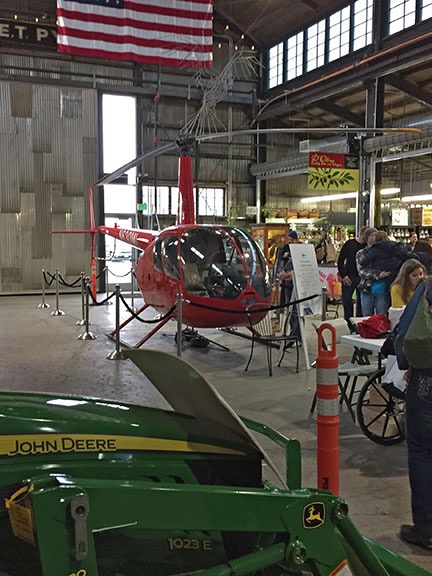
N630ML at Pybus Market
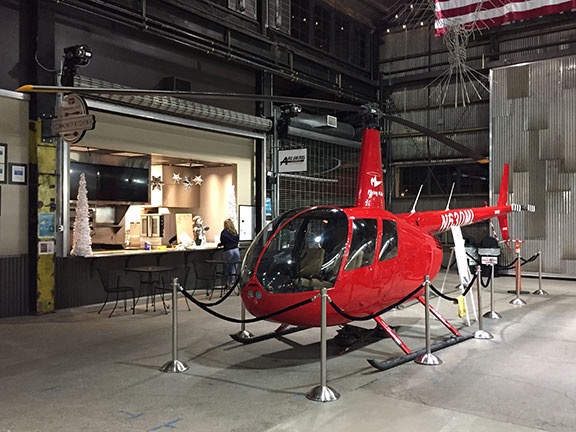
My helicopter is parked inside Pybus Public Market this week.

The second was on Sunday. I did a repeat performance of last year’s flight to Pybus Public Market (which I apparently didn’t blog about last year). I took along my friend Kathy and her grandson Dominick. We picked up Santa at Wenatchee Airport and flew to Pybus, landing in front of an audience of at least 200 people. Afterwards, we pulled the helicopter indoors so folks could get a good look at it. The people who run Pybus do their best to have interesting things to see inside the building and I don’t think you can get much more interesting than a helicopter.

Although both Santa flights had a community service aspect to them, it’s the second one that I’m most proud of. You see, for the past two years I’ve offered to do this for Pybus without compensation. It’s my way of giving back to the community, of making things just a little special for others without expecting anything in return.

Sure, I have some company literature in front of the helicopter and yes, I’d be thrilled if someone picked up a rack card and called me to book a flight. But I did this last year, too, and it didn’t lead to any business. Based on that experience, if business was all I cared about, (1) I wouldn’t leave the helicopter parked inside Pybus for nearly a week and (2) I probably wouldn’t bother doing the Santa flight in the first place.

(In the interest of full disclosure, this year the folks at Pybus surprised me by giving me some money to help cover the helicopter’s operating costs for the flight. I think I appreciated that even more than they appreciated me bringing Santa in.)

I’ve done other community service flights with my helicopter. Although I did a completely unappreciated golf ball drop in Wickenburg a few years back, I also did several fly-in presentations at schools in Arizona: Congress, Salome, and Wickenburg. In each case, I arranged in advance to fly into the school grounds with students on hand to watch. Then I made a separate presentation to each grade group, telling them about the helicopter and pilot careers and how important math and science and geography were for pilots. And I answered questions. The way I see it, if even one kid on the brink of making a bad life decision makes the right decision instead because of something in my presentation, I’ve got a total win.

I’ve done community service without the helicopter, too. The most memorable was a presentation about being a writer that I did for an English class at Wickenburg High School. It was a very eye-opening experience. I learned two things (1) kids don’t seem to care much about education these days and (2) we don’t pay teachers enough money.

I’m trying hard to get into a construction job for Habitat for Humanity here in Wenatchee, but so far the only thing they’re interested in is having me work in their store. While I’m happy to give them a full day of work once a week, I want to work on a home so I can learn more about construction. It’s a give and take situation.

Why bother doing community service at all? Well, there certainly is a feel-good aspect to it. For two weeks leading up to my Pybus Market event, the Santa flight was widely advertised on all local radio stations, as well as in flyers and digital info boards around town. And it worked! As I mentioned earlier, there were at least 200 people of all ages waiting for our arrival. The kids gathered around Santa as he left the landing zone and, as soon as my blades stopped, folks gathered around the helicopter to look at it and take photos with their kids. Without me, none of that would have happened. How can I not feel good about playing such a major role in their day?

But community service goes beyond that. It’s a way to make your community stronger and more vibrant, without donating hard cash and wondering how it will be spent. It’s a way to meet your neighbors and make new friends. It’s a way to learn more about your community and help it achieve goals that you have the skills or know-how to help them achieve. It’s a way to make a positive impact on the lives of others — and your own.

Community service opportunities are all around you. It’s all about volunteering. Schools, non-profits, charities — they can all use help. Pick the one that means the most to you — or the one you think you could help the most — and ask them what you can do for them.

I promise — you won’t regret it.