The Bible and Science

PZ Myers explains; I agree.

Just a quick blog post to give you all something to read and think about. Not here. On The Humanist Web site.

That’s where you’ll find an article titled “Comes a Horseman” by PZ Myers. In it, you’ll find this paragraph, near the end, which (to me) sums up why we should all be concerned about religion, especially in our schools:

And this is why I oppose religion. It’s not because it kills people, although it does. It’s not because it poisons everything, although it does. It’s not because it is nothing but a philosophical construct even though that’s all it is, and I actually kind of like philosophical constructs. Even moderate religion is an exercise in obscurantism, the elevation of feel-good fluff over substance. I oppose it because it is a barrier to understanding, a kind of simplistic facade thrown up to veil knowledge with a pretense of scholarliness. It’s an imaginary shortcut that leads people astray, guaranteeing that they never see the real glory of a cell or of the stars. And I honestly hope that once people see the creation story for what little it is–one thin sheet of tissue paper–they will be able to crumple it up and toss it aside.

Read the whole thing.

Why Isn’t “Childhood’s End” in my Local Library?

But boatloads of religious and mystical crap are?

Sir Arthur C. Clarke died in 2008. He was an award-winning science fiction author — and that’s an incredible understatement given the number of awards and his impact not only on science fiction but science itself. Most people know him for his novel 2001: A Space Oddyssey, which was made into a ground-breaking science fiction film in 1969.

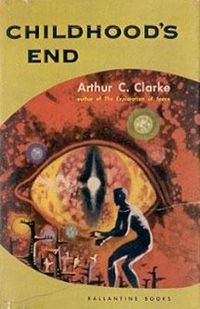
Childhood's End CoverOn the day he died, Twitter was filled with commentary about his work. But it wasn’t 2001 that came up again and again. It was his 1953 book, Childhood’s End.

From Clarke’s Wikipedia entry:

Many of Clarke’s later works feature a technologically advanced but still-prejudiced mankind being confronted by a superior alien intelligence. In the cases of The City and the Stars (and its original version, Against the Fall of Night), Childhood’s End, and the 2001 series, this encounter produces a conceptual breakthrough that accelerates humanity into the next stage of its evolution. In Clarke’s authorized biography, Neil McAleer writes that: “many readers and critics still consider [Childhood’s End] Arthur C. Clarke’s best novel.”

Indeed, Childhood’s End is so outstanding among Clarke’s work that it has its own Wikipedia entry.

I’m pretty sure I read the book, but I honestly don’t remember it. My science fiction reading was done mostly in my late teens and I consumed a lot of Clarke’s work. Rendezvous with Rama remains my favorite of his books. But when so many people on Twitter were raving about Childhood’s End, I made a mental note to track it down and read it (again).

Time passed. I’ve halted all book buying in an effort to stem the tide of incoming clutter at my home. I wanted to read something other than the books on my reading pile. Something to escape the real world. And I remembered Childhood’s End.

So I visited Wickenburg’s Public Library to pick up a copy.

And was surprised to learn that they didn’t have it.

Not that it was simply out on loan. They just didn’t have the book in the library.

They had 2001, 2010, 2061, and even 3001 (which I didn’t even know existed). And there was another Clarke title on the shelf — although it wasn’t listed in the computerized card catalog. But no Childhood’s End — which many consider his best work. No Rama, either.

I was disappointed, but not terribly surprised. They didn’t have Carl Sagan’s Contact, either. That book had been made into a movie starring Jody Foster. You’d expect it to be present on the shelves, but … well, I’ll get to my reason why in a moment.

I looked around the library for what they did have. The New Arrivals section bore little resemblance to the New Arrivals tables at the Barnes and Noble I visit near our Phoenix place. Those were new, noteworthy books. I only found one of them in Wickenburg: The Murder of King Tut by James Patterson. I grabbed it. There was very little fiction and much of the fiction they did have had Christian crosses on the binding. That’s Wickenburg’s way of noting that a book is Christian literature. They do the same thing with mysteries and science fiction, but the New Arrivals area had far more crosses on bindings than other symbols.

I wandered back to the paranormal section of the nonfiction shelves, hoping to find some of the books I’d seen listed on various skeptics sites. To their credit, they had Flim Flam! by James Randi — an excellent read that I reviewed here. But that was the only title for skeptics. Meanwhile, they had over two dozen titles by Sylvia Browne. And the health section was stuffed with books about unproven remedies and health regimens.

I wandered back toward fiction and started actually looking at the bindings. That’s when I started noticing that there was an unusually high percentage of books with that Christian cross on it. Christian fiction. The library was full of it.

But it only had four books by Arthur C. Clarke.

I looked around. Other than a young woman surfing the net on her MacBook Pro, I was the youngest patron in the place. I’m in my 40s. The rest of the patrons were 60+.

I went to the desk and asked if the library could get books from other libraries in Maricopa County. I was told no, the library is run by the Town of Wickenburg and is separate.

I asked why the library didn’t become part of the Maricopa County library system. I was told that then Wickenburg would be told what books it had to carry.

“Maybe that wouldn’t be such a bad thing,” I said.

“Yes, it would,” the librarian replied. “We know what our patrons want to read.”

They do? Sure fooled me.

I’m a patron, but I don’t want to read any of the Christian fiction and pro pseudoscience crap that fills the shelves. I want to read bestsellers, the classics, and award-winning fiction. I want to read non-fiction that educates me about science and philosophy and opens my mind to critical thinking.

Clearly, I’m not going to get any of that at Wickenburg Library.

And that brings me back to my suspicions on why Contact and more books by Arthur C. Clarke and other thought-provoking authors are not in the library: the themes of these books have the audacity to suggest that there might not be a God. That the meaning of life might be something beyond what’s in the Bible. That science and a reality based on known facts are important to our survival as a species or civilization, more important than man’s religions.

Censorship at our local library? I’m convinced. Why else would they refuse to be a part of one of the biggest library systems in the state?

And my tax dollars are paying for this?

When I asked whether I could get a Maricopa County library card, the librarian confirmed that I could — but not there. “Aguila has a branch,” she told me.

Aguila is a farming community 25 miles west of Wickenburg. I’d estimate that at least 25% of the population doesn’t even speak English. Most people live in trailer homes. It’s a sad, depressed community with nothing much to offer. The possibility that it might have a better library than Wickenburg boggles my mind.

“If you get a Maricopa County library card, it’ll cost us money,” the librarian said. It was almost as if she were asking me not to, just to save them a few bucks.

What she didn’t realize was that she gave me even more reason to get one. I think my husband will have to get one, too.

Fortunately, there’s a branch of the Maricopa County Public Library walking distance from our Phoenix place. I guess I’ll be getting my reading materials there, on Wickenburg’s dime.

Arguing with a True Believer

It’s a waste of time.

I’m a skeptic. I’ve been a skeptic for at least the past 10 years, although I didn’t have a label for it way back when. After realizing that there was no proof in a lot of things I’d been told to simply believe, I started looking at things with a more skeptic eye. Although you can’t prove a negative — for example, something doesn’t exist — you can withhold believe until proof of the positive. That’s where I sit now.

Mary’s Mother

It’s also where I sat a few days ago when a house guest brought up the topic of a person’s spirit continuing to exist after death. When she — we’ll call her Mary (not her real name) — asked me whether I believed a person’s spirit existed after death, I said, without hesitation, no. She then launched into a long story about why she believed that spirits do go on after death.

It was kind of pitiful. Mary’s mother had died about two years before after about a year of declining health. Mary lived in California. Her mother lived in New York. Her mother was financially stable and had hired in-home nurses to care for her as she began the dying process. She’d been an alcoholic for most of her life and although she was always upbeat and fun, her last months were painful. Mary believed that the Hispanic nurses had held back on pain medication until her mother “accepted Jesus” — not very likely, as she was Jewish — and, as a result, her mother’s eventual death was more painful than it should have been.

Mary and her brother visited during the months their mother’s health was declining. In the end, they stayed until it was over.

Mary claims that a few days after her mother died, she had a dream that convinced her that her mother had died “a horrible death.” (I have trouble believing that, as she was fortunate enough to die at home with family nearby.) Mary claimed that her mother’s spirit was trapped in her house, unable to escape to whatever other place spirits are supposed to go.

Desperate to resolve the situation and save her mother’s tortured spirit, she sent a family member to the now unoccupied house to tell her mom to leave. (Mary was back in California by this time.) I don’t know if this family member actually did this.

Mary then contacted a psychic in California for assistance. I didn’t get all the details on the first contact. Apparently, Mary e-mailed the psychic a photo of her mother. I don’t know if she provided her mother’s name. In any case, they spoke by phone and the psychic managed to convince Mary that she could communicate with her dead mother. Tarot cards were involved; Mary didn’t understand why she needed them but was willing to put that aside. She told Mary that her mother was indeed trapped in her home and that the only way to free her spirit was for three people in three different places to light candles and play her mother’s favorite music and pray to her mother to “cross over.” I think they had to do this for three days in a row, but I may have that wrong.

So Mary asked her husband and cousin to do this. She did it, too. She says she’s not sure if her cousin did it.

Afterwards, she met with the physic in person. The psychic told her she did not remember their initial contact. She asked the psychic about her mother’s spirit. The psychic said that her mother’s spirit had been trapped but then something had “popped” (her word) and her mother had crossed over.

Mission accomplished.

I don’t know how much money exchanged hands, but I know Mary can afford whatever it was. And I do know that Mary is happy now, so I guess you can easily argue that no harm was done.

I’m not quite that generous, though.

Cold Reading

What followed was a discussion of cold reading, where a “psychic” makes a bunch of guesses and then reads his subject’s response to zero in on actual facts. It is documented that the human mind is more likely to remember correct guesses than incorrect ones. So if a “psychic” does a “psychic reading” and makes 5 correct yes/no guesses, 9 yes/no misses, and one direct hit, people come away thinking that the “psychic” has real psychic power.

Of course, John Edward came up in our conversation. Mary fully believed in his power. She had examples of “proof” of his power. She was not interested in the fact that every John Edward Crossing Over show is taped and then edited. They edit out the discussions he has that result in mostly misses and leave in the results that are mostly hits. The result might be something like this, which I don’t think is very convincing:

Did you watch this video? This is classic cold reading. Throwing out a common name, picking the person who responds, and asking questions to get information. Guessing all kinds of things that are relatively common — cancer, military service, etc. Pulling info out of people with questions. And they think he has real power. But listen carefully. How much is he actually getting right? How much is he telling them? Isn’t it more of a fishing expedition to suck information from people who already believe in his ability?

As Joe Nickell writes in his piece about John Edward:

The “psychic” can obtain clues by observing dress and body language (noting expressions that indicate when one is on or off track), asking questions (which if correct will appear as “hits” but otherwise will seem innocent queries), and inviting the subject to interpret the vague statements offered. For example, nearly anyone can respond to the mention of a common object (like a ring or watch) with a personal recollection that can seem to transform the mention into a hit.

I could not convince Mary. She was not willing to believe in my explanation of how he could have gotten a particular detail correct. The discussion got heated. She kept trying to convince me. I could not be convinced about a “trick” when I knew how it was done.

What I find particularly disturbing about all this is that Mary has a PhD in psychology and treats patients with particularly troubled backgrounds. She should be the voice of reason in these people’s lives. I hope that “woo” does not find its way into her diagnoses or treatments.

Another Friend

When I tried to relate this story to another friend of mine, he said two conflicting things in the same sentence: “You know I’m skeptical about all kinds of things, but I really believe the psychic I go to has real power.”

It was difficult for me not to explode with laughter.

He then went on to tell me about what was likely a personal, one-on-one cold reading. He’d make an easy subject. He’s a real talker and it wouldn’t take much to pull information out of him. He’s also willing to believe, which makes him more likely to remember hits more than misses or turn partial misses into hits by voluntarily providing information that makes a wrong guess right. This is why true believers will always continue to believe. They don’t understand that if a person had real psychic power, he/she should be able to make far more factual statements than errors. And the technique wouldn’t be a glorified guessing game, like the one John Edward plays on his television show.

My friend told me I should go see his psychic for proof. He’d set up an appointment. He’d tell her that I was a skeptical friend —

I stopped him right there. I told him I’d go, but only if he didn’t tell her a single thing about me — including my name. He didn’t seem to understand that she could simply Google me to learn all kinds of things about me that would be useful in her “reading.” It wouldn’t be a cold reading anymore; it would be a hot reading. She could simply recite things off my bio.

Will I go? Only if I’m sure she doesn’t know anything about me when I arrive. I may throw out my first name to see if she takes the hispanic bait (in Arizona, it’s far more likely for a woman named Maria to be Mexican than Italian). I’ll likely dress myself up a bit to alter my appearance and lead her to believe things about me that might not be true. I think these would be good tests of her ability to read minds rather than physical appearances. It would be an interesting experiment.

After all, I am a skeptic. Although I don’t believe that anyone has psychic power, I’m willing to let them try to prove that they do.

Two Kinds of Road Trips

Reflections on traveling long distance by car.

The TruckThis past week, I traveled with my sister as part of a convoy of vehicles moving her from New Jersey to Florida. The other vehicles included my dad in a Budget rental truck (see photo) containing the contents of my sister’s recently sold condo and my dad’s wife in an SUV. We buzzed down I-95 at highway speed, stopping only for food, fuel, and bladder demands.

If you’ve ever driven I-95 — or most freeways, for that matter — you know how mind-numbingly boring the trip can be. You’re moving at 55 to 75 miles per hour down a corridor that’s often straighter than an arrow shaft. Although there are occasional scenic vistas, they’re usually ruined by the tractor-trailer trucks you’re passing (or passing you). The main points of interest are the billboards and the variety of fast food joints and hotel chains at exits. The only excitement comes when some jackass cuts you off or something falls off the trailer in front of you.

The benefit of the interstate highway system is speed, of course. If there’s no construction or accidents or rush-hour traffic in a major metropolitan area, you can zip right along to your destination. We travelled almost exactly 1,000 miles over a day and a half. My dad routinely makes this drive to/from farther south without an overnight stop. It’s a lot of driving, though. And it just isn’t fun.

Each year, I drive from the Phoenix area to Central Washington State and back towing a travel trailer. It’s about 1,200 miles each way. Although Google Maps tries to put me on freeways for the entire trip, I don’t go that way. Instead, I take the back roads that criss-cross the western states. Last year, I was mainly on Route 93. This year, I was mainly on Route 95. These are long two-lane, so-called “blue highways” that pass through small western towns and cities. Along the way, you can get a feel for the landscape and the way folks live. There’s seldom any traffic and the speed limit is often as high as 65 mph so you can move from place to place at a reasonable pace. You can stop just about anywhere along the way and although your choices for meals and fuel and hotels might be limited, they’re not just the same chain establishments you’ll see along the freeway. It’s a whole different way to travel, a whole different experience.

What I like about the blue highways is the opportunities to stop at interesting spots along the way. Instead of pulling into a McDonald’s for lunch, I might stop in a parking area with a scenic view and have a picnic lunch there. Instead of staying overnight at a Super 8 motel adjacent to a truck stop or parking my camper in a Walmart parking lot, I might roll into a state park and camp alongside a creek. If there’s a historic site or roadside attraction, I can easily pull over to take some time there and enjoy it. I can change my route at any intersection. Best of all, I set the pace.

Back in 2005, I conducted what I like to call my “midlife crisis road trip.” I hopped into my little red Honda S2000 with some luggage and credit cards and hit the road for 16 days. I traveled almost every day, getting as far away from Arizona as Mt. St. Helens in Washington, western Montana, and Yellowstone National Park. I had a general idea of where I wanted to go, but no reservations and no need to be anywhere on any day. I slept in motels, hotels, rustic cabins, and even a yurt. I ate all kinds of meals, from crappy fast food and terrible coffee at drive-thru joints to fine dining at the foot of Mt. Shasta. I made side trips daily, visited parks, and talked to lots of strangers. I put more than 5,000 miles on my car, got two oil changes on the road, and even replaced the rear tires after wearing them out. (Z-rated tires just don’t last very long.) I had a great time — better than most vacations — and I’d do it again in a heartbeat.

While I realize that this week’s trip wasn’t for pleasure — the goal was to get my sister, her car, and her belongings from New Jersey to Florida in the minimum amount of time — it certainly did highlight the differences between my usual kind of road trip and motoring down the interstate between points A and B.

And it reminded me why I prefer the blue highways when enjoying the trip is more important than getting to the destination.

Two Ways NOT to Ask for a [Pilot] Job

More real stories from my e-mail in box and blog.

I was away for four days, completely off the grid. Even my cell phone didn’t work where I was. I had a lot of catching up to do when I got home Sunday night. This included my e-mail in box and comments on my blog. Both yielded fodder for this blog post.

The post is really about job hunting and two things you shouldn’t do when trying to find a job as a pilot. In this case, it’s a helicopter pilot job, but it could be any kind of pilot job. In fact, it could be just about any kind of job at all.

Fishing with Comments

The first was a comment on one of my blog posts. The post in question was from June, 2008. That’s over a year ago. I’d written about my upcoming work drying cherries in Washington State. The post had gotten a few comments — over a year ago. But this weekend’s comment came out of the blue and had very little to do with the post content:

Do you hire any pilots of have any pilots that help you out with flying?

Knowing the number of out-of-work helicopter pilots are out there, I automatically jumped to the conclusion that this person was fishing around for job openings. I wasn’t kind to him. (I really can be a bitch sometimes.) My response was:

If this is the extent of your job-hunting capabilities — posting comments on old blog posts — you may as well give up on finding any job. Sorry to be so blunt, but you asked for it.

After posting this snippy response, I considered that maybe he wasn’t looking for a job. Maybe he was just curious to know whether I hired other pilots to help me — but didn’t necessarily want to be one of those pilots.

But my first instinct was probably right.

The One-Paragraph Resume by E-Mail

The second poor job hunting attempt arrived in my Flying M Air e-mail in box. Keep in mind that unless you have my Flying M Air e-mail address, which I no longer publish anywhere, you can only e-mail me by filling in a form on Flying M Air’s Web site. The same page that includes the form also includes my phone number. Yet this person chose to use e-mail to inquire about job openings. Here’s what he wrote; I XXXed out the identifying info to protect this guy from personal ridicule:

Maria Langer/Chief Pilot:

My name is XXX and I am a commercial helicopter pilot. I am inquiring about whether there is an available pilot position within Flying M Air. I have a little over 200 hours total time, which consist of 120 hours in the R-22, R-44 pilot in command endorsement, 70(+)hours in the Hughes 300, and the Robinson safety course in 2008. In addition, I will be receiving my Associates in Applied Science degree-Flight Technology in December 2009. If you have any questions or would like to schedule an interview I can be reached at XXX-XXX-XXXX or emailed at XXX@XXX.com.

This is wrong on so many levels:

  • This guy has only 200 hours. What helicopter charter company would even consider hiring a pilot with barely enough flight time to qualify for a commercial certificate?
  • This guy has only 10 hours of time in the aircraft my company owns and operates: an R44. (Do the math.)
  • How much of this guy’s flight time is solo or other PIC? (Remember, he said total time.) I’m guessing less than 25 hours solo and only 100-125 PIC.
  • Does this guy really think that an AS degree is worth anything to an employer looking for a pilot? (Or, with apologies to those of you who place significant value on a 2-year degree, any employer?)
  • Is this the extent of this guy’s resume?
  • Does this guy really think that an employer would call him for an interview after receiving a paragraph about him via e-mail?

Although I wanted to reply with any combinations of these thoughts that ran through my mind, I didn’t. Instead, I wrote:

Sorry, we don’t have any jobs available at this time.

Good luck.

And that brings up the real problem with this lame attempt at job-hunting: my reply e-mail bounced back. He’d entered the wrong e-mail address in the form.

FAIL.

Think of What You’re Asking For

When you ask for job, you’re asking for a responsibility.

For a pilot job, you’re responsible for your employer’s paying passengers or cargo. That means other lives or possibly valuable merchandise. Do you honestly think someone would consider hiring you when the best you can do is fish for a job online via blog comments or e-mail? When the ink is barely dry on your commercial pilot certificate? When you can’t even type in the correct e-mail address to get a response from the person you’re querying?

The helicopter job market is tight — especially for low-time pilots. The economy has tourism down — and tourism jobs are the entry level jobs most pilots wind up with. The other jobs are being filled by the out-of-work tour pilots who have just enough turbine time to give them added value to an employer. Silver State and the copycat flight schools that still exist are pumping out helicopter pilots after feeding them healthy doses of optimism and lies about the job market and taking their money — much of it acquired through loans.

The truth is, I don’t know of any employer who will hire a pilot with fewer than 500 hours of flight time. If they say they will, read the fine print. Are they really hiring and paying as a pilot? Or is it just a scam for them to get free pilots while suckers build flight time?

I get at least one contact per week from a helicopter pilot looking for a job. I’m not hiring. But I know that I wouldn’t hire the vast majority of the folks who contact me. They just don’t understand what it is that employers want and what they’re asking us to give them.