Internet Frustration with a Crappy ISP

Sometimes it’s better to have no Internet service than bad internet service.

For the past two months, I’ve been living in my RV at a golf course campground in Quincy, WA. This is my third June/July here.

Some Background

Wireless AntennaThe first year, I tried to get Internet service here using what I was told was the only local provider. The provider uses wireless Internet. It picks up a signal from a nearby tower using an antenna it placed on the golf course’s pro shop roof. The signal goes down to a router and broadcasts Internet service via WiFi to those within range.

That first year, it worked okay for the short time it was available. But the groundskeeper was convinced that its wireless signal was messing with the irrigation system’s wireless signal and had it taken down after two weeks.

The second year, the service was up and running again. My camper was parked in the second space from the pro shop (again) and I was able to connect. I paid the $40 monthly fee and had relatively decent service, although speed was often an issue, especially in the evening.

This year, I’m parked in space #5 which is long enough for my new rig. I soon discovered that although the golf course was using the same provider, that provider had changed the way it did business. Rather than one router for the pro shop and campers, they had three routers installed: one for the pro shop, one as a “hotspot” for the restaurant, and one for the campers.

The Trouble Begins

The trouble began when I first attempted to connect to the RV-dedicated router. The system they used required my MAC address. I’m using three devices — my iMac, my MacBook Pro, and my iPad. So we had to set all that up over the phone. He got the MAC address wrong for one of them, causing all kinds of problems.

By the next day, I realized that I couldn’t hold a signal with the router. My Mac was reporting 3 bars when connected, but half the time, it couldn’t even see the router. Turns out, these idiots had installed a router for a campground that didn’t have enough range to cover the whole campground. I guess if you want Internet service, you need to park next to the pro shop building.

So they switched me to the password-protected hotspot router, warning me that they’d change the password once a month. Whatever. It seemed to work so I was okay.

Seemed is the appropriate modifier here. In reality, it only worked about 80% of the time. Sometimes, the router would disappear. Other times, it would be there, but would not send an IP address. Other times, it was there and sent my devices IP addresses, but those addresses couldn’t connect to the Internet. Outages like this would be frequent on some days, lasting anywhere from 2 minutes to 2 hours. One night the Internet went offline around 7 PM and didn’t come back until 10 AM the next day. The golf course pro shop was having the same problems.

The amount of frustration this caused me cannot be measured. I’d be working on an e-mail message or blog post and not be able to send it. I’d be uploading movie files to a publisher who had me on a deadline and the upload would fail. I’d try to download updates for my computer and they’d stall and eventually fail. I’d have a client calling, asking what I saw on weather radar and I couldn’t get online to look.

And then it would just work again.

Even when it did work, the speed of the connection was sometimes agonizingly slow. I mean so slow that it caused physical pain — from pulling my hair out — to use a Web browser. I couldn’t even watch YouTube videos. Even tethering from my BlackBerry has enough bandwidth for YouTube.

Service sucked and I was paying $40/month for it.

I started seriously considering a MiFi.

The D & J Show

Then there was the surprise password change.

The company is run by two guys. One guy, D, is the money guy and knows next to nothing about technical matters. He’s the guy that answers the phone when you call for help. The other guy, J, is the tech guy and I think he probably does know what he’s doing — at least well enough to get by. When you need help, you’re directed to call his cell phone, which he never answers. He also doesn’t respond to text messages or return calls.

D decided, one day, that too many people had the password for Hotspot and it was time for a change. So he changed it to the word golf. Unfortunately, 4-character passwords were not appropriate for the type of network security they were using. So, as a result, it wouldn’t work for anyone, even if they had the password.

J, upon hearing about the problem, changed it back to the old password. That fixed things — or at least brought them back to their semi-functional service level — for a while.

Sputnik

Last week, I flew up to Chelan to spend a day with a friend. I got back around 7:30 PM, and like any other computer-dependent geek, went to check my e-mail.

Sputnik?

The typos on this login screen should give you an idea of the level of professionalism I’m dealing with here.

I couldn’t connect. The router had disappeared. Instead, there was a different router name that included the word hotspot and was not password protected. I told my computer to connect. Still no joy. I launched my Web browser. And the sign-on screen shown here is what I saw.

I was paid up for another three weeks, but I had never been given login information. All I had was a password. I tried all different combinations of my name with the password to connect. No joy.

I got pissed off. I called the number on the screen and got an answering machine telling me that D was on the phone. Not likely. He was more likely gone for the day. J didn’t answer his phone. I started leaving messages, and they were not friendly. I was pissed off.

In the morning, nothing had changed. No one returned my calls — as if I had reason to expect that they might. I started calling again and still not getting through. I had to connect via BlackBerry Bluetooth tethering just to check the weather and my e-mail.

At 10 AM, when I called J again, he answered the phone. (I heard that hell froze over that day, too.)

“We upgraded the service yesterday and put in a new router,” he told me, as if I had no reason to be angry. “It should work a lot better now.”

He was full of crap but I believed him for about 10 minutes. That’s how long it took to set up an account for me and get me connected. He’d already hung up when I realized I had the same crappy service I’d had for the past month and a half.

And now I had the extra bonus of having to log in several times a day.

The login process is especially frustrating on my iPad, which won’t remember my user ID or password and must be prompted to connect by trying to access a simple Web page (I use Google.com) rather than refreshing whatever was last viewed.

Sputnik. That’s a good name for this service. It’s 1950s technology.

I’m outta here in less than a week, so the frustration will end.

And the folks at the golf course have already told me that they’re thinking of switching to another service.

All I know is that I’m not giving another dime to these clowns again.

Update: 10 minutes after posting

It Never EndsYou want irony? Here’s the message I got in my Web browser only 10 minutes after posting this whine. These guys don’t even know how to configure the obsolete software they use.

Just Because It’s Free Doesn’t Mean You Should Waste It

I’ve become the power police.

My Neighbor's TrailerThis photo shows the trailer parked in the spot next to mine. It’s been here longer than me and I suspect it isn’t going anywhere soon.
For a while, a family of four and dog lived in it. They kept weird hours. They’d come home between 9 PM and 11 PM, make a bunch of noise, and then go inside and (I assume) sleep. Occasionally, before turning in, one of them would do something in the car with the key in the ignition and the door open so it would beep-beep-beep for 20 minutes at a time. In the morning, around 10 AM to 11 AM, the door would open and they’d begin spilling out in their pajamas. After screwing around at the trailer for a while, they’d leave. The whole process would start again that night.

About a month ago, they started leaving the “porch” light on. This makes sense when you know you’re going to get in late, but what bugged me is that they never turned it off. And while this isn’t a huge deal if they’re parked all by themselves, their porch light is about 10 feet from one of my bedroom windows. It’s so bright outside at night that I actually woke up in the middle of the night last week and thought it was morning.

It was morning. One o’clock in the morning.

I considered asking them to turn if off at night when they got in, but I was too embarrassed. They were a family of four in a 20-year-old 22-foot travel trailer with a dog. I was a family of one in a brand new 36-foot fifth wheel trailer with a parrot. I had no right to whine.

About two weeks ago, they started leaving the air conditioning on all day long, even when they — and their little dog — were out. They also left the two top vents and one of the windows open. Air conditioning on, windows closed isn’t bad. Air conditioning off, windows open is good. But air conditioning on, windows open is wasteful — especially when no one is home.

The campground we’re in is dirt cheap: $200 per month for a full hookup! There’s no electric meter, so you can suck as much power as you want. But that doesn’t mean you should suck power when you don’t need to. Or blatantly waste it.

About a week ago, they stopped coming home. I don’t know where the hell they are. For all I know, they’ve been deported.

So now there’s a vacant trailer next door with its porch light on, shining into my bedroom window, and the air conditioning blowing cold air out the open vents and windows. 24/7.

It gets cool here at night — in the 60s most nights. The kind of night you want to leave your windows open to feel the fresh breeze and hear the wind in the trees.

Of course, with windows and blinds open, I get to hear the air conditioning from next door and have that damn light shining on me.

I mentioned the light to some folks I had dinner with last night. They all told me to pull the bulb out.

But last night, I did something better. I snuck around to their electrical box and turned off their circuit breaker. Instant silence, instant dark.

I slept very well last night.

They didn’t come home. Although I was tempted to leave everything turned off, I know they have an electric refrigerator — the kind you buy for a dorm room; I saw them bring it in the day I moved in — and I was worried that the food inside it (if there was any) would spoil. So before taking my walk this morning, I flicked everything back on.

Tonight, I’ll flick it off again.

I figure that if they show up, they’ll just assume the circuit breaker popped. Maybe they’ll even get the idea that they shouldn’t leave the air conditioning on when they’re not around.

Geocaching Revisited

Hunting for hidden treasures.

Back in 2005, I discovered geocaching, an outdoor activity where people use a GPS to find hidden containers of trinkets. I wrote about my thoughts on the topic — and some big plans that never came to fruition — in some detail here. Because part of the game is to pull something out of a cache and replace it with something else, I started gathering items to share. Among these were some “travel bugs,” which are basically serial numbered tags you can affix to an item so it can be tracked. The tracking is mostly done on the Geocaching.com Web site. That’s also were you can find a list of geocaches just about anywhere in the U.S.

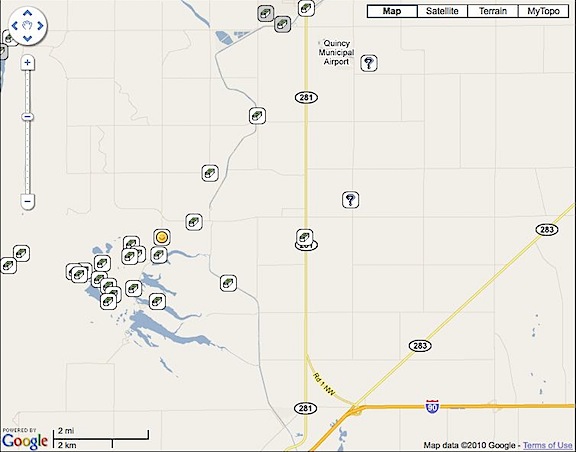
And that’s the interesting thing: these things are everywhere. Did you drive more than 10 miles to work today? I bet you passed at least a dozen of them within 3 miles of your car. There’s one a block from my house in Wickenburg and one 4/10 of a mile from my RV here in Quincy. As this map shows, they’re all over the place:

Geocaches Near Me
My RV is just about dead-center in this map. The little box and question mark icons indicate geocaches in the area. The smiley face icon is a geocache I found that I logged.

For some reason, I find the proliferation of these little boxes of hidden “treasure” fascinating. It emphasizes how big the world really is. It also reminds me a bit of a walk my husband, Mike, and I had along the rim of the Grand Canyon once. We got off the beaten path and walked right along the rim, far from where the tourists wander. We happened to stop for a rest on a rock outcropping. And there, tucked under an overhang with a beautiful view of the canyon, was an urn of cremated remains. How long had it been hidden there? We didn’t know. It was like an uncharted geocache. Seems like a good final resting place to me.

Geocaches are hidden. They’re tucked away in painted coffee cans, sealed lengths of black PVC pipe, and plastic Tylenol bottles. In the old days, ammo cans were popular, but I think the value of these has prevented their widespread use — too likely to be stolen if found. (I bought 3 nice-sized ammo cans from a seller in Beatty, NV some years back to create my own geocaches; I still have them.) Caches are hidden in bushes, under rocks, and among the remains of pioneer trash heaps. You’re not likely to stumble upon any of them by accident. You have to look for them. And even with GPS coordinates, they’re not always easy to find.

For some reason, I brought my bag of geocache goodies along with me on my trip to Washington this year. I guess I thought I’d try it again. I didn’t think much of it until the other day when a Twitter friend, @PlagiarismToday, started tweeting about his weekend geocaching activities. It got me thinking about it. I pulled out my bag and took a look inside it. I had a GPS with me, and an Internet connection to get information about local caches, so I had everything I needed to try again.

So I went out yesterday to search for three caches. I found three, but not the original three I’d set out to find.

  • Ryann’s Hide was the first cache I’d hunted for in over 5 years. Although I’m using a newer GPS (a Garmin GPSMap 60c) than I did in 2005, I soon realized that precision was something that needed patience. As I walked, the GPS would guide me, but I quickly overshot the location. Seems that the GPS could not keep up with my movement. I needed to slow down and let the signals catch up. Zooming in on the map gave me ever-increasing detail. Standing still, gave me ever-increasing precision. Once I caught on, I was able to zero in on the location. The cache was alongside a two-track road that led down a hill to a fishing spot. The road was closed to unauthorized vehicles. It started on the edge of an orchard and curved down into a very pleasant wooded area. (I think I need to explore further down that trail.) The container was a painted coffee can with a plastic lid. I pulled out a plastic car and replaced it with a tiny stuffed teddy bear. I entered my Geocaching.com user name in the log book, closed everything back up, and replaced it exactly where I’d found it. Success!
  • Quincy Valley Rest Area II was a bit easier to find — once I got on the correct side of the rest area fence. It was a nicely made cache container consisting of a short length of black PVC pipe with a screw-top on one end. Inside was a baggie with the logbook, some plastic dinosaurs, and a very nice shell. I took the shell and replaced it with an emery board with advertising for a nudist colony on it. (I really don’t remember where I got such a thing, but it is pretty funny — and clean.) I logged my visit and closed it all back up. Success!
  • West Bar Overlook is the one I really wanted to find. It’s located on Babcock Bench, high above one of the orchards I dried several times this summer. The entry on Geocaching.com provided lots of photos and information about the geologic significance of the spot. I’d brought along my camera, planning to get some shots from its perfect vantage point. Unfortunately, the two-track access road that appeared to link the cache area with pavement was inaccessible. Not only was there a locked gate across the road, but there were lots of tall weeds making the start of the trail a bit questionable for someone wearing shorts during snake and tick season. I’ll either try again next spring, before the weeds grow so tall or possibly try to visit via helicopter. I already scouted the power lines in the area. So this was a failure.
  • Rust Everywhere was my consolation prize. I’d already imported its GPS coordinates into my GPS, so I knew approximately where it was. But because I hadn’t planned to look for it, I didn’t have the details — like a basic description of what it looked like. Having a location but no description makes things a bit tougher. Patience and perseverance paid off, though. The cache was a label-less Tylenol bottle hidden well among rocks. I pulled out a kid’s hair clip and replaced it with a computer chip, logged my visit, and put it back. Success!

In all, it was a nice way to spend the afternoon. I was at it for about two hours and it got me out and about. To onlookers, I must have looked pretty silly, walking around while studying a GPS. But I got to find a neat place — that wooded trail — and get some exercise and fresh air. I hope to do more tomorrow.

I also think that it would be a great family or small group activity. A way to combine socialization with exercise. Working together to complete a challenging task.

I do have a geocaching project lined up. I’m going to release one of my travel bugs into the wild with the mission of traveling down to New Orleans, LA. That’s where @PlagiarismToday lives and does his geocaching. He, in turn, is going to send one my way. We’ll see which one completes its mission first.

I’ll likely blog about the progress here.

Walking

My new morning routine.

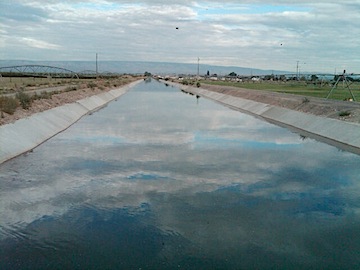
Canal
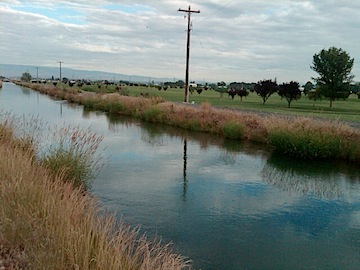
A shot looking west up the canal from the first bridge.

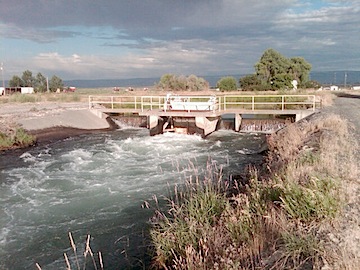
Second Bridge
The second bridge is exactly 1.3 miles from my RV.

Apple Orchard
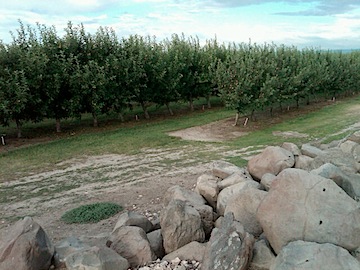
I walk for about a half mile alongside this apple orchard. This morning, I saw three woodchucks in rocks like these along the canal edge.

Last week, I began walking regularly. It’s part — the only part, I should admit — of an exercise regime. I know it’s not much, but it’s more than I was doing the week before.

I usually get out between 6:30 and 7:00 AM, when it’s still nice and cool. I’m back within 45 minutes.

I should be clear here: I don’t go for a short stroll. I walk 2.6 miles at an average speed of 3.6 miles per hour. How do I know this so precisely? Simple: I monitor my progress using the trip computer on my handheld GPS.

(While other people are relying on a touch-screen GPS with computerized voice to find their way around town, I use my GPSes for things I can’t easily do on my own. But let’s not go there, huh? That’s fodder for a whole other blog post.)

I took the photos you see here on this morning’s walk. The pauses brought my average speed down to 3.3 miles per hour.

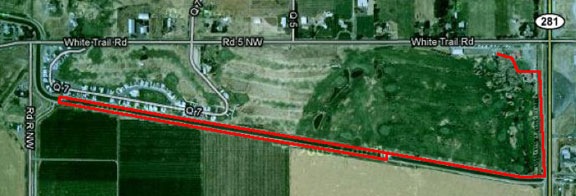
I start at my RV at Colockum Ridge Golf Course. I cut through the golf cart staging area and past the maintenance shed. That puts me on a two-track gravel road between a narrow drainage ditch full of clear-running water and the golf course. I walk about .3 miles south, then make a right onto another gravel road that runs along the north side of a canal. If I’m lazy, I cross the canal at the first bridge and come back along the other side for a 1.2 mile walk. But if I’m serious about exercise, I continue to the second bridge. The whole time, I’m walking alongside the golf course and then the 55+ trailer community beyond it. When I cross the second bridge, I walk back along the south side of the canal with an apple orchard and then an alfalfa field on my right. I cross back over the first bridge and retrace my route back to my RV.

Here’s what it looks like in satellite view on Google Maps:
My Walk

Alfalfa Bales
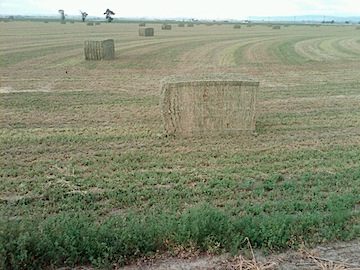
These aren’t the little wimpy alfalfa bales we bought for our horses. These probably weigh 500 pounds each and stand nearly as tall as me.

Canal and Golf Course
A view of the golf course from the opposite side of the canal.

I really enjoy the scenery. I love the changes in the farmland. Yesterday, the alfalfa was cut and piled. Today it was baled. The apples are ripening. Some farm equipment off in the distance was harvesting soybeans or something. The groundhogs are kind of cute.

3.6 miles per hour is a good walking pace. It’s probably the pace I used regularly when I walked the streets of New York. If you don’t walk fast in Manhattan, you get run over by other pedestrians or messengers on bikes or guys pushing racks of clothing. (I spent a bunch of time in the garment district one summer.) I’d like to get my walking speed up to 4 miles per hour, but it would likely kill me.

I listen to music when I walk. I have a little iPad shuffle and keep it stocked with an ever-changing mix of my favorite music. I discovered the other day that my walking pace is at the same tempo as Paul Simon’s “Late in the Evening.” I have long legs so I have long strides. I feel it in my knees and hips.

When I get back to the trailer, I’m sweating like a pig. (Do pigs really sweat?) I force myself to drink water or vitamin water before jumping in the shower. When I’m that hot and sweaty, the shower feels like heaven and makes the walk worthwhile. Afterwards, I have breakfast: high fiber cereal with fresh berries and low-fat milk. I have coffee before the walk — I am human, after all.

According to the Walking Calories Calculator on About.com, I burn at least 259 calories each time I do my walk. That’s not very much, but it is better than nothing. I’m hoping the regular brisk walk will also help me recover some of my muscle tone, which is quickly melting away.

I’m middle-aged now, and I’m not going down without a fight.

Hitching a Ride in a Helicopter

Looking back, I realize this was a bit over the top.

I’ve been wanting to blog this story, but a lot of time has gone by and it’s a bit stale in my mind. It is something I want to journalize so I can remember it in years to come. Since that’s mostly what this blog is about, and because a Twitter friend showed some interest in reading it, here it is.

It was April and I was planning to spend a few days down in our Phoenix apartment. I’d already paid for my monthly hangar rental down at Deer Valley Airport (DVT) and figured I’d fly the helicopter down and put it in the hangar in case I got any calls for flights while I was down there.

My faithful Toyota was sitting in the airport parking lot, waiting for me. A true “airport car,” I left it there so I’d have something to drive when I flew in. My to do list for the upcoming month included driving it home and stowing it for the summer, when it wasn’t needed. (No sense in letting the poor thing rot out in the sun.)

I pulled the helicopter out of my Wickenburg hangar with a golf cart I have just for that purpose and parked it on the ramp. I unhooked the tow gear and disconnected the ground handling wheels. I put the golf cart and tow bar away. I parked my Jeep in the hangar, too, and locked it all up. I was good to go.

I did my preflight and climbed on board. A few minutes later, the engine was running and the blades were spinning.

And then my Aux Fuel light came on. The circuit breaker had popped out.

Let me take a moment to explain what this means. A Robinson R44 Raven II is fuel injected. It has two fuel pumps. One is the engine-driven pump which is the primarily means of feeding the engine when the engine is running. The other is the auxiliary fuel pump, an electric pump that’s used to prime the engine and as a back up in the unlikely event that the engine-driven pump fails. It’s a secondary system. If it fails in flight, the helicopter will continue to run.

I have a history with Zero-Mike-Lima’s auxiliary fuel pump dating back to the day after I picked it up at the factory. Back then, I educated myself about the system to troubleshoot a popping circuit breaker problem. My thorough knowledge of the fuel system helped me out on an FAA check ride 2 years later when the circuit breaker popped again. I got the fuel pump replaced right after that incident, when the helicopter was only two years old.

The fuel pump had begun giving me problems a few weeks before — but I didn’t recognize it, at first, as a problem. Circuit breaker had popped during a tour in the Phoenix area. I (incorrectly, it appears) assumed that the front seat passenger had knocked the circuit breaker out with her sandals. Okay, so it was a stupid assumption, but since it didn’t pop again when I pushed it back in, what else could I assume?

On another flight a week or so later, it happened again. That’s when I realized the pump was acting up again and would likely need replacement soon. Fortunately, I still had the old one. I did some checking around and learned that the manufacturer could rebuild it for about 60% of the cost of a new one. Since saving $600 on a like-new part sounded like a good idea to me, I sent it off to be rebuilt and kept my eye on the situation.

Well, the situation came to a head that day on the ramp at Wickenburg. As I sat there, blades spinning, looking at that warning light, a few thoughts went through my mind:

  • If I flew down to Deer Valley, there was no one there to fix the fuel pump. If it completely failed, the helicopter would be stuck there.
  • If I left the helicopter in Wickenburg, my mechanic there could replace the fuel pump when the rebuilt one arrived. After all, he’d replaced the last one.
  • I really didn’t want to drive down to Phoenix. I already had a car there and my husband, Mike, already had two cars down there. Besides, it was a long drive.

I knew what I should do. I cut the throttle, flicked the Clutch switch off, and shut down.

While I was doing this, a helicopter flew in to the airport and landed at the fuel island. It was a MD helicopter that looked like a 500. I didn’t know who it belonged to, so it wasn’t someone local. That meant when the pilot was done fueling, he’d likely leave. It was late in the day. Maybe he’d go home. He was flying a helicopter. There are lots of helicopters based at Scottsdale, which is near Deer Valley. Maybe Deer Valley was on the way home for him. Maybe he could drop me off.

This gives you an idea of the way I think. I have a problem, I immediately consider all kinds of options — including wacky ones — as a solution.

Could I ask a perfect stranger to fly me to Deer Valley Airport in his helicopter?

Nah.

My blades slowed to a stop. I got out and looked at that helicopter by the fuel island.

Why not?

I walked over to the pilot, who was now out, messing with the hose. He was about my age — maybe a bit older — and looked friendly and easy-going in jeans and a casual shirt. He reminded me a bit of the two Hughes 500 pilots who lived in Wickenburg. Regular guys who just happened to own turbine helicopters.

After the usual, “Hi, how are you doing?” greeting, I asked, “Where are you based?”

“Stellar,” he replied. Stellar Air Park was a private residential/commercial airport in Chandler, south of Phoenix. Wickenburg was north of Phoenix. This was looking promising.

“You’re not going home from here, are you?”

“Well, I was just out tooling around the desert. Why? What do you need?”

I explained my situation.

Before I could ask for a lift, he said “Sure, I can drop you off at Deer Valley.”

“That would be great. I just need to put the helicopter away.”

I hurried back to my hangar and fetched my tow gear. Ten minutes later, the helicopter and tow gear was all put away again and the hangar was locked. I left my Jeep parked on the ramp outside my hangar door. I got to the helicopter at the fuel island just as the pilot finished fueling.

We introduced ourselves and he told me to hop in.

I climbed on board. It really was a climb. 500s have long legs. I maneuvered into the passenger seat with the cyclic stick between my knees and stowed my small bag behind me. He climbed in the other side.

The aircraft’s panel looked brand new, with glass cockpit instrumentation. I said something idiotic like, “Great panel. Did you have it redone?”

“No. The helicopter is new.”

That’s when I realized it wasn’t the same model as the Hughes 500s my friends flew. Theirs dated from the 1970s.

“It’s not a 500?” I asked.

MD 500f

This wasn’t the helicopter I flew in, but this is the same model. Photo from the MDHelicopters Web site.

“No. It’s a 530.”

I sat back as he started up. First, the rapid click-click-click of the igniter. Then the woosh as the jet fuel lit. Then the familiar whine as the jet engine spun up and the blades picked up speed over our heads. If there’s one thing I like about turbine helicopters, it’s the sound of the engine startup and the smell of burning JetA.

The flight to Deer Valley was uneventful. We talked about mutual friends — he knew one of my Hughes 500 pilot friends in Wickenburg and had heard of the other. We talked about places to fly. He was also an airplane pilot and had already flown much of the state — and then some. There was no place new I could suggest.

He offered to let me fly but I turned him down.

He was smooth on the controls and had the same low-flying habit the rest of us desert explorers have. (Once we know where the wires are, it’s not uncommon for us to cruise just a couple hundred feet over the empty desert floor.) He told me he’d never flown into Deer Valley, so I filled him in on what I usually do and where I park. He came in from the north, crossed over the top as instructed by the tower, and set down on one of the two helipads in front of the terminal. I grabbed my bag from the back, thanked him several times, and climbed out. He lifted off just as I got to the terminal gate.

It wasn’t until later that I gave the whole thing some serious thought. Did this qualify as hitchhiking? If so, what would my mother say?