On Canvas Grocery Bags and Pilot Uniforms

Being a “local” has its privileges.

When I started working at Papillon, I was told that many of the Tusayan businesses offered discounts for local residents and employees. I was also told that the grocery store was not one of them.

But the truth emerged slowly. While waiting in line to check out — in uniform at the end of the workday — the girl in front of me whined that she’d forgotten to bring her canvas shopping bag, the one that entitled her to the discount. She, her friend, and I were the only three people in line. The check out guy pretended at first that he didn’t know what she was talking about. But she was persistent and he finally gave in, probably to shut her up. But when she left, he was faced me with — obviously another local. He gave me the discount, too.

At Papillon, I asked around about the grocery bag. I was told that you had to buy a special canvas grocery bag and use it every time you shopped. You’d get a 10% discount on the bag and anything you bought when you had the bag with you. It was a sort of signal, a way to let the checkout guy know you were a local and you knew about the discount without spilling the beans in front of the tourists.

So today I went into the grocery store. I poked around, looking for the canvas shopping bag. When I didn’t find it, I went to the checkout counter, where the clerk was taking care of a customer. He asked me if he could help me.

I said, “I was told I needed to buy a certain canvas shopping bag.”

He looked at my uniform and nodded knowingly. “I haven’t seen one of those bags here in a while,” he said, packing the other customer’s purchases. “I’ll see if I can find one.”

But then other customers came and his line got long. I decided to let him work. I began to gather up the groceries I needed. I found the other clerk stocking shelves. I asked him about the bag. He told me they didn’t sell them. They only sold them in their grocery store in the park. I certainly didn’t plan on driving into the park to get a 10% discount on a few groceries. I finished shopping and brought my basket to the counter. The other customers were gone and the two clerks were talking. The one at the register said that even though I didn’t have the canvas bag, he’d give me the discount. And he did. I saved $4.

Afterwards, I went to Wendy’s and ordered a Chicken Spinach Salad at the drive thru window. (I don’t really like fast food, but I admit that Wendy’s makes a pretty good salad.) When I got to the pay window and asked how much (I can never understand them on those speakers), he mumbled a number, then said, “But four sixty seven with the discount.” He’d obviously seen my captain’s bars.

Oddly enough, I’m starting to FEEL like a local here. I just have to get my hands on one of those canvas bags.

I Finally Got Smart

I give up my contract at Wickenburg Airport and feel an enormous weight lifted off my shoulders.

It was driving me nuts.

I’d won the fuel manager contract in late 2002 and started with the lofty goal of turning the airport around, making it a place where pilots would want to hang out, drink coffee, and do some hangar flying. Like a clubhouse. And while they were there, they’d pull out their planes, go for a flight, and buy some fuel so the town and I could make some money.

If you compare the airport now with what it was under the previous fuel manager, you’d have to admit that I succeeded. But at what cost?

The original idea was to find a full-time guy (or gal) to manage the place for me. I’d handle the money, the manager would handle everything else. But reality set in quickly. First, I couldn’t find such a person. And then I realized that even if I did, I couldn’t afford to pay one.

So I became that person. And the nightmare began.

The job was fraught with frustration:

Frustration at dealing with the town and its slow (almost backward) speed of getting things done. I’ve been told that all small towns are like this and that I should be patient. Believe it or not, I can be VERY patient. But no one who has an interest in seeing things done can be THAT patient.

Frustration at attending airport commission meetings, which discussed the same semi-relevant topics every month. My favorite was the hangars at Forepaugh issue, which was begun by a local ultralight pilot because he supposedly couldn’t get a hangar in Wickenburg without insurance. (Untralight pilots can’t easily get insurance.) As soon as he got a hangar in Wickenburg, he stopped coming to meetings. (Has anyone checked for insurance? I doubt it.) But the topic was discussed for at least two more months, with nothing being resolved. And let’s not even talk about Forepaugh. How so many people can waste so much breath over a dirt strip in the middle of the desert absolutely amazes me.

Frustration at dealing with customers who got their kicks by complaining to ME about things I have absolutely no control over. “When is that self-serve fuel system going to be fixed, anyway?” “Why are fuel prices so high?” “Why are hangars so expensive?” “Why can’t I build my own hangar?” “How could you let so-and-so cut me off in the traffic pattern?” “Why didn’t you tell me that the windsock on the east end of the field shows different wind that the one at the west end of the field?” It never ended.

Frustration at dealing with people who weren’t customers — people who were proud of the fact that they didn’t buy a thing from me — coming in and drinking my coffee and sitting on my sofa a few times a week. Getting donut crumbs on the floor and missing the urinal when they took a leak. And talking other customers out of buying things that kept me in business.

Frustration at seeing the annual “Fly In,” which is sponsored by an organization that knows less about aviation than the Girl Scouts, turn into a poorly publicized car show with no control over aircraft or people on the ramp. Last year, when I needed to fly out during the event, I had to enlist the help of FOUR people to prevent bystanders from walking too close to my helicopter while it was preparing to depart. There were no movement/non-movement areas defined!!! No safety personnel to prevent spectators from walking into spinning props!!! Parked cars blocking the doors to many of the hangars!!! And the C-130 they finally got to appear at the event taxied down a taxiway it didn’t fit on and climbed one of its wings up on a hangar. When it put its engines in reverse, it churned up enough grass, weeds, and pebbles to shower the spectators and cover the ramp for weeks. Jeez! As fuel manager for the place, I could be held liable for damages in the event of an accident! And I could only imagine the lawsuit the town would get slapped with.

Frustration at being told that I wasn’t supposed to voice my opinions if they weren’t favorable. What kind of bullshit is THAT? Hello? Aren’t we in America? Isn’t there a document called the Constitution that grants all of us the right to voice our opinions until we’re blue in the face? Or longer?

Frustration at being an employer. What was I thinking?

If I told you what the FBO netted last year, you’d laugh at me. If I told you how much of my personal money I put into the airport building to fix minor problems that the town consistently avoided fixing and making improvements to make the terminal more appealing, you’d tell me I was nuts.

I was nuts. I know that now. I suspected it at least six months ago when I snapped at a customer, after dealing with his complaints and sexual harassment for ten months. I called him something I reserve for people who really annoy the hell out of me. (Something so foul I won’t even repeat it here. But ask me in person and I’ll tell you.) I called him that loudly and repeatedly. He tried to get me removed by the town. If only he knew what a favor he would have been doing me! Six months less of insanity.

I made my decision to quit on Thursday morning. I kept it to myself that morning. The mayor-elect was coming by to visit me at the airport with three members of the airport commission. I decided that if I thought there was ANY chance of a change, I’d reverse my decision again. But when the mayor-elect came by, I wasn’t impressed. In fact, I guess you could say I was DEpressed.

Later, I stopped by town hall to drop off some paperwork. I got called into the Airport Manager’s office. He immediately started giving me grief about a list of airport fixes that were outstanding that I had submitted to him. I broke the news to him so he could save his breath. I dropped the official letter off the next day.

Fortunately, there’s a way that I can make my exit without hurting the airport or the town. The folks at Master Aircraft (the airport paint shop) are interested in taking over. So interested, in fact, that they’re willing to buy my airport assets (just about everything in the building) and take over as my agent until my 90 termination period is up. They’ll keep the place just as nice and friendly as I did. And after watching me for 6 months, they already know what they’re in for, so they’re more likely to stick it out.

Now back to my regularly scheduled life.

Truth vs. Fiction

How I get another life experience proving that truth is stranger than fiction.

First, the background info.

My company, Flying M Air, is the Fuel Manager at Wickenburg Municipal Airport. This means that I’m required to provide warm bodies to pump fuel into aircraft, sell pilot supplies and refreshments, answer questions, and keep the terminal building presentable. They do other stuff, too, but that isn’t worth going into for the purpose of this tale.

I have a staff of three employees, all of whom are semi-retired with some kind of aviation experience. Gary is a pilot who has thousands of hours of experience in all kinds of airplanes. Jeff is a pilot who is now building his own airplane. Alta is one of only five women in the world qualified to sit in the engineer’s seat on a 747.

Unfortunately, when one or more of these people need time off, the others can’t always fill in. That means I have to work at the airport. Trouble is, when I’m working at the airport, I’m not writing books. When I’m not writing books, I’m not earning a living. So it’s my best interest to find additional warm bodies to keep on staff.

That’s half the background.

Now here’s where it starts getting weird.

Last January (that’s 2004), I get a phone call from the Wickenburg police at 1:30 AM. They tell my half-asleep brain that someone has just called them, reporting that he witnessed three men fueling and then loading C-4 explosives into a C170 (that’s a Cessna taildragger) at the airport. When asked, these three men told the witness that they were flying to Washington to blow up the White House.

I replied to the police that they really didn’t have much to worry about because it would take a Cessna a few days to reach Washington. (Yes, I really did say that. They probably have it on tape somewhere. Remember, I was half asleep.)

The officer started asking questions and I started waking up. The gravity of the situation started to sink in. After 9/11, reports like this at airports are taken very seriously. The police tell me what they’d been told. And I realize that the story didn’t match what I knew to be fact: Namely, that the plane couldn’t have fueled up at 6:30 when the witness claimed because I’d fueled the last plane at 5:30 PM and had locked up everything (including the pumps) at 6 PM when I left for the night. I suggest that perhaps the whole thing is a hoax.

Two more phone calls from the police that night before I’m finally able to get back to sleep.

A few days later, I’m at Macworld Expo in San Francisco, loitering outside the Peachpit Press booth. My cell phone vibrates. It’s the police in Wickenburg again. They tell me that the case has been resolved. That the witness has been charged with submitting a false terrorist report. They tell me the witness’s name, but it doesn’t ring a bell and doesn’t stick. They give me the report number in case I ever want to look at the report. All I hope is that I’m not called as a witness in some trial.

Time goes by. It’s now March. Two of my airport staff members are away at the same time and the third can’t work. I wind up working four days in a row at the airport while my editor anxiously awaits more chapters of my QuickBooks book. Enough is enough. Time to get more warm bodies.

I get a call from a guy named Bob Doe. (That isn’t his real name, but it’ll do.) He says he talked me to me several months ago about a job at the airport but I wasn’t hiring back then. Am I hiring now? Sure, I tell him. Go to the airport and fill out an application.

He comes by the airport while I’m working. He’s in his mid thirties. His resume shows all kinds of airport experience. But he’s working as a stocker in the supermarket. (Actually, he isn’t. But he does have an equally unrelated part-time job.) He’s very enthusiastic and I’m sucked in, desperate for more warm bodies so I can get back to work. I think I notice alcohol on his breath, but I could be imagining it. I tell him to come by the next day for training.

“So I got the job?” Bob says.

“Well, I want to see how you do at training,” I reply evasively, trying hard to convince myself that it isn’t alcohol at 11 AM.

Bob leaves and I think about it. I’m not sure about him. I voice my concerns to one of the medivac pilots stationed at the airport. He tells me to go with my gut feeling.

I call one of Bob’s references and learn that he worked there for two months. Human resources tells me they fired him for not showing up for work and not calling. I can’t track down the other recent reference because he didn’t include a phone number. I decide to put off training for another day when Mike, my significant other, will be around to help train him.

The next morning, I call him at 8 AM. I get his answering machine. I tell him not to come in until the next day. At 9 AM a taxi (yes, a taxi — the only one we have in town) rolls up and he gets out. I tell him about the message. He says he never got it. He says he must have been in the shower. I tell him I can’t train him that day. He gets a little nasty, pointing out that he’d taken a cab. I tell him I’ll pay the cab fare. He tries to get me to change my mind and let him stay. I tell him about the reference checks and tell him I need phone numbers for all of his references. I then pay the $14 round trip cab fare and send him on his way.

Bob calls later with phone numbers for two personal references. The other reference I’d tried to contact had gone out of business. (How convenient, I think.) He gives me the name of a supervisor at the other reference. After he hangs up, I leave a message on the supervisor’s voicemail.

The next day, Bob shows up in a cab again. He’s 10 minutes late. He sweeps in like he owns the place and immediately begins leaving the things he brought with him — backpack, coffee mug, etc. — around the terminal. I hand him over to Mike for training; I have a catering order to handle and two helicopter rides to give.

Later, when things calm down, I can see there’s a problem with this guy. He has a superior attitude that just doesn’t fit into our cosy little establishment. He doesn’t give a hoot for the little plane pilots and complains when the only jet we service that morning leaves without giving him a tip. (We don’t get tips in Wickenburg.) His possessions are scattered all over the terminal. And I can tell that even Mike — that deep well of patience — has had it with him.

When I leave to get lunch for Mike and me, I take Bob home (he was scheduled for training until 1 PM). On the way, he tells me how great it feels to be working at an airport again. He wants to know how many hours we’ll be giving him so he can quit one of his part time jobs. (I didn’t realize that he had two jobs.) I tell him I don’t know yet, that I’d have to let him know.

Back at the airport, Mike and I compare notes. We decide that Bob’s warm body just isn’t the right temperature for us. I get Mike to break the news to him on the phone. I write a check for $24 to cover the promised training pay and put it in the mail.

The next day, Mike is at the airport when Bob storms in, looking for me. He tells Mike that he spoke to me that morning and that I said I’d be at the airport at noon. (A blatant lie.) He tries to say that we’re not hiring him because of age discrimination. Mike points out that all of our employees are at least 20 years older than he is. Mike tells him we need someone more interested in the small plane pilots. He doesn’t get it. He keeps going on about how experienced he is dealing with jets. Mike tells him we get 50 small planes in for every jet that lands so that his experience isn’t worth much to us. Bob storms out, slamming the door behind him.

And yes, there was definitely alcohol on his breath.

Today, Mike and I are having lunch at a local restaurant. Bob comes up in conversation. Something triggers a switch in the back of my mind and I recall the January C-4 in a Cessna incident. Suddenly, Bob’s name seems more familiar than it should.

I stop at the police station on my way back to my office.

“Remember that case in January when the guy reported C-4 being loaded into a Cessna to blow up the White House?” I ask a woman behind a grill.

The woman nods with a strange smile on her face.

“Just tell me,” I say. “Was the person who reported it Bob Doe?”

She nods again.

Cliff Dwellings — Not!

Mike and I take Three-Niner-Lima to explore some cliff dwellings and get less than we bargained for.

If you’ve been reading this bLog, you may recall that on a trip to the Wayside Inn, I passed what looked like a cliff dwelling along the Date Creek wash. It was a cut out in the cliff face that looked like a cave. I’ve seen plenty of cliff dwellings around the southwest and although this wasn’t big, it looked like the real thing.

I told Mike about it and on Sunday, after doing a quick photo shoot in Forepaugh, we decided to check it out.

I used my GPS to head straight out toward the Wayside Inn, then dropped into the wide Date Creek wash when I was still at least ten miles out. The cave had been on the left, near the top of the cliff. We flew at a good pace, but not too fast to see where we were going. It was a very clear day, but windy. We’d had a tailwind most of the way out, but when we dropped into the wash, much of the wind was blocked. It was a smooth flight.

I saw the cave and pointed it out to Mike. He looked though some binoculars he’d brought along and made a noncommittal noise. I told him I’d pass by again, lower and slower. I made a tight turn, then flew back up the canyon. I turned again, then dropped altitude until I was about 200 feet AGL, cruising at about 70 knots. Mike looked; I watched where I was going. He agreed that it could be a cliff dwelling.

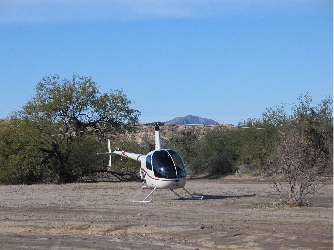
PhotoI looked for a place to land and found a large, clear area in the middle of the wash. It had rained several days before and had snowed up in the mountains. Areas of the was were still wet. I set down on a high, sandy area where the sand looked packed. I lowered the collective slowly once I’d touched down, watching my skid sink into the sand. It sunk in about an inch. Mike said there was no sink on his side. Satisfied, I shut down.
We took our picnic lunch, my new Canon G5 camera (which we’d used for the photo shoot), and a flashlight out of the helicopter and packed them in a canvas bag. Then we started walking. The cave was about 1/4 mile away. The walk to the base of the cliff was easy — gently sloping desert terrain with creosote, palo verde, cholla, and joshua trees. The slopes were cut with shallow washes — hundreds of them — that drained water into the wash. The ground was damp and relatively soft. There were no animal tracks and no signs of people.

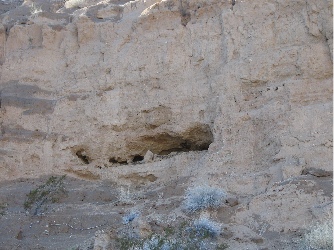
PhotoAt the base of the cliff, I stopped to take a photo of the cave. It looked very promising. In fact, I was sure I could see signs of a manmade wall inside the cave.
We started climbing up the side of the hill. It was easier than it looked. The soft soil made it easy to step up on. It only took us about 10 minutes to make the climb.

But when we reached the cave, we were disappointed. The cave was only a fraction of the size we thought it was. In fact, it couldn’t have been more than 20 inches high in its highest spot. The cave roof was stained by leeched water containing some kind of chemical. It made an interesting pattern in one area. The cave floor was littered with cholla spines. It was obvious that the cave had been used as a home by some kind of rodent — probably a pack rat.

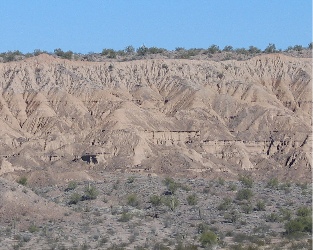
PhotoDisappointed, we made our way back down the hill. We stopped on a sunny spot and ate lunch, admiring the view across the wash, where years of erosion had eaten away the cliffs.
We walked back to the helicopter, climbed on board, and took off. We continued down the wash to the point where it joined the upper end of Alamo Lake. Then I turned east, flying up the Santa Maria River. I’d seen another cave the last time I’d been through and thought about visiting it, too. But I was kind of turned off to the cave thing after our disappointment. In any case, I didn’t see the one along the Santa Maria.

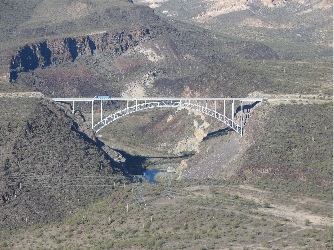
PhotoWe followed the river east to route 93 and explored some of the rock formations there. Some people on ATVs looked up at us as we flew over. Then we headed up the road to Burro Creek. Mike wanted to see the campground from the air; we were thinking about spending a few days there at the end of the month. He shot these two excellent photos. The bridge over Burro Creek. (Yes, it is possible to fly under the bridge, but we didn’t do it that day. The bridge isn’t the problem; the power lines, which hang lower than the bridge, are what’s scary.)

By this time, I was getting alarmed about our fuel situation. We’d left with about 22 gallons on board and had been flying for more than an hour. We decided to go straight home. I punched Wickenburg’s designator into the GPS and set a course. Unfortunately, the tailwind we’d had while flying toward Alamo Lake had become a headwind — about a 15-knot headwind. I dropped down to about 400 AGL, hoping to stay out of the wind. It didn’t help much. I watched the fuel gauges drop steadily. I pitched for my best range speed of 85 knots. We were still about 20 miles out when the Aux tank gauge got to E. I knew we had at least 15 minutes left on the main tank, but the GPS said it would take 17 minutes to reach Wickenburg. Route 93 was within sight. I decided that if the main tank gauge approached E while I was still 5 or more miles out, I’d fly over the road. Then, if the Low Fuel (read that “Land Now”) light went on, I could land close to the road and not have to walk far for a ride.

Fortunately, we made it to Wickenburg and I landed without seeing the light. But both fuel gauges were on E. I took this shot as I cooled down the engine; note the oil pressure; the engine really is running for this shot.

The trip had been fun, although a bit stressful. It was good to get out and fly with Mike; I’d been doing so much solo flying. But next time, I won’t let the fuel get so low.

The Kofa Cafe is Gone

One of my favorite fly-in destinations changes ownership and goes down the tubes.

The Kofa Cafe is gone. And I’m very unhappy about it.

The Kofa Cafe was one of my favorite fly-in meal destinations. About 50 nautical miles southwest of Wickenburg (bearing 240° as per my GPS), it was a great place to fly for a burger, some good chicken fried steak, or an ice cream sundae. I’d land in the back, among the creosote bushes and pencil cholla, off the dirt road so I wouldn’t kick up so much dust with my rotor wash. I’d shut down and walk in. Because no windows looked out at the back, no one knew I’d arrived by helicopter. I’d have my meal, visit the ladies room, pay, and leave.

Kofa CafeI wrote about my first landing at the Kofa Cafe in an article for wickenburg-az.com’s Day Trips section. I liked the restaurant’s big servings and down-to-earth atmosphere. I liked all the junk out on the front porch and in the yard. I liked eating with the truckers. I liked taking the helicopter someplace that wasn’t on an airport but didn’t get me in trouble. Three-Niner-Lima parked in the truck parking area the first time I visited the Kofa Cafe. The Cafe is the blue building.

The Kofa Cafe was for sale for years. No one wanted to buy it. Finally, the owners just packed up everything on the porch, locked the doors, and left. That was last spring. I’d arranged a helicopter outing there with our Heli Group and I found out the day before that the place had closed down. (We wound up going to Prescott instead. Not the same.)

But a few weeks ago, Mike and I had flown over in Mike’s plane. When I looked down, I saw cars in the parking lot. Perhaps the owners had come back. Perhaps they’d opened for the season. Today, I decided to fly out and find out.

Well, the old owners didn’t come back. Instead, there’s a new owner. He was there and he’s a certifiable jerk. He spent all of his time talking loudly to another customer, telling them how he runs the place so much cheaper than the last one. He complained about my waitress putting too much whipped creme (not cream) on my sundae — “I lose $2 every time she makes one of those.” He demanded to know why he was paying for iceberg lettuce and bagged salad. He claimed his property was worth “three quarters of a million dollars” and that’s why he lived in a motorhome there.

The guy was obnoxious, the place was sad. It had been open 24 hours a day. Now it’s open 12 hours a day, only 6 days a week. Half the menu items are gone. There are only three flavors of ice cream. The pies aren’t’ even made on the premises anymore. And I won’t even go into detail about the Alzheimer’s lady they leave sitting at a table by herself so they can keep an eye on her.

The waitress was unhappy. Frankly, I would quit rather than put up with her boss’s obnoxious behavior.

Needless to say, I won’t be back unless it gets a new owner again.

The Kofa Cafe is indeed gone — don’t let anyone tell you otherwise.