Photographer Mike Reyfman takes first place in “Abstracts” category.
I’m extremely pleased to spread the news that one of Flying M Air’s best clients, Mike Reyfman, has won an award in the Pilsner Urquell International Photography Awards. His series of photos of the sandstone canyons uplake from Rainbow Bridge has taken first place in the “Abstracts” category. Here’s one of Mike’s photos, reproduced with his permission. You can see them all here.
I’d like to add two things here.
First, whenever a photographer who flies with me wins an honor or publishes a photo taken from my helicopter, I feel a great deal of pride. Although I didn’t frame the image and snap the photo, I do feel as if I’m part of the photographer’s “equipment.” My small part in any great photo makes me feel good.
Second, Mike offers photo excursions all over world. Although most of his clientele are from Russia (where Mike is originally from), I’m pretty sure he’ll take anyone who can speak either Russian or English. Lake Powell is only one of the destinations he comes to regularly; he’s also taken groups to Iceland, the Pacific Northwest, New Zealand, and lots of other places I wish I could go. Aerial work is only a small part of some of the trips he offers. You can learn more and see Mike’s gallery of photos from his travels on his Web site.
And thanks, Mike, for letting me know about your award! Congratulations!
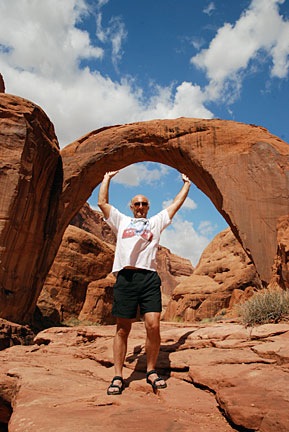
My husband, Mike, joined me in Page for the weekend. I did some work, but we also had some fun. Yesterday, we rented a boat and went out to Rainbow Bridge, the world’s largest natural stone arch. Rainbow Bridge is only accessible by boat from the lake or by a grueling hike from a trailhead near Navajo Mountain. Even by boat, there’s currently a 2/3 mile hike from the dock to the Bridge. But that doesn’t stop hundreds of people — mostly on the three daily tour boats — from visiting.
I have a lot more to say about this day trip, but I can’t stop to write about it now. I’m terribly behind on a book project — partially because I took yesterday off — and I need to get the darn book done already.
But I leave you with this photo of Mike, apparently holding up the bridge. We took this photo in response to Mike’s friend, Bob, who recently sent a photo of himself holding up the Unisphere, a New York City landmark.
One of the things that’s so frustrating to me as a pilot and photographer is that I can’t do both activities at the same time. You see, when I fly, my hands are full. I can’t let go of the cyclic to frame a shot — the helicopter would begin aerobatic maneuvers that would make me sick (or worse). So although I get to see some pretty amazing things from the air, I rarely get a chance to take a decent picture of any of it.
So I was tickled pink today when I went through my Google Alerts and found that photographer Ann Torrence had mentioned me in two recent blog posts. In each post, she shared a photo she’d taken from the left seat of my helicopter when we flew from Page to Marble Canyon and back on August 16.
The first post shows a great — and very unusual — shot of Horseshoe Bend. Everyone takes the same picture of this place, primarily because they all take it from the same viewpoint, on the east side of the cliff. But when you’re in a helicopter, above the terrain, you can shoot from anywhere. And as I circled this outrageous bend in the Colorado River, Ann shot from the northwest. As she said, it’s the first time she’d seen it from that angle. And it’s the first time I’ve seen a picture taken from there.
The second post shows the two Navajo Bridges — historic and newer — over Marble Canyon. Marble Canyon is the extreme starting point of the Grand Canyon. It’s a narrow, deep gorge cut through relatively flat rock plateau. As I used to tell my Grand Canyon passengers, it was named by John Wesley Powell, one of the original explorers of the Colorado River through the Grand Canyon, who thought the walls of the canyon were made of marble. (They’re not.) From the air, it looks like a crack. Ann’s shot of the bridges is pretty good, although I did have a passenger take a nice shot for me, years ago, from the other side of the bridge looking downstream. Trouble is, the bridge is in restricted airspace, so you can’t just fly around it. You can only fly past on landing or takeoff from Marble Canyon’s little airport.
I should point out here that there are other images taken from my helicopter in the Page, AZ area on the Web. Photographer Mike Reyfman has a number of galleries of LakePowell and Monument Valley. And at least one photo taken from my aircraft in this area has wound up in a Cessna magazine ad.
Anyway, I’m up in Page, AZ, offering photo flights in the area through American Aviation. I’ll be here through the end of September and possibly into October. If you’re in the area and want to see a different perspective for your photos, give American a call at 928/608-1060. They’ll set you up for a photo flight you’ll never forget. And maybe — just maybe — you’ll get some photos as good as Ann’s and Mike’s.
Yesterday, after finishing Chapter 7 of the book I’m working on, I took the afternoon off. I really needed a break and yesterday seemed like a good time to take it.
I drove out to Romana Mesa. These days, as some of you know, I’m living in Page, AZ, where American Aviation is booking photo flights and day trips for my helicopter. I only want 5 to 10 hours of flight time a week, and that’s just what they’re giving me. It gives me plenty of time to work on my book and, when I need a break, I can take it.
Romana Mesa is on the north side of Lake Powell, across the lake from Tower Butte. It’s a high mesa, about 1,000 feet of the surface of the lake. The tour planes flight right over it and use it as a reporting point. On a recent helicopter flight, I saw a truck out there. I figured if someone else got a truck out there, I could, too.
So I did some research and, with the help of Google Maps, discovered which back roads would get me there. I had no idea of the condition of the roads, but I had Mike’s 4WD Chevy pickup which I figured would be able to handle most conditions. I used Garmin’s MapSource software to load area topo maps into my Garmin GPSMap60c — I’d had Washington maps in there — and packed up some food and clothes (in case I got stuck), my camera and tripod, and a cooler full of ice and drinks. At 3 PM, I headed out.
This segment of the Lake Powell Map shows my route. The purple line traces my route in and out.
I drove out on highway 89 to Big Water and turned right onto the only road that ventured north east along the north side of the lake. The road soon turned to dirt. I drove through Wahweap Creek, which wasn’t much more than a puddle. Further on, I was surprised to find a sign that pointed me toward Utah Route 12, which I knew ran east/west far north of the lake. Evidently, there was back road access to it.
The road wasn’t in bad shape, but it obviously hadn’t been graded since the last rainstorm. The mud had been deeply grooved by trucks and other vehicles that had been out there when it was still wet. That mud was now dry and rock hard. The going was easy enough, but it jarred my bad back in more than a few places. I wished I had my Jeep, which offers a softer ride on roads like that.
There were signs at each intersection. I followed the one to the Grand Bench, then turned right on route 264. By this time, I’d climbed to mesa-top level. The road struck out over flat terrain studded with small bushes and grass. Very easy going, despite the fact that the road had narrowed down to a single-lane cut through the sand and rock.
About four miles down the road, I got to my first viewpoint. I was rather surprised to find a white Jeep Cherokee (or some other SUV; I really wasn’t paying attention) out there. I chatted with the woman while her husband walked to the edge of the cliff to snap photos. They were from Boston. I got the impression that she was nervous about being so far away from roads and people. She stuck with her vehicle, then followed me as I went to the cliff edge to take some photos. I gave her some ideas for photographing Lower Antelope Canyon and Horseshoe Bend. They moved on down the road while I took a break for some cold water.
The road got weird. It was all rock in one place with deep cracks and fissures. The road was invisible — no tire tracks in sight. But beyond that area I could see the road continuing on toward the end of the mesa. The people from Boston gave up and turned around. I kept going. I found a path over the rocks and joined up with the road again. A while later, I had to repeat the same process in another spot. The road forked off in a few places, but I stuck with the main road. It ended a few minutes later, less than a mile from where the Bostonians had turned around. I parked and got out.
I was on the edge of a cliff, looking down at Gunsight Butte. There were houseboats down below me and a few powerboats cutting wake into the otherwise calm water. I walked around a bit and took pictures. Then I settled down to wait for the light to change.
It had taken me close to two hours to get out to the edge of the mesa — a distance of about 40 road miles and less than 10 air miles. I wanted to take photos in the late afternoon light. There was a storm out to the west and the sun would soon be sinking behind it. There was another storm to the east, which appeared to be moving toward me. I couldn’t stay until sunset because, if I did, I’d be driving at least 25 miles of unimproved, unmarked dirt road in the dark. My night vision is pretty crappy and I knew that would not be a good idea. So I decided to wait no longer than until 6 PM.
While I waited, I took photos and drank cold beverages and ate cherries. I also took this video:
I left the area at 6:10 PM. It took 30 minutes just to drive the 5 miles to the turnoff for the mesa. The sun set while I was about 2/3 back. My headlights came on when I reached pavement. It was about 7:40 PM when I rolled back into the campground.
Would I do it again? Definitely. Would I recommend it to others? Yes. But on a cooler day. (It was 95°F out there.) Bring plenty of water. An overnight camping trip out there would be incredible, too.
But that’s not why I bought it. It was the Amazon reviews that convinced me. Although I’ll never rely on reviews there to buy a book — I’ve been burned before, in more ways than one — I find that reviews of camera equipment are generally fair and reliable. It’s easy to identify fanboys and people with a gripe against the company. Weed those out and you can get some solid opinions of the products. In this case, just about all owners liked the lens.
But it was comments like these that sold me:
I have both the 18-135 and the 18-200, yet this lens has become my everyday go to lens for most of my photography. …Given the great sharpness (especially in the 16-50mm range), VR, and almost total lack of noticeable CAs, I can highly recommend the 16-85 for a general purpose, on-the-camera-all-the-time lens. – D80Shooter
I think 16-85mm VR and 70-300 VR lenses is probably all amateur like me needs, with light and compact 16-85mm VR lens mounted on camera most of the time. – Alex
This is how I was using the 18-55mm lens — as an everyday lens. This one promised more flexibility with better optics.
Of course, when I got back to Wickenburg, I had just 3 days to do a ton of stuff. I didn’t have time to play with the lens other than to snap a few photos in the kitchen to check the focal length range. Photography would have to wait.
When we flew to Seattle on Friday, the new lens was in my camera bag with the rest of the camera equipment I take on the road. But with the back problems that have been slowing me down, I didn’t have time to do anything fun in Seattle, despite the fact that we had the whole day there. (I spent much of it sleeping off some painkillers.) The next morning, we began our helicopter flight from Seattle to Page. I was sitting up front, handling navigation while Louis flew. I had my hands full with directions for our scud-run south. I didn’t realize it at first, but Mike was sitting in back, snapping photos with the new lens. He continued to do so on both days of the flight and got quite a few good shots from the air. This photo, taken just outside of the Bryce Canyon area, is especially attractive to me because of the shadow created by the big, puffy, low clouds.
My photography was limited to shots taken on the ground, like this photo of my helicopter at the Spanish Fork, UT airport. Although the photo doesn’t seem too interesting in this low-res shot, it’s really impressive in full-resolution, with clear detail of the clouds — enhanced with the use of a circular polarizing filter on the camera (not in Photoshop) — and dramatic mountains in the background. I think it’s my new favorite picture of my helicopter.
I’ll be uploading the best photos from the flight to my gallery at Flying M Photos.
I’m in Page, AZ now, planning to spend the next month and a half flying tours around Lake Powell and Monument Valley. (You can learn more about my summer flying gigs on the Flying M Air Web site.) I’m also working hard this month to complete my 72nd book, which, unfortunately, I can’t talk about here. So while I’ll be very busy through August, I should have free time in September to go exploring. Antelope Canyon is less than 5 miles away and I expect to spend several mid-day sessions in Lower Antelope Canyon. There’s also an interesting rock formation called The Wave within 50 miles of here — not sure where yet — and if my back heals up, I’ll take a hike there. This new lens should be perfect for these tight locations, since it offers a really wide view without much distortion. (My fisheye lens can take some cool photos, but its a limited use lens.) I might also charter an airplane for some aerial photo work. Airplanes are extremely limited for this kind of work — helicopters are so much better — but it might be worthwhile to give it a try.
If you have a lens like this, I’d love to hear from you. Use the Comments link or form for this post to share your thoughts.

 I’m extremely pleased to spread the news that one of Flying M Air’s best clients, Mike Reyfman, has won an award in the Pilsner Urquell International Photography Awards. His series of photos of the sandstone canyons uplake from Rainbow Bridge has taken first place in the “Abstracts” category. Here’s one of Mike’s photos, reproduced with his permission. You can see them all here.
 I have a lot more to say about this day trip, but I can’t stop to write about it now. I’m terribly behind on a book project — partially because I took yesterday off — and I need to get the darn book done already.
 Bob, who recently sent a photo of himself holding up the
 I was on the edge of a cliff, looking down at Gunsight Butte. There were houseboats down below me and a few powerboats cutting wake into the otherwise calm water. I walked around a bit and took pictures. Then I settled down to wait for the light to change.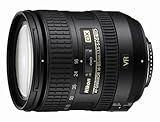
 When we flew to Seattle on Friday, the new lens was in my camera bag with the rest of the camera equipment I take on the road. But with the back problems that have been slowing me down, I didn’t have time to do anything fun in Seattle, despite the fact that we had the whole day there. (I spent much of it sleeping off some painkillers.) The next morning, we began our helicopter flight from Seattle to Page. I was sitting up front, handling navigation while Louis flew. I had my hands full with directions for our
  My photography was limited to shots taken on the ground, like this photo of my helicopter at the Spanish Fork, UT airport. Although the photo doesn’t seem too interesting in this low-res shot, it’s really impressive in full-resolution, with clear detail of the clouds — enhanced with the use of a circular polarizing filter on the camera (not in Photoshop) — and dramatic mountains in the background. I think it’s my new favorite picture of my helicopter.