Photo Shoot at San Xavier Mission

A nice excuse to visit Tucson.

This past weekend, Mike and I took the camper down to Tucson, parked it at Gilbert Ray Campground (highly recommended) on the west side of the city, and joined the members of Arizona West Shutterbugs for a photo outing at the San Xavier del Bac Mission just off I-19 south of Tucson.

I’ll likely blog about the rest of the trip another time; for now I wanted to share some information about the photo shoot, as well as a few photos.

We were scheduled to meet the group at 7:30 AM at the mission. We’d spent the night nearby, so we were less than a half hour away when we started down there. We arrived at about 7:10; less than 15 minutes before sunrise.

The place was almost deserted. A few members of our group had arrived and were parked off to one side. We parked in the back of the parking lot so as not to block anyone else’s long shot of the mission.

It’s not my purpose to tell you about the mission. You can learn about it on the San Xavier del Bac Mission Web site or Wikipedia. So please don’t criticize me for being short on facts here. I’m typing this in a camper and have to literally dial-up (via my cell phone and Bluetooth) to go online and check facts.

Candles at San Xavier MissionIt was cloudy to the east when we arrived, so sunrise was pretty much a non-event. Although I did take some photos of the front of the building in first sun (or what we had of it), I detoured to a small shrine-like building on the west side of the main church building. My friend, photographer Ann Torrence, had suggested this. I took a number of photos of the multitude of statues in candlelight before light started creeping in through the door behind me. The one here was shot with one of the 10mm lenses we rented from BorrowLenses.com.

Only a few minutes later, a pickup truck backed up to the front of the church gates. There was a blue coffin in the back. A man set up a coffin dolly and several others carried the coffin over to it. People started assembling in front of the church. Any photographer present stopped taking photos in respect for the family and friends of the deceased. A priest in traditional Catholic priest garb came out. He spoke with the family, then stood in the doorway of the church and began the service. The sound of his voice echoed in the building behind him and for a while, I thought it was a trick of the acoustics. I later discovered that he was wearing a wireless microphone. So much for construction design miracles.

The service lasted about an hour. During that time, the rest of the photographers arrived and we swarmed all around the outside of the church, snapping photos just about everywhere. There were about a dozen of us. Most of us had tripods and digital SLRs, but there were a few folks shooting without tripods or with less sophisticated camera equipment. I’d come fully prepared with a tripod, my Nikon D80, and four lenses: 10.5mm fisheye, 10-24mm, 16-85mm, and 70-300mm. I mostly used the 10-24mm rented lens and my usual 16-85mm lens.

Virgin Mary at San Xavier MissionWhen the funeral ended, we paused as the blue coffin was loaded into the back of a Cadillac Escalade hearse — which I didn’t even know existed. As the mourners departed, the photographers swarmed into the church.

The mission is beautiful in a weird old Spanish/Native American way. It’s amazingly colorful and ornate, with dozens of statues of saints and angels. Spotlights are strategically placed to bring certain statues to life. Don’t get me wrong: you’ll need a tripod (recommended) or flash (not recommended) to get good photos in there — it’s mostly pretty dark. But with the right exposure, you can get some stunning images.

Altar at San Xavier MissionThe main altar area, which is shown here, is a crazy ornate masterpiece of southwestern art. Having grown up Catholic, I can’t imagine sitting through a mass amid such decorations. Yet the church is active and has mass daily. (No photography allowed during church services.)
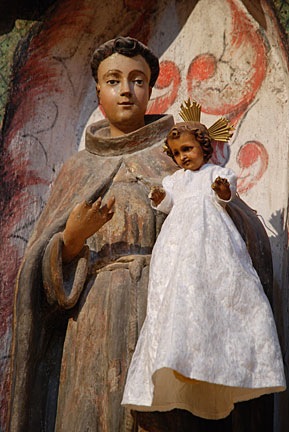
St. Anthony at San Xavier MissionThere are also candles all over the place. The sale of candles is probably the church’s biggest fund-raiser. They’re not expensive — only $3 each — and they’re quite beautiful when lined up in racks near statues. I bought one in memory of my grandmother. I’m not religious, but she was. She would have liked the place, so I bought a candle and put in in front of Saint Anthony (or “S. Antonio,” as the label at the bottom of the statue said). My grandmother used to have a Saint Anthony statue in the guest room — my mother has it now — so Saint Anthony statues remind me of her.

San Xavier MissionBy the time we were finished inside, the sun was out and the sky was nearly clear. I shot this photo of the front of the mission, after waiting about 10 minutes for various tourists to meander in and out of my composition. This was shot at f/16 with a polarizer to enhance the color of the sky. There’s definitely some distortion in this shot, but I rather like it. It’ll probably end up in my photo blog.

San Xavier Mission PewsI also got a little creative, working with various elements inside and outside the main building. These two photos are examples. The first is of the backs of the church pews. They’re simple carved wood with this unusual scalloped edge. It was sad to see that more than a few people had carved words into the backs of them.

San Xavier Mission Wall DetailThis shot is a closeup of a scroll design in the stucco finish of a wall outside. I like textures and try to experiment with them in my photography. Although not very interesting, this is a good example.

These are only a few of the 100 or so photos (not including bracketed exposures) I shot at the mission. I’d like to go back and try for a sunrise shoot again.

If you plan to go, here’s some advice:

  • Bring a tripod. You’ll need one if you plan to shoot indoors.
  • Leave your flash at home. All it will do is make ugly shadows behind the statues.
  • Don’t plan on photographing any kind of church service inside the mission. It felt good when the priest came into the church a half hour after the funeral was over and thanked us for respecting the privacy of the mourners and waiting until they were gone before shooting. And there are signs outside that warn against any kind of photography during mass.
  • Go early. The earlier you go, the fewer people will be there to wander through your shots. And with a good sunrise, the front of the mission building would likely glow in that early morning light.
  • Go everywhere you can. There are lots of public areas. Explore them.
  • Leave behind a donation — or buy a candle in memory of a loved one. Entrance to the mission is free, but it’s certainly worth your support.

Two Kinds of Road Trips

Reflections on traveling long distance by car.

The TruckThis past week, I traveled with my sister as part of a convoy of vehicles moving her from New Jersey to Florida. The other vehicles included my dad in a Budget rental truck (see photo) containing the contents of my sister’s recently sold condo and my dad’s wife in an SUV. We buzzed down I-95 at highway speed, stopping only for food, fuel, and bladder demands.

If you’ve ever driven I-95 — or most freeways, for that matter — you know how mind-numbingly boring the trip can be. You’re moving at 55 to 75 miles per hour down a corridor that’s often straighter than an arrow shaft. Although there are occasional scenic vistas, they’re usually ruined by the tractor-trailer trucks you’re passing (or passing you). The main points of interest are the billboards and the variety of fast food joints and hotel chains at exits. The only excitement comes when some jackass cuts you off or something falls off the trailer in front of you.

The benefit of the interstate highway system is speed, of course. If there’s no construction or accidents or rush-hour traffic in a major metropolitan area, you can zip right along to your destination. We travelled almost exactly 1,000 miles over a day and a half. My dad routinely makes this drive to/from farther south without an overnight stop. It’s a lot of driving, though. And it just isn’t fun.

Each year, I drive from the Phoenix area to Central Washington State and back towing a travel trailer. It’s about 1,200 miles each way. Although Google Maps tries to put me on freeways for the entire trip, I don’t go that way. Instead, I take the back roads that criss-cross the western states. Last year, I was mainly on Route 93. This year, I was mainly on Route 95. These are long two-lane, so-called “blue highways” that pass through small western towns and cities. Along the way, you can get a feel for the landscape and the way folks live. There’s seldom any traffic and the speed limit is often as high as 65 mph so you can move from place to place at a reasonable pace. You can stop just about anywhere along the way and although your choices for meals and fuel and hotels might be limited, they’re not just the same chain establishments you’ll see along the freeway. It’s a whole different way to travel, a whole different experience.

What I like about the blue highways is the opportunities to stop at interesting spots along the way. Instead of pulling into a McDonald’s for lunch, I might stop in a parking area with a scenic view and have a picnic lunch there. Instead of staying overnight at a Super 8 motel adjacent to a truck stop or parking my camper in a Walmart parking lot, I might roll into a state park and camp alongside a creek. If there’s a historic site or roadside attraction, I can easily pull over to take some time there and enjoy it. I can change my route at any intersection. Best of all, I set the pace.

Back in 2005, I conducted what I like to call my “midlife crisis road trip.” I hopped into my little red Honda S2000 with some luggage and credit cards and hit the road for 16 days. I traveled almost every day, getting as far away from Arizona as Mt. St. Helens in Washington, western Montana, and Yellowstone National Park. I had a general idea of where I wanted to go, but no reservations and no need to be anywhere on any day. I slept in motels, hotels, rustic cabins, and even a yurt. I ate all kinds of meals, from crappy fast food and terrible coffee at drive-thru joints to fine dining at the foot of Mt. Shasta. I made side trips daily, visited parks, and talked to lots of strangers. I put more than 5,000 miles on my car, got two oil changes on the road, and even replaced the rear tires after wearing them out. (Z-rated tires just don’t last very long.) I had a great time — better than most vacations — and I’d do it again in a heartbeat.

While I realize that this week’s trip wasn’t for pleasure — the goal was to get my sister, her car, and her belongings from New Jersey to Florida in the minimum amount of time — it certainly did highlight the differences between my usual kind of road trip and motoring down the interstate between points A and B.

And it reminded me why I prefer the blue highways when enjoying the trip is more important than getting to the destination.

Book on Expedia, Get Stuck in a Middle Seat

Using Expedia may save a few bucks, but it lowers your status to one step above baggage.

Just a quick whine — and a warning for people booking flights with services such as Expedia.

I booked a round trip flight more than 10 days ago. One leg was a non-stop on Continental. The other was a flight with a plane change on American.

Although Expedia allowed me to see the available seats on my Continental flight, it would not allow me to choose one. Each time I tried, it ignored my selection and said I had to get my seat when I checked in.

This evening, I checked in. Still no seat assignment.

I called the airline. Although there had been at least 10 window seats available when I booked the flight and as recently as four days ago, I was offered a choice between two middle seats. And that’s what I’m stuck with: a middle seat.

Crap.

Airline travel already sucks. Who the hell wants to be stuck on a plane for 4-1/2 hours in a middle seat? Not me.

Lesson learned: Don’t book on Expedia. Don’t buy a ticket unless you can get your seat assignment when booking.

Animals from the Air

Wild horses, antelope, and sheep — oh, my!

I flew from Grand Canyon Airport to Page Municipal Airport (at Lake Powell) again yesterday.

FlightPath.jpgEach time I make this trip, I follow pretty much the same route, hugging the southeast corner of the Grand Canyon Special Flight Rules Area (SFRA) until I get to the Little Colorado River Gorge and then heading pretty much due north. I wind up just outside the SFRA near Marble Canyon so I can show off Navajo Bridge and Lees Ferry before a quick flight past Horseshoe Bend, the Glen Canyon Dam, and Wahweap Marina. If the wind is in my favor, I can touch down at Page within an hour of departure from Grand Canyon. The same distance by car would take about 2-1/2 to 3 hours.
The terrain for most of this flight — from the Little Colorado River Gorge north, in fact — is high desert — technically the famous “Painted Desert” — and relatively barren. There are, however, some interesting features if you look hard for them. Since I’m always trying to point out interesting things for my passengers to see, I look very hard.

Ruins are relatively common. Round rock foundations are the remains of ancient hogans. (This area is on the Navajo reservation.) There are also the remains of animal enclosures, usually build with the same rock. There are complete hogans, some of which may still be occupied for at least part of the year, and ranches with hogans, sheds, outhouses, animal enclosures, and other buildings. All of these things are scattered across an immense landscape that takes more than 30 minutes to cross at 120 miles per hour.

There are also animals.

One of the questions I’m asked quite often by passengers is whether I see wildlife from the helicopter. I do, but not so often as to make it a common occurrence. It depends on where I’m flying, what time of day it is, and how hard I’m looking for wildlife.

Take antelope, for example. There are a few “prairies” north of I-40 and west of Mt. Kendricks in northern Arizona where, if I look hard enough, I can usually spot a herd of antelope. I know where to look and I remember to look. They’re hard to spot because their color matches the terrain so well. It usually takes movement to spot them. When I see them and point them out, my passengers never see them at first. I have to slow down, turn around, and drop a few hundred feet as we approach the herd. That gets them running a bit so my passengers can see them. As soon as they’re spotted — and photographed, if the passengers remember to whip out a camera — I move away. It’s not my goal to terrify the antelope population of northern arizona by buzzing them with a helicopter.

(When I flew at the Grand Canyon, I always saw at least one elk a day in the forest on one of my first or last flights for the day. My passengers never saw them and, since swooping around to show them wasn’t possible, I simply stopped pointing them out. It would be my own private treat.)

There are wild horses in numerous places throughout Arizona. I wrote a bit about them here. They’re also on the route I take from the Grand Canyon to Page. Today, my passengers and I spotted at least four herds of them — the most ever. They’re a lot easier to spot than antelope because of their size and color. But they’re also a lot easier to confuse with cattle. I look for long legs and long, thick tails.

There are domesticated sheep in various places throughout northern Arizona. We flew over a good-sized herd tended by four dogs today. They were a lot farther south than I expected — I usually see them farther north. This could be a different herd, of course. There were about 50 animals in that herd and the dogs did a pretty good job of keeping them together, even when my helicopter spooked them. (Yes, I had to do a circle for my passengers to see them; they were pretty small.)

In the past, I’ve also seen javelinas (pronounced have-a-leenas) from the air. They’re usually in herds of a dozen or more animals and I’ve only spotted them when I was alone, flying a lot lower than I do with passengers on board.

Of course, I don’t have photos of any of this. I’m flying and my hands are usually busy. My passengers never seem to remember to send me their shots. But one of these days, I’ll have some photos to share.

At the Right Place at the Right Time

I tag along on a mystery tour — of the Kolb Studio living quarters.

Outside Kolb Studio

The public entrance to Kolb Studio, which clings to the rim of the Grand Canyon.

If there’s any such thing as “luck” I think it has to do with being at the right place at the right time. People who are truly lucky can recognize such an alignment and take advantage of it.

Like I did yesterday.

I was in the Kolb Studio at Grand Canyon Village. The Kolb Brothers were the original photographers of the Grand Canyon. They shot more images of tourism at the South Rim — there are 60,000 negatives in the archives — than anyone else. They also made a movie of their boat trip down the Colorado River through the Canyon and it played daily at their studio for over 45 years, making it the longest running movie in the world. That’s what the Ranger told us, anyway.

Today, the Kolb Studio is known primarily as a bookstore and art gallery. The old movie screening room which is on the second level down, has been converted into a gallery. Last time I was at the Canyon, the gallery was closed for some reason. This time, when I stood at the top of the steps to look down into it, I saw that they were packing up artwork to ship it back to the artists.

But as I stood on that upper landing, a young, thin, female ranger walked by, followed, like a mother duck, by a long string of tourists. There must have been about 15 of them. They were walking purposely down the stairs, past the barrier that had been erected to keep people out. I asked one of the last people, “Is this a tour?”

“Yes. Go to the desk to see if you can join us.”

I knew that if I went to the desk, even if they said yes, I’d be too late. So I just followed them.

Mind you, I had no idea what the tour was about. I had time to kill and it was clear that these people were going someplace I’d never been before. I wanted to go with them.

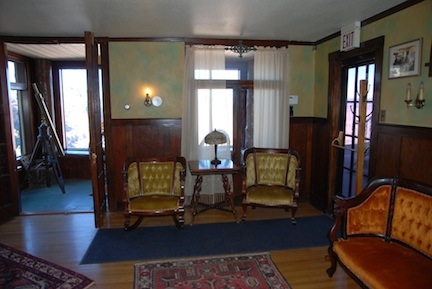
Kolb Sitting Room

The sitting room in the living quarters at Kolb Studio. Beyond this is a “sunroom” with windows looking over the canyon.

I’d hit the jackpot. It turned out to be a tour of the Kolb Studios living quarters — the home of the Kolb Brothers.

Emory and Elsworth Kolb were given a piece of land at the edge of the canyon by Ralph Cameron who owned Bright Angel Trail and a bunch of other land on the rim. This was back in the early 1900s and Bright Angel Trail was a toll road. The Kolbs were given the land with the stipulation that they were to collect the tolls when Cameron wasn’t around. The Kolb brothers built their studio — first a tent, then a wooden frame building — on the edge of the cliff. A window on the building looked out over the start of the trail. The Kolbs would snap photos of the groups of mule riders going down. Then one of them would run all the way down to Indian Gardens, which is 4-1/2 trail miles and 3,000 feet down, where there was water. He’d develop the glass plates, make prints, and run all the way back up to the studio. When the riders returned, the photos were ready for purchase.

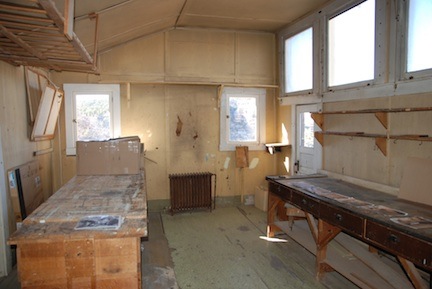
Inside Kolb Studio

Inside the actual photo studio. The window on right right is the one they took photos of mule riders through.

There’s a lot more history to the Kolb brothers, but I’m not about to retell it here. Check out the PBS documentary about them or look them up in Wikipedia to learn more.

The more interesting thing is the house. It was built with its top floor level with the canyon rim. Subsequent floors were added below that. So the house literally clings to the side of the cliff. And it looks as if it were built over time by people who cared more about functionality than architecture.

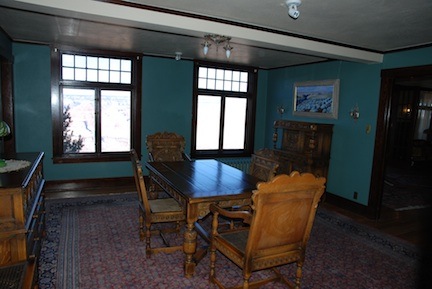
Kolb Dining Room

The dining room at the Kolb Studio living quarters. Those windows look right out over the Grand Canyon.

But inside — wow. A perfect example of early 1900 homebuilding. The house I grew up in was built in 1901, so I know the style. Plaster walls, wood floors, molding. And all the windows looked right into the Grand Canyon.

The ranger led us though about a dozen rooms, including the sun porch, sitting room, kitchen, bedrooms, dining room, and, of course, studio and darkroom. (The darkroom was added after water became available at the Rim.) We were invited to take photos — even through the window the Kolb Brothers had used all those years ago. It was fascinating and a real treat for me.

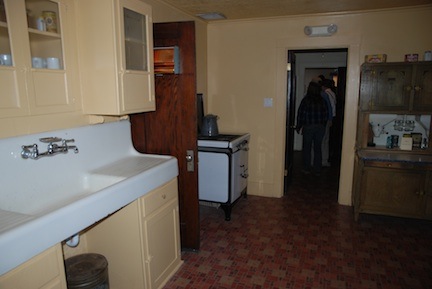
Kitchen at Kolb Studio

The kitchen at Kolb Studio.

Let’s face it: I come to the Grand Canyon at least two dozen times a year. I’ve seen all the usual things. I’ve taken photos from the rim trail and every single rest stop or parking area on the rim. I’ve visited all the shops and eaten in all the restaurants and stayed in all of the hotels. I’m at the point where I’m almost bored when I come here. Almost.

When I finished the tour, the first thing I did was call Mike to tell him. I think he was jealous. Heck, I’d be if he’d gone without me!