Planning the Big Move

I make plans to move my “rolling mansion” and helicopter from Wenatchee to Page, AZ.

My last cherry drying contract for the season ends on Wednesday, August 25. I need to be in Page, AZ with my trailer and helicopter by the middle of September. I’m just starting to plan for the move.

This is an exercise in logistics that I go through twice a year. Every time it’s slightly different.

The fun starts on Thursday, when my husband arrives on a late flight into Wenatchee. We’ll spend a few days in the area on a mini vacation. It’ll be the first time I’ve seen him since May 15. He goes home on Monday morning.

The move starts on Sunday, August 29 (weather permitting) with a flight over the Cascades with the helicopter to Boeing Field (BFI). With perfect weather, the flight should take less than an hour. But I’ve only had perfect weather once in the ten or so times I’ve made the flight. The last time I did it, it took about 4 hours because I had to fly all the way down to the Columbia River at Hood River to get under the clouds.
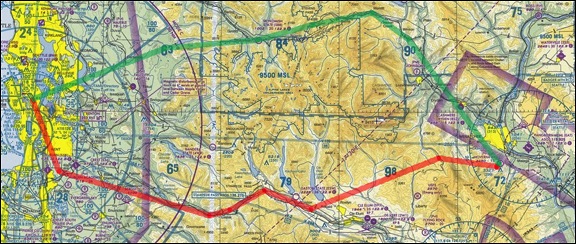
Planned Routes

Two different routes to get from Wenatchee to Seattle by helicopter. The red route includes a stop at my friend Don’s house.

Moitek Mount

My new Moitek Video Mount, pictured in my friend Erik’s helicopter.

At BFI, I’ll take possession of my new Moitek Video Mount, which I bought from the estate of a helicopter friend who passed away last year. A videographer who used the mount with my friend will be meeting with us to show us how to set it up. He’ll bring along a camera and get some footage on a flight down to Longview, where we’ll meet with the mount’s designer and maker to ask questions and get other tips. I’m hoping my friends Don and Jim, each R44 owners, will accompany us for this little trip. I’d love to get some air-to-air video for a project I’ve been working on for some time.

Back at BFI, I’ll drop off the helicopter for some maintenance. It needs its blades painted (again) and since I’m coming up on my 100-hour inspection, I figured I’d have it taken care of then. It’ll stay at the maintenance shop until I return in September to pick it up.

I’ll get back over the mountains by plane or helicopter (piloted by a friend) on Monday morning. I’ll spend the rest of the day and most of the next prepping the RV for the long drive. I’ll need to put away all loose items and clean up as well as I can.

RV Route

The RV Route

On Wednesday, September 1, I’ll hook up and roll out of here. The plan (so far) is to go to Walla Walla, where I’ll spend a few days at an RV park I know. Walla Walla has some great restaurants and wineries. It’ll be like my own little vacation on the way home.

On Saturday or Sunday, I’ll get an early start and hit the freeway for the 10-hour drive to Salt Lake City. If some friends are available to meet me, I’ll go in on Saturday; otherwise, I’ll do it on Sunday. I’m planning on parking overnight at the Draper Camping World, which should be affordable and convenient. I probably won’t even bother unhooking my truck.

On Monday morning, I head out early for Page. I hope to get there early in the afternoon and find a place to park my rig for about a week. Weather permitting, Mike will fly up to Page in his plane and pick up me and Alex the Bird to take us home. The truck and RV will remain at Page until I return with the helicopter.

On Tuesday or Friday, I’ll head up to Seattle by commercial airliner. Then, on Wednesday or Saturday, I’ll start the long flight to Page. It’ll take 8 to 10 hours, so I’m likely to do it over two days. I might have a passenger; I’ll know more this week. If I do, we’ll be doing the flight on Saturday/Sunday to Las Vegas, possibly with part of the flight along the California Coast, and I’ll be going on to Page alone. If not, I’ll do the flight on Wednesday, making the best time possible to Page by flying through Oregon, Idaho, and Utah on pretty much the same route I followed to get here before the start of the season.

In Page, I’ll set up camp — probably in the campground I lived in for two months two years ago — and offer aerial photo flights over Lake Powell. I have clients meeting with me starting on September 20, so there’s definite business for at least 5 days. On September 25, I fly the helicopter home, hopefully with a passenger (if she hasn’t forgotten). I’m not sure when I’ll retrieve the truck and RV; it depends on whether I have a training video shoot the following week in California.

So if you were wondering what I’ll be doing for the next month or so of my life, you now know.

I’ll be interesting to see how closely I can follow these plans in the weeks to come.

Farm Stand Fruit Isn’t Always the Best

Look before you buy.

When I was a kid, when the harvest months rolled around in northern New Jersey and Upstate New York, my family would take Sunday drives to farm stands and apple orchards. The drive was the activity, the destination was the excuse. The destination also had the rewards: fresh-picked apples, fresh local corn, fresh-made donuts, cider, soft-serve ice cream. The smell of apples and cinnamon and donuts brings back memories of those days.

Just a Memory

A regular destination was Tice Farm, which was founded in 1808. It was torn down in the late 1980s so a mall could be built in its place. This article on NorthJersey.com offers a look back at two of the farms we visited when I was a kid.

It’s this fond memory of farm stands that has always remained with me. It’s no wonder I began visiting a handful of farm stands in Washington State where I spent much of the summer. But I soon realized that today’s farm stands cannot be compared to the ones we visited 30+ years ago.

Today’s farm stands are mostly tourist attractions. Sure, they have some produce (more on that in a moment), but they also seem to sell an awful lot of non-food items that can’t easily be connected with a farm. Things like candles and scarves and t-shirts. Things like made-in-China “crafts.” Stocking and selling these items must be more satisfactory for the farm stand owner. After all, they’re cheap to buy, don’t need to be refrigerated, and don’t spoil. Sure, they’re usually the same kind of crap you can buy in any mall — even Tice’s Corner Mall — and probably even in a local Walmart. But tourists don’t care. They come, they buy, the farm stand owners keep them stocked.

Reject Fruit?

It’s the produce that upsets me, though. I visited a farm stand in Quincy, WA several times early this summer, attracted by its handmade signs for whatever “fresh” produce was currently available. What I found was often produce that was bruised or otherwise damaged, days old and, surprisingly, often not local.

I bought my first cherries of the season there and was disappointed to find that nearly half the bag’s contents had to be discarded because of splits and bird pecks. This is the fruit that the packing companies reject.

I suspect that the cherries I’d bought were from orchards in Mattawa that had lost 60% or more of their crop in heavy rains early in the season. (That’s what the helicopters are for, folks — to keep those cherries dry so they don’t split.) When the grower decides not to pick and take a loss for the season, the pickers will sometimes go into business for themselves, picking fruit and selling it directly to farm stands.

Rainier Cherries

These organic Rainier cherries, although ripe and tasty, were flawed for two reasons: they’re slightly bruised by the wind and there’s not enough red on them.

I saw this first hand at one of my client’s orchards this season. He had several acres of Rainier cherries that didn’t get enough color. (50% of a Rainier cherry needs to be red to meet standards.) The fruit was good — I picked at least 15 pounds for my own consumption and they lasted two weeks in my fridge — but the packing companies wouldn’t take it. The grower didn’t pick but the pickers descended on the orchard anyway, taking away a lot more fruit than I did. Was it a coincidence that local Rainier cherries appeared in the supermarket for 99¢ a pound that week? I don’t think so. I’m sure that farm stand got their share, too.

Fresh, Quality, Local Produce? Not Always

And that’s the point: the farm stands don’t always get quality produce. It’s not always local. It’s not always fresh. It’s whatever they can get cheap and sell at premium prices. The tourists don’t know any better. They see farm stands and they think fresh, local, organic. They don’t realize that they’re often buying the produce that the packing houses don’t want.

Is all this produce bad? No. The cherries pictured above were sub-standard for the packing houses, but they were perfectly good to eat. (And it’s good to see that someone was picking them and making them available for consumption — I picked so much primarily because the idea of all those cherries going to waste was very upsetting to me.) Still, a farm stand might charge a premium for them just because they’re Rainiers and just because they’re at a farm stand. It’s the sucker tourist who doesn’t know any better who is paying a premium price at the farm stand when they might get better fruit at the local supermarket.

As for local…well, I’ve never seen an orange grove in Washington State. Lemons, limes, kiwis — these are all produce you might find at a farm stand. If you’re looking for local produce, think of what you’re buying and ask if it really is local.

And fresh? Here’s a secret: apples are picked in the late summer and early autumn. If you buy an apple anywhere in the U.S. in May, it’s either not fresh or it not local. Now I’m not saying you shouldn’t buy apples off season — apples are one of the few fruits that we’re able to preserve for up to a year and maintain in near-fresh condition. I’m just using apples as an example, since apples appear at nearly every farm stand you might visit.

Look before You Buy

My point: don’t automatically think that the best produce can be found at a farm stand. Not all farm stands are created equally. Look before you buy. Ask questions. Don’t buy pre-bagged items — remember my bag of bad cherries? Make sure you get what you’re paying for.

And support the good farm stands — the ones really delivering produce right from the local farms — by visiting them often.

Packing Up, Moving Out

Moving day is upon me.

On Wednesday (yesterday), I got a call from my last client for the season. Instead of starting the contract on July 25, he wanted to start on July 22.

Thursday (today).

That seemed to work out fine for me. My previous contracts all ended on Wednesday and there was no rain in the forecast. So even through two of my clients were still picking cherries, it was unlikely that they’d need me to extend. A quick call to each of them confirmed this.

I’d been planning to move on Sunday. Or maybe Monday. Now it looked like I’d have to move on Friday.

The fifth wheel RV that I’ve been living in since the start of the season is in Quincy, WA in a campground on a golf course with a full RV hookup. My helicopter is parked across the street at an ag strip there. I need to get both of them up to Wenatchee Heights, WA, and park them on an orchard.

Today, I’m driving up to Wenatchee Heights to meet with my client and agree on a place for me to park. I have my eye on a spot, but the land doesn’t belong to my client and he’s not sure how to contact the owner. I’m hoping I don’t have to park in the orchard. The roads in there are very narrow and I’m worried about getting my 36-foot rig around the corners. I’m also thinking that there probably isn’t 36 feet of level space in the whole place.

This afternoon, I’m going to a salmon grill party at the ag strip where I’ll probably give helicopter rides to my hosts and their families.

Then I’ll come back to the RV and pack it up.

RVs are great because they’re set up for living and can be very comfortable. Mine is extremely comfortable. But when an RV is on the move, all loose items need to be stowed. When you spend weeks parked in one place, you tend to take out a lot of items. I need to put all these things away where they won’t go flying as I drive around curves and down bumpy roads. Among the larger of these things is my 24-in iMac computer, which has been sitting on my desk since I got here and unpacked. I’ll be putting it away in its box until I get home from my travels at the end of September. I have a laptop — actually, three, but who’s counting? — with me for the book project I’ll likely start on Saturday.

I expect packing and cleaning to take most of the day. By morning, I need to have it 90% done.

Tomorrow, I’ll fly the helicopter up to the orchard at about 7 AM. My client will meet me there again and drive me back to Quincy — a distance of about 40 miles. Then I’ll finish packing up, take care of all the dumping and disconnecting, get Alex out of his cage and into his travel box, close up the RV, and hook it up to the truck. With luck, all that will go smoothly and I’ll be on site at Wenatchee Heights by noon.

There’s a pretty good chance that I won’t have any hookup when I get to my next parking space. That’s three weeks without water, power, or sewer connections. Power isn’t an issue; I have a solar panel on the roof that should keep the batteries charged and a 2000 watt generator if I need more power. (I really don’t want to run the generator if I don’t have to, but with daytime temperatures getting into the 90s, it looks as if I’ll need it just to run the air conditioner.) Water could be more of a problem. I know I can’t last three weeks with 62 gallons of water. I’m hoping I can run a hose from a water source to the RV to fill its tanks occasionally. We’ll see how that works out.

I’m looking forward to the move. I was actually starting to get pretty tired of this place — especially with no work for the past four weeks. But I am nervous about it. This is a known; where I’m going is an unknown. Hopefully, later this morning I’ll have a better handle on where I’ll be parked and what’s available to me. I can take it from there.

Details to come…

Internet Frustration with a Crappy ISP

Sometimes it’s better to have no Internet service than bad internet service.

For the past two months, I’ve been living in my RV at a golf course campground in Quincy, WA. This is my third June/July here.

Some Background

Wireless AntennaThe first year, I tried to get Internet service here using what I was told was the only local provider. The provider uses wireless Internet. It picks up a signal from a nearby tower using an antenna it placed on the golf course’s pro shop roof. The signal goes down to a router and broadcasts Internet service via WiFi to those within range.

That first year, it worked okay for the short time it was available. But the groundskeeper was convinced that its wireless signal was messing with the irrigation system’s wireless signal and had it taken down after two weeks.

The second year, the service was up and running again. My camper was parked in the second space from the pro shop (again) and I was able to connect. I paid the $40 monthly fee and had relatively decent service, although speed was often an issue, especially in the evening.

This year, I’m parked in space #5 which is long enough for my new rig. I soon discovered that although the golf course was using the same provider, that provider had changed the way it did business. Rather than one router for the pro shop and campers, they had three routers installed: one for the pro shop, one as a “hotspot” for the restaurant, and one for the campers.

The Trouble Begins

The trouble began when I first attempted to connect to the RV-dedicated router. The system they used required my MAC address. I’m using three devices — my iMac, my MacBook Pro, and my iPad. So we had to set all that up over the phone. He got the MAC address wrong for one of them, causing all kinds of problems.

By the next day, I realized that I couldn’t hold a signal with the router. My Mac was reporting 3 bars when connected, but half the time, it couldn’t even see the router. Turns out, these idiots had installed a router for a campground that didn’t have enough range to cover the whole campground. I guess if you want Internet service, you need to park next to the pro shop building.

So they switched me to the password-protected hotspot router, warning me that they’d change the password once a month. Whatever. It seemed to work so I was okay.

Seemed is the appropriate modifier here. In reality, it only worked about 80% of the time. Sometimes, the router would disappear. Other times, it would be there, but would not send an IP address. Other times, it was there and sent my devices IP addresses, but those addresses couldn’t connect to the Internet. Outages like this would be frequent on some days, lasting anywhere from 2 minutes to 2 hours. One night the Internet went offline around 7 PM and didn’t come back until 10 AM the next day. The golf course pro shop was having the same problems.

The amount of frustration this caused me cannot be measured. I’d be working on an e-mail message or blog post and not be able to send it. I’d be uploading movie files to a publisher who had me on a deadline and the upload would fail. I’d try to download updates for my computer and they’d stall and eventually fail. I’d have a client calling, asking what I saw on weather radar and I couldn’t get online to look.

And then it would just work again.

Even when it did work, the speed of the connection was sometimes agonizingly slow. I mean so slow that it caused physical pain — from pulling my hair out — to use a Web browser. I couldn’t even watch YouTube videos. Even tethering from my BlackBerry has enough bandwidth for YouTube.

Service sucked and I was paying $40/month for it.

I started seriously considering a MiFi.

The D & J Show

Then there was the surprise password change.

The company is run by two guys. One guy, D, is the money guy and knows next to nothing about technical matters. He’s the guy that answers the phone when you call for help. The other guy, J, is the tech guy and I think he probably does know what he’s doing — at least well enough to get by. When you need help, you’re directed to call his cell phone, which he never answers. He also doesn’t respond to text messages or return calls.

D decided, one day, that too many people had the password for Hotspot and it was time for a change. So he changed it to the word golf. Unfortunately, 4-character passwords were not appropriate for the type of network security they were using. So, as a result, it wouldn’t work for anyone, even if they had the password.

J, upon hearing about the problem, changed it back to the old password. That fixed things — or at least brought them back to their semi-functional service level — for a while.

Sputnik

Last week, I flew up to Chelan to spend a day with a friend. I got back around 7:30 PM, and like any other computer-dependent geek, went to check my e-mail.

Sputnik?

The typos on this login screen should give you an idea of the level of professionalism I’m dealing with here.

I couldn’t connect. The router had disappeared. Instead, there was a different router name that included the word hotspot and was not password protected. I told my computer to connect. Still no joy. I launched my Web browser. And the sign-on screen shown here is what I saw.

I was paid up for another three weeks, but I had never been given login information. All I had was a password. I tried all different combinations of my name with the password to connect. No joy.

I got pissed off. I called the number on the screen and got an answering machine telling me that D was on the phone. Not likely. He was more likely gone for the day. J didn’t answer his phone. I started leaving messages, and they were not friendly. I was pissed off.

In the morning, nothing had changed. No one returned my calls — as if I had reason to expect that they might. I started calling again and still not getting through. I had to connect via BlackBerry Bluetooth tethering just to check the weather and my e-mail.

At 10 AM, when I called J again, he answered the phone. (I heard that hell froze over that day, too.)

“We upgraded the service yesterday and put in a new router,” he told me, as if I had no reason to be angry. “It should work a lot better now.”

He was full of crap but I believed him for about 10 minutes. That’s how long it took to set up an account for me and get me connected. He’d already hung up when I realized I had the same crappy service I’d had for the past month and a half.

And now I had the extra bonus of having to log in several times a day.

The login process is especially frustrating on my iPad, which won’t remember my user ID or password and must be prompted to connect by trying to access a simple Web page (I use Google.com) rather than refreshing whatever was last viewed.

Sputnik. That’s a good name for this service. It’s 1950s technology.

I’m outta here in less than a week, so the frustration will end.

And the folks at the golf course have already told me that they’re thinking of switching to another service.

All I know is that I’m not giving another dime to these clowns again.

Update: 10 minutes after posting

It Never EndsYou want irony? Here’s the message I got in my Web browser only 10 minutes after posting this whine. These guys don’t even know how to configure the obsolete software they use.

Just Because It’s Free Doesn’t Mean You Should Waste It

I’ve become the power police.

My Neighbor's TrailerThis photo shows the trailer parked in the spot next to mine. It’s been here longer than me and I suspect it isn’t going anywhere soon.

For a while, a family of four and dog lived in it. They kept weird hours. They’d come home between 9 PM and 11 PM, make a bunch of noise, and then go inside and (I assume) sleep. Occasionally, before turning in, one of them would do something in the car with the key in the ignition and the door open so it would beep-beep-beep for 20 minutes at a time. In the morning, around 10 AM to 11 AM, the door would open and they’d begin spilling out in their pajamas. After screwing around at the trailer for a while, they’d leave. The whole process would start again that night.

About a month ago, they started leaving the “porch” light on. This makes sense when you know you’re going to get in late, but what bugged me is that they never turned it off. And while this isn’t a huge deal if they’re parked all by themselves, their porch light is about 10 feet from one of my bedroom windows. It’s so bright outside at night that I actually woke up in the middle of the night last week and thought it was morning.

It was morning. One o’clock in the morning.

I considered asking them to turn if off at night when they got in, but I was too embarrassed. They were a family of four in a 20-year-old 22-foot travel trailer with a dog. I was a family of one in a brand new 36-foot fifth wheel trailer with a parrot. I had no right to whine.

About two weeks ago, they started leaving the air conditioning on all day long, even when they — and their little dog — were out. They also left the two top vents and one of the windows open. Air conditioning on, windows closed isn’t bad. Air conditioning off, windows open is good. But air conditioning on, windows open is wasteful — especially when no one is home.

The campground we’re in is dirt cheap: $200 per month for a full hookup! There’s no electric meter, so you can suck as much power as you want. But that doesn’t mean you should suck power when you don’t need to. Or blatantly waste it.

About a week ago, they stopped coming home. I don’t know where the hell they are. For all I know, they’ve been deported.

So now there’s a vacant trailer next door with its porch light on, shining into my bedroom window, and the air conditioning blowing cold air out the open vents and windows. 24/7.

It gets cool here at night — in the 60s most nights. The kind of night you want to leave your windows open to feel the fresh breeze and hear the wind in the trees.

Of course, with windows and blinds open, I get to hear the air conditioning from next door and have that damn light shining on me.

I mentioned the light to some folks I had dinner with last night. They all told me to pull the bulb out.

But last night, I did something better. I snuck around to their electrical box and turned off their circuit breaker. Instant silence, instant dark.

I slept very well last night.

They didn’t come home. Although I was tempted to leave everything turned off, I know they have an electric refrigerator — the kind you buy for a dorm room; I saw them bring it in the day I moved in — and I was worried that the food inside it (if there was any) would spoil. So before taking my walk this morning, I flicked everything back on.

Tonight, I’ll flick it off again.

I figure that if they show up, they’ll just assume the circuit breaker popped. Maybe they’ll even get the idea that they shouldn’t leave the air conditioning on when they’re not around.