Call Me Captain, 2023 Edition

I am approved for my Operator of Uninspector Passenger Vessel (OUPV) “Six Pack” captain’s license by the US Coast Guard.

I’m going to keep this short — or try to — because I’ve been working hard on getting my Great Loop blog up to date and need to spend more time doing that. I just wanted to share the news that the boat experience time, training, testing, and tedious application filing has all paid off: the US Coast Guard has approved my application for an OUPV Captain’s license. I should get the paperwork in the mail any day now and will (hopefully) have it forwarded by my house sitter before month-end.

What does this mean? It means that it’s now legal for me to take up to six passengers for hire on board my boat for tours, charters, or educational cruises. This is something I’d like to do to help me cover the cost of cruising for the next year or so along the Great Loop.

DO IT NOW Belmont Bay
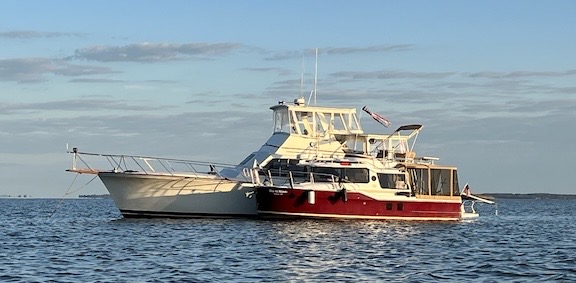
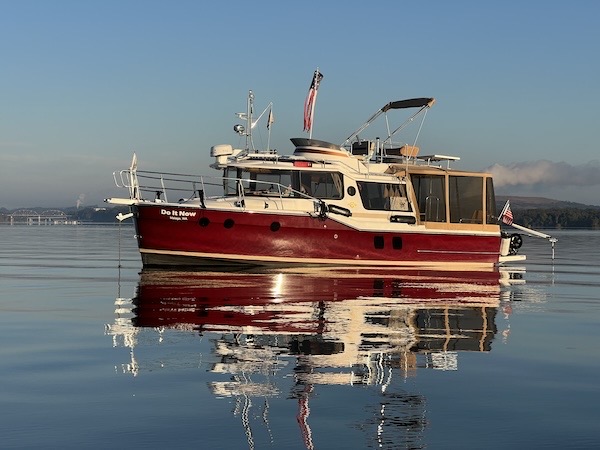
Here’s my boat, Do It Now, anchored in Belmont Bay, not far from the Potomac River.

What do I have in mind? Well, I’m thinking of the following options:

  • Garmin Chartplotter and Autopilot classes. So many folks don’t understand how they can use the navigation equipment on their boats to reduce their workload and enhance safety. I’d like to show people how to use the features of this equipment while out on the water, actually crusing. I’m thinking a 4-hour course for up to two people at a time would be beneficial. I can do classes on my boat or on the student’s boat, provided the equipment is similar enough to mine.
  • Single-Handing a Small Trawler course. A lot of people seem really surprised when they realize that I’m doing the Great Loop mostly solo. They think it’s hard to single-hand a boat. The reality is that it isn’t hard at all if you know your boat and a handful of tricks to make the hard part — usually docking and anchoring — easier. I’d like to take just one person at a time on a 4 to 7 day cruise to show them what I do, let them try it for themselves, and then pretend I’m not on board while finishing up the trip.
  • Co-Captain course. Created primarily for a boat’s “first mate,” this course will cover everything the second in command needs to know to help the captain or take over for him (or her) in the event of an illness or accident. In today’s world, I expect this class to be of interest mostly to women cruising with their husbands. I’ve met too many couples on the Loop where the wife is in charge of cooking, cleaning, and tossing lines to dock hands and knows little or nothing else about operating the boat. My idea is to provide a ground up foundation of knowledge from boat operations, to trip planning, to handling emergencies. I think the second in command on any boat should be able to handle the boat when the captain needs help but the captain isn’t always the best teacher. I can be that teacher. 4 days on board should be enough to get started.

I’m also thinking about the possibility of offering 3-4 day mini cruises on the ICW to give folks a taste of what cruising is all about. Unfortunately, due to the relatively small size of my boat (and limited sleeping accommodations), it might not make for a comfortable journey folks are willing to pay for. This is something I need to explore more.

This is exactly the kind of thing I like to do: teach people something I know. I have an extensive background in training in classrooms and one-on-one, as well as charter work through my (recently sold) helicopter charter company. This should be easy for me. As usual, the hard part will be attracting potential clients. But I’m working on some ideas for that, too.

And you thought I was “retired”….

Wish me luck!

In case you’re wondering, the title of this post calls back to 2004 when I got my Captain’s bars to fly for Papillon at the Grand Canyon. You can read about that here.

My History with a 1995 Sea Ray SeaRayder F-16

In my possession for 12 years before last week’s sale, it played a part in the theater of my crazy divorce.

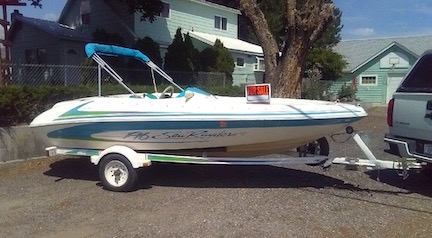
Jet Boat For Sale
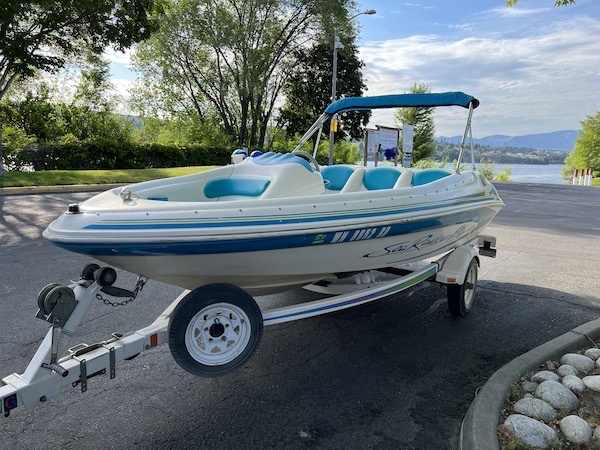
Here’s my little jet boat parked in front of Bob’s house on the corner. He also sold my Yamaha motorcycle for me. Now if only I can get him to take my truck camper…

Last week, I sold my little jet boat.

Or my friend Bob did. He lives on a main road and had a caller within 30 minutes of putting the For Sale sign on the boat where it was parked on the corner at his house. The next day, after a launch and engine run, he had cash in hand and the new owner was driving away.

About the Boat

The boat was 28 years old when I sold it. That is not a typo.

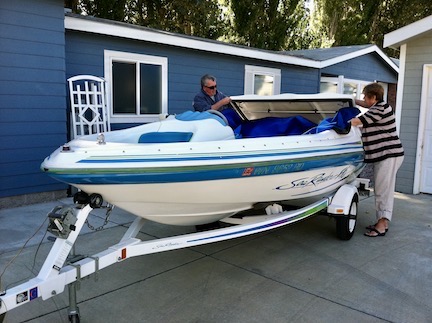
First Look
My friend Pete and the boat’s previous owner open the engine lid for a look inside. It was immaculate.

I bought it in late summer 2011 from the original owner, a couple who lived at Crescent Bar in Quincy, WA. I’m pretty sure my future wasband told me not to buy it — he didn’t like me buying anything anymore, even though I always bought with money I’d earned and not our joint funds.

It was a fun little boat. At the age of 16 years old — when I bought it — it was in amazing condition, having been stored indoors for most of its life. The one season the original owners had left it in the water on a mooring ball at Crescent Bar, the upholstery had taken a beating and they’d replaced it. It looked great. It started right up. It was easy to tow, easy to launch by myself, easy to drive, and easy to get back on the trailer by myself.

Because it was a jet boat, it seemed to steer from somewhere about 1/3 down the boat — instead of from the back. It was a weird sensation, especially at high speed. Virtually no body roll. It would just seemingly slide into a turn.

It had a 120 horsepower jet boat engine which, considering the boat’s diminutive size — it was only about 17 feet long — seems like a lot. But it didn’t have enough power to pull a skier — I was told that by the owner when I bought it. That was fine with me. All I wanted was a way to get out on the water and have some fun. The price of admission — just $1,500 — made it a no-brainer to buy.

Winter 2011/2012

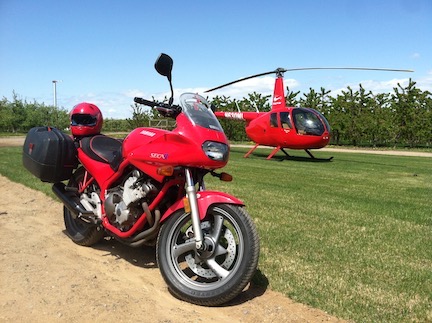
Helicopter and Motorcycle
I had one of my two motorcycles shipped up to Washington because I was spending every summer there and wanted something to get around on other than my wasband’s truck. Here it is with my old helicopter parked at my friend Pete’s winery/orchard. Both of these are gone now; more life subchapters closed.

I couldn’t bring it home with me to where I was still living in Arizona because I had to drag home the fifth wheel I spent my summer working months in. Instead, I made arrangements to have it and my old Yamaha Seca II motorcycle, which I’d had shipped to Washington earlier that year, stored indoors for the winter.

I went home and had a miserable winter with my future wasband, trying to keep our marriage together by living with him during the week in his Phoenix condo and coming home with him on weekends. If anything, living in the cave-like condo he’d bought (for reasons I still don’t understand) made matters worse.

In the spring of 2012, I went back to Washington for my fifth consecutive season of cherry drying. I was growing my business there and had hired another pilot to help me during the busiest part of the season. I was also working on a Mac OS book revision — I was still writing computer books back then — and picking up flying work by taking people to wineries with the helicopter. It was summer 2012 and my flying business was really looking up.

When I wasn’t writing or flying and there wasn’t rain in the forecast, I was able to take my little jet boat out on the river from Crescent Bar and ride my motorcycle. My summer job was looking more and more like a paid summer vacation every year.

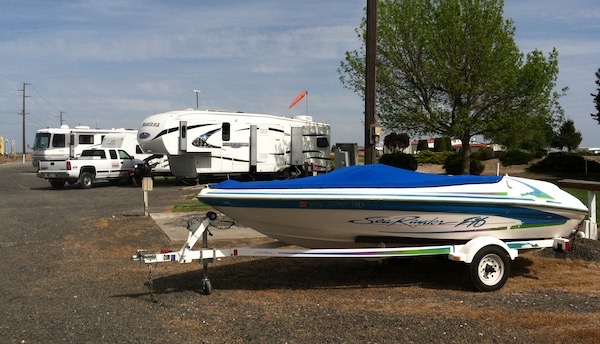
Parked Boat
Here’s the boat parked at the Colokum Ridge Golf Course campground, where I started each summer. You can see my old Montana fifth wheel and my wasband’s white Chevy truck in the background.

The Divorce Bullshit Begins

The idiot I was was dumb enough to marry called on my birthday to tell me he wanted a divorce. (Can you believe that shit?) A lot of weird stuff followed and if you look hard enough in this blog under early posts tagged divorce you should find plenty of that.

Meanwhile, I was stuck in Washington for work and I wasn’t sulking around. I was doing what I always did when I was there: hanging out with friends, flying for work and pleasure, writing, and doing fun things like day trips with the boat or my motorcycle or my wasband’s truck, which is what’d used to take that big fifth wheel up to Washington again.

When he didn’t actually file for divorce and swore that there was no other woman, a friend of mine told me that he wasn’t serious about the divorce and was probably just blowing steam. I emailed him to tell him I’d be home in September with the boat so we could use it on Lake Pleasant. But then I found out about the old woman he was already shacking up with and my plans changed.

At the end of cherry season, I stored the boat and the fifth wheel and went home. More weirdness followed. Then the nitty gritty of divorce bullshit. He dragged that out for months, certain for some reason that I was in a hurry to get back to Washington and would give him anything he wanted to finish things up quickly.

For a man who’d lived with me for 29 years, he certainly didn’t know me very well. I had no reason to go back to Washington before cherry season and I only had one home. So other than taking a few trips to visit friends and family members, I just stayed home and packed. I’d already decided that when the divorce dust settled, I’d buy 10 acres of land in Malaga that some friends were selling and build a new home on it.

The boat never crossed my mind, although, in hindsight, it would have been a lot of fun on Lake Pleasant and the Salt River lakes while I waited for him to get a clue.

The Boat as a Divorce Pawn

The boat was included in my list of personal property. Because I had purchased it while we were married, it was technically part of our community property, despite the fact that only my name was on the title. I don’t remember if I listed it for its purchase price of $1500 or something a little lower, perhaps $1200. I was honest about the value — which is more than I can say for the way he tried to undervalue his Mercedes by neglecting to mention its AMG upgrade. Although we tried mediation to split the personal property and other things before our court date in May 2013, the old woman he’d replaced me with — who was apparently managing the divorce for him — told him not to agree to anything. So that’s how the boat wound up in court.

Skinny Me
I lost 45 pounds while I was away in Washington during the summer of 2012. I’m surprissed my future wasband didn’t have a heart attack when he first saw me on my return. I looked and felt like the new woman I was about to become.

And this is where the farce began. I think it was our second day in court. Before things got started, his lawyer told my lawyer that my future wasband wanted the boat and was willing to pay half its value. He offered me $1000 for my share.

Now this was, in no way I knew of, half the boat’s value. The boat, in my mind, wasn’t worth a penny more than I’d paid nearly two years before: $1500. For some reason, he was claiming it was worth $2000.

But I knew what was really going on. They — my future wasband and his “advisor” (or mommy; call her what you will) — thought the boat was worth a lot more. Remember, he’d never actually seen more than photos. They figured that if they lowballed me and I refused, they’d somehow be able to prove it was worth more than I said. (For what purpose at this very late stage in the game, who knows?)

But I knew what the boat was worth: $1500 max. So he was offering me $250 more than half the value.

I’m not a complete idiot. I took the offer.

While all this was going on, my future wasband was squirming in his seat. It was pretty clear to me — after all, I’d lived with him for 29 years, too, and I’d been actually paying attention — that he didn’t want the damn boat. This was a ploy his mommy and lawyer had agreed to play in court as the judge was settling into his seat for the day and I don’t think he was happy about it. When I mentioned that the boat was in Washington and I would not be storing it for him, he started to see the reality of the situation: having to not only pay for a boat he didn’t want, but drive 1200 miles to Quincy, WA to retrieve it and another 1200 miles to bring it home. I relished the thought of him doing that for an 18-year-old boat he’d overpaid for.

So he told his lawyer he didn’t want it and it went back into the property pool.

Oddly enough, when the judge made his decision, he let me keep everything I’d bought over the years, even if I’d bought it since we were married. That included the fifth wheel, a hangar in Page, AZ (which was actually an exchange for like property purchased before we married), and the boat.

So I got to keep the boat and didn’t have to pay him a dime for it.

The Boat in My New Life

Janet Fishing
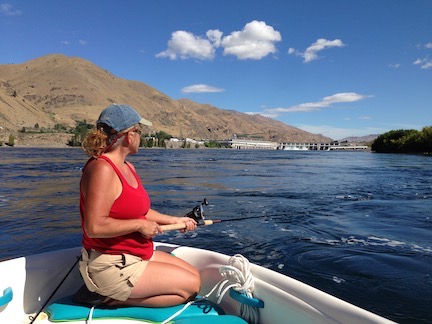
My friend Janet spent a week with me in late summer 2013. We took the boat out and she did some fishing. A typical trip would be to drive at full throttle up to the nearest dam, kill the engine, and drift back downriver, listening to music, snacking, and talking with whoever had come along for the ride.

When I moved up to Washington “full-time” to reboot my life closer to work, the boat became part of that life. My garage was big enough to store it and although I didn’t use it as much as I wanted to, it was great to be able to just hook it up to my Jeep and drag it down to the Columbia River on a hot summer day with friends. I even dragged it to Arizona behind my truck camper years later, long after that fifth wheel had been sold so I could go boating on the Colorado River, Lake Havasu, and Lake Pleasant.

Boat Dogs
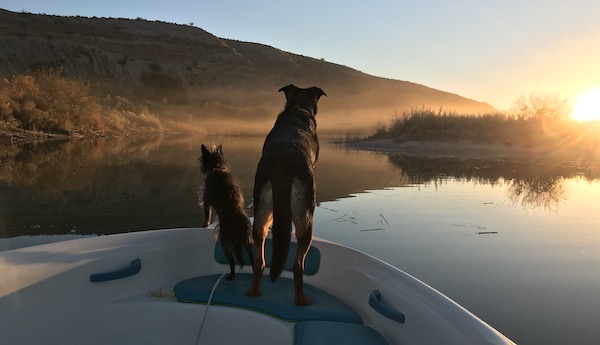
Although I didn’t use the boat as much as I liked when I took it back to Arizona, it was good for a few outings on the Colorado River, Lake Pleasant, and Lake Havasu. Here’s my old dog Penny with Janet’s dog Dually on the bow when we headed out to the Colorado River late one afternoon.

But time marches on. I wanted to do more serious boating. Cruising in something I can live aboard while covering long distances. Like maybe the 6,000 mile Great Loop. After a series of unexpected positive events, I wound up buying the 2019 Ranger Tug R29 CB I named Do It Now. I’ve spent a total of 179 days on board since September 5, 2022 and I’ll be going back for more at the end of this September.

I didn’t need that little jet boat any more. I knew that, despite the fact that I really liked it and how easy it was to just go out on the river for a day of fun. It was taking up space in the garage, space I’d hoped to store other stuff in. Like maybe a trailer for that bigger boat.

Selling the Boat

So after a lot of soul searching, I put it up for sale last week.

I suspected, at this point, that it was worth more than I’d paid. Everything these days is worth more. (My truck camper is worth at least $7K more than I’d paid for it 6 years ago.) So I originally priced it at $2200, hoping to settle on $2,000.

Last Day
Here’s the boat on the last day I owned it. I’d taken it down to the river for one last ride with the neighbors who were interested in buying it. I almost changed my mind — as I almost had on my last motorcycle ride — but stayed firm.

The neighbors who wanted to buy it — well, she did and he didn’t and he won — said it was worth more. So when I dropped it off at Bob’s house where it would get a lot more exposure, I suggested $2500. He thought that was high, but it was worth a try.

It sold in less than 24 hours for the full asking price of $2500. I paid Bob a commission and pocketed $2250.

Did I lie about the boat’s value back in 2013? No. I think inflation and the fact that the 28 year old boat was in mint condition — due to being garaged for its entire life — worked in my favor.

And thus ends another subchapter of my life: my small boating days.

The world around you changes in minutes. Pay attention.

Three photos show how the world around you can change — in less than 12 hours.

Just a quick blog post to remind you to live life mindfully. The world around you changes every minute. Stop and watch.


Sunset yesterday evening at Belhaven Marina in North Carolina.


Minutes later, after the sun had set.


This morning, just after dawn, as fog blanketed the far bank of the river.

It’s April. Here’s What I’m Up To.

I’m still on board Do It Now, but paused to take care of some business and now prepping to come home.

Here’s what I’ve been up to for the past month or so.

Northbound

Cruising, of course, on the Atlantic Intracoastal Waterway. That’s the mostly sheltered series of rivers, bays, inlets, and canals that runs from Florida all the way up to New Jersey.

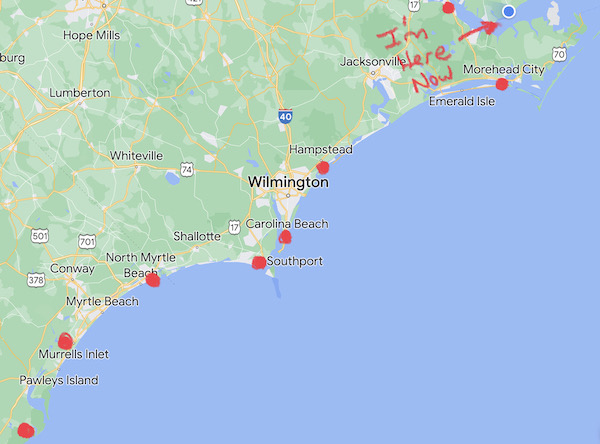
When I last blogged here, I was in Georgetown, SC. Since then, I’ve been to Bucksport and North Myrtle Beach, SC, and then Southport, Carolina Beach, Hampstead, Morehead City, and New Bern, NC. I’m now in Oriental, NC, where I’ve been for a while, taking care of some business.


The red dots indicate my stops along the way since my last blog post here in in March.

Although I was ahead of the Looper pack for most of the past three weeks, I’m now part of the leading edge as other Loopers catch up with me. My boat buddy friends are, unfortunately, still quite a way behind me. That’s my fault since I needed to head north at a quicker pace to make a deadline. I’m hoping to make some new friends as I continue north from here in a day or two at a more leisurely pace.

Captain’s Training Done

Today marks another little milestone in my life: I finished a required 56-hour Coast Guard approved training course and took (and passed) the required tests to get my OUPV (Six Pack) Captain’s License.


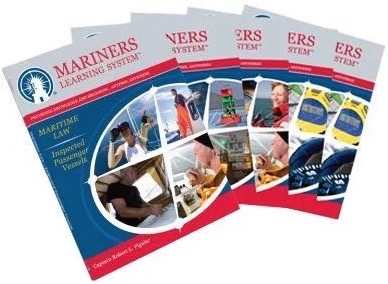
Here are the study guides I bought and barely used. They are in mint condition and I’d like to sell them for $95. (I paid $150 for them.) Contact me if interested.

This is something I’d been wanting to do for more than a year now — in fact, I purchased some study guides all the way back in November 2021. While I could have done it online, I knew from experience that if I didn’t sit in a classroom every day with an instructor there to check off my name on a list, I’d never get it done. So I looked for and found a classroom course that ran eight consecutive days with the test on the last day. It was a bit tricky. Although there are classes all along the east coast, where I’m currently cruising in Do It Now, timing was an issue. I missed a class in Stuart, FL by two days and wound up with the one that started March 31 in Oriental, NC. That’s why I’m here and have been here for over a week — my longest stop yet.

Sadly, I was not impressed with the quality of training, the study materials they provided, or even the classroom facility. And the instructor, although a very nice man who probably has a lot of great boating stories to tell, could have been a lot less deaf and a lot more animated. So I can’t recommend the training organization. But I also can’t deny that they got results. I’m pretty sure all of the attendees in my class of nine experienced boaters passed their tests. I know I did and I now have the certificate to prove it.

What’s next? I still need two pieces of the puzzle before I can submit all my paperwork to the Coast Guard and actually get my Captain’s License: a physical exam (similar to what I need as a pilot) and a drug test (which I also needed when I ran my own helicopter charter operation).

In case you’re wondering why I decided to chase down this certification, an OUPV Captain’s License will enable me to legally operate charters on my boat for up to six paying passengers at a time. (Ironically, it’s similar to the Part 135 certificate my business, Flying M Air LLC has, but it doesn’t involve the FAA (or Coast Guard, for that matter) breathing down my neck and making unreasonable and often costly demands. I sold Flying M Air last year, so the FAA can breathe down someone else’s neck.) I plan on using it to offer one-on-one training for people who want to learn how single-hand a boat like mine or women who want to learn more about boat handling from someone other than a spouse. The next logical step would be to offer multi-day charters along the Great Loop, but I’m not sure if Do It Now is well-suited for that mission.

Prepping for a Summer at Home

As much as I like to think I’m retired, I’m technically not. I still do cherry drying work.

What’s that, you say? How can I still be flying helicopters when I sold my helicopter and I sold my charter business?

Well, the truth of the matter is that pilots are pretty hard to come by these days and I’ve got access to pilotless helicopters that I can fly for cherry season. Right now, it’s a matter of finding the right match. And whether I personally fly or not, I’m still managing a team of pilots to provide cherry drying services to my clients. This will be my 16th season (!) and I’ll be honest: I hope it’s my last. I really do want to retire. I’m hoping someone on my team will buy me out this year. It sure would be nice spending the summer of 2024 on Do It Now cruising the Canadian canal system.

In addition to that, I still make and sell jewelry. I’ve lined up four consecutive weekends at art shows in Washington in May, before cherry season starts. That means I need to get home to build inventory and do those shows.

To that end, I booked a flight for myself and my pups on Alaska Air on April 27. I’ve already given my house sitter the news so I can sleep in my own bed when I get home.

I hope to get my boat up to the Annapolis area by April 25 and put it on the dry there until I get back. I’ll get the bottom checked (and possibly painted); take a look at the prop, rudder, and other bottom stuff; and possibly have the zincs replaced. I’m also hoping to find an electronics guy to install my new Garmin Black Box 800 for AIS transmission capabilities and a Nebo hard install. And, if the stars align just right, I’m hoping I can find a good canvas company to enclose my entire rear deck in a screen/vinyl/canvas enclosure that’ll really increase my usable living space.

If all goes well this season at home, I’ll do a few more art shows after cherry season and be back on the boat by mid-September.

(I still laugh when I think about the family members who advised me not to buy the boat because I’d “never use it.” Since buying it, I’ve spent more nights sleeping aboard than I have in my own bed at home. Hell, I’ve been onboard nonstop since November 25. My house sitter spends more time in my house than I do.)


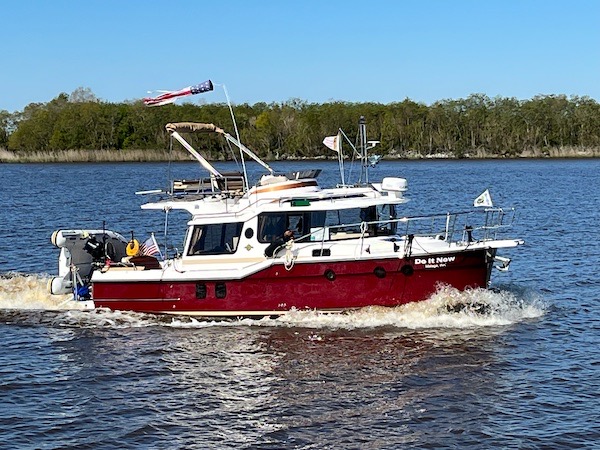
Here’s Do It Now under way in South Carolina. A passing Looper took this shot and texted it to me. (I sent them one of their boat, too!)

A Day at a Time

Now that I’m finished with the Captain’s training ordeal — for lack of a better word — and I don’t have to worry about practice questions invading my dreams anymore, I can do what needs to be done to get up to Annapolis and get Do It Now tucked away for its summer vacation. I’ve already planned my next week or so of travel, which will get me to Chesapeake Bay. I’ll be taking them on, one day at a time, until my winter travels end and I’m back home in Malaga.

And as for that other blog — well, I haven’t written a word there in over a week because of my class schedule. I’m farther behind than ever. But I’ll catch up if it takes all summer to do it.

Applying for a Vessel MMSI Number

I’m surprised to learn that applying for an MMSI number for my boat with the FCC is a lot quicker and easier than I thought.

I’m currently on the home stretch for adding AIS transmit capabilities to my boat and I thought I’d share what I’ve been going through, along with instructions for getting an MMSI number from the FCC. If all you care about are the instructions for applying for the number, skip ahead to the section titled “Applying for an MMSI with the FCC” below.

AIS on My Boat Explained

My boat’s navigation Garmin navigation and communication components — specifically, it’s VHF radio and chartplotters (with GPS) — are compatible with the AIS system for tracking boats. Here’s what Wikipedia has to say about this system (edited for length):

The automatic identification system (AIS) is an automatic tracking system that uses transceivers on ships and is used by vessel traffic services (VTS). … AIS information supplements marine radar, which continues to be the primary method of collision avoidance for water transport. Although technically and operationally distinct, the ADS-B system is analogous to AIS and performs a similar function for aircraft.

Information provided by AIS equipment, such as unique identification, position, course, and speed, can be displayed on a screen or an electronic chart display and information system (ECDIS). AIS is intended to assist a vessel’s watchstanding officers and allow maritime authorities to track and monitor vessel movements. AIS integrates a standardized VHF transceiver with a positioning system such as a Global Positioning System receiver, with other electronic navigation sensors, such as a gyrocompass or rate of turn indicator. Vessels fitted with AIS transceivers can be tracked by AIS base stations located along coast lines or, when out of range of terrestrial networks, through a growing number of satellites that are fitted with special AIS receivers which are capable of deconflicting a large number of signatures.


The AIS target appears as a triangle pointing in the direction of travel (top). Tapping the target on the chartplotter screen displays the name of the vessel (middle). Tapping other buttons eventually displays info screens for the target that include the vessel name, direction of travel, and speed (bottom). In most cases, there’s a second page screen with more info. Note that most of the statuses say “Sleeping” at the top; I still don’t know why.

What all this means is that AIS enables vessels to be tracked by ground- and vessel-based stations. The way it currently works on my boat is that my VHF radio includes an AIS receiver which gathers the data and sends it to my chartplotters, where those signals are plotted. AIS targets appear as little triangles pointing in the direction of travel. I can tap a triangle to get information about the target, including vessel name, type, speed, direction, and time to intercept (if applicable).

If you’ve been reading my Great Loop blog, you should have an idea of how helpful this has been when traveling among large commercial boats such as tugboats with barges (referred to as tows). I can see them on screen before I see them with my eyes and I can make radio calls to them by name to arrange for passing, etc.

The trouble is, my boat does not transmit my information to the AIS system. That means that my boat remains invisible to others on their chartplotters. I can see tows but they can’t see me.

(I should mention here that this is exactly opposite to the requirements of ADS-B systems on US-based aircraft, which are required to transmit (ADS-B Out) but not receive (ADS-B In). Of course, no part of the AIS system is currently required at all on a boat of my size and type.)

Lots of folks might think it’s a good thing that I’m invisible to the AIS system. Privacy, etc. [Insert eyeroll emoji here.] But I want to be seen by other, especially larger, vessels. I want to appear on their systems just like they appear on mine so they can reach out and talk to me if they need to.

And thus the challenge of adding this feature to my system began.

Getting the Numbers

The one component you must have to set up an AIS transmit feature on a boat is an MMSI number. Here’s another Wikipedia explanation for you:

A Maritime Mobile Service Identity (MMSI) is effectively a maritime object’s international maritime telephone number, a temporarily assigned UID, issued by that object’s current flag state (unlike an IMO, which is a global forever UID).

An MMSI comprises a series of nine digits, consisting of three Maritime Identification Digits (country-codes), concatenated with a specific identifier. Whenever an object is re-flagged, a new MMSI must be assigned.

My boat, Do It Now, is a “maritime object.”

(If you’re interested in a more gov-speak description, here’s more on the FCC website.)

You can get an MMSI number two ways — but wait. I’m getting ahead of myself here.

Before you can get an MMSI number, you need to have a Coast Guard documentation number, referred to by the Coast Guard as the vessel’s Official Number (O/N). It’s a 6 or 7 digit number assigned to the vessel at the time it is first documented with the US Coast Guard. This number remains with the vessel indefinitely and must be permanently affixed to the vessel in accordance with a bunch of rules we don’t need to go into here.

Coast Guard documentation is not required for a boat like mine. The previous owner, in fact, opted to skip documentation and simply register the boat with the state of Washington. That gave the boat a WN number which appeared with a registration sticker on boat sides of the bow. When I bought the boat, it was registered in my name so I believe that as far as the state of Washington is concerned, it’s still registered with that number. But when a boat is documented with the Coast Guard, that number is not used — in fact, it must be removed from the boat. Instead, the name and hailing port of the boat must be affixed to it in accordance with a bunch of rules that, again, we don’t need to go into here.

When a bought the boat, the title company handling the transaction — and yes, when you buy a boat like mine, a title company does get involved — handled my application for documentation. I was warned that it could take several months. Until then, I had my application for the number — in case the Coast Guard or anyone else needed to see it — and I could remove the WN number and put my boat name on the boat. I did that in November in Alton, IL. It seemed like a major step forward.

When I went home for three weeks in November, there was nothing from the Coast Guard waiting for me. Since then, I’ve had my house sitter check my mail regularly. In late January, he found a thick letter from the title company. The Coast Guard documentation was in it. He forwarded my mail and I finally got my hands on the Official Number in early February.

Yes, it had taken the Coast Guard a five full months to process the title company’s request on my behalf.

So that hurdle had been jumped. (I’m now in the process for getting the number affixed on the boat in a way that satisfies Coast Guard requirements.)

Back to the MMSI number… I mentioned that there were two ways to get this number.

One way, which I was told was the “easy way” was to apply through an organization such as Boat US, which had an online form. Everyone I asked told me to do this. But those same people didn’t read the fine print on the page:

BoatUS has been authorized by both the Federal Communications Commission (FCC) and the U.S. Coast Guard to assign MMSI numbers only to vessels that meet the following criteria:

  • Used for recreation only
  • Not required by law to carry a radio
  • Not required by law to have a FCC Ship Station license
  • Vessel is under 65′ in length
  • Do not communicate with or visit foreign ports (i.e. Canada, Bahamas, Mexico, and the Caribbean)

If you do not meet these criteria, you are legally required to obtain a Ship Station License from the FCC. They will issue an MMSI number with a Ship Station License.

It’s that fifth point that makes getting an MMSI through BoatUS impossible for me. You see, I have every intention of taking my boat to foreign ports — Canada and perhaps the Bahamas. So I must go through the FCC to get my boat’s MMSI number. (Also, I have to wonder why anyone would lock their boat to an MMSI number that didn’t allow overseas travel/communication. Getting an MMSI through the FCC obviously increases the market value of the boat; it’s ready for anything.)

Applying for an MMSI with the FCC

And that’s where the trouble began. You see, the FCC’s website is a typical US Government website, obviously designed by the lowest bidder whose job is to make it work — not make it work well or intuitively. It is confusing — far more confusing than it needs to be. And despite my years in tech, I struggled with it.

I knew — from extensive Googling — that I needed to fill out form 605. Specifically, according to the FCC:

In order to obtain a new MMSI number, please indicate that you wish to be assigned a new number in Question 11 of FCC Form 605, Schedule B.

I tracked down Form 605 and was able to download it as a PDF. Trouble is, it must be filed electronically. That means I had to do it online. And when I followed the link for filing forms online, I reached my next hurdle: I had to register with the FCC to obtain an FCC Registration Number (FRN).

I clicked the link to do that. I filled out a form. Eventually, I got a login that included an FRN.


You have to know which service to pick to use the wizard.

I logged into my new FCC account. I clicked a link to Apply for a New License. And that’s when everything went off the rails. You see, the FCC doesn’t just give you a list of forms you can fill in online — even after telling you exactly which form and line on the form you needed to complete! Instead, it displays the first page of an extremely poorly designed “wizard” that begins by asking you to “Select the radio service for the new license.” The pop-up menu includes dozens of options, several of which seem to relate to marine use. There is no guidance telling you which one to pick for an MMSI number. If you choose the wrong one, you don’t know it until you’ve filled out the form and realized that they never asked for the appropriate information. Then you have to start all over again with a different option. (Ask me how I know this.)

I’ll save you the bother of trying to figure it out for yourself (as I had to). The option you want is SA or SB – Ship.

I then worked my way through the “wizard” to answer questions. Eventually, I had to enter that Coast Guard Official Number (the documentation number). I also had to enter my boat’s name and some other information. Finally, I was done and was able to add my application to a sort of cart for payment. The fee was $185.

Even paying the fee wasn’t intuitive. I had to go to a payment system and then provide my FRN and select the item I was paying for. They take credit cards, so it was easy enough to pay. Finally, I submitted the form.

I did all this on a Sunday. I wondered how long it would take to process my application and whether the paperwork would arrive in the mail and how soon I’d have to start asking my house sitter to start looking for a letter from the FCC.


The FCC might have a crappy website, but it does have quick turnaround on applications.

But on Tuesday morning — yes, just yesterday — I got confirmation in the mail that my application had been accepted. The message contained a link and when I clicked it, my computer downloaded a PDF of the paperwork. So yes, once I’d figured it out, I had my MMSI within 48 hours of applying for it.

Next Steps


Garmin’s Blackbox has no interface. I hope it’s small; my electronics cabinet is very full.

If you recall, the whole purpose of getting the MMSI number was so that I could set up my boat for AIS transmit. Unfortunately, that’s also going to require additional equipment, specifically the Garmin AIS 800 Blackbox Transceiver. Although Garmin frustrates the crap out of me and I hate giving them my money, this is the “easy” way to get my boat set up to transmit AIS.

I was told by the General Manager at Pocket Yachts in Jensen Beach, FL — last Monday’s stop — that the best way to get this was to order it from West Marine and have it shipped to wherever I was going to have it installed. West Marine would program my MMSI number into it for me so as long as the installer knew what he was doing, it should work as soon as it’s powered up.

Today I’m in Melbourne, FL and there’s a West Marine a bike ride away. If they can do the programming in the store, I’ll buy it and take it with me. (I have a bunch of credits at West Marine that should bring down the price significantly.) If they can’t program it, I’ll figure out where I’ll have it installed and have it shipped there. I’ll be in Titusville, St. Augustine, and Jacksonville over the coming weeks; one of those places must have a Garmin installer nearby.

That should be the last hurdle to get this done. We’ll see.