Weird R44 Things: Partial Clutch Activation

You learn something new…

Yesterday, I picked up my helicopter down in Chandler (CHD) where it was getting some maintenance. After 10 years of mechanic hopping — not my choice — it looks like I’m finally back with a good mechanic who won’t disappear and who will be able to handle my maintenance needs in the Phoenix area on a timely basis.

Because I’m a commercial operator, I am required to get a big inspection every 100 hours. The 100-hour inspection is basically the same as an annual inspection for my helicopter. I fly about 200 hours a year — although I’m likely to hit 300 this year — so I get these big inspections at least twice a year. I’m very happy to be having it done by someone who has been maintaining and repairing Robinsons for longer than I’ve been flying them.

After I paid up, they rolled the helicopter out onto the ramp, and we said our goodbyes, I did a good walk-around. Then I climbed on board and started up. And that’s when I noticed things were different.

Normal Startup

Understand than when you start the same aircraft over 1,000 times over a 6-1/2 year period, you get a pretty good idea of how startup goes. On my ship, with temperatures in the high 80s as they were yesterday, 5 seconds of priming is usually enough to get a cold engine started. I press the starter button and push in the mixture control gradually. When the engine catches, I push in the mixture in all the way, flick on the Alternator, Clutch, and Strobe, and watch the RPM gauges as the clutch engages and the belts catch the drive train.

Right around this point, the helicopter’s engine compartment usually starts making a gawdawful squealing noise. It’s the rubber belts catching on the upper and lower sheaves as they move apart and the belts tighten. The engine RPM is dragged down by the weight of the drive system it’s becoming burdened with. I add a bit of throttle to keep the engine RPM as close to 55% as possible. There’s a final drag on the engine and then the belts become secure. The squealing stops and the RPM recovers. The two RPM needles — Engine and Rotor — become matched and begin to climb. I normally reduce throttle a tiny bit again, just to keep RPM at about 55%. This whole process — from engine start to squeal end — takes about 15-20 seconds. When the clutch light goes out — usually 15 to 30 seconds later — I throttle up to 68% RPM to complete the warm-up process.

Yesterday’s Weird Startup

Unfortunately, that’s not how it happened yesterday and I was in tune to everything that was different. First, no squeal. Second, the engine RPM wasn’t dragged down. Third, the rotor RPM did not match the engine RPM until after the clutch light had gone out. And that clutch light went out a lot quicker than normal.

What the hell was going on?

Everything sounded okay and when I throttled up to 68%, everything seemed okay. I continued the warm up process, watching gauges. Everything seemed normal.

Until I throttled it up to 75% for my mag check. The rotor RPM lagged and the engine sped more than it should have. It was obviously not carrying the full burden of the rotor system.

I signaled to my friend Don, who was in the helicopter next to mine going through his startup routine, that I had to shut down. Don had kindly flown me down to Chandler from Deer Valley so I could pick up my ship. Now it looked as we wouldn’t be flying back as a “flight of two helicopters” after all. I filled him in on the situation, certain there was a problem with the clutch that the mechanics inside could fix, and sent him on his way. Then after checking “under the hood” to make sure it wasn’t an obvious problem, I walked back into the hangar to track down the mechanics.

Under the Hood

My description probably sounded flakey, but I managed to communicate to them that there was a clutch issue. They came out and, with the engine shut down, flicked on the Master switch and engaged the clutch. Looking into the compartment that gives a clear view of the upper sheave and clutch actuator, we could hear the clutch engage and see the upper sheave begin to move. It moved for about 10 seconds, then stopped.

“Did you hear the click?” one mechanic said to the other.

“No,” the other one replied.

They disengaged the clutch and it began running again, now in the opposite direction. It stopped when fully disengaged. Then they engaged it again. It ran and stopped, again without the click.

For some reason, the clutch wasn’t fully engaging. That meant the belts weren’t properly tightening. That also meant that the engine would not be able to turn the rotor blades sufficiently for flight.

In other words, I had a serious problem if I planned on using the helicopter for anything other than as a lawn ornament.

MT558-1 Use

From the R44 Maintenance Manual, this illustrates how to use the MT558-1 [Clutch Actuator Test Plug] Tool. Warning to Pilots: Do not use this tool without following the instructions in the manual!

As R44 pilots should know, there’s a little plastic socket inside the compartment near the warning light test buttons. R44s come with a pair of plugs that go into this socket. Each plug disables one of the two up-limit switches for the clutch. Although I had the plugs under the pilot seat (with a spare gas cap, batteries for my Spot Tracking device, and duct tape), they didn’t ask for them. (I guess they didn’t think I carried them with me.) Instead, they used the scissors on my pocket knife to do what one of the plugs does. They engaged the clutch and this time, it ran all the way up with a satisfactory click.

Not completely satisfied, they disengaged the clutch and then cycled it again, this time without the scissors. We were rewarded with a nice, healthy click. Then again. Click. Then again. Click. It seemed to be working fine.

They disengaged it again and let the belts fully loosen up. They told me that sometimes, when they wash inside the cowling, the clutch switch gets wet and doesn’t work quite right. They’ve had this problem once or twice on R22s. They listed a bunch of symptoms to watch out for in case there was a problem with the clutch switch itself, but they doubted that it was a real problem. Just one of those weird things that happen sometimes.

I know about those weird things. They do happen. When they do, they get your attention and you watch them closely. If they don’t happen again, after a while you just write them off as one of those weird things. But if a pattern begins, you follow up with a mechanic.

Fixed? Looks that Way

I thanked them, started up without any problems, and headed up to Scottsdale (SDL) — a 15-minute flight. I parked on the ramp, walked to the Apple store about 1/2 mile away, and took care of some business there. After dinner with my husband at a restaurant in the area, I went back to the helicopter. It started up again without any problems. I flew it to Deer Valley (DVT) and left it on the ramp for the FBO line guys to put away.

I’ll be watching the situation closely as I prepare for my annual trip to the northwest. I’ve already been advised on how to handle the situation when I’m on my cherry drying contracts — I’ll be keeping those two plugs handy, just in case.
Is iPhone/iPad Killing Stand-alone GPS?

I think so.

This morning, while going through the tweets in my Twitter stream that had arrived overnight, I stumbled upon a MacObserver article that discussed the iPhone becoming the top “camera” on Flickr. (I have my own opinions on that factoid, which I left as a comment on that post; it’s not a favorable commentary on Flickr users.) That post linked to a far more interesting one by Ted Landau titled “A Dozen Devices the iPhone is Killing.” In it, Ted discusses how features in the iPhone that duplicate those in stand-alone devices are making those devices redundant or simply not necessary.

GPS for Everyday Use

As I commented on that post, Ted is right on target with the GPS analysis. I’ve been using various GPS tracking apps on my iPhone for a while now and am super-impressed with the results. The first one I tried was the $2 GPSTrack app, which I wrote about here. Since then, I’ve also played with GPSLite, a free app that does much the same and more for free (which an interface I find a bit too complex for everyday use). My goals with apps like these is to create track logs and trip computer data for flights and for geotagging photos.

Although I’m not fond of turn-by-turn navigation, I know there are plenty of apps that do this, too. So, as Ted pointed out, in-car GPS navigation systems can also be replaced by an iPhone.

GPS for Flying

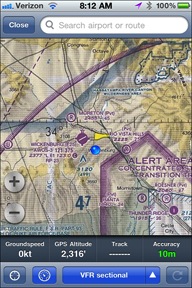
ForeFlight on iPhone

ForeFlight runs on my iPhone and includes not only GPS capabilities, but flight planning, weather, airport information, and more.

For pilots, a great app called ForeFlight, which works on both iPhone and iPad, offers better functionality than the $12,000 panel-mount Garmin GPS in my helicopter. Rather than view my location on a primitive screen display, I can see it on an actual aeronautical chart. I can also download charts and other information in advance so there’s no need to rely on 3G connectivity in flight. If I do have 3G connectivity, I can also get up-to-date weather information in flight. And although the iPhone screen is generally too small for my aging eyes to see the details, the same software works on my iPad — that screen size puts my panel mount system to shame. In fact, ForeFlight is the reason I’m updating to a G3 iPad 2 — that model includes a GPS; my original WiFi iPad does not.

Garmin is apparently trying to play catch-up with this functionality but I don’t think they’ll succeed. Why would someone pay thousands of dollars for a one-trick pony like a panel mount GPS when less than $700 will get you an iPad with GPS and Internet capabilities that can be updated on the fly and do so much more — for example, e-mail, Web browsing, ebook reader, and other apps? Best of all, the FAA is starting to accept apps like Foreflight as “electronic flight bags,” thus making traditionally required documents such as printed charts and flight plans unnecessary. (This is something I hope to blog about in more detail soon.)

And Another Thing…

ForeFlight on iPad

Here’s ForeFlight on my iPad. Although this iPad doesn’t have a GPS and can’t do accurate tracking, my iPad 2, which should arrive soon, will.

One thing Ted didn’t mention is the main reason why I don’t like carrying more devices than I have to: batteries and charging. When I go on the road, it seems that my “gadget kit” is filled with cables and charging devices. And spare batteries. What a pain in the butt! Wouldn’t it be nicer to carry just one cable and charger, perhaps with a DC adapter? While it’s true that running a GPS app on an iPhone, especially in tracking mode, sucks battery power more than almost anything else you’re likely to do with the phone, a DC charging device can usually remedy this. Heck, even my helicopter has a DC power port.

At this point, it’s hard to imagine why someone would buy a standalone GPS if they had an iPhone or another smartphone with equally good GPS capabilities. Can you think of a reason?

A Hectic Month

And I thought February was bad.

March was likely the most hectic month I’ve had since I began freelancing back in 1990. It combined flying, travel, customer service, and the completion of a book in such a way that I was constantly busy and constantly thinking about what would come next. The month’s almost over now and I can look back at the craziness that was March 2011.

Two Businesses, Two Sets of Balls to Juggle

Those of you who know me or have been reading this blog for a while know that I wear two hats:

  • Freelance writer. I’ve been a freelance writer since leaving my corporate job back in 1990. I write mostly books, but I also write some articles. My area of “expertise” is software how-to for Mac OS, Microsoft Office, Twitter, WordPress, FileMaker Pro, etc. I’m a Mac person but I also “do Windows” when necessary.
  • Helicopter pilot. I’ve owned and operated Flying M Air, a helicopter charter company since 2001, although the business “got serious” in 2005 with the acquisition of a larger helicopter and an FAA Part 135 certificate. I fly tours, day trips, charters, multi-day excursions, aerial photography, and survey flights in the Southwest U.S. during the winter months and escape the heat to the Northwest U.S. for agricultural work in the summer.

Juggling these two jobs has never been difficult. Writing gives me a huge amount of flexibility as far as time is concerned. I can usually put a writing project aside for a few hours or a day or even a few days to handle the demands of my flying business. After all, there never was much flying business — until recently.

And that brings us to March 2011.

Starting Off with a Bang

Hoover Dam and BridgeThe month started off with a bang. One, two, three: three days, three charters. I took a couple on a Moonlight Dinner Tour on Tuesday, took three people to the Las Vegas area and back on Wednesday, and took another couple to Sedona for a few hours on Thursday. That’s 8.9 hours of flight time in three days.

(Okay, so I know that I used to fly a lot more when I was a tour pilot at the Grand Canyon. But this is different. These flights are for my company, not some humongous tour operator serving busloads — no exaggeration there — of people daily.)

Wildlife Surveys

Escape RouteI changed gears the following week and spent a good portion of the next two weeks conducting wildlife surveys for a client in various locations throughout Arizona and New Mexico. Not only did this require me to do about 40 hours of seriously intense flying in a relatively short period of time, but I also spent four nights away from home.

In the middle of all that, I had to arrange for some minor maintenance for the helicopter — I was quickly approaching my 50-hour required oil change. I’m still amazed that I managed to pull that together as quickly as I did. Many thanks to my now-retired local mechanic, Ed, for taking care of it for me.

The Excursion

Also on my calendar for the month — booked months ago — was a custom 8-day version of Flying M Air’s Southwest Circle Helicopter Adventure. I don’t do these trips very often — they’re costly and not everyone understands the value of what the package price includes — but it’s become almost routine, with me using the same hotels and tour operators and flying the same routes each time.

Icy-covered HelicopterThe emphasis this time around was on “adventure” in that the weather really messed with us. Not only did we get snowed in at the Grand Canyon, but high winds made flying conditions less than ideal. It was extremely stressful for me; these folks had paid a lot of money for a trip and it was my job to make sure they were happy. Worse yet, to make up for scenery missed when I had to reposition the helicopter without my passengers on board, I had to fiddle around with the routes a bit to make sure we overflew certain terrain. And then there were doors-off photo flights as part of the trip; that wouldn’t have been so bad if it weren’t so darn cold.

In the end, I wound up flying more than 10 hours, driving more than six hours, and spending seven nights in various hotels all over northern Arizona. All while stressed out. Exhausting.

First LightI did, however, get a chance to fly down to Marble Canyon at dawn for breakfast with a friend. Shot some nice video along the way. I’m working on another video with the 10+ hours of “nosecam” footage I shot that week.

And the Total Is…

In case you’re wondering, I flew a total of 76 hours in March. To give you an idea of just how much that is for me and my business, for the past six years, I’ve flown only about 200 hours per year.

So in one month, I flew more than 1/3 of the hours I fly in an entire year.

But Wait, There’s More!

That’s just the flying side of things. I was also chest deep in a new book for a publisher I haven’t worked with before.

I don’t want to go into details about the book. I’ll just say that the experience was not ideal for me — and likely not for the publisher, either. The trouble is, the book seemed to drag on and on. Normally, I can knock off a new book in a month or so with constant pressure and support from my editor. This book…well, we’ll just say that no one seemed to be too interested in me finishing it up.

Until March.

That’s when someone pulled the project off the back burner and turned up the heat. I had to finish writing a chapter or two, then start reviewing edits and proofs. And revising screenshots — let’s not go there, okay?

Trouble is, I needed to do this kind of work in my office and I was away from my office for about half the month. So the days I was in my office, I was working my butt off on this book.

Yesterday, I reviewed the last of the first-round proofs. The book looks remarkably good and I’m more proud of it than I should be. But they tell me there’s a second round of proofs to come. How can I politely tell them that I’m sick of looking at it? Answer: I can’t.

The Months Ahead

So far, my April calendar looks refreshingly open. I have another short wildlife survey, two moonlight dinner tours, and a multi-day photo flight with a regular client. I have two book projects to start — one brand new, one a revision. And that’s it.

In May, I have another wildlife survey flight that’ll likely go two or three days and then a week at Lynda.com to record a course revision. And then, at month end, I move up to the Pacific Northwest for the summer.

I’m Tired…And Glad It’s Behind Me

The month of March left me exhausted and I’m glad its over. I wish I’d been busy like this 5 or 10 years ago. Now that I’m getting older, I’m really feeling the impact of hard work and long hours flying or in front of a computer. It’s great for my businesses, but difficult for me.

Anyway, this should give you an idea of why my blog posts have been in short supply. I’ll try to start writing more regularly again soon.