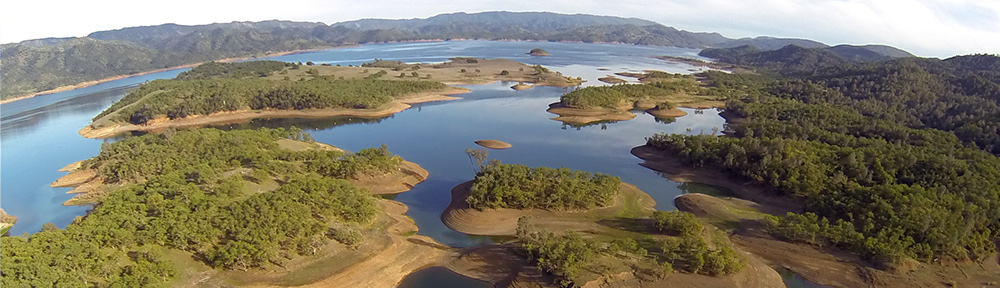
I get a photographic image of a helicopter that hasn’t been built yet.
 Marketing is an important part of any business. And the most effective marketing includes visuals. Take, for example, my slides at the movie theater. There are a few aerial shots of the town and some cattle tanks, giving people an idea of what they can see from the air. But there’s also an excellent air-to-air photo of my old helicopter, Three-Niner-Lima. In the photo, I’m flying past Vulture Peak, just like I do on my Grand Tour of Wickenburg. It’s a real photo that Mike took from the passenger seat of a Piper Cub years ago, when we were flying in formation just to take the photos. I have several of these shots. One — the one you can clearly see me in the cockpit, looking at the camera — is on my business card. These photos look so good that I’ve been accused of cooking them up in Photoshop. But I didn’t. They’re real.
Three-Niner-Lima is gone now and I’m in a transition phase as far as the helicopter tour business goes. I’ve been getting calls for rides, but I have to tell callers that there won’t be any rides until mid-December, when the new helicopter arrives. In the meantime, I need to warm up my marketing machine. Christmas is coming and I usually do a nice business with gift certificates. I want to sell a bunch of rides now, so I have plenty to do when Zero-Mike-Lima arrives in town. I also want everyone to see what the new helicopter will look like. Lots of people thought Three-Niner-Lima was a kit helicopter because it was so small. They won’t think that they they see Zero-Mike-Lima. It’ll be considerably larger and more impressive.
The trouble is, Zero-Mike-Lima hasn’t been built yet. Just this week, it should have taken its place on the factory’s assembly line. But there certainly isn’t anything to take a picture of yet.
And I won’t have my hot little hands on its controls until December 8 at the earliest. That’s a bit too late for Christmas marketing.
So what was I to do? I thought about John Stonecipher. He runs Guidance Helicopters in Prescott, AZ, a flight school that also does tours and charter work. His R44 looks very much like mine would. Did he have some air-to-air photos I could use? I could use Photoshop to remove the N-Number (if visible) so it couldn’t be identified as his. I asked him and he said he did have some photos. He said he’d send them. I waited. And waited. And nagged. And waited. Finally, he sent a CD-ROM disc, probably just to get me to stop nagging him. There were three photos on it. None of them were suitable — they were blurry and the helicopter was too far away. I think when I do get my ship I should go up there and help him take some decent air-to-air photos of his.
So I wasted a month waiting for photos that wouldn’t do the job for me. Back to square one.
 Meanwhile, I had a number of air-to-air photos of my friend Tristan’s R44 taken here in Wickenburg. I leased Tristan’s ship last year for the season and did relatively well with it. That’s what convinced me that I could build the business much better with a 4-seat helicopter. We’d taken the pictures for last year’s ad campaign: “Share the view with a friend or two!” Trouble is, Tristan’s ship is metallic gray with a dark blue stripe. My ship will be Ferrari red with no stripe.
Now I know that a knowledgeable person can work miracles with Photoshop. One of the things you can do is change the color of something. Unfortunately, I’m not a knowledgeable person. I use Photoshop to fine-tune the screenshots for my computer books, prepare photos and other images for the Web, and turn photographic images into computer-generated paintings for greeting cards. But I do know a Photoshop whiz. It was time to bother him.
Bert Monroy is another Peachpit author. He’s an artist and his specialty is Photoshop. He’s amazing — he can create, from scratch, photorealistic images. I have seen him do this at presentation. He blows me away.
 So I sent Bert an e-mail with a thumbnail image of the photo I wanted him to convert and brief instructions. He said he’d do it, that I should just send him a bigger image. I sent the image with more complete instructions. I asked him to remove Tristan’s N-Number. I told him that if he wanted to get really fancy, he could add mine. The next day, the fruits of his labor arrived in my e-mail inbox. It was a photo of Tristan flying a helicopter that hadn’t been built yet.
I was incredibly excited. I couldn’t believe how good it looked. It looked real because it was real. The only thing he’d done is given Tristan’s helicopter a paint job and changed the N-Number.
I immediately started building my marketing materials.


First was the series of slides for the local theater. The slides would be released one at a time, about 2-3 weeks apart. The last slide would take its place in the carrousel when the helicopter arrived in Wickenburg, before I had a chance to take new photos. I e-mailed the PowerPoint slide file to ColorMark (in Phoenix) and got their assurance that I could pick up the slides on Monday morning. (I have a meeting down in Scottsdale with the FAA that day.) The first of the new slides should make it into the carrousel on Friday. The next marketing item was a 4×6 postcard that would serve as a rack card until I could take new photos for a real rack card. It would also make a good insert for the WE event scheduled for November 19. I laid out the postcard in InDesign, then FTPed all of its files to SimplyPostcards.com, which prints 4-color postcards at a very reasonable price. I’m hoping to get those back within a week or so. Then I’ll be leaving them all over town.
On Monday, when I get back to the office, I’ll use Bert’s creation to modify a few of the photos on the Flying M Air Web site. And I’ll probably show it off on my own Web site, too.
After all, how often do you get a photo of something you’ve bought before it’s even built?
 I’d had trouble starting the last Raven II I’d flown (about 14 months ago, in St. George, UT), so I was very surprised when this one started right up for me. We went through all the checks and I brought it into a hover without really thinking much about it. It did feel a lot like the Long Ranger and it had been less than a month since I’d flown one of those. We went out to Deer Valley where I did some maneuvers; steep approach, normal approach, maximum performance takeoff, normal takeoff, hovering autorotation, straight in autorotation. Along the way, I got a throttle chop (simulated engine failure), which I handled pretty well. (I have pretty good reaction time.) But I did have a bit of trouble with the steep approach when the governor was disabled — kept chasing the RPM with the throttle. And my autorotations, although “survivable,” were not very pretty. Afterward, we went over to the Cave Creek Dam (the earth dam) for a pinnacle/confined space landing. Although I did a perfectly fine landing, George said he wanted to hear more from me as I did my reconnaissance. That’s a problem I have, though. I don’t vocalize what I’m thinking and seeing when I fly. Unfortunately, flight instructors expect to hear their students vocalize. So although I’d seen and considered most of the things he listed, I hadn’t vocalized them, leading him to believe I hadn’t even thought about them. Interesting, I think, that someone who talks and writes as much as I do would keep quiet when expected to talk.
 Now look at the picture here. In the first two close call incidents, I was the red line, which got clearance to depart to the southeast. In one incident, the blue line (Grand Canyon Helicopters) got a clearance right after me to depart to the west. In another incident, the green line (AirStar) got a clearance right after me to depart to the west. In both cases, I had to alert the departing pilots — on the tower frequency — that I was in their departure path. In one case, I actually began evasive maneuvers when the pilot didn’t appear to hear me. Mind you, the tower had given all of us clearance so we were all “cleared” to depart. Scary, no?
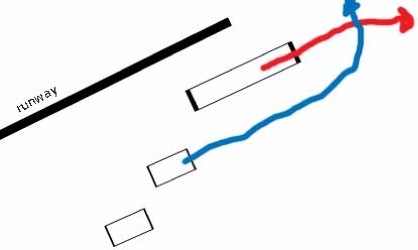 Let’s look at another close call. In the picture to the right, I was the red line with a clearance to depart to the northeast. The blue line had just gotten a clearance to depart to the northwest. Because he took off before me, we were on a collision course. But I’d been listening and I heard him get the clearance. So when I took off, I kept an eye out for him and made sure I passed behind him.
 My most recent controlled close call incident was two days ago. I’d gone down to Chandler to meet a friend for lunch. I landed at the Quantum ramp at Chandler Airport (CHD). We had lunch and returned at close to 1 PM — just when Quantum’s training ships were returning. I asked for and got clearance to hover-taxi to the heliport’s landing pad. I then asked for and got an Alpha departure clearance. This requires me to take off from the helipad and follow a canal that runs beside the airport (and helipad) to the north (the red line). When I got my clearance, the tower alerted me to an inbound helicopter that was crossing over the field. I did not hear that helicopter get a landing clearance, but he may have gotten it from Chandler’s south frequency, which I was not monitoring (because I could not). I took off along the canal just as the other helicopter (the purple line) turned left to follow the canal in. We were definitely on a head-on collision course. I saw this unfolding and diverted to the west, just as the tower said something silly like, “Use caution for landing helicopter.” Duh. I told the tower I was moving out of the way to the west. There was no problem. But I wonder what that student pilot thought. Or what Neil, owner of the company, thought as he hovered near the landing pads in an R44, watching us converge.