Don’t sacrifice when you can shop smart and save.
Wow, does that tag like look like something written up by a marketing guy for a discount store or what? But that’s not what this is all about. It’s about really shopping smart and taking advantage of sales to buy the things you want and need.
Where I’m Coming From
First, I need to make something clear: I’m not a shopper. I don’t read newspaper ads, looking for the best deals on this and that. I don’t spend hours every week hopping from store to store to save a few bucks. I don’t clip coupons. I don’t have the time or patience for any of that.
And I should also point out that Mike and I are a family of two with just two pets. No kids, no huge meals. Although we might spend as much on food as a family of four, it’s because we like good food. We tend to lean toward quality and the things we really like rather than quantity and settling for second best.
We’re not broke — we’re both still gainfully employed in this f’ed up economy. But like many smart people out there, we’ve seen the writing on the wall. Who knows what could come next? Who knows whether Mike’s company can stay afloat in these troubled times? Or whether people will still be interested in treating themselves to helicopter tours. I’ve already seen a sharp drop in book sales — the real source of my income.
That said, it really irks me to pay more than I have to for the grocery items I like or need. I’m talking about everyday staples, like paper products (toilet paper, paper towels, tissues), coffee, milk, butter, etc.
What I’ve been doing for years now is buying the items I need in quantity when they’re on sale or when I find them somewhere else at a really good price. Here are some examples.
Coffee
 I like Eight O’Clock Coffee. It’s an Arabica bean with a light roast. It’s more robust than Dunkin’ Donuts coffee, which I liked before I left New Jersey and could no longer get here in Arizona. (It’s now available in Arizona; I tried it again and was disappointed.) But it’s mellower than Starbucks or any of the other boutique coffee brands — although I’ll take Starbucks Breakfast Blend in a pinch. I buy it as whole beans and grind it at home as part of my coffee-making ritual. Nothing like a good cup of coffee first thing in the morning, huh?
My local supermarket sells a 12-0z bag (whatever happened to a “pound” of coffee?) of Eight O’Clock coffee beans for $7.59. I think that’s outrageous. But every once in a while, it goes on sale for $4.99. That’s more like it. I buy enough to last until the next sale, saving about $2.60/bag or 21¢ per ounce. Not bad. But recently, they’ve been having these really kick butt sales on the coffee, selling it for $3.89 per bag. That’s about half price. Each time I find it at that price, I buy eight or ten bags.
One of the nice things about coffee is that it’s sold in the kind of airtight containers designed to keep it fresh. While coffee doesn’t have an unlimited shelf life, if stored properly, it should stay fresh for at least half a year. So why not buy it at that low price and stock up? Just make sure you rotate your stock so you’re always using up the older stuff before the new.
And while I’m talking about coffee, it also makes sense t talk about coffee filters. I make my coffee in a Black and Decker single cup coffee maker. I’m the only coffee drinker and I like my coffee brewed just before I drink it. I don’t like coffee that’s been sitting on a pot on a burner for more than maybe 5 minutes. After that, it starts getting stale and I really can’t drink it.
 My coffee maker comes with one of those “gold” filters. It’s a washable thing that’s supposedly better for brewing coffee because it helps the oils of the beans meld together or some such bull. Whatever. What I find is that using the reusable filter guarantees bitter bean residue at the bottom of my cup. I’ll stick to paper filters. The coffee maker takes a #2 cone filter. I don’t buy Melita brand or unbleached or any such nonsense. I buy the cheapest ones I can find — they do the job perfect well. My supermarket sells them in packs of 50 or 100. At my rate of 2+ cups per day, that’s enough filters for one or two months. But over the past summer, I discovered that Wal-Mart sells off-brand paper filters like the ones I use in packs of 250 for less than what I pay for 100 at my local supermarket. So when I go to Wal-Mart — which isn’t very often, thank heaven — I buy two or three packs. Stock up and save.
Oh, and if you’re a coffee aficionado reading this and want to “educate” me about brewing and drinking coffee, save it for another blog. I’m tired of people telling me about how my coffee should be. I make it the way I like it, thank you. My point is not how I brew or drink coffee. It’s how I buy what I like and stock up when it’s at a good price.
Other Products
My husband and I don’t go grocery shopping. We go to the store when we need something and buy what we need, along with a few other things. You’ll never see us in the supermarket with a cart full of groceries. We’re usually able to check out on the 15-items-or-less line. It’s been that way for years, since the days in New Jersey when we’d walk to our local grocery store/meat market after work each day and buy dinner right before we cooked it.
You might think that this kind of shopping is less conducive to saving money. It isn’t really — at least not for us. (Again, remember that we don’t have a family to feed.) We’re still walking many of the aisles of the supermarket. And we’re still keeping an eye out for bargains. When butter goes on sale, we buy two or three pounds and freeze what we don’t immediately need. The same goes (without the freezer) for canned items such as chicken broth and soups. (We don’t eat much canned food.) Pasta, pasta sauce, salad dressing — we buy it all on sale before we need it. We pay close attention to the “Best by” dates and don’t buy anything that we don’t think we’ll use before it “expires.”
What we don’t do is buy things we don’t like or won’t need just because it’s on sale. Mike’s a good example — often, I can buy a gallon of milk for just a bit more than I’d pay for a quart. But there’s no way I’ll use a gallon of milk before it goes bad and I’m not interested in freezing it (as some people do). I also don’t believe in throwing food away. If you buy something you don’t like or don’t use, you’re throwing your money away.
The Lure of Costco and Sam’s Club
Ever notice that if you go into a Costco or Sam’s Club you’re lucky to get out of there without spending at least $200? Ever wonder about that? Ever wonder if you’re really saving money?
I’ve been avoiding these places unless I know for sure that there’s something there I need that’s cheaper there than anywhere else. I firmly believe that I can get better prices on an item in my local supermarket when it’s on sale than I can in a Costco. Best of all, I don’t have to buy a case of it.
 My husband — well, he’s still sucked in. He buys cases of canned corn and canned chicken broth. He buys huge plastic jars of nuts and garlic powder and peppercorns. He buys buffet plates full of smoked salmon and styrofoam trays of flank steaks. He buys a lot of junk we don’t need. He freezes things that are better not frozen. We eventually do eat or use most of what he buys, but we also throw some of it out. I don’t like that.
My thoughts on these warehouse stores is that unless you’re shopping for a large family or group — or a restaurant — you probably shouldn’t be shopping in there. Sure, the strawberries are a great price per pound, but do you really think you can eat 10 lbs of them before they go bad? What are you going to do with 12 giant fresh-baked muffins? Got room in your freezer for that 10-lb bag of flash-frozen chicken breast? Are you even going to get them home before they start defrosting? And where are you going to store those 24 rolls of toilet paper and eight boxes of Kleenex? And you do realize that even canned food doesn’t have an infinite shelf life, right?
Shop with a Calculator
Buying bigger isn’t always cheaper. Don’t get conned into buying the jumbo size just because you’re too lazy to do the math.
I know this sounds dorky, but if you have trouble comparing prices of items because they’re sold in different quantities, use a calculator. 12 ounces for $2.39 is cheaper than 20 ounces for $5.29. Most supermarkets will help you by posting the per ounce (or other unit) price for each item on the shelf.
Going back to my coffee example, my supermarket also sells Eight O’Clock coffee in a larger bag. I think it’s 2 pounds. But a comparison of the per ounce price clearly shows which bag is a better deal; when the small bags are on sale, they’re almost always cheaper per ounce.
A calculator and a cheat sheet with supermarket prices would certainly help me prove my theory about Costco. But that brings me back to my original point: I’m not a shopper. I just buy the things I want or need in reasonable quantity when I find them at a good price.




 Here’s how it works.
 Tap a downloaded magazine to read it. In portrait mode, it appears as a single page. In landscape mode, it appears as a spread. You can pinch and drag to magnify and scroll.
 Tap a downloaded magazine to read it. In portrait mode, it appears as a single page. In landscape mode, it appears as a spread. You can pinch and drag to magnify and scroll.
 Today I was contacted by a similar organization. This one, which I refuse to publicize with a company name or link, gets businesses to offer special deals on goods and services on the organization’s Web site. They sell the deal and then take a “commission for the use of the platform.”
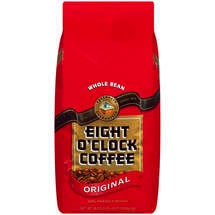 I like Eight O’Clock Coffee. It’s an Arabica bean with a light roast. It’s more robust than Dunkin’ Donuts coffee, which I liked before I left New Jersey and could no longer get here in Arizona. (It’s now available in Arizona; I tried it again and was disappointed.) But it’s mellower than Starbucks or any of the other boutique coffee brands — although I’ll take Starbucks Breakfast Blend in a pinch. I buy it as whole beans and grind it at home as part of my coffee-making ritual. Nothing like a good cup of coffee first thing in the morning, huh?
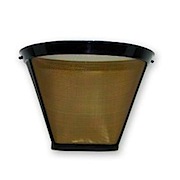 My coffee maker comes with one of those “gold” filters. It’s a washable thing that’s supposedly better for brewing coffee because it helps the oils of the beans meld together or some such bull. Whatever. What I find is that using the reusable filter guarantees bitter bean residue at the bottom of my cup. I’ll stick to paper filters. The coffee maker takes a #2 cone filter. I don’t buy Melita brand or unbleached or any such nonsense. I buy the cheapest ones I can find — they do the job perfect well. My supermarket sells them in packs of 50 or 100. At my rate of 2+ cups per day, that’s enough filters for one or two months. But over the past summer, I discovered that Wal-Mart sells off-brand paper filters like the ones I use in packs of 250 for less than what I pay for 100 at my local supermarket. So when I go to Wal-Mart — which isn’t very often, thank heaven — I buy two or three packs. Stock up and save.
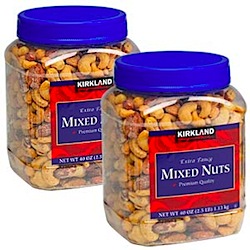 My husband — well, he’s still sucked in. He buys cases of canned corn and canned chicken broth. He buys huge plastic jars of nuts and garlic powder and peppercorns. He buys buffet plates full of smoked salmon and styrofoam trays of flank steaks. He buys a lot of junk we don’t need. He freezes things that are better not frozen. We eventually do eat or use most of what he buys, but we also throw some of it out. I don’t like that.