The Joys of Online Shopping

Why visit stores?

I have gotten to the point where I do about 75% of my non-grocery shopping online. I’m willing to bet that a good portion of the folks who read this are in the same situation. The rest of you might wonder why.

The Shipping Cost Argument

Most people use this as their argument against online shopping: if you shop in a store, you don’t pay shipping.

Okay, this is true. But I still have to get to the store. That takes time and costs money for fuel.

While I’m more concerned with the value of my time than the cost of fuel to drive to a store that has what I need, I won’t deny that I probably would have to drive at least 80 miles roundtrip from my Wickenburg home to find the item I’m looking for.

Let’s do the math here.

First, my time. Suppose I have to drive 80 miles round trip to get to a store that might have what I want to buy. Suppose I can get to the store in about an hour and that it takes me a half hour to find what I want to buy and pay for it. Then another hour to get home. That’s 2-1/2 hours. But what if the store that I thought had what I wanted didn’t have it? Then I have to go to another store, which may or may not be nearby. Let’s estimate 30 minutes for each store I visit. Now let’s estimate 2 stores per item I need to buy. So if I have to buy something as simple as a pair of jeans, I might be spending about 3 hours to get to the store, find them in my size and color, buy them, and get home. In 3 hours, I can write a how-to article for publication on a Web site that pays me several hundred dollars per article. So I’m potentially losing out on several hundred dollars of income.

Okay, so suppose I wasn’t planning on doing anything else that day. For the sake of argument, let’s assume my time is worthless.

But let’s look at the fuel costs. Suppose I drive that in my Honda, which gets about 20-25 miles per gallon highway. There’s some highway driving and some nasty “city” driving in terrible traffic where I usually shop. To make the math easier, let’s assume 20 miles per gallon. That’s 4 gallons for the 80 miles. Fuel prices for premium (which this little car takes) have ranged from $1.50 to $5.00 per gallon over the past year. We’ll use today’s price, which is about $2 per gallon. That’s $8 in fuel alone.

How much is the shipping cost for that pair of jeans?

It’s Not Secure

What? Get with the program. If you shop smart online, your transaction is secure.

In fact, it’s probably more secure than handing your credit card to a waiter in a restaurant where it’s all too easy to copy down credit card information before running a charge for your meal. Or reciting it over the phone, in a place where it could be overheard, or to a company that may or may not have honest employees or good intentions.

What’s risky is entering credit card information in unsecured forms online. Look for the lock icon on the edge of your browser window to ensure that a form is secure. You can also look at the URL; it should start with https (note the all-important “s”). Another thing that’s risky is putting your credit card information in an e-mail message. There’s no reason to do it, so don’t.

It Doesn’t Support the Local Economy

Well, that’s certainly true. But neither does shopping at the mall. Or at Wal-Mart.

And neither does hiring staff in India or China or Pakistan to provide telephone support or make products.

Let’s not go there, okay?

Today’s Purchase

Simply said, online shopping is fast, convenient, and affordable. Here’s an example.

Chef PantsI just bought 3 pairs of the “chef” style baggy pants I like to wear. (And no, I didn’t buy them with this crazy pattern — although you have to admit they look pretty funky.) As I was buying them online, my husband pointed out that he knows a place in Phoenix that sells “those kind of pants.” But do they sell the brand I’m wearing right now? The brand that seems to be cut perfectly for my middle-aged body and relatively long legs? And how much do they sell for there? These are all unknowns. There’s a chance that I could track down the store he knows and spend 30 minutes in there only to find out that they don’t have what I want. That my time wasted.

I found an online retailer that sold the pants I wanted by doing a Google search for a brand name. I immediately saw a store I’d bought from in the past, as well as a bunch of other online stores. Within about 10 minutes, I confirmed that the store I’d used before had the colors I was interested in at the best price. (You want to buy your own pair? The pants are from Five Star Fundamentals and the online store is AllHeartsChefs. These a great pants.) The entire shop-and-buy transaction took 15 minutes of my time as I sat at the kitchen table, enjoying my morning coffee.

Shipping on these three pairs of pants was a hefty $12.50. That’s a lot more than the $8 of fuel that I use up on a Wickenburg to Peoria shopping trip. But guess what? There was no sales tax added to my purchase. That saved me about $4.50. Oddly enough, when you add the cost of fuel to the sales tax I saved, it results in exactly $12.50 for this purchase. So the net savings was just my time.

And I’ll continue to argue that my time is of value to me.

The Death of Brick and Mortar Retailers

Online shopping is going to put a lot of brick and mortar retailers out of business. It’s sad, but is it such a bad thing? Don’t you think we have enough strip malls in this country? Aren’t you sick of seeing “big box” stores popping up all over the place, causing traffic jams during the day and blotting out the night sky with their parking lot lights?

Yes, there’s a loss of jobs. Or maybe it’s just a shift of jobs from malls to warehouses.

The benefits — as far as being green go — are real. People argue that when you buy online, the item has to be shipped to you and the shipper has a carbon footprint. That’s true, but don’t I have a carbon footprint when I drive my Honda down to Peoria and back to buy a single pair of jeans? The UPS guy, in contrast, is bringing goods for dozens — if not hundreds — of Wickenburg residents every time he comes to down. He’s doing the driving for all of us. And the more online shopping we do, the more driving we don’t have to do — while his driving remains almost the same.

This is the same argument the railroads have been using lately to say why shipping freight via rail is more green than shipping via truck. They’re already making the trip; adding more items doesn’t substantially increase the carbon footprint.

Personally, I’d like to see malls go away. I’d like to see downtowns revitalized. I’d love to be able to go to downtown Wickenburg and shop for things like clothes and shoes and books and music. I’d love to sit at an outdoor coffee shop with friends in my own town, with shopping bags at our feet while we discuss the bargains we’ve found. None of that kind of shopping is available in my town or anywhere near it.

Just as malls are killing downtown shopping, online retailers are killing malls.

And the way I see it, I’ve wasted enough time and money shopping. When I want to buy, I’ll buy it online.

What do you think? Use the Comments link or form to share your thoughts.

Cheaper Charts from NACO

I find a less expensive source for aeronautical charts.

For the past few years, I’ve been using iPilot.com as a source for my aeronautical charts. I subscribe to the charts I want, providing a credit card number up front. When the new chart is available, it’s automatically shipped to me and my card is charged for the amount due. The service is very good and very reliable. I always get the new charts before the old charts expire. The prices are slightly discounted and, for regular charts, shipping is free.

Shipping is not free, however, for the Airport/Facilities Directory (A/FD) — that green book with information about airports. Although I seldom refer to this book, I’m required by the FAA to have a current one covering my area of flight on board my aircraft for every Part 135 flight — which is pretty much every flight I do. The books cost $4.45 each. Shipping, however, is another $4.80. That brings the total to $9.35.

Every 56 days.

It’s a tough nut to swallow. After all, it’s a book I rarely refer to which rarely changes. Yet I’m required to buy it every 56 days. It’s an operating cost — one of the smaller costs that make owning and operating a helicopter charter business so costly. And yes, that might not seem like much, but when you have 20-40 of these stupid little expenses, they really add up.

FAA LogoI’ve ordered charts from NACO — that’s the National Aeronautical Charting Office of the Federal Aviation Administration (FAA) in the past. Although they sell charts at list price, they don’t charge for shipping. They also don’t charge for shipping non-chart items like the A/FD or similarly bulky Terminal Procedures Publications (TPPs).

But, as I discovered today, they do discount items when you buy subscriptions. A subscription for an A/FD is 7 editions — basically a full year. A subscription for a Sectional chart is 4 editions — basically two full years.

So, for example, I can subscribe to 7 editions of the Southwest A/FD for a total of $27.02. That’s $3.86 each. Shipping is included. So I save about $5.49 per 56-day cycle. Or $38.43/year.

There is a downside to this. Two of them, really:

  • You must pay for an entire subscription up front. There are no refunds. So rather than pay each time an item is shipped, it’s all paid for in advance.
  • You must renew the subscription manually when it expires. NACO will send you a reminder via e-mail 30 days in advance so you don’t forget, but it is slightly less convenient.

Today I switched my A/FD subscription from iPilot.com to NACO’s online ordering service. I’m keeping my charts with iPilot.com, at least for now. I’ll wait and see how well NACO handles the subscription before I make any more changes. I wouldn’t be saving that much money on a chart subscription and I rather like the convenience of iPilot’s system.

One more thing I should mention…you can download pages from the A/FD or TPP publications for free on an as-needed basis. Although this would not satisfy my requirements for the A/FD, it’s certainly handy for folks needing airport diagrams and instrument approaches. Most of us don’t need them all, right?

If you haven’t checked out the NACO site, I recommend doing so. There’s a lot of information there. Sure, it’s not a pretty site, but you know it’s accurate because it is the source.

Lake Pateros Fun

Action photos at the lake.

Jetski at Lake PaterosI spent the July 4 holiday weekend at Lake Pateros in Washington State. Most of the time I wasn’t flying — I spent 3.1 hours on Friday drying cherries — I was holed up at the extremely pleasant (and helicopter-friendly) Lake Pateros Motor Inn. Mike and I lounged a bit on the upper deck patio walkway right outside our room. The lake was wild with boaters and jet skiers and wake boarders. On a whim, I took out my Nikon D80 camera and its 70-300 mm lens. I set the camera to continuous shooting, zoomed all the way, and started snapping photos.
To my surprise, a few of them came out pretty darn good.

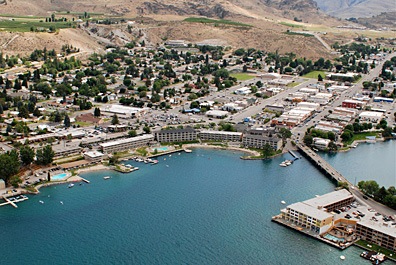
Chelan, WA from the AirI continued snapping photos throughout the weekend. On Saturday, Mike and I took a helicopter flight around central Washington and we took turns snapping photos out of the helicopter. (He’s a pilot, too, and we had the dual controls in, so I had a rare opportunity to use both hands and decent equipment for aerial photography with doors off.) Some of those photos were pretty good, too, like Mike’s shot of downtown Chelan.

This all goes back to my theory that if you have decent digital photographic equipment, are in a good place to take photos, have good photographic conditions (i.e., lighting), and enough storage space on your memory card that you don’t have to skimp on the number of photos you take, you have to get some good shots. Mike and I took over 200 shots from the air during a 3-hour flight the other day. I bet we only wind up with about a dozen really good ones.

Anyway, I put the Lake Pateros photos online on a new Web site I’m experimenting with: Flying M Photos. I’m hoping to build up a library of stock and fine art images, as well as event images like this, for sale. With luck, this will fund my photography habit, which is quickly becoming quite expensive.

Were you out on Lake Pateros during the July 4 weekend? Check the site to see if I got an action photo of you! If I did and you want to buy a copy to remember your day at the lake, use the coupon code LAKEP to save 20% on your photo order.

Hotwire Loses a Customer

Mike finally wises up.

My husband, Mike, is always looking for a travel deal. While there’s nothing wrong with that, what he usually winds up with is a prepaid travel deal with restrictions and other strings attached that make the trip a little less pleasant.

Hotels Deals?

His use of Hotwire, for example, has screwed us up more than once. He often uses it to book hotels. He claims he gets a better deal. What he usually gets, however, is a substandard room in the least desirable part of the hotel that doesn’t match his requests. I’m talking about the third-floor room in a high-rise that overlooks the air conditioning units on the roof of the hotel’s conference center. Or the one across the hall from the ice machine or elevator bank or housekeeping storage closet.

The request thing really bugs me. Hotwire — and most of those special deal booking services — include a field in the reservation form where you can enter requests, such as “quiet room” or “upper floor.” It usually also includes form fields for bed size (i.e., King, 2 Queens, etc.). The trouble is, the hotels either don’t see or don’t get these requests. While we’ve never been stuck in a smoking room after requesting nonsmoking, we seldom get our requested bed size (a single King or Queen). And the other requests regarding room type are usually ignored.

So what is your special deal getting you? Certainly not what you wanted.

And what kind of a deal is that?

While it really doesn’t matter on a one-night stay, getting a less-than-satisfactory room on a multi-night stay can really ruin the trip, especially if it’s supposed to be for pleasure.

The hotels, in the meantime, don’t give a shit about you. In their eyes, you’re paying $99 for a $199 room — or whatever your special deal is — and you’re at the very bottom of their list for service. They don’t care about you. They don’t want your kind in their hotel. The very fact that they have to take in Hotwire guests cheapens their establishment, in their eyes. So when you realize that your vacation is about to be ruined by your room’s view of the garbage dumpsters rather than the mountains or ocean on the other side of the building, and ask to get a different room, they respond that the hotel is full. They’re not even willing to do a deal with you for an upgrade. I think it’s because you pay Hotwire for the room — not the hotel itself — and making a change is likely to start an accounting nightmare for whoever’s at the desk.

This happened to us twice on trips Mike booked for the two of us. After the second time, I made him promise he’d never book a hotel through Hotwire for a trip I was going on with him. But Mike continues to use Hotwire for his solo trips, and for the trips he takes with his family members. Whatever.

Rental Car Reservations?

Well, Mike got bit bad by Hotwire this week. He’s flying to Seattle to visit me out in central Washington. I told him to fly into Wenatchee, which is 30 miles from where I was staying, but he was too cheap to pay the extra $220 airfare from Seattle to Wenatchee. He expected me to drive the 300 round trip miles twice to pick him up in Seattle and then take him back. When I explained that wasn’t happening in my 10 miles per gallon truck, he decided to rent a car. I had no problem with that because I figured that whatever he rented would be more comfortable and fuel-efficient than my 1994 Ford F150 redneck truck.

Now, I’ve rented cars too many times to count over the past 20 or so years. I don’t like doing it. There are too many different prices and options and add-on fees. I’ve found that the very best way to get a good deal is to check the Web sites or call the toll-free numbers for the top 3-5 car rental places that serve the market you’re going to and get quotes. Have your AAA or AOPA or whatever discount code ready. Unless you’re traveling with a lot of people, always ask for the smallest, cheapest car. Nine times out of 10, you’ll get upgraded for free. (I’ve been upgraded to convertibles, minivans, SUVs, and even sports cars.) The trick is to compare apples to apples to make sure each quote is for the complete and total amount. When you find the best price, book it through the car rental agency. They usually just ask for a name and phone number; they seldom ask for a credit card. You write down the confirmation number and present it at the rental counter when you arrive.

But Mike reserved through Hotwire. And not only did they charge him over $350 up front for the entire rental, but the “reservation” was non-refundable. So when I picked up a contract in the Chelan, WA area and needed my truck (and its miserable fuel transfer system) up there with me, he was unable to cancel the car reservation and make the plane reservation (as I’d originally requested — and yes, that’s an “I told you so”). As a result, he’s paying $350 to rent a car to drive himself from Seattle to Quincy and back again. For the rest of his stay, the car will be parked in front of my camper at the Quincy Golf Course.

After battling with a “supervisor” at Hotwire and the rental car agency and getting nowhere, he admitted that he’d learned his lesson: He will never book anything with Hotwire again.

The Moral of this Story

I guess the thing that bugs me most about this affair is the fact that you can really get screwed just trying to save a few bucks. And while it’s nice to save money when you can, there comes a point when saving $20 or $50 on a 10-day car rental isn’t worth the restrictions and headaches that go along with the savings. In this case, by booking his car rental through Hotwire a few days in advance of the trip, he forfeited all of his travel flexibility.

Moments ago, with 10 minutes of work, without any discount codes, I found a suitable car rental through Enterprise for $373.56 — less than $25 more. Is it worth $25 — less than 7% of the purchase price — to pay for something in advance without any chance of refund?

To add insult to injury, our financial situation does not make it vital to save the $25. It’s not like we’re broke. But that’s part of the big picture. And sometimes, for some people, it’s tough to see the forest for the trees.

More Stupid eBay Buyers

Proof (again) that many people who buy on eBay are idiots.

A few months back, I speculated that eBay was for suckers when I reported on the condition of a “mint” condition lens I’d bought at almost retail and an auction for another lens that I passed on when the bid went more than $100 higher than the selling price on Amazon.com.

What “Mint” Really Means

According to my Mac OS X Dictionary widget, mint, when used as an adjective, means “in pristine condition; as new.” If that’s the case, then why is the term “mint,” when used on eBay, always followed up with additional describing words and phrases like “It is in mint condition, no scratches, no dust and no marks”?

Hello? Mint means mint. Like new. New items don’t have scratches or dust.

Unless, of course, you’re dealing with an eBay item.

The lens I bought that was in “mint” condition looked as if it had been on a shelf for two years. Yes, some of the dust had been wiped off, but there was enough in the cracks and crevices to tell the tale. And there was the tiniest of scratches on the lens closest to the camera body. That’s not mint.

And my husband, who recently decided that the low profile wheels that came with his used AMG weren’t quite right for Wickenburg’s dirt roads, replaced them with “mint” condition stock wheels. In the seller’s world, “mint” is an adjective that can be applied to tire rims that have obviously been scraped along a curb. No amount of polishing will get those scratches out. My husband’s good deal wasn’t such a good deal after all.

I try to use words carefully. Because of that, I would never apply the word “mint” to any item that has been used in any way. Unfortunately, I’m one of the few people who take the meaning of words like “mint” seriously.

The Price Thing Still Cracks Me Up

The other day, I bought another lens from Amazon.com — but not before I started “watching” an auction for a “4-month old,” “mint” condition lens on eBay. The auction ended a little while ago and the lens sold for $454. Add $19.95 shipping and the final price was just $5 less than I paid Amazon for a brand new lens.

I don’t know about you, but I think it’s worth the extra $5 to get something brand new in a box, shipped by a reputable company than to get suckered in by yet another eBay seller offering “mint” merchandise that isn’t.

So the question is, don’t these eBay buyers do their homework? Don’t they realize that they can buy brand new items for less than they’re paying for [often] misrepresented used items?

Or does the excitement of the auction process get them to bid stupidly?