I arrive at Howard Mesa for my summer vacation.
It was months in the planning. And, near the end, it didn’t seem as if I’d make it as scheduled. But on Saturday, June 25, I flew up to Howard Mesa with whatever gear I could stuff into Zero-Mike-Lima. Mike, with his pickup filled with purchases, Jack the Dog, Alex the bird, and the horse trailer with two horses, came up the slow way.
I left Wickenburg about forty-five minutes after Mike. I wasn’t in a rush. The idea was to get there before him, but with an estimated flight time of about an hour and an estimated drive time of 2-1/2 hours, I had plenty of time. It was a relatively smooth flight, but the sky was quickly filling with cumulus clouds. Unusual, given that it was only around 8 AM. I was sprinkled on just east of Paulden, but it wasn’t enough rain to get the bugs off my cockpit bubble.
There was also enough sun during the flight for me to sun my legs. I was wearing a pair of ratty gym shorts with my Keds. I hate getting a Keds tan — that’s when your feet are white and there’s a tan line across the middle of your foot. So I took off my shoes and rested my heels on the tops of the pedals. I was pretty surprised that I still had good control of the pedals, even with my legs stretched almost straight out. Not that I needed to do much pedal pushing. At 110 knots, it isn’t tough staying in trim.
I stopped for fuel at Williams, where the 100LL price is currently $2.89/gallon. That’s 40¢/gallon cheaper than Wickenburg. I took 38.3 gallons. The Airport Manager, George, and his wife came out to look at the helicopter. He wanted to help me fuel, but I insisted on doing it myself. It was cool and breezy and quite a pleasure to be outside.
George wants me to offer helicopter rides from Williams airport for the summer. I told him I probably wouldn’t because I only planned to be in the area 6 to 8 weeks and I had lots to do at my place at Howard Mesa.
I took off after 20 minutes and headed north. Valle’s Planes of Fame museum was having their semiannual War Bird Fly In and I heard the pilots doing fly bys chatting on the radio. Things got a bit tense when one of them called a Mayday, but he evidently resolved the problem because he kept flying. (Hell, it the word Mayday ever comes out of my mouth, you can bet I’ll be on the ground as soon as possible.)
Since I had time, I decided to do a little fly by of my own. Zero-Mike-Lima isn’t a war bird, but kids like helicopters and I figured that if any kids were there, I’d give them a little bonus. I got into the pattern behind something slow — slower than me — and had to cut power and pull back to avoid flying up his butt. He did a low, slow fly by on Runway 14, which is closed, and I followed him, trying to hang back so I would steal any of his thunder. Then I dropped down to about 50 feet AGL and, as soon as he was out of the way, pushed my nose forward, increased power, and zipped past whoever may have been watching. Then I headed south to Howard Mesa, anxious to get away from slow-flying airplanes.
 I landed on my gravel helipad near the trailer and shut down. Then I proceeded to do chores. Unlocking the camper, turning on the power and refrigerator, tuning in the stereo (presets get lost when you shut power), hooking up the water, setting up the pump, opening the gate, putting out the carpet. I was just staking down the awning when I heard Mike’s truck pull in. He unloaded the horses and other critters and I made him lunch. Then we put away all the things he’d brought: Alex’s big cage from the coffee shop, the cabinets I’d bought for the shed, and the tools I’d need to work over the summer.
It was after 12 PM when we headed down to Williams. I had a radio interview with Inside Mac and they had requested that I call their toll-free number from a land line. Since there’s no land line at Howard Mesa, we decided to take care of it in Williams, where we had some shopping to do anyway. I found a payphone in the Fray Marcos hotel, spent exactly 12 minutes on the phone with a guy who mentioned the title of my Tiger book, using the wrong title (“virtual” rather than “visual”) about ten times. Then we hit the hardware store and Safeway supermarket and headed back up to the mesa.
We have forty acres at Howard Mesa and one of the first things we did after buying the place was to fence it all in. It took about a mile of fencing and $8K to get the job done. It was done by Grantham Custom Fence of Wickenburg and they did an incredible job. The straight bits are perfectly straight and the fence is good and sturdy. We do need to make repairs now and then when the top wire gets damaged by an elk jumping over. My only complaint is that the corner posts are coming out due to the annual freeze-thaw cycles. Although Ty’s guys used concrete and dug each one in at least two feet, the earth squeezes them up a little every year. The fence is still sound, of course, but it looks a little weird in the corners.
The reason we fenced it all in was so the horses could run free. We call it the “salad bar” because as soon as they step off the trailer, they’re grazing. They love it at Howard Mesa, although the first night they were up here this year, they did get snowed on. They have a round pen here where we put their food and water, but the gate is always open. They come and go as they please. Right now, as I write this, they’re about 100 feet away, grazing.
Somewhere along the line, Jack the Dog decided that it was his job to keep the horses away from us. He’d wait until they were about 50-100 feet away, then tear off after them, barking. Cherokee, who is afraid of rabbits, would take off and Jake, not quite sure why Cherokee was running, would start running, too. It look a lot of yelling and rock throwing — yes, at the dog — to get him to stop.
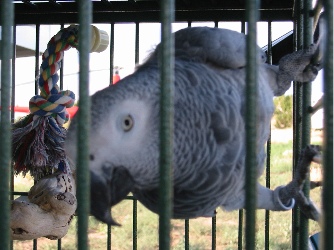
 Mike spent the afternoon hooking up the camper to our septic system. It was a good thing he did, because the camper had been used for three short trips without being dumped and it was beginning to get stinky. I took care of things inside — putting away groceries, making the bed, cleaning things up. Two hot showers later, we had dinner at the picnic table outside the camper, with our horses and the San Francisco Peaks to admire while we ate. Cherokee decided to stand on the other side of the bird cage while we ate dinner. His head was about 2 feet from Alex. Alex was very quiet while Cherokee was there. Then Cherokee decided to sample the corn cob litter I’m using at the bottom of Alex’s cage. I think he likes it. We had to scold him and chase him off. Jake came over and watched us eat our corn. I think he was begging. It was very weird having the horses so close to us — less than five feet away — while we ate. I’m not sure how much I like it. Meanwhile, Alex has already learned to imitate the squeaky screen door. He makes the sound every time we open the door. I’m waiting for him to learn how to call Cherokee.
We watched the sun set and it immediately cooled down. It had been in the high 70s all day, with several isolated thunderstorms that had missed us by a few miles. Nice rainbows. When the sun set, the temperature dropped about 10 degrees in less than 30 minutes. We went in for the night because we were cold.
Sunday dawned with a beautiful cloudless sky. For a while, there was very little wind. We had a light breakfast and set about our morning chores. My job was to take the new weed whacker and whack weeds. I started with the horse’s round pen, which we use to feed them. The weeds were knee high in some places, but I made short work of them. Then I whacked around the camper and went after the tumbleweeds growing on the southeast side of my helipad. The tumbleweeds were young and fleshy and they splattered me with green stuff. Anyone who uses a weed whacker without eye protection should have his head examined.
Mike worked on the shed’s roof. Some of the shingles on top were loose and he wanted to seal them up with glue and special nails. he finished before me and spent a lot of time watching me go after the weeds. I finally stopped when the engine was out of gas. I was out of gas, too. And my right arm was so weak I couldn’t lift a glass of water to my mouth.
We decided we’d go to Flagstaff for the rest of the morning, but changed our mind halfway down the mesa. Instead, we’d go to either the Grand Canyon or Williams for brunch. We decided on Williams because we didn’t feel like dealing with weekend traffic at the canyon. Bad decision. We wound up in a terrible restaurant in downtown Williams. The food was only partially edible, the service was terrible, and the waiter was skeevy. And it wasn’t cheap. A learning experience, we agreed. We wouldn’t go there again.
We went for lattes in a coffee shop and I discovered that they had free wireless Internet. I’ll probably have a latte there tomorrow morning while this is sent to my blog server and I collect my e-mail.
Back on the mesa, we relaxed for a while before doing our final chore for the day: surrounding the helicopter’s landing area with a “fence.” We had some plastic fence posts designed to hold electric tape. We’d bought the whole system — complete with solar fence charger — as an option for when we went camping with the boys. But we’d since used the fence charger and some of the tape to surround the chicken coop and keep our neighbors dogs and coyotes out. We had these posts and plenty of tape left, so we used them to make a perimeter around the helicopter. The idea is to keep the horses out of the landing zone when the engine is running. Our horses respect fences, so we knew it would keep them out. We just weren’t sure how well the posts and tape would hold up to rotor wash.
We got to try it out a few hours later. I was keeping Mike’s truck with me at Howard Mesa, so I needed to take Mike home. Let’s see…two hours round trip by helicopter or five hours round trip by truck? Tough decision, huh? Mike waited outside our little fence while I started up, warmed up, and brought it up to 100% RPM. The fence held. Mike climbed aboard and we took off. The horses watched from 150 yards away. Cherokee looked very confused.
We had a quartering headwind for most of the trip home, so it took us the full hour. Mike offloaded his stuff and put a few things from the hangar on board for me. I took off for the return trip with a quartering tailwind that brought my ground speed up as high as 144 knots. Yee-ha! I got back to the mesa in about 45 minutes.
As I came in for my landing, I looked for the horses. They were about 100 yards from the landing zone. When they saw me coming in, however, they took off running. Unfortunately, they decided that the safest place was their corral, which was about 50 feet from my fenced-in landing zone. They stood by the gate and watched me set down. I think Jake recognized the big red thing that had been parked there all weekend and had left just two hours before. I waved at them. When I killed the engine, I got out and talked to them, then got them some alfalfa. They forgot all about scary loud red flying machines.
I’ve done my chores for the evening and taken a walk “around the block” with Jack the Dog. The sun set about 20 minutes ago and it’s starting to get cool. I’m wearing long pants, a long sleeved shirt, and a sweatshirt. Mike, who called a while ago, says it’s in the 90s back home. He’s watching the Mets/Yankees game on television and says the house is weird with no animals or other people.
To me, Howard Mesa is weird with all these animals but no Mike.
 I didn’t see or smell smoke all day yesterday. But in the evening, as the sun was setting, I saw the smoke on the northwestern horizon. Probably the fire out in the St. George area about 120 miles away. This morning, the smoke from Arizona’s big fire — the second biggest in its history — had drifted north, past the San Francisco Peaks, shrouding the eastern horizon. I almost missed the sunrise. The sun fought to be seen through the thick smoke, appearing as an orange globe poking out through the top of the thickest of it. There was little light from the sun at first. Then, when it broke clear of the cloud layer, I could feel its bright warmth. The smoke cloud faded back to a blue-gray blanket on the horizon.
 I didn’t have to cut any wood. I’d bought all the wood pre-cut to my specifications. There’s a hardware store in Wickenburg (Johnson Lumber) that is very nice about cutting wood for me and that’s where I bought it. I took measurements last time I was up here, so I had exact numbers. That was odd because the vertical studs each needed to be a different length. When I assembled all the pieces, they fit perfectly.
 To see whether I’d be able to get my ever-growing butt past the bathroom vanity once it was installed, I took it out of its box and set it in place. That’s when I realized why it had only cost me $78 assembled with a sink basin: it was a piece of junk. It was falling apart and I had to use some skinny nails I happened to have to bang it all back together. Then I placed the basin in (partially to help hold the thing together) and moved it into place, trying to imagine a wall behind it. Yes, I could walk past it. Next, I worked on the ladder we’d use to get up to the loft. The loft is about 6-1/2 feet high, and just tall enough to sit up comfortably on. We’ll be putting a bed up there. Well, a mattress. And some carpeting under it. I positioned one 8-foot 2×4 on an angle against the edge of the loft, then took the precut 18-inch long pieces and a level and marked off where they’d need to be nailed in. The ladder’s rungs need to be parallel to the ground. This is something I learned when I built my first loft, back in college. The first ladder’s steps had been perpendicular to the sides and the ladder had been placed vertically. This made it very difficult to negotiate. So I put the ladder on an angle and then had to reposition the steps so I wouldn’t hurt my bare feet climbing up and down.
 Horses are herd animals. That means they like to be together. When the lead horse moves, the rest of the herd follows. My horses follow that rule. I only have two of them: Jake, a sorrel Quarter Horse, and Cherokee, a Paint Quarter Horse. Jake is generally the boss, but they’re good buddies and they’re always within sight of each other, if not right next to each other.
 It took some doing, but I finally found Jake about a third of the way down the hill, at least a quarter mile away. I called him, but even if he heard me (which I doubt), I knew he wouldn’t come. (Jake is not like a dog. He’s more like a cat.) So I called Cherokee. At least he indicated that he heard me. But he was too panicky to even think of why I might be calling him. Long story not as long: I went back to the round pen, put the lead rope on Cherokee, and led him down toward Jake. When I had a good view of him, I pointed him out. But horses don’t understand pointing fingers. He looked everywhere except where I was pointing. Then Jake saw us. He let out a loud whinny that seemed to say, “What the hell are you doing up there?” Cherokee whinnied back. I took off the lead rope and he trotted down to his buddy.
 I landed on my gravel helipad near the trailer and shut down. Then I proceeded to do chores. Unlocking the camper, turning on the power and refrigerator, tuning in the stereo (presets get lost when you shut power), hooking up the water, setting up the pump, opening the gate, putting out the carpet. I was just staking down the awning when I heard Mike’s truck pull in. He unloaded the horses and other critters and I made him lunch. Then we put away all the things he’d brought: Alex’s big cage from the coffee shop, the cabinets I’d bought for the shed, and the tools I’d need to work over the summer.
 Mike spent the afternoon hooking up the camper to our septic system. It was a good thing he did, because the camper had been used for three short trips without being dumped and it was beginning to get stinky. I took care of things inside — putting away groceries, making the bed, cleaning things up. Two hot showers later, we had dinner at the picnic table outside the camper, with our horses and the San Francisco Peaks to admire while we ate. Cherokee decided to stand on the other side of the bird cage while we ate dinner. His head was about 2 feet from Alex. Alex was very quiet while Cherokee was there. Then Cherokee decided to sample the corn cob litter I’m using at the bottom of Alex’s cage. I think he likes it. We had to scold him and chase him off. Jake came over and watched us eat our corn. I think he was begging. It was very weird having the horses so close to us — less than five feet away — while we ate. I’m not sure how much I like it. Meanwhile, Alex has already learned to imitate the squeaky screen door. He makes the sound every time we open the door. I’m waiting for him to learn how to call Cherokee.
 Back on the mesa, we relaxed for a while before doing our final chore for the day: surrounding the helicopter’s landing area with a “fence.” We had some plastic fence posts designed to hold electric tape. We’d bought the whole system — complete with solar fence charger — as an option for when we went camping with the boys. But we’d since used the fence charger and some of the tape to surround the chicken coop and keep our neighbors dogs and coyotes out. We had these posts and plenty of tape left, so we used them to make a perimeter around the helicopter. The idea is to keep the horses out of the landing zone when the engine is running. Our horses respect fences, so we knew it would keep them out. We just weren’t sure how well the posts and tape would hold up to rotor wash.