
 I check out a few points of interest from the air.
As you may have read in another entry, I am addicted to flying. If I don’t get a “fix” every few days, I get crazed. And here at Howard Mesa, where there’s not much else going on to keep me busy, I get crazed a lot easier than I would elsewhere.
Today I decided to make an early morning breakfast run. The destination was Winslow, which has a restaurant at the airport, but there was no reason to go straight there. (Especially since “straight there” would require me to overfly Mt. Kendricks, which is a bit too tall to fly over comfortably.) So I decided to swing north for the flight out and south for the flight back.
I was ready to leave by about 6:30 AM. Horses fed, masked, and sprayed. Dog confined in screened-in room. Bird in cage. iPod, camera, handheld GPS, and decibel meter on board. I started up, warmed up, and took off. I reset the trip computer and track log in my handheld GPS. I just got the GPS for my birthday. It’s a Garmin GPSMap 60c. A bit of a step up from my old GPSMap 12. I wanted it because it could store more maps than the old one and had WAAS capabilities, which could make it more accurate — something I’ll need if I ever get serious about geocaching. I left the GPS on to track my progress. The idea was to transfer the resulting tracklog to my laptop and use Terrabrowser to superimpose it over either a topo map or satellite photos. (I’m writing an article about doing this for Informit.com, so I don’t want to go into any detail here.) Here are the first pass results of this experiment. The white and black areas are ones I didn’t have satellite images cached for. The red letters are referenced throughout; A is my starting point at Howard Mesa.
 I headed northeast, right into the sun. Not good. I’d forgotten to put my hat on and the sun was shining right in my face, flickering through the blades. (I hate when that happens.) So I moved my headset down around my neck, put my hat on, and then put my headset back over my ears. Doesn’t sound like a big deal, does it? Well, you try to do it with one hand — your left hand. It was worth the struggle, though. The hat shaded my eyes nicely. I hit route 180 and followed it east, toward Flagstaff. I wanted an aerial view of Red Mountain, which I wrote about in another blog entry a few weeks ago. I had my camera and managed to snap two photos. Here’s one of them. Neither really shows the mountain well, but it’s hard to take pictures left-handed while flying a helicopter right toward a mountainside.
Then I headed on a more northerly track. I wanted to intersect with the Little Colorado River, but didn’t want to fly as far as Cameron. The high desert I flew over was deserted — at least at first. Then I flew into the outskirts of the Navajo reservation and began seeing small ranching settlements beneath me. There were some cows, but mostly sheep. The homes out there were picturesque, with rolling green hills all around and a good view of the San Francisco Peaks, which is one of the Navajo’s sacred mountains. I saw round hogans with doors facing east, livestock pens, and outhouses. Life is simpler out there. Way simpler. I crossed highway 89, which runs from Flagstaff to Page, and got into more rugged terrain. There were fascinating rock formations below me and, every once in a while, another Navajo homestead. Then I spotted the Little Colorado River valley. I reached the river and was very disappointed to find it dry. I turned right (B) and followed it toward Winslow.
 This was my second trip along the Little Colorado River. It isn’t a very exciting flight, but it is mildly interesting. There are a few remains of Navajo homesteads and something that looked like an old mine. The highlight, of course, is usually the Grand Falls of the Little Colorado. But without any water falling over the big cliff, it was extremely disappointing. From that point, I headed pretty much straight toward Winslow cutting across the high desert, 300 feet above the ground at 100 knots.
I landed at the airport (C), shut down, and went into town. All that is covered in another entry I wrote earlier today.
After chatting with two guys who had flown in from Redlands, CA to look at a business in Winslow — I can’t imagine what business in Winslow would be worth flying 450 miles in a Cessna to see — I climbed back on board and started up. While I was waiting to warm up, I used my decibel meter to get a reading on the ambient noise level inside the cockpit. About 100 decibels. Not good. I wanted to get a reading because I want to be able to fly with Jack the Dog and Alex the Bird and I’m worried about damaging their hearing. Alex travels in a lucite box and the sound levels are probably lower inside it, but I can’t imagine them being that much lower. Oddly enough, I checked the sound levels again after taking off, at 100% RPM, and they were pretty much the same. I didn’t expect it to get quieter, of course. But I also didn’t expect it to stay the same.
 I headed west along I-40 for a short while, then spotted the “mountain” formed around Meteor Crater and headed straight toward it. I’d tried to get a summer gig at the Crater and they wanted me, but they also wanted $15 million in insurance, which I cannot get. (I don’t know anyone who can, either.) I like to fly over the crater when I’m in the area. I think it’s the best view; about 400 feet above the rim. I circled it once (D) and took a few pictures, then headed back toward I-40 again. I followed I-40 for a while, then decided to follow the traces of old Route 66. I did that past Twin Arrows, Winona, Flagstaff, Belmont, and Parks. It’s interesting the way the road fades in and out of existence along the way.
 When I got close to Williams, I caught sight of the black smoke spit out by the Grand Canyon Railroad’s steam engine. I caught up with it just short of Howard Mesa and managed to take a halfway decent photo of it from the air. (Remember, I’m doing this left-handed, and, in this case, through the passenger side window, while flying a helicopter. So cut me some slack.) Back at Howard Mesa, I followed the state road up to my property. I flew low and slow, trying to check out the road work they’d been doing. They were still working on it. I probably gave the road grader guy a mini heart attack when I passed him 50 feet off the deck about 100 feet to his left at 60 knots. (He’ll have something to tell his wife tonight.) I set down on my pad and shut down. I’d logged 2.1 Hobbs hours and had gotten a good fix.
Oh, and in case you’re wondering about point E on the photo map, that’s the Grand Canyon. I didn’t fly over it, but doesn’t it look cool from space?
 The hotel wasn’t very impressive from the outside. But step inside and WOW. The restoration work was incredible. Although I didn’t much care for the weird paintings that adorned the walls — paintings that probably have architect and designer Mary Jane Colter spinning in her grave — the place was beautiful.
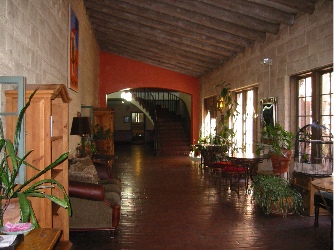 Afterwards, I explored the place, checking out the various public rooms on the main floor. I had my camera with me and snapped about a dozen photos so I could show Mike what the place was like. Beautifully decorated, beautifully restored. There was a garden in a courtyard out front and a lawn with covered patio in back facing the tracks. It was easy to imagine what staying at this place had been like years ago. I grabbed a brochure, noted the moderate room rates, and decided to talk Mike into making the trip for a weekend stay sometime in the future.
 Last year, when I worked at Papillon, I had my R22, Three-Niner-Lima, up here with me. Sometime during the summer, we had a load of cinders (volcanic gravel which is widely available here) delivered and we — well, mostly Mike — spread it out to make an oddly shaped landing pad. That’s where I landed Three-Niner-Lima, and this year, that’s where I’m landing Zero-Mike-Lima. The pad is less than 50 feet away from our trailer and its screened-in room. It’s also less than 50 feet away from the horse corral, where our horses go to drink and to eat whatever we throw down to supplement their grazing. As I sit here in the screened-in room, typing this, it’s right in front of me. I put a little fence around it to keep the horses from wandering in. That’s probably a good thing, because they’ve been itchy lately and scratching themselves on anything handy: the corral gate, tree stumps, the BBQ grill shelf. I can just imagine them scratching themselves on the helicopter’s stinger and cracking a tail rotor blade in the process.