Another Lazy Job Seeker

It’s so easy for them these days, but they still take the lazy way out.

When I was getting ready to graduate college with a BBA in the early 1980s, my school provided some advice about how to look for a job and prepare for an interview. There were basically two different paths:

  • For a posted job opening, research the company to see whether it would be a good “fit.” The write a cover letter to send in with your resume that explained how you not only qualified for the position but could bring additional benefits to the company.
  • For a company you wanted to work for that didn’t have any posted job openings, research the company to learn more about it. Then write a cover letter to send in with your resume explaining what job or department or division interested you and how you could benefit the company.

There’s an underlying theme here: research the company. Learn about it. Understand what it did and how you might fit in. Even if the job you were looking for wasn’t available, the person on the receiving end of your cover letter and resume might realize that you’d done your homework and that might make enough of an impression to forward your resume to someone who was hiring people like you.

In those days, researching a company meant going to the library, tracking down annual reports, and combing through the periodicals Index to find articles about the company. It meant microfilm and microfiche. It mean spending an hour or two or even more to gather enough information to become informed about the company and sound that way if a phone call came. If you got an interview, it was back to the library to learn even more.

These days, we’re lucky — oh, so very lucky — to have the Internet. Researching a company is as easy as visiting its Web site or Googling its company name. All the information you could possibly want — and more! — is there, at your fingertips, in the comfort of your dorm room, living room, or a coffee shop.

Yet people still continue to take the lazy way out, sending generic e-mail messages to anyone they find online that might possibly have a job for them. In many cases, they don’t even bother to research the company and possibly job openings while they’re on that company’s Web site. Instead, they zero in on the Contact Us page or link and paste in their job request.

Here’s the most recent gem to cross my e-mail inbox:

I am seeking an internship position in the helicopter industry and was wondering if your company has any positions available in Phoenix. I am approaching my senior year in my Bachelor’s Degree in Aviation Administration and training for my Instrument and Commercial Rotorcraft Rating. I am very interested in doing an internship with your company so any information would be greatly appreciated.

Contact FormI should note here that this e-mail message was sent using a form on Flying M Air’s Web site, which is reproduced here as an image (reduced to fit). At the very top of the form is the parenthetical statement, “Note to Pilots: We are not hiring.” I added this when I got tired of getting e-mail messages very similar to the one quoted above. I figured I’d just tell them up front that no jobs were available so they wouldn’t waste their time — or mine. Evidently, reading the page the form was on was too much for this soon-to-be-college graduate.

I composed a response:

You’re “very interested in doing an internship” with my company? Really? What do you know about my company?

I’m sure you sent this same message out to every helicopter operator in the Phoenix area who you could contact. Copy and paste makes it pretty easy these days. Are you just as interested in working for all of them?

And tell me: when you used the contact form on our Web site, didn’t you see where it said “Note to Pilots: We are not hiring?” Did you think that somehow did not apply to you? Or did you skip over all the information about my company and that note right above the form so you could quickly fire out yet another generic request for work?

Did you ever think that maybe you should put a little more effort into your job hunt? That some people in the industry aren’t interested in hiring lazy people who can’t be bothered to learn about a company or read available information about job openings — or lack thereof?

Still interested in doing an internship for my company?

We’re not hiring.

I’ve said it before and I’ll say it again: I can be a real bitch. But I didn’t send this. Instead, my husband and I agreed on a better response:

Information about job availability can be found on our Web site.

This is actually a more evil response. It will require him to do some work:

  1. Figure out what our Web site is. I didn’t include a signature line with the URL and my e-mail domain name does not match that of my company.
  2. Search the site to find the one place — which is right above the form he used to contact me — where it says we’re not hiring.

And why shouldn’t he put a little effort into a job hunt? Won’t he be required to work if he gets a job?

Weight and Balance: A Primer for Passengers

Or why you shouldn’t lie to your pilot about your weight.

The other day, I booked a scenic flight for three passengers. At the time of the booking, I took the passenger names and weights — as I always do. Here’s what I was told:

Joe: 200 lbs
Bill: 200 lbs
Sally: 150 lbs

Why Pilots Ask for Weights

You might be wondering why a pilot needs the weight of passengers on a flight. After all, when you book a flight on United or US Airways, they don’t ask how much you weight. Why should a helicopter pilot care?

First of all, you should be aware that the airlines do care about weights. Weight information is required to calculate aircraft weight and balance (W&B) at takeoff and landing. The airlines are allowed, however, to use a blanket estimate for each person’s weight. This is set forth in an Advisory Circular issued by the FAA. (I found AC 120027C dated 1995, but I think this has been recently revised to account for heavier passengers; can’t find the new info, though.)

As a Part 135 operator of a small aircraft, I’m required to calculate an accurate weight and balance for each flight I conduct. The calculation is complex and customized to my aircraft. If I had to do it manually, it would take a good 15-20 minutes — with a calculator. Fortunately, I’ve created an Excel worksheet that does the number crunching and calculations for me, so the whole process, which I can do on my laptop, takes less than 5 minutes and spits out a required flight manifest and flight plan at the same time.

Weight and balance is important for safe flight. An aircraft is loaded out of CG (center of gravity) could fly erratically or have impaired controls. For example, if my helicopter is loaded too heavy up front, I might not be able to pull the cyclic back far enough to arrest forward movement in flight. That would make stopping and landing very difficult indeed.

Likewise, an aircraft loaded beyond maximum gross weight will not perform to specifications and could suffer structural damage. For example, if my helicopter is carrying a heavier load than what’s specified in my Pilot Operating Handbook (POH) and legally allowed, I might not be able to hover in ground effect or take off with a climb rate sufficient to avoid obstacles.

What a Weight and Balance Calculation Looks Like

A weight and balance calculation includes a bunch of very large numbers that are subsequently divided to make much smaller numbers. The result is plotted on a graph surrounded by boundaries often called an envelope. The goal is for the plotted points and the line often drawn between them to be within the envelope.

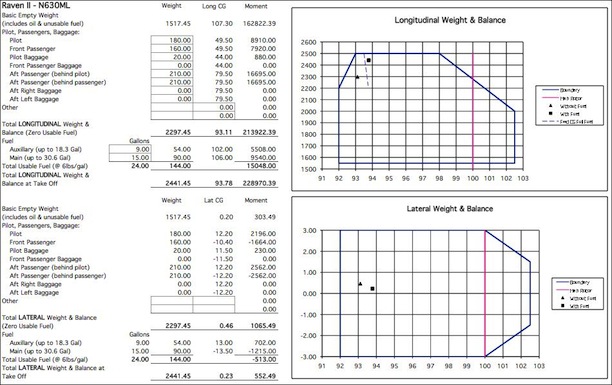
Here’s what the W&B calculations and envelopes look like for the charter flight with Joe’s party with 1/2 tanks of fuel on board:

Weight & Balance

Note that the plotted square and triangle are within the envelope for both Longitudinal and Lateral Weight and Balance. I can look at these two graphs and see that based on how I’ve seated the passengers, we’ll be a little heavy in front and on the pilot’s side. But the weight distribution is within the range my aircraft and its controls can handle.

It’s Not a Time to Be Vain

Weight and age are the two things people are least likely to be truthful about. As a pilot, I don’t care how old you are — I’ve flown with passengers aged 6 months up to 95 years — but I do care how much you weigh. Lying is not in your best interest at all.

But because I assume people will lie, I automatically add 10 pounds to each passenger’s stated weight when calculating my W&B. So here’s the revised W&B looks like for Joe’s party:

Weight and Balance

Now we’re starting to get closer to the limits. The weight is way up front now — almost at my limit. Still okay to fly, still legal. But I know that there’s very little wiggle room.

I know from experience that I can make the situation better by putting a lighter person up front. So maybe I’d put Sally in the seat beside me. Here’s what that looks like:

Weight and Balance

That looks a lot better. See how the two boxes in the top graph have shifted to the right? That means the weight is shifted aft. More balanced.

But I also know from experience that some men are unlikely to take a back seat to their wives. And I know that big guys don’t fit very well in the back seat of my helicopter. There was a pretty good chance that the guy who’d booked the flight and was paying for it would not sit in the back.

Getting it Wrong Can Make it Dangerous

Unfortunately, not everyone underestimates weight by just a pound or two. Sometimes, they’re very wrong. Consider Joe’s party. Turns out that they’d underestimated weights by at about 20 pounds per person. Now my W&B calculation looks like this:

Weight and Balance

Ouch. As you can see here, the two plotted points on the top graph are just outside the envelope for forward CG. That means that the aircraft would be too nose-heavy for safe flight.

How could I fix the problem? Again, I could shuffle around the passengers, putting the lightest one up front. I could take the contents of the pilot’s baggage compartment and shift it to the baggage compartment for one of the back seats — or leave it behind. Loading less fuel would not help — although it would reduce the weight of the aircraft (and the endurance time), it wouldn’t resolve the CG issue.

How do I know all this? By playing what-if with my Excel spreadsheet and observing the results.

Don’t Lie to Your Pilot

What bothers me sometimes is the flippant attitude some passengers have about weight. These people were a good example. The man who booked the flight didn’t take any of it seriously. He just threw some numbers at me to answer my question. I could tell when I laid eyes on them that they were heavier than reported. One passenger confirmed his weight at 220; the other passenger’s wife confirmed his weight at 220. 20 pounds is not a small error. It’s 10%.

In this case, it was the difference between a safe flight and a potentially unsafe one.

What they don’t realize is that underestimating or just plain lying about weights can make a flight dangerous. They can put their lives at risk by providing incorrect information. Is it worth it? Just so a stranger thinks you weigh less than you really do?

I don’t think so.

[Another] Predawn Flight to Scottsdale

Flying before the day begins.

I had an early flight in Scottsdale yesterday. Three passengers wanted a custom tour of the Phoenix area.

The man who booked it kept asking to do it earlier and earlier. First 8 AM. Then 7:30 AM. Then 7:00 AM. And then 6:30 AM. “We’ll meet you at 6:15 AM,” he finally said. “Will the pilot be ready to fly right away?”

I assured him that the pilot would be ready to fly within 10 minutes of meeting them. I didn’t mention that the pilot would be me. I hung up, glad he hadn’t shifted the flight another fifteen minutes earlier.

The helicopter was in Wickenburg. Although I’ve been storing it in Deer Valley for most of this season, I took the month of March off. There were a few reasons for it, including two trips (that were eventually postponed). So I had to fly the helicopter down to Scottsdale from Wickenburg — a 35-minute flight — before meeting the clients. When I calculated my departure time, I realized I’d have to leave my house by 5:00 AM to make it on time.

I set my alarm for 4:20 AM. I woke up at 3:30 AM. I showered and thoroughly enjoyed a cup of coffee with Alex the Bird and Jack the Dog. Then I packed up my laptop and flight manifest, shut off the lights, and stepped out to start my day.

It was dark outside. The moon had set, but I could see stars. That meant it was clear. The weather forecast looked as good as it usually does, so I wasn’t expecting any difficulties on the flight. The only questions were about the client: Had he lied about the weights of the passengers? Would he really give me 90 minutes of flight time, making the trip worthwhile? (He wasn’t paying for my ferry time, so a short flight would make the trip a loss.) Would he really be at the airport by 6:15?

I drove to the airport in my Ford truck, passing just a few cars and trucks along the way. The green-white-green-white sweep of the rotating beacon cut through the night as I pulled into the drive. I paused long enough to enter a combination on a keypad and wait while the metal gate rolled aside with a beep-beep-beep. Then I steered the truck down the asphalt drive, turned into the first row of hangars, made a broad U-turn, and parked in front of my hangar’s left door, with my headlights facing out. Even though the motion-sensor lights we’d installed over the hangar door went on, I’d need my truck’s headlights to see the combination on the padlock that secured the hangar. Once unlocked, I rolled the right door all the way open on the track and flicked on the lights. The big box hangar filled with light and the steady hum of the overhead fluorescents. I killed the lights on my truck before they killed the battery.

I’d done most of my preflight the afternoon before, after washing the helicopter and putting it away. I’d debated leaving it out overnight, but decided against it in case the client cancelled at the last minute. If I’d left it out, it would have saved me 15 minutes of time that morning. Instead, I had to use the ground handling equipment — a golf cart, a tow bar, and a set of ground handling wheels — to get the helicopter out onto the ramp. I backed the golf cart out of the hangar, towing the helicopter out nose first. Then I turned off the lights in the hangar and rolled the big door shut, securing it with the padlock again.

It was quiet and dark as I backed the cart out onto the ramp. Some of the overhead lights out on the ramp don’t work. It didn’t matter much to me — I wouldn’t park under any of them anyway. I needed room for my rotors to spin; it simply didn’t make sense to park next to a pole. But the ramp was too dark to see what I was doing. I had to turn on the golf cart’s headlights to unhook the tow bar. I’d never used them before and was rather surprised to find that they worked.

With the ground handling equipment out of the way, I climbed into the cockpit and went through my startup procedure. It took two tries to start the engine; not enough priming the first time for the cold. The engine roared to life and I flicked the appropriate switches to get the blades turning, battery charging, and radios working. I clearly heard the relatively high-pitched whine the engine — or something else back there — makes when it’s cold out. I knew from experience that the sound would go away as the engine warmed up. I turned on the navigation lights, which also illuminated the instruments. The green position light beneath my door reflected in the dusty surface of my side window.

I plugged my iPod into the intercom system. I’d listen to music on the way down.

It took a long time for the engine to warm up. While I waited, the guy in the hangar across from mine drove up and parked in front of his hangar. It was 5:30 in the morning — a full hour before sunrise — and the guy didn’t have a plane. What the hell was he doing there? He spent more time at the airport than most aircraft owners did, usually just sitting in his truck and talking on the phone. It creeped me out.

When the cylinder head temperature had sufficiently warmed, I did my mag check and needle split. I loosened the frictions and brought the engine and rotor RPM up to 102%. I was ready to go.

It was still very dark.

I made my radio call: “Wickenburg traffic, helicopter Six-Three-Zero-Mike-Lima is on the ramp, departing to the southeast.” I flicked on my landing lights, surprised, as always, by the sudden glow and the brightness of the dust particles swirling around in my downwash. Then I lifted into a hover, used the pedals to point the nose at the taxiway, and eased forward, climbing gently. When I reached the taxiway, now eight feet off the ground, I banked right and followed the pavement on a heading of 50°.

Wickenburg at Night

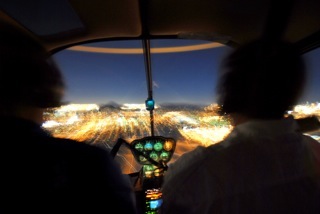
This photo by Jon Davison of us landing at Wickenburg at night gives you an idea of what the view from the cockpit looks like with the runway lights on.

The landing light shined down on the taxiway and out ahead of me as I gathered speed and altitude. I was about a quarter of the way down the taxiway when I realized I’d neglected to turn on the runway lights. I pressed the mic switch seven times. Nothing happened. I tried again, more slowly. The runway lights came to life: two strands of glistening white pearls turning to orange and then to red as they receded into the distance. The taxiway lights, glowed blue in a pair of light strings to their right beneath me. Beyond them was the dark void of empty desert and the greedy dreams of a failed real estate project. Aligning myself with the taxiway lights, I climbed out into the night. I flicked the switch to kill the landing lights.

The lights of Wickenburg spread out before me like a handful of gems cast into the desert by a giant. As I gained altitude to clear the invisible mountains just south of the town’s center, the distant glow of the Phoenix area came into view on the horizon, blocked here and there by the dark shapes of mountains that lay between me and the city beyond. I continued to climb. My goal would be to clear all those little mountains so I wouldn’t have to worry about hitting them in the dark.

I’ve flown the route between Wickenburg and Scottsdale many times. I even flew it at least one other time before dawn. But this time, I was tuned in to the darkness and silence of the night. I pressed the play switch on my iPod, letting some classic rock accompany the steady hum of my engine and the beat of my rotor blades. I climbed to 4,000 feet MSL — more than fifteen hundred feet over the desert below me — and leveled out. I was clear of all mountains between me and my destination.

Once away from Wickenburg, below me was only the darkness of the empty desert. With no moon, there was barely enough starlight to make out the meandering lines of dry washes and the occasional dirt road. Without visual landmarks, I realized I didn’t know where I was. Was that the Santo Dominguez Wash? Or one of the lesser washes in the area? And how about those lights to the left? Campers? Or that ranch off Constellation Road, viewed from a different angle? Only my GPS and the view of Phoenix’s lights spread out in the distance before me assured me that I was heading in the right direction.

The sky brightened ever so slightly as I glided southeast. The air was calm and smooth; my helicopter could have been a skiff floating on glassy water. I crossed over a well-defined dirt road that had to be Castle Hot Springs Road. Then I recognized the lights of the Quintero golf course and vehicles on Carefree Highway. The brightening sky reflected in Lake Pleasant, far to my left.

After ten minutes of flying over empty desert, I was returning to civilization: the northern reaches of Peoria.

I descended through 3500 feet, feeling ridiculously high above the ground as the glow from lights below me started reflecting in the inside of my cockpit bubble. I turned up the brightness on my instrument lights just a bit. Still descending, I flicked the radio to listen to the ATIS at Deer Valley. It was 5:50 AM and the tower was still closed. The automated weather observation system reported calm winds and an altimeter setting of 30.04. I adjusted my altimeter while listening to the recorded voice of the controller who’d closed the tower the night before. The tower would open at 6 AM. I wondered whether I’d reach the airport before then. I tuned the radio to the common traffic advisory frequency for Deer Valley, made a radio call with my position ten miles out, and continued on a course that would take me right over the top.

Lights at Night

The lights of the Phoenix area, at night. Photo by Jon Davison.

To the south, the brightness of lights on the ground intensified. The area was packed with new subdivisions, some completed before the housing bubble burst while others still had empty, weed-filled lots beneath their street lamps. It was a sharp contrast to the empty desert I’d been flying over for most of the trip. It amazed me that people wanted to live like that — packed like sardines into bulldozer-groomed lots — when there was so much beautiful desert, with rolling hills, cactus, and natural landscaping only a half mile away. The wide open spaces are what drew us to Wickenburg in 1997, but even that small town wasn’t immune to the greed of developers. Town planning restrictions were overturned on a case-by-case basis — often against voter’s wishes — for favored developers, resulting in smaller and smaller lots. Land zoned as horse property was rezoned to keep horses out and make lots too small to have them anyway. The retirees bought second homes in town to escape the cold of the midwest, doubling the population — for half the year, anyway. A friendly little western town turned into a retirement community right before our eyes. All of our young friends moved on to places like Colorado and New Mexico and California, leaving us with the retirees.

But I’m not ready to retire from life.

I descended to 2500 feet — a good 500 feet above where I normally flight during daylight hours — and leveled off. At five miles out, I made another call to Deer Valley traffic. I was now crossing into Deer Valley’s airspace; if the Tower had been occupied, I’d have to establish radio communication with the controller. I was the only one on the radio though — no one else spoke up. I crossed over the Central Arizona Project (CAP) canal where it meets the I-17 freeway. The sky, now quite bright, reflected in its smooth waters, drawing a bright line to the southeast.

Two miles from Deer Valley, I made another position call. No answer. I was close enough to see the tower; there was some light up there. Towers are normally kept dark so the controllers can see outside without bothersome reflections. A moment later, the airport’s two runways stretched out below me. I didn’t bother turning on the lights; I wasn’t landing and didn’t need them. But I could still see them quite clearly in the predawn light. It was about 5:58 AM and I expected the tower to open at any minute. I used the radio to announce that I was over the top and transitioning to Scottsdale. No answer. I glided on my way, descending down to 2300 feet.

Horizon

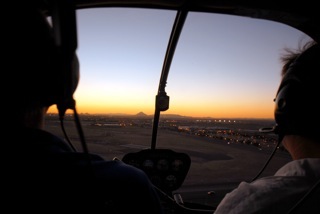
In this last shot by Jon Davison, you get an idea of how the horizon looks before dawn. (This shot was actually taken after sunset.)

Now the lights were bright below me as I flew over one subdivision after another. I crossed the Loop 101 freeway. Ahead of me, I could see the rotating beacon at Scottsdale Airport, about 12 miles away. The black bulk of the mountains on the horizon were well defined with sharp edges against the bright sky. Four Peaks was clearly identifiable by its four individual peaks.

I used my second radio to listen to Scottsdale’s ATIS while remaining tuned into Deer Valley. That airport was still closed, too. The automated weather system reported light winds and an altimeter setting just a few hundredths off from Deer Valley’s. The recorded controller’s voice warned of an unlighted 150-foot construction crane and advised that the tower would open at 6 AM. I flicked the recording off.

Now I was wondering about my client again, wondering whether he’d show up on time, whether he’d lied about his weight, whether he’d give me more than the 90 minutes of flight time he promised. I’d know soon enough.

The sound of a telephone dial tone came through the radio in three short bursts. Then the Deer Valley controller came on. He sounded tired and depressed, as if he’d just woken up to bad news, as he read the standard tower opening statement over the radio. It was long. I was still in his airspace, so I listened. At the end, he said, “Helicopter Zero-Mike-Lima, traffic ahead and to your left is a helicopter at twenty-five hundred feet. Frequency change approved.”

I’d already seen the helicopter flying west along the north side of the Loop 101. I replied: “Zero-Mike-Lima has that traffic in sight. Changing frequencies. Have a good day.”

I switched over to Scottsdale tower with the flick of a button. A female controller with a bright, bubbly voice was giving instructions to a jet preparing to take off.

I waited until she was finished and the pilot had replied, then made my call: “Scottsdale Tower, helicopter Six-Three-Zero-Mike-Lima is seven to the west off Deer Valley landing at the terminal.”

“Helicopter Zero-Mike-Lima, proceed inbound, report a half mile west.”

“Will report a half mile west, Zero-Mike-Lima.”

I continued inbound, crossing over Route 51. The sky was much brighter now; dawn was only 30 minutes off. I continued my descent to 2000 feet, roughly 500 feet over the ground. I listened to the tower talk with a female airplane pilot with the call sign “Traffic Watch” and wondered what kind of traffic she could watch from an airplane. Maybe I’d misheard them. She was using Runway 3.

Then I was less than a mile out and ready to start my final approach. I reported my position and was cleared to land on the ramp with the usual “use caution; ramp uncontrolled” and “remain west of the runway and taxiway at all times.” I repeated the “remain west” restriction as I steered to the south, descending. When I was abeam the approach end of runway 3, I swung northeast and lined up with the ramp, parallel to runway 3 and the taxiway beside it. I came in behind all the jets parked on the ramp and hover-taxied beyond them to transient parking for small airplanes. I set down at the end of the “Reserved” row and started my shutdown procedure.

In front of me, the terminal’s empty windows reflected the bright glow of the predawn sky, along with the flash of my helicopter’s strobe light. It wasn’t night anymore, but it wasn’t really day, either. It was that in-between time, the time of day when you put the secrets of the dark night behind you and prepare to embrace the day. It’s a special time, a time that’s always calm, always reflective. A time that makes me feel good to be alive.

I shut down and went inside the terminal. It was 6:10 AM.

And in case you’re wondering, the passengers did show up, they lied by a total of 50 pounds about their weights, and they flew with me for a full two hours.
On Limited Literacy

Is it wrong to be prejudiced against people who don’t even try to be literate?

I mentioned in my blog that I sometimes allow rated helicopter pilots to fly my aircraft on ferry flights for my flight cost. This is a substantial savings over what they’d pay to rent an aircraft to build time. In addition, they get the chance to fly a long cross-country flight (usually around 10 hours over two days) with an experienced pilot.

I get e-mails from people who are interested in this opportunity. The most recent arrived yesterday:

Yes sir i was intrested in biulding some time i am a commercial rated pilot with 250hr most in a robinson 22 i really need this chance to fly thank you for your time.

Although he managed to capitalize the first letter of the first word and put a period after the last word everything in between is a mess. Spelling? Punctuation? Is this what our schools are churning out?

Keep in mind that he sent me this message using the contact form on my Web site. A Web site that displays my name in the browser’s address bar when viewed. A web site that includes my name, bio, and other information in all kinds of places. Yet he addressed me as “sir.” I figured he’d somehow missed that I was a woman.

Still, the whole message put me in a foul mood. My response got to the point:

Do you have an R44 endorsement?

Maria

Without an R44 endorsement and 10 hours of flight time in R44s, you cannot fly an R44 with a passenger (even me) aboard. No exceptions.

Note that I included my name, just in case he really did miss it the first time.

His reply:

no sir im afraid i do not have it i would be willing to get one if you could let me know what it would take to get one thanks for your time

He didn’t even bother trying to get capitalization or punctuation right this time. Perhaps his shift key broke.

And I wasn’t about to let him get away with “sir” again. I replied:

First of all, I’m not a “sir.” Maria is a woman’s name. You sent an e-mail message to the woman who owns and operates the company and flies the aircraft.

If you don’t have an R44 endorsement, you cannot fly the aircraft. I’m sorry. If you want to get an R44 endorsement, talk to a flight school that operates R44s.

Maria

I’m bugged by this exchange. I’m bugged that someone bordering on illiterate — or too damn lazy to even try to get his spelling, punctuation, or grammar right — has the nerve to ask if he can fly my aircraft. There’s no way in hell I’d let anyone who communicates like that at the controls.

Being a commercial pilot is more than just taking flight lessons and getting the appropriate ratings. If this guy can’t write, how do I know he can read? That he understands the training materials he was given? That he took the time to read the pilot operating manual?

You might argue that he must have because he passed a written and oral test — two of each, in fact — to get as far as he did. But how do I know the quality of his CFI or pilot examiner? Or in the case of sheer laziness, if he’s too lazy to create two short e-mail messages written in proper grammar, why should I do him any favors at all? Frankly, I think even responding to him was going beyond the call of duty here.

Am I wrong to believe that written communication should be created with some semblance to proper grammar? Am I wrong to thumb my nose at people who fail to meet even the lowest tests of their ability to communicate in writing by composing two or three complete sentences?

Is this what our schools are churning out?

Taming My Skeptical Side

And how a podcast helps guide me.

As a skeptic, I’m not likely to believe any outrageous claims without solid proof. Unfortunately, I’m surrounded by people with all kinds of weird beliefs.

I have friends and relatives who believe in things such as ghosts, astrology, psychic power, homeopathy, magnetic therapy, crystal power, and other tested yet unproven concepts. Over the years, as I’ve learned more and more about how unproven these ideas are, I’ve wanted to share my insight to “enlighten” these people in my life. All I’ve faced, however, is frustration. They cannot let go of these beliefs — even enough to see how “proofs” can be faked.

Strained Relationships

One example of this is psychic power. I know people who watch John Edward on television and visit psychics and swear that they’re proof of real psychic power. Yet it’s pretty obvious to me that all these “psychics” are doing is using cold or even hot reading techniques and relying on human nature to remember the “hits” and forget the “misses.” I try to convince these people that what they’re seeing is a scam, but they don’t believe me. In the end, frustrated and disappointed, I feel a great loss. My inability to reconcile my knowledge with their conflicting belief causes me to lose my connection with them. I can’t see them the same way anymore. It puts a huge dent in our relationship.

In the end, I simply begin avoiding the person with the wacky beliefs.

I should clarify here. There are a lot of things people believe in that I don’t. For example, God. I’m an atheist, but I understand why people believe in God and how it helps them in their daily life. If we don’t discuss it, their belief does not affect my relationship with them. The same goes for any other relatively harmless belief that they have but generally keep to themselves.

It’s only when a wacky belief becomes a regular conversation point that I start to back off. Some people want to “convert,” me, to make me a believer, too. But they’re unable to provide the proof I need to believe. I’m unable to convince them to look at things from my point of view. We’re deadlocked. If this becomes an issue each time we’re together, I’d rather just avoid them.

And yes, I realize that “wacky” is a strong and possibly derogatory term. But from my point of view, many of these beliefs are just that: wacky.

Realistic Expectations, Curiosity, and Caution

Actually SpeakingEnter the Actually Speaking podcast. This is a different kind of podcast for skeptics. Instead of preaching to the choir by providing us with the facts and scientific evidence we need to understand the reality of unproven beliefs, Actually Speaking helps us deal with non-skeptics in a way that won’t ruin our relationships. Podcaster Mike Meraz offers advice, not facts. And the advice is, on the whole, very good.

Want an example? Well, the frustration I feel when dealing with the wacky beliefs of my friends and family members is a perfect example of how my skepticism can damage my relationships with these people. My reaction — to just back off — isn’t doing anyone any good. Mike suggests, in Episode 2, to develop realistic expectations for discussing conflicting beliefs. My goal should not be to convince people that I’m right and they’re wrong but to try to guide them to the point of Episode 3, curiosity and caution. After all, does it really matter what they believe? Isn’t it more important that they consider looking at their beliefs from other points of view and not get hurt by decisions made based on faulty beliefs? (For example, using homeopathy to cure a real problem rather than visiting a physician and getting real medicine.)

I realized, after listening to these two episodes back-to-back, that I had actually taken this approach and had a very positive outcome. I thought I’d blog about it to share my experience with other skeptics.

The Dowser

The situation dealt with dowsing. According to Wikipedia, dowsing is:

…a type of divination employed in attempts to locate ground water, buried metals or ores, gemstones, oil, gravesites, and many other objects and materials, as well as so-called currents of earth radiation, without the use of scientific apparatus. Dowsing is also known as divining (especially in reference to interpretation of results), doodlebugging (in the US), or (when searching specifically for water) water finding or water witching.

A Y- or L-shaped twig or rod, called a dowsing rod, divining rod (Latin: virgula divina or baculus divinatorius) or witching rod is sometimes used during dowsing, although some dowsers use other equipment or no equipment at all.

In this situation, an acquaintance — we’ll call him Joe — claimed to be able to dowse gravesites to determine the gender of people buried. He uses this “skill” out in the desert to comb through pioneer cemeteries and other unmarked gravesites and report about people buried there.

A friend of mine — we’ll call him Bill — often writes articles about desert exploration for a Web site I manage, wickenburg-az.com. He went on an outing with Joe and documented Joe’s findings. He then submitted an article about their outing for inclusion on the Web site.

While the general content of the article was interesting and I was sure the site’s readers would enjoy it, Bill included a detailed listing of the gravesites Joe had dowsed, including the number of graves (all unmarked) and the genders of the people buried there. I had a problem with this. I don’t believe that dowsing can provide factual information like this.* Including an account of the dowsing and its results could undermine the otherwise fact-based account of their outing. It could make the site look like a supporter of unscientific beliefs or, to use a term that’s falling out of fashion among skeptics these days, woo.

Worse yet, the article could provide a source of information for serious researchers attempting to find gravesites of specific individuals. Was the female grave at the site the grave of so-and-so’s long-lost aunt Mabel? How could I allow the article to state that there was a female grave there at all if there was no real proof? After all, the only way to be sure there was a grave at all would be to dig it up — which was completely out of the question for so many reasons.

I was in a quandary. I wanted the article, but I didn’t want the dowsing information in it. Bill, I felt, was a reasonable person. I was surprised that he believed in the power of dowsing. So I asked him straight out if he thought the dowsing results were reliable. I told him that I hadn’t heard of any scientific proof of dowsing claims. I told him I was skeptical and didn’t want to report unreliable information.

Bill, to his credit, considered my words. He got on the Internet and started doing some research. He found some documents that seemed to support dowsing. But then he found better documents from better sources — scientific sources — that indicated that dowsing was unproven and likely not possible. He sent me links to everything he found. He seemed embarrassed that he had been taken in by Joe’s confidence in his abilities. He rewrote the article to remove the mention of dowsing. I published it on the site.

By encouraging Bill to be curious about dowsing, I’d helped him come to his own conclusions about dowsing. He made the changes I needed in his article to feel comfortable about publishing it. Our relationship didn’t suffer at all. In fact, Bill seemed genuinely glad that I’d questioned him about it and that he’d had an opportunity to learn more.

Exploring the Human Side of Skepticism

Actually Speaking has helped me see how the way I dealt with Bill’s belief was the right way to deal with it. I didn’t tell him he was wrong. I didn’t belittle or insult him. I treated him like the intelligent human being he is. I made him curious enough to do his own research and come to his own conclusion. This tells me that the advice is Actually Speaking is good, solid advice because it can work.

Are you a skeptic or critical thinker surrounded by people with wacky beliefs? If so, give Actually Speaking a try. I think it might help you with your relationships with these people.

——–

* Curious about dowsing? Check out this article in the James Randi Educational Foundation Library: “The Matter of Dowsing.” You can also read about an actual test in James Randi’s book, Flim-Flam! Psychics, ESP, Unicorns, and Other Delusions.