
Three Productivity Tips from a Long-Time Blogger

A guest post for WordCast.

About this Post
I wrote this post to complement my participation in a Blog Productivity panel podcast for WordCast. I was invited by Lorelle (of WordPress fame), and I really enjoyed participating. If you listen to the podcast, it’ll soon become clear that I’m the “odd man out” (so to speak) in that I do things a bit differently than the rest of the pack. The podcast is full of great tips from all panelists and definitely worth a listen if you’re serious about blogging. This post appeared on the WordCast site earlier in the week.

I might not be the most influential blogger you’ve ever heard of — if you’ve heard of me at all. Or the most prolific. But I’m probably one of the most experienced: I’ve been blogging since October 15, 2003.

Still, I was extremely pleased to be asked to join a panel of expert bloggers for a recent WordCast podcast about blogging productivity. The folks at WordCast asked me to follow-up with a blog post sharing some of my tips. I can’t help thinking that my co-panelist’s tips were better, but here’s what I have to offer.

1. Create and Stick to a Blogging Schedule

One of the most important things about keeping a blog is adding new content regularly. “Regularly” is a tricky word. It doesn’t have to mean every day. It just means often enough to keep your readers checking in for more.

For example, suppose your life gives you enough free time that you can post once or twice a day for a few weeks or months. Suddenly, however, life takes as turn and that blogging time is gone — or you get bored with your blog and put it on the back burner. Go a week without posting something new and the folks who check in regularly for your words of wisdom may stop checking.

While I realize this is an extreme example, it does illustrate my point: regular readers will pick up on the rhythm on your posting and expect you to stick with it. When you don’t, they move on.

The way to prevent this from happening is to create a posting goal and schedule time to write. Perhaps you think twice a week is a good frequency. Pick two days a week — Tuesday and Friday? — pick a time that works for you — at breakfast with your morning coffee? — and blog on schedule. Make it part of your routine, part of your life.

I try to get a new blog post out at least five days a week. My schedule has me sitting in front of my laptop with my morning coffee every morning I can. Since I’m an early riser — usually up by 6 AM — I usually get my blog post done before I start my work day.

Got something coming up that’s likely to break your schedule? Vacation? Business trip? Family commitments? Write extra posts when you can and schedule them to appear in the future. This is particularly handy if your topic is not time-sensitive or you know you’ll be unable to blog on schedule in the future. Here are two suggestions:

  • Long posts can often be cut it into multiple parts with each part scheduled to appear on a different day. Not only does this stretch a single work out to fill a posting schedule, but if done properly, your readers will make sure they come back for the subsequent parts.
  • Do double-duty and write two posts at a sitting, scheduling one of them to appear in the future. If you’re able to write a lot very quickly, you can actually write a week’s worth of content at one sitting. No one has to know that each day’s new post was actually written some time ago.

2. Take Notes

How do you know what to blog about? One way is to take notes. As ideas and thoughts come to you — either from the workings of your own mind or from something you read online or heard in a conversation — jot them down. If you spend enough time thinking and reading and listening, you should be able to accumulate plenty of ideas.

Call me old-fashioned, but I don’t use software or web-based tools such as Evernote to organize notes and clippings. I use paper. I keep spiral-bound notebooks on my desk and in my computer bag and make notes as things come to me. When I’ve processed the note — blogged about it, made the call, tracked down the Web site, ordered the product, etc. — I recycle the paper. The huge file containing all my thoughts and ideas is my blog.

The point is, it doesn’t matter how you take notes. The important thing is to take them. Keep track of the little ideas that pop into your head when you’re in the shower or driving. Write down the key words of a conversation that’ll help you remember what you found so intriguing. Then, when you’re ready to compose a blog post, you’ll have most of the material you need to get it written.

Don’t get me wrong: I’m not knocking software tools. I just can’t be bothered climbing up the learning curve to use them effectively. Pen and paper works for me.

3. Automate!

There are lots of software tools and solutions out there to help automate tasks. After all, isn’t that what computers are for? To do the work and make our lives easier?

Here are three examples of tools I use to automate blogging-related tasks:

  • Delicious with Postalicious. Delicious is a bookmarking Web site. You read a Web page, want to remember it, and create a Delicious bookmark with its URL and a description and tags you specify. I’ve been using Delicious for years, since it could be found only at http://del.icio.us. Postalicious is a WordPress plugin that creates a blog post based on your new Delicious entries and the descriptions you provide. It then automatically posts the links entry to your blog at a predetermined time. You can find plenty of examples on my blog. Postalicious also works with other services, such as ma.gnolia, Google Reader, Reddit, or Yahoo Pipes. I rely on this combination of tools to collect and share Web-based content that I found interesting and want to share with my readers. The format isn’t perfect, but it’s certainly good enough for my needs. Oh, and one more thing: I use the RSS feed for my Delicious bookmarks to generate a list of recently bookmarked pages in the sidebar of my blog.
  • Twitterfeed with Twitter. Twitter is an incredible tool for communicating short snippets of information with other people all over the world. (If you haven’t heard of it or tried it, crawl out from under that rock, brush the dust and cobwebs off your clothes, and join the rest of the social networking community.) Twitterfeed is a Web-based service that scans your blog’s RSS feed and tweets links to your new posts. This is a great, automatic way to tell your Twitter followers about new content on your blog.
  • Feedburner’s Email Subscriptions. Feedburner is a service that modifies your RSS feed to add features. Although it was started as an independent service, it’s now part of Google, so you need a free Google account to take advantage of its features. The Email Subscriptions feature creates e-mail messages based on your RSS feed and sends them out to subscribers. The subscription list is maintained inside Feedburner, so you don’t have to deal with it; users can add and remove themselves without bothering you. This is a great way for folks who want to read your content regularly to get it on a timely basis without using RSS readers. Best of all, once you set it up, it’s automatic.

Conclusion

When thinking about blog productivity, it all comes down to working smart. Make blogging part of your life schedule. Keep notes about the topics you find interesting so you have plenty of topics to write about when you’re ready to blog. And automate tasks whenever possible.

These are just three tips. Give it some thought — or read the blog posts of my co-panelists here — for more.

About the Author

Maria Langer is a freelance writer who has been writing about computers and the Internet since 1990. She’s the co-author of the first-ever book on WordPress and has since authored three WordPress video titles for Lynda.com. Maria’s also a commercial helicopter pilot and serious amateur photographer. Her blog, An Eclectic Mind, can be found at aneclecticmind.com.
Got a Keyboard? Use it.

A blog post should be more than just screenshots of what other people Tweeted.

This morning, as I sat drinking my coffee, I began my usual ritual of checking out some of the links tweeted overnight by the people I follow. One of them was about the iPad. Interested in the iPad as my future ebook reader, I followed the link.

I wound up on a blog post that consisted primarily of screenshots of Twitter. The blogger had posted a question on Twitter about the iPad and then sat back and captured screenshots of the responses as they were tweeted.

I call that lazy blogging.

It was also extremely tedious to read. So tedious, in fact, that I stopped reading after the first scroll down. I did continue scrolling to see if there was some content added by the blogger, but there was so little of it that I wound up simply closing the browser window and getting on with my day.

And then I realized how much it bugged me that there was someone out there passing off screenshots of Twitter responses as a blog “post.”

There is so much crap on the Internet today. Huge quantities of it. I don’t “surf” the net. My Web activity is limited to looking up things I need to know about and following what appears to be interesting links that I receive from friends and business associates verbally, via e-mail, and via Twitter. I don’t want to spend my day wading through the crap online. I want the good stuff.

A blogger should not simply regurgitate what’s readily available on the Web. If I wanted to know what Twitter users thought of the iPad, I’d use Twitter’s built-in search feature — which is also part of Nambu, my preferred Twitter client — and set up a search. I’d then read the results myself. I don’t need to go to a blog to read the same stuff. As screenshots, for Pete’s sake! Hell, if I were at home with my miserably slow Internet connection, the damn page would have taken five minutes to load!

A blogger’s job is to both inform and provide analysis. A summary sentence at the top of 20 screenshots that simply says, “Many people think lack of multi-tasking is a deal breaker,” doesn’t do much for me. And I certainly don’t need to see those 20 screenshots. I get it. You’re not making this up. All these Twitter users said it. I guess it must be true.

And it’s immensely ironic that this post was retweeted. As if it had value. WTF?

My point: if you call yourself a blogger and want to add something of value to the Web, dust off your keyboard and use it.

On Becoming a "Power Blogger"

I define a new [to me] phrase.

Yesterday, I was one of four guest panelists on the WordCast podcast. The topic was blog productivity — tips and tricks for blogging more efficiently — and a phrase I’d never heard before came up in the discussion: power blogger.

Let me take a few steps back before I move forward. Although I’ve written extensively about blogging from the blogger point of view and I’ve also co-authored and authored various WordPress training materials (books and videos), I’m not someone who keeps up-to-date with the world of blogging. I don’t know the buzzwords or phrases, I don’t follow the hot trends. I just obtain the tools, use them the way they work for me, and try to publish new blog posts regularly. Along the way, I provide a sprinkling of advice for bloggers in my own blog posts.

So the phrase power blogger was brand new to me.

And meaningless.

When the question, “What advice can you give to people who want to become power bloggers?” came up, I felt a tingling of stage fright. Surely I’d sound like an idiot if I admitted I had no idea what the phrase meant.

Fortunately, another panelist spoke up. I listened carefully to glean meaning from his response. And what I learned was that he — and the others — considered the quantity of blog posts a major component of power blogging. By their definition — at least one post a day — I was a power blogger!

I sure don’t feel like one.

When it was my turn to speak, I proposed my own definition of power blogger. I don’t remember the exact words, but it went something like this:

The number of blog posts a blogger publishes should have nothing to do with whether he’s a power blogger. Instead, it should be the influence the blogger has over his readership and beyond. What’s important is whether a blog post makes a difference in the reader’s life. Does it teach? Make the reader think? Influence his decisions? If a blogger can consistently do any of that, he’s a power blogger.

I recall comparing Twitter — which is, after all, “microblogging” — to blogging. Someone can tweet dozens of times a day, but if there isn’t any value in what he’s tweeting, what good is it? There are plenty of bloggers out there simply rehashing the same material, over and over, without adding anything new to the mix. They might post five or ten times a day. But if it isn’t worth reading, how can you consider them power bloggers?

And I guess that’s the advice I want to share in this post: If you’re serious about blogging, don’t go for quantity. Go for quality.

Make a difference with what you post.

The Three Tiers of Writing

Some thoughts from a top tier player.

Other posts that explore why writers write:
Why Write?
Why Writers Write
BE a Writer

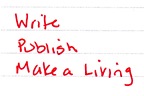
A few weeks ago, I had lunch with my friend and editor — and yes, it is possible to be friends with an editor — Esther. Like me, Esther also writes about computers and computing for a living. But while my audience tends to be end users, hers are of a more technical or managerial nature. In other words, she writes stuff I probably couldn’t understand.

We got to talking about writing and why people do it. During the conversation she (or we?) said something that was so profound to me at the time that I wrote it down on a notepad I’d brought along. It was the only note I’d jotted down during our lunch:

Notes

Why People WriteI see these reasons for writing as three separate but overlapping groups that a writer might be part of.

Do you remember set theory back in high school math? You can have multiple groups of people, some of which belong to more than one group while a limited number belong to just one group. I’ve created this image to visualize what I mean. Keep this image in mind as you read the next three sections.

Write

One group of people write to fulfill a desire or need to write.

If you’re one of these people, you know it. You’ve likely been writing or at least telling stories since you were a child. Perhaps you were the queen of the campfire with your original and frightening ghost stories. Perhaps you told yourself stories to get to sleep. Perhaps you always had at least one notebook filled with the never-ending saga of some characters you’d dreamed up to populate your made up world.

There are many thousands of people worldwide who belong to this tier. They write primarily because they need to. There’s something in their head and they need to get it out.

Some of these people share their work with others, but I’m willing to bet that a good percentage of them — perhaps even half or more — don’t. They don’t need to share. They just need to create, to get the words out.

But some of these people also belong to one or more of the other groups.

Get Published

A large (but not as large) group of writers write because they want to get published. Creating isn’t enough for them. They want to see their work in print. They want to have a book or magazine they can hold in their hand and show off to friends and family.

Although they might not realize it, having a published work is a lot like getting a trophy. It’s a symbol of an accomplishment.

Esther and I talked at length about how easy it is to get published these days. Yes, I did say easy. While vanity presses have been around for a long time, blogging and print on demand publishers make getting published cheaper and easier than ever before. Now anyone who wants to get published can get published — no matter how good or bad his work is.

This just reinforces my trophy analogy. After all, you can get a trophy two ways: by having it given to you by someone else who believes you’ve earned it or by going to the trophy store and buying it for yourself. That’s the difference between being published by an established publisher who is publishing your work because he thinks it deserves to be published and self publishing your work because you think it deserves to be published.

Some people write solely because they want to get published. They have no desire to be writers at all; they just want the end product — a published work — in hand. Who might be in this group? How about a professional in a non-publishing field who wants to look like an expert in that field? A doctoral candidate? A college professor?

While just being published is enough of a motivation for the people in this group, some want to take it the next step and are part of the last group.

Earn a Living

An even smaller group of writers write because they want to earn a living as a writer. Perhaps they are interested in the perceived lifestyle or the ability to earn a living from their creative efforts. They imagine working in their pajamas whenever they feel like it, doing book signings where they’re surrounded by adoring fans, and raking in enough dough to buy homes and cars and perhaps even helicopters.

(Ah, if only it were that easy!)

Some people write soley for this reason. They don’t care about the writing itself and the idea of having a published book is meaningless without the cash. They just think it might be an easy way to earn a living and heck, who wouldn’t want that?

But most really do want to write and do have a desire to be published.

The Reality

Unfortunately, motivation doesn’t always match reality.

You might write because you want to get published, but can you achieve this? Although it’s easier now than ever before, it’s still beyond the ability of many writers.

And what if you want to earn a living as a writer? A very small percentage of writers do.

Why People WriteSo rather than using set theory to illustrate the realities of writing, it might be better to use a pyramid shape with multiple tiers, as shown here.

At the bottom are the people who are writing but have not yet achieved publication.

Next up is a smaller group of writers who have achieved publication but have not yet written or published to the point where they can earn a living as writers.

And at the top is a much smaller group of writers who can actually earn a living as writers.

If you’re a writer, it should be pretty easy to figure our which tier you’re part of.

What this Means

What does this mean to the folks whose circle doesn’t match their tier level? For many folks, it just means you need to keep trying or try harder.

Let’s look at the folks in the Get Published or Earn a Living circle who are in the bottom tier of the pyramid. Have you tried to get your work published? It’s quite difficult to go any further until you do. If you have, but haven’t succeeded, why? Putting self-publishing aside for a moment, are you being rejected because you aren’t meeting the needs of publishers? Is the quality of your work sufficient for publication? Are you being reasonable and understand that an established publisher knows more about the industry and what will sell than you do? Or, if you have a niche market for your work, have you considered self-publishing?

How about the folks in the Earn a Living circle who are in the middle tier of the pyramid. Why isn’t your work selling well enough to earn you a living? Is the target audience too small? The book too expensive? Has the publisher — who may be you! — dropped the ball as far as marketing and promotion is concerned? Is there too much competition? Not enough interest? If a published work doesn’t sell, there won’t be enough money coming in to earn a living.

It all comes down to you. You need to write what people want to read. You need to get it published and marketed in a way that’ll sell it. It’s not an easy task and the work never ends. Unless you’re talented and fortunate enough to write and publish a best-seller, the work never ends.

The View from Near the Top

I’m sitting in the middle of the top tier right now, but I could slip down within my tier — or even to a lower tier — at any time. I have to keep working, keep writing, keep getting my work published by organizations that can sell it. I’m a cog in a wheel and that wheel is changing its shape as the publishing industry evolves.

Yes, I come to work in my pajamas sometimes and yes, I’ve even bought helicopter. But I also work harder than 95% of the people I know — people who whine and complain about their bosses as they stand chatting around the water cooler. People who know at the beginning of the year exactly how much they’ll make by year-end. People who have health benefits and weekends off.

It’s skill and hard work that got me where I am. And it’ll be skill and hard work that keeps me here.

And there’s room up here for anyone who’s not afraid of the climb.

Why I Just Signed the Worst Publishing Contract I Ever Got

And why I probably won’t regret it.

Moments ago, I put my signature on a contract to create a series of videos based on one of my books. Details beyond that are neither prudent nor required for this blog post. Let’s just say that the book is one of my better-selling efforts and the publisher is one that I’ve enjoyed a good relationship with for a while.

The contract, however, sucked.

My main concerns with the contract fall into two areas:

  • The language of the contract makes it nearly impossible to understand without drawing a flowchart or having a lawyer at my elbow to translate the legalese. We’ve come a long way since 1995, when the owner/publisher of the company signed the contracts and all checks and I, the author, was referred to throughout as “Maria.” Instead, it’s “we” and “you” and the single-spaced monstrosity stretches for six full pages, with numerous cross-references to other paragraphs. Whoever wrote this thing could easily get work writing government documents in legalese, such as FARs for the FAA or the latest version of the health care bill. It’s a shame they’re wasting their talents on publishing contracts, where contract recipients actually have a chance of understanding what they’ve written. They could be confusing a much larger audience.
  • The rights clause(s) in the contract require me to give away all rights to the work. All of them. For every possible means of publication and market, existing now or in the future. Forever and ever. It even says that if they need me to sign some other document to give them rights, I’m required to sign it. (Have you ever heard of such a thing?) I get it. I’m writing something for them and I should never expect to have any right in it ever again.

You might be asking why I would sign such a thing. After all, why should I give away all rights in a work I create? After 20 years in the business of writing technical books, don’t I have enough of a track record or reputation or following or whatever to successfully push back and keep some of those rights?

My response: Why would I want to?

Let’s face it — what is the life of a computer book these days? I feel fortunate when I see sales on a book that’s a year old. What good is having the rights revert back to me on a book that’s too stale to sell? Especially when I’ve already written and published the revision?

And do I really think I can sell something better than the marketing machine that my publisher controls? While I don’t think they do as well as they could, they certainly do better than I could.

But the real reason I signed without dwelling on it was the money. There. I said it.

The contract did not offer an advance against royalties. It offered a grant to compensate me for production expenses. The difference between the two is huge:

  • An advance against royalties is applied against royalties as they’re earned. So if you earn $8K in royalties in a quarter and they paid you $5K in advances, your first royalty check would be for just $3K.
  • A grant isn’t applied against any royalties. That means you start earning money on the very first unit sold. Using the same example, if you earned $8K in royalties in a quarter and they paid you a $5K grant, your first royalty check would be for $8K.

The royalty rates in this particular contract weren’t the greatest, but they weren’t bad. If this works out well and they want me to do another one, I think I can push a bit harder for better royalties or perhaps a larger grant. But not this first time.

You see, this is the first project of this kind at this particular publisher. We’re all sailing uncharted waters here.

And that’s probably the third reason I signed. I wanted an opportunity to try this.

Publishing is changing.

I remember the day about 10 years ago when I received six book contracts in the mail. All on the same day. The total advances for those books exceeded what a lot of people I knew earned in a year. And that year, I wrote ten books.

Things are different today. Titles that I thought would last forever — Microsoft Word for Windows Visual QuickStart Guide comes to mind — have died. Too much competition, not enough novice users needing a book, too much online reference material. The Internet’s free access to information is cutting into the royalties of the writers who used to get paid to write the same material. Paper and shipping is expensive. Ebooks have a lower perceived value than their printed counterparts. Brick and mortar bookstores have limited shelf space and a fading customer base. All this spells hard times for the folks who do the kind of writing I do: computer how-to books for the beginning to intermediate user.

When opportunity knocks, I answer the door. If the deal looks good, I shake hands, accept the offered check, and get to work. Even if the deal isn’t as good as I’d like it to be, I’m more likely to take it than I was 10 years ago.

After all, who knows when I’ll hear another knock on my door?