Truth vs. Fiction

How I get another life experience proving that truth is stranger than fiction.

First, the background info.

My company, Flying M Air, is the Fuel Manager at Wickenburg Municipal Airport. This means that I’m required to provide warm bodies to pump fuel into aircraft, sell pilot supplies and refreshments, answer questions, and keep the terminal building presentable. They do other stuff, too, but that isn’t worth going into for the purpose of this tale.

I have a staff of three employees, all of whom are semi-retired with some kind of aviation experience. Gary is a pilot who has thousands of hours of experience in all kinds of airplanes. Jeff is a pilot who is now building his own airplane. Alta is one of only five women in the world qualified to sit in the engineer’s seat on a 747.

Unfortunately, when one or more of these people need time off, the others can’t always fill in. That means I have to work at the airport. Trouble is, when I’m working at the airport, I’m not writing books. When I’m not writing books, I’m not earning a living. So it’s my best interest to find additional warm bodies to keep on staff.

That’s half the background.

Now here’s where it starts getting weird.

Last January (that’s 2004), I get a phone call from the Wickenburg police at 1:30 AM. They tell my half-asleep brain that someone has just called them, reporting that he witnessed three men fueling and then loading C-4 explosives into a C170 (that’s a Cessna taildragger) at the airport. When asked, these three men told the witness that they were flying to Washington to blow up the White House.

I replied to the police that they really didn’t have much to worry about because it would take a Cessna a few days to reach Washington. (Yes, I really did say that. They probably have it on tape somewhere. Remember, I was half asleep.)

The officer started asking questions and I started waking up. The gravity of the situation started to sink in. After 9/11, reports like this at airports are taken very seriously. The police tell me what they’d been told. And I realize that the story didn’t match what I knew to be fact: Namely, that the plane couldn’t have fueled up at 6:30 when the witness claimed because I’d fueled the last plane at 5:30 PM and had locked up everything (including the pumps) at 6 PM when I left for the night. I suggest that perhaps the whole thing is a hoax.

Two more phone calls from the police that night before I’m finally able to get back to sleep.

A few days later, I’m at Macworld Expo in San Francisco, loitering outside the Peachpit Press booth. My cell phone vibrates. It’s the police in Wickenburg again. They tell me that the case has been resolved. That the witness has been charged with submitting a false terrorist report. They tell me the witness’s name, but it doesn’t ring a bell and doesn’t stick. They give me the report number in case I ever want to look at the report. All I hope is that I’m not called as a witness in some trial.

Time goes by. It’s now March. Two of my airport staff members are away at the same time and the third can’t work. I wind up working four days in a row at the airport while my editor anxiously awaits more chapters of my QuickBooks book. Enough is enough. Time to get more warm bodies.

I get a call from a guy named Bob Doe. (That isn’t his real name, but it’ll do.) He says he talked me to me several months ago about a job at the airport but I wasn’t hiring back then. Am I hiring now? Sure, I tell him. Go to the airport and fill out an application.

He comes by the airport while I’m working. He’s in his mid thirties. His resume shows all kinds of airport experience. But he’s working as a stocker in the supermarket. (Actually, he isn’t. But he does have an equally unrelated part-time job.) He’s very enthusiastic and I’m sucked in, desperate for more warm bodies so I can get back to work. I think I notice alcohol on his breath, but I could be imagining it. I tell him to come by the next day for training.

“So I got the job?” Bob says.

“Well, I want to see how you do at training,” I reply evasively, trying hard to convince myself that it isn’t alcohol at 11 AM.

Bob leaves and I think about it. I’m not sure about him. I voice my concerns to one of the medivac pilots stationed at the airport. He tells me to go with my gut feeling.

I call one of Bob’s references and learn that he worked there for two months. Human resources tells me they fired him for not showing up for work and not calling. I can’t track down the other recent reference because he didn’t include a phone number. I decide to put off training for another day when Mike, my significant other, will be around to help train him.

The next morning, I call him at 8 AM. I get his answering machine. I tell him not to come in until the next day. At 9 AM a taxi (yes, a taxi — the only one we have in town) rolls up and he gets out. I tell him about the message. He says he never got it. He says he must have been in the shower. I tell him I can’t train him that day. He gets a little nasty, pointing out that he’d taken a cab. I tell him I’ll pay the cab fare. He tries to get me to change my mind and let him stay. I tell him about the reference checks and tell him I need phone numbers for all of his references. I then pay the $14 round trip cab fare and send him on his way.

Bob calls later with phone numbers for two personal references. The other reference I’d tried to contact had gone out of business. (How convenient, I think.) He gives me the name of a supervisor at the other reference. After he hangs up, I leave a message on the supervisor’s voicemail.

The next day, Bob shows up in a cab again. He’s 10 minutes late. He sweeps in like he owns the place and immediately begins leaving the things he brought with him — backpack, coffee mug, etc. — around the terminal. I hand him over to Mike for training; I have a catering order to handle and two helicopter rides to give.

Later, when things calm down, I can see there’s a problem with this guy. He has a superior attitude that just doesn’t fit into our cosy little establishment. He doesn’t give a hoot for the little plane pilots and complains when the only jet we service that morning leaves without giving him a tip. (We don’t get tips in Wickenburg.) His possessions are scattered all over the terminal. And I can tell that even Mike — that deep well of patience — has had it with him.

When I leave to get lunch for Mike and me, I take Bob home (he was scheduled for training until 1 PM). On the way, he tells me how great it feels to be working at an airport again. He wants to know how many hours we’ll be giving him so he can quit one of his part time jobs. (I didn’t realize that he had two jobs.) I tell him I don’t know yet, that I’d have to let him know.

Back at the airport, Mike and I compare notes. We decide that Bob’s warm body just isn’t the right temperature for us. I get Mike to break the news to him on the phone. I write a check for $24 to cover the promised training pay and put it in the mail.

The next day, Mike is at the airport when Bob storms in, looking for me. He tells Mike that he spoke to me that morning and that I said I’d be at the airport at noon. (A blatant lie.) He tries to say that we’re not hiring him because of age discrimination. Mike points out that all of our employees are at least 20 years older than he is. Mike tells him we need someone more interested in the small plane pilots. He doesn’t get it. He keeps going on about how experienced he is dealing with jets. Mike tells him we get 50 small planes in for every jet that lands so that his experience isn’t worth much to us. Bob storms out, slamming the door behind him.

And yes, there was definitely alcohol on his breath.

Today, Mike and I are having lunch at a local restaurant. Bob comes up in conversation. Something triggers a switch in the back of my mind and I recall the January C-4 in a Cessna incident. Suddenly, Bob’s name seems more familiar than it should.

I stop at the police station on my way back to my office.

“Remember that case in January when the guy reported C-4 being loaded into a Cessna to blow up the White House?” I ask a woman behind a grill.

The woman nods with a strange smile on her face.

“Just tell me,” I say. “Was the person who reported it Bob Doe?”

She nods again.

The Truth about Me

A report on the fallout from a previous journal entry.

A long time has gone by since I wrote the journal entry titled “Living on the Edge of Nowhere.” Much has happened in that time.

First of all, I have to say that I’m flattered. At least one person in Wickenburg, the tiny desert town I live in, finds my writing stimulating enough to read everything I’ve ever written on all of my Web sites. That’s the only explanation. How else could someone here find my Weblog, which is buried deep in the bowels of my Web work and not even hosted on my own server?

One of these people liked the”Life on the Edge of Nowhere” piece so much that he (or she) sent it around to other fans via e-mail. He (or she) also printed it, photocopied it, and shared it with a bunch of others. Obviously, this person is above copyright law because he (or she) flagrantly violated it by distributing my work without my permission. (My lawyer is working on the paperwork for that issue.)

The result of the widespread distribution of this one article is quite comical. A few people asked me about it. They weren’t happy, but when told about the context in which it appeared, they didn’t seem to mind. After all, it isn’t as if this piece were printed on the front page of the New York Times. (Although I’m sure a lot of New Yorkers would have enjoyed it very much.) Other people, who I know read it, never said a word to me about it. To them, it was business as usual. A few other people who read it stopped me to tell me how much they agreed with me and how I shouldn’t be so frustrated living in Wickenburg. (The piece was written in a moment of frustration — that should be clear to anyone who read it.) One person even stopped by with his copy to read his favorite parts aloud to me, laughing the whole time. And a few people who didn’t know much about me made a point of looking me up to talk about things. Two of them booked helicopter rides and enjoyed them immensely.

The people who distributed the piece did so for a reason. They want the townspeople to think that I’m a one-woman hit squad, out to get Wickenburg. This isn’t what THEY think — they know better. They’ve seen the work I’ve done in town, especially at the airport, where I’ve invested over $20,000 in furniture, building improvements, a courtesy car, and landscaping. They’ve seen me at fundraising events for the museum and the Rotary. They watched me land Santa Claus at the Community Center in my helicopter for Cops Who Care and have seen me marking numbers on horse butts as a volunteer for the Land of the Sun Endurance Ride. They’ve heard about my presentations to school kids in Congress and Salome, about how I landed my helicopter in the schoolyard, then spent several hours addressing each class of kids. And they’ve seen the dozens of pages I’ve written for wickenburg-az.com , a Web site I maintain at my own expense that provides a wealth of non-commercial information about the town without charging anyone a penny for advertising or access.

But it isn’t the positive things I’ve said on wickenburg-az.com that they spread around. It’s the work where I point out Wickenburg’s shortcomings. As a result, the people who read what they illegally distribute get a lopsided picture of me.

What the people who distributed the piece don’t realize (partially because they’re so close-minded and self-served that they can’t see reality) is that voicing opinions of Wickenburg — both positive and negative — brings to light the way people see the town. We all know what’s good about the town: the laid back atmosphere, the weather (at least 10 months out of the year), the widespread spaces between many of the homes, the relatively low (yes, I said low) cost of living, the ability to live without fear of crime. And frankly, we all know what’s not so good about Wickenburg, too. Why shouldn’t we voice our opinions about it?

Wickenburg isn’t perfect — we all know that. No place is perfect. If there were a perfect place to live, everyone would move there and it wouldn’t be perfect anymore. (I think that’s what happened to San Diego.)

By bringing Wickenburg’s shortcomings to light, we make people aware of them, people who can make a difference. For example, if I complain about the lack of good ethnic food here in Wickenburg it may become a topic of conversation. Someone who has been interested in starting a restaurant might realize that there’s a niche to fill. He might open up an Indian or Greek or Spanish or fill-in-the-blank restaurant in town. That’s adding to what the town offers residents and visitors. It adds tax revenues to the town’s coffers. It offers employment opportunities. It makes the town better.

This has worked in the past. For example, way back before Alco came to town, townspeople often complained that there were no basic clothing stores in town. Indeed, if you needed to buy underwear or socks, you had to go “down the hill” to Surprise, Glendale, etc. The folks at Double-D heard what was being said. They now sell these things. And Alco came along to add more variety to these offerings and more.

I could write all day about the good and not-so-good things in Wickenburg, but I won’t do it here. Why should I? This article won’t get the widespread attention that “Life on the Edge of Nowhere” got. Because it shows me the way I really am: someone who cares enough about the town to speak out.

And the folks who want to keep that picture of me slanted the other way just don’t want people to know the truth.

Living on the Edge of Nowhere

How a native New Yorker feels about living in a small Arizona town.

Wickenburg, where I currently live, is a small desert town about 50 miles northwest of downtown Phoenix, AZ. You drive through a lot of empty desert on your way to Wickenburg and when out-of-towners come to stay with us, they tell us we live in the middle of nowhere. No, I correct them. We live on the edge of nowhere.

We chose Wickenburg because of its small-town atmosphere, the affordability of housing (when compared with where we came from in northern New Jersey), the availability of services I needed to work (overnight FedEx, Internet access), and its relative proximity to a major airport (Sky Habor is 70 miles door-to-door).

In general, we got what we wanted. Our home, which was brand new when we bought it, sits on 2.5 acres of horse property near state land. We saddle up the horses right at the house and ride out on dozens of miles of riding trails. Our neighbors are far enough away that we don’t need to worry about closing curtains or blinds. We have real privacy, which I like. And peace and quiet, which I really like. I can work and keep in touch with my editors. And there are plenty of outdoor things to do, including horseback riding, off-roading, and hiking.

Wickenburg has just about everything we need to live comfortably, although there are some things I miss. Restaurants is a big one. Wickenburg’s restaurants are, for the most part, the plain vanilla variety where you can get a decent meal at a good price. But ethnic food is another story. There’s a very good German restaurant and several decent Mexican restaurants. There’s a Chinese restaurant, but it’s terrible (sorry, Mae). One restaurant, which is open during the winter season only, has very good “gourmet-style” (for lack of a better term) food, which is actually interesting. We try to go there at least once a month. For other food fixes — such as Japanese, Thai, and Chinese (we’re fond of Pacific Rim foods) — we have to go down to Phoenix or up to Prescott.

Wickenburg’s shopping is somewhat limited, too, although the Safeway Supermarket does a good job of meeting special requests. Certain types and cuts of meat are special order items; veal and lamb are seldom in the store. I have, on occasion, ordered a veal shank (for osso bucco) and a crown roast of lamb (for Christmas dinner). These items were extremely costly, but at least I was able to get them.

I work with computers and Wickenburg completely drops the ball when it comes to electronics. There’s a Radio Shack, but it’s run by a pair of morons who have serious attitude problems. I do most of my computer purchases via mail order or make a trip down to Fry’s Electronics on Thunderbird off I-17.

Wickenburg does not have a Wal*Mart (thank heaven), Home Depot, or Gap. It also doesn’t have a decent bookstore. Its singles scene stinks. So it will never be on anyone’s top-ten places to live.

Except, of course, retirement places lists. Unfortunately, Wickenburg always seems to appear on these lists. As a result, the town’s population doubles to 10,000 or so in the winter when old folk come down from the midwest and northwest to spend the winter where it’s warmer. And that’s where I’m having a serious problem living in Wickenburg.

The trouble is, these people (we call them Q-Tips because of their white hair) come for six months and act like they own the town. For the most part, they’re terrible (read that “dangerous”) drivers who are a real menace in parking lots and at intersections. They operate at a a speed that makes a normal Wickenburg resident look like the Roadrunner of cartoon fame, and makes a former New Yorker like me appear to be operating at light speed. They’re easy to bump into or trip over. They stop to chat in supermarkets and the post office, not seeming to notice that they’re blocking aisles. They seem to look down on local residents, perhaps because we don’t have two homes and they do — or at least a home and a motorhome that cost as much as a home. But the biggest problem is that they’re cheap and don’t want to spend money on anything in town if they can get it cheaper elsewhere. They cruise down to the Wal*Mart and other bargain stores in Surprise (40 miles way) regularly and whine about fuel prices in town. As a result, they don’t help support the local economy and they make it impossible for anyone to open a shop or restaurant that doesn’t cater to their cheap, white bread tastes.

Do I sound like I can’t stand them? In general, I can’t. There are a few exceptions, although I can’t think of any at the moment.

The other problem with living among all these old people is that you start to feel old, too. You start to wonder why, at the age of 42, you’re living in a retirement town. You’re not retired. You still have a lot of good years ahead of you. So why the hell are you living in a place where old people come to spend their last winters?

If the winter isn’t depressing enough, the summer can be sheer hell. In July and August, during the monsoon season, daily temperatures go into the 100s and 110s, with humidity sometimes peaking at 30% or more. It’s a nasty combination that makes it difficult to do anything outdoors. So we spend a lot of time indoors. Or in the air conditioned car. Or in the air conditioned store.

So Mike and I are seriously considering a move. To someplace that doesn’t get so damn hot in the summer and isn’t packed with the 55+ crowd in the winter. To someplace where we can feel alive, all year around. Where we can still get the peace and privacy we need to be happy.

If you know of such a place, let me know.

The House Surrounded by Wood

About the simple photo shoot that took two tries (so far) to get right.

The client left a voicemail message, explaining that she wanted us to take an aerial photo of her house as a surprise Christmas present for her husband. She left a phone number, but I was afraid to call her back. I didn’t want to spoil the surprise.

She caught me in my office two days later. We met at the airport so I could take her deposit and learn more about the job.

She explained where the house was — less than a mile south of the airport — and described it as being surrounded by chopped wood. “You have to take the photo soon,” she urged. “Before all the wood is gone.”

She’d done her homework on the Flying M Air Web site, and knew all about the Pentax 67 camera with the big negatives. The one I’d just decided to sell because it was so difficult to use. She wanted us to use that camera because she wanted the photo blown up to a large print.

I took a $50 deposit and told her I’d call her when I had a contact sheet for her to look at, probably within a week. She told me to e-mail her, since her husband never looked at the computer.

Mike and I went up a few days later. We’d loaded the camera with 10 shots, but had decided to use half of them photographing Rancho de los Caballeros, in hopes of selling them a postcard. I flew for about 20 minutes. Mike took pictures. I had to climb to 5000+ feet for the photos of the ranch.

I dropped off the film at Safeway, requesting Kodak processing. The only kind of processing I could get for that kind of film. I noted that I wanted a contact sheet only. No sense in spending $20 on processing.

The contact sheet was a major disappointment. If the client wanted a great shot of her neighborhood, we could deliver. But a photo of just her house and all that wood? By the time we had it cropped enough, we would have been better off with the 35mm negatives.

I broke the news to Mike. He complained that the camera didn’t show the right thing through the viewfinder. I didn’t point out that the ranch photos came out okay. There didn’t seem to be a need to start an argument.

I e-mailed the client and explained the situation. I asked her to come to the airport and tell me which angle she liked best and to draw her property line on the best shot. She came in and looked at the contact sheet. “My house is one of those?” she asked. I assure her it was. Then I pointed it out. She picked an angle and I used a Sharpie to mark up the image. I told her we were switching to a 35mm camera, one my photographer was more accustomed to using. I told her he’d do a better job and she could still get her enlargement. I told her it was a “man thing.” She understood completely.

We went up today to try again. Mike loaded his Nikon with zoom lens with 24 exposures of 100 ASA Kodak print film. He shot about 10 of the house, 10 of the ranch, and 4 of the town. I dropped off the film at Osco, so I could pick up the prints tomorrow.

Let’s hope I don’t have to continue this tale in another blog entry.

Exposing a Chop Shop

I take a customer with a camera for a ride to gather evidence for the police.

The call came on Tuesday from a friend.”Are you available to do some aerial photography work? There’s a guy burying garbage in the river bed and we want to get him busted.”

I scheduled the flight for Friday morning, when I was assured that the culprits would still be asleep. The passenger arrived with her camera 30 minutes early. She went with me while I pulled the helicopter out of its hangar and onto the ramp. I did a good preflight, gave her the safety speech, and convinced her to put all loose items (including plastic film canisters) under her seat. A few moments later, the blades were spinning up and we were ready to go.

Photo
My helicopter in its hangar. The stagecoach is a long story.

It was a beautiful autumn morning. For Arizona, that means temperatures in the 70s and perfectly clear skies. The air was smooth as we took off and headed east, toward the Hassayampa River. At first, my passenger was extremely quiet. She used hand signals to ask whether her voice would be heard over the radio if she spoke. I assured her that it wouldn’t and she began giving me flying directions and the background information about the culprits.

It seems that there were a few bad guys in town who made a living stealing equipment and vehicles, salvaging parts, and selling off what they could. They buried the evidence of their misdeeds in the riverbed, which was sandy and mostly dry for the entire year. My passenger was interested in shooting photographs of the suspects’ properties, with the idea that the police could blow up the photos and get license plates and other information from the vehicles, as well as spot stolen equipment. She was also interested in tracking down a large front-end loader that had been stolen and was probably being used to dig very big holes in the sand.

She warned me that if the suspects were out and about and didn’t like me circling, they might shoot. She told me she’d keep an eye out for anyone and let me know if I should make a quick departure.

Photo
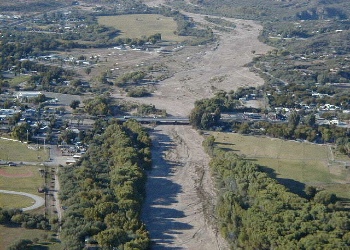
An aerial view of the Hassayampa River Bridge in Wickenburg, from the South.

We circled two residences along the riverbed while she snapped photos. Both places looked like junkyards from the air — vehicles, equipment, building parts, and all kinds of stuff was scattered all over. Then we headed farther upriver to a third residence that looked quite respectable from the air. We didn’t find the big tire tracks she was looking for, but she seemed satisfied.

A roll and a half of film and 30 minutes later, we touched down at the airport. She paid what I asked and went away happy — probably to the local one-hour photo place.