Night Shots at Grand Canyon Village

There are still opportunities for photography after the sun goes down.

I know I’ve written about this before in this blog, but it’s worth repeating: I like taking photos at night. I like the way the light illuminates the things we don’t notice during the day. I like the weird colors of the light sources. I like the deep shadows and the way some things seem to come out of darkness.

Grand Canyon Village, with its rustic, historic buildings, is one of my favorite places to photograph at night. And since I was so lazy yesterday afternoon, I thought I’d make up for it by taking my camera and tripod for a walk from Bright Angel Lodge, where I’m staying, to the El Tovar Hotel, which just happens to have a nice bar.

These are some of the shots I took along the way.

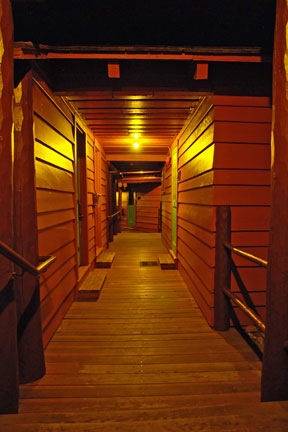
Outdoor Passageway

Outdoor Hallway

The historic Bright Angel Lodge is a series of stone and wood buildings along the South Rim of the Grand Canyon. The main lodge building houses the lobby, a museum, restaurants, and various service desks. The other lodge buildings are cross-shaped and house small, simple guest rooms like the one I usually stay in. And then there are cabins with two or four guest rooms per building.

Covered, wooden plank walkways run between many of the buildings. They’re illuminated at night and glow rusty red from the red-painted walls.

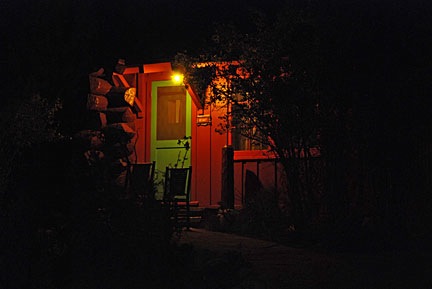
Cabin Door

Cabin Door

The cabins at Bright Angel Lodge are scattered along the rim. They’re all unique. Some have partial views into the canyon. Others are hidden away among the trees alongside the gravel parking lot.

At night, the doors to some of the cabins glow with a friendly, almost beckoning light. This one, facing into the canyon, seems to await the return of its occupants, who left chairs out front to watch the sunset from their room.

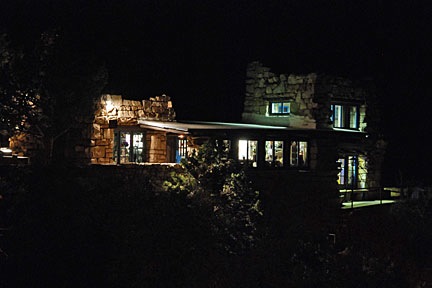
Lookout Studio

Lookout Studio

Lookout Studio is another of Mary Colter’s designs. This historic building now houses a gift shop. But if you come to the canyon, walk in and through the building. You’ll emerge on the other side, on the top level of a terraced overlook. Climb down for a good spot to watch sunsets or condors or tourists.

The building is lighted mostly from within at night. The wooden trim around its windows is painted a bright teal green.

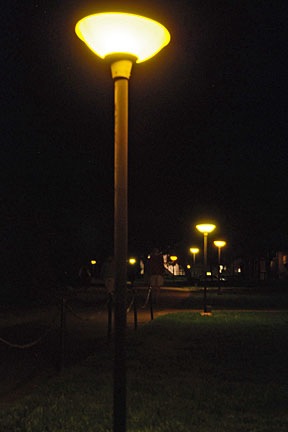
Light Posts

Light Posts

Subdued lighting lines the path between the main building of Bright Angel Lodge and El Tovar Hotel. The lights are just bright enough to ensure that you don’t trip or bump into a grazing deer or elk along the path at night — but no brighter.

Although they line the path in even intervals, the curve of the path gives them the appearance of random blobs of light ahead.

Hopi House

Hopi House

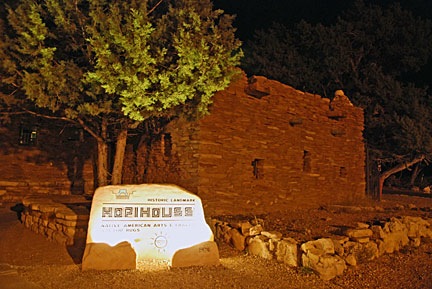
Mary Colter also designed Hopi House, which is currently set up as a gift shop and gallery. She based her design on the architecture of Pueblo indian tribes such as the Hopi. In the old days — the early 1900s — Native American peoples actually lived in upper floors and on the roof of the building.

The building’s stone walls are a textural delight for anyone who admires such things. Set roughly, the stones cast deep shadows on the walls at almost any time of day. At night, things are a bit more subdued.

El Tovar Entrance

El Tovar Entrance

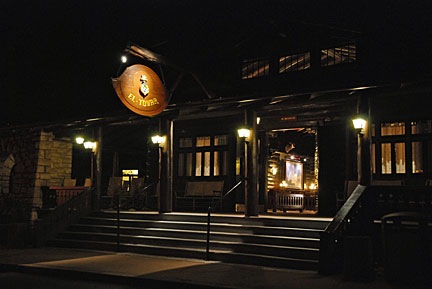
El Tovar, which was completed around 1905, is the grand hotel of the Canyon. When finished, it was hailed as the finest hotel in the west.

Made of dark wood with large porches and pitched roofs, El Tovar seems more in place in a densely forested mountain setting than at the rim of a desert canyon. Last night, its sign seemed to glow and its wide open doors welcomed visitors into the lobby.

El Tovar Lobby

El Tovar Lobby

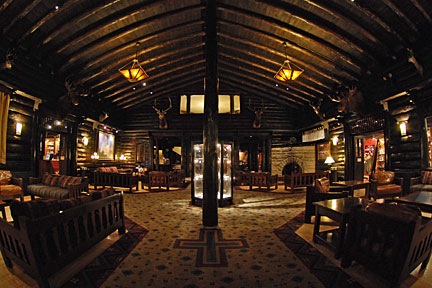
The lobby of El Tovar is an impressive collection of mounted wildlife heads, southwestern decor carpets, plus leather sofas in seating areas, and gift shop displays. Last night, a young woman sat in a corner with her laptop, probably surfing the Web — the lobby is one of the few places where WiFi might be available.

I captured this shot with my fisheye lens, which is why it appears distorted around the edges. I like the symmetry of this shot.

Jewelry Case

Jewelry Case

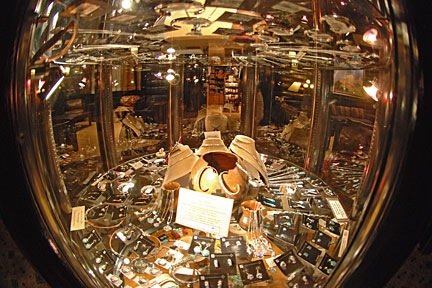
One of the highlights of El Tovar is this round jewelry case in the middle of the lobby. FIlled with the finest quality, handmade Native American jewelry sparkling under bright lights, it’s like looking into a museum display.

I used my fisheye lens for this shot, too. Although intended mostly as an experiment, I thought it was good enough to share here.

The Best Irish Coffee I Ever Had

By the time I reached this point, it was 9 PM — too late for the martini I had on my mind when I left my room. But I stepped into the bar anyway. It was nearly deserted. I sat at the bar and ordered an Irish Coffee. The bartender made me the best one I’d ever had, complete with a single sugar cube, fresh whipped cream, and a bit of creme d’menthe for color and minty flavor.

When I finished, I set my tripod on my shoulder and walked back to my room. I nearly bumped into a mule deer doe and her fawn along the way.

And yes, I was the only photographer out last night.

Why I’m Not Taking Photos at the Grand Canyon

And why I didn’t finish this post right after I started it.

I’m at the Grand Canyon. Again.

I come here 20 to 30 times a year, often on helicopter charters. This time, I’m taking a couple from Montana on a Southwest Circle Helicopter Adventure. That’s a 6-day/5-night excursion. The second day (and night) is spent at the South Rim of the Grand Canyon.

Bright Angel Lodge

A fisheye view of my room at the Bright Angel Lodge. Simple and relatively cheap.

As usual, I have one of the tiny rooms in the Bright Angel Lodge. The historic lodge and cabin buildings were designed by Mary Colter and built in the early 1900s. My room lacks the features most guests take for granted: television, air conditioning, and shower. I don’t need the first two and the third is down the hall.

I lucked out this trip and wound up with a corner room that has windows on two sides. There’s even a window in the bathroom. But best of all, it’s literally 100 feet from the rim of the canyon. In fact, if I look out one of my windows, I can see the wall of the North Rim 10 or 15 miles away.

Not bad for $80 a night.

My passengers are staying at the Thunderbird Lodge, with a partial view of the canyon. Their room is modern and has all amenities. It also cost $180 per night.

Grand Canyon

A shot taken in passing on my way to lunch today. The clouds were great; they really added depth to the scene.

This trip, for some reason, is different than the others. I didn’t feel at all motivated to walk along the rim and shoot pictures. I think I’m tired of photographing the Grand Canyon. Is that possible?

I have hundreds of photos of this place. But none of them can really capture its magnificence. Every time I try, I’m disappointed. I feel that it’s time to stop trying.

So I spent most of the afternoon in my hotel room, pulling movies off SD cards to clear them for more movies, catching up on Twitter and e-mail, and putting a few videos online. By 5 PM, I realized that I was avoiding my photographic duties. And that made me wonder why I considered taking photos a “duty.” Almost as if it were a chore. Was it?

I sat down to write this post. I entered the title in my offline editor. And then I stopped and scolded myself.

No, I was not going to miss a beautiful Grand Canyon sunset. I was going to get my ass outside and walk along the rim. I didn’t have to take photos, but I could if I wanted to. It was more important to be outside, in the fresh air, on a beautiful late summer afternoon with one of the world’s Natural Wonders in front of me.

So I went outside with my camera. Less than a minute later, I was on the Rim near the Lookout Studio, admiring the way the late afternoon sunlight played on the buttes and canyon walls right in front of my face.

There were lots of other people out there. Most were moving about, snapping photos along the way. Many spoke in languages other than English. They were all ages, although I can’t say I noticed any school-age kids.

El Tovar

El Tovar, in the late afternoon light.

I noticed an artist sitting on a rock with an easel in front of him. This week is the Grand Canyon Celebration of Art: Plein Air Event & Modern Masters Show. The artist, Sedona-based Williamson Tapia, was using oils to paint his interpretation of the cliff on which El Tovar Hotel sits and the magnificent clouds above it. His piece was mostly clouds.

We chatted for a while about art and the Canyon as I watched the light change. The red light and deep shadows behind the buttes were calling me. I excused myself, ducked through Lookout Studio to the cliffside overlooks below it, and snapped a few photos.

Grand Canyon

A look into the Grand Canyon in the light of the setting sun. The dark and hazy canyon is Bright Angel Canyon.

I shot RAW + JPEG Fine. I don’t usually shoot RAW. I’m hoping that I can learn more about it and use it to make better photos. I figure that I can’t learn more about RAW unless I have some photos to work with. So today was the day to start collecting them. The JPEG Fine will give me some thing easy to play with until I’m ready to work with the RAW format images.

When I was finished, I went back. Will claimed I’d given him good luck; that he’d found his style for the painting. We chatted some more as he worked. I watched him paint the green bushes and trees on the cliff below the hotel and then touch up the clouds with bright white tops and lavender gray bottoms. The light got softer and redder, but it didn’t affect his work; he was painting something completely different, something he saw. Onlookers came and went, admiring his work. None lingered. We continued to talk, agreeing (among other things) that one day a week, there should be no television broadcasts.

Finally, the light faded to the point that he couldn’t continue his work. He stepped aside and I got a good look at it. He told me he’d put it in the fridge back where he was staying so the oil would stay pliable. If those clouds were back the next day, he’d continue working on it to finish it.

We exchanged cards, shook hands, and went our different ways. I came right back to my room to finish the blog post I’d started with a title two hours before.

Now, as I listen to the crickets outside my window, I wish I’d spent the day outdoors, exploring some new part of the Rim.

Note to Self: Not Everyone Flies

I have to keep reminding myself because I do forget.

Yesterday afternoon, I sat down with the September 2009 issue of Flight Training magazine (because “a good pilot is always learning”), prepared to page through the mostly airplane-specific content for a few good tidbits that also applied to flying helicopters. I started with the “President’s Perspective” by new AOPA president Craig Fuller.

The fourth paragraph nearly knocked me off my seat:

Over the Independence Day holiday, I urged everyone to celebrate their freedom to fly by getting out and into the air, whether for a family vacation or a quick sightseeing expedition. I also urged certificated pilots to take a nonpilot for a ride to let them experience a new perspective on general aviation. There’s no better way to make sure that GA remains relevant and vibrant than to get out in the sky and do it! Taking nonfliers along for the ride can introduce them to a new world, and might even be the key to bringing the next generation of pilots into the cockpit.

I added the emphasis here; these are the phrases that woke me up from my afternoon burn out.

These phrases reminded me that as a pilot, I’m a member of a tiny community of folks who can just get out and fly. Very few people are as fortunate as we pilots are in this respect.

It’s a Natural Part of My Life

Oddly, flying has become such a part of my life that I don’t think twice about doing it. Here’s a good example from this week.

I need to reposition my “redneck truck” to Grand Canyon Airport (GCN) before next Thursday. The truck is one of the few vehicles I own that can seat three people comfortably. Ground transportation from GCN into the park sucks — the shuttle service is inconsistent and a huge time suck and there are no rental cars (what’s that about?) — and I’ll be there by helicopter at least three times within the next three months with at least two passengers each time. I need to get my people into the park quickly and comfortably — they’re not paying all that money to sit around waiting for a shuttle van. Since I can’t rent a car and I happen to have a spare truck, I figured I’d just put my own transportation there for the season.

I have to drive the truck up there. No getting around that. It’s a 2-1/2 to 3 hour drive. But I didn’t even think about getting someone to drive me back. Instead, I figured I’d ask a friend to fly up and fetch me in return for a fuel top-off. I sent out an e-mail to a friend with a Mooney who is always looking for an excuse to fly, we picked a date and time, and we’re good to go. If he didn’t want to do it, I could think of at least four other people — including my husband, who is half-owner in a Grumman Tiger — who might do it. The idea of driving back never even entered my mind.

Until I read Fuller’s comments and realized that just about everyone else in the world would plan to drive back. The idea of flying back would never even enter their minds.

What It Means to Me

It’s hard to explain to a nonflier what flying means to me. Part of that is because I can no longer imagine things from their perspectives — not being able to just get out and fly. But the other part is their sheer lack of understanding of what it’s like to be airborne. Yes, I know what my town, a good portion of Arizona, and lots of the western states look like from 500 or 1000 feet above the ground. I know how the air will behave as I cross over a dark green alfalfa field on a sunny day or slip into the shade of a cumulous cloud just starting to get heavy with precipitation. I know what it’s like to fly over or past or under a large bird, to cross over the top of an airport with a plane just touching down on the runway beneath me, to slip 1,500 feet below a 747 landing at Sky Harbor Airport (PHX). I know what it’s like to fly up a twisting canyon, level with the tops of the canyon walls, and how it feels to zip low over the surface of a lake or desert plain. I know the feel of the aircraft around me, responding to inputs that my hands and feet automatically feed into it at the whim of my brain — to be one with a vehicle that can move freely in three dimensions, against the pull of gravity.

North to the Future

When I started up my laptop to write this, this is the photo that popped up as my random desktop picture. The world is wide open to a pilot.

I’m not the only one around here who can say all of these things. Once I learned to fly and began spending more and more time at airports, it was only natural to meet and become friends with other pilots. Whether they’re helicopter pilots like me, owners of well kept classic airplanes like my friend’s Mooney, or tinkerers who built their aircraft with their own two hands, they’ve all tasted and perhaps feasted on the freedom of flight. From the guys who put fat tires on their taildraggers so they can land in dry riverbeds to the folks flying big twins and small jets to places like Washington, Idaho, or Colorado, they’re all the same. They’re pilots.

Get on Out There and Fly!

It’s strange that I can no longer see the other person’s point of view — strange because of the number of nonfliers I take flying routinely for my flying business. Perhaps that’s because I fly helicopters. I take it for granted that most people don’t fly in helicopters. But the reality is that most people don’t fly in small aircraft at all.

So here’s my request to all the readers of this post:

If you’re a pilot, take someone who’s never been in a small aircraft flying with you sometime between now and the end of the year. Let them experience the wonder of flight; give them the “new perspective” Craig Fuller wrote about.
If you’re not a pilot, grab a friend and go flying. Take a flight at your local airport or the next time you have a chance to take a tour where aerial tours are offered. Do it before the end of the year.

And then think about it — from all perspectives — and feel fortunate that such an activity is within your grasp.

Still Alive and Kicking

Just very busy and so off-the-grid it isn’t funny.

I wanted to take a moment to assure readers that I’m still among the living. I’ve just been very busy traveling, spending most of each day on the road and making overnight stops where Internet access is just not an option.

I hope to be able to put out a new blog post about my travels, as well as some photos, later today.

Stay tuned.

Wenatchee to Walla Walla to Lewiston to Coeur d’Alene

On the road again.

Those of you who read this blog regularly, may have begun wondering why I’m not posting as regularly as usual. The truth of the matter is that I’m traveling, on a long road trip from Washington State to Arizona.

We’re doing the trip at a leisurely pace, with stops 100 to 250 miles apart. No rush; our friend John is watching over our place. (Hi, John!)

Wenatchee to Walla Walla

Our first leg was mostly in the farmland of Central Washington, ending up in the wheat- and wine-growing area of Walla Walla. Walla Walla has special significance to me; twice it was listed as one of the top ten places I should live by FindYourSpot.com.

Ghost Photo

Some places just scream to be photographed at night. (Hey, is that a ghost?)

We spent two nights in the Four Seasons RV Resort, which I rate 4 out of 5 stars. (Partially wooded and relatively quiet, park-like setting with tall trees and shade, pet friendly, washer/dryers, limited WiFI, affordable.) During the day, we explored Walla Walla, ate in great restaurants (I recommend Saffron Mediterranean Kitchen), visited wineries, and went out on the bike trail. In the evening, we did a little photo shoot of this weird spot at the back of the RV park property.

Walla Walla to Lewiston

It was just 100 miles or so to Lewiston, ID. We drove on route 12, which wound through small farm towns and wheat fields. It’s mostly past harvest now, so the fields were left with short-cut tan stalks of wheat or plowed brown dirt.

After the Sun

View from our campsite. Not too shabby, huh?

In Lewiston, we stayed at Hell’s Gate State Park, which I rate 5 out of 5. (Wooded, riverfront sites with full or partial RV hookups, beach, bike trail.) The idea was to hop on a jet boat tour down Hell’s Canyon, but we soon discovered that all day trips are 11 hours long and half-day trips don’t run regularly. Since Lewiston isn’t exactly our idea of a great destination, we only stayed one night.

Lewiston to Coeur d’Alene

We drove up to Coeur d’Alene on route 95, which winds through some of the prettiest rolling hills and wheat fields you could imagine. We had a little adventure when we pulled off the main road in search of a picnic lunch site and found ourselves, pulling our trailer, on a narrow dirt road used by large trucks for some unknown (to us) purpose. We got about 3 miles down the road, trailed closely by a very large truck, before we found a place to turn around. We wound up having lunch at a cafe in Plummer, ID. Can’t say I recommend it, although the peach pie was good.

Dropping in at Cabella's

Jim took us to lunch at Cabella’s. (Pardon the crappy quality of this cell phone photo.)

In Coeur d’Alene, we camped at the Blackwell Island RV Park, which I rate 2 out of 5. (Full sun on all sites, closely packed sites, gravel driveways not long enough for rigs, a list of rules longer than my arm, sporadic WiFi, riverfront location, expensive.) After exploring a beautiful and vibrant downtown area, we met up with my friend Jim and his wife, Teresa for dinner at 315 in the Greenbriar Inn. Jim runs a helicopter charter business remarkably similar to mine. On Wednesday, he took us for a helicopter tour of the area that included landing at Cabellas at State Line for lunch. I spent the evening catching up on some work while Mike went swimming in the Spokane River with Jack the dog.

Coeur d’Alene to Glacier National Park?

Well, that’s the plan, anyway. We hope to be on the road by 8 AM. More later.