Home is Where the Heart Is

So good to be home.

I was away for about two months, on a frost contract in Woodland, CA near Sacramento.

When I moved my “mobile mansion” south in the middle of February, I was actually glad to be getting away from the Wenatchee area. I’d just spent my first winter back in a cold climate after about 15 Arizona winters. The short days combined with an amazing amount of fog — of all things — had made me kind of glum. Even though I’d was very comfortable with a house-sitting gig near my own home, I was ready for a break that included warm weather.

So when the frost control job in the Sacramento area materialized again this year with better standby pay coupled with the requirement to actually remain in the area for the duration, I jumped at it. I was heading south with my RV before the end of February and settled in at Watts-Woodland Airport by February 25.
Me in a Balloon
My hot air balloon flight was a highlight of the trip.

I had a great time in the Sacramento area. Daytime temperatures ranged from 60°F to 84°F with nighttime temperatures seldom dipping below 40°F. We were only put on call for possible frost flying once in 42 days. If my contract had been the same as the one I had in 2013, I would have taken a financial hit. But this contract paid better for standby so I was actually better off if I didn’t have to fly. So it was a win-win.
In fact, in a way it was like an all-expense-paid vacation with a bonus at the end.

I did a lot while I was there — kayaking in the American River and Putah Creek, hiking in the hills and in Muir Woods, ballooning, joy-flying in the helicopter, wine tasting in Napa Valley, whale watching, hosting friends, making new friends, visiting San Francisco. I even learned to fly a gyroplane. I blogged a bit about some of these things (follow the links) but not as much as I would have liked to — I was just too darn busy to sit down and write much!

Gyro Solo
I learned to fly this gyro in 6 days, soloing after just 7 hours of flight time. I’m now thinking a bit more seriously about a fixed wing rating.

Still, before March month-end, my Wenatchee area clients started calling, asking when I’d be back. They had places to go, things to photograph. The damage to the Wanapum Dam and the draining of the lake above it had all the locals wanting to see the river from the air. There was flying to do when I got home.

There was also a home to be built. I’d been sitting on plans for what’ll basically be a custom garage with living space for more than a year and had given the green light to the builder before heading south. They were planning on an April 30 start date. Some earth work needed to be done and I wanted to be there for the entire process.
So by the first week in April, I was anxious to get home.

I said my farewells to new friends and headed out with the RV in tow on Sunday morning, April 13. By sunset, I was parked in a very nice campsite on the Columbia River in Maryhill State Park, enjoying a full hookup and a full moon.

The next day, I continued on to Wenatchee, less than 4 hours away. I dropped my RV off at the local RV fixit place — the gas furnace had been misbehaving and wound up needing a circuit board — and drove the rest of the way up to my 10 acres of view property in Malaga.

Everything was just as I’d left it. I offloaded my bees, setting them up on a palette near where they’d lived before our trip south and took stock of the things I’d need to do to finish moving back in.

Then I went down to the valley and ran errands until 6 PM, when the RV was ready. After a quick hook up, we made the 20-minute drive back up the hillside and down the 2 miles of improved gravel road to my lot. It took a few moves to get the RV back in place beside the septic system connection, where I’d left the water and power lines waiting for me. Within an hour — including time spent chatting with a neighbor — I had everything all hooked up.

Moonset
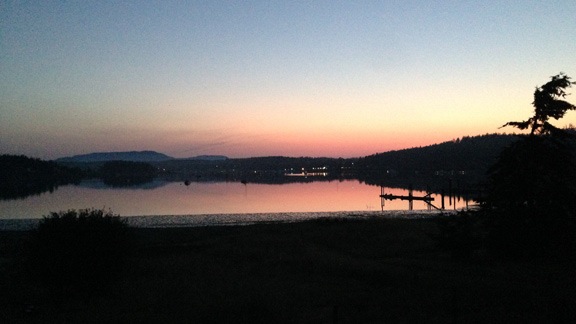
I might have missed the eclipse Monday night, but I did catch the moon setting behind the cliffs from my home early this morning.

I really enjoyed seeing the lights of the city spread out before me that evening. It was mostly cloudy so I missed the eclipse, but I was too darn tired after my long trip and the setup to stay up anyway. I slept like a log.

The next few days were spent doing taxes — I always wait until the last minute — finishing setup, moving things in and out of storage, running errands, and meeting up with friends and contractors. Yesterday was overcast and rather cold — I could swear it was snowing up at Mission Ridge, which I can see from my place. I got home from errands by 6:30 and there was still plenty of light to watch a storm move in and the clouds descend over Wenatchee Heights and down toward Stemilt Hill. The sun broke through periodically, bathing the cliff walls north of me with a golden light.

Magic.

I lounged on the sofa with a book, relaxing with Penny on my lap. I think that’s when I first started to realize how good it felt to be home. And when I started to get really excited about the project ahead of me — building my dream home in a place I love.

This morning dawned mostly clear with crisp, clean air on a strong breeze. As I sat at the table with my coffee, writing in my journal, I looked up to see the valley washed in the golden hour light. I stepped outside with my camera for a few shots.

Morning from Cathedral Rock
I shot this photo from the steps of my RV this morning with my Nikon. This is uncropped, shot with a zoom lens set to 46mm (per Photoshop). I can’t tell you how good it feels to know that I’ll be able to see something like this every day right from my home.

I started having second (or third or fourth or fifth) thoughts about where I was putting my building. The builder and I had set corner stakes in February, before I left. (The last time I positioned a building, I’d wished I’d done it differently. But that was supposed to be a temporary building; not the only building on the property. And it’s now pretty much abandoned, so I guess it doesn’t really matter.) I wanted to get it right because it couldn’t be changed once the construction began. So I walked out to the building site with my coffee cup in hand and stood on the ground beneath where one of my bedroom windows would be. I looked out over the valley, reminding myself that I’d be about 12 feet higher when I was looking through a window or standing on the deck that would soon be above me.

And I liked what I saw: a beautiful, unobstructed view down toward Wenatchee and the Columbia River, with nothing but orchards and grasslands and scattered homes and mountains as far as the eye could see.

Home Sweet Home
I shot this image with my phone as I drove off to meet a friend for breakfast this morning. My home will be built to the left of the shed, beyond the frame of this photo.

I went inside to finish my coffee and journal entry.

A while later, my phone rang. It was Bob, one of the friends who’d called and texted me repeatedly while I was gone, just to catch up. That morning, he was looking for a companion for breakfast out. I said yes (of course) and hurried to get dressed, thinking about the warm hug I’d get when I saw him.

It was good to be home.

Missing Grandma at Muir Woods

Funny what you think about when you’re wandering among the giant trees.

I went to Muir Woods on Saturday, on my way home from whale watching. It was my third or fourth visit ever.

Muir Woods National Monument is a valley just north of San Francisco that’s filled with groves of giant redwood trees along a small creek. It features a boardwalk and paved pathway, several other trails, and signage to help you understand the ecology and history of the woods.

All the other times I’ve been there have been late in the day when the place was mostly deserted. On Saturday, I arrived at 5 PM and although the place was definitely emptying out, it was pretty obvious that it had been packed earlier in the day; there were cars parked along the road for at least two miles leading up to the park entrance with so many people walking back to them that I thought the cars were for some big party at Muir Beach.

In Muir Woods
It was dark down at the base of the tall trees.

Along the creek
There wasn’t much water in Redwood Creek, but it was picturesque, anyway.

Because of the time of day and the angle of the sun and the park geography, the pathways were in dark shadows. But if you looked up toward the tops of the giant trees, you’d see the sun still shining on them. Still, I didn’t take many pictures. Instead, I just walked along the pathways along the creek at my own pace, thinking about what I was seeing and trying to tune out the noise of the tourists all around me.

I remembered my first visit to Muir Woods, years before in January. Back in the 1990s, I was a regular speaker at Macworld Expo in San Francisco. I’d fly out for a few days — usually with my future wasband — see the show, do my speaking thing, and then spend some time in the area. Airfare and hotel costs in the city were a write-off as a business expense. The vacation tacked on afterward was just fun. One year we visited Napa Valley, another year we visited Sonoma Valley, another year we went south to Monterrey and St. Louis Obispo, and another year we headed to Hawaii. Those were great trips in days long gone.

I don’t remember which year we first went to Muir Woods. But I do remember the quiet of the woods and seeing two salmon heading up stream to spawn in water that was barely deep enough to cover them. One male, one female, several hundred feet apart, struggling to move upstream. I wanted so badly to just grab one of them and put it with the other one in the same pool of water so they could go about their business and die.

I don’t remember the park being very crowded or noisy. I just remembered it being dark and kind of hushed.

It was dark on Saturday, but definitely not hushed.

Even when signs asked visitors to “Enter Quietly” — as they do upon entry to the Cathedral Grove — people called back and forth to each other and kids screamed and cried. I could have been at the mall.

I tried hard to tune it all out, focusing on the tall, straight trees. And when I made a turn down a pathway and found myself in a little cul-de-sac with a bench before a huge tree, I found myself thinking about my grandmother.

Born in 1912 as one of eight children, my grandmother was a hardworking woman who never experienced much outside the world of her home in the New York Metro area. In the 1980s, when I had a job that required a lot of business travel, and then later, when I traveled with my future wasband, I’d send her a postcard from everyplace I went. That and television were he exposures to the rest of the country. When she died in 2002, we found a shoebox with all those postcards inside it. She’d kept every single one.

I found myself thinking about the last time I’d gone hiking with her. She was in her late 70s at the time and still very active, working part-time as a hostess in a family restaurant. I’d taken her to the State Line Lookout in Palisades Interstate Parkway and we’d walked one of the trails through the woods. I’d been worried about her when I realized how steep the trail was in parts, but I didn’t need to. At one point, I saw her stabbing a branch she’d picked up as a walking stick into a hole alongside the trail. When I asked her what she was doing, she told he she’d seen a snake go in the hole. Someone else’s grandmother (or mother or girlfriend, for that matter) might have screamed and run the other way. But not my grandmother. She was tough.

As I stood in the clearing at the base of the tree, I realized that the path through the woods was made so that everyone could enjoy the wonder of the trees, no matter how old or young they were. I found myself wishing that I could have brought my grandmother there. I could imagine her awe as she looked up and realized just how tall that tree was. Or when she looked at the base of the tree and realized just how big the trunk was.

“For crimsey’s sake!” she’d say. None of us knew where that came from but we knew that when she said it, it meant she was impressed. It was like me saying “Holy cow!” (or “Holy shit!”)

I wished I could shown her the big trees. Or the Grand Canyon. Or the view from my helicopter on a flight along the Pacific Coast. Or even the giant cactus that grew in my yard in Arizona or the amazing view from my homesite in Washington. The incredible but normal things beyond her limited range of travel and experience.

The things we take for granted as we make our way through life. The things we don’t miss if we never see them at all.

I miss you, Grandma.

Joy-Flying Over Napa Valley

Sometimes it’s nice to treat yourself to an afternoon out.

I went for a joy ride in my helicopter this afternoon.

I hadn’t been flying since last Wednesday when I finished my Part 135 check ride with an FAA inspector from South Dakota. The helicopter was sitting out on the ramp, blades tied down, gathering dust and then standing up to high winds for a week.

Torn Tie Down
Like the helicopter, the tie-downs are now 8 years old. A strong wind earlier this week tore this one.

One of the blade tie-downs had torn and, although it was still holding, I thought I should repair it. So I untied the blades, brought the tie-downs inside, and did some mending. I looked out the back window while I was on the phone with a client, talking about work this coming summer season back home in Washington. My helicopter sat there patiently in the afternoon’s gentle breeze, less than 200 feet away, waiting for me to tie down its blades again.

Or fly it.

So I flew it.

It was very warm this afternoon — in the high 70s here in the Sacramento area. Too warm for the black T-shirt and jeans I was wearing. So I slipped into a tank top and shorts before going out with Penny and my iPad and my GoPro camera.

Penny waited on her bed in the front passenger seat while I preflighted and added a half quart of oil. Then I snapped the camera into it’s “BellyCam” position, turned on its wifi, and climbed on board beside Penny. A short while later, the engine was running, the camera was recording video, and I was listening to classic rock through my Bose headset. I made a radio call to the empty sky around me, eased up the collective, and lifted gently off the ground. Then I was speeding across the runway only 10 feet off the ground, gathering momentum and climbing out into the California afternoon.

As usual when I’m joy-flying, I didn’t have a specific destination. I had some vague idea of flying down to Nut Tree airport (VCB) in Vacaville, which I’ve been told has a restaurant within walking distance. Thought I’d check it out as a possible destination for when my friend George gets back from Alaska and we take turns flying his gyro and my helicopter. But that destination was too close. I wanted to get out for at least 45 minutes. Maybe I’d stop there on my way back.

I wandered south along highway 505 and turned right at Winters. I was following the road that runs to Lake Solano County Park, where I’d gone paddling the previous Thursday, and beyond that to Lake Berryessa. I was flying into the sun, though, and I knew the video wouldn’t be much good. Would it capture any decent footage of that nice canyon going up to the Lake?

Apparently, it did.

Aerial View of Lake Solano Park
Here’s an aerial view of the Lake Solano County Park. You can see the dock where I put in my kayak last week. I paddled upstream (up in this photo) from there.

I followed the canyon up to the lake, keeping a sharp eye out for wires. There were power poles on the right side of the canyon, but none seemed to cross the canyon. I flew over the dam and headed up lake. The water level was low — California is suffering from a serious drought — but the hillsides were fresh and green from the rain we’d had two weeks ago. Without more rain, the grass would turn brown, possibly before it even got a chance to go to seed.

I saw cattle in the low lands along the lake and ranches up in the hills. Very picturesque.

I flew about halfway up the northeast side of the lake with the sun coming into the cabin from my left. Penny, who had been hot while we were flying into the sun — she hasn’t fully shed her heavy black winter coat — was now in partial shade, leaned back in her seat but still panting from the heat. I was comfortable in my summer clothes; I didn’t realize until I got home how much sun I’d gotten. (Next time I’ll wear shorter shorts and really work on my tan.)

Napa Valley Balloons
In Napa Valley? Want an amazing experience you’ll remember for the rest of your life? Fly with these guys.

I got the idea that I wanted to see Yountville from the air. About a month ago — the day after I arrived with the RV, in fact, a hot air balloon had landed in my “backyard” here — the airport ramp. I’d introduced myself to the pilot and sent him a copy of a picture I’d taken of him landing, along with a suggestion that we swap flights. He booked me on a flight tomorrow morning at Yountville, at the Domain Chandon tasting room. I wanted to see what it looked like from the air.

Hell, I can come up with an excuse to fly anywhere if I try hard enough.

So I banked hard to the left and flew back down lake. I figured I’d follow the road toward Rutherford and then branch off to the south when I got to Napa Valley. I switched the camera from video mode to time-lapse with shots every 10 seconds. I captured this image as we flew down the lake.

Lake Berryessa
Here’s a shot of Lake Berryessa.

I followed the road I’d driven a few times before, most recently on Sunday, on my way back from Napa Valley. Then I made some turns, following valleys, watching out for power lines. Finally, I popped over some hills and dropped down into Napa Valley over the Silverado Trail.

Silverado Trail
Over the Silverado Trail, somewhere near Rutherford, CA.

Below me, the homes, wineries, and vineyards of Napa Valley stretched in all directions. Although the vineyards were not yet leafing out, there was an abundance of green in the grass, trees, and hillsides. It was gorgeous.

Somewhere around this time, I started thinking of my wasband, as I often do when I have amazing experiences I think he would enjoy. We did more than a few joy-flights together over the years, exploring the desert around our home in Arizona or going further afield, perhaps on cross-country trips to Lake Powell or Las Vegas or Washington State. We shared a bird’s eye view of so many amazing things from the air: the red rocks of Sedona, the blue waters of Lake Powell, the winding path of the Colorado River, the grandeur of the Hoover Dam, the haystack rock formations of the Oregon coast.

As I flew over the vineyards, I could imagine him beside me, trying to identify things we’d seen from the ground on previous visits to Napa Valley. His memory was better than mine — at least before he became delusional — and maybe he’d remind me of things I’d forgotten. Would he spot the winery where they’d served us chocolate cake with our cabernet? Surely it was down there somewhere. He might remember where.

But I reminded myself that any fond memories of my wasband were flawed and false. Maybe he wouldn’t have enjoyed this afternoon’s flight after all. Although he always seemed to like being in the helicopter, especially when he got to take the controls, these days I wasn’t sure what he really thought of those flights. He insinuated in court that he thought they were “work” that, for some reason, he should have been paid for — even though he lacked the pilot certification to do commercial flying and I was always sitting beside him in the pilot-in-command seat. Thinking back on our last few years together, I remember all the weekends he spent in front of a television, watching DVRed car shows. Perhaps he preferred doing that to flying. (He didn’t fly his plane either.)

His loss.

I don’t think I could ever get tired of flying a helicopter, especially on days like today when I’m free to go wherever I like in such a beautiful place. Sure beats anything on TV.

I consulted Foreflight on my iPad and realized I had passed Yountville. I made a sweeping turn to the right, lining up with route 29 on the other side of the valley as I headed north. Moments later, I overflew Yountville and the site I think we’ll be departing from tomorrow in a hot air balloon.

Domaine Chandon
I’m not 100% positive, but I think this is where our balloon will be launching from tomorrow.

I continued up the valley, once again retracing my route, in reverse, from Sunday’s drive. Rutherford, St. Helena, Calistoga. I saw the V.Sattui Vineyard looking quiet and empty on the late weekday afternoon. I saw the main drag in St. Helena. I saw the spas and resorts in Calistoga.

St. Helena
An aerial view of St. Helena in Napa Valley.

At Calistoga, I turned east again. I climbed over the mountains on the east side of the valley and dropped into a rugged canyon. I’d been flying for more than 30 minutes and was starting to think of heading back. I punched a GoTo to my base airport into the GPS and turned in the direction of the line. On Sunday I’d driven past Clear Lake, but I didn’t feel like flying out that way. I thought I’d give Lake Berryessa another flyby instead.

East of Calistoga
The mountains east of Calistoga are rugged, with basalt cliffs not unlike those near my home in Washington.

Pope Valley
The valley east of Napa — which I think is called Pope Valley — has vineyards, lakes, and ranch land.

Lake Berryessa Narrows
A narrow channel on Lake Berryessa. I had to be careful here; there were wires across the lake nearby.

Dam at Lake Berryessa
The BellyCam just happened to capture this perfect image of the Dam at the lower end of Lake Berryessa.

I flew down the lake, over the dam, and back into the canyon leading to Winters. Then, before I reached town, I headed north in the foothills with the vague notion of overflying the Cache Creek Casino. But before I got to Esparto, I changed my mind. Instead, I turned inbound to my base airport and, after a few radio calls, landed on the runway and taxied into parking. I set it down gently exactly where it had been an hour and 10 minutes earlier.

Penny
Penny waited for me while the BellyCam continued to snap photos every 10 seconds.

Penny stood up and looked at me, wagging her tail. She was ready to get out. I lifted her out and set her on the ground. She waited at the nose of the helicopter while I cooled the engine and shut it down. The camera caught several images of her standing on the tarmac with my mobile mansion home in the background.

Later, I used the mended tie-downs to secure the main rotor blades and locked up the helicopter.

It had been a great afternoon flight — one I’m glad I treated myself to. I’ll fly again soon — maybe with a balloon pilot beside me and two of his crew in back. Or maybe with my pilot friend George at the controls, exploring a new place. (Something tells me that he’s not very interested in television.) I’ve got a month left here and I plan to enjoy it every way I can.

I never did get down to Nut Tree airport.

California Strawberries

Sweet, with bittersweet memories.

StrawberriesThis morning, as I cut up some fresh, ripe California strawberries for breakfast, I found myself thinking back to April days in the late 1980s.

Back then, I worked as an Internal Auditor for ADP. Each spring, in April, they’d send a team of us — usually 3 or 4 auditors — out to their La Palma, CA location. In those days, I lived in New Jersey with the man I’d later marry and a three-week trip to California at the tail end of winter was like a gift from heaven.

They put us up in the Embassy Suites (now a Radisson Suites) up the road from Knotts Berry Farm, each in our own suite. (Back in those days, a “suite” was really two rooms.) Great breakfast every day, happy hour every evening. We really got to know the staff and used to party with them once in a while. There was one rental car for each pair of us, so ground transportation was not a problem. 9 to 5 at the office a few miles away, then on our own with expense accounts for R&R in the evenings.

There was a set of high tension power lines running alongside the hotel’s property. And there, under the power lines, they farmed strawberries.

That’s not the only place, of course, Fresh local strawberries were all over southern California in April. Strawberry shortcake in every restaurant. I especially remember a place near Disneyland in Anaheim. My brain keeps telling me it was called Carroll’s, but I can’t find it in Google. We joked that it was Paul Bunyan‘s restaurant — the portions were enormous. Even the flatware was huge — a soup spoon could not fit in my mouth. The strawberry shortcake there could feed a whole table of people.

On weekends, we had the option of sticking around or using our hotel allowance to pay for lodging elsewhere. One year, I met up with fellow auditors working in the San Francisco area for a trip to Lake Tahoe where they skied and I sipped spiked hot cocoa. Another year, we went to La Jolla and stayed in a hotel on the coast with a trip into Tijuana.

The trips to California were three weeks long and we were given a choice: fly home one of the two weekends or have someone from home fly out to California. Each year, my future wasband would fly out on the second weekend. (That was back in the days when he preferred to spend his vacation time with me rather than with his mother.) We’d do something fun together over the weekend and then he’d spend the week goofing off while we worked, taking the rental car to explore the area. He saw the Spruce Goose and Queen Mary, drove up the coast, and did all kinds of things during his free vacation. At 5 PM, he’d be back in the parking lot with the rental car to pick us up.

When the job was over, I’d take my vacation, tacking a week on to the end of the trip. One year, we drove out to Death Valley and Las Vegas. Another year, we explored Kings Canyon, Sequoia, and Yosemite National Parks. We’d car camp — he’d bring our camping gear with him in a big duffle bag — and explore. They were some of the best vacations I had, visiting beautiful places with the man I loved, back when he seemed more interested in the beauty of the world around us and having fun than buying expensive cars and other assets he didn’t need and couldn’t afford. Best of all, the trips were remarkably affordable with the airfare for both of us covered by my employer.

When I moved out of my Wickenburg home last year, I left behind the photos I took on those trips. They’re in photo albums of prints painstakingly laid out afterwards to share with family and friends. I wanted to forget that part of my life and the man, now dead, who I shared it with. But too many memories survive, even without the photos.

And they can be triggered by something as simple as the look, smell, and taste of fresh, ripe strawberries from California.

My Traveling Bees

If spring won’t come to the bees, the bees will go to spring.

I was very surprised, about a month ago, when a fellow helicopter operator offered me a 6-week (minimum) frost control contract in the Sacramento area. I’ll explain what frost control is in another post; for now, just understand that it required me to relocate with my helicopter to California for at least the 6 weeks of the contract.

Winter in Washington had been mild, with seasonal daytime temperatures around freezing but very little snow. All that changed about two weeks ago when the temperature dropped and then the snow started falling. Not a lot of snow, but enough to make it actually feel like winter for the first time. It was my first real winter since leaving New Jersey in 1996 or 1997 and although I didn’t exactly mind the cold weather, I was ready for spring. So I was very pleased to be offered an early escape from winter that would bring me back home in time for the local spring.

My bees, of course, were all set up for winter. I’d lost one of the three hives and wasn’t sure how the other two were doing. The cold weather was keeping them inside their hives where they’d cluster together around the queen to keep her and themselves warm. It wasn’t a good idea to open up the hives for a good look when it was cold out. I’d already had a peek in late January and had a good enough idea of the situation.

The Crazy Idea

Sometime in the last week before moving my RV out of Washington, I got this crazy idea: it was warm in California and the entire area would be full of blooming almond trees and then walnut trees. If I brought my bees with me, they could skip the last two months of winter and get an early start on spring. I might even be able to get a good start on honey production and do a hive split. And of course, with so many bees in the area for almond pollination, there was even a chance I’d be able to capture a swarm or two.

But could I bring my bees? While it’s true I was driving a full bed pickup truck, I was also pulling a fifth wheel RV. But that fifth wheel had a gooseneck hitch on it, greatly reducing the amount of space the hitch needed in the bed. Could I fit the hives in the pickup bed and still tow the trailer?

The two hives were set up differently. One, the weaker of the two hives, was a single deep hive body with a frame feeder in it to supplement the frames of honey. The other was a deep hive body with a medium body on top; that contained a top feeder. But I didn’t need that top box or feeder for the trip south. I could make that a single deep box high, too. That would fit in the truck bed beneath the fifth wheel.

In all honesty, it wasn’t until the day before I pulled out that I made the decision to give it a try. Even then, I decided that if I couldn’t get it to work out, I’d leave them behind. But late Wednesday morning, I was up at my property with the pickup parked in eight inches of relatively fresh snow near the hive shelter I’d built the previous autumn. And as the temperatures climbed into the high 30s, I was unwrapping the winter insulation from the hives, reconfiguring the taller hive, strapping the hive boxes between their covers and bases, and stuffing rags into the hive entrances. Then I lifted them into the back of the truck. I put the dead hive in there, too; I’d need its components for a hive split or swarm capture and may as well bring it along.

The Drive South

By 12:30 PM — a half hour after my planned departure time, I was at the airport where I’d parked my RV before the snow had come. (Good think I did!) It was all packed and ready to go. I just needed to hook it up to the truck.

When I backed into position, however, I realized that there were bees flying around the back of the truck. On closer inspection, I discovered that they were escaping through the bottom of the hive. You see, I’d replaced the solid hive bottoms with screened bottoms for mite control. While the weaker of the two hives had a Mann Lake screened hive bottom, the other one had a hive bottom made by a friend of mine. He’d used 1/4 inch mesh. As I pointed out to him, he really needed to use 1/8 inch mesh — the bees could squeeze through the larger openings. And indeed, that’s what they were doing. Some of them were coming out for cleansing flights. This would be a problem.

I went into my hangar and found some cardboard. I stuffed it under the hives. Then, for good measure, I stuffed an old saddle blanket I keep in the truck under the hive the bees were coming out of. That would have to do.

Day One
I covered 287 miles the first day of driving.

I hooked up the RV, did my walk around, climbed into the truck, and started off. It was 1 PM and I was hoping to cover about 450 miles that day all the way to a casino near Klamath Falls, OR.

The drive was long but pleasant, with lots of sun and scenery. I drove through Quincy and got on I-90 at George. Then onto Route 97 near Ellensburg. South through Yakima. Cross the Columbia River at Maryhill State Park. Diesel on the Oregon side. Then mile after miles of rolling Oregon farm and ranch land.

It got dark along the way. I don’t like driving in the dark. Weird shit happens.

I changed my destination from Klamath Falls to Bend and then to whatever outpost of civilization I could spend the night in.

I wound up in Madras, parked overnight at a Les Schwab tire dealer parking lot, with a coffee stand on one side of me and a Subway restaurant across the street. I’d driven 287 miles.

I checked the bees before going in for the night. The hives had shifted around a bit, but there were no bees outside the hive. That didn’t surprise me. It was too cold for them to want to come out.

Icy rain fell during the night. In the morning, on my way to the coffee stand at 6:15 AM, I nearly slipped on the ice that had formed in the parking lot.

No sign of life among the bees. But I honestly didn’t expect them to be out and about with temperatures around freezing.

Day Two
I covered 461 miles on the second day of my trip.

I waited until 7:30 before continuing on my way. (Related: Subway, which opens at 7 AM, sells breakfast sandwiches.)

I continued along Route 97, passing through Bend and Klamath Falls. I was lucky to find a truck stop just before the border of Oregon and California where I fueled up for the second time on the trip. The truck was getting about 300 miles per tank of fuel. (It gets way better mileage than the Chevy I used to drive.) I realized that I might make it all the way to my destination without refueling again.

I followed a remarkably straight piece of road that had to be at least 50 miles long before climbing and descending in the foothills again.

At one point, I had an amazing view of Mount Shasta. Or at least the bottom half of Mount Shasta — the top was in a cloud.

Eventually, I reached Weed and joined up with I-5. The next 100 or so miles were mountainous, which wasn’t much fun in the rain. At least I didn’t have to worry about the bees wanting out.

Lake Shasta looked nearly empty. The water was at least 80 feet below the high water mark.

Finally, past Redding, the home stretch. It was great to see flowers on the almond trees I passed.

I got off the freeway at my exit and waited at the stop sign to make a left turn. That’s when I glanced up in the rearview mirror and saw about 200 bees flying around the back of my truck. As I’d driven, the weather had cleared and it had gotten warmer. The hives had shifted; the bees had begun to find their way out. With the truck stopped, they wanted out.

Bees
Hundreds of very unhappy bees buzzed around the back of my truck as I parked the RV.

I made my left turn and hurried the last 6 miles to my destination. By the time I was ready to back the RV into its space beside a hangar at the airport, it looked as if there was a swarm of bees in the back of my truck.

It was just after 4 PM and I’d covered 461 miles.

I had to put on my bee suit to unhook the RV. (Thank heaven no one was around to see that.)

I carried the two hives over to the side of the hangar about 25 feet in front of my RV and took the rags out. The bees from the strong hive immediately began flying out. The other hive remained quiet. I was beginning to think it was dead.

I went into town for a richly deserved dinner of chicken chow fun and Chinese ribs from my favorite Chinese restaurant West of the Mississippi. When I arrived at the restaurant, the bees that had been flying around the back of my truck were gone.

Parking the Bees

The next day, the airport manager told me to move the bees to the other end of the airport, in a rough grassy area where they tended to dump junk like old wood, tires, and fencing. We picked a place near the base of a tree. I dropped her off, donned my bee suit, and loaded the bees into the back of the truck. I had to move fast; it was getting warm quickly and the bees were eager to get outside.

I found an old palette in the temporary bee yard and set it up as a base. Then I put the hives on it, one facing northeast and the other facing northwest.

Bee Hives
The bees on arrival in their temporary home. (Can you see the hot air balloon in the corner of the photo?)

Later on, I returned with the dead hive and my beekeeping toolkit. I unstrapped the two hives and opened them up one at a time. I was shocked to see the number of bees in the healthier of the two hives. The population looked nearly as high as it did when I last looked inside that summer.

I pulled out and examined a few frames. I replaced empty honey frames with partially filled honey frames from the dead hive. I shuffled the frame around and put some brood frames from the dead hive near the center of the live one. The brood cells were empty, but there was plenty of honey in the cells around them. With luck, the queen would get right to work filling these cells with eggs. I also added a drone frame. (What the heck; why not?) Then I put a medium hive body on top of the deep and filled it with 10 medium frames. I kicked myself for leaving queen excluders at home; later, I’d buy one at the local Mann Lake store.

I closed up that hive — which was a good thing, because the bees were pretty pissed off by then — and moved on to the other one. I really didn’t expect to see anyone alive inside. But there was a clump of bees on two frames on one side of the box. They’d apparently eaten their way through the honey stores in the middle of the box. The clump wasn’t big — maybe 1,000-1,500 bees? I could only hope the queen was in the middle of the clump.

Bees
The two beehives after being configured for the next few weeks.

I did some major reorganizing. I removed some very old brood frames and replaced them with newer and cleaner brood frames from the dead hive. Then I added a honey frame filled with honey. I shuffled things around. I had to move the bees, of course — I used my bee brush to brush them into the frames in the center of the hive. Then I closed up the hive. I figure there’s a 50-50 chance of the bees surviving. If they make it through the next week and the queen is still alive, they’ll survive. I’ll examine the hive closely when I return from a trip to Santa Barbara this coming week. If I see the queen or eggs, I’ll know it’s all good. If I see neither, I’ll take action.

Either way, you can bet I’ll report on my progress here.

One more thing: it feels great to be working with my bees again.