I watch a documentary about the Kolb Brothers on PBS and realize something tragic.
KAET, Channel 8, is one of our local PBS television stations. Last night, it showed a 30-minute documentary about the Kolb Brothers.
Emery and Ellsworth Kolb made their name as Grand Canyon Photographers. They started their business in 1903 (or thereabouts) and it remained in business until 1978 (or thereabouts; I’m good with dates, but not perfect). The studio where they lived and worked on the Grand Canyon’s South Rim still stands. It’s a bookstore now, with a gallery downstairs where their old movie theater used to be.
Because of a shortage of water at the Rim, when the Kolbs were first starting out, they printed their photographs down at Indian Gardens, which had a year-round creek. It was a nine-mile hike down and back and the Kolbs did it almost every day.
They’d start out at the top of the Bright Angel Trail, where they’d take photos of the mule riders as they began the descent. Then they’d run back to their studio on the rim and create proofs, often using muddy water collected from puddles and ponds to wash them. Then they’d hurry down the trail, on foot, and catch up to the mule riders before Indian Gardens. At the gardens, they’d show the proofs to the riders. The riders would order prints, then continue to Plateau Point or the river by mule. The Kolbs would create finished prints at Indian Gardens, where they could wash them with clear water. Then they’d hurry back up to the rim and be there when the riders returned at the end of the day to finish the sale.
Having been into the Grand Canyon less than 2 months ago, the thought of doing that hike every day sends chills down my spine. Of course, the Kolbs were young and weren’t carrying around extra weight, like I am. I think if I started doing it (and didn’t die of heart failure soon after starting), I’d drop my extra weight, strengthen up my muscles, and feel pretty good after a few months.
The point, of course, is that these guys came up with a plan to succeed and they worked hard to make it happen. Harder than 98% of the U.S. population would be willing to work. And that’s a problem.
It seems to me that people are soft these days, more interested in how much money they can make with the minimum amount of work than how much work it would take to really succeed and get ahead.
I’m not talking about time here. People don’t seem to care about how much time they spend at work. In my old corporate America days, when I worked in Corporate Headquarters for Automatic Data Processing (ADP) as an auditor and later, financial analyst, I often saw people staying late in their cubicles, heads buried in documents that were likely just giving them something to focus on in case their bosses came by. The goal, of course, was to be seen by your boss at your desk after quitting time as often as possible. That supposedly showed how hard you worked. To me, it showed how little regard you had for your family or how little life you had outside the office. I didn’t play that game. I started at 8 and quit at 4 (to beat the traffic both ways) and got a lot of work done in between. No one ever bothered me about leaving so early — probably because I always had the coffee ready for them when they got in at 8:45 AM.
These days, promotions seemed based more on how long you’ve been on the job than how well you do that job. People are constantly looking for ways to minimize the amount of work they do. Few people ask to do more work than they’re given. Instead, they stretch that work out so it takes as long as possible. They look busy, but they’re taking their blessed time. After a while, they naturally slow down. Then they can’t keep up. And they complain.
I think being an employer here in Wickenburg woke me up a bit. As fuel manager, I had a staff of employees who spent the day sitting in the airport terminal, providing airport condition information on the radio, pumping fuel into the few airplanes that stopped by, and keeping the place neat and clean. The vast majority of the 8-hour day was spent sitting at a desk that looked out over the fuel pump area. On a windy or rainy or very hot day, no one would fly in. Otherwise, they could expect 10 to 20 planes a day, 25% of which might actually stop for a bathroom break or soda or fuel. Sometimes, people would drive in to chat or check the place out. So the employee chatted — that was part of the job, too. “Ambassador to Wickenburg,” was one of the phrases that was thrown around by the town. Whatever.
I’d created a checklist of things that had to be done every day. Things like check the fuel farm for leaks (a 5-minute walkaround), get the mail (2 minutes if you used the back door), fill the fridge with soda (5 minutes with 2 trips to the closet in the hallway), clean out the bathrooms (15 minutes; they were seldom used and seldom dirty), take morning and afternoon readings from the fuel pumps (5 minutes each trip), mop the floor (15 minutes) — you get the idea. There was about 2 hours of real work on that checklist and, on a really dead day, that would only take about an hour to do (bathrooms don’t get dirty, soda isn’t sold, etc.). Most of my employees did the job without complaining. After all, there really wasn’t much to do and they had 8 hours to get it done. But one or two of them just couldn’t do it without complaining and whining. Sometimes they’d skip things on the checklist and try to tell me that it had been too busy with aircraft fueling at quitting time to do it. Of course, they didn’t mention that they were too busy reading a book or talking on the phone the rest of the day.
One of these guys quit when I reminded him that he had to do everything on the checklist. He just quit with no notice. Sheesh. Did he think I was going to back down? He obviously didn’t know me very well.
It was employee problems that caused me to sell out my Airport fuel manager contract. I just couldn’t deal with the mentality of the one or two people who couldn’t be thankful for a job that paid them to sit on their butts most of the day, in a relatively comfortable place (heat and air conditioning at their command), chatting or reading or just watching the planes go by.
One of the guys tried getting his new boss to pay him more. A lot more. Like almost double what he was making, which was already too much. When the new boss refused, this guy quit. No notice. It really put the new boss in a bad spot, especially since he was already shorthanded and this guy worked 5 days a week. And the boss’s uncle had just died in Idaho and he needed to make a trip to the funeral. This employee obviously thought he’d get his way. But the new boss was a lot like me in one respect. He doesn’t back down. So the guy was unemployed for a long time and I heard he even filed bankruptcy. (He tried to tell the Airport Manager that I’d gotten him fired. Can you imagine that?)
The new boss wound up getting the guy who’d quit working for me to work for him. Recently, when he reminded that guy about his work responsibilities, he quit again. At least he gave two weeks notice this time.
It’s this kind of mentality that has me worried about the U.S. It isn’t just adults who think and act this way. It’s kids, too. In fact, I think the kids are worse. They spend more time and effort thinking about how little work they could do to get by rather than actually doing work that’ll help them get ahead.
I think of the Kolb brothers running up and down that trail. I can’t think of one person — myself included — who would do that kind of work to make a business succeed. Maybe that’s a problem.
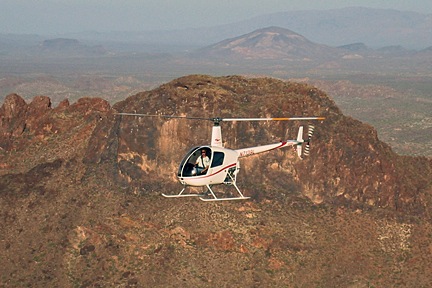 I’ve done this before. Years ago, when I needed photos of my R22 for marketing material, a friend took Mike and a camera up in a Piper Cub. We flew in formation around Vulture Peak. Mike snapped off 50 or so digital photos. I loaded them into my computer, discarded the really bad ones, and cropped the good ones to get what I needed.
 Two years ago, we did the same thing with Tristan’s R44. This time, I flew Mike in my R22. We flew in formation around Vulture Peak until Mike had about 30 pictures. For some reason, the focus wasn’t good on all of them — I think the camera’s autofocus feature was just starting to die at that point — but we had enough good photos for what we needed.
 But Mike did get a few decent photos of my helicopter. One of them was almost perfect. A few of them were pretty funny; Mike managed to cut off various parts of the helicopter in others. Two of the photos didn’t show the helicopter at all. (That might have been when I spotted Jim over my left shoulder and veered away from him.) None of the photos, however, were as good as that first Vulture Peak shoot. In those photos, I’d been looking right at the camera. (That’s because I’d been following the lead, looking at the lead like I was supposed to. On this shoot, I’d been the lead but Jim had lost sight of me and passed me. Seeing him beside me, just after this photo was taken, scared the shit out of me.)
 The photos of Jim’s helicopter weren’t very good at all. Jim had this idea of background firmly entrenched in his mind. So rather than form up with us and let Mike shoot photos with him relatively close, he followed the contours of a cliff face. He must have been a few hundred feet away from the cliff for the entire run. I couldn’t see him because I was ahead of him so I didn’t know how far away he was. He should have been watching me, forming up on me, adjusting his distance accordingly. I don’t know what kind of camera lens he thought we had. Mike claimed that Jim’s helicopter filled “one third to two thirds of the frame,” but Mike was seriously mistaken. In most shots, Jim’s ship is a red, white, and blue speck against the desert. I cropped the hell out of this shot here; it would not be suitable for printing.
 I was a nervous wreck when we finished up and very glad to be done. (My hands were shaking for some time afterward.) We landed and parked side by side on the ramp. Then we wandered over to the terminal to the shade to look at the photos in the camera’s tiny screen. We were both disappointed. I knew I had a few usable shots, but Jim’s were just too small to be of any use.