
One last photo flight and the long flight home.
Day One: Rushing to Russians
Day Two: Page, the windy city — and more
Day Three: Lots of flying
Day Four: Night flight on the Rez, rain, rest
Day Five: Rest, a great ferry flight, and a tall ship in the desert
Day Six: One last photo flight and the long flight home (this article)
I was ready to go in the lobby with my luggage at 6 AM the next morning. The motel — like most “standard” motels these days — offered a free breakfast. It was the usual collection of high-carb breakfast junk food and juice from concentrate. I was nursing a cup of weak coffee at 6:30 AM when Mike appeared. After loading the SUV with luggage and waiting while the two of them had a cigarette, we headed back to the airport.
We pulled the left side doors off the helicopter and stowed them in their SUV, which they parked alongside a hangar nearby. Then I fired up the helicopter and started the warmup process. It was cold that morning — 37° F — and my papered aircraft usually doesn’t like starting on cold mornings after spending the night outdoors. But that morning it started right up, ready for more.
The Flight
Dawn broke through a layer of haze as we started off toward Shiprock. Suddenly, my passengers were in a hurry. With doors off, my speed was limited to 100 knots, but I used it all and got out there just as the light was getting good.
We made several slow flights over the north-south ridge line, as close to the ridge as I dared, so they could shoot up the ridge with Shiprock in the background. With each pass, we got closer to the peak. The shadows from the ridge and peak were long but got shorter with every pass.
As Mike snapped photos, he made lots of ooh and aah sounds, punctuated occasionally with a soft wow. At one point, he showed me the image in the LCD panel of his camera. Wow was an understatement. I’m hoping he shares a lo-res copy of the image with me so I can put it here.
We kept at it for quite some time. Then they told me to head on back to Farmington. As we neared the airport, they shot a few more images of the town — mostly fields alongside the river. The tower cleared me to land and I set down on the pad. Then it was over.
Getting Ready for Departure
We put the doors back on and loaded in my luggage. We said some parting words, and shared hugs. I handed over the piece of paper I’d been using to keep track of all the flight times. Mike passes my costs along to his passengers based on the amount of time each of them flew and I’d been keeping meticulous records for him for the past six days.
They drove off and I placed my fuel order with the FBO girl, who was still on duty. She gave me a lift back to the FBO office so I could use the facilities and settle my bill. When she dropped me off at the helicopter again, I handed over a pair of tens: one for her and one for the previous day’s FBO guy.
A while later, I was in the air, heading southwest.
If you look at a Denver sectional — which is where you’ll find Farmington and the area around it — and you trace a route that’ll bring you toward the Phoenix area (on the Phoenix sectional), you’ll soon find that there isn’t much in the way of airports between the two points. I estimated the flight at just under 3 hours which I should be able to do with the full tanks of fuel I had on board. But having come close to running out of fuel on long trips across open desert before, I wasn’t planning on doing it in one shot. I wanted a fuel stop. That meant stopping at Winslow.
But how to get there? I wasn’t interested in overflying the Chuska Mountains. It was getting windy and I simply didn’t feel like being tossed around while I climbed over 8,000 foot peaks. If I went around to the north, I’d overfly Chinle. If I went around to the south, I’d overfly Window Rock. I chose south.
 I don’t remember too much about the flight. I know that the first 40 to 50 minutes was spent flying first across some half-neglected farmland and then over relatively flat open and deserted desert. One highlight was seeing a pretty large herd of sheep being tended by a single dog; when he heard me coming, he rounded all the sheep up into a frantic group. After that, I got my camera ready for other photo ops. But the only interesting things I passed were the remains of old hogans or corrals.
 Yes, I was still on the Rez. The Navajo reservation, as I’ve said earlier in this narrative, is huge. I was flying from near its most northeastern point (Farmington) to near its most southwestern point (near Flagstaff). It would take me about an hour and a half just to make that flight.
 I rounded the southern end of the Chuska Mountains and adjusted my course slightly to the west to overfly Window Rock. I started to climb. The terrain below me was rising with tall pines all around. The few homes I flew over looked more like winter residences than year-round homes.
A few very interesting rock formations appeared just outside of Window Rock. I tried to get photos but discovered that my camera’s card was filled. (I’d left photos on it from a previous trip when I started this one and didn’t even know it.) I managed to delete a photo (while I was flying!) so I could take one as I came into town.

Then I was over Window Rock, which is named for a huge hole in a rock on the north side of town. The government offices are built nearby it and there’s a park so you can walk right up to the formation. I’d been there on the ground when visiting the Navajo Nation County Fair in previous years. This time, I saw it but couldn’t snap a photo. How annoying!
I reprogrammed my GPS for my next waypoint: Winslow and made a slight course adjustment. For a while, I continued flying over tall pines. Then the terrain started to slope down and the pines faded away. I fumbled with my charts to switch to the right area on the Phoenix sectional. Although I was using a GPS for navigation, it’s always a good idea to know where you are on a sectional. I used landmarks such as powerlines and roads to track my route. Soon I was in the painted desert, flying between low buttes in an almost barren terrain.
As I neared Winslow, I tuned into its frequency. A helicopter was just departing to the south. An airplane was on its way in. I saw the Little Colorado River’s green belt and the town beyond it. A while later, I was landing on the ramp.
Oil Leak and a Long Walk
The first thing I noticed after shutting down were the spots of oil all over the ground under the helicopter. Oil from the helicopter.
Now I’d been noticing a higher-than-usual oil consumption during the past few days. I’d also been noticing more oil than usual in the engine compartment, which I try to keep clean. I’d been at a complete loss as to exactly where the oil was coming from. There wasn’t so much oil that it was a serious problem. It was more of an annoyance. Something to get looked at but not something to stop flying over. After all, it was holding enough oil to keep gauges in the green.
I called Ed, my Wickenburg (engine) mechanic and talked to him about it. Could he look at it as soon as I came in? I had a 6-day excursion coming up on Sunday (four days away) and would be in deep doo-doo if I couldn’t do it. He promised to check it out when I flew in.
I went with the FBO guy to the FBO office and put in a fuel order to top off the tanks. The girl at the counter ordered a cab to take me into town. The cab dispatcher said it would be 15 minutes.
I plugged my iPod’s charger into an outlet at the FBO office. (Guess I didn’t mention that I’d been listening to music during the entire flight. The iPod connects to the helicopter’s intercom system so it automatically cuts out when someone comes on the radio.) Then I used the restroom and stepped outside to wait. It was 9:45 AM, back on MST. (I was off the Rez.) A beautiful day with light winds. I waited.
And waited.
After about 15 minutes, I called the cab company to see what the status was.
“I told her it would be a while,” the woman snapped at me.
“Well, it’s a nice day so I’m going to start walking,” I told her. “So if you see someone walking on the side of the road toward town, it’s me. You can pick me up where you find me and take me the rest of the way.”
“I have two other people in front of you,” she said.
“Fine,” I replied.
We hung up and I started walking.
You can probably figure out the rest. I walked all the way into town. It’s about a 2-mile walk and I can’t say it’s very interesting. But the weather was nice and I can use the exercise. I just wish I was wearing my walking shoes instead of those damn Keds. They’re simply not designed for long distance walking.
By the time I got to La Posada — 45 minutes after I’d started walking — I was hot and a bit cranky. They sat me at a table near the window so I could look out over the gardens and the train tracks. I ordered eggs on polenta with green sauce — my favorite breakfast there — and started tanking up on iced tea. Then I paid my bill and went to the hotel desk to see if they could call a different cab company to pick me up.
The girl at the desk offered to run me over to the airport. We had a nice drive and, at the end, I gave her the money I would have given the cab driver. “Lunch on me,” I told her. That was two fares the cab company lost that day.
The Last Leg
I settled my bill with the FBO and walked out to the helicopter. The oil problem didn’t seem any worse, so it evidently leaked only when the engine was running. I added a quart of oil, did a quick preflight to make sure I wasn’t missing anything obvious, and climbed on board. Then I started up, warmed up, and headed southeast toward Sedona.
Although a straight-line route would have taken me south of Sedona, it also would have kept me away from any airport that I could have used if the oil leak started giving me bad indications — like loss in oil pressure or increase in oil temperature. So I chose a route that put several airports within range: Flagstaff, Sedona, Cottonwood, Prescott. I didn’t actually overfly any of these places. I just kept them within a short flight distance in case I felt a need to land. Sure, you can land a helicopter almost anywhere, but landing in the middle of nowhere, miles from help, isn’t exactly the best situation to put yourself into.
But everything was fine. I completed the flight in just under an hour and a half, flying a route I’d taken many, many times. It felt good to see familiar mountains and roads again. And it even felt good to see Wickenburg Airport in the haze as I descended from the Bradshaw Mountains.
Oil Leak Investigated
I was still cooling down the engine on the ramp when Ed came out of his hangar. He stood patiently nearby until the blades stopped spinning. I opened up the side panel, where he could clearly see oil splattered all over the top of the battery box. He’d cleaned the box cover when he’d done an oil change before the trip. I’d cleaned it at least twice during the trip.
His main concern was that the oil leak was coming from the filter — which would mean he’d screwed up on the oil change. But that was not the problem and I knew it wasn’t. Ed is extremely conscientious about his work. Heck, the man won’t even give you a bill for work done until he knows he’s done it right.
I offloaded my luggage and towed the helicopter into one of Ed’s hangars. He went to work on it. I was still at the airport a while later when he came up with his verdict: the oil was leaking from one of the engine’s connections to a magneto. All he had to do was tighten a bolt.
We pulled the helicopter out onto the ramp between two rows of hangars and let it down off its towing equipment so its skids were flat on the ground. Although I hardly ever run it up near the hangars, there was no one around other than Ed, his assistant Kenny, and me. All the hangars were closed. So I fired it up while Ed sat a safe distance away, looking at the affected area through a pair of binoculars. I ran it at idle speed (55% RPM) and then at warm-up speed (68% RPM) for about five minutes before Ed signaled that it was okay to shut down. The leak had been fixed.
I put the helicopter away and headed home for some well-deserved rest.
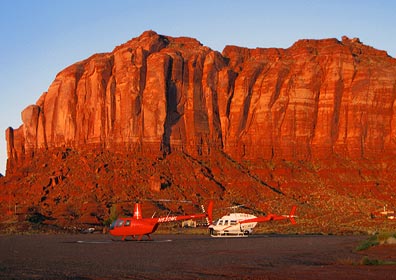 Outside, as dawn broke, a young Navajo man stepped out of the car that had been parked next to the Long Ranger on the helipad beside mine. Turned out, he’d been hired as security for the helicopter and had spent the night in his car.
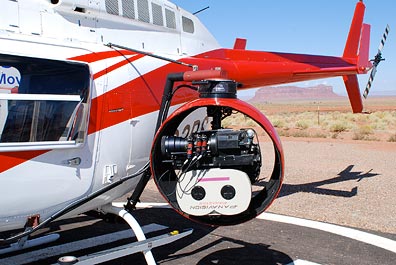 The camera guys were out with their truck again, working on the mount they’d put on the Long Ranger. Now they had a big ball on one side that turned out to be the camera mount and camera. The pilot and his fuel guy came by for a quick chat with them before they all took off for a meeting at the nearby high school, where the rest of the film crew were gathered.
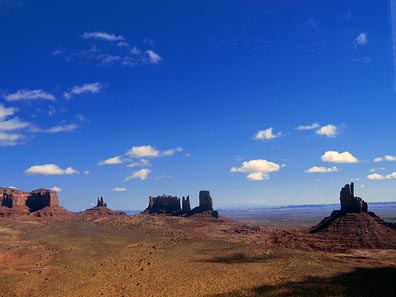 I flew through the northwest corner of Monument Valley, snapping a few photos along the way. These weren’t the great artistic photos my passengers had snapped during our flights. They were quick point-and-shoot images taken left-handed through the plexiglas. A way to document my trip and share images with blog readers. (I still hope to get a few low-res images from the photographers to share here.)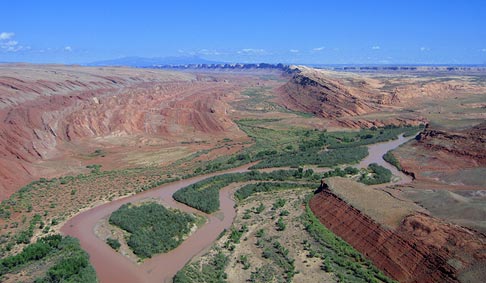
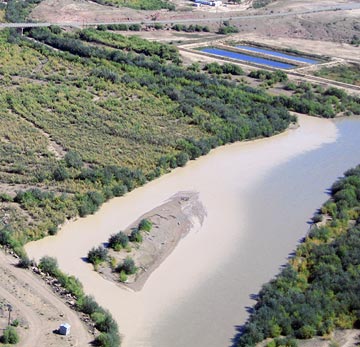 The canyons leveled out and I continued following the river through relatively flat terrain. The river, which was a greenish tan color, was being fed in many places by side streams of silty runoff water from the previous day’s rain. It was interesting to see the places where the two water flows met.
 My GPS clearly showed the intersection of four state lines. I was approaching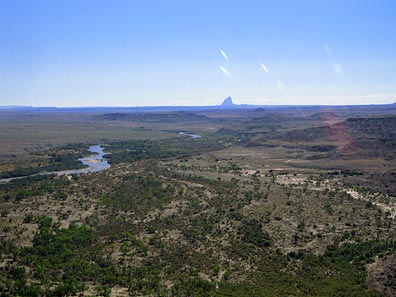
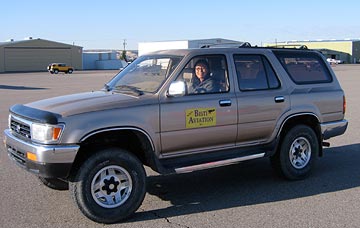 I do need to say a bit more about this courtesy car. It was the absolute worst car I’d ever driven in my life. It was a Toyota SUV with manual transmission. I have no trouble driving a stick shift car — all three of my vehicles have manual transmission. But the clutch pedal on this one would stick to the floor. You’d put it in first gear and start moving, then go to push the clutch down to shift into second, but the pedal was already on the floor and the clutch was not engaged. I quickly learned to use the toe of my shoe to pull the pedal back up after each shift. I kept things simple by sticking to first and second gear and parking in the very first spot I found in town. On the way back, I had a bit of trouble and thought I’d actually finished off the transmission. But then I got it moving again and returned it to the FBO. It was an interesting experience — very funny but frustrating at the same time.
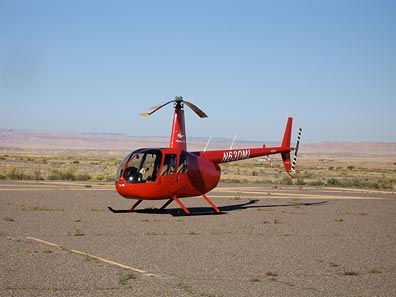 Four SUVs and a crowd of Russians waited for me at Shiprock’s lonely little airstrip. The wind was howling from the southeast. I set down on the ramp, cooled down the engine, and shut down. As I joined my future passengers, I wondered what the local police would think if they drove up and found a helicopter and four SUV loads of Russians on temporary visas.
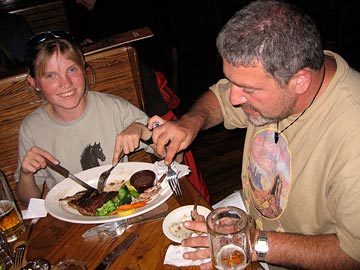 We put the doors on, stowed my luggage in their SUV, and took off in search of the Super 8 where we were staying. That’s when we discovered that Farmington was a lot bigger than we’d all thought. The motel was on the far east side of town, right next door to a Wal-Mart. Before checking in, though, we hit an Outback Steak House for a quick meal. It was after 9 PM and I kept things light.
 This photo is of the patio between the Bright Angel Lodge’s main building and the Grand Canyon’s South Rim at the Grand Canyon.
 This is the entrance to two of the cabin rooms at Bright Angel Lodge at the Grand Canyon. The cabins are small buildings, each of which house two or four guest rooms. They’re located right on the rim and some of them even have views into the Grand Canyon.
 Lookout Studio is perched on the rim of the Grand Canyon. I’m not quite sure of its original purpose at the canyon, but it now houses a gift shop that seems to specialize in t-shirts, rocks, and postcards. It has a wonderful balcony and a series of lower terraces.
 I took this photo from the balcony of my room at the Lake Powell Resort. The marina is in the foreground; the Navajo Power Plant is in the background, almost floating in the blackness of the empty desert around it.
 Here’s a close-up of the power plant. I used a 210 mm lens to get a this shot of the plant, which is about four to five miles from here.
 This is a boat dock with a fueling station at the Wahweap Marina. It looked cool from my room and even better in the photo.
 It was partly cloudy at Goosenecks. We spent a lot of time hovering not far from the parking area — but about 1,500 feet above it. We got a few shots of a rock formation near there, then went back for more Goosenecks shots. The air was relatively smooth, but Oleg did not ask for one of his 360° panoramics. (I think it’s because Mike doesn’t like the flying I have to do for them — which makes two of us.)
 Visibility in Monument Valley had dropped to just a few miles. I could no longer see the ridge to the northwest that I’d crossed four times that day and the buttes in the valley were shrouded by clouds. It rained on and off. Every once in a while, I’d pop outside to see what things looked like in the valley. A few times, I took photos.
 It cleared a little and the two Huskies that had been on the ramp overnight returned from wherever they’d been all day. A while later, a Bell 206L landed on the helipad beside mine.
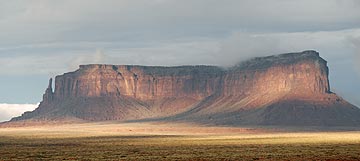 About an hour before sunset, the sun broke through some of the clouds, illuminating one of the buttes. I took out my “good camera” — my Nikon D80 is nothing compared to the super high tech professional equipment carried by the photographers I’d been flying for the past few days — and took some photos. I could see the hint of a rainbow to the east, but not enough to photograph.