Clive Cussler Doesn’t Know Much about Helicopters

Apparently, even best-selling authors can’t be bothered to do their homework.

Atlantis Found CoverIn my never-ending quest for light reading while I sit around in Wickenburg waiting for my marriage to be terminated, I picked up a copy of Atlantis Found by Clive Cussler from the library. This book features Cussler’s protagonist, Dirk Pitt, a man so outrageously skilled and lucky that he makes James Bond look as inept as Inspector Clouseau.

Hey, I did say I wanted light reading, didn’t I? (And yes, I do realize I was bitching about a supposed Cussler book just the other day.)

But no matter how light reading is, it really bugs me when an author gets something insanely wrong. Take, for example, this passage from the book:

Purchased by Destiny Enterprises from the Messerschmitt-Bolkow Corporation, the Bo 105LS-7 helicopter was designed and built for the Federal German Army primarily for ground support and paramilitary use. The aircraft chasing the Skycar carried a crew of two, and mounted twin engines that gave it a maximum speed of two hundred and eighty miles an hour. For firepower, it relied on a ventral-mounted, swiveling twenty millimeter cannon.

My helicopter pilot brain shouted “How fast?

You see, there’s a little thing called retreating blade stall which normally limits the airspeed of a helicopter. I don’t know of any helicopter capable of going 280 miles per hour. Certainly not one with a single main rotor system.

But hell, I’m not an expert. I’m just a pilot. What do I know?

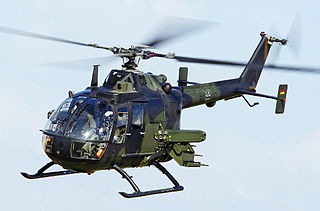
Bo 105P
German Army BO 105P photo by Joey Quan.

So I looked it up the MBB Bo 105 on Wikipedia. And I scrolled down to the Specifications Section. And I learned the following specs:

  • Never exceed speed: 270 km/h (145 knots, 167 mph)
  • Maximum speed: 242 km/h (131 knots, 150 mph)
  • Cruise speed: 204 km/h (110 knots, 127 mph)

280 miles per hour? How about 150 miles per hour? That’s more reasonable.

And, coincidentally, it’s the never exceed speed for my Robinson R44 Raven II — although, admittedly, I don’t have any ventral-mounted, swiveling twenty millimeter cannons.

Come on, guys! Do your homework! I know it’s fiction, but when you discuss the capabilities of an aircraft that actually exists, how about getting it right?

This guy gets it. Do you?

More fodder from my inbox.

Yesterday, I was very pleased to find the following message in my email inbox (emphasis added):

Maria –

I’m not selling anything…and I’m not asking for anything =) I just wanted to drop a heartfelt “Thanks!” for what you’ve written. I’m a career Navy guy… I retire in a year and a half. I finally started my flight training this past Feb. Now that I’m on shore duty and not at sea, I have the time. Fortunately for me, the GI Bill is covering the cost of my flight training. It really is the realization of a lifelong goal. I *almost* had the opportunity to fly in the Navy, but my 31st birthday fell three weeks prior to receiving my BA. When you couple that with a backlog of Student Aviators pushed back in their training due to Hurricane Ivan, it meant… No age waiver approval for me. The Navy wouldn’t let me fly…

I never gave up though and while I had to put my flight training on the back burner when I was out to sea, it’s finally coming together now. It’s a poor choice for a second career, I know. However, there is just something about flying that draws me in and I can’t see myself doing anything else. I’ve perused the various forums throughout the years and despite all the negativity associated with anything related to pilot jobs… I’m still moving forward. I’m a firm believer that what you achieve in this life is directly proportional to what you put in.

So what’s the point? Thanks for posting up your perspective! Your blog is a goldmine of lessons learned and experience gained. I really enjoy reading it. It’s motivating for an “old guy” like me. Yes, I “get” that I should have started this career 20 years ago but it’s water under the bridge now. In any case, at least I’ll have my retirement pay to supplement the low wages :). Ultimately though, being satisfied with what I do rather than how much I make is what matters most. Thanks again for blogging!

Ryan

Now that’s what I call the right attitude.

Here’s a guy approaching retirement age — not quite sure what that is for career Navy guys, but I assume it’s past 40. He knows what his passion is. He knows that it’s not the best career choice if money is important. But money isn’t important to him and he’s going after his dream job, knowing that his retirement pay will supplement his pilot income. You have to have a lot of respect for someone like that.

I know I do. He’s in nearly the same boat I was in back in early 2000 at age 38. I was also fortunate enough to have another income to fall back upon as I worked my way up. I was chasing down a dream. Profits didn’t matter — at least at first while that second income was there for me. What mattered was rising to the challenge and doing something I really wanted to do — something I loved.

But what really struck me were the two sentences I highlighted in bold above.

I’m a firm believer that what you achieve in this life is directly proportional to what you put in.

This is the truth. There are many ways to go through life. One way is to “skate,” doing just as much as you need to glide forward on a satisfactory path. (I was married to a skater, although he didn’t think he was. But if he would have turned off the TV once in a while and spent that time learning and doing the things he needed to achieve his goals, he’d be in a happier place right now. I think we both would be. But that, too, is water under the bridge.)

The other way to go through life is to work hard and smart and to stay focused on your goals, doing whatever you need to do to achieve them. It’s not easy and it can be exhausting. I know this. I think Ryan does, too. But the rewards of all this work are worth all the effort.

The more you put into life, the more you get back from it.

Ultimately though, being satisfied with what I do rather than how much I make is what matters most.

This is another version of the old adage, “Do what you love.” If there was any one piece of advice I could give a young person, this would be it. Remember, if you’re not happy with what you do every day, you will not have happiness in life. Only by following your dreams and doing what matters most to you can you be really happy.

This is something I learned back in 1990, when I left a job I hated to start a freelance career. The way I see it, I wasted 8 years of my life. But what followed (so far) were 23 great years doing work I loved and achieving my goals. Ryan understands this, too.

Being happy at work is far better than making a lot of money at a job you don’t like.

Do you understand these things? When you do and you’re not afraid to let it guide your life, you’ll be on your way to a rich, fulfilling life, too.

Frost Control

I get a job but no experience.

In February, I got my first contract for a frost-control job in the Sacramento Valley of California. It was a 60-day contract and it only recently ended.

Frost control work is similar to cherry drying, but the contract — at least my contract — was very different. And this year, it offered no opportunity to fly and very little profit.

The Goal

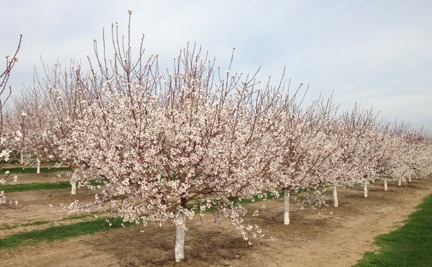
Almond Trees in Full Bloom
These almond trees in one of my orchards are in full bloom. As you can see, they’re quite beautiful — especially when you see hundreds of acres of them. The contract starts right around this time.

The goal of frost control flying is to grab the warm air above the orchard in thermal inversion situations and suck it down into the trees. My client tells me that you can only do this for about 3 hours before the warm air is depleted.

As the almonds (or walnuts, if you’re doing them) are forming, they’re gelatinous and very susceptible to damage from frost. Each degree below 30° can knock off a significant percentage of the crop. This is serious business — serious enough to have enough helicopters on hand to protect the developing nuts.

My client hired 17 helicopters of various makes and models to protect its orchards this season. I was just one of them, positioned in Woodland, CA.

About the Flying

Like cherry drying, which I’ve done every summer for the past five seasons and hope to do again this summer (if I ever get out of Arizona), frost requires you to fly low-level over trees. But there are a few major differences:

  • Frost control flying is usually done at night. This means flying in the dark, although a flight could last until just after dawn. Let’s face it: cold weather comes at night, with the coldest weather just before dawn. (More on that in a moment.)
  • Frost control flying is usually done higher than cherry drying. My client told me approximately where he wanted me to fly, but also said that I needed to check my outside air temperature (OAT) gauge to make sure I was in the warmer air above the trees. This means anywhere from 20 to 50 feet off the ground.
  • Frost control flying is usually done faster than cherry drying. Again, my client advised me to operate at a speed of about 20 to 30 miles per hour. That’s right at ETL in my ship, which would make for an interesting flight. (I can’t remember any prolonged flying right at ETL.)

And if you’re a helicopter pilot, you probably realize that this altitude and airspeed combination still puts the aircraft right, smack dab in the middle of the deadman’s curve.

Flying in the Dark

But flying in the deadman’s curve doesn’t really bother me. I’m used to it. What does bother me, however, is flying in the dark.

Note that I didn’t say flying at night. I said flying in the dark. There’s a difference.

First of all, you need to understand that these orchards are in farm country. Some of them are huge, stretching across a section (square mile) of land. The only things in the orchard are usually the trees. Trees don’t need lights at night so there aren’t any. So the orchards are naturally dark at night.

When there’s any kind of moon, it really isn’t that dark. In fact, when the trees are in bloom and there’s a moon, you can see the trees from quite a distance up. It’s actually quite beautiful when there’s enough moonlight to see them.

But when there’s no moon — which is basically more than half the month (considering that flight is normally conducted between the hours of 3 AM to 7 AM) — everything is dark. Pitch black dark. And that’s where the real challenge is.

You see, the entire area is criss-crossed with power lines — the big “Bonnevilles” and smaller lines going to homes and shops. If you’re lucky enough to not have wires in your orchards — which I was — you still have to worry about the wires on the way to your orchard. So you’re flying at least 500 feet up to avoid the possibility of hitting wires.

You use a GPS to get to your orchard. When you think you’re right over it, you look down and, if there’s no moon, you don’t see anything except a black hole. You wonder whether the coordinates are for the center of the orchard or one corner. If a corner, which one? And how close are you really to those coordinates? You’re wondering this while you’re flying over the orchard, knowing you have to get way down there, just over the trees that you can’t see, and knowing that if you’re not where you think you might be, you could also be over or near wires you can’t see and you might descend down into them.

Even if you know exactly where you are, you can’t simply descend straight down into the orchard from 500 feet above it. Doing so would put you in serious risk of settling with power. So you have to spiral down into it, making sure that you’re remaining clear of wires that could be in the area. With luck, you’ll see the trees before you hit them.

My Test Runs

Before actually flying a mission, a friend and I went out on a test run with me at the controls. We looked for one of my orchards that I knew had wires along one edge, Bonnevilles nearby, and a huge unlighted windmill less than a mile away. I went to the coordinates and looked down. There was moonlight and I thought I could see a patch of trees. I began my spiraling descent and doubt creeped into my mind. Were those trees? The shape wasn’t right. I realized that I was looking at a small lake near the orchard and couldn’t remember where it was in relation to the orchard. I realized that the windmill was near the lake. Knowing that I wasn’t where I thought I was, I aborted the descent. My friend was with me on that decision.

We tried my other orchard, which had a more regular shape. I got into position over it and began my descent. I could see the flowers on the trees in the moonlight. But when I got within 100 feet of them, my landing light flashed on wires where I didn’t think there were any. Was I over the right orchard? If I wasn’t, I had no idea where wires could be. Again, I aborted the descent.

I was seriously concerned about my ability to get the job done. My friend was even worse, suggesting that it wasn’t possible without lighting from the ground. When I pointed out that other pilots had been doing it for years, he couldn’t argue.

Trail Tracker for iPad
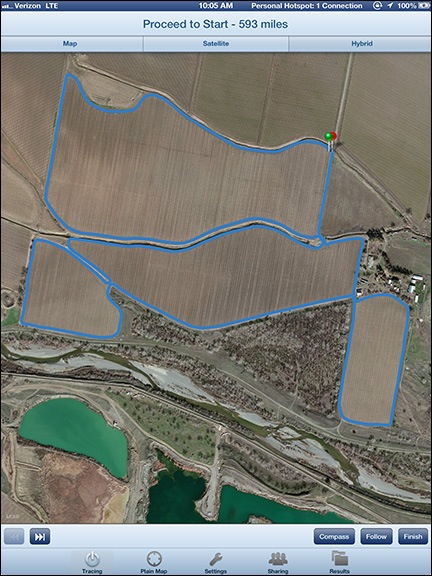
One of my orchards consisted of four separate irregularly shaped fields. There were wires along the northeast side, running to the house. Note the ponds to the south; the windmill is southwest of the orchard, out of the image.

The next day, I downloaded an app called Trail Tracker for my iPad. This app creates a track log as you travel. I drove out to each of the orchards, turned the app on, and drove around the entire orchard. This created a blue track line that surrounded the orchard.

Later that day, I hopped into the helicopter with the iPad mounted in it stand. I then flew out to the orchards, one at a time, with the tracking software displaying the orchard’s outline. A GPS marker indicated my position on the map, although there was a bit of a time lag. I was able to see on the iPad where I was in relation to the orchard.

The next night, we went out again. This time, my friend flew his helicopter and I was a passenger. We flew out to my odd-shaped orchard first and were able to successfully descend down over the trees while knowing exactly where we were in the dark. While we were in flight, I also noted nearby lights that would give me visual references at night — the farmhouse on the east side was a good source of light and there was another at a shop up the road to the orchard (not shown in this image). We also flew all the way up to Williams to check out my friend’s orchards. We were able to find them and descend over the trees. He made a note of lights in the area, too.

So by approaching it with more information, we were able to get a bit more comfortable about the task we’d be called to perform.

But did I like it? Hell no! As I told another friend after I returned home the next day, this would be some of the most dangerous flying I’d ever do. I was not looking forward to it at all.

About My Contract

Unfortunately, my frost control contract was very different from a cherry drying contract. Although the helicopter was required to be onsite for the duration of the contract, I was not. I could go on with the day-to-day living of my life with two exceptions:

  • I couldn’t fly my helicopter because it was positioned in California. This made it impossible to accept flying jobs anywhere else. And since I didn’t advertise my availability where the helicopter was based in California, I didn’t book any flying work for the duration of the contract.
  • I could be called at any time to get on active standby. Once called, I’d pretty much have to drop everything and head out to California to prep the helicopter and wait until I was launched.

Because I wasn’t required to be with the helicopter, the standby money was considerably less than I’d get with a cherry drying contract. Like 25% of that amount. Ouch. I actually couldn’t afford to stay with the helicopter. My living expenses would be too high.

The contract did, however, provide additional revenue when I was called out and when I was on active standby. I was called out for two consecutive days. The callout and standby fees easily covered the cost of hopping on a Southwest Airlines flight from Phoenix to Sacramento and hanging around for two days.

But the temperatures never got low enough to launch me. I was there with the helicopter, the helicopter was fueled and ready to fly, but I didn’t need to fly.

That was early in the contract. I wasn’t called out again.

Later, my client told me that it was the warmest spring he’d ever been through.

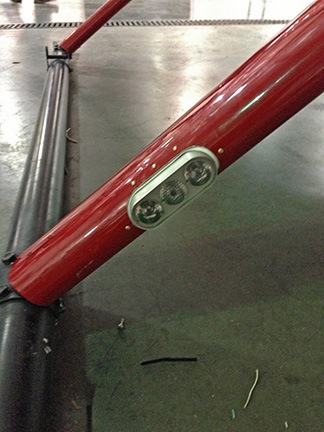
Devore Aviation Lights
Devore Aviation’s Forward Facing Recognition Floodlight System consists of LED lights mounted on the two front skid legs. The lights and installation were very costly, but I might get some use out of them during cherry season.

In all, it was a break-even gig for me. The standby money covered the cost of getting special lights installed on the helicopter and repositioning the helicopter to California and back to base. The callout and standby fees covered my living expenses for the few days I was in Woodland with the helicopter.

Would I Do It Again?

In all honesty, I’m not sure I’d do this again.

I certainly would not do it again with the same contract in place. I’d much prefer a contract more similar to a cherry drying contract with higher standby fees, even if the contract required me to stay in Woodland for the entire contract term. Woodland is a nice little farm town very close to Sacramento and not far from Sonoma Valley; I think I’d really enjoy spending two months there — especially with the days free to do what I like.

But it really all depends upon the demand for my services in the Wenatchee area, where I’ll be living as soon as I can get out of Arizona. While cherry drying season doesn’t usually start for me until June, I might be able to get other flying work if I were in Washington with the aircraft before then.

It’s a decision I’ll have to make next year.
My Planned Home

What I’m planning. What do you think?

I moved this post here from my private blog on Wednesday, June 5, 2013. Read about the hilarity that ensued that day to understand why I went public with this post.

A few people have been asking me where I’m going to live when the divorce is over and I leave my Wickenburg home. The answer isn’t simple.

RV Living

At first, I’ll likely live in my RV in Washington State, as I have for the past five consecutive summers. I’ll live at the golf course where I’ve been parking in May and June and much of July since 2008. My helicopter will be parked at the ag strip across the street, where I can see it from my RV’s back window and get to it for work within minutes.

In mid July, I’ll likely move up to Wenatchee Heights, where I’ve been parking in late July and August since 2010, when I first got my big fifth wheel. The owner of the land there was kind enough to set up an RV parking spot for me with 30 amp power, water, and even a septic hookup. With my helicopter parked in his backyard and the orchard I’m responsible for drying right across the street, life is very good indeed — especially the fringe benefit of being able to pick fresh cherries and blueberries every afternoon for the entire length of my stay.

A Hangar Home with a View

My New View
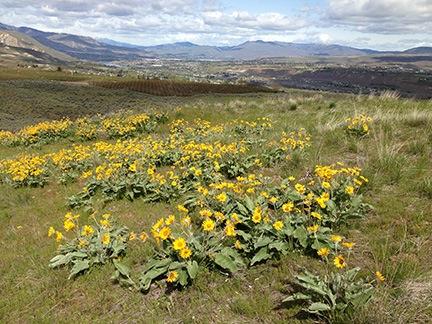
Having a view like this out the window of my home is something I can really look forward to.

Of course, that’s just my temporary living plan. I’m in the process of buying a 10-acre parcel of land in Malaga, WA, just downriver from Wenatchee. It sits on a shelf high above the Columbia River and Wenatchee Valley, with views of rolling hills, orchards, snow-covered mountains, and, of course, the Columbia River. It’s amazingly quiet and private, yet just 15 minutes by car from a great little city (Wenatchee) with just about anything I could want or need. I hope to close on or before my birthday — making this a much happier birthday than last year’s or any other birthday within memory.

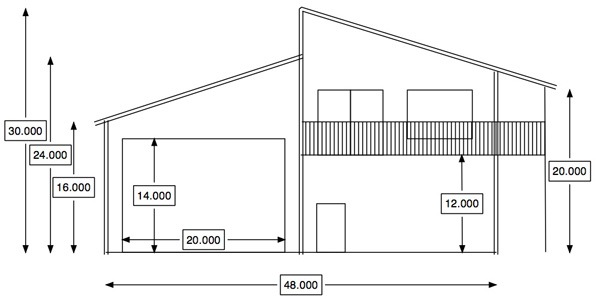
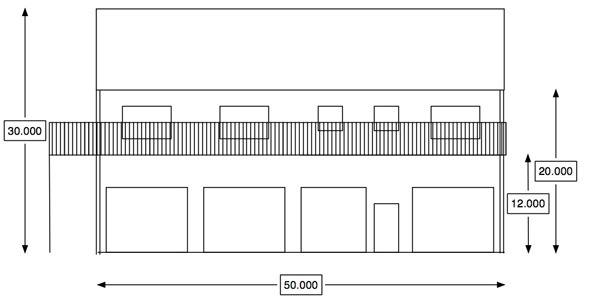
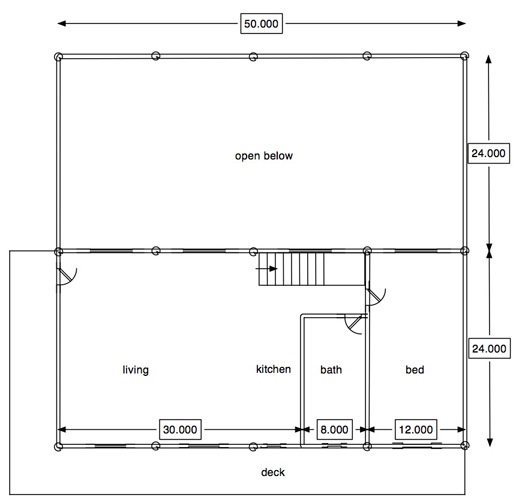
I’m already working with a builder to construct what’s called a “pole building.” It’s a type of construction that’s simple and very popular for “shops” or barns. Sitting on a 50 x 48 foot concrete pad with a 25 foot apron/helipad out front, the building’s main floor will have two sides: one for my helicopter and RV to be parked side by side, and one for a four-car garage.

Front Elevation
Front elevation.

Garage Elevation
Garage side elevation.

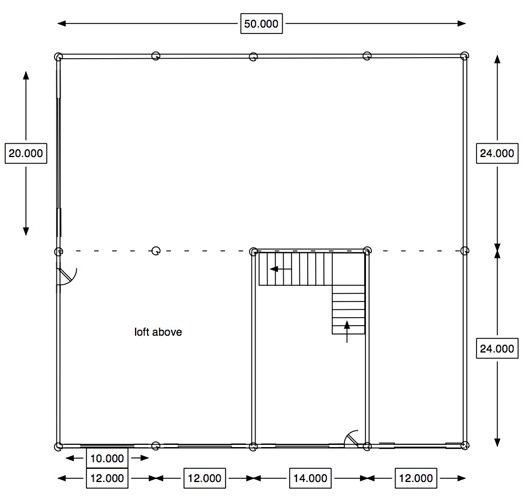
One of those garage bays will be enclosed with a flight of stairs going up to a loft with a vaulted ceiling. That loft will be completely enclosed and insulated, with plenty of big windows and a deck on two sides. The 1200 square feet will have just two rooms with a bathroom between them. Windows in the vaulted wall will let in lots of light; windows below them will look into the hangar.

Downstairs Floorplan

Loft Floorplan
Loft level floor plan.

My original plan was to use this as temporary living space until I could afford to build a real house on the property. But the more I look at my savings and the more I think about my future earning potential, the more convinced I am that this will be my only home on this property. So I’ve decided to make it very comfortable, with a dream kitchen that’ll put my old one to shame and a bathroom with the deep soaking tub I’ve always wanted.

And there’s plenty of space on the property if I ever do have enough money to build a home. I can then rent out this deluxe apartment to someone else and have some rental income.

So that’s the plan.

When? Who Knows?

The only thing I know for sure is that I’ll close on the land by July 30. That’s a must if I want to get the excellent price the sellers and I have agreed on.

As far as the building is concerned, the builders are scheduling out into September now. I can’t get on the schedule until I buy the land and come up with a 20% deposit on the building. Once I do that, and deliver another 50% when the materials arrive, they can complete the building shell in 6 weeks. Then it’s up to me — and some helpers — to turn that loft into a home.

Do you know drywall? Electrical wiring? Plumbing? Kitchen installations? Want a working holiday in a beautiful place? Call me! I’ll get you on my schedule this fall.

A Story about (Dis)Honesty in Business

I can’t deal with people like this. Can you?

Drying Cherries
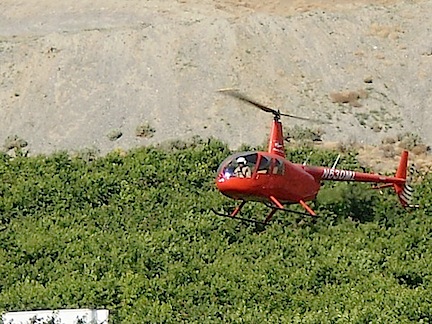
Here’s a photo of me in action over a cherry orchard in 2010.

As many people know, I now make most of my income in the summer doing agricultural work in Washington state with my helicopter.

Each year, my client base has minor changes, adding and removing acreage. It’s gotten to the point, however, that I usually need a second helicopter to help me during a one-month “crunch” period that runs roughly from the third week in June to the third week in July.

As I prepared to start my search for another helicopter with pilot, I was very pleased to get the following message via the contact form on Flying M Air‘s website:

Hello,
I was just wondering if you might know of a farmer who wants a helicopter for the upcoming season that you are unable to take care of? I have several helicopters available and have been doing frost abatement and cherry drying for over 5 years now.

An experienced guy with several helicopters? It sounded too good to be true. I replied:

I am looking for an experienced pilot with a helicopter for one month in the Wenatchee area. It would start around the end of June and run until the end of July. If you’re interested please give me a call.

He called. We spoke. He told me he had five helicopters: a JetRanger, a LongRanger, an R44, a Hiller, and an Enstrom. I told him I was interested in the R44 but only if the pilot had at least 500 hours in helicopters and 50 hours or more in the R44. He said all his pilots had over 1,000 hours.

At this point, a little nagging voice should have been whispering in my ear: This can’t be real. If this guy is experienced and has five helicopters, why doesn’t he already have contracts, especially for the R44, which would be anyone’s first choice of aircraft?

But if that little voice was talking, it may have been whispering. And since my brain is so caught up in divorce bullshit these days, I didn’t hear it.

Instead, I enthusiastically made him an offer for the R44, which he enthusiastically accepted. I told him I’d send a contract so he understood the terms and that I’d be able to give him more accurate dates in about a month. When we hung up, I remember thinking: Well, that’s one less thing to worry about. I even told a friend I’d already found a pilot to help me.

A week went by. I did some traveling. I didn’t get a chance to send the sample contract. There really wasn’t a rush; the work was still more than three months away.

I got another email message from the operator:

It was nice talking with you last week and thank you for the opportunity to work on cherries together in WA. Since our conversation I have had a chance to look a little closer at he numbers for an R44 and it looks like the lowest daily rate I can work with is $XXX per day but the $XXX per hour is the hourly rate needed so you were right on the mark with it. If you can’t do that as a daily rate I understand but I do have an Enstrom that I can get you for $XXX per day and only $XXX per hour.

I don’t want to give exact numbers here; I like to keep contract terms between me and the people I work with/for. He was telling me he needed $50 more per day for the R44 but only $25 more per day for an Enstrom, which I didn’t want. He could save me $25/hour of flight time on the Enstrom. So if I wanted the R44, it would cost me $1,500 more. Since my clients weren’t paying me that much, I’d lose money every day.

Classic bait and switch.

To say I was pissed is an understatement. I don’t like to be played. I know what it costs to own and operate an R44 and I know my offer was right in line with the going rate. So I replied honestly and politely:

Thanks for letting me know your requirements. I’m not sure I’ll be able to collect enough money from my clients to fill your needs. I’ll keep looking for someone else to handle the contracts for me. I don’t think the Enstrom will do the job. I’ll be in touch either way.

A few days went by. I got to talking to a friend of mine who also does cherry drying. He told me he’d been contacted by an operator who wanted to hire him and his Hiller to dry cherries in my area this summer. He told me that he was having a problem with the contract terms this guy was offering. Although the money was okay, this guy wouldn’t pay until after the grower had paid him. So my friend would be providing services with no guarantee of being paid if the guy who hired him didn’t collect.

You know what’s coming, right?

The guy who called my friend to hire him to fly was the same guy who had contacted me looking for work. He was acting as a broker — a middleman. He needed me to pay him more so he could pay the going rate to the guys who would fly for him and pocket money on the side. He wasn’t providing the services with his helicopters or his pilots.

A day or two later, I started writing a nasty email to him, but wisely deleted it.

Another week went by. Yesterday, I got this email from him:

I was just wondering if you have been able to find another 44 yet? If not can you do $XXX per day?

He was still looking for work for that R44, but now he’d dropped the daily rate to just $25/day more than I was offering. In all honesty, I could have made that work. But by then, I knew that I couldn’t trust him. And I didn’t want to work with someone I couldn’t trust.

Here’s where I’m different from most people. If you do something what bothers me, I will tell you about it. I want people to understand where I’m coming from. I’m not going to sneak around behind people’s backs and pretend everything is A-OK when it’s not. So I sent this message and BCCed it to my friend:

In all honesty, I’m not happy with the way you accepted my terms on the phone and then said you had to have more. I’m also not happy that you said that YOU owned the helicopters and I later found out that you tried to hire another pilot to cover cherry contracts for you. I’m thinking that you don’t have enough helicopters to cover your contracts or that you are trying to be a middleman. I’m also thinking that you’re not being entirely straight with me. I am not interested in working with someone I can’t trust. My clients are extremely important to me and I need to feel comfortable with the service I’m providing.

So I’m thinking that its best that we don’t work together this season. Sorry.

Too blunt? Probably. But that’s the way I am. I call it the way I see it.

It was obviously too blunt for him. He fired back:

Ok, so I never said it would actually work I said it may work on the phone. I never said I owned the helicopters, I have been doing this for over five years and have quite a few of my own contracts. I work with several other companies who are very happy with the service I provide. I never misrepresented what I do, just because you assume something doesn’t mean I said it or implied it. As far as being the middle man what are you doing?

Sorry, but I don’t agree with this. On the phone, he made it sound as if he had five helicopters. He even listed the models and told me all his pilots had 1,000 hours. And yes, he did say that the terms I offered would work — why else would I feel as if the job of finding another aircraft was done? I don’t have a recording of the conversation and I don’t have any notes. But I know what I heard and I know I was misled.

I replied:

I am not a middleman. These are my clients. I fly the contracts too. You misled me in our discussion and now you’re making excuses. I don’t deal with people I can’t trust.

And that’s when he showed his true colors:

ok, I should have listened to what people say about you but I thought I would give you a chance.

Yep. What kind of responsible business person makes a crack like that? Not only did he just slam the door on working with me in the future on cherries or frost (or anything else), but if any the other operators I routinely work with ask about him, I’ll tell them about this.

What should he have done? Well, he should have been a little bit apologetic, perhaps saying that he was sorry that he didn’t make the situation clear or sorry that I misunderstood him. He could have offered to start over with a more truthful account of his setup. But instead, he chose to take the line that I was at fault and that he should have known better to work with me after what he’d heard about me.

As if I give a shit what he and others say about me behind my back.

And him give me a chance? Jeez. How out of touch with reality is this guy? Aren’t I the one offering the work? The way I see it, I’d be giving him a chance.

Which, of course, I would now never do.

I got a call from my friend this morning. He had read the exchanges between me and the other guy. We chatted some more about this guy. Some details emerged. He had a helicopter last season and crashed it on a cherry contract. He apparently doesn’t currently have any helicopters at all. The deal he offered my friend for frost work required my friend to fly a certain number of hours for free or pay him for hours not flown. My friend would have lost money this season — especially since there was no frost flying to be done due to unseasonably warm weather all spring. He was glad he didn’t take the deal. And after our talk, he likely won’t be doing any deal with this guy in the future.

Sadly, this isn’t an isolated case. This business is highly competitive. People will say anything they need to in order to get a contract. They’ll promise the world. But when it comes time to deliver, they fall short.

Like the guy last season who said he’d work for me and seemed satisfied with the contract terms, but refused to sign a contract and refused to prove he had liability insurance. Needless to say, I didn’t work with him, either.

This isn’t a game. It’s business.

Oh, and if you feel like spending a month making good money with an R44 helicopter this summer, check this out. The only catch: you have to bring the helicopter.