I arrive at Howard Mesa and take care of a few unusual chores.
Last week, when I left Howard Mesa, I decided to check the water level in the big water tank. I tapped on it but couldn’t find the place where the water level was. So I opened the top and looked in. And saw a dead animal floating in the water.
There was a dead animal in my water supply. The water I bathed in. The water I washed my dishes in. Thank heaven it wasn’t the water I drank.
In my mind, the water was contaminated and had to be replaced. That meant it had to be drained out and someone had to scoop out that dead thing and any other dead things that might have been floating with it. And the water truck would have to come up to the mesa to bring fresh water.
Obviously, this was a job for Mike.
He arranged to meet the water truck at the bottom of the mesa this morning at 11 AM. We woke up at 5:30 to a cloudy day. The original plan had me flying my helicopter to Grand Canyon Airport (GCN), picking up my Jeep, and meeting him and his plane at Williams Airport. This way, he could avoid the 2-1/2 hour drive each way. The flight would take him less than an hour. But with low clouds, and t-storms in the forecast, I knew he wouldn’t fly. So I took off in Three-Niner-Lima while he took off in the Chevy.
I had an incredible 25-knot tailwind most of the way. At one point, my GPS showed a ground speed of 118 knots. Egads! And although it was cloudy, the air was smooth and there was no rain. A very pleasant flight. But with rain in the forecast, I decided to pick up the Jeep at GCN anyway, so I flew straight there. 1.2 hours on the Hobbs meter — a new record from Wickenburg. I’d left at 7 AM and had arrived at 8:15 AM. Wow.
I tied down the helicopter, placed a fuel order, and hopped in the Jeep. I bought $20 worth of regular gasoline at a whopping $2.39/gallon. I used my Papillon discount at McDonalds to buy a bacon egg cheese biscuit breakfast with orange juice (I’m very picky about my coffee). Then I hit the road for the 40-minute drive to Howard Mesa.
Did you know that when an antelope is running straight toward you, it looks just like a kangaroo? When I got to the mesa, I thought I was seeing a kangaroo until it turned and I saw what it really was. A kangaroo would have been too weird.
When I unlocked the camper door, I was greeted with an all-too-familiar beep-beep noise. It was the refrigerator, telling me that it was out of propane. Of course, it didn’t run out just before I got there. It ran out some other time, perhaps days ago, so all the food inside it had plenty of time to not only go bad, but get really stinky. Well, that’s not true. Only the freezer was really stinky. It had been full of frozen uncooked shrimp and frozen chicken potstickers. And ice. The shrimp and potstickers stunk to high heaven and the humidity caused by the melted and warmed ice had gotten a good mold crop growing. Are you grossed out yet? Well, you didn’t smell it. I did.
I cleaned out the freezer and fridge while I waited for Mike. His timing was perfect. I was just finishing when he pulled up. He went right to work on the water tank. He didn’t see the critter right away, but eventually did. He fished it out with a pool skimmer we use at home for our hot tub. (Like leaves fall in it.) He said it was very small. He offered to show it to me three times. He didn’t seem to think it required a water drain. But it was a dead animal. I didn’t care if it was the size of my thumb. It was dead. It was in my water. The water was tainted. I wanted it out.
We had to dump 800 gallons of water. We dumped a bunch of it into the trailer’s holding tank to rinse it out. Right now the trailer is connected to our septic system so nothing is actually “held” in the holding tank. But since the toilet uses so little water, I thought there was a chance that stuff wasn’t getting flushed down the pipe. So why not use some of that water to flush out the tank?Mike used the rest to make mud. He did this while I was waiting for the water truck man. I left at 10:45 and arrived at the bottom of the mesa at 10:58. I then proceeded to wait until 11:50, when the truck finally rolled into view. Good thing I’d brought a book with me. Mike called twice during that time; the first time to report that he’d spoken to the water man’s wife and the second time to tell me that she’d spoken to him and that he’d be there “any minute.” The truck followed me toward the mesa. I noticed that anytime we went up a hill — even a little hill — he fell way back. I decided to give him a choice on which road to take to the top. I stopped right before the turnoff to the state road and walked back to his truck. “You have a choice,” I said. “The steep road or the bumpy road.””We took the bumpy road last time,” he told me, remembering his trip to us on Easter Sunday (what a guy!). “How steep is the steep road? What’s the grade?””I don’t know,” I admitted. “But when I take the Jeep up, I have to shift into 4 wheel drive. Of course, I don’t usually carry 2,000 gallons of water over my drive wheels.””Let’s take the bumpy road,” he said.
I led him up the state road. He did very well. We arrived at the camper and I parked. He pulled into position in front of the big tank, driving through some of that nice fresh mud Mike had made just for him. The tank was almost empty. Mike needed the water guy to help him tip it to pour the rest out. They did that, then the water guy helped us rinse it out with a jet of water from the truck. Satisfied that it was as clean as it would get, Mike put the fittings back on and the water guy started pumping.
While he pumped, we talked about his truck. It had a white plastic tank on back. You could see all 2,000 gallons of water on board, right through the plastic, and you could watch it drain from the tank as he pumped. The truck had a Chevy Duramax engine, like Mike’s truck, and weighed 17,000 pounds when it was full of water. Wow.
He told us that in Flagstaff, it was cheaper to have water delivered than to buy it from the city. It was only $80 per load. (That works out to only 4¢/gallon.) Of course, it was $150 per load (7.5¢/gallon) to us on top of Howard Mesa. But it sure beats fetching it yourself. And if there hadn’t been a mouse in the water, the 800 gallons we had left would have easily lasted me the rest of the season. That’s $150/year for water.
 While we were doing odd jobs around the place, I decided to peek into the engine compartment for my Toyota. The Toyota lives at Howard Mesa these days and every time it’s parked for more than a week, mice take up residence in its engine compartment. I was supposed to put moth balls in there last time I was up, but I forgot. So when I opened the lid, I fully expected to find at least one mouse nest to clean out. Instead, I found a rabbit crouched on top of the engine. He was alive and very cute, with big brown eyes. He didn’t move when I saw him and asked what he was doing in there. He didn’t even move when Mike came over to look at him. Or when I took a picture. We were just starting to think that it was a mommy bunny sitting on some babies when it took off through the engine. It hit the ground running and gave Jack the Dog something to chase for a minute or so. I left the lid up to discourage other squatters from taking up residence.
When the water guy was done, we led him and his truck down the steep road. We had the camper’s gas tanks and a cooler with us. We made the trip into Williams where we had an extremely mediocre lunch, filled the gas tanks, and spent $100 on groceries — some of which replaced the items that had turned into the stinky mess in the freezer and fridge. We finished up our trip to Williams with Dairy Queen. Back at the camper, I put away the groceries while Mike took care of the gas tanks. A while later, the fridge was running again, with some dry ice to help it along.
Mike and Jack left at 4:00 PM. Since then, I’ve been doing odds and ends to set up housekeeping for the week, writing blog entries, and having dinner of potstickers. I wish the iced tea I made this afternoon would get cold already.
Autumn is coming. It’s 7:22 PM and already 66 degrees inside and out. Time to close up the place for the night.
 This first shot is a group shot one morning before preflight. One of the pilots (Bubbles, I think), had brought a camera and asked if we’d all go down and pose in front of a ship. It turns out that five or more of us had cameras with us so the loader who took the picture was pretty busy. Back row, from left to right: Don (“Gorgeous Don”), Greg (“Clogger”), Walter (“Wheezer”), Scott, me, Tom. Front Row, from left to right: Tyler (“Daisy”), Ann, Chris (“Bubbles”), Ron, Eduardo, Vince. This isn’t everyone, of course. Just the folks that were around that morning. If anyone has a shot of a different crew from this year, please e-mail it to me.
 This second shot is the instrument panel on a Bell LongRanger. This happens to be Copter 30, but they all looked pretty much alike. I took this picture while I was idling on the ground at the heliport, waiting for passengers. The instruments from top to bottom, left to right are: Oil pressure and temperature, Transmission Oil pressure and temperature, Fuel level, DC Load and Fuel pressure; next row down: Torque, TOT, N1, time (clock); next row down: Airspeed Indicator, N2/Rotor RPM; next row down: Attitude Indicator, Directional Gyro (incorrectly set but I always used the compass, which is not shown in this photo), ball (for trim indication); last row down: altimeter, vertical speed indicator, another ball (for trim indication; I didn’t realize there were two on this ship until just now).
 Now look at the picture here. In the first two close call incidents, I was the red line, which got clearance to depart to the southeast. In one incident, the blue line (Grand Canyon Helicopters) got a clearance right after me to depart to the west. In another incident, the green line (AirStar) got a clearance right after me to depart to the west. In both cases, I had to alert the departing pilots — on the tower frequency — that I was in their departure path. In one case, I actually began evasive maneuvers when the pilot didn’t appear to hear me. Mind you, the tower had given all of us clearance so we were all “cleared” to depart. Scary, no?
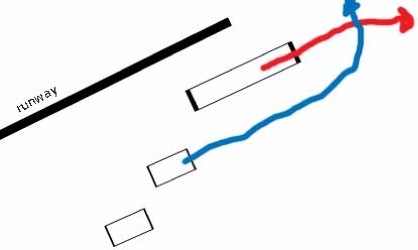 Let’s look at another close call. In the picture to the right, I was the red line with a clearance to depart to the northeast. The blue line had just gotten a clearance to depart to the northwest. Because he took off before me, we were on a collision course. But I’d been listening and I heard him get the clearance. So when I took off, I kept an eye out for him and made sure I passed behind him.
 My most recent controlled close call incident was two days ago. I’d gone down to Chandler to meet a friend for lunch. I landed at the Quantum ramp at Chandler Airport (CHD). We had lunch and returned at close to 1 PM — just when Quantum’s training ships were returning. I asked for and got clearance to hover-taxi to the heliport’s landing pad. I then asked for and got an Alpha departure clearance. This requires me to take off from the helipad and follow a canal that runs beside the airport (and helipad) to the north (the red line). When I got my clearance, the tower alerted me to an inbound helicopter that was crossing over the field. I did not hear that helicopter get a landing clearance, but he may have gotten it from Chandler’s south frequency, which I was not monitoring (because I could not). I took off along the canal just as the other helicopter (the purple line) turned left to follow the canal in. We were definitely on a head-on collision course. I saw this unfolding and diverted to the west, just as the tower said something silly like, “Use caution for landing helicopter.” Duh. I told the tower I was moving out of the way to the west. There was no problem. But I wonder what that student pilot thought. Or what Neil, owner of the company, thought as he hovered near the landing pads in an R44, watching us converge.
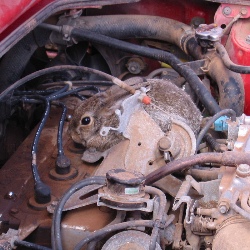 While we were doing odd jobs around the place, I decided to peek into the engine compartment for my Toyota. The Toyota lives at Howard Mesa these days and every time it’s parked for more than a week, mice take up residence in its engine compartment. I was supposed to put moth balls in there last time I was up, but I forgot. So when I opened the lid, I fully expected to find at least one mouse nest to clean out. Instead, I found a rabbit crouched on top of the engine. He was alive and very cute, with big brown eyes. He didn’t move when I saw him and asked what he was doing in there. He didn’t even move when Mike came over to look at him. Or when I took a picture. We were just starting to think that it was a mommy bunny sitting on some babies when it took off through the engine. It hit the ground running and gave Jack the Dog something to chase for a minute or so. I left the lid up to discourage other squatters from taking up residence.